
Exodus 13:21 to 22 · Symbol · Featured Study
The Pillar of Cloud and Fire
The pillar led the camp out of Egypt, and the commentators divide over whether the angel of God in it was the Son.
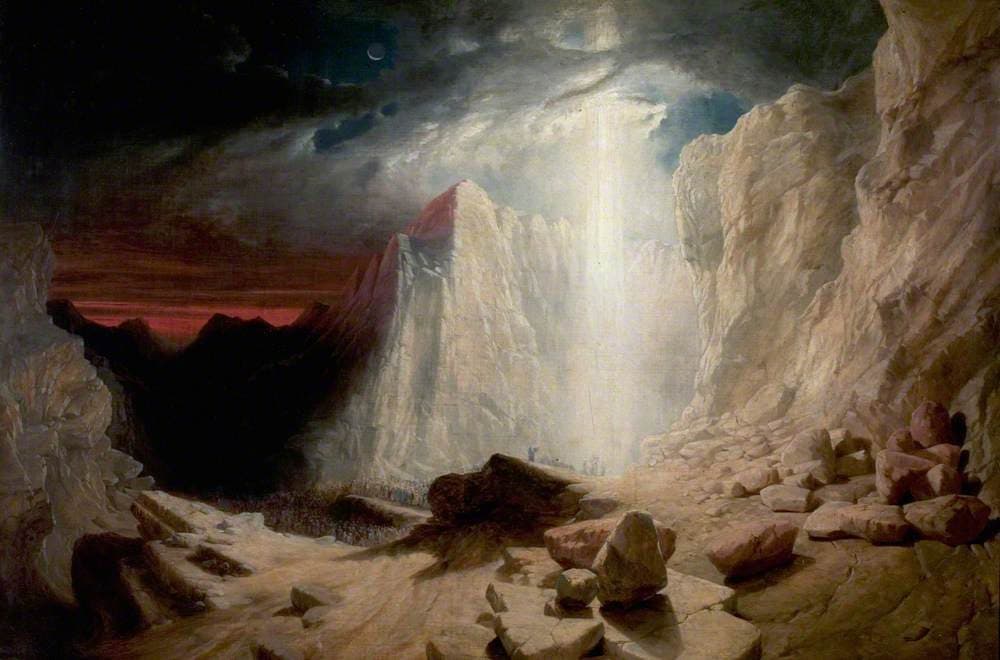
William West, The Israelites Led by the Pillar of Fire by Night, 1845, Nottingham City Museums and Galleries. Public domain by date, painted before 1930, via Wikimedia Commons.
THE ARTWORKWest painted the pillar of fire as a column of white light falling into a rocky gorge at night, with the Israelites small and dark below the cliffs.
Israel set out when the cloud lifted and camped where it settled, whether it stayed one night or a month.
Summary
The LORD went before Israel as a cloud by day and as fire by night.
- At the sea the pillar moved behind the camp and stood between Egypt and Israel all night.
- The pillar came down at the entrance of the tent outside the camp and later rested over the tabernacle.
- Nehemiah 9 and Psalms 78, 99 and 105 recall it, and Isaiah 4:5 promises it again over all Mount Zion.
From Succoth to the Sea
Exodus 13:20 to 14:24 follows the pillar from Etham to the morning watch at the sea.
God led Israel by the wilderness road toward the Red Sea, and they camped at Etham on the edge of the wilderness.
And the LORD went before them in a pillar of cloud to guide their way by day, and in a pillar of fire to give them light by night, so that they could travel by day or night. Neither the pillar of cloud by day nor the pillar of fire by night left its place before the people.These verses are the first mention of the pillar, and every later text that names it looks back to them.
BEHIND THE CAMP
The angel of God who had gone before Israel withdrew behind them, and the pillar of cloud moved with him.
BETWEEN THE CAMPS
The cloud came between the camps of Egypt and Israel, and all night long neither camp went near the other.
THE MORNING WATCH
The LORD looked down on the army of the Egyptians and threw their camp into confusion.
The Pillar Across the Canon
Seven books, from Exodus to 1 Corinthians, return to the cloud and the fire.
- Exodus 40:34the cloud covers the Tent of Meeting
- Exodus 40:38fire in the cloud over the tabernacle by night
- Numbers 9:17the cloud lifts and the camp sets out
- Numbers 12:5the LORD comes down in the pillar at the Tent's entrance
- Deuteronomy 31:15the cloud stands over the entrance of the tent
- Nehemiah 9:19the pillar never turned away in the wilderness
- Psalm 99:7the LORD spoke to them from the pillar of cloud
- Psalm 105:39a cloud as a covering and a fire to light the night
- Isaiah 4:5a cloud of smoke by day and a flame of fire by night over Zion
- 1 Corinthians 10:2baptized into Moses in the cloud and in the sea
A strip of ten passages.
The Cloud at the Tent and the Tabernacle
Exodus 33, Exodus 40 and Numbers 9 move the pillar from the head of the march to the place where the LORD met Moses.
After the golden calf, Moses pitched a tent at a distance outside the camp and called it the Tent of Meeting.
As Moses entered the tent, the pillar of cloud would come down and remain at the entrance, and the LORD would speak with Moses. When all the people saw the pillar of cloud standing at the entrance to the tent, they would stand up and worship, each one at the entrance to his own tent.The people watched the cloud come down from their own tent doors, so every household saw where the LORD spoke with Moses.
“The cloudy pillar, which had withdrawn itself from the camp when it was polluted with idolatry, now returned to this tabernacle at some distance, coming back gradually.”
Matthew Henry · Commentary on the Whole Bible · on Exodus 33:9Puritan
Whenever the cloud was lifted from above the tabernacle, the Israelites would set out through all the stages of their journey. If the cloud was not lifted, they would not set out until the day it was taken up.This is the rule of the march.
| How long the cloud stayed | What the camp did |
|---|---|
| Many days | kept the LORD's charge and did not set out |
| A few days | camped and set out at the LORD's command |
| From evening until morning | set out when it lifted in the morning |
| Two days, a month or longer | stayed in camp until it was lifted |
One Pillar or Two
Exodus names a pillar of cloud and a pillar of fire, and later verses put the fire inside the cloud.
Exodus 14:24 joins the two names in one phrase, the pillar of fire and cloud.
On the day that the tabernacle, the Tent of the Testimony, was set up, the cloud covered it and appeared like fire above the tabernacle from evening until morning. It remained that way continually; the cloud would cover the tabernacle by day, and at night it would appear like fire.This is the fullest account of how the pillar looked.
Rashi, the commentator of Troyes in France (1040 to 1105), reads Exodus 13:22 after the Talmud, Shabbat 23b, as two pillars that handed over the camp, each rising before the other set.
Signals on the March
The pillar told the camp when to march and when to stay, and three commentators explain how it was seen and followed.
Fire and smoke before an armyAlbert Barnes
Albert Barnes, in his Notes on Exodus 13:21, records that the Persians and Greeks used fire and smoke as signals on the march. He adds that an Egyptian papyrus calls the commander of an expedition a flame in the darkness at the head of his soldiers.
He holds that the LORD did by means beyond nature what armies did by natural means, and that the sign showed Him as their leader and general.
The LORD is a warrior, the LORD is His name.The song at the sea calls the LORD a warrior, the verse Barnes cites for that title.
The cloud's descent at set timesAdam Clarke
Adam Clarke, on Exodus 33:9 and Numbers 9:23, argues that no human art could have counterfeited the cloud. It came down at those times and at no others, and all the people saw it.
The cloud over the camp of JudahRashi, after the Baraita
Rashi, on Numbers 9:18, gives the Baraita on the making of the Tabernacle. When the camp set out, the cloud rolled itself up and spread like a beam over the camp of Judah, and the trumpets sounded.
By the same account the cloud did not move until Moses said the words of Numbers 10:35.
The Words of the Pillar
Four Hebrew words and one Greek word carry the sign, from the pillar to the glory.
| Word | Sense | Where it stands |
|---|---|---|
| ammud, H5982 | a column, as standing | the pillar of cloud and of fire |
| anan, H6051 | a cloud, as covering the sky | the cloud that covered the tabernacle |
| esh, H784 | fire, literal or figurative | fire in the cloud by night |
| kavod, H3519 | weight, used only of splendour | the glory of the LORD that filled the tabernacle |
| nephele, G3507 | a cloud | the cloud the forefathers were all under |
What the Text Leaves Unsaid
Exodus and Numbers describe the pillar's work and are silent on three things about it.
Exodus gives no account of what it was made of or how high it stood.
No verse records the day it ceased. The narrative names it for the last time in Deuteronomy 31:15, near the end of Moses' life.
Adam Clarke, on Exodus 13:22, writes that neither Jews nor Gentiles agree how long the cloud stayed with Israel. He judges it probable that it went with them to the Jordan and that the ark led them after.
Under the Cloud and in the Sea
The cloud of the wilderness returns in four later chapters.
I do not want you to be unaware, brothers, that our forefathers were all under the cloud, and that they all passed through the sea. They were all baptized into Moses in the cloud and in the sea.These verses are the New Testament's own reading of the cloud, and every reading of it as a type starts from them.
Baptized into MosesAdam Clarke
Adam Clarke, on 1 Corinthians 10:2, reads baptized into Moses as brought into the covenant of which Moses was the mediator. Christians, in the same way, are baptized into Christ and bound to keep the precepts of the gospel.
Now these things happened to them as examples and were written down as warnings for us, on whom the fulfillment of the ages has come.This verse gives Paul's reason for reading the wilderness accounts to the church.
The promise over ZionJohn Calvin
John Calvin, in his Harmony on Exodus 13:21, reads the promise of Isaiah 4:5 to 6 as the LORD fulfilling in Christ's coming, really and in substance, what the wilderness saw under a figure.
Then the LORD will create over all of Mount Zion and over her assemblies a cloud of smoke by day and a glowing flame of fire by night. For over all the glory there will be a canopy, a shelter to give shade from the heat by day, and a refuge and hiding place from the storm and the rain.Isaiah promises over Zion the shade by day and the refuge by night that the pillar gave in the wilderness.
The clouds of the transfiguration and the ascensionMatthew Henry
While Peter was still speaking, a bright cloud enveloped them, and a voice from the cloud said, “This is My beloved Son, in whom I am well pleased. Listen to Him!”Henry writes that God spoke from this bright cloud as He had spoken of old from the cloudy pillar, and he cites Psalm 99:7.
After He had said this, they watched as He was taken up, and a cloud hid Him from their sight.Henry writes that God had often come down in a cloud and that here Christ went up in one.
Voices on the Cloud and the Fire
Three voices from the fourth century to the nineteenth read the cloud and the fire.
“Therefore this darkness of the body has been placed between us and God, like the cloud of old between the Egyptians and the Hebrews. This is perhaps what is meant by ‘He made darkness his separate place,’ namely, our dullness, through which few can see even a little.”
Gregory of Nazianzus · Theological Oration 2:12 · on Exodus 14:20Patristic
“This was an evident token of God's special presence with, and providence over them. And this cloud was easily distinguished from other clouds, both by its peculiar figure and by its constant residence in that place.”
John Wesley · Explanatory Notes upon the Old Testament · on Numbers 9:15Evangelical
“He spread a cloud for a covering. Never people were so favoured. What would not travellers in the desert now give for such a canopy? The sun could not scorch them with its burning ray; their whole camp was screened like a king in his pavilion. Nothing seemed to be too good for God to give his chosen nation, their comfort was studied in every way. And fire to give light in the night. While cities were swathed in darkness, their town of tents enjoyed a light which modern art with all its appliances cannot equal.”
Charles Spurgeon · The Treasury of David, Vol. 5 · on Psalm 105:39
Who Went Before Them
Exodus names the LORD in the pillar and then the angel of God at the sea, and three readings join the two.
The Son before His incarnationJohn Calvin, John Wesley, Jamieson, Fausset & Brown
John Calvin, in his Harmony on Exodus 14:19, says the Leader of the people was God's only-begotten Son, who was afterwards manifested in the flesh, and he grounds it in 1 Corinthians 10:4.
“The Shechinah or appearance of the divine Majesty, which was a precious manifestation of the eternal Word, who in the fulness of time was to be made flesh, and dwell among us. Christ was with the church in the wilderness, 1 Cor. x, 9.”
John Wesley · Explanatory Notes upon the Old Testament · on Exodus 13:21Evangelical
Jamieson, Fausset & Brown, on 1 Corinthians 10:4, write that Christ mostly went before Israel and followed behind them when the need came, as at Exodus 14:19.
The objection is that Exodus 14:19 names an angel of God and does not name the Son.
We should not test Christ, as some of them did, and were killed by snakes.Paul's warning counts Christ as the one some of Israel tested.
A messenger in the cloudAdam Clarke
Adam Clarke, on Exodus 14:19, allows that the angel and the pillar of cloud may be one thing. He writes that an angel might take the form of a cloud, or that a cloud appointed for the work might itself be called the LORD's messenger, since malach means a messenger.
And they will tell it to the inhabitants of this land. They have already heard that You, O LORD, are in the midst of this people, that You, O LORD, have been seen face to face, that Your cloud stands over them, and that You go before them in a pillar of cloud by day and a pillar of fire by night.Moses, speaking to the LORD, says that the LORD Himself goes before Israel in the pillar.
God in His glory leading the pillarRashi, after the Mekhilta
Rashi, on Exodus 13:21, reads the pillar of cloud as the agent through which the Holy One in His glory led Israel, and he says it showed the way and gave no light.
On Exodus 14:19, after the Mekhilta, he reads the name God in the angel of God as a sign that Israel stood in judgment that night, to be saved or to be destroyed with Egypt. On Exodus 14:20 he gives the Mekhilta's parable of a father who moves his son behind him from robbers, in front of him from a wolf, and onto his arm when both come.
It was I who taught Ephraim to walk, taking them in My arms, but they never realized that it was I who healed them.Rashi closes the parable with this verse of God taking Ephraim in His arms.
The Christian objection is Paul's word in 1 Corinthians 10:4 that the spiritual rock that accompanied Israel in the wilderness was Christ.
Books on the Pillar
Three commentaries on Exodus a student reads next.
Commentaries on the Four Last Books of Moses Arranged in the Form of a Harmony
John Calvin, translated by Charles William Bingham · 1852
Calvin reads the pillar as a sign joined to the presence it showed.
Read at CCELCommentary on the Whole Bible, volume 1
Matthew Henry · 1706
Henry comments on the pillar in Exodus 13, 14, 33 and 40.
Read at CCELPentateuch with Rashi's Commentary
Rashi, translated by M. Rosenbaum and A. M. Silbermann · 1929 to 1934
Rashi gives the rabbinic readings of the pillar in Exodus 13 and 14.
Read at SefariaThe LORD Who Goes Before
The passage asks the reader to follow where God leads, to keep His charge as Israel kept it in the wilderness, and not to test Christ as some of them did.
Keep studying
Studies4