
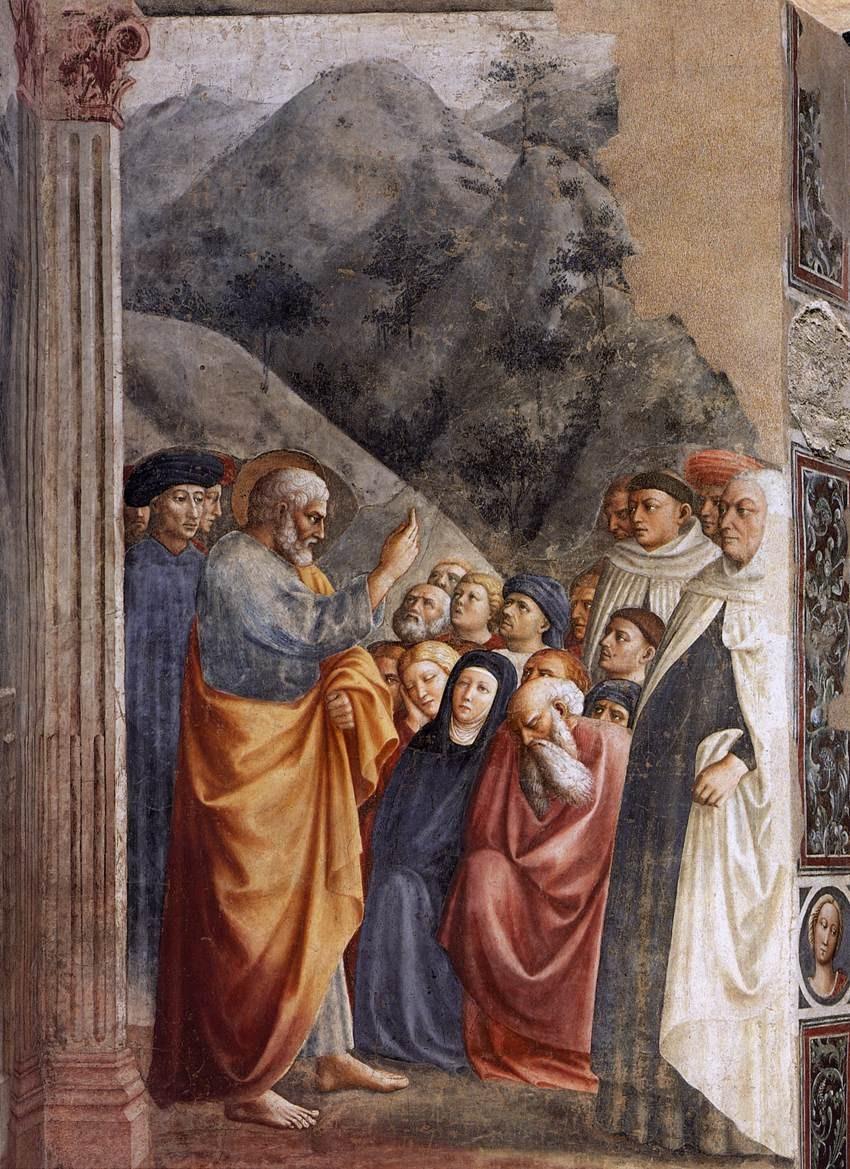
Masolino da Panicale, Saint Peter Preaching, 1426 to 1427. Public domain.
Acts 2, 7, 13 and 17 · Subject · Featured Study
The Sermons of Acts
Luke records sermons by Peter, Stephen and Paul, from Jerusalem to Athens.
Knowling reckoned in 1900 that even the longest speech in Acts would take no more than five or six minutes to deliver.
Therefore let all Israel know with certainty that God has made this Jesus, whom you crucified, both Lord and Christ!”
Therefore let all Israel know with certainty that God has made this Jesus, whom you crucified, both Lord and Christ!”
- Book
- Acts
- Hold in memory
- Acts 2:36, Acts 17:31
Summary
Acts gives the first church's preaching in short speeches. They began at a feast in Jerusalem and reached the philosophers of Athens.
- About three thousand people were baptized after Peter's sermon at Pentecost.
- Stephen's speech, from Acts 7:2 to 53, is the longest in the book.
- The council stoned Stephen at the end of his speech, and the witnesses left their garments with a young man named Saul.
Three Texts From the Sermons
Peter at Pentecost, Peter with Cornelius and Paul at Athens each reach a claim about Jesus.
All the prophets testify about Him that everyone who believes in Him receives forgiveness of sins through His name.”Peter tells Gentile hearers that the prophets Israel read point to Jesus.
For He has set a day when He will judge the world with justice by the Man He has appointed. He has given proof of this to everyone by raising Him from the dead.”Paul ends at Athens with the coming judgment and the raising of the Judge.
The Sermons Side by Side
Each sermon has its own hearers, its own starting point and its own call.
Peter speaks four times in these sermons, Stephen once and Paul three times.
| Sermon | Hearers | Where it starts | What it presses home |
|---|---|---|---|
| Peter at Pentecost | Jews in Jerusalem for the feast | Joel's prophecy of the Spirit | Repent and be baptized |
| Peter at Solomon's Colonnade | The crowd at the temple | The lame man they had seen healed | Repent and turn back |
| Peter before the council | The rulers and elders | The healed man standing before them | Salvation in Jesus alone |
| Stephen before the council | The Sanhedrin and high priest | God's dealings with Abraham | Israel has always resisted the Spirit |
| Peter in the house of Cornelius | Gentiles who feared God | The ministry of Jesus they had heard of | Forgiveness for all who believe |
| Paul at Pisidian Antioch | Jews and God-fearing Gentiles | Israel's story, Egypt to David | Justification through Jesus |
| Paul at Lystra | A pagan crowd | The living God who made all things | Turn to the living God |
| Paul at the Areopagus | The council of the Areopagus | An unknown god's altar | Repent before the judgment |
Paul at Lystra, Paul at the Areopagus
Peter's First Sermon, Step by Step
Luke gives Peter's sermon in twenty-seven verses, Acts 2:14 to 40.
Peter's sermon runs from the prophet Joel through the death and raising of Jesus to the call to repent.
- What Peter says
- What the crowd sees is what Joel foretold
- What Peter says
- God worked miracles through Jesus among them
- What Peter says
- Jesus was handed over by God's plan and put to death
- What Peter says
- Death could not hold Him, and God raised Him
- What Peter says
- Repent, be baptized and receive the Spirit
Five links of Acts 2, each in Peter's order.
The Scriptures the Preachers Quoted
The sermons to Jewish hearers argue from the Psalms, the Law and the Prophets.
Five of the nine quotations drawn here come from the Psalms.
| Scripture | Quoted by | What the quotation shows |
|---|---|---|
| Joel 2 | Peter at Pentecost | God pours out His Spirit on all people, sons and daughters, in the last days |
| Psalm 16 | Peter at Pentecost | God will not let His Holy One see decay in the grave |
| Psalm 110 | Peter at Pentecost | David's Lord sits at God's right hand until His enemies fall |
| Deuteronomy 18 | Peter at the temple | God will raise up a prophet like Moses, and the people must listen to Him |
| Psalm 118 | Peter before the council | The stone the builders rejected has become the cornerstone |
| Psalm 2 | Paul at Pisidian Antioch | God's decree to His Son, fulfilled in the raising of Jesus |
| Isaiah 55 | Paul, in the same sermon | The holy and sure blessings that God promised to David, given in the risen Jesus |
| Psalm 16 | Paul, in the same sermon | The Holy One who did not see decay |
| Habakkuk 1 | Paul, in the same sermon | A warning to scoffers who will not believe the work God is doing in their days |
Isaiah 55, Psalm 16, Habakkuk 1
Fitted to the Hearers
The preachers began where each audience stood.
John Chrysostom wrote that Peter set out from facts his hearers knew and then came to hidden things. John Calvin noticed the same care: Peter first called Jesus a man sent by God, proved by His miracles, and only then told of the resurrection.
At Lystra Paul spoke to a crowd of pagans, and he began with what they could see.
Yet He has not left Himself without testimony to His goodness: He gives you rain from heaven and fruitful seasons, filling your hearts with food and gladness.”Paul's hearers had no Scriptures, so he pointed them to what they had lived through.
The Voices
Matthew Henry and Jamieson, Fausset and Brown wrote on the sermon at Pentecost.
Matthew Henry (1662 to 1714)
Matthew Henry asked why Luke kept only Peter's sermon from that day.
“And it was not by Peter's preaching only, but that of all, or most, of the rest of the hundred and twenty, that three thousand souls were that day converted, and added to the church; but Peter's sermon only is recorded, to be an evidence for him that he was thoroughly recovered from his fall, and thoroughly restored to the divine favour.”
Matthew Henry · Commentary on the Whole Bible · on Acts 2:14Puritan
Jamieson, Fausset & Brown (1802 to 1910)
Jamieson, Fausset and Brown explained why the sermon ends on the crucified Jesus as Lord.
“To prove to them merely that Jesus was the Messiah might have left them all unchanged in heart. But to convince them that He whom they had crucified had been by the right hand of God exalted, and constituted the ‘LORD’ whom David in spirit adored, to whom every knee shall bow, and the CHRIST of God, was to bring them to ‘look on Him whom they had pierced and mourn for Him.’”
Jamieson, Fausset & Brown · Commentary Critical and Explanatory on the Whole Bible · on Acts 2:36Reformed
Where Readers Differ
Two questions about the sermons, with the writers who answer them.
Did Luke write the speeches himself?3 paragraphs
Ancient historians often wrote speeches for their characters. Thucydides said he made his speakers say what each occasion demanded, while keeping as close as he could to the general sense of what was said.
F. C. Baur, in the English edition of 1876, held that every speech in Acts passed through the author's hands and his literary licence. Adolf Harnack, in 1909, wrote that Luke used the historian's freedom to insert speeches, whether reports or free compositions.
R. J. Knowling, in 1900, granted that the speeches bear Luke's style but held them substantially accurate. R. B. Rackham, in 1901, took them for summaries from notes, which Luke wrote out in his own words.
Why does Stephen not answer the charges?1 paragraph
False witnesses said Stephen spoke against the temple and the Law. Calvin thought Stephen would have said more if an uproar had not broken off his speech. Chrysostom held that the opening already answers them, since God appeared to Abraham before there was any temple or sacrifice.
Books to Read Next
Three works, each free to read online.
The Acts of the Apostles
R. B. Rackham · 1901
Rackham explains how the speeches were recorded and what they share.
Free at the Internet ArchiveThe Acts of the Apostles, in The Expositor's Greek Testament, volume 2
R. J. Knowling · 1900
Knowling comments on Acts verse by verse, with the Greek text.
Free at the Internet ArchiveThe Acts of the Apostles
Adolf Harnack, translated by J. R. Wilkinson · 1909
Harnack studies Luke's aims and his teaching about Christ.
Free at the Internet ArchiveOne Message, Many Hearers
The sermons of Acts were preached to Jews, to God-fearers and to pagans. Luke kept enough of each for a reader to see how the gospel was first told.
Sources
Scripture is the Berean Standard Bible.
- The Holy Bible, Berean Standard Bible (read 2026)
- Thucydides, History of the Peloponnesian War 1.22, translated by Richard Crawley (1874)
- F. C. Baur, Paul the Apostle of Jesus Christ, volume 1, edited by E. Zeller, translated by A. Menzies (1876)
- Adolf Harnack, The Acts of the Apostles, translated by J. R. Wilkinson (1909)
- R. J. Knowling, The Acts of the Apostles, in The Expositor's Greek Testament, volume 2 (1900)
- R. B. Rackham, The Acts of the Apostles, Westminster Commentaries (1901)
- John Calvin, Commentary upon the Acts of the Apostles, volume 1, translated by Christopher Fetherstone, edited by Henry Beveridge (1844)
- John Chrysostom, Homilies 4, 6 and 15 on Acts, Nicene and Post-Nicene Fathers, first series, volume 11 (1889)
- Matthew Henry, Commentary on the Whole Bible (1710); Jamieson, Fausset and Brown, Commentary Critical and Explanatory (1871)
Keep Studying
Studies5
People and groups8
Doctrines1