
Exodus 1 · Person · Featured Study
Shiphrah and Puah, the Hebrew Midwives
Exodus 1:15 to 21 tells how two midwives refused the king of Egypt's order and how God was good to them.
Pharaoh's second plan against Israel depended on two midwives, and it failed because they feared God.
- The name means
- Shiphrah, read by Rashi from a verb for making fair; Puah, from a verb for crying aloud
- Places
- Egypt
- First named
- Exodus 1:15
- Last named
- Exodus 1:21
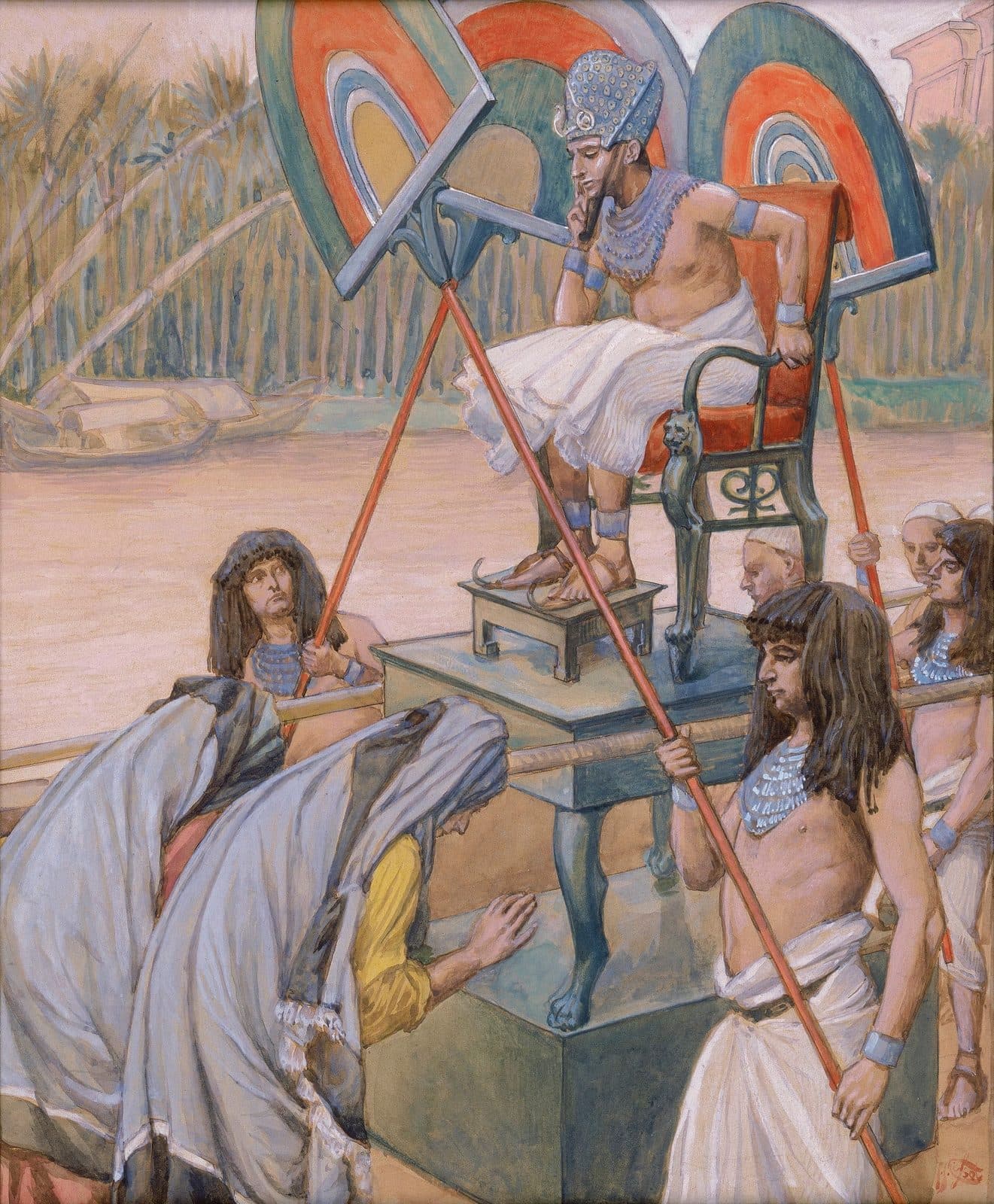
James Tissot, Pharaoh and the Midwives, about 1896 to 1902, the Jewish Museum, New York. Public domain, via Wikimedia Commons.
THE ARTWORKTissot painted the two midwives bowing before the king of Egypt, who sits on a throne his servants carry beside the river.
Summary
Shiphrah and Puah were the midwives whom the king of Egypt ordered to kill every Hebrew son at birth.
- Summoned by the king, they told him that the Hebrew women gave birth before a midwife arrived.
- God was good to the midwives and gave them families of their own, and the people kept multiplying.
- The king then commanded all his people to throw every Hebrew son into the Nile, and under that order Moses was born.
- Teachers have long divided over whether their answer was a lie and whether the two women were Hebrew or Egyptian.
Where Shiphrah and Puah Stand in Scripture
Exodus names the two women in Exodus 1:15, and their part in the story ends at Exodus 1:21.
Then the king of Egypt said to the Hebrew midwives, whose names were Shiphrah and Puah,Exodus calls them the Hebrew midwives, a phrase readers have taken in two ways.
And because the midwives feared God, He gave them families of their own.God gives families to the women who had kept the Hebrew families from losing their sons.
The King's Three Measures
Exodus 1 records three measures of the king of Egypt against Israel's growth, and the midwives were set to carry out the second.
| Measure | Given to | What followed | Verse |
|---|---|---|---|
| Hard labour under taskmasters | Taskmasters over the Israelites | The more they were oppressed, the more they multiplied. | Exodus 1:11 to 12 |
| Kill each son at birth | Shiphrah and Puah | The midwives refused, and the people kept growing. | Exodus 1:16 to 17 |
| Throw every son into the Nile | All his people | Moses was born, hidden and drawn out of the water. | Exodus 1:22 |
- Given to
- Taskmasters over the Israelites
- What followed
- The more they were oppressed, the more they multiplied.
- Verse
- Exodus 1:11 to 12
- Measure
- Kill each son at birth
- Given to
- Shiphrah and Puah
- What followed
- The midwives refused, and the people kept growing.
- Verse
- Exodus 1:16 to 17
- Given to
- All his people
- What followed
- Moses was born, hidden and drawn out of the water.
- Verse
- Exodus 1:22
The Order and the Refusal
The account runs from the king's word to two midwives to his command to all his people.
Exodus 1:15 turns from the brick and mortar of the labour gangs to the births of Hebrew sons.
“When you help the Hebrew women give birth, observe them on the birthstools. If the child is a son, kill him; but if it is a daughter, let her live.”Matthew Henry reads the order as a plan to pass the deaths off as mishaps at birth.
The midwives, however, feared God and did not do as the king of Egypt had instructed; they let the boys live.This is the first refusal of the king's will that Exodus records.
So the king of Egypt summoned the midwives and asked them, “Why have you done this? Why have you let the boys live?” The midwives answered Pharaoh, “The Hebrew women are not like the Egyptian women, for they are vigorous and give birth before a midwife arrives.”The summons shows that the king learned of the refusal, and the reply is the only speech of the midwives that Exodus records.
So God was good to the midwives, and the people multiplied and became even more numerous.God's goodness to the two women comes in the same verse as the growth the king had tried to stop.
Then Pharaoh commanded all his people: “Every son born to the Hebrews you must throw into the Nile, but every daughter you may allow to live.”The king now commands all his people, so the order no longer depends on two women.
What the Text Says
Exodus 1 sets down three details of the midwives' story that retellings often pass over.
THEIR REASON IS GIVEN TWICE
Exodus names the fear of God as the cause of the refusal in Exodus 1:17 and as the cause of their reward in Exodus 1:21.
THE MIDWIVES ARE NAMED AND THE KING IS NOT
Exodus 1 gives the names of two midwives and calls the ruler only the king of Egypt or Pharaoh, which Strong's lexicon defines as a general title of Egyptian kings.
THE DAUGHTERS WERE TO LIVE
Both of the king's orders spare the daughters, and in Exodus 2:5 to 6 it is Pharaoh's own daughter who saves a Hebrew son.
The World Behind the Story
The commentators explain the birthstools of Exodus 1:16 and how two midwives could serve a whole people.
The Hebrew word for the birthstools is obnayim, which Strong's lexicon defines as a pair of stones, used of a potter's wheel or a midwife's stool. Adam Clarke, in his Commentary on the Bible, says the word stands elsewhere in the Hebrew Bible only in Jeremiah 18:3, for the potter's wheel. He adds that some took it for a stone trough in which the newborn was washed.
Exodus names only two midwives for a people that filled the land. Ibn Ezra, the Spanish commentator (1089 to 1167), says in his commentary on Exodus that these two were in charge of all the other midwives, who must have numbered in the hundreds. Keil and Delitzsch also call them the heads of the whole profession.
John Calvin gives two answers in his Harmony of the Law. The king spoke to these two so that they would spread fear of him among the rest, or he tried their firmness first in the hope that the others would follow. Matthew Henry gives a third answer, from the date of the order.
“The two midwives he tampered with in order hereunto are here named; and perhaps, at this time, which was above eighty years before their going out of Egypt, those two might suffice for all the Hebrew women, at least so many of them as lay near the court, as it is plain by ch. ii.”
Matthew Henry · Commentary on the Whole Bible · on Exodus 1:15 to 16Puritan
Questions Their Story Raises
Readers ask four questions of Exodus 1:15 to 21, and the lexicon, the commentators and the rabbis answer them.
What do their names mean?Strong's lexicon; Rashi
Rashi, the French commentator (1040 to 1105), reads Shiphrah from a verb for making fair, because she put each newborn into good condition. He reads Puah from a verb for crying aloud, because she soothed the crying child. He takes both readings from the Talmud, tractate Sotah 11b, and for Puah he points to the verb of Isaiah 42:14.
Strong's lexicon glosses shaphar as to glisten or be fair, and shepher as beauty. It glosses pa'ah, the verb of Isaiah 42:14, as to scream.
Were they Hebrew women or Egyptian?Josephus; Albert Barnes; Matthew Henry; John Calvin; Keil and Delitzsch
The Hebrew of Exodus 1:15 can be read as the Hebrew midwives or as the midwives of the Hebrew women, as Albert Barnes notes in his Notes on the Old Testament. The Septuagint, the Greek translation of the Old Testament, reads the midwives of the Hebrews and spells their names Sepphora and Phua.
Josephus, in his Antiquities of the Jews (book 2, chapter 9), calls them the Egyptian midwives. Matthew Henry thinks the king could never have expected Hebrew women to kill the sons of their own nation. Barnes notes that the women bear Egyptian names and were probably Egyptians.
John Calvin answers that Josephus conjectured falsely, since the women feared God before the king spoke to them. Keil and Delitzsch say plainly that they were Hebrew women. Strong's lexicon glosses each name as an Israelitess.
Were they Jochebed and Miriam?The Talmud, Sotah 11b; Rashi; Ibn Ezra
The Babylonian Talmud, in tractate Sotah 11b, records two views of the rabbis Rav and Shmuel. In one the midwives were a mother and her daughter, Jochebed and Miriam, and in the other a mother-in-law and her daughter-in-law, Jochebed and Elisheba, the wife of Aaron. Rashi gives the first view in his commentary on Exodus 1:15, and Ibn Ezra calls the tradition of mother and daughter correct.
Exodus itself makes no such link. It names Jochebed in Exodus 6:20, as the wife of Amram and the mother of Aaron and Moses, while in Exodus 2 the mother and the sister of Moses go unnamed.
To whom did God give families?Albert Barnes; Jamieson, Fausset & Brown; John Calvin; Rashi
The Hebrew word behind families in Exodus 1:21 is houses. Albert Barnes reads the verse as the midwives marrying Hebrews and becoming mothers in Israel. Jamieson, Fausset & Brown say that in Hebrew idiom to make a house means a numerous offspring.
and have done since the day I appointed judges over My people Israel. I will give you rest from all your enemies. The LORD declares to you that He Himself will establish a house for you.The promise to David uses a house in the same sense, a line of descendants.
In Calvin's reading the word them in Exodus 1:21, masculine in the Hebrew, means the Israelites, whose houses multiplied through the midwives. Rashi, after the Talmud, reads the houses as the priestly line descended from Jochebed and the royal line from Miriam.
What Exodus Leaves Unsaid
Exodus tells what the midwives did and said and leaves the rest of their lives untold.
Exodus gives neither woman an age, a husband, a child's name or a death, and Scripture never uses either name again.
It does not say whether the king believed their answer, or what became of the two women once he gave his order to all his people.
Where Their Refusal Points
Exodus 2, Hebrews 11, Acts 5 and Matthew 2 carry the midwives' refusal forward to Moses, to the apostles and to Jesus.
Now a man of the house of Levi married a daughter of Levi, and she conceived and gave birth to a son. When she saw that he was a beautiful child, she hid him for three months.Moses is born under the order of Exodus 1:22, which the king gave when the midwives failed him.
By faith Moses’ parents hid him for three months after his birth, because they saw that he was a beautiful child, and they were unafraid of the king’s edict.The parents of Moses refuse the order of Exodus 1:22 as the midwives had refused the order of Exodus 1:16.
But Peter and the other apostles replied, “We must obey God rather than men.The apostles give this answer to the council in Jerusalem, and Matthew Henry sets it beside the midwives' refusal.
Matthew Henry also sets Pharaoh beside Herod, and reads both kings as agents of the dragon of Revelation 12 that stood ready to devour the child as soon as it was born.
When Herod saw that he had been outwitted by the Magi, he was filled with rage. Sending orders, he put to death all the boys in Bethlehem and its vicinity who were two years old and under, according to the time he had learned from the Magi.Herod's order fell on the boys of Bethlehem while the child he sought, Jesus, had been carried to Egypt.
Voices on the Midwives
Commentators from Ibn Ezra to Adam Clarke explain why the fear of God made the midwives refuse the king.
Ibn Ezra, on Exodus 1:21, says that the midwives feared the Lord rather than the king of Egypt, and that the Lord was good to them for it.
John Calvin, in his Harmony of the Law (1563), sets the fear of God against the dread of punishment, which might have kept the midwives from doing right. He adds that their example is enough to condemn those who obey a king's wicked will against God.
Adam Clarke, in his Commentary on the Bible, says they knew that God had forbidden murder from the beginning.
Whoever sheds the blood of man, by man his blood will be shed; for in His own image God has made mankind.Clarke names this word to Noah after the flood, given long before the law forbade murder at Sinai.
Matthew Henry says they dreaded God's wrath more than Pharaoh's, and that where the fear of God rules in the heart it guards against the snare of the fear of man.
Was Their Answer to Pharaoh a Lie?
Teachers have long divided over whether the midwives spoke falsely and what God rewarded in them.
A lie that God forgaveAugustine; John Calvin; Keil and Delitzsch
Augustine, in Against Lying, says that what God rewarded in the midwives was their mercy to His people, and that He forgave their deceit for the sake of that mercy. He adds that they would have done better to refuse the king plainly and die, for a reward far greater than the families they were given.
John Calvin holds that the two women lied, and so sinned, and that God bore with the fault because they had acted with courage. Keil and Delitzsch say the reply deceived the king, and they quote Augustine on what God rewarded.
John Lightfoot, as Calvin's editor quotes him, objects that it would be no hard thing to show that what the midwives said was most true.
A true answerMatthew Henry; Adam Clarke; John Lightfoot
Matthew Henry sees no reason to doubt the truth of the reply. He holds that the Hebrews were then under an extraordinary blessing of increase, so that the mothers had quick and easy labour. Adam Clarke reads the reply as a plain statement of fact, since women who worked hard in the fields through pregnancy gave birth with ease.
Lightfoot, as the same editor reports, called the words of the midwives a glorious confession of their faith.
John Calvin objects that the midwives did not confess their piety to the king, while Exodus 1:17 says they let the boys live because they feared God.
Books to Read Next
Five works from the first century to the nineteenth take up the midwives of Exodus 1.
Antiquities of the Jews
Flavius Josephus · about 94
Josephus retells the order of Exodus 1 and names the midwives as Egyptians.
READ IT FREE AT PROJECT GUTENBERG →Against Lying
Augustine of Hippo · English 1887
Augustine weighs the midwives and Rahab against the rule that no lie is just.
READ IT FREE AT NEW ADVENT →Commentaries on the Four Last Books of Moses Arranged in the Form of a Harmony
John Calvin · 1563
Calvin explains the midwives' answer, their people and the families of Exodus 1:21.
READ IT FREE AT CCEL →Commentary on the Whole Bible
Matthew Henry · 1710
Henry draws a lesson from each verse of Exodus 1:15 to 22.
READ IT FREE AT CCEL →Biblical Commentary on the Old Testament: The Pentateuch, volume 1
C. F. Keil and F. Delitzsch · English 1864
The volume explains the Hebrew of Exodus 1:15 to 21 phrase by phrase.
READ IT FREE AT ARCHIVE.ORG →They Feared God
Shiphrah and Puah stood between Pharaoh and the newborn sons of Israel, and they chose to fear God.
In Matthew 10:28 Jesus tells His disciples not to be afraid of those who kill the body, and to fear the One who can destroy both soul and body. The story asks the reader to fear God above any human command and to trust Him with what that fear may cost.