
Luke 1 to Acts 19 · Person · Featured Study
John the Baptist
The priest's son who preached in the wilderness of Judea and baptized in the Jordan before Jesus began His ministry.
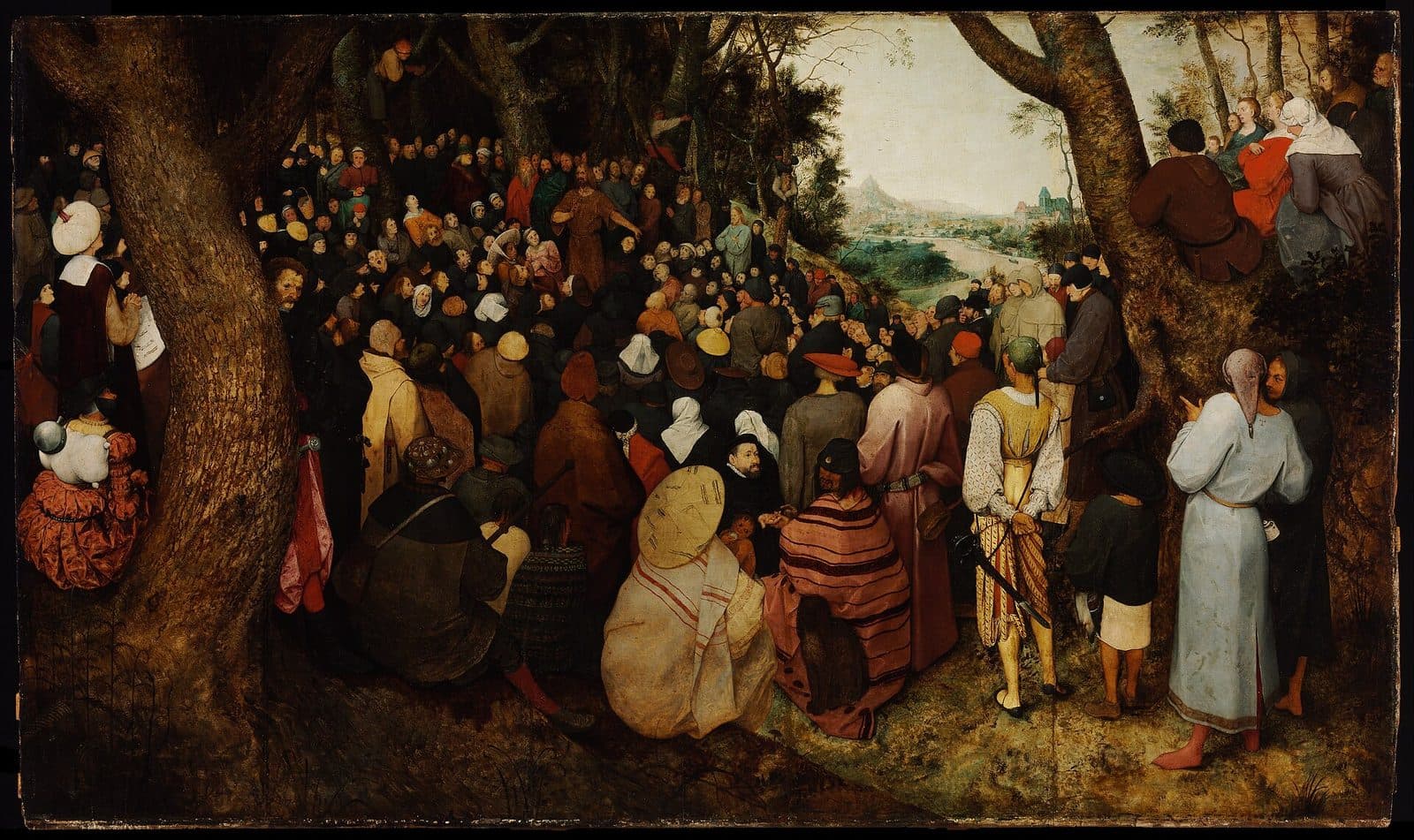
Pieter Bruegel the Elder, The Sermon of Saint John the Baptist, 1566, Museum of Fine Arts, Budapest. Public domain, via Wikimedia Commons.
THE ARTWORKBruegel painted the hearers large in the foreground and set the preacher small and far back among the trees.
Jesus said no one born of women was greater than John, and John said his own part was to decrease.
Summary
John, son of the priest Zechariah, preached a baptism of repentance at the Jordan and pointed Israel to Jesus as the Lamb of God.
- He was born about six months before Jesus to Elizabeth, a relative of Mary.
- Luke dates the start of his preaching to the fifteenth year of Tiberius Caesar.
- He told tax collectors to collect no more than they were authorized and soldiers to be content with their wages.
- Herod Antipas imprisoned him for rebuking the marriage to Herodias and had him beheaded in the prison during a birthday banquet.
Where John Stands in Scripture
His birth foretold in Luke 1 and his preaching in Matthew 3
And he will go on before the Lord in the spirit and power of Elijah, to turn the hearts of the fathers to their children and the disobedient to the wisdom of the righteous—to make ready a people prepared for the Lord.”The angel's words to Zechariah about the son he would have.
In those days John the Baptist came, preaching in the wilderness of Judea and saying, “Repent, for the kingdom of heaven is near.” This is he who was spoken of through the prophet Isaiah: “A voice of one calling in the wilderness, ‘Prepare the way for the Lord, make straight paths for Him.’”His message, and the voice of Isaiah 40:3 that Matthew says he fulfils.
The Life, Turn by Turn
Twelve turns from the temple to the prison
- His birth foretold to Zechariahthe temple, in the days of Herod, Luke 1:13
- Leaps in the womb at Mary's greetinga town in the hill country of Judah, Luke 1:41
- Named John on the eighth dayhis father's house, Luke 1:63
- Grows up in the wildernessuntil he appears to Israel, Luke 1:80
- The word of God comes to himthe fifteenth year of Tiberius, Luke 3:2
- Baptizes crowds who confess their sinsthe Jordan River, Matthew 3:6
- Baptizes Jesusthe Jordan, Matthew 3:13
- Answers the priests and LevitesBethany beyond the Jordan, John 1:28
- Names Jesus the Lamb of Godthe next day, John 1:29
- Says he must decreaseAenon near Salim, John 3:23
- Sends his question from prisonHerod's prison, Matthew 11:2
- Beheaded in the prisonduring Herod's birthday banquet, Mark 6:27
A table of the turns of John's life in the order the Gospels give them, each with its verse.
From the Temple to the Prison
Luke 1 to Mark 6
Zechariah and Elizabeth were old and childless when the angel Gabriel promised them a son who would turn many in Israel back to the Lord.
Grown, John came out of the wilderness preaching a baptism of repentance for the forgiveness of sins, and people came to him from Jerusalem and all Judea.
When priests and Levites asked who he was, he said he was not the Christ, and the next day he pointed to Jesus as the Lamb of God.
His imprisonment ended at Herod's birthday feast, where an oath sworn to a dancing girl cost him his life.
A priest's son, promised in the temple
In the time of Herod king of Judea there was a priest named Zechariah, who belonged to the priestly division of Abijah, and whose wife Elizabeth was a daughter of Aaron. Both of them were righteous in the sight of God, walking blamelessly in all the commandments and decrees of the Lord. But they had no children, because Elizabeth was barren, and they were both well along in years.His parents: a priest of the division of Abijah and a daughter of Aaron, both old and childless.
But the angel said to him, “Do not be afraid, Zechariah, because your prayer has been heard. Your wife Elizabeth will bear you a son, and you are to give him the name John. He will be a joy and delight to you, and many will rejoice at his birth,The name John, and the joy his birth will bring.
the seventh to Hakkoz, the eighth to Abijah,Abijah's course, the eighth in the list of priestly divisions.
Zechariah doubted the promise and was struck silent until the child was born.
On the eighth day the relatives wanted to name the boy after his father, and Zechariah wrote on a tablet that his name is John.
The preaching at the Jordan
John wore a garment of camel’s hair, with a leather belt around his waist. His food was locusts and wild honey. People went out to him from Jerusalem and all Judea and the whole region around the Jordan. Confessing their sins, they were baptized by him in the Jordan River.His dress of camel's hair and his food of locusts and wild honey.
But when John saw many of the Pharisees and Sadducees coming to his place of baptism, he said to them, “You brood of vipers, who warned you to flee from the coming wrath? Produce fruit, then, in keeping with repentance. And do not presume to say to yourselves, ‘We have Abraham as our father.’ For I tell you that out of these stones God can raise up children for Abraham. The axe lies ready at the root of the trees, and every tree that does not produce good fruit will be cut down and thrown into the fire.His warning to the Pharisees and Sadducees: the axe already lies at the root of the trees.
The crowds asked him, “What then should we do?” John replied, “Whoever has two tunics should share with him who has none, and whoever has food should do the same.” Even tax collectors came to be baptized. “Teacher,” they asked, “what should we do?” “Collect no more than you are authorized,” he answered. Then some soldiers asked him, “And what should we do?” “Do not take money by force or false accusation,” he said. “Be content with your wages.”His answers to the crowds, the tax collectors and the soldiers who asked what they should do.
I baptize you with water for repentance, but after me will come One more powerful than I, whose sandals I am not worthy to carry. He will baptize you with the Holy Spirit and with fire. His winnowing fork is in His hand to clear His threshing floor and to gather His wheat into the barn; but He will burn up the chaff with unquenchable fire.”The One coming after him will baptize with the Holy Spirit and with fire.
The witness to Jesus
And this was John’s testimony when the Jews of Jerusalem sent priests and Levites to ask him, “Who are you?” He did not refuse to confess, but openly declared, “I am not the Christ.”The delegation from Jerusalem, and his first answer.
So they said to him, “Who are you? We need an answer for those who sent us. What do you say about yourself?” John replied in the words of Isaiah the prophet: “I am a voice of one calling in the wilderness, ‘Make straight the way for the Lord.’”The words of Isaiah he takes for himself.
The next day John was there again with two of his disciples. When he saw Jesus walking by, he said, “Look, the Lamb of God!” And when the two disciples heard him say this, they followed Jesus.Two of his disciples hear him and follow Jesus.
One of the two was Andrew, the brother of Simon Peter.
So John’s disciples came to him and said, “Look, Rabbi, the One who was with you beyond the Jordan, the One you testified about—He is baptizing, and everyone is going to Him.” John replied, “A man can receive only what is given him from heaven. You yourselves can testify that I said, ‘I am not the Christ, but am sent ahead of Him.’ The bride belongs to the bridegroom. The friend of the bridegroom stands and listens for him, and is overjoyed to hear the bridegroom’s voice. That joy is mine, and it is now complete. He must increase; I must decrease.When his disciples complain that everyone is going to Jesus, he answers that his joy is complete.
The prison and the banquet
So Herodias held a grudge against John and wanted to kill him. But she had been unable, because Herod feared John and protected him, knowing that he was a righteous and holy man. When he heard John’s words, he was greatly perplexed; yet he listened to him gladly.Herodias's grudge, and what held Herod back.
On Herod’s birthday, her opportunity arose. Herod held a banquet for his nobles and military commanders and the leading men of Galilee. When the daughter of Herodias came and danced, she pleased Herod and his guests, and the king said to the girl, “Ask me for whatever you wish, and I will give it to you.” And he swore to her, “Whatever you ask of me, I will give you, up to half my kingdom!”The banquet, the dance and the oath.
Then she went out and asked her mother, “What should I request?” And her mother answered, “The head of John the Baptist.” At once the girl hurried back to the king with her request: “I want you to give me the head of John the Baptist on a platter immediately.” The king was consumed with sorrow, but because of his oaths and his guests, he did not want to refuse her. So without delay, the king commanded that John’s head be brought in. He sent an executioner, who went and beheaded him in the prison. The man brought John’s head on a platter and presented it to the girl, who gave it to her mother.Herodias names her price, and the king keeps his oath.
When John’s disciples heard about this, they came and took his body and placed it in a tomb.The last verse of Mark's account.
Matthew sets John's death before the feeding of the five thousand: when Jesus heard of it, He withdrew by boat to a solitary place.
What the Gospels Set Beside Him
Six details retellings often drop
KNOWN BY HIS WORDS ALONE
The crowds beyond the Jordan said John never performed a sign, and that all he said about Jesus was true.
A HERALD WHO FIRST KNEW HIM BY A SIGN
John says the One who sent him told him to watch for the Spirit descending and resting on a man.
THE LEADERS WOULD NOT ANSWER
Asked whether John's baptism was from heaven or from men, the chief priests and elders gave no answer, because the people held John to be a prophet.
CALLED A DEMON
Because he came neither eating bread nor drinking wine, some said he had a demon.
JESUS WITHDREW AT HIS ARREST
When Jesus heard that John had been imprisoned, He withdrew to Galilee.
HEROD FEARED HE HAD RISEN
Herod told his servants that Jesus was John the Baptist risen from the dead.
The World He Preached In
Tiberius, the tetrarch of Galilee and the account of Josephus
Luke fixes the start of John's preaching by the rulers of the day: Tiberius in Rome, Pontius Pilate in Judea, Herod Antipas in Galilee, and Annas and Caiaphas in the high priesthood.
Suetonius, in his Life of Augustus, records that Augustus died on 19 August in the consulship of the two Sextuses, which is AD 14. Counted from that accession, the fifteenth year of Tiberius falls near AD 28 or 29.
John in Josephus
Josephus finished his Antiquities in the thirteenth year of Domitian. He calls John a good man who taught the Jews to practise virtue and to come to baptism. That virtue, he says, meant righteousness toward one another and piety toward God.
He says Herod feared that John's hold on the crowds might lead to a revolt, sent him as a prisoner to the fortress of Machaerus, and put him to death there.
Josephus adds that some Jews held the later defeat of Herod's army by the Arabian king Aretas to be God's punishment for what Herod did to John.
Herodias and her two husbands
For Herod himself had ordered that John be arrested and bound and imprisoned, on account of his brother Philip’s wife Herodias, whom Herod had married. For John had been telling Herod, “It is not lawful for you to have your brother’s wife!”Mark names her first husband Philip, Herod's brother.
Josephus names her first husband Herod, a son of Herod the Great by Mariamne, the high priest's daughter, and says she left him while he was alive to marry Antipas. William Whiston's translation writes the name Philip in brackets beside that Herod, reading the two accounts as one man.
Josephus also says the emperor Gaius later banished Antipas to Lyons in Gaul, and that Herodias went into exile with him.
The Family of John
Three ties, each with its verse
| Person | Tie to John | Verse |
|---|---|---|
| Zechariah | His father, a priest of the division of Abijah. | Luke 1:5 |
| Elizabeth | His mother, a daughter of Aaron, barren until old age. | Luke 1:7 |
| Mary | His mother's relative, who visited Elizabeth in her sixth month. | Luke 1:36 |
- Person
- Zechariah
- Tie to John
- His father, a priest of the division of Abijah.
- Verse
- Luke 1:5
- Person
- Elizabeth
- Tie to John
- His mother, a daughter of Aaron, barren until old age.
- Verse
- Luke 1:7
- Person
- Mary
- Tie to John
- His mother's relative, who visited Elizabeth in her sixth month.
- Verse
- Luke 1:36
The Places of His Ministry
Six places, from the temple to Ephesus
| Place | What happened there | Verse |
|---|---|---|
| The temple | Zechariah burned incense when the angel appeared to him. | Luke 1:9 |
| The wilderness of Judea | John preached there that the kingdom of heaven was near. | Matthew 3:1 |
| The Jordan River | People confessed their sins and were baptized by him there. | Mark 1:5 |
| Bethany beyond the Jordan | He answered the delegation from Jerusalem there. | John 1:28 |
| Aenon near Salim | He baptized there because the water was plentiful. | John 3:23 |
| Ephesus | Paul met disciples there who knew only John's baptism. | Acts 19:3 |
- Place
- The temple
- What happened there
- Zechariah burned incense when the angel appeared to him.
- Verse
- Luke 1:9
- What happened there
- John preached there that the kingdom of heaven was near.
- Verse
- Matthew 3:1
- Place
- The Jordan River
- What happened there
- People confessed their sins and were baptized by him there.
- Verse
- Mark 1:5
- What happened there
- He answered the delegation from Jerusalem there.
- Verse
- John 1:28
- Place
- Aenon near Salim
- What happened there
- He baptized there because the water was plentiful.
- Verse
- John 3:23
- Place
- Ephesus
- What happened there
- Paul met disciples there who knew only John's baptism.
- Verse
- Acts 19:3
Questions His Life Raises
Three questions answered from their verses
Was John Elijah?
“Then who are you?” they inquired. “Are you Elijah?” He said, “I am not.” “Are you the Prophet?” He answered, “No.”The question put to John by the priests and Levites.
And if you are willing to accept it, he is the Elijah who was to come.Jesus speaking to the crowds about John.
For the angel says to Zechariah concerning John: "He will go before him in the spirit and power of Elijah." He is said to be coming in the spirit and power of Elijah because just as Elijah will precede the second coming of the Lord, so John preceded the first. Just as the former will be the precursor of the Judge, so the latter was made the precursor of the Redeemer. John therefore was Elijah in spirit; he was not Elijah in person. What the Lord therefore declares concerning the spirit, John denies concerning the person.
Gregory the Dialogist · Forty Gospel Homilies, Homily 7 · on Luke 1:17Patristic
“He was a hairy man,” they answered, “with a leather belt around his waist.” “It was Elijah the Tishbite,” said the king.How the king knew Elijah by his dress.
Matthew gives John the same leather belt in his description of John's dress.
The Mishnah, in tractate Eduyot 8:7, gives the Sages' teaching that Elijah will come to make peace in the world, and cites Malachi's words about turning the hearts of fathers and children.
As Moses in Mal 4:4 represents the law, so Elijah represents the prophets. The Jews always understood it of the literal Elijah. Their saying is, "Messiah must be anointed by Elijah." As there is another consummating advent of Messiah Himself, so also of His forerunner Elijah; perhaps in person, as at the transfiguration (Mt 17:3; compare Mt 17:11).
Jamieson, Fausset & Brown · Commentary Critical and Explanatory on the Whole Bible · on Malachi 4:5Reformed
Was John a Nazirite?
for he will be great in the sight of the Lord. He shall never take wine or strong drink, and he will be filled with the Holy Spirit even from his mother’s womb.The angel's charge for the child.
he is to abstain from wine and strong drink. He must not drink vinegar made from wine or strong drink, and he must not drink any grape juice or eat fresh grapes or raisins.The Nazirite rule in the Law of Moses.
The angel's words echo the Nazirite rule, and the Gospels never use the word Nazirite of John.
How is the least in the kingdom greater than John?
Truly I tell you, among those born of women there has risen no one greater than John the Baptist. Yet even the least in the kingdom of heaven is greater than he.None born of women is greater, yet the least in the kingdom is greater than he.
For all the Prophets and the Law prophesied until John.The saying that follows the one on greatness.
Jesus sets John at the close of the Law and the Prophets, and Luke adds that since John the gospel of the kingdom is preached.
John's greatness is measured against all born of women, and the least in the kingdom is measured by the kingdom John announced.
What the Gospels Leave Unsaid
Four silences: his community, the dancer's name, his age and his grave
The Gospels place John in the wilderness and name no community he belonged to there, Essene or other.
Mark and Matthew call the dancer only the daughter of Herodias; the name Salome comes from Josephus.
No Gospel gives John's age or the year of his death.
Mark says his disciples laid his body in a tomb and names no place.
Why Every Gospel Begins With Him
The messenger of Malachi 3:1 and the voice of Isaiah 40:3
As it is written in Isaiah the prophet: “Behold, I will send My messenger ahead of You, who will prepare Your way.” “A voice of one calling in the wilderness, ‘Prepare the way for the Lord, make straight paths for Him.’” John the Baptist appeared in the wilderness, preaching a baptism of repentance for the forgiveness of sins.Mark opens his Gospel with two prophecies, the messenger of Malachi and the voice of Isaiah, and then names John.
Behold, I will send you Elijah the prophet before the coming of the great and awesome Day of the LORD. And he will turn the hearts of the fathers to their children, and the hearts of the children to their fathers. Otherwise, I will come and strike the land with a curse.”The last promise of Malachi, whose turning of hearts Luke 1:17 takes up.
The Hebrew of Malachi 3:1 reads malakhi, my messenger, and Jesus applies the verse to John.
The Fourth Gospel says John came as a witness to testify about the Light, and that he himself was not the Light.
John's baptism and the baptism that followed
Before the arrival of Jesus, John preached a baptism of repentance to all the people of Israel. As John was completing his course, he said, ‘Who do you suppose I am? I am not that One. But He is coming after me whose sandals I am not worthy to untie.’Paul at Pisidian Antioch: John preached repentance and said he was not that One.
“Into what, then, were you baptized?” Paul asked. “The baptism of John,” they replied. Paul explained: “John’s baptism was a baptism of repentance. He told the people to believe in the One coming after him, that is, in Jesus.” On hearing this, they were baptized into the name of the Lord Jesus.Men at Ephesus who knew only John's baptism are baptized into the name of the Lord Jesus.
Voices on John
Four teachers in their own words on John's decrease
Clement of Alexandria writes on John's words in the sixth book of his Stromata.
"I must decrease," said the prophet John, and the Word of the Lord alone, in which the law terminates, "increase." Understand now for me the mystery of the truth, granting pardon if I shrink from advancing further in the treatment of it, by announcing this alone: "All things were made by Him, and without Him was not even one thing." Certainly He is called "the chief corner stone; in whom the whole building, fitly joined together, groweth into an holy temple of God," according to the divine apostle.
Clement of Alexandria · The Stromata Book 6 · on John 3:30Patristic
Cyril of Alexandria writes on the same verse in the second book of his Commentary on the Gospel of John.
He convicts his disciples of being yet troubled about trifles, and of taking unseasonable offence at what they by no means ought, and of not yet knowing accurately, Who and whence Emmanuel is. For not thus far, saith he, shall His Deeds be marvelled at, nor because more are baptized by Him, shall He for this alone surpass my honour, but He shall attain to so great a measure of honour, as befitteth God.
Cyril of Alexandria · Commentary on the Gospel of John, Book 2 · on John 3:30Patristic
Two more voices
"He must increase, but I must decrease." What is this? He must be exalted, but I must be humbled. How is Jesus to increase? How is God to increase? The perfect does not increase. God neither increases nor decreases. For if He increases, He is not perfect; if He decreases, he is not God. And how can Jesus increase, being God? If to man's estate, since He deigned to be man and was a child; and, though the Word of God, lay an infant in a manger; and, though His mother's Creator, yet sucked the milk of infancy of her: then Jesus having grown in age of the flesh, that perhaps is the reason why it is said, "He must increase, but I must decrease." But why in this? As regards the flesh, John and Jesus were of the same age, there being six months between them: they had grown up together; and if our Lord Jesus Christ had willed to be here longer before His death, and that John should be here with Him, then, as they had grown up together, so would they have grown old together: in what way, then, "He must increase but I must decrease"? Above all, our Lord Jesus Christ being now thirty years old, does a man who is already thirty years old still grow? From that same age, men begin to go downward, and to decline to graver age, thence to old age. Again, even had they both been lads, he would not have said, "He must increase," but, We must increase together. But now each is thirty years of age. The interval of six months makes no difference in age; the difference is discovered by reading rather than by the look of the persons.
Augustine of Hippo · Tractates on John 14 · on John 3:30Patristic
IT was not John's business to attract followers to himself but to point them to Jesus, and he very faithfully discharged his commission. His opinion of his Master, of whom he was the herald, was a very high one. He reverenced Him as the Anointed of the Lord, the King of Israel, and, consequently, he was not tempted into elevating himself into a rival. He rejoiced to declare, "He must increase but I must decrease."
Charles Spurgeon · The Metropolitan Tabernacle Pulpit, Sermon No. 1044: “Loosening The Sandal Strap” (lightly modernized text, CCEL edition) · on Luke 3:16
Why Did John Ask From Prison?
Three readings of Matthew 11:3, each with its holders
Meanwhile John heard in prison about the works of Christ, and he sent his disciples to ask Him, “Are You the One who was to come, or should we look for someone else?” Jesus replied, “Go back and report to John what you hear and see: The blind receive sight, the lame walk, the lepers are cleansed, the deaf hear, the dead are raised, and the good news is preached to the poor. Blessed is the one who does not fall away on account of Me.”The question John sent from prison after he had named Jesus the Lamb of God, and the answer Jesus sent back.
He asked for his disciples' sake
John Chrysostom, in his thirty-sixth homily on Matthew, holds that John's disciples were jealous of Jesus and that John sent them so they would see for themselves. John Calvin, in his Harmony of the Evangelists, calls the question John's last remedy for disciples who still hesitated.
The objection: Jesus tells the men to report to John himself, and His closing word, blessed is the one who does not fall away, reads as a word for John.
He asked out of real doubt
Tertullian's reading rests on a contrast. John had preached an axe at the root and a fire that would not go out. The reply lists the blind, the lame and the poor, and names no judgment.
He was in doubt whether He was actually come whom all men were looking for; whom, moreover, they ought to have recognised by His predicted works, even as the Lord sent word to John, that it was by means of these very works that He was to be recognised. Now, inasmuch as these predictions evidently related to the Creator's Christ-as we have proved in the examination of each of them-it was perverse enough, if he gave himself out to be not the Christ of the Creator, and rested the proof of his statement on those very evidences whereby he was urging his claims to be received as the Creator's Christ.
Tertullian · Against Marcion Book IV · on Luke 7:21Patristic
The objection rests on what John said at the Jordan.
I have seen and testified that this is the Son of God.”His testimony after the Spirit descended on Jesus.
He asked what to announce among the dead
Jerome, in his Commentary on Matthew, reads the question as John, near his death, asking whether he should announce Christ to the dead as he had to the living.
The objection: the reply Jesus sends names works done among the living, and the only dead in it are the dead who are raised.
Books to Read Next
Four works: a historian, two commentators and a preacher
Antiquities of the Jews
Flavius Josephus · 93 to 94
Josephus gives an account of John written outside the New Testament.
READ IT FREE AT PROJECT GUTENBERG →Tractates on the Gospel of John
Augustine of Hippo · before 430
Augustine preaches through John's witness in John 1 and 3.
Commentary on a Harmony of the Evangelists
John Calvin · 1555
Calvin reads Matthew, Mark and Luke side by side, John's question from prison among them.
READ IT FREE AT CCEL →Explanatory Notes upon the New Testament
John Wesley · eighteenth century
Wesley writes short notes on the verses of John's preaching, his witness and his death.
He Must Increase
John pointed to Jesus and said, Look, the Lamb of God, who takes away the sin of the world. His whole work was to bring people to that sight and then step aside.
The life asks the reader to repent as John preached, to look where John pointed, and to say with him that Christ must increase.
Keep studying
Read it5
Studies8
People2
Places2
Doctrines7
Peoples and groups1