
From Derby to the Conference at Manchester · Story · Featured Study
The Preaching of Women
Wesley let women of the Methodist societies exhort and then preach, and his Conference narrowed that consent twelve years after his death.
Sarah Crosby expected about thirty people at her class in Derby one Sunday in February, and near two hundred came.
- When
- 1761 to 1803
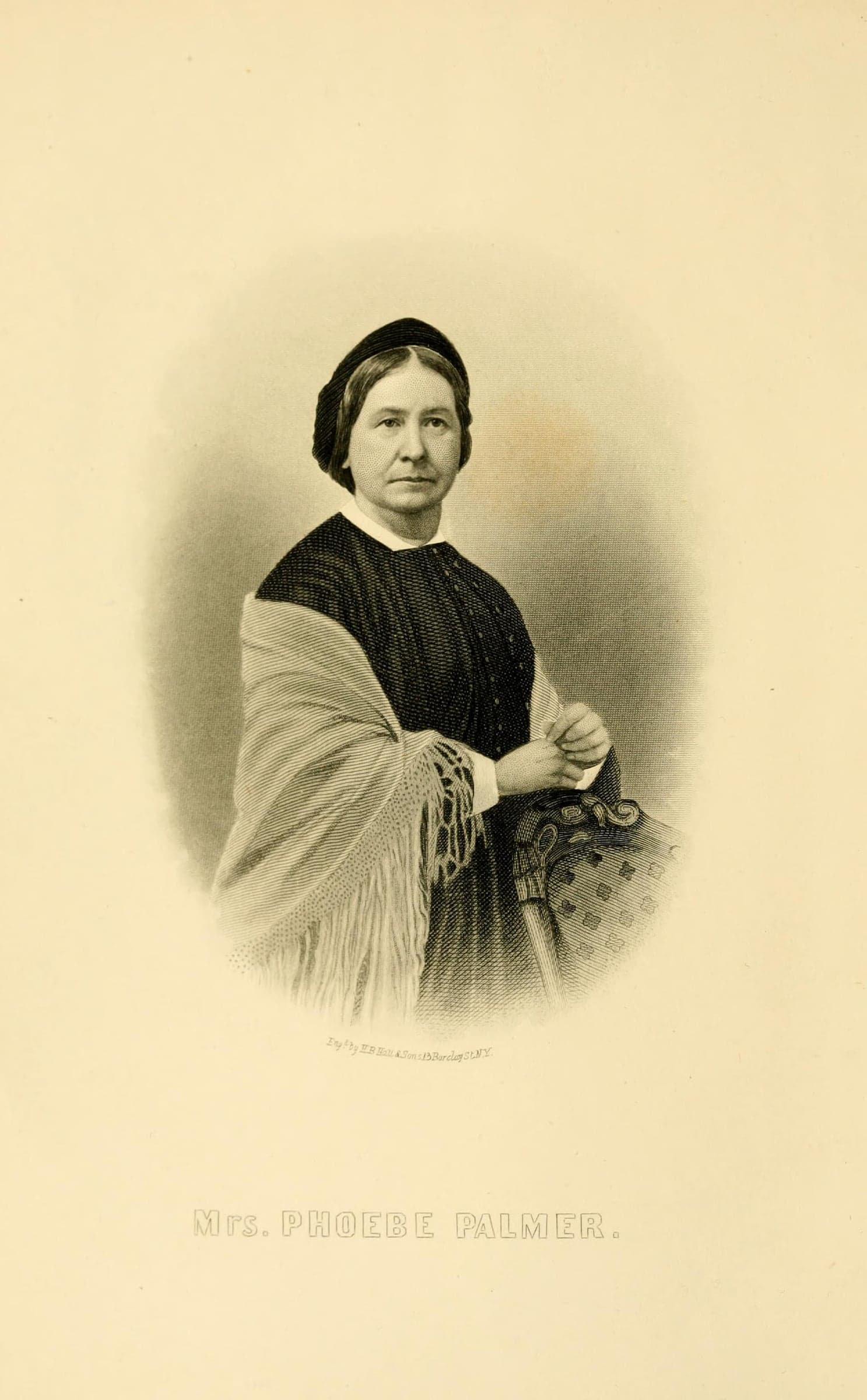
H. B. Hall and Sons, Mrs. Phoebe Palmer, 1881. Public domain.
‘In the last days, God says, I will pour out My Spirit on all people. Your sons and daughters will prophesy, your young men will see visions, your old men will dream dreams.
Summary
Three women of the Methodist societies spoke in public in Wesley's lifetime. Their own accounts survive in print.
- Mary Bosanquet later married John Fletcher, vicar of Madeley.
- One of them preached in the open air, in barns and in wagons.
- Wesley died on 2 March 1791.
The Texts of the Question
Both verses stand at the centre of Bosanquet's letter and Wesley's answer.
Women are to be silent in the churches. They are not permitted to speak, but must be in submission, as the law says.
Bosanquet held that Paul spoke it in a time of dispute, and Wesley called it Paul's ordinary rule.
And every woman who prays or prophesies with her head uncovered dishonors her head, for it is just as if her head were shaved.
Bosanquet set it against the reading that a woman may never speak to edify the church.
What Wesley Allowed, Year by Year
Four letters and a note show what Wesley allowed and when.
Wesley moved from allowing a public testimony to allowing a preacher's note.
| When | What Wesley allowed | The record |
|---|---|---|
| 14 February 1761, to Crosby | She had not gone too far, and once she had told them that the Methodists do not allow women preachers, she might tell them what was in her heart, or read them a sermon | Taft, volume 2 |
| 18 March 1769, to Crosby | She might pray and exhort, but was to keep from what is called preaching and never take a text | Taft, volume 2 |
| June 1771, to Mary Bosanquet | The strength of her cause rested on her having an extraordinary call | Taft, volume 1 |
| The next day, to Crosby | Reading a chapter and making short observations might be as useful as any way of speaking | Taft, volume 2 |
| 1787, from the Conference at Manchester | Mallet might be a preacher in the connection while she preached its doctrines and kept its discipline | Taft, volume 1 |
The Story From Derby to Norfolk
It moves from a class meeting that overflowed to a woman who took a text and divided it.
At Derby Crosby was not sure it was right for her to exhort in so public a manner. She could not speak to each person one by one. She gave out a hymn, prayed, and told them part of what the Lord had done for her.
On the Friday after, a day of public fast, she spoke to them again and showed them the willingness of Christ to save.
Mary Bosanquet wrote Wesley a long letter from Cross-Hall near Leeds to ask whether he approved her light. She and Crosby had led meetings in Yorkshire. She answered six objections to her speaking.
She read Paul's words to Timothy as forbidding a woman to take authority over her husband or to meddle with church discipline. She did not read them as forbidding her to entreat sinners to come to Jesus.
I do not permit a woman to teach or to exercise authority over a man; she is to remain quiet.Bosanquet answered the first objection from this verse, which Taft's print gives as 2 Timothy 2:12.
Against the charge of immodesty she named Mary, who carried the news of the resurrection. She named the wise woman of the besieged city in 2 Samuel 20, and Deborah.
Many of the Samaritans from that town believed in Jesus because of the woman’s testimony, “He told me everything I ever did.”Bosanquet named the woman of Samaria among the women who spoke for Christ without immodesty.
Some preachers were against Sarah Mallet, she wrote, until the Conference's note reached her, and after it she was little opposed by them. The greatest part of her labours were in Norfolk and Suffolk. Her way from the first was to take a text and divide it.
Do not extinguish the Spirit. Do not treat prophecies with contempt,Mallet wished every preacher would think more on these words, in himself and in others.
Others the Letters Name
Two more women and two preachers stand in the letters and accounts.
The women's letters name the women before them and the preachers who came to their circuits.
| Person | Where the record names them | The record |
|---|---|---|
| Sarah Ryan | She began small prayer meetings with Bosanquet at Leytonstone. | Taft, volume 1 |
| Grace Walton | Wesley had advised her as he later advised Crosby. | Taft, volume 2 |
| John Hampson | Wesley's first letter to Crosby told her to prepare her hearers for his coming. | Taft, volume 2 |
| Joseph Harper | He carried the Conference's note when he was appointed to Norwich. | Taft, volume 1 |
The Conference of 1803
The Conference answered the question by a rule with conditions.
The Conference met at Manchester and asked whether women should be permitted to preach among them. It answered that "in general, they ought not".
It gave two reasons: a vast majority of the people were opposed to it, and there were preachers enough for every place. A woman who thought she had an extraordinary call was to address her own sex, and those only. She needed the approval of her superintendent and a Quarterly Meeting in her own circuit, and a written invitation from the superintendent of any other.
Who Tells the Story
Most of the story's record was printed by Taft, who argued for it.
Taft held that God calls men to the ministry in the usual way and calls women only by exception. He gives only a short extract of Bosanquet's letter.
His first volume prints Wesley's answer as his reply to Bosanquet, dated the twelfth of June. His second prints it among the letters Crosby received, dated the thirteenth, with its wording changed in three places.
Where the Line Led
Between 1856 and 1935 the case moved from Wesley's extraordinary call to the promise of Pentecost.
In December 1856 Phoebe Palmer wrote in her journal the question "Has the spirit of prophecy fallen on woman?" Her biographer judged that her book The Promise of the Father grew from such thoughts. Catherine Booth's Female Ministry quotes her. Palmer held that preaching and prophesying are one, so that women did preach in the early church.
The Apostolic Faith was the paper of the Azusa Street mission in Los Angeles. In January 1908 it printed "Who May Prophesy?" from the same texts and from Philip's four daughters.
In 1935 the General Council of the Assemblies of God changed its by-law. Women ordained to the ministry might now serve as evangelists or as pastors.
How the Key Verse Was Taught
Four writers from the fourth century to the nineteenth taught the promise of Pentecost.
Ambrose of Milan (died 397)
On the Holy Spirit, Book 1
Ambrose gives the earliest of the four readings, in his treatise On the Holy Spirit.
“‘I will pour out of My Spirit’: He said not Spirit, but ‘of My Spirit,’ for we are not able to receive the fulness of the Holy Spirit, but we receive as much as our Master divides to us of His own according to His will.”
on Acts 2:17Patristic
John Chrysostom (died 407)
Homily on Acts 5
Chrysostom preached on the verse in his homilies on Acts, with Peter's sermon before him.
“And he added nothing, but, ‘This,’ says he, ‘is that which was spoken by the prophet Joel; And it shall come to pass in the last days.’ He shows, in fact, that the consummation is nigh at hand, and the words, ‘In the last days,’ have a kind of emphasis.”
on Acts 2:16 to 17Patristic
Matthew Henry (1662 to 1714)
Commentary on the Whole Bible
Henry's commentary of 1710 gives a Puritan reading from before Wesley's time.
“It refers to the last days, the times of the gospel, which are called the last days because the dispensation of God's kingdom among men, which the gospel sets up, is the last dispensation of divine grace, and we are to look for no other than the continuation of this to the end of time.”
on Acts 2:17 to 21Puritan
Catherine Booth (1829 to 1890)
Female Ministry, in Papers on Practical Religion, page 134
Booth carried the verse into her case for a woman's right to preach.
“Why should woman be confined exclusively to the kitchen and the distaff, any more than man to the field and workshop?”
Salvation Army
Matthew Henry, Catherine Booth
In Their Own Words
Three women of the societies and Wesley wrote these words.
John Wesley (1703 to 1791)
Letter to Mary Bosanquet from Londonderry, in Zechariah Taft, Biographical Sketches of the Lives and Public Ministry of Various Holy Women, volume 1, page 24
An extraordinary dispensation
“It is plain to me that the work of God, termed Methodism, is an extraordinary dispensation of His providence. Therefore I do not wonder, if several things occur therein, which do not fall under the ordinary rules of discipline.”
Evangelical
About this saying1 paragraph
Wesley grounded his consent in what he believed of the whole eighteenth-century movement.
Sarah Crosby
Her journal, in Zechariah Taft, Biographical Sketches of the Lives and Public Ministry of Various Holy Women, volume 2, page 43
My scruples removed
“My soul was much comforted in speaking to the people, as my Lord has removed all my scruples respecting the propriety of my acting thus publicly.”
Methodist
About this saying1 paragraph
Crosby wrote this in the 1760s, after she had spoken to the crowd at Derby a second time.
Mary Bosanquet Fletcher
Letter to John Wesley from Cross-Hall, in Zechariah Taft, Biographical Sketches of the Lives and Public Ministry of Various Holy Women, volume 1, page 23
An extraordinary manner
“If I did not believe so, I would not act in an extraordinary manner. I praise God, I feel him near, and I prove his faithfulness every day.”
Methodist
About this saying1 paragraph
Bosanquet closed her case with this answer to the sixth objection, in the year 1771.
Sarah Mallet
Her account, in Zechariah Taft, Biographical Sketches of the Lives and Public Ministry of Various Holy Women, volume 1, page 85
The voice of the people
“When I first travelled I followed Mr. Wesley's counsel, which was, to let the voice of the people be to me the voice of God;—and where I was sent for, to go; for the Lord had called me thither.”
Methodist
About this saying1 paragraph
The preacher of Norfolk and Suffolk looked back by 1825 on her first years of travelling.
Mary Bosanquet Fletcher, Sarah Mallet
Where Readers Disagree
Readers have divided on two questions of the story.
What did Paul's rule forbid?2 paragraphs
Wesley and Bosanquet allowed an exception to the rule wherever God gave an extraordinary call. Calvin read it as keeping the office of teaching for men. To the case of Deborah he answered that extraordinary acts of God do not overturn the ordinary rules of government.
Booth and the Azusa Street paper read the promise of Pentecost as a gift given to daughters as to sons. The same paper still wrote that no woman with the Spirit of Jesus wants to usurp authority over the man.
Did Wesley change his mind?2 paragraphs
Wesley's Explanatory Notes upon the New Testament, printed in 1755, already allowed women to speak in the churches under an extraordinary impulse of the Spirit, and read the rule to Timothy as forbidding public teaching.
Taft answered that Wesley encouraged the women who helped in the gospel, more especially during the latter part of his life.
Books to Read Next
Four free books keep the record, the first two printed by Methodists before 1830.
Biographical Sketches of the Lives and Public Ministry of Various Holy Women
Zechariah Taft · 1825
It keeps Bosanquet's letter, Crosby's journal and Mallet's account.
Read it free onlineMinutes of the Methodist Conferences, volume 2
The Methodist Conference · 1813
It holds the Conference's answer of 1803.
Read it free onlinePapers on Practical Religion
Catherine Booth · 1891
It reprints Female Ministry, first printed in 1859.
Read it free onlineThe Life and Letters of Mrs. Phoebe Palmer
Richard Wheatley · 1881
It prints Palmer's letters and journals, with her portrait.
Read it free onlineWhat the Consent Left
The consent left a precedent for women's preaching that rested on Wesley's own words.
Sources
Scripture is the Berean Standard Bible.
- The Holy Bible, Berean Standard Bible (read 2026)
- Zechariah Taft, Biographical Sketches of the Lives and Public Ministry of Various Holy Women, volume 1 (London: Kershaw, 1825) and volume 2 (London: printed for the author, 1828), the lives of Mary Fletcher, Sarah Crosby and Sarah Mallet.
- Henry Moore, The Life of Mrs. Mary Fletcher, Consort and Relict of the Vicar of Madely, Salop (Baltimore: William and Joseph Neal, 1836), the title page.
- Minutes of the Methodist Conferences, volume 2 (London: Conference Office, 1813), the Conference of 1803, question 19, pages 188 to 189.
- John Wesley, Explanatory Notes upon the New Testament (London: William Bowyer, 1755), on 1 Corinthians 14:34 and 1 Timothy 2:12.
- John Calvin, Commentaries on the Epistles to Timothy, Titus and Philemon, translated by William Pringle, on 1 Timothy 2:12.
- Catherine Booth, Female Ministry; or, Woman's Right to Preach the Gospel, in Papers on Practical Religion (London: Salvation Army, 1891)
- Richard Wheatley, The Life and Letters of Mrs. Phoebe Palmer (New York: W. C. Palmer, 1881), pages 496 to 497.
- The Apostolic Faith (Los Angeles), volume 1, number 12, January 1908, Who May Prophesy?
- Minutes and By-Laws of the General Council of the Assemblies of God, 12 to 19 September 1935 (Springfield, Missouri), pages 110 to 111.
Keep Studying
Studies1
People and groups16
Church history2