
Exodus 31 and 35 · The Craftsmen of the Tabernacle
The Spirit given for craft: Bezalel and Oholiab
Two chapters of Exodus record the call of the two master craftsmen of the tabernacle and the gift that fitted them for the work.
The words the Spirit of God, used of Bezalel in Exodus 31:3, first appear in Genesis 1:2, over the waters of creation.
- First taught
- Exodus 31:3
- Fullest statement
- Exodus 35:30 to 35
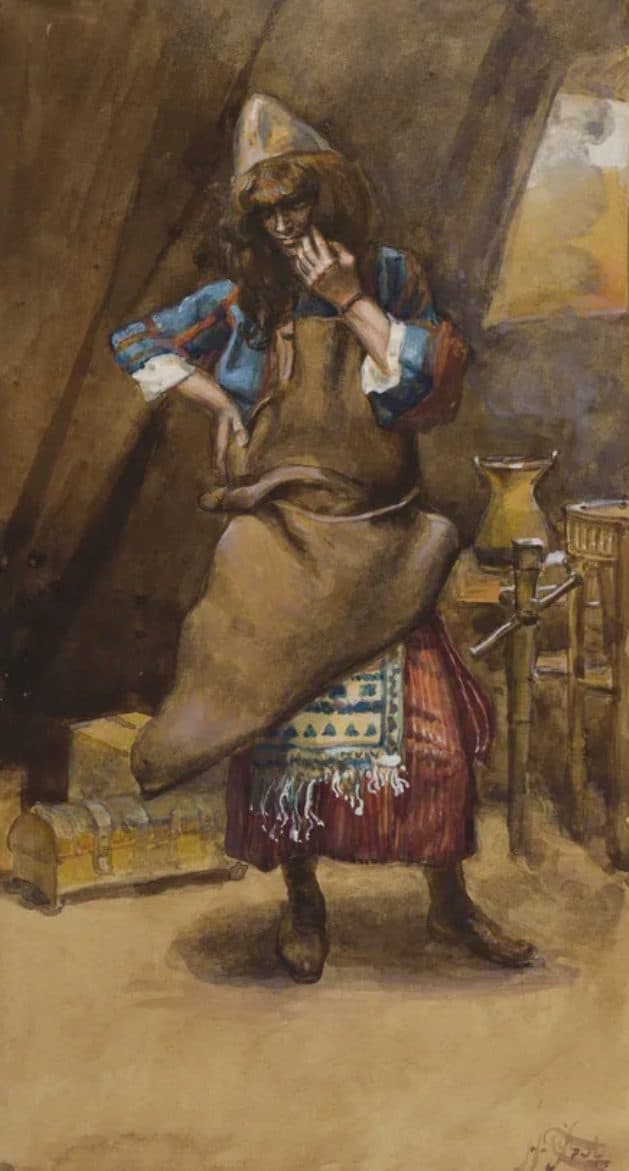
James Tissot, The Goldsmith (Bezalel), gouache on board, about 1896 to 1902, Jewish Museum, New York. Public domain, via Wikimedia Commons.
THE ARTWORKTissot painted Bezalel as a goldsmith in a leather apron for his series on the Old Testament, and the Jewish Museum titles the work The Goldsmith. He stands in his workshop with one hand at his chin, between a chest at his feet and a jar on the bench.
Summary
The LORD called Bezalel of the tribe of Judah by name and gave him skill, ability and knowledge for every craft the tabernacle needed.
- Oholiab of the tribe of Dan was appointed as his assistant, and the LORD gave skill to all the craftsmen.
- Moses told the people that the LORD had also given both men the ability to teach others.
- The people gave more than the work needed, and Moses had the offering stopped.
- Readers differ on whether the Spirit gave Bezalel a new skill, raised a skill he had, or showed that every art is God's gift.
Called by Name and Filled
In Exodus 31:1 to 6 the LORD names the two craftsmen and says what He has given them.
The call follows the pattern of the tabernacle and its furnishings that the LORD gave Moses in Exodus 25 to 30.
“See, I have called by name Bezalel son of Uri, the son of Hur, of the tribe of Judah. And I have filled him with the Spirit of God, with skill, ability, and knowledge in all kinds of craftsmanship,The LORD names the man before He names the gift, and the gift is for craftsmanship.
to design artistic works in gold, silver, and bronze, to cut gemstones for settings, and to carve wood, so that he may be a master of every craft.Bezalel's gift is named by the materials he would shape.
Moreover, I have selected Oholiab son of Ahisamach, of the tribe of Dan, as his assistant. I have also given skill to all the craftsmen, that they may fashion all that I have commanded you:The gift reaches past Bezalel to his assistant and to every craftsman.
When Moses tells the people of the call in Exodus 35:30 to 33, he repeats the LORD's words.
And the LORD has given both him and Oholiab son of Ahisamach, of the tribe of Dan, the ability to teach others. He has filled them with skill to do all kinds of work as engravers, designers, embroiderers in blue, purple, and scarlet yarn and fine linen, and as weavers—as artistic designers of every kind of craft.Verse 34 adds a gift that Exodus 31 does not name, and verse 35 gives every craft to both men.
The Works and the Workers
Exodus 37 and 38 credit most of the furnishings to Bezalel, by his name or by the pronoun that follows it.
| Maker | Material | Work or trade |
|---|---|---|
| The skilled women | spun yarn in blue, purple and scarlet, fine linen and goat hair | the yarn they spun |
| The skilled craftsmen | finely spun linen and yarn of three colours | the ten curtains, with cherubim worked into them |
| Bezalel | acacia wood | the ark, two and a half cubits long |
| Bezalel | pure gold | the mercy seat and its two cherubim |
| Bezalel | acacia wood | the table |
| Bezalel | pure hammered gold | the lampstand, all of one piece |
| Bezalel | acacia wood | the altar of incense |
| Bezalel | the spices and olive oil named in Exodus 30 | the sacred anointing oil and the fragrant incense |
| Bezalel | acacia wood | the altar of burnt offering, five cubits square |
| Bezalel | the bronze mirrors of the women who served at the entrance | the basin and its stand |
| Oholiab | blue, purple and scarlet yarn and fine linen | engraving, design and embroidery |
| Bezalel | finely spun linen embroidered with gold and coloured yarn | the ephod |
From the Call to the Finished Work
Exodus follows the gift of chapter 31 in four steps to the blessing of Exodus 39:43.
1. Exodus 31:7 to 11, the works the LORD named1 passage
the Tent of Meeting, the ark of the Testimony and the mercy seat upon it, and all the other furnishings of the tent— the table with its utensils, the pure gold lampstand with all its utensils, the altar of incense, the altar of burnt offering with all its utensils, and the basin with its stand— as well as the woven garments, both the holy garments for Aaron the priest and the garments for his sons to serve as priests, in addition to the anointing oil and fragrant incense for the Holy Place. They are to make them according to all that I have commanded you.”The list sets out what the gift of verse 3 was given to make, from the Tent of Meeting to the incense.
2. Exodus 36:1 to 7, the workers summoned and the offering stopped2 passages, 1 quotation
“So Bezalel, Oholiab, and every skilled person are to carry out everything commanded by the LORD, who has given them skill and ability to know how to perform all the work of constructing the sanctuary.” Then Moses summoned Bezalel, Oholiab, and every skilled person whom the LORD had gifted—everyone whose heart stirred him to come and do the work.The workers come for two reasons, a skill that was given and a desire of their own, and the verse names both.
and said to Moses, “The people are bringing more than enough for doing the work the LORD has commanded us to do.” After Moses had given an order, they sent a proclamation throughout the camp: “No man or woman should make anything else as an offering for the sanctuary.” So the people were restrained from bringing more, since what they already had was more than enough to perform all the work.The report comes from the craftsmen, the people who knew what the work required.
Matthew Henry traces the people's gifts back to the spoil of Egypt.
“Who would have thought that ever the wealth of Egypt should have been so well employed? but thus God has often made the earth to help the woman, Rev. xii. It was by a special providence and promise of God that the Israelites got all that spoil, and therefore it was highly fit that they should devote a part of it to the service of that God to whom they owed it all.”
Matthew Henry · Commentary on the Whole Bible · on Exodus 35:27Puritan
3. Exodus 38:22 to 23, the craftsmen named in the account1 passage, 1 quotation
Bezalel son of Uri, the son of Hur, of the tribe of Judah, made everything that the LORD had commanded Moses. With him was Oholiab son of Ahisamach, of the tribe of Dan, an engraver, designer, and embroiderer in blue, purple, and scarlet yarn and fine linen.The inventory that begins at Exodus 38:21 names the two craftsmen before it weighs the gold, silver and bronze.
Rashi, Rabbi Shlomo Yitzchaki of Troyes (1040 to 1105), comments on verse 22 in his commentary on Exodus. He reads it to mean that Bezalel's own judgment agreed with the instructions given at Sinai, even where his teacher had not passed them on.
Matthew Henry, on the bronze of verse 27, draws one lesson from the givers and the workmen together.
“The brass, though less valuable, was of use not only for the brazen altar, but for the sockets of the court, which probably in other tents were of wood: but it is promised ( Isa. lx. 17 ), For wood I will bring brass. See how liberal the people were and how faithful the workmen were, in both which respects their good example ought to be followed.”
Matthew Henry · Commentary on the Whole Bible · on Exodus 38:27Puritan
4. Exodus 39:42 to 43, the work inspected and blessed1 passage
The Israelites had done all the work just as the LORD had commanded Moses. And Moses inspected all the work and saw that they had accomplished it just as the LORD had commanded. So Moses blessed them.Moses checks the finished work against the command, and his blessing closes the account of the building.
Bezalel's Line and His Altar
Chronicles traces Bezalel's family to Caleb of Judah and places his altar at Gibeon in Solomon's day.
Caleb son of Hezron had children by his wife Azubah and by Jerioth. These were the sons of Azubah: Jesher, Shobab, and Ardon. When Azubah died, Caleb married Ephrath, who bore to him Hur. Hur was the father of Uri, and Uri was the father of Bezalel.This is the one genealogy of Bezalel in Scripture.
Jamieson, Fausset & Brown comment on Bezalel's grandfather in their Commentary Critical and Explanatory on the Whole Bible. They take him to be the Hur whom Moses left with Aaron to settle the people's disputes while he went up the mountain.
When Moses’ hands grew heavy, they took a stone and put it under him, and he sat on it. Then Aaron and Hur held his hands up, one on each side, so that his hands remained steady until the sun went down.Exodus first names Hur at the battle with Amalek, where he and Aaron hold up Moses' hands.
But the bronze altar made by Bezalel son of Uri, the son of Hur, was in Gibeon before the tabernacle of the LORD. So Solomon and the assembly inquired of Him there.This is the last time Scripture names the craftsman of Exodus 31, and his work is still in use.
What the Text Leaves Unsaid
Exodus leaves three things about the craftsmen unrecorded.
Exodus records neither man's age or death, and Oholiab, whose name appears in no other book, drops from Scripture after Exodus 38:23.
Exodus 35:34 does not say how the two men taught or whom they taught.
Exodus does not say what was done with the offerings the people brought beyond what the work needed, as John Gill observes on Exodus 36:7 in his Exposition of the Old Testament.
The Spirit and the Builders
Scripture speaks of skill for the priest's garments and for Solomon's temple, and of gifts given to build up the church.
The three Hebrew nouns of Exodus 31:3 return in 1 Kings 7:14, at the building of Solomon's temple.
Now King Solomon sent to bring Huram from Tyre. He was the son of a widow from the tribe of Naphtali, and his father was a man of Tyre, a craftsman in bronze. Huram had great skill, understanding, and knowledge for every kind of bronze work. So he came to King Solomon and carried out all his work.Unlike Exodus 31:3, the verse does not name the Spirit of God as the source of Huram's skill.
In the New Testament the Spirit gives gifts to the church, and Paul says they are given for the common good.
There are different gifts, but the same Spirit. There are different ministries, but the same Lord. There are different ways of working, but the same God works all things in all people. Now to each one the manifestation of the Spirit is given for the common good.Paul traces many gifts to one Spirit, one Lord and one God, and he gives the purpose of every gift in verse 7.
All these are the work of one and the same Spirit, who apportions them to each one as He determines.The Spirit decides who receives each gift, as the LORD chose Bezalel by name.
And it was He who gave some to be apostles, some to be prophets, some to be evangelists, and some to be pastors and teachers, to equip the saints for works of ministry and to build up the body of Christ,Here the gifts are the people themselves, given for a building made of believers.
Matthew Henry reads the choice of a man from Dan through Paul's words on the body in 1 Corinthians 12.
“Christ sent forth his disciples who were to rear the gospel tabernacle, two and two, and we read of his two witnesses. Aholiab was of the tribe of Dan, which was one of the less honourable tribes, that the tribes of Judah and Levi might not be lifted up, as if they were to engross all the preferments; to prevent a schism in the body, God gives honour to that part which lacked, 1 Cor. xii.”
Matthew Henry · Commentary on the Whole Bible · on Exodus 31:6Puritan
Exodus 28:3, the makers of Aaron's garments1 passage
You are to instruct all the skilled craftsmen, whom I have filled with a spirit of wisdom, to make garments for Aaron’s consecration, so that he may serve Me as priest.Exodus first speaks of a spirit given to craftsmen here, for the makers of the priest's clothing, three chapters before Bezalel is named.
2 Chronicles 2:13 to 14, the craftsman from Tyre1 passage
So now I am sending you Huram-abi, a skillful man endowed with creativity. He is the son of a woman from the daughters of Dan, and his father is a man of Tyre. He is skilled in work with gold and silver, bronze and iron, stone and wood, purple, blue, and crimson yarn, and fine linen. He is experienced in every kind of engraving and can execute any design that is given him. He will work with your craftsmen and with those of my lord, your father David.Chronicles gives the craftsman a mother from the daughters of Dan, Oholiab's tribe, and lists crafts close to those of Exodus 35:35.
Voices on the Craftsmen
Jamieson, Fausset & Brown and Matthew Henry comment on the naming of the craftsmen and on the people who served with them.
Jamieson, Fausset & Brown explain why Moses told the people who had been chosen once the gifts were gathered.
“But now that the collection had been made, the materials were contributed, and the operations of building about to be commenced, it was with the greatest propriety he reminded the people that the individuals entrusted with the application of their gold and silver had been nominated to the work by authority to which all would bow.”
Jamieson, Fausset & Brown · Commentary Critical and Explanatory on the Whole Bible · on Exodus 35:30Reformed
Matthew Henry, on the call to every skilled person in Exodus 35:10, names two kinds of service.
“Those that were rich must bring in materials to work on; those that were ingenious must serve the tabernacle with their ingenuity; as they needed one another, so the tabernacle needed them both, 1 Cor. xii. The work was likely to go on when some helped with their purses, others with their hands, and both with a willing heart.”
Matthew Henry · Commentary on the Whole Bible · on Exodus 35:10Puritan
Matthew Henry, on the women who spun the goat hair in Exodus 35:26, sets them beside the women Paul names as his fellow workers.
“Mary's anointing of Christ's head shall be told for a memorial ( Matt. xxvi. 13 ); and a record is kept of the women that laboured in the gospel tabernacle ( Phil. iv. 3 ), and were helpers to Paul in Christ Jesus, Rom. xvi.”
Matthew Henry · Commentary on the Whole Bible · on Exodus 35:26Puritan
What the Filling Gave
Readers differ on what the Spirit added to Bezalel's skill, and each reading rests on Exodus 31:3 to 6.
A gift given for the work
Rashi, in his commentary on Exodus, glosses each noun Exodus 31:3 uses for Bezalel's gift. Wisdom is what a person hears from others and makes his own, understanding is what he deduces by his own intelligence, and knowledge is holy inspiration.
Matthew Henry sets Bezalel's gift against what Moses himself could do.
“A great deal of fine work God had ordered to be done about the tabernacle; the materials the people were to provide, but who must put them into form? Moses himself was learned in all the learning of the Egyptians, nay, he was well acquainted with the words of God, and the visions of the Almighty; but he knew not how to engrave or embroider.”
Matthew Henry · Commentary on the Whole Bible · on Exodus 31:2Puritan
The objection rests on the Hebrew of Exodus 31:6, where the LORD puts wisdom in the hearts of those already wise of heart, and on the skilled women of Exodus 35:25.
A natural skill raised by the Spirit
Jamieson, Fausset & Brown comment on Exodus 31:3 to 5 in their Commentary Critical and Explanatory on the Whole Bible. They think it probable that Bezalel had a natural gift for mechanical work and had gained great skill in the arts in Egypt.
Adam Clarke, in his Commentary on the Bible, on Exodus 31:6, holds that every man with a natural genius received an increase of wisdom by immediate inspiration from God. He cites Seneca on the seeds of every art that God brings out in people.
The objection is that Exodus gives no account of Bezalel's training, and it ascribes his skill, his teaching and the skill of the others to the LORD in Exodus 31:3, 35:34 and 36:1 to 2.
Every skill in the arts is the Spirit's gift
John Calvin, in the Institutes of the Christian Religion, book 2, chapter 2, section 16, reasons from the skill imparted to Bezalel and Oholiab. He concludes that the Spirit dispenses excellent gifts to whom He will for the common benefit of mankind, the ungodly among them.
Abraham Kuyper, in the fifth of his Lectures on Calvinism, given at Princeton in 1898, calls art one of the richest gifts of God to mankind. He holds that God gives the liberal arts to believers and unbelievers alike by common grace.
The objection is that Exodus 31:2 calls one man by name, and Exodus 31:6 to 11 ties the skill it gives to the making of what the LORD commanded.
The wisdom by which the world was made
The Babylonian Talmud, compiled between about 450 and 550, discusses Bezalel in tractate Berakhot 55a.
There Rabbi Shmuel bar Nachmani, in the name of Rabbi Yonatan, says Bezalel was named for his wisdom. Bezalel told Moses that a house is built before its vessels are made, and Moses answered that he must have been in the shadow of God, betzel El.
Adam Clarke, in his Commentary on the Bible, on Exodus 31:2, gives the same meaning of the name, in or under the shadow of God.
Rav Yehuda, in the name of Rav, says Bezalel knew how to join the letters by which heaven and earth were created, and he finds the same nouns in Proverbs 3:19 to 20.
The LORD founded the earth by wisdom and established the heavens by understanding. By His knowledge the watery depths were broken open, and the clouds dripped with dew.The order of the words here matches Exodus 31:3, and their subject is the LORD Himself.
The objection is that Exodus never ties Bezalel's gift to creation, and the link rests on the repeated nouns alone.
The Craftsman's Calling
Skill in Exodus 31 is received from God and spent on what He commanded.
Peter writes to believers who have each received a gift, and he names what the gift is for.
As good stewards of the manifold grace of God, each of you should use whatever gift he has received to serve one another. If anyone speaks, he should speak as one conveying the words of God. If anyone serves, he should serve with the strength God provides, so that in all things God may be glorified through Jesus Christ, to whom be the glory and the power forever and ever. Amen.Peter gives every believer the rule Bezalel worked under, that a gift is used for others and for its Giver.
Keep studying
Read it1
Studies1
Doctrines8
Peoples and groups2