

David George Hogarth, A Euphratean Ferry, 1910. Public domain.
Genesis 15:18 · Place · Featured Study
The Euphrates
The Euphrates is the fourth river named in Eden and the eastern limit of the land God promised to Abram's descendants.
Abraham's family came from beyond this river, and Joshua told Israel to put away the gods their fathers had served on its far side.
On that day the LORD made a covenant with Abram, saying, “To your descendants I have given this land—from the river of Egypt to the great River Euphrates—
- Today
- Turkey, Syria and Iraq, joining the Tigris in the Shatt al-Arab
- Region
- Mesopotamia, from the Armenian highlands to the Persian Gulf
- Site
- 31.004, 47.442
- First named
- Genesis 2:14 “…the fourth river is the Euphrates.”
- Last named
- Revelation 16:12 “…bowl on the great river Euphrates, and its…”
Abraham's family came from beyond this river, and Joshua told Israel to put away the gods their fathers had served on its far side.
Summary
The Euphrates is the longest river of western Asia, and Scripture names it from Genesis 2 to Revelation 16.
- Its Hebrew name is Perath, and Scripture often calls it simply the River.
- Balaam was summoned from Pethor beside it, and David fought Hadadezer for the lands along it.
- Revelation names it twice, in chapters 9 and 16.
The Fourth River and the Border
Genesis names the river first in Eden and then in the LORD's covenant with Abram.
The name of the third river is Hiddekel; it runs along the east side of Assyria. And the fourth river is the Euphrates.The other three rivers each get a land, and the Euphrates is named with nothing added.
On that day the LORD made a covenant with Abram, saying, “To your descendants I have given this land—from the river of Egypt to the great River Euphrates—The LORD's covenant with Abram sets the river as the far edge of the land.
Genesis 15:18 calls it the great River, and the same title returns when Moses and Joshua describe the land in Deuteronomy 1:7 and Joshua 1:4.
The name of the third river is Hiddekel; it runs along the east side of Assyria. And the fourth river is the Euphrates.The other three rivers each get a land, and the Euphrates is named with nothing added.
Genesis 15:18 calls it the great River, and the same title returns when Moses and Joshua describe the land in Deuteronomy 1:7 and Joshua 1:4.
The River on Spruner's Plate
Spruner's plate of 1865 runs from the Armenian highlands to the head of the Persian Gulf.
The river runs south and east from Carchemish past Babylon to Ur.
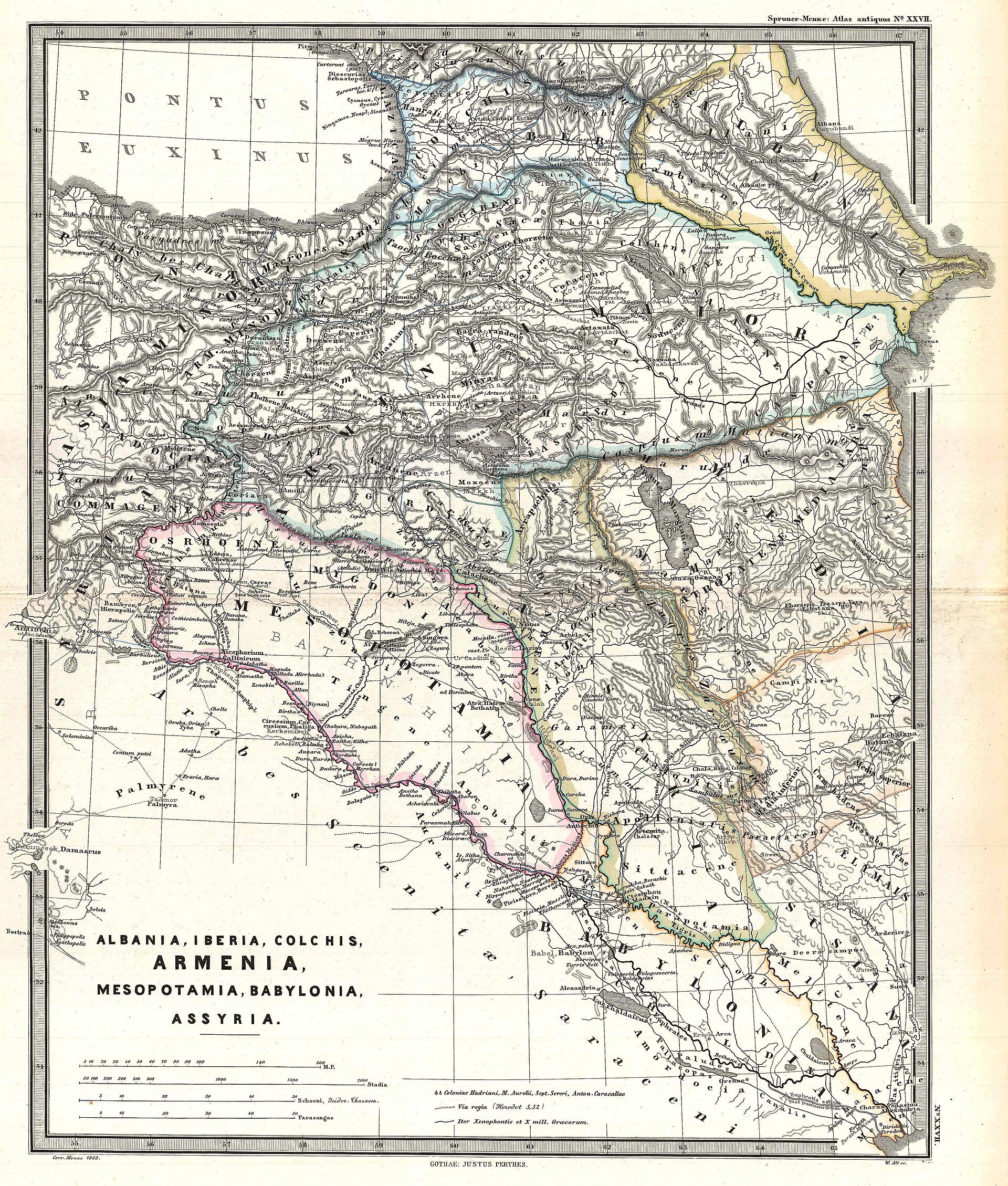
- Located: the site is known
- Probable: Tiphsah, identified with Thapsacus (OpenBible score 754 of 1,000)
- 1Carchemish, The last seat of the Assyrian remnant, on the upper river Jeremiah 46:2
- 2Tiphsah, The northern limit of Solomon's rule west of the river 1 Kings 4:24
- 3Babylon, The exiles sat and wept by its rivers Psalm 137:1
- 4Ur, Abram's family set out from here for Canaan Genesis 11:31
- 5Haran, Laban's town, east of the river Genesis 31:21
Base map: Albania, Iberia, Colchis, Armenia, Mesopotamia, Babylonia, Assyria, Karl von Spruner and Theodor Menke, Atlas Antiquus, plate XXVII (Gotha: Justus Perthes, 1865), public domain. Places with a place page stand at its coordinates and the others at the point cited for each, set on the plate by Haran and Babylon, as the plate prints them.
Five places, the first four numbered down the river from Carchemish to Ur. The ring of Tiphsah carries OpenBible's identification score.
The Euphrates in Scripture, in Order
Six moments at the river, from Eden to Jeremiah's scroll.
The river marks a border in the Law and the meeting place of empires in the Prophets.
- EdenA river waters the garden and branches into four headwatersGenesis 2:10
- The covenantThe LORD promises the land as far as the riverGenesis 15:18
- Balak's summonsMessengers go to Balaam at Pethor by the riverNumbers 22:5
- David's warsHadadezer marches out to restore his rule along the river2 Samuel 8:3
- Josiah's deathPharaoh Neco marches to Carchemish by the river2 Chronicles 35:20
- Jeremiah's scrollSeraiah is told to sink the scroll against Babylon in the riverJeremiah 51:63
Each row gives the moment and the verse that tells it.
The River in the Prophets
Two prophets use the river as a picture of an empire or of a rescue.
FLOODWATERS OVER JUDAH
Isaiah warns that the LORD will bring the floodwaters of the Euphrates over Judah, and he names them as the king of Assyria and all his pomp.
TWO EMPIRES AND THEIR RIVERS
Jeremiah sets the waters of the Euphrates beside the waters of the Nile to rebuke Judah for looking to the two empires for help.
A SECOND CROSSING IS PROMISED
Isaiah promises that the LORD will split the river into seven streams for men to cross with dry sandals.
The Battle at Carchemish
The battle on the upper river decided which empire would rule Judah.
concerning Egypt and the army of Pharaoh Neco king of Egypt, which was defeated at Carchemish on the Euphrates River by Nebuchadnezzar king of Babylon in the fourth year of Jehoiakim the son of Josiah king of Judah:The oracle's heading ties Jeremiah's words to a battle the reader can date.
The battle was fought around 605 BC, and Nebuchadnezzar commanded the Babylonian army while his father Nabopolassar was still king in Babylon.
Now the king of Egypt did not march out of his land again, because the king of Babylon had taken all his territory, from the Brook of Egypt to the Euphrates River.The writer of Kings records the result in the land between Egypt and the river.
Albert Barnes, in his Notes on 2 Kings 24:7, dates Egypt's withdrawal from the year of the battle of Carchemish.
The River Itself
The river's length, its course, and the one ford Kings names.
The river's two branches rise northwest of Lake Van and meet in eastern Turkey. It then flows through Syria and Iraq and joins the Tigris in the Shatt al-Arab, which empties into the Persian Gulf.
Albert Barnes, on 1 Kings 4:24, identifies Tiphsah with Thapsacus and explains the name as ford or passage. He writes that the stream is fordable there and nowhere else in that part of its course.
The whole river is more than four times as long as either branch.
The three counts as a table
| Stream | Length in km |
|---|---|
| Kara Su, the western branch | 450 |
| Murat Su, the eastern branch | 650 |
| The Euphrates, its whole length | 2,780 |
Three lengths in kilometres, each drawn from zero.
What Scripture Leaves Unsaid
Genesis 31 leaves one practical question open.
In Genesis 31:21 the Hebrew says only that Jacob crossed the River, and it gives no account of how he took his flocks across. Adam Clarke, in his Commentary on the Bible, notes that the Targum names the river as the Euphrates. He reports the rabbinic claim of a miracle and leaves the crossing to the power of God.
The Border and the Promise
Kings sets Solomon's border at the river, and Psalm 72 looks past it.
And Solomon reigned over all the kingdoms from the Euphrates to the land of the Philistines, as far as the border of Egypt. These kingdoms offered tribute and served Solomon all the days of his life.This verse stands in Kings' summary of Solomon's officials and the provisions of his court.
John Wesley, in his Explanatory Notes on 1 Kings 4:21, holds that God's promise of the land as far as the Euphrates was fulfilled under David and Solomon.
May he rule from sea to sea, and from the Euphrates to the ends of the earth.The psalm turns a border of the land into the starting line of a wider reign.
The Voices on the Euphrates
Ambrose, Calvin and Henry each wrote on passages that name the river.
died 397 · Ambrose of Milan
Ambrose of Milan reads the fourth river of Eden as a picture of justice.
“The fourth river is the Euphrates, which means in Latin ‘fecundity and abundance of fruits.’ It presents a symbol of justice, the nourishment of every soul. No virtue produces more abundant benefits than equity or justice, which is more concerned with others than with itself, neglecting its own advantages and preferring the common good. Many derive Euphrates from the Greek apo tou euphrainesthai, that is, from a ‘feeling of gladness,’ because the human race rejoices in nothing more than it does in justice and equity.”
Ambrose of Milan · On Paradise · on Genesis 2:14Patristic
1509 to 1564 · John Calvin
John Calvin asks why Jeremiah's oracle on the defeat at Carchemish was given to Judah.
“It is not known whether or not the design was to alleviate the sorrow of the people by this prophecy; and yet I am disposed to receive what the greater part of interpreters have held, that as at that time the people were in the greatest trouble, this prophecy was given in order that the faithful might know that God had not ceased to care for his people.”
John Calvin · Commentaries · on Jeremiah 46:2Reformed
1662 to 1714 · Matthew Henry
Matthew Henry reads the defeat at Carchemish as God's purpose at work under Egypt's own plans.
“They meant one thing, but God meant another; they designed it for the advancement of their dignity and the enlargement of their dominion, but God designed it for the great abasement and weakening of their kingdom. It is a day of vengeance for Josiah's death; it is a day of sacrifice to divine justice, to which multitudes of the sinners of Egypt shall fall as victims.”
Matthew Henry · Commentary on the Whole Bible · on Jeremiah 46:10Puritan
1662 to 1714 · Matthew Henry
He also notes how far from its victims the judgment of the sixth trumpet lay bound.
“The instruments that God makes use of to punish a people may sometimes lie at a great distance from them, so that no danger may be apprehended from them. These four messengers of divine judgment lay bound in the river Euphrates, a great way from the European nations.”
Matthew Henry · Commentary on the Whole Bible · on Revelation 9:14Puritan
Matthew Henry, Matthew Henry
Where Was Perath in Jeremiah 13?
Jeremiah hides a loincloth at Perath, and readers differ on whether he went to the river.
“Take the loincloth that you bought and are wearing, and go at once to Perath and hide it there in a crevice of the rocks.” So I went and hid it at Perath, as the LORD had commanded me.The Berean text keeps the Hebrew name Perath here, which leaves the place open.
The river EuphratesAdam Clarke, 1832
Adam Clarke, on Jeremiah 13:4, reads Perath as the Euphrates and holds that the distant place points to the country where Judah would be taken captive.
The objection: Jeremiah goes to Perath twice, and a place near Jerusalem would make both trips short.
A place near BethlehemEbenezer Henderson, as Jamieson, Fausset and Brown report him, 1871
Jamieson, Fausset and Brown report that Ebenezer Henderson read Perath here as Ephratha, the old name of Bethlehem, six miles south of Jerusalem. They add that the word river, which usually stands before the name when it means the Euphrates, is missing in these verses.
The objection: Strong's dictionary glosses Perath only as the Euphrates, a river of the East.
From Eden to the Last Bowl
The Euphrates stands at the start of Scripture as a river of the garden and at its end as a river of judgment.
And the sixth angel poured out his bowl on the great river Euphrates, and its water was dried up to prepare the way for the kings of the East.Revelation's last word on the river comes with the sixth of the seven bowls.
Sources
Scripture is the Berean Standard Bible.
- James Strong, Exhaustive Concordance of the Bible (1890), Hebrew dictionary, entries 6578 and 5104.
- Adam Clarke, Commentary on the Bible (1832), on Genesis 31:21.
- Adam Clarke, Commentary on the Bible (1832), on Jeremiah 13:4.
- Jamieson, Fausset and Brown, Commentary Critical and Explanatory on the Whole Bible (1871), on Jeremiah 13:4.
- Albert Barnes, Notes, Explanatory and Practical, on the Old and New Testaments, on 2 Kings 24:7.
- Albert Barnes, Notes, Explanatory and Practical, on the Old and New Testaments, on 1 Kings 4:24.
- Matthew Henry, Commentary on the Whole Bible (1710), on Jeremiah 46:10.
- John Wesley, Explanatory Notes upon the Old Testament (1765), on 1 Kings 4:21.
- Ambrose of Milan, On Paradise, on Genesis 2:14.
- John Calvin, Commentaries (1554), on Jeremiah 46:2.
- Matthew Henry, Commentary on the Whole Bible (1710), on Revelation 9:14.
- Karl von Spruner and Theodor Menke, Atlas Antiquus, plate XXVII (Gotha: Justus Perthes, 1865), public domain.
Keep Studying
Read it4