
Exodus · Group · Featured Study
The Levites
The tribe took its name from Levi, the third son Leah bore to Jacob.
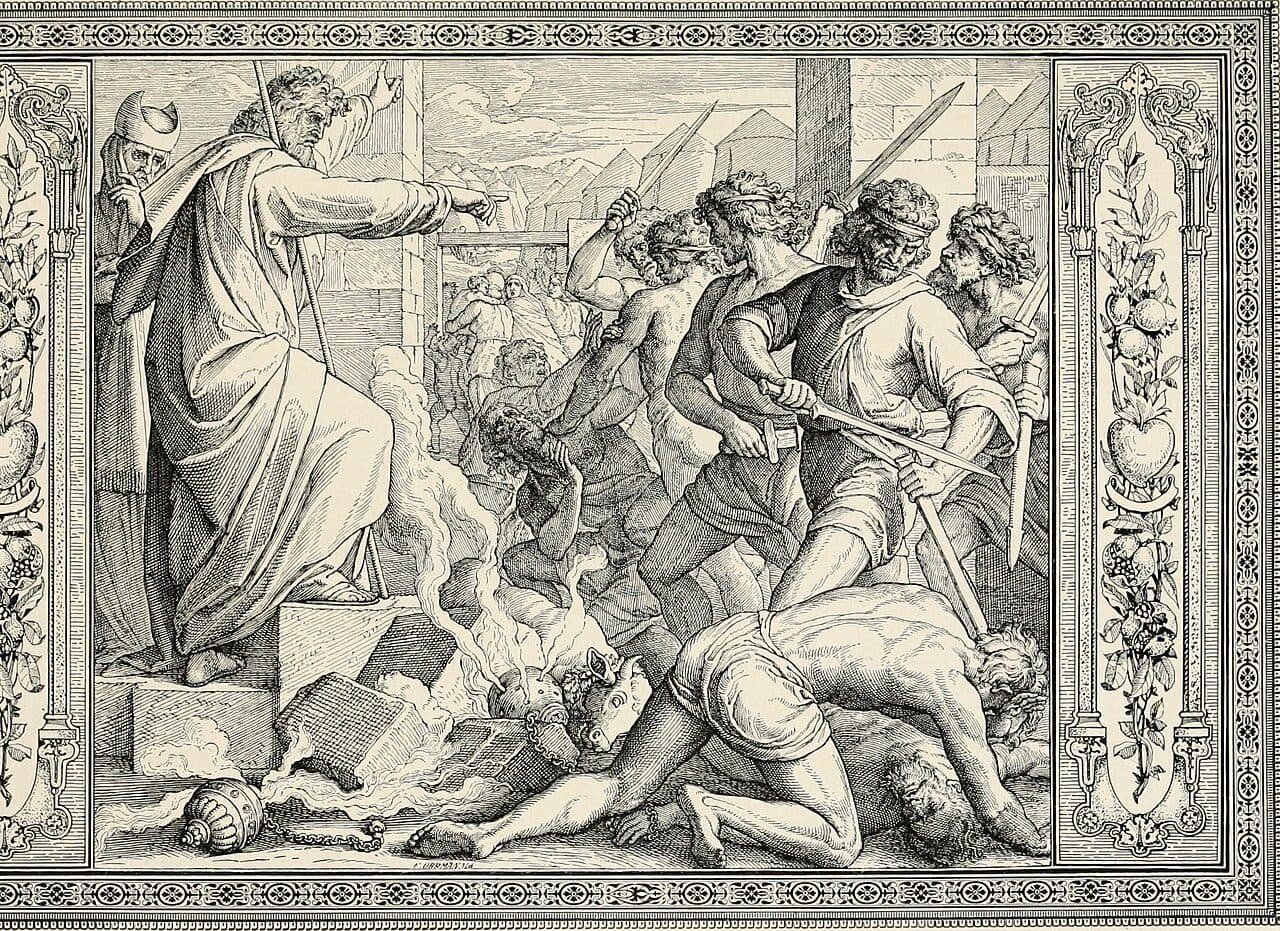
Engraving from The Bible and Its Story (New York: F. R. Niglutsch, 1908), the Princeton Theological Seminary Library copy scanned by the Internet Archive, via Flickr Commons; Wikimedia Commons, File:The_Bible_and_its_story.._(1908)_(14586345548).jpg. Published 1908, public domain by date.
THE ARTWORKThe engraver drew Moses on the step pointing the armed men through the camp, as Exodus 32:27 commands, with the broken calf smoking at his feet and a priest in a tall cap behind him.
When Israel counted its men of twenty and older for the army, the tribe of Levi was left out of the census.
Summary
The Levites were the tribe the LORD took for the service of the tabernacle in place of Israel's firstborn, under the priests descended from Aaron.
- Levi's three sons, Gershon, Kohath and Merari, gave the tribe its three clans.
- Only Aaron and his sons served as priests, and the rest of the tribe worked under them.
- Moses' last blessing gave Levi the teaching of the law.
The Sons of Levi at the Gate of the Camp
Exodus 32 tells of the day the tribe of Levi stood apart for the LORD.
So Moses stood at the entrance to the camp and said, “Whoever is for the LORD, come to me.” And all the Levites gathered around him.Moses' call divided the camp, and the Levites are the one tribe the text names as answering it.
The Levites did as Moses commanded, and that day about three thousand of the people fell dead.The count of the fallen shows that the Levites carried out the order on the same day.
Afterward, Moses said, “Today you have been ordained for service to the LORD, since each man went against his son and his brother; so the LORD has bestowed a blessing on you this day.”Moses ties the Levites' ordination to what that day cost them.
Levi's clans in Exodus 6
These were the names of the sons of Levi according to their records: Gershon, Kohath, and Merari. Levi lived 137 years.The three sons named here are the three clans that Numbers 3 counts and puts to work at the tabernacle.
Rashi on Deuteronomy 33:9
Rashi reads Moses' blessing of Levi as spoken of this day at the gate. He holds that no one of the tribe of Levi had sinned with the calf.
The Clans and Their Charges
Numbers 3 and 4 set each clan on one side of the tabernacle and give it its work.
| Clan | Camp | Charge | Males a month old or more | Men from thirty to fifty | Verses |
|---|---|---|---|---|---|
| Gershon | West, behind the tabernacle | The tabernacle and tent, its covering, the curtains of the entrance and of the courtyard, and the cords | 7,500 | 2,630 | Numbers 3:21 to 26 and 4:40 |
| Kohath | South side | The ark, the table, the lampstand, the altars, the articles of the sanctuary and the curtain | 8,600 | 2,750 | Numbers 3:27 to 31 and 4:36 |
| Merari | North side | The frames, crossbars, posts and bases, with the courtyard's posts, tent pegs and ropes | 6,200 | 3,200 | Numbers 3:33 to 37 and 4:44 |
| Moses, Aaron and Aaron's sons | East, before the Tent of Meeting | The sanctuary's duties, with any outsider who approached it put to death | None given | None given | Numbers 3:38 |
- Clan
- Gershon
- Camp
- West, behind the tabernacle
- Charge
- The tabernacle and tent, its covering, the curtains of the entrance and of the courtyard, and the cords
- Males a month old or more
- 7,500
- Men from thirty to fifty
- 2,630
- Verses
- Numbers 3:21 to 26 and 4:40
- Clan
- Kohath
- Camp
- South side
- Charge
- The ark, the table, the lampstand, the altars, the articles of the sanctuary and the curtain
- Males a month old or more
- 8,600
- Men from thirty to fifty
- 2,750
- Verses
- Numbers 3:27 to 31 and 4:36
- Clan
- Merari
- Camp
- North side
- Charge
- The frames, crossbars, posts and bases, with the courtyard's posts, tent pegs and ropes
- Males a month old or more
- 6,200
- Men from thirty to fifty
- 3,200
- Verses
- Numbers 3:33 to 37 and 4:44
- Camp
- East, before the Tent of Meeting
- Charge
- The sanctuary's duties, with any outsider who approached it put to death
- Males a month old or more
- None given
- Men from thirty to fifty
- None given
- Verses
- Numbers 3:38
In Place of the Firstborn
Numbers 3 and 8 give the reason the LORD took the Levites and the rite that set them apart.
“Behold, I have taken the Levites from among the children of Israel in place of every firstborn Israelite from the womb. The Levites belong to Me, for all the firstborn are Mine. On the day I struck down every firstborn in the land of Egypt, I consecrated to Myself all the firstborn in Israel, both man and beast. They are Mine; I am the LORD.”The verses prove that the Levites' service was owed, since it stands in place of the firstborn whom the LORD already held as His own.
WATER OF PURIFICATION
The Levites were sprinkled with the water of purification, shaved their whole bodies and washed their clothes.
THE HANDS OF THE ISRAELITES
The Israelites laid their hands on the Levites before the LORD.
A WAVE OFFERING
Aaron presented the Levites before the LORD as a wave offering from the sons of Israel.
TWO BULLS
The Levites laid their hands on two bulls, one for a sin offering and one for a burnt offering, to make atonement for themselves.
FROM TWENTY-FIVE TO FIFTY
A Levite entered the work at twenty-five and retired from it at fifty, and after that he could assist his brothers.
Rashi on Numbers 3:12
Rashi says the firstborn first did the service and lost it when they worshipped the golden calf.
What the Levites' service did for Israel
And I have given the Levites as a gift to Aaron and his sons from among the Israelites, to perform the service for the Israelites at the Tent of Meeting and to make atonement on their behalf, so that no plague will come against the Israelites when they approach the sanctuary.”The LORD states what the Levites' work was for, and the cleansing of Numbers 8 prepared them to do it.
Matthew Henry distinguishes the Levites' part in that atonement from the part of the priests.
“But what is the service they do the children of Israel? It follows, it is to make an atonement for them, that there be no plague among them. It was the priests' work to make atonement by sacrifice, but the Levites made atonement by attendance, and preserved the peace with heaven which was made by sacrifice.”
Matthew Henry · Commentary on the Whole Bible · on Numbers 8:19Puritan
The LORD Is Their Inheritance
Numbers 18 and 35 give the Levites tithes and cities in place of a share of the land.
Then the LORD said to Aaron, “You will have no inheritance in their land, nor will you have any portion among them. I am your portion and your inheritance among the Israelites.The LORD gives the rule first to Aaron and his house.
That is why Levi has no portion or inheritance among his brothers; the LORD is his inheritance, as the LORD your God promised him.The rule still stood in the fortieth year, when Moses spoke to the generation about to enter the land.
The tithe and the cities
| Provision | What it was | Verse |
|---|---|---|
| The tithe | All the tithes in Israel, given in return for the work of the Tent of Meeting | Numbers 18:21 |
| The tithe of the tithe | A part of the Levites' tithe, presented as an offering to the LORD | Numbers 18:26 |
| Forty-eight cities | Cities to live in, given from each tribe in proportion to its inheritance | Numbers 35:7 to 8; Joshua 21:41 |
| Six cities of refuge | Six of the forty-eight, where a manslayer could flee | Numbers 35:6 |
| Pasturelands | Land for herds and flocks, reaching a thousand cubits from the wall on every side | Numbers 35:3 to 4 |
- Provision
- The tithe
- What it was
- All the tithes in Israel, given in return for the work of the Tent of Meeting
- Verse
- Numbers 18:21
- Provision
- The tithe of the tithe
- What it was
- A part of the Levites' tithe, presented as an offering to the LORD
- Verse
- Numbers 18:26
- Provision
- Forty-eight cities
- What it was
- Cities to live in, given from each tribe in proportion to its inheritance
- Verse
- Numbers 35:7 to 8; Joshua 21:41
- Provision
- Six cities of refuge
- What it was
- Six of the forty-eight, where a manslayer could flee
- Verse
- Numbers 35:6
- Provision
- Pasturelands
- What it was
- Land for herds and flocks, reaching a thousand cubits from the wall on every side
- Verse
- Numbers 35:3 to 4
Barnes on Numbers 18:21
Albert Barnes reaches back to Abraham and forward to Nehemiah.
“Abraham paid tithes to Melchizedek: Jacob had promised the tithe of all wherewith God blessed him if he should return in peace to his father’s house. But now first the Lord’s tithes are assigned to the Levites for their support (compare Lev 27:30). The payment of tithes to them is recognized in Neh 10:37; Neh 12:44; Tobit 1:7.”
Albert Barnes · Notes, Explanatory and Practical, on the Old and New Testaments (1832-1869) · on Numbers 18:21Evangelical
The Priests of Egypt
Origen of Alexandria set the priests of Pharaoh in Genesis 47:22 beside the priests of the LORD.
“Indeed, do you wish to know what the difference is between the priests of God and the priests of Pharaoh? Pharaoh grants lands to his priests. The Lord, on the other hand, does not grant his priests a portion in the land but says to them, ‘I am your portion.’”
Origen of Alexandria · Homilies on Genesis 16:5 · on Numbers 18:20Patristic
What the Text Leaves Unsaid
Exodus and Numbers leave these questions about the Levites open.
Exodus 32 does not say whether any Levite had joined in the worship of the calf before Moses called the camp.
Numbers 4 counts the Levites who served from the age of thirty, and Numbers 8 sets the age of entry at twenty-five. Neither chapter explains the difference.
The three clans of Numbers 3 come to 22,300 males, and Numbers 3:39 gives the total as 22,000. The text gives no reason for the difference.
Scattered in Israel
Jacob's sentence on Levi in Genesis 49 and Moses' blessing in Deuteronomy 33 both speak of the tribe's place in Israel.
Cursed be their anger, for it is strong, and their wrath, for it is cruel! I will disperse them in Jacob and scatter them in Israel.The tribe's later life without territory begins in this sentence on the anger of Simeon and Levi.
He will teach Your ordinances to Jacob and Your law to Israel; he will set incense before You and whole burnt offerings on Your altar.The tribe that carried the sword through the camp is given an office at the altar.
Three Voices on the Levites
Gregory the Dialogist, Matthew Henry and John Calvin
Gregory the Dialogist draws from the Levites' swords a lesson for those whose office is to rebuke.
“It is therefore to be well weighed, when there is rest from chiding, how culpably peace is kept with the worst of men, if so great a prophet offered this as a sacrifice to God, that he excited the enmities of the wicked against himself for the Lord. Hence it is that the tribe of Levi, when they took their swords and passed through the midst of the camp because they would not spare the sinners who were to be smitten, are said to have consecrated their hands to God.”
Gregory the Dialogist · The Book of Pastoral Rule, Part 3, Chapter 22 · on Exodus 32:29Patristic
Henry reads Moses' call at the gate as a choice between two sides.
“The interest of sin and wickedness is the devil's interest, and all wicked people side with that interest; the interest of truth and holiness is God's interest, with which all godly people side; and it is a case that will not admit a neutrality.”
Matthew Henry · Commentary on the Whole Bible · on Exodus 32:26 to 28Puritan
John Calvin explains how the Levites, living far from the tabernacle, could still eat the food God appointed them.
“But since by God's command they were scattered over the whole land, and did not cease to be ministers of the tabernacle on account of the distance of their residence, it was justly permitted that, wherever they might be, they should eat of the meat appointed them by God.”
John Calvin · Commentaries · on Numbers 18:31Reformed
Priests and Levites
Two readings of when the line of Aaron was first set apart from the rest of the tribe of Levi as its priests.
A distinction made at SinaiJohn Wesley; Albert Barnes; James Orr
John Wesley, in his Explanatory Notes upon the Old Testament, holds that the priesthood was given to Aaron's descendants alone, so that the sons of Moses were common Levites. Albert Barnes, in his Notes on Numbers 8:5, marks the difference between the consecration of the priests in Leviticus 8 and the lesser purification of the Levites. James Orr defended this reading against Wellhausen in The Problem of the Old Testament (1906).
So you shall appoint Aaron and his sons to carry out the duties of the priesthood; but any outsider who approaches the tabernacle must be put to death.”This reading rests on the appointment of Aaron and his sons to the priesthood in the chapter that gives the Levites to them as helpers.
The objection: Wellhausen reads Deuteronomy as a law under which any Levite might minister at the sanctuary.
The Levitical priests—indeed the whole tribe of Levi—shall have no portion or inheritance with Israel. They are to eat the offerings made by fire to the LORD; that is their inheritance.This is the first of the three verses of Deuteronomy 18 that he quotes for that reading.
A distinction made after EzekielJulius Wellhausen
Julius Wellhausen, in his Prolegomena to the History of Israel (German 1878, English 1885), reads Ezekiel 44 as the sentence that first set the Levites below the priests. Until Ezekiel, he argues, the Levites held the priesthood by right, and the law that puts them under the sons of Aaron was written after him.
The objection: James Orr answers that the Priestly Code has nothing of degraded priests or of a penalty. Numbers sets the Levites apart in the wilderness by the LORD's own choice, as a gift to Aaron and in place of the firstborn.
Books to Read Next
Three works on the Levites, from 1710 to 1906
Commentary on the Whole Bible
Matthew Henry · 1710
Its note on Numbers 18:8 applies the priests' provision to the support of Christian ministers.
Prolegomena to the History of Israel
Julius Wellhausen · 1878; English 1885
Its fifth chapter treats the dues paid to the clergy, the firstlings and the Levitical towns.
Read it at Project GutenbergThe Problem of the Old Testament
James Orr · 1906
Its opening chapter sets the whole dispute as a question of the supernatural in the religion of Israel.
Read it at the Internet ArchiveA Holy Priesthood
Hebrews 7 and 1 Peter 2 read the priesthood of Levi in the light of Christ.
Now if perfection could have been attained through the Levitical priesthood (for on this basis the people received the law), why was there still need for another priest to appear—one in the order of Melchizedek and not in the order of Aaron?The question shows that the Levitical priesthood looked past itself.
For it is clear that our Lord descended from Judah, a tribe as to which Moses said nothing about priests.Christ's descent from Judah, a tribe of which Moses said nothing about priests, shows that His priesthood does not rest on the line of Levi.
you also, like living stones, are being built into a spiritual house to be a holy priesthood, offering spiritual sacrifices acceptable to God through Jesus Christ.Peter gives every believer a priestly work, which is the reader's own part in what the Levites' service pointed toward.
Keep studying
Read it4