
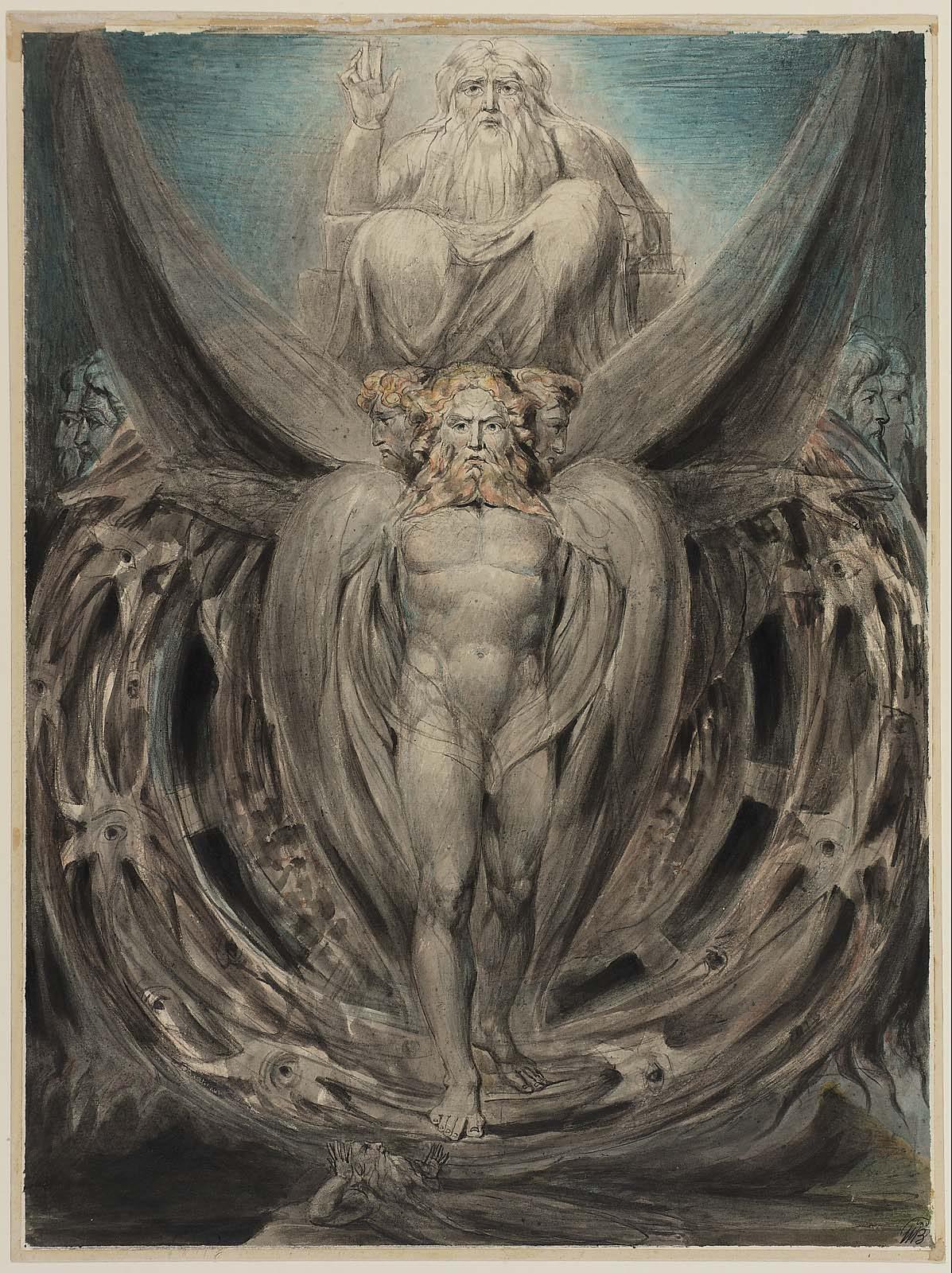
William Blake, The Whirlwind, 1803 to 1805. Public domain.
Ezekiel 1 · Subject · Featured Study
The Chariot Vision
Ezekiel 1 tells the vision of God's throne that a priest saw among the exiles by the River Kebar.
Ezekiel's first chapter never uses the word chariot, yet Jewish teachers named the vision for it.
Above the expanse over their heads was the likeness of a throne with the appearance of sapphire, and on the throne high above was a figure like that of a man.
Above the expanse over their heads was the likeness of a throne with the appearance of sapphire, and on the throne high above was a figure like that of a man.
- Book
- Ezekiel
- Hold in memory
- Ezekiel 1:28
Summary
The vision came in the fifth year of King Jehoiachin's exile.
- Jerome wrote that the Hebrews did not study it before the age of thirty.
- In chapter 10 Ezekiel knew the living creatures were cherubim.
- In chapter 43 he saw the same glory come back to the temple.
By the River Kebar
The first verses of the book give two dates for the vision.
In the thirtieth year, on the fifth day of the fourth month, while I was among the exiles by the River Kebar, the heavens opened and I saw visions of God. On the fifth day of the month—it was the fifth year of the exile of King Jehoiachin— the word of the LORD came directly to Ezekiel the priest, the son of Buzi, in the land of the Chaldeans by the River Kebar. And there the LORD’s hand was upon him.Keil and Delitzsch give 595 BC as the fifth year of Jehoiachin's exile. The Cambridge Bible dates Ezekiel's call to 592 BC, six years before Jerusalem fell.
Barnes' Notes tie the call to the letter Jeremiah had sent to the captives a few months before, in Jeremiah 29.
What Ezekiel Saw
Each stage stands in the prophet's own words.
Ezekiel describes the vision upward, from the storm and the creatures to the One on the throne.
- The storm“a whirlwind coming from the north, a great cloud with fire flashing back and forth”Ezekiel 1:4
- The living creatures“the form of four living creatures… each had four faces and four wings”Ezekiel 1:5 to 6
- The fire among them“glowing coals of fire, or of torches”Ezekiel 1:13
- The wheels“Their workmanship looked like a wheel within a wheel.”Ezekiel 1:16
- The expanse“the likeness of an awesome expanse, gleaming like crystal”Ezekiel 1:22
- The voice“a voice from above the expanse over their heads”Ezekiel 1:25
- The figure on the throne“From what seemed to be His waist up, I saw a gleam like amber”Ezekiel 1:27
- The glory“like that of a rainbow in a cloud on a rainy day”Ezekiel 1:28
The vision runs from Ezekiel 1:4 to the end of the chapter.
The figure on the throne, The glory
The Wheels Beside the Creatures
The wheels rise and stand with the creatures, because the spirit of the creatures is in them.
Their rims were high and awesome, and all four rims were full of eyes all around. So as the living creatures moved, the wheels moved beside them, and when the creatures rose from the ground, the wheels also rose. Wherever the spirit would go, they would go, and the wheels would rise alongside them, because the spirit of the living creatures was in the wheels. When the creatures moved, the wheels moved; when the creatures stood still, the wheels stood still; and when the creatures rose from the ground, the wheels rose alongside them, because the spirit of the living creatures was in the wheels.The Cambridge Bible calls the eye the expression of life and intelligence, and points to the eyes of Ezekiel 10:12.
The Thirtieth Year
Ezekiel dates the vision to a thirtieth year without naming what the years are counted from.
The commentators count the thirty years from five different starting points.
| Counted from | Held by | Work |
|---|---|---|
| Ezekiel's own birth | Origen; Pulpit Commentary; Ellicott; Barnes' Notes | Ellicott's Commentary |
| A year of Jubilee | John Calvin | Commentaries on Ezekiel |
| The Law found under Josiah | Jerome | Commentary on Ezekiel |
| The rise of Nabopolassar | Michaelis; Rosenmüller; Ewald; Henry | Henry's Commentary |
| An era now unknown | Keil and Delitzsch | Biblical Commentary |
The Name Chariot
First Chronicles calls the cherubim a chariot, and Sirach and the Mishnah give the name to Ezekiel's vision.
the weight of the refined gold for the altar of incense; and the plans for the chariot of the gold cherubim that spread their wings and overshadowed the ark of the covenant of the LORD.Keil and Delitzsch read the cherubim of that verse as the chariot on which God is enthroned. Ellicott adds that the Jews call Ezekiel's vision The Chariot.
Sirach, a book of the Apocrypha, says that Ezekiel saw the glorious vision "upon the chariot of the cherubims," as the King James Version renders Sirach 49:8.
The Mishnah, the rabbis' written code of the oral law, forbids a man to expound the Design of the Divine Chariot by himself unless he is wise. The rule stands in Chagigah 2:1, here in the William Davidson English translation.
The Likeness of a Man
Ezekiel ends the vision with a light like the rainbow around the figure on the throne.
Barnes' Notes read the rainbow, in a cloud on a day of rain, as a message of mercy suited to Ezekiel's charge, which was first to announce judgment and then restoration.
Jamieson, Fausset and Brown read the bow as the sign of the covenant of mercy, as in the flood of Noah's day.
The Son of Man on the Throne
Jamieson, Fausset and Brown read the man on the throne in the light of the Gospels.
Jamieson, Fausset & Brown (1802 to 1910)
Their note sets the prophet's title beside the Lord's.
“The azure sapphire answers to the color of the sky. As others are called ‘sons of God,’ but He ‘the Son of God,’ so others are called ‘sons of man’ (Eze 2:1, 3), but He ‘the Son of man’ (Mt 16:13), being the embodied representative of humanity and the whole human race; as, on the other hand, He is the representative of ‘the fulness of the Godhead’ (Col 2:9).”
Jamieson, Fausset & Brown · Commentary Critical and Explanatory on the Whole Bible · on Ezekiel 1:26Reformed
The Readings Weighed
Three questions about the vision divide the commentators.
Who is the figure on the throne?Calvin; Barnes' Notes; the Pulpit Commentary; Keil and Delitzsch; Ellicott
Calvin follows the fathers who call the figure a prelude to the mystery of God shown in the flesh. He calls Jerome's reading of it as the Father harsh, since the Father never took flesh. Barnes' Notes call the vision the prophetic announcement of the Incarnation, and the Pulpit Commentary calls it an anticipation of that thought.
Keil and Delitzsch say only that the LORD appeared in human form, as in Daniel 7:9. Ellicott holds that Ezekiel saw appearances that showed the character of God, and allows only a possible hint of the Incarnation.
Why does the storm come from the north?Keil and Delitzsch; Ellicott; Barnes' Notes; the Pulpit Commentary; the Cambridge Bible
Keil and Delitzsch, Ellicott and Barnes' Notes read the north as the quarter from which judgment would come on Judah, the road of its conquerors. The Pulpit Commentary takes the leading thought to be that the presence of God has left the temple in Jerusalem.
Barnes' Notes report a third reading, that the north stands for the seat of God's power. The Cambridge Bible answers it, since Ezekiel saw the heavens opened and could not mean that God lives in the north.
What do the wheels and their eyes show?Keil and Delitzsch; the Pulpit Commentary; John Calvin
Keil and Delitzsch read the wheels as the ease with which the throne moves toward the four quarters of the heavens.
The Pulpit Commentary reads the eyes as the knowledge of God at work in nature and history, which it calls guided forces and not blind ones. John Calvin says that men, blind themselves, charge God with what they cannot see under the name of fortune, and for this reason the prophet gives the wheels eyes.
Books to Read Next
Two older commentaries read the vision verse by verse.
Commentaries on the First Twenty Chapters of the Book of the Prophet Ezekiel
John Calvin · translated by Thomas Myers
Calvin reads the vision phrase by phrase in his first lectures on the book.
Read it free at CCELBiblical Commentary on the Old Testament
Carl Friedrich Keil and Franz Delitzsch · 1857 to 1878
The commentary gives a note on the date, the north and the wheels.
Read it free at BibleHubThe Throne John Saw
John saw a rainbow around the throne in heaven as well.
At once I was in the Spirit, and I saw a throne standing in heaven, with someone seated on it. The One seated there looked like jasper and carnelian, and a rainbow that gleamed like an emerald encircled the throne.Sources
Scripture is the Berean Standard Bible.
- Carl Friedrich Keil and Franz Delitzsch, Biblical Commentary on the Old Testament (1857 to 1878), on Ezekiel 1 and 1 Chronicles 28; public domain.
- The Cambridge Bible for Schools and Colleges, on Ezekiel 1; public domain.
- The Pulpit Commentary, on Ezekiel 1; public domain.
- Ellicott's Commentary for English Readers (public domain), on Ezekiel 1 and on the chariot of the cherubim.
- Barnes' Notes on the Bible, on Ezekiel 1, as BibleHub prints it; public domain.
- John Calvin, Commentaries on the First Twenty Chapters of the Book of the Prophet Ezekiel, volume 1, translated by Thomas Myers; public domain.
- Sirach 49:8, King James Version with the Apocrypha.
- Mishnah Chagigah 2:1, William Davidson Edition, English.
- Jerome, Letter 53, to Paulinus, in the Nicene and Post-Nicene Fathers translation.
- The commentators' notes on Ezekiel 1 and Ezekiel 1:26 to 28.
- Jerome, Commentary on Ezekiel, on Ezekiel 1:1.
- Matthew Henry, Commentary on the Whole Bible (1710), on Ezekiel 1:1.
- Jamieson, Fausset and Brown, Commentary Critical and Explanatory on the Whole Bible (1871), on Ezekiel 1:26 and 1:28.
Keep Studying
Studies4
Symbols2
Doctrines1
Subjects1