
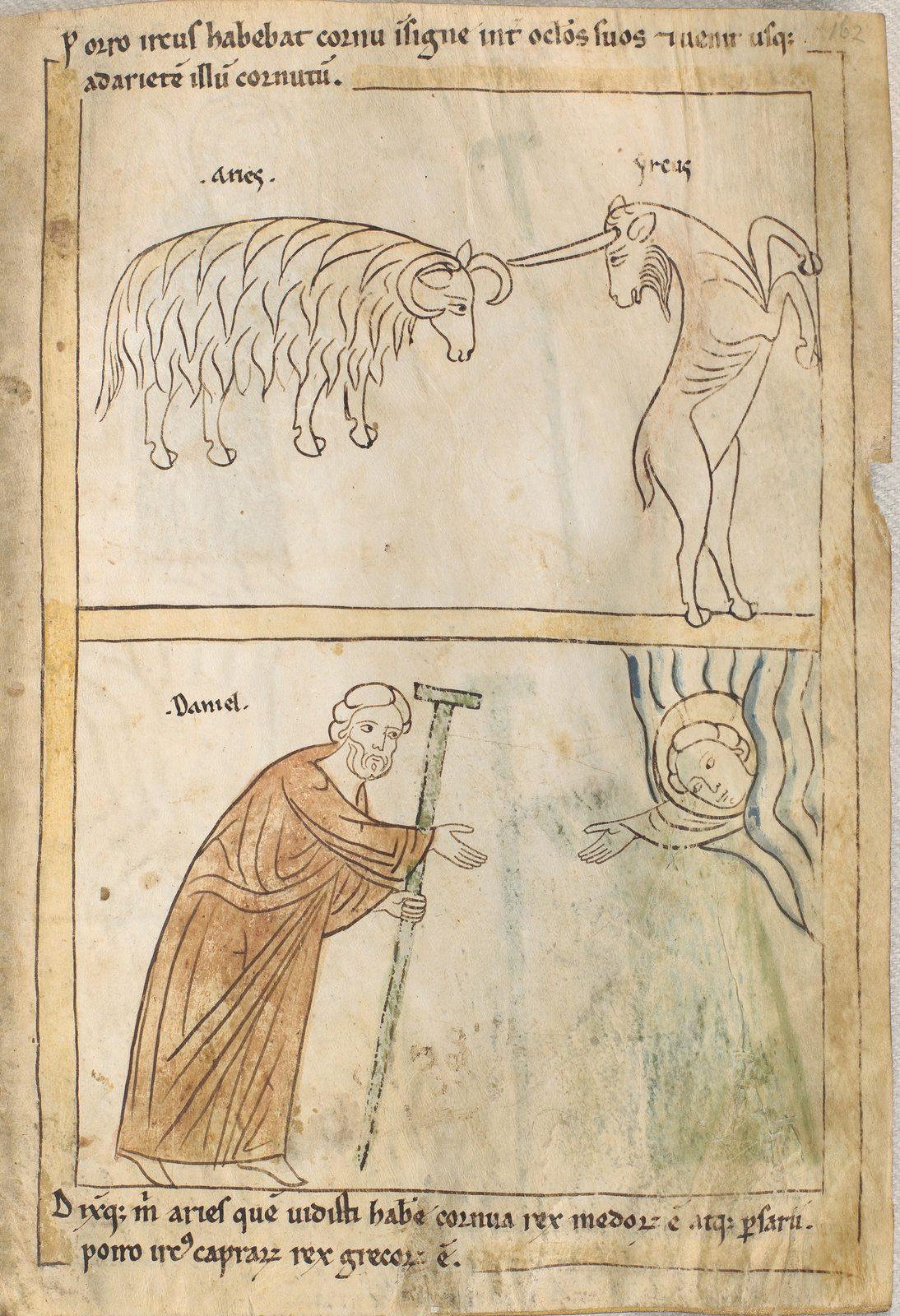
Workshop of the Pamplona Bible, The Ram and the Goat, about 1200. Public domain.
Daniel 8 · Subject · Featured Study
The Ram, the Goat and Antiochus IV
Daniel saw a ram with two horns fall to a goat from the west, and a little horn rise to stop the daily sacrifice.
Daniel saw this vision beside the Ulai Canal, and a voice from between its banks sent Gabriel to explain it.
and said, “Behold, I will make known to you what will happen in the latter time of wrath, because it concerns the appointed time of the end.
and said, “Behold, I will make known to you what will happen in the latter time of wrath, because it concerns the appointed time of the end.
- Book
- Daniel
- Hold in memory
- Daniel 8:20
Summary
The angel says the ram stands for the kings of Media and Persia and the goat for the king of Greece. He also tells of a proud king who will be broken without human hands.
- In the year 145 of the Greeks, under Antiochus, the abomination of desolation was set on the altar.
- Many readers name the first king Alexander and the little horn Antiochus IV.
- Some count the 2,300 evenings and mornings as days, some as years, and some see a king still to come.
The Vision Beside the Ulai
The vision came in the third year of Belshazzar.
Jerome noted that this vision came two years after the vision of Daniel 7.
Then I lifted up my eyes and saw a ram with two horns standing beside the canal. The horns were long, but one was longer than the other, and the longer one grew up later.The ram is the first beast, and verse 20 names it.
As I was contemplating all this, suddenly a goat with a prominent horn between his eyes came out of the west, crossing the surface of the entire earth without touching the ground.The goat is the second beast, and verse 21 names it.
Thus the goat became very great, but at the height of his power, his large horn was broken off, and four prominent horns came up in its place, pointing toward the four winds of heaven.Verse 22 gives the meaning of this turn in the vision.
From one of these horns a little horn emerged and grew extensively toward the south and the east and toward the Beautiful Land.This is the horn most readers name Antiochus IV.
It magnified itself, even to the Prince of the host; it removed His daily sacrifice and overthrew the place of His sanctuary.The daily sacrifice is the subject of the question asked in verse 13.
Daniel 8:8, Daniel 8:9, Daniel 8:11
The Vision and Its Explanation
Daniel 8:20 to 25 gives a meaning to each beast and horn.
The angel names Media, Persia and Greece, and gives the first king and the insolent king no name.
| In the vision | The angel's explanation | The name readers give |
|---|---|---|
| A ram with two horns, the longer grown up later | The kings of Media and Persia | The Persian kingdom, for Theodoret |
| A shaggy goat from the west | The king of Greece | The Greeks, for Hippolytus and Matthew Henry |
| A large horn between the goat's eyes, broken off | The first king | Alexander the Great, for Hippolytus, Theodoret and Matthew Henry |
| Four horns toward the four winds | Four kingdoms without the same power | Seleucus, Demetrius, Ptolemy and Philip, for Hippolytus |
| A little horn that grows toward the Beautiful Land | An insolent king, skilled in intrigue | Antiochus IV Epiphanes, for Ephrem, Jerome and Theodoret |
Matthew Henry set Alexander's conquests, and his tears that no world was left, beside the goat that crosses the earth.
“This was Alexander the Great, the son of Philip king of Macedonia. He came from the west, from Greece, which lay west from Persia. He fetched a great compass with his army: he came upon the face of the whole earth; he did in effect conquer the world, and then sat down and wept because there was not another world to be conquered.”
Matthew Henry · Commentary on the Whole Bible · on Daniel 8:5Puritan
Antiochus IV Epiphanes
1 Maccabees, Polybius and Josephus record the king most readers find in the little horn.
From his accession in the year 137 to his death in 149, 1 Maccabees dates five turns of Antiochus's reign.
- 137Antiochus Epiphanes, once a hostage at Rome, begins to reign1 Maccabees 1:10
- 143After his war in Egypt he enters the sanctuary and takes the golden altar and the lampstand1 Maccabees 1:20 to 23
- 145, the 15th of CasleuThe abomination of desolation is set up on the altar1 Maccabees 1:54
- 148, the 25th of CasleuJudas and his brothers dedicate the altar and keep the feast eight days1 Maccabees 4:52 and 59
- 149King Antiochus dies1 Maccabees 6:16
The reign of Antiochus IV in the years of the kingdom of the Greeks, as 1 Maccabees counts them.
1 Maccabees says that after Alexander's death his servants ruled each in his place, and that out of them came Antiochus, called Epiphanes. His decree forbade the burnt offerings and the sacrifices in the temple.
Polybius, in the twenty-sixth book of his Histories, says Antiochus was called Epimanes, the madman, in place of Epiphanes, because of his conduct.
Josephus, in the Antiquities of the Jews, book 12, set the desolation of the temple beside the prophecy of Daniel. He said the prophecy was given four hundred and eight years before.
Ephrem the Syrian, in his Commentary on Daniel, names the little horn.
“This is Antiochus, who was born from the family of Seleucus Nicanor. ‘It grew great toward the south and toward the east.’ Antiochus extended his empire especially in these two parts of the world.”
Ephrem the Syrian · Commentary on Daniel 8:9 · on Daniel 8:9Patristic
The Insolent King
Gabriel describes the king of the little horn in Daniel 8:23 to 25.
His power will be great, but it will not be his own. He will cause terrible destruction and succeed in whatever he does. He will destroy the mighty men along with the holy people.This verse sets the king against the holy people, the point the readings of Antiochus turn on.
Through his craft and by his hand, he will cause deceit to prosper, and in his own mind he will make himself great. In a time of peace he will destroy many, and he will even stand against the Prince of princes. Yet he will be broken off, but not by human hands.The angel ends his account of the king with his fall.
1 Maccabees tells that the king fell sick for grief in Persia when news came that his armies had fled from Judea.
Voices on Daniel 8
John Calvin, Theodoret and Matthew Henry wrote on the vision from the fifth century to the eighteenth.
Theodoret of Cyrus (died 458)
Theodoret of Cyrus, in his Commentary on Daniel, compared the four kingdoms with Alexander's.
“After [Alexander's] death his empire will be divided into four kingdoms, but though those reigning over them are four, they will not succeed in achieving what he achieved but will be seen to be much inferior to his strength.”
Theodoret of Cyrus · Commentary on Daniel 8:22 · on Daniel 8:22Patristic
John Calvin (1509 to 1564)
John Calvin, in his Commentaries, explained why God showed Daniel the kingdoms after Babylon.
“For God wished to show him first what various changes should happen before Christ's advent. The second redemption was the beginning of a new life, since God then not only restored afresh his own Church, but as it were created a new people; and hence the departure from Babylon and the return to their country are called the second birth of the Church.”
John Calvin · Commentaries · on Daniel 8:1Reformed
Matthew Henry (1662 to 1714)
Matthew Henry took the number of Daniel 8:26 in its plain sense.
“That vision of the evening and morning is true, in the proper sense of the words, and needs no explication. How unlikely soever it might be that God should suffer his own sanctuary to be thus profaned, yet it is true, it is too true, so it shall be.”
Matthew Henry · Commentary on the Whole Bible · on Daniel 8:26Puritan
How Far Does the Vision Reach?
Three readings of the 2,300 evenings and mornings, each with its holders and the objection to it.
He said to me, “It will take 2,300 evenings and mornings; then the sanctuary will be properly restored.”This is the number the three readings count in different ways.
As he came near to where I stood, I was terrified and fell facedown. “Son of man,” he said to me, “understand that the vision concerns the time of the end.”The three readings part over which end the angel means here.
Days, under AntiochusAlbert Barnes, John Wesley and Jerome
Albert Barnes, in his Notes, held that an evening and a morning make one day. That gives six years and a hundred and ten days. John Wesley, in his Explanatory Notes, counted it from the falling away that Menelaus the high priest brought about to the cleansing of the sanctuary.
Jerome, in his Commentary on Daniel, read the verse beside the books of Maccabees and Josephus. They record that Antiochus set up the statue of Jupiter in the temple.
The objection: Barnes himself noted that this number is hard to fit to the other times in Daniel and to the three years of Josephus.
Years, counted to a later ageAdam Clarke; John Cumming, as Jamieson, Fausset and Brown report him; William Miller
William Miller counted the years to 1844. After the date passed he wrote, in his Apology and Defence, that his faith was unchanged in any essential feature.
The objection: the verse speaks of evenings and mornings, which Barnes held to be days.
A pattern of a king at the endJamieson, Fausset and Brown, Commentary Critical and Explanatory
Jamieson, Fausset and Brown called Antiochus the forerunner of the final Antichrist. They held that the chapter's immediate subject is Antiochus and that its further reference may belong to a king to come.
The objection, which Jamieson, Fausset and Brown meet themselves: Daniel 8:9 draws the little horn out of one of the four horns of Greece. They answer that the later king need not come from those four kingdoms.
Seal Up the Vision
The vision of the evenings and the mornings that has been spoken is true. Now you must seal up the vision, for it concerns the distant future.”The angel confirms the number of verse 14 before the vision is sealed.
I, Daniel, was exhausted and lay ill for days. Then I got up and went about the king’s business. I was confounded by the vision; it was beyond understanding.The chapter closes on the prophet's own response to the vision.
Sources
Scripture is the Berean Standard Bible.
- 1 Maccabees, in the King James Version with the Apocrypha (1611)
- Polybius, Histories, book 26, fragment 1, Loeb Classical Library translation (1926)
- Josephus, Antiquities of the Jews 12.7.6 to 7, translated by William Whiston.
- Hippolytus, Commentary on Daniel 4.26 (235); Ephrem the Syrian, Commentary on Daniel (373); Jerome, Commentary on Daniel (420); Theodoret of Cyrus, Commentary on Daniel (458); John Calvin, Commentaries (1554); Matthew Henry, Commentary on the Whole Bible (1710); John Wesley, Explanatory Notes upon the Old Testament (1765); Adam Clarke, Commentary on the Bible (1832); Albert Barnes, Notes (1832 to 1869); Jamieson, Fausset and Brown, Commentary Critical and Explanatory (1871); William Miller, Apology and Defence.
Keep Studying
People and groups7