
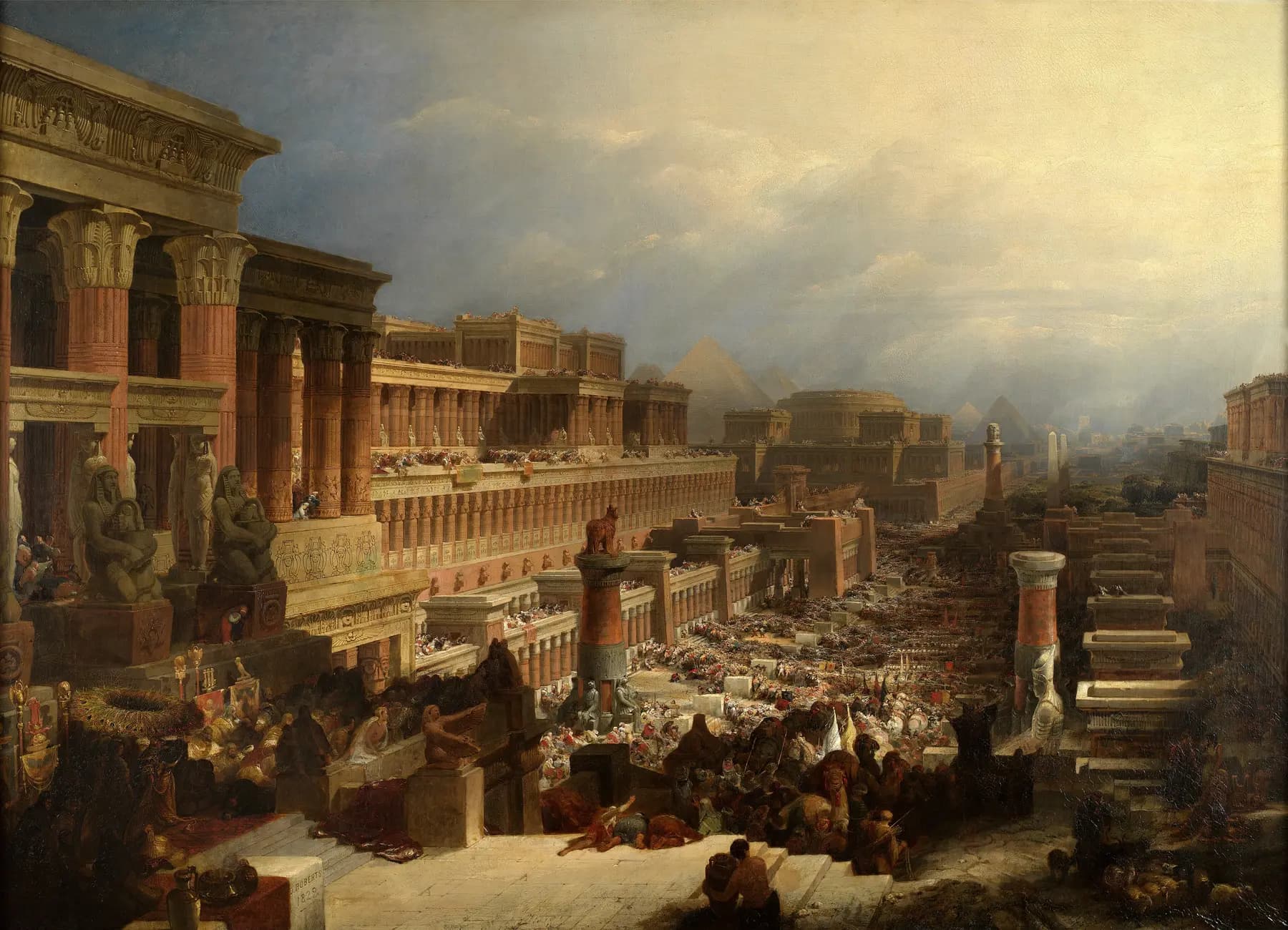
The Israelites Leaving Egypt, David Roberts, 1829. Public domain.
Old Testament · Book 2 of 66
Exodus
Exodus records how God brought Israel out of slavery in Egypt through Moses and led the people to Mount Sinai. There he gave them his law, made his covenant with them and had the tabernacle built.
Exodus records how God brought Israel out of slavery in Egypt through Moses and led the people to Mount Sinai. There he gave them his law, made his covenant with them and had the tabernacle built.
What is Exodus about?
Exodus opens with slaves whose crying reaches heaven and ends with God living in a tent in the middle of their camp. God hears a groaning he had promised to answer and gives Moses his Name at a burning bush. He empties Egypt of every god it trusted and brings a nation out of slavery by the blood of a lamb and a divided sea. Three months out, at a mountain in fire, he binds the rescued people to himself by covenant. Then he gives them the pattern of a tent, and when it is built his glory fills it.
All 40 chapters
Every chapter of the book, in one grid. Each cell opens that chapter.
- BondageExodus 1 to 12
- DeliveranceExodus 13 to 18
- CovenantExodus 19 to 24
- DwellingExodus 25 to 40
The colour is the movement of the story the chapter stands in, and every cell opens that chapter's Study level.
Who wrote it, where, when, for whom, and why?
Exodus says three times that Moses wrote at the LORD's command: the judgment on Amalek (17:14), all the words of the LORD before the covenant was sealed (24:4), and the words of the renewed covenant (34:27). The rest of the Law says that Moses recorded the stages of the journey (Numbers 33:2) and wrote down the law and gave it to the priests (Deuteronomy 31:9). Joshua builds an altar as it is written in the Book of the Law of Moses (Joshua 8:31). Jesus calls the account of the burning bush the Book of Moses (Mark 12:26), explains the Scriptures beginning with Moses (Luke 24:27), and says that Moses wrote about him (John 5:46).
And Moses wrote down all the words of the LORD. Early the next morning he got up and built an altar at the base of the mountain, along with twelve pillars for the twelve tribes of Israel.
Exodus 24:4, Berean Standard Bible.
The book opens in Egypt, where Israel builds the store cities Pithom and Rameses (1:11) and lives in the land of Goshen (8:22). Israel sets out from Rameses to Succoth (12:37), camps at Etham on the edge of the wilderness (13:20), crosses the sea into the Desert of Shur (15:22), and comes by the Desert of Sin to Rephidim (17:1). In the third month it reaches the Wilderness of Sinai and camps in front of the mountain (19:1 and 2), and the book does not move again.
Scripture keeps its own count of the years. Abram is told that his descendants will be strangers and slaves four hundred years (Genesis 15:13), Israel's stay in Egypt is counted at 430 years (12:40), and Solomon begins the temple in the 480th year after Israel came out of Egypt (1 Kings 6:1). The book never names its pharaoh, and how these numbers date the exodus is set out under Where do readers disagree.
Exodus is written for Israel at Sinai and for their children. The Passover is kept so that children who ask what the service means are told what the LORD did (12:26), and the firstborn are bought back so that a son who asks is told that the LORD brought Israel out of Egypt with a mighty hand (13:14).
The book says why God acted: so that Israel would know that he is the LORD their God (6:7), so that they would tell their children and grandchildren what he did in Egypt (10:2), and so that he might dwell among them (29:46).
Exodus stands in the Egypt of the pharaohs, a kingdom of brick, river and many gods. The book names the store cities Israel built (1:11), the magicians who copy the first signs by their arts (7:11 and 22), and the gods of Egypt the LORD judges on the Passover night (12:12). Beyond the delta lie the desert roads, the priest of Midian and his household (2:16 and 3:1), and the Amalekites who attack Israel at Rephidim (17:8).
Sources. Exodus 1:11, 2:16, 3:1, 6:7, 7:11 and 22, 8:22, 10:2, 12:12, 12:26, 12:37, 12:40, 13:14, 13:20, 15:22, 17:1, 17:8, 17:14, 19:1 and 2, 24:4, 29:46 and 34:27; Genesis 15:13; Numbers 33:2; Deuteronomy 31:9; Joshua 8:31; 1 Kings 6:1; Mark 12:26; Luke 24:27; John 5:46. Every verse is read in the Berean Standard Bible.
How is Exodus arranged, and what is it for?
The four movements the book falls into, then what it teaches and what it was written to do.
- BondageExodus 1 to 12, 335 verses
A slave people under a king who orders their sons drowned, a God who hears them, ten plagues and the blood of a lamb.
- DeliveranceExodus 13 to 18, 159 verses
A sea that opens and closes, and a road through the wilderness that teaches trust.
- CovenantExodus 19 to 24, 169 verses
Three months out, at a mountain in fire, the rescued people are bound to their Rescuer.
- DwellingExodus 25 to 40, 550 verses
A tent built to a given pattern, and the glory that fills it at the last verse.
The theme
The God of the fathers hears an enslaved people groaning, tells Moses his covenant Name, and brings them out of Egypt by ten plagues, a slaughtered lamb and a divided sea. He does it because he swore an oath to Abraham. At Sinai he binds the rescued people to himself by covenant, giving the Ten Words and the pattern of a sanctuary. The rescue comes first and the law answers it. Israel breaks the covenant at its own inauguration. Moses intercedes, God proclaims himself merciful and gracious, and the book ends with the glory filling the tent.
The purpose
Exodus was written so that Israel would know the LORD as the God who brought them out of Egypt, and would tell their children what he had done. It gives the rescued people the covenant that binds them to him and the tent that lets a holy God live in their camp. It leaves them at the mountain with the glory in their midst, which is where Leviticus takes up the law of that tent.
Bondage, Exodus 1 to 12
What the text says in these 12 chapters, and the pages they open on.
Jacob's family grows into a nation in Egypt, and a king who did not know Joseph makes them slaves and orders their sons drowned. One boy is drawn out of the Nile and raised in Pharaoh's house. As a man he flees to Midian, and there God calls him from a bush that burns and is not consumed, gives him the Name and sends him back with Aaron. Pharaoh refuses, and ten plagues fall on Egypt, each met by a hardened heart. On the last night every household of Israel kills a lamb and marks its door with the blood, the firstborn of Egypt die, and Israel goes out.
God said to Moses, “I AM WHO I AM. This is what you are to say to the Israelites: ‘I AM has sent me to you.’”
- Study
Exodus 1a new king, forced labour and the order to drown the sonsShow the summary and 4 pagesShow summary, 4 pagesHide the summary
Jacob's family grows into a great people in Egypt, and a new king who did not know Joseph turns them into slaves. When hard labour does not stop their growth, he orders every Hebrew son thrown into the Nile.
- Seventy people go down to Egypt and fill the land.
- Pharaoh sets taskmasters over Israel, and they build Pithom and Rameses.
- The midwives Shiphrah and Puah fear God and let the boys live.
On this chapter (4)
- The exodus
The rescue from Egypt followed as the pattern of later redemption.
- Egypt
Egypt in Scripture, from Abram's visit to the flight of the holy family.
- When did the exodus happen?
Answered under Where do readers disagree, lower on this page, with each reading and who holds it.
- Exodus 1:11
The verse on its own page, with the commentators on it by era.
- Study
Exodus 2the basket on the Nile, the flight to Midian, God rememberingShow the summary and 3 pagesShow summary, 3 pagesHide the summary
A Levite mother hides her son and then sets him in a basket on the Nile, and Pharaoh's daughter draws him out and names him Moses. Grown, he kills an Egyptian, flees to Midian and marries there, while Israel groans and God hears and remembers his covenant.
- Miriam watches the basket and brings the boy's own mother to nurse him.
- Moses defends the daughters of Reuel at a well and marries Zipporah.
- The chapter ends with God hearing, remembering, seeing and knowing.
On this chapter (3)
- Moses in the bulrushes
The basket on the Nile and the daughter of Pharaoh.
- Miriam, the prophetess
Moses' sister from the riverbank to the song by the sea.
- Exodus 2:24
The verse on its own page, with the commentators on it by era.
- Study
Exodus 3the burning bush and the NameShow the summary and 5 pagesShow summary, 5 pagesHide the summary
God calls to Moses out of a bush that burns and is not consumed, on Horeb, the mountain of God. He sends Moses to Pharaoh to bring Israel out, and he gives his name: I AM WHO I AM.
- Moses is told to take off his sandals, because the ground is holy.
- God says he has seen the misery of his people and has come down to rescue them.
- He promises that Egypt will let Israel go and that they will not leave empty-handed.
On this chapter (5)
- The burning bush
The bush that burns and is not consumed, and the name given there.
- Names of God
The names Scripture gives God, the LORD among them.
- The Angel of YHWH
The angel in the bush, and who the angel has been taken to be.
- Who wrote Exodus?
Answered under Where do readers disagree, lower on this page, with each reading and who holds it.
- Exodus 3:14
The verse on its own page, with the commentators on it by era.
- Study
Exodus 4the staff turned serpent, Aaron as spokesman, and the elders believingShow the summary and 1 pageShow summary, 1 pageHide the summary
Moses' objections and signs. The rod that becomes a serpent; the hand leprous and restored; water becoming blood. ‘Who gave man his mouth? Or who makes the mute or the deaf, the sighted or the blind? Is it not I, the LORD?’ Moses pleads his slowness of speech; Aaron is appointed as his mouthpiece. He returns to Egypt. On the way God meets him to kill him. Zipporah circumcises their son and throws the foreskin at Moses' feet. The covenant sign cannot be neglected even by the deliverer. Aaron meets him at the mount of God; together they declare the words to the elders; the people believe, bow their heads, and worship.
On this chapter (1)
- Exodus 4:1
The verse on its own page, with the commentators on it by era.
- Exodus 4:1
- Study
Exodus 5the first demand refused, the straw withheld, and the officers beatenShow the summary and 1 pageShow summary, 1 pageHide the summary
First confrontation with Pharaoh. ‘Let My people go, so that they may hold a feast to Me in the wilderness.’ ‘Who is the LORD that I should obey His voice and let Israel go?’ The straw is taken away but the tally of bricks is not lowered. The Israelite officers are beaten; they cry out to Pharaoh; Pharaoh accuses them of idleness. They meet Moses and Aaron with bitter words: ‘you have made us a stench before Pharaoh’. Moses returns to the LORD: ‘Lord, why have You brought trouble upon this people?’ The chapter closes in darkness. Deliverance has made the bondage worse before it makes it better.
On this chapter (1)
- Exodus 5:1
The verse on its own page, with the commentators on it by era.
- Exodus 5:1
- Study
Exodus 6the answer to the complaint, the promises to redeem, and Levi's lineShow the summary and 1 pageShow summary, 1 pageHide the summary
God's answer to Moses' complaint. ‘I am the LORD. I appeared to Abraham, to Isaac, and to Jacob as God Almighty, but by My name the LORD I did not make Myself known to them.’ Seven I-wills thunder across the chapter. I will bring out, I will rid, I will redeem, I will take, I will be, I will bring in, I will give. Israel hearkens not for anguish of spirit and cruel bondage. A genealogy of Reuben, Simeon, and Levi roots the deliverer in the tribal structure of Israel. Moses and Aaron are no interlopers but covenant sons. The promises are named before the plagues begin.
On this chapter (1)
- Exodus 6:1
The verse on its own page, with the commentators on it by era.
- Exodus 6:1
- Study
Exodus 7the first sign, the first plague, the first hardeningShow the summary and 5 pagesShow summary, 5 pagesHide the summary
Moses and Aaron stand before Pharaoh, Aaron's staff becomes a serpent, and the magicians copy the sign. The first plague turns the Nile to blood, and Pharaoh's heart is hardened.
- God says Egypt will know that he is the LORD when he stretches out his hand.
- Moses is eighty and Aaron eighty-three when they speak to Pharaoh.
- The water of Egypt turns to blood for seven days, and the magicians do the same by their arts.
On this chapter (5)
- The ten plagues
Each plague, the gods of Egypt, and the questions the account raises.
- Egypt
Egypt in Scripture, from Abram's visit to the flight of the holy family.
- Who hardened Pharaoh's heart?
Answered under Where do readers disagree, lower on this page, with each reading and who holds it.
- Are the plagues judgment on the gods of Egypt?
Answered under Where do readers disagree, lower on this page, with each reading and who holds it.
- Exodus 7:5
The verse on its own page, with the commentators on it by era.
- Study
Exodus 8the plagues on the land, the magicians' failure, and Goshen sparedShow the summary and 1 pageShow summary, 1 pageHide the summary
Plagues two, three, four: frogs, lice, flies. The frogs cover the land; the magicians copy it; Pharaoh begs relief, Moses prays, the frogs die and stink in heaps. Lice. The dust becomes lice. The magicians fail: ‘this is the finger of God’. Flies. A grievous swarm that corrupts the land, but not in Goshen where Israel dwells. Pharaoh begins to bargain: sacrifice in the land; sacrifice but not very far away. Each bargain is refused; each plague increases the pressure. The pattern across the chapter is request, plague, partial softening, hardening. Henry marks the heart that will yield only as far as pain presses.
On this chapter (1)
- Exodus 8:1
The verse on its own page, with the commentators on it by era.
- Exodus 8:1
- Study
Exodus 9the herds struck, sores on man and beast, and Pharaoh's brief confessionShow the summary and 1 pageShow summary, 1 pageHide the summary
Plagues five, six, seven: murrain on the cattle, boils on man and beast, hail. The cattle of the Egyptians die; not one of Israel's. The magicians cannot stand before Moses because of the boils. The hail is the worst since Egypt was a nation. Fire mingled with the hail; smitten man and beast and every herb of the field. Those who feared the word of the LORD brought their servants and cattle into the houses; those who regarded not the word left them in the field. Pharaoh confesses ‘I have sinned this time’ but when the thunder stops he hardens himself again.
On this chapter (1)
- Exodus 9:1
The verse on its own page, with the commentators on it by era.
- Exodus 9:1
- Study
Exodus 10the crops stripped bare, the land without light, and Pharaoh's threatShow the summary and 1 pageShow summary, 1 pageHide the summary
Plagues eight and nine: locusts and darkness. The locusts devour what the hail left, covering the face of the whole earth until the land is darkened. Pharaoh's servants plead with him: ‘How long will this man be a snare to us? … Do you not yet realize that Egypt is in ruins?’ The locusts are driven into the Red Sea. Then three days of thick darkness. Darkness that may be felt. While all the children of Israel have light in their dwellings. Pharaoh offers another partial concession; Moses refuses. ‘Make sure you never see my face again, for on the day you see my face, you will die.’ The stage is set for the last plague.
On this chapter (1)
- Exodus 10:1
The verse on its own page, with the commentators on it by era.
- Exodus 10:1
- Study
Exodus 11the midnight death of the firstborn announced, and Moses leaving in angerShow the summary and 1 pageShow summary, 1 pageHide the summary
The last plague announced. At midnight the LORD will go out into the midst of Egypt and all the firstborn. From Pharaoh on the throne to the maidservant behind the mill to the firstborn of beasts. Shall die. A great cry such as was never heard, and never shall be again. But against any of the children of Israel shall not a dog move his tongue. Pharaoh's servants will bow down and urge them out. Moses goes out from Pharaoh ‘in a great anger’. The Hebrews are told to borrow of their neighbours jewels of silver and gold. The threshold of deliverance is lit; the night of the exodus stands over Egypt.
On this chapter (1)
- Exodus 11:1
The verse on its own page, with the commentators on it by era.
- Exodus 11:1
- Study
Exodus 12the Passover and the night Israel goes outShow the summary and 7 pagesShow summary, 7 pagesHide the summary
God gives the Passover: a lamb for each household, its blood on the doorposts, and bread without yeast eaten in haste. At midnight the firstborn of Egypt die, and Israel leaves after 430 years.
- The month of the rescue becomes the first month of Israel's year.
- Children who ask what the service means are to be told what the LORD did.
- The blood is the sign, and the LORD passes over the houses that carry it.
On this chapter (7)
- Passover
The feast, the lamb and the night Israel left Egypt.
- The lamb
The lamb followed from Moriah to the throne of Revelation.
- Unleavened bread
The week of bread without yeast that follows the Passover.
- The firstborn
The firstborn struck in Egypt and bought back in Israel.
- The Hebrew feasts
The appointed times of Israel's year, the Passover first.
- How many people left Egypt?
Answered under Where do readers disagree, lower on this page, with each reading and who holds it.
Show the next 1
- Exodus 12:13
The verse on its own page, with the commentators on it by era.
The ten plagues fall in order, three sets of three and then the tenth
- First three
- Second three
- Third three
- The tenth
- 1BloodFirst three, Exodus 7Heart hardened at 7:22, by no one named
- 2FrogsFirst three, Exodus 8Heart hardened at 8:15, by Pharaoh
- 3GnatsFirst three, Exodus 8Heart hardened at 8:19, by no one named
- 4FliesSecond three, Exodus 8Heart hardened at 8:32, by Pharaoh
- 5LivestockSecond three, Exodus 9Heart hardened at 9:7, by no one named
- 6BoilsSecond three, Exodus 9Heart hardened at 9:12, by the LORD
- 7HailThird three, Exodus 9Heart hardened at 9:35, by no one named
- 8LocustsThird three, Exodus 10Heart hardened at 10:20, by the LORD
- 9DarknessThird three, Exodus 10Heart hardened at 10:27, by the LORD
- 10The firstbornThe tenth, Exodus 12Heart hardened at 11:10, by the LORD
Characters (7)
Who the text follows. A name with a page carries its door.
- Moses
Drawn out of the Nile, sent back from Midian, and the one who speaks with God for the people.
- Aaron
Moses' brother and spokesman, and the first high priest.
- Miriam
Moses' sister, who watches the basket and leads the women's song by the sea.
- Pharaoh
The king of Egypt, never named, whose heart is hardened again and again through the plagues.
Show the next 3
- Shiphrah and Puah
The Hebrew midwives who fear God and let the boys live.
- Jethro
The priest of Midian, also called Reuel, whose daughter Zipporah marries Moses.
- Zipporah
Moses' wife, a daughter of the priest of Midian.
Places (5)
Where the chapters stand.
- Egypt
The land of the bondage and of the plagues.
- Goshen
The district of the delta where Israel lived and the plagues did not fall.
- Pithom and Rameses
The store cities Israel built for Pharaoh under taskmasters.
- Midian
The land Moses fled to, where he kept Jethro's flock.
Show the next 1
- Horeb
The mountain of God, where the bush burned.
Themes (5)
What these chapters raise, each on its own page.
- The burning bush
The call of Moses and the name given there.
- The ten plagues
Each plague, the gods of Egypt and the hardened heart.
- Passover
The lamb, the blood on the door and the night of leaving.
- Names of God
I AM WHO I AM, and the LORD, the name God gives Moses.
Show the next 1
- The firstborn
The firstborn of Egypt struck, and the firstborn of Israel bought back.
Where the New Testament uses these chapters (2)each marked as a quotation or an allusion, with the evidence
- Explicit quotationThe Passover lamb, Exodus 12:1 to 13 at 1 Corinthians 5:7. Paul names the feast and applies it: Christ our Passover lamb has been sacrificed. John 1:29 points at Jesus as the Lamb of God in the same picture. Held by Paul, and John the Baptist as John records him.
- Explicit quotationNot a bone broken, Exodus 12:46 at John 19:36. John cites the rule as fulfilled when the soldiers pass Jesus by without breaking his legs. The same rule stands at Exodus 12:46 and at Numbers 9:12, and Psalm 34:20 carries a close wording, so John may be citing any of the three. Held by John.
Deliverance, Exodus 13 to 18
What the text says in these 6 chapters, and the pages they open on.
Israel goes out by the wilderness road and camps by the sea, and Pharaoh's chariots come after them. God divides the water, Israel crosses on dry ground, and the sea closes over the army. Moses and Miriam lead the people in song on the far shore. Then the road teaches them to trust: bitter water made sweet at Marah, bread from heaven in the desert of Sin, water from the rock at Rephidim, and a victory over Amalek while Moses' hands are held up. Jethro comes out to meet Moses and counsels him to share the work of judging the people.
The LORD will fight for you; you need only to be still.”
- Study
Exodus 13the feast taught to the sons, Joseph's bones, the pillar of cloudShow the summary and 1 pageShow summary, 1 pageHide the summary
Consecration of the firstborn and the pillar of cloud. Every firstborn, whether of man or beast, is set apart to the LORD in memory of the night of the exodus. The firstborn of the ass is redeemed with a lamb. The Feast of Unleavened Bread is rehearsed for the generations: ‘you are to explain to your son … With a mighty hand the LORD brought us out’. God does not lead them by way of the Philistines ‘If the people face war, they might change their minds and return to Egypt.’. Moses takes the bones of Joseph with him. The pillar of cloud by day and pillar of fire by night goes before them.
On this chapter (1)
- Exodus 13:1
The verse on its own page, with the commentators on it by era.
- Exodus 13:1
- Study
Exodus 14the sea divided and the army drownedShow the summary and 4 pagesShow summary, 4 pagesHide the summary
Pharaoh pursues Israel to the sea with his chariots, and the people cry out in fear. God divides the water, Israel crosses on dry ground, and the sea returns over the army of Egypt.
- Moses tells the people that the LORD will fight for them.
- The angel of God and the pillar of cloud move behind the camp.
- Israel sees the great power the LORD used and fears and believes him.
On this chapter (4)
- The Red Sea crossing
The crossing, the site debate, and how the New Testament reads it.
- The exodus
The rescue from Egypt followed as the pattern of later redemption.
- Which sea did Israel cross?
Answered under Where do readers disagree, lower on this page, with each reading and who holds it.
- Exodus 14:14
The verse on its own page, with the commentators on it by era.
- Study
Exodus 15the song of the sea, and the bitter water at MarahShow the summary and 3 pagesShow summary, 3 pagesHide the summary
Moses and Israel sing to the LORD on the far shore, and Miriam leads the women with a tambourine. Three days into the desert of Shur the water at Marah is bitter, and God makes it sweet.
- The song praises the LORD as a warrior who threw horse and rider into the sea.
- It looks ahead to the nations trembling and Israel planted on God's mountain.
- At Marah God tests Israel and names himself the LORD who heals.
On this chapter (3)
- The Red Sea crossing
The crossing, the site debate, and how the New Testament reads it.
- Miriam, the prophetess
Moses' sister from the riverbank to the song by the sea.
- Exodus 15:2
The verse on its own page, with the commentators on it by era.
- Study
Exodus 16manna and quail, and the first SabbathShow the summary and 3 pagesShow summary, 3 pagesHide the summary
In the desert of Sin the people grumble for the food of Egypt, and God sends quail in the evening and manna in the morning. Each day's gathering is enough for that day, with a double portion before the Sabbath.
- Manna kept overnight breeds worms, except on the Sabbath.
- A jar of manna is set aside for the generations to come.
- Israel eats manna for forty years, until they reach the border of Canaan.
On this chapter (3)
- Manna
The bread from heaven, the Sabbath rule, and the bread of life in John 6.
- Sabbath rest
The seventh day from creation to the rest that remains.
- Exodus 16:4
The verse on its own page, with the commentators on it by era.
- Study
Exodus 17water from the rock, and Amalek at RephidimShow the summary and 3 pagesShow summary, 3 pagesHide the summary
At Rephidim there is no water, the people quarrel with Moses, and God tells him to strike the rock at Horeb. Amalek then attacks, and Israel prevails while Aaron and Hur hold up Moses' hands.
- Moses names the place Massah and Meribah, because Israel tested the LORD.
- Joshua leads the fighting on the plain.
- God tells Moses to write the judgment on Amalek on a scroll.
On this chapter (3)
- Moses strikes the rock
The water at Horeb and the second rock at Meribah.
- The rock in the wilderness
The rock that gave water, and Paul's reading of it.
- Exodus 17:6
The verse on its own page, with the commentators on it by era.
- Study
Exodus 18the family returned, the burnt offering, and judges set over the peopleShow the summary and 1 pageShow summary, 1 pageHide the summary
Jethro's counsel. The priest of Midian brings Zipporah and the two sons back to Moses at the mount of God. He rejoices in the LORD's deliverance; offers a burnt offering; eats bread with Aaron and the elders. Watching Moses judge the people alone from morning to evening, he advises: ‘What you are doing is not good. … Surely you and these people with you will wear yourselves out’. Rulers of thousands, hundreds, fifties, tens. Great matters to Moses; small matters themselves. Moses hearkens. The first governmental reform of Israel comes from a Gentile father-in-law. Scripture acknowledges wisdom where it is found. Jethro returns home.
On this chapter (1)
- Exodus 18:1
The verse on its own page, with the commentators on it by era.
- Exodus 18:1
Israel goes out from Rameses to the mountain in nine named stages
The stations (9)
- 1Rameses Exodus 12:37identified
- 2Succoth Exodus 12:37proposed
- 3Etham Exodus 13:20proposed
- 4Pi-hahiroth and the sea Exodus 14:2proposed
- 5Marah Exodus 15:23proposed
- 6Elim Exodus 15:27proposed
- 7The Desert of Sin Exodus 16:1proposed
- 8Rephidim Exodus 17:1proposed
- 9Sinai Exodus 19:1 to 2proposed
- Filled: an identified site.
- Dashed ring: a proposed site, one candidate among several.
- Arrow: the order of travel, schematic.
Characters (6)
Who the text follows. A name with a page carries its door.
- Moses
Drawn out of the Nile, sent back from Midian, and the one who speaks with God for the people.
- Miriam
Moses' sister, who watches the basket and leads the women's song by the sea.
- Joshua
Leads Israel in the fight with Amalek and waits for Moses on the mountain.
- Aaron and Hur
The two who hold up Moses' hands until the sun goes down.
Show the next 2
- Amalek
The people who attack Israel at Rephidim, and whose memory God says he will blot out.
- Jethro
Moses' father-in-law, who brings his family and advises judges over the people.
Places (5)
Where the chapters stand.
- The Red Sea
The sea Israel crosses on dry ground and Egypt's army drowns in.
- The Desert of Shur
Three days of desert with no water after the crossing.
- Marah and Elim
Bitter water made sweet, then twelve springs and seventy palms.
- The Desert of Sin
Between Elim and Sinai, where the manna first falls.
Show the next 1
- Rephidim
The camp with no water, and the battle with Amalek.
Themes (3)
What these chapters raise, each on its own page.
- Manna
The bread from heaven and the bread of life.
- Moses strikes the rock
The water at Horeb and the rock that was Christ.
- Sabbath rest
The seventh day, first kept with the manna.
Where the New Testament uses these chapters (3)each marked as a quotation or an allusion, with the evidence
- Explicit quotationThe crossing of the sea, Exodus 14:21 to 31 at 1 Corinthians 10:1 to 2. Paul says the fathers were all baptized into Moses in the cloud and in the sea, and reads the crossing as a figure of baptism. Held by Paul.
- Explicit quotationThe manna, Exodus 16:4 to 35 at John 6:31 to 35, 48 to 51. The crowd quotes a line about bread from heaven and Jesus answers it by calling himself the bread of life. The wording they quote stands closest to Psalm 78:24, with the manna of Exodus 16 behind both. Held by Jesus, as John records him.
- Explicit quotationThe rock at Horeb, Exodus 17:6 at 1 Corinthians 10:4. Paul names the rock that gave the water and says that the rock was Christ. Held by Paul.
Covenant, Exodus 19 to 24
What the text says in these 6 chapters, and the pages they open on.
In the third month Israel camps before the mountain, and God offers to make them his own treasure, a kingdom of priests and a holy nation. He comes down on Sinai in fire and cloud and speaks the Ten Commandments to the whole people, who stand far off in fear. Moses then receives the book of the covenant, the laws that apply the ten to servants, property, justice and worship. The people answer that they will do everything the LORD has said. Moses throws the blood of the covenant over them, and the elders eat and drink before God on the mountain.
“I am the LORD your God, who brought you out of the land of Egypt, out of the house of slavery.
- Study
Exodus 19the camp before the mountain and the offer of covenantShow the summary and 4 pagesShow summary, 4 pagesHide the summary
In the third month Israel reaches the wilderness of Sinai and camps before the mountain. God offers them a covenant to be his own treasure, a kingdom of priests and a holy nation, and he comes down on the mountain in fire, smoke and thunder.
- God reminds Israel that he carried them on eagles' wings.
- The people answer that they will do all the LORD has spoken.
- A boundary is set around the mountain, and the people wash and wait three days.
On this chapter (4)
- The Mosaic covenant
The covenant made at Sinai, its terms and its sign.
- The covenants
The covenants God makes in Scripture, read in order.
- The priest
The priest who stands between God and the people, and the kingdom of priests.
- Exodus 19:6
The verse on its own page, with the commentators on it by era.
- Study
Exodus 20the Ten CommandmentsShow the summary and 4 pagesShow summary, 4 pagesHide the summary
God speaks the Ten Commandments to all Israel, opening with the rescue he has already done. The people stand far off in fear, and Moses draws near to the thick darkness where God is.
- The first four words concern God, and the last six concern one's neighbour.
- Moses tells the people not to fear, since God has come to test them.
- The chapter ends with laws for an altar of earth or uncut stone.
On this chapter (4)
- The Ten Commandments
The ten words, how they are numbered, and how the New Testament uses them.
- Sabbath rest
The seventh day from creation to the rest that remains.
- The altar
The altars of Scripture, the altar of earth among them.
- Exodus 20:2
The verse on its own page, with the commentators on it by era.
- Study
Exodus 21the seventh-year release, the capital crimes, and eye for eyeShow the summary and 1 pageShow summary, 1 pageHide the summary
The book of the covenant begins. Case laws elaborating the Decalogue. Hebrew servants' rights (a seven-year release, with the option of lifelong service marked at the door-post). Capital offences named. Murder, kidnap, striking or cursing parents. The lex talionis (‘eye for eye, tooth for tooth’) limits vengeance rather than licensing it. Damages for assault, for a servant's injury, for miscarriage caused by fighting. The ox that gores. The chapter is the first casebook of biblical ethics; the principles run from creation-image dignity (life for life) to covenantal mercy (release and jubilee in miniature). Jesus' ‘You have heard that it was said’ passages engage this material directly.
On this chapter (1)
- Exodus 21:1
The verse on its own page, with the commentators on it by era.
- Exodus 21:1
- Study
Exodus 22restitution for theft, care for the stranger, the widow and the poorShow the summary and 1 pageShow summary, 1 pageHide the summary
Laws of property and community. Theft, restitution, fire damage, deposits and loans, harlotry's prohibition on the daughter of a priest, sorcery, bestiality, apostasy. ‘You must not exploit or oppress a foreign resident, for you yourselves were foreigners in the land of Egypt.’ Widows and orphans; lending to the poor without usury; the pledge taken at sundown returned at evening ‘his cloak is the only covering he has’. Firstborn of sons and beasts dedicated. Holiness required: ‘You are to be My holy people. You must not eat the meat of a mauled animal found in the field’. Social ethics anchored in redemption-memory. Egypt cannot be forgotten.
On this chapter (1)
- Exodus 22:1
The verse on its own page, with the commentators on it by era.
- Exodus 22:1
- Study
Exodus 23honest witness, the sabbath year, the yearly gatherings, the angel sent aheadShow the summary and 1 pageShow summary, 1 pageHide the summary
Continuation of the covenant code. A just witness; not following a multitude to do evil; helping an enemy's ass laden under its burden. The Sabbath year; the Sabbath day. For the servant and the stranger to rest. The three feasts: unleavened bread, harvest, and ingathering. All males to appear before the LORD thrice yearly. ‘You must not cook a young goat in its mother’s milk.’ Then the promise of an Angel whose Name is in him, going before Israel to drive out the Canaanite nations. ‘You must not bow down to their gods … you are to demolish them and smash their sacred stones to pieces.’ Henry notes how covenant faithfulness guarantees the land's blessing.
On this chapter (1)
- Exodus 23:1
The verse on its own page, with the commentators on it by era.
- Exodus 23:1
- Study
Exodus 24the blood of the covenant and the meal on the mountainShow the summary and 4 pagesShow summary, 4 pagesHide the summary
Moses writes down all the words of the LORD, builds an altar with twelve pillars, and throws the blood of the covenant on the people. Then Moses, Aaron, his sons and seventy elders see the God of Israel and eat and drink.
- The people answer twice that they will do all the LORD has said.
- Moses goes up into the cloud and stays on the mountain forty days and forty nights.
- The glory of the LORD looks like a consuming fire on the mountain top.
On this chapter (4)
- The Mosaic covenant
The covenant made at Sinai, its terms and its sign.
- The covenants
The covenants God makes in Scripture, read in order.
- The sacrificial system
The offerings of Israel and the blood that seals a covenant.
- Exodus 24:8
The verse on its own page, with the commentators on it by era.
The Ten Words stand on two tables, and the book of the covenant works them out in four kinds of case
Toward God
- 1No other gods20:3
- 2No carved idol20:4
- 3The name not taken in vain20:7
- 4The Sabbath kept holy20:8
Toward neighbour
- 5Honour father and mother20:12
- 6No murder20:13
- 7No adultery20:14
- 8No stealing20:15
- 9No false witness20:16
- 10No coveting20:17
The book of the covenant, Exodus 20:22 to 23:33, applies the ten to the cases of daily life under four heads.
- Persons21:1 to 32
Servants, and harm done to life and limb.
- Property21:33 to 22:15
Pits, oxen, theft, and goods held for another.
- Justice22:16 to 23:9
The widow, the orphan, the poor, the court and the foreigner.
- Worship20:22 to 26; 23:10 to 19
The altar, the seventh year, the Sabbath and the three feasts.
Characters (5)
Who the text follows. A name with a page carries its door.
- Moses
Drawn out of the Nile, sent back from Midian, and the one who speaks with God for the people.
- Aaron
Moses' brother and spokesman, and the first high priest.
- Joshua
Leads Israel in the fight with Amalek and waits for Moses on the mountain.
- Nadab and Abihu
Aaron's sons, who go up with the seventy elders and see the God of Israel.
Show the next 1
- The seventy elders
The leaders of Israel who eat and drink before God on the mountain.
Places (1)
Where the chapters stand.
- Sinai
The mountain where Israel camps from 19:1 to the end of the book.
Themes (4)
What these chapters raise, each on its own page.
- The Ten Commandments
The ten words, how they are numbered and how the New Testament uses them.
- The Mosaic covenant
The covenant made at Sinai, its terms and its blood.
- The covenants
The covenants God makes in Scripture, read in order.
- The priest
A kingdom of priests, and the priest who stands between.
Where the New Testament uses these chapters (2)each marked as a quotation or an allusion, with the evidence
- Explicit quotationThe blood of the covenant, Exodus 24:8 at Matthew 26:28; Hebrews 9:20. Hebrews quotes Moses word for word at 9:20, and Jesus takes the same phrase over the cup at the supper. Held by The writer to the Hebrews, and Jesus as Matthew records him.
- Explicit quotationThe Ten Words, Exodus 20:1 to 17 at Matthew 19:18 to 19; Romans 13:9; James 2:11. Jesus lists the commandments to the rich young man, Paul gathers them under love of neighbour, and James quotes two of them side by side. The same commandments stand at Deuteronomy 5:6 to 21, so a quotation of them is not a quotation of Exodus alone. Held by Jesus as Matthew records him, Paul, and James.
Dwelling, Exodus 25 to 40
What the text says in these 16 chapters, and the pages they open on.
On the mountain God gives Moses the pattern of a tent, so that he may live in the middle of his people. While Moses is away the people make a golden calf, and the covenant breaks at the foot of the mountain where it was made. Moses pleads for them, asks to see God's glory, and hears the LORD proclaim his own name, compassionate and gracious. The covenant is renewed, and the people build the tabernacle just as the LORD commanded. When it stands, the cloud covers it and the glory of the LORD fills it, and the book ends with God living among the people he rescued.
Then the cloud covered the Tent of Meeting, and the glory of the LORD filled the tabernacle.
- Study
Exodus 25the offering, the ark, the table and the lampstandShow the summary and 6 pagesShow summary, 6 pagesHide the summary
God asks for a freewill offering and tells Moses to make a sanctuary so that he may dwell among his people. He gives the pattern of the ark with its mercy seat, the table for the bread of the Presence, and the golden lampstand.
- Everything is to be made by the pattern shown on the mountain.
- The two cherubim face each other over the mercy seat.
- God says he will meet with Moses above the mercy seat, between the cherubim.
On this chapter (6)
- The tabernacle
The tent God asked for, its parts, and how the New Testament reads it.
- The ark of the covenant
The chest in the Most Holy Place and what it held.
- The mercy seat
The lid of the ark, where God said he would meet with Moses.
- The showbread
The bread of the Presence on the table in the Holy Place.
- The lampstand
The golden lampstand and its seven lamps.
- Exodus 25:8
The verse on its own page, with the commentators on it by era.
- Study
Exodus 26the curtains, the boards and the veil before the most holy placeShow the summary and 1 pageShow summary, 1 pageHide the summary
The tabernacle itself. Ten curtains of fine twined linen with cherubim in blue, purple, and scarlet, joined by loops and taches of gold. Eleven curtains of goats' hair above; rams' skins dyed red for an outer covering; badgers' skins for the final roof. Boards of shittim wood standing up, sockets of silver, bars of shittim wood. The veil of blue, purple, and scarlet with cherubim, divides the holy from the most holy. The ark is set within the veil; the table and lampstand stand without. The hanging at the door of the tent. Every detail received, then to be built ‘according to the pattern shown you on the mountain’.
On this chapter (1)
- Exodus 26:1
The verse on its own page, with the commentators on it by era.
- Exodus 26:1
- Study
Exodus 27the horned altar, the linen court, and oil for the lampShow the summary and 1 pageShow summary, 1 pageHide the summary
The bronze altar and the court. An altar of shittim wood overlaid with brass, hollow with boards, four horns at the corners, pans and shovels and basins and fleshhooks and firepans all of brass. Staves for bearing. The court. A hundred cubits long, fifty wide. Hung with fine twined linen on silver-filleted brass-socketed pillars. The gate of the court twenty cubits long with an hanging of blue, purple, and scarlet. Pure oil olive beaten for the light; Aaron and his sons to order it from evening to morning: ‘This is to be a permanent statute for the Israelites for the generations to come’.
On this chapter (1)
- Exodus 27:1
The verse on its own page, with the commentators on it by era.
- Exodus 27:1
- Study
Exodus 28the ephod, the breastpiece with the tribes' names, and the gold plateShow the summary and 1 pageShow summary, 1 pageHide the summary
The priestly garments. For Aaron the high priest: ephod, breastplate, robe, broidered coat, mitre, girdle. The ephod of gold, blue, purple, scarlet, and fine twined linen, with onyx shoulder-stones engraved with the names of the twelve tribes. The breastplate of judgment. Twelve precious stones in four rows, one for each tribe. Bearing the names ‘upon his heart’ when he goes in before the LORD. Urim and Thummim set within it. The robe of blue with bells and pomegranates alternating on the hem, sounding as he goes in and out of the holy place. The plate of pure gold on the mitre: HOLINESS TO THE LORD.
On this chapter (1)
- Exodus 28:1
The verse on its own page, with the commentators on it by era.
- Exodus 28:1
- Study
Exodus 29the ordination offerings, blood on ear and thumb, the daily lambsShow the summary and 1 pageShow summary, 1 pageHide the summary
The consecration of Aaron and his sons. Seven days of ordination. A bullock for sin offering, two rams. One for burnt offering, the other the ‘ram of consecration’. Blood on the right ear, the thumb of the right hand, and the great toe of the right foot of each priest. The wave offering, the heave offering, the meat offering, the drink offering. A daily burnt offering of two lambs. One at morning, one at evening. For all generations. ‘I will meet with the children of Israel, and the tabernacle shall be sanctified by my glory. And I will dwell among the children of Israel, and will be their God.’
On this chapter (1)
- Exodus 29:1
The verse on its own page, with the commentators on it by era.
- Exodus 29:1
- Study
Exodus 30the golden altar, the census money, the bronze basin, the anointing oilShow the summary and 1 pageShow summary, 1 pageHide the summary
The altar of incense, the atonement money, the brass laver, the anointing oil, and the holy incense. The incense altar of shittim wood overlaid with pure gold, set before the veil. Sweet spices burned morning and evening, a perpetual incense. Every man numbered in the census pays half a shekel, an atonement for his soul. Rich no more, poor no less. The laver of brass between the tent and the altar for priestly washing. The holy anointing oil compounded of myrrh, cinnamon, calamus, cassia, and olive oil. For the furnishings and the priests; not to be poured on common flesh. The incense compounded of stacte, onycha, galbanum, and frankincense. Not to be imitated.
On this chapter (1)
- Exodus 30:1
The verse on its own page, with the commentators on it by era.
- Exodus 30:1
- Study
Exodus 31the craftsmen named and filled with the Spirit, and the tablets givenShow the summary and 1 pageShow summary, 1 pageHide the summary
Bezaleel and Aholiab called by name and filled with the Spirit of God in wisdom, understanding, knowledge, and all manner of workmanship. To devise cunning works in gold, silver, and brass, in stone-cutting and wood-carving, to make all the furnishings of the tabernacle. The Sabbath once more enjoined: ‘it is a sign between me and the children of Israel for ever’. The two tables of testimony are given to Moses at last: ‘tables of stone, written with the finger of God’. The first mention of the Spirit filling a man for task-work in Scripture. Artistry and Sabbath framed together. Worship and rest.
On this chapter (1)
- Exodus 31:1
The verse on its own page, with the commentators on it by era.
- Exodus 31:1
- Study
Exodus 32the golden calf and the broken tabletsShow the summary and 2 pagesShow summary, 2 pagesHide the summary
While Moses is on the mountain, the people make a golden calf, and Aaron builds an altar before it. Moses pleads for them, breaks the tablets at the foot of the mountain, and offers to be blotted out of God's book in their place.
- The people call the calf the gods who brought them out of Egypt.
- The Levites rally to Moses, and about three thousand die.
- God says the one who sinned will be blotted out, and a plague strikes the people.
On this chapter (2)
- The golden calf
The calf at the mountain's foot, the broken tablets and the intercession.
- Exodus 32:32
The verse on its own page, with the commentators on it by era.
- Study
Exodus 33the Presence promised and the glory passing byShow the summary and 3 pagesShow summary, 3 pagesHide the summary
God says he will send an angel but will not go up among a stubborn people, and the people mourn. Moses speaks with God face to face in the tent of meeting, asks to see his glory, and is hidden in a cleft of the rock as the glory passes by.
- The people take off their ornaments as a sign of mourning.
- God promises that his Presence will go with Moses and give him rest.
- No one may see God's face and live, so Moses sees his back.
On this chapter (3)
- The tabernacle
The tent God asked for, its parts, and how the New Testament reads it.
- The Angel of YHWH
The angel God promises to send ahead of Israel.
- Exodus 33:14
The verse on its own page, with the commentators on it by era.
- Study
Exodus 34the Name proclaimed and the covenant renewedShow the summary and 4 pagesShow summary, 4 pagesHide the summary
Moses cuts two new tablets, and the LORD passes before him proclaiming his name, compassionate and gracious, slow to anger and abounding in loving devotion. God renews the covenant, and Moses comes down with his face shining.
- Moses bows and asks the LORD to go with his people and pardon them.
- Israel is told to make no covenant with the peoples of the land.
- Moses veils his face after speaking to the people.
On this chapter (4)
- Names of God
The names Scripture gives God, the LORD among them.
- The Mosaic covenant
The covenant made at Sinai, its terms and its sign.
- The veil
The veil over Moses' face and the veil of the tabernacle.
- Exodus 34:6
The verse on its own page, with the commentators on it by era.
- Study
Exodus 35gifts from every willing heart, and the craftsmen charged with the workShow the summary and 1 pageShow summary, 1 pageHide the summary
Construction begins. Moses rehearses the Sabbath once more. Then the freewill offering: ‘whosoever is of a willing heart, let him bring it, an offering of the LORD’. Gold, silver, brass; blue, purple, scarlet, fine linen, goats' hair, rams' skins, badgers' skins, shittim wood, oil, spices, stones. Every wise-hearted man and woman brings what they have. Bezaleel and Aholiab are identified again and charged with the work. The wise-hearted women spin. The chapter brims with generosity. The ruined people restored, the calf-makers made tabernacle-makers. Henry notes the beauty of the scene: willing hearts, a tabernacle funded by the same gold that once poured into a calf.
On this chapter (1)
- Exodus 35:1
The verse on its own page, with the commentators on it by era.
- Exodus 35:1
- Study
Exodus 36more than enough given, the giving stopped, and the curtains madeShow the summary and 1 pageShow summary, 1 pageHide the summary
The work proceeds. So much so that the people must be restrained: ‘the people bring much more than enough for the service of the work’. Moses proclaims: let neither man nor woman make any more offering. The curtains are made according to the pattern; the coupling loops and the taches; the ten curtains of blue, purple, scarlet, and fine twined linen with cherubim; the goats' hair covering; the rams' skins dyed red; the badgers' skins; the boards of shittim wood overlaid with gold; the bars; the sockets of silver; the veil of blue, purple, and scarlet with cherubim. The chapter follows chapter 26 word-for-word. The obedience of execution matching the commandment of instruction.
On this chapter (1)
- Exodus 36:1
The verse on its own page, with the commentators on it by era.
- Exodus 36:1
- Study
Exodus 37the craftsman's own hand on the ark, the mercy seat, the lampstandShow the summary and 1 pageShow summary, 1 pageHide the summary
The ark, the mercy seat, the table of shewbread, the golden lampstand, and the altar of incense all wrought. Bezaleel himself makes the ark. Shittim wood overlaid within and without with pure gold; the crown of gold round about; four rings of gold in the four corners; staves overlaid with gold; the mercy seat of pure gold, the two cherubim of beaten work covering it with their wings, facing each other, their faces toward the mercy seat. The table, the lamp-stand with its seven lamps and snuffers of pure gold, and the altar of incense with its horns and its crown. Chapter 25's instructions fulfilled in order. Everything exactly as Moses saw in the mount.
On this chapter (1)
- Exodus 37:1
The verse on its own page, with the commentators on it by era.
- Exodus 37:1
- Study
Exodus 38the bronze altar, the basin of mirrors, and the metals countedShow the summary and 1 pageShow summary, 1 pageHide the summary
The bronze altar, the laver, and the court. The altar of shittim wood overlaid with brass, hollow with boards, with horns at the four corners; the brass grating and staves. The laver of brass, made of the mirrors of the serving-women. Instruments of vanity now put to holy use. The court of fine twined linen, its gate of blue and purple and scarlet, hung on pillars with silver hooks. A careful inventory of the metals used: twenty-nine talents and seven hundred thirty shekels of gold; a hundred talents and 1,775 shekels of silver from the atonement money; seventy talents and 2,400 shekels of brass. Every half-shekel accounted for.
On this chapter (1)
- Exodus 38:1
The verse on its own page, with the commentators on it by era.
- Exodus 38:1
- Study
Exodus 39the ephod and robe sewn as commanded, and the finished work blessedShow the summary and 1 pageShow summary, 1 pageHide the summary
The priestly garments made. The ephod of gold, blue, purple, scarlet, and fine twined linen; the onyx shoulder-stones; the breastplate with its twelve stones in four rows; the robe of blue with the bells and pomegranates; the plate of pure gold engraved HOLINESS TO THE LORD fastened with a lace of blue upon the mitre. ‘As the LORD commanded Moses’ is the chapter's refrain. Seven repetitions within the chapter alone. When all is finished, the children of Israel bring all the work to Moses; he inspects it; he sees it is done according to the pattern; and he blesses them. Obedience completed, now the raising.
On this chapter (1)
- Exodus 39:1
The verse on its own page, with the commentators on it by era.
- Exodus 39:1
- Study
Exodus 40the tabernacle raised and the glory filling itShow the summary and 4 pagesShow summary, 4 pagesHide the summary
Moses sets up the tabernacle on the first day of the first month and puts each piece in its place. The cloud covers the tent of meeting and the glory of the LORD fills the tabernacle, so that Moses cannot enter.
- Aaron and his sons are washed, dressed and anointed.
- The refrain that Moses did as the LORD commanded runs through the chapter.
- The cloud lifting and settling leads Israel through all its journeys.
On this chapter (4)
- The tabernacle
The tent God asked for, its parts, and how the New Testament reads it.
- The bronze laver
The basin between the altar and the tent.
- The priest
Aaron and his sons washed, dressed and anointed.
- Exodus 40:34
The verse on its own page, with the commentators on it by era.
The priest walks from the gate in the east to the ark in the west, past each piece in its place
The three spaces
- The court, 100 by 50 cubits
- The Holy Place, 20 by 10 cubits
- The Most Holy Place, 10 by 10 cubits
The path, in order (8)
- 1The gate, on the eastExodus 27:16
- 2The altar of burnt offeringExodus 27:1
- 3The bronze basinExodus 30:18
- 4The lampstand, on the southExodus 26:35
- 5The table, on the northExodus 26:35
- 6The altar of incense, before the veilExodus 30:6
- 7The veilExodus 26:33
- 8The ark and the mercy seatExodus 25:10 and 17
Characters (4)
Who the text follows. A name with a page carries its door.
- Moses
Drawn out of the Nile, sent back from Midian, and the one who speaks with God for the people.
- Aaron
Moses' brother and spokesman, and the first high priest.
- Joshua
Leads Israel in the fight with Amalek and waits for Moses on the mountain.
- Bezalel and Oholiab
The craftsmen God fills with skill to build the tabernacle.
Places (2)
Where the chapters stand.
- Sinai
The mountain where Israel camps from 19:1 to the end of the book.
- The tent of meeting
Moses' tent outside the camp, where he spoke with God face to face.
Themes (7)
What these chapters raise, each on its own page.
- The tabernacle
The tent, its parts, and how the New Testament reads it.
- The golden calf
The calf, the broken tablets and the intercession.
- The ark of the covenant
The chest behind the veil and the mercy seat over it.
- The veil
The veil before the Most Holy Place and the veil over Moses' face.
Show the next 3
- The mercy seat
Where God said he would meet with Moses.
- The showbread
The bread of the Presence on the table.
- The bronze laver
The basin where the priests washed.
Where the New Testament uses these chapters (5)each marked as a quotation or an allusion, with the evidence
- Explicit quotationThe tabernacle as a copy, Exodus 25:8, 25:40, 40:34 at Hebrews 8:5; John 1:14. Hebrews quotes the command to make everything by the pattern shown on the mountain and calls the tent a copy and shadow. John says the Word pitched his tent among us. Held by The writer to the Hebrews.
- Probable allusionThe mercy seat, Exodus 25:17 to 22 at Romans 3:25; Hebrews 9:5. The Greek Old Testament renders the kapporet with hilasterion, and Paul uses that word of Christ set forth by God. Hebrews names the mercy seat directly in its description of the tent. Held by Paul, read against the Greek Old Testament.
- Explicit quotationThe veil, Exodus 26:31 to 33; 34:33 at Hebrews 10:20; 2 Corinthians 3:14 to 16; Matthew 27:51. Paul names the veil over Moses' face and reads it of a veil over the reading of the old covenant. Hebrews speaks of a way through the veil. Matthew records the temple veil torn at the death of Jesus. Held by Paul, and the writer to the Hebrews.
- Probable allusionMoses the mediator, Exodus 20:19; 32:30 to 32 at Hebrews 3:1 to 6. Hebrews sets Jesus over the house where Moses served in it, with the Exodus scenes of Moses standing between God and the people behind it. The row was corrected on 2026-09-21: Acts 3:22 to 23 quotes Deuteronomy 18:15 and 18:19, not Exodus, so it is not a use of this book and has been removed from this row. The words faithful in all my house that Hebrews 3:2 and 3:5 take up stand at Numbers 12:7. Held by The writer to the Hebrews.
- Explicit quotationThe golden calf and the wilderness generation, Exodus 32:1 to 6 at 1 Corinthians 10:7; Acts 7:39 to 41. Paul quotes Exodus 32:6 as a warning to the Corinthians, and Stephen retells the calf in his defence before the council. Held by Paul, and Stephen as Luke records him.
- Author
- Moses, traditional attribution; internal narrator identifies Moses as recorder (17:14, 24:4, 34:27)
- Date
- 15th or 13th century BC, depending on chronology of the exodus
- Audience
- The wilderness generation and their children, being formed as a covenant people
Where do readers disagree?
One list: the readings with their holders, and what the evidence does not settle.
When did the exodus happen?
- The early date, about 1446 BC. Held by John Bimson, by Eugene Merrill, Kingdom of Priests (1987), and by Bryant Wood on Jericho's destruction layer.
- The late date, about 1260 BC. Held by Kenneth Kitchen, On the Reliability of the Old Testament (2003), and by James Hoffmeier, both conservative Egyptologists.
What the evidence does not settle: Whether the 480 years of 1 Kings 6:1 are arithmetic or schematic, and which Egyptian synchronism carries more weight; this site takes neither date as its own position.
The argument in full
The early date, about 1446 BC. 1 Kings 6:1 places the exodus 480 years before the fourth year of Solomon, and Judges 11:26 counts three hundred years of occupation, which agrees with it.
The late date, about 1260 BC. The store city Raamses at Exodus 1:11 points to the Nineteenth Dynasty, and the Canaanite destruction layers fit the thirteenth century. The 480 years are read as twelve schematic generations of forty.
The Merneptah Stele fixes a ceiling and not a date: it shows Israel already in Canaan by about 1208 BC and says nothing about when they arrived.
Exodus never names its pharaoh. In forty chapters he is only ever Pharaoh, the office rather than the man, so the identification has to be argued from chronology. Here is what each dating commits a reader to.
On the early date, c. 1446 BC
- The king of the oppression
- Thutmose III (reigned c. 1479–1425 BC)
- The king of the exodus
- Amenhotep II (reigned c. 1453–1419 BC)
Moses flees one long-reigning king and is told to return only after that king has died (2:23; 4:19), a reign long enough to cover Moses' forty years in Midian, which Thutmose III's fifty-four years supply. Set out by Merrill, Kingdom of Priests.
On the late date, c. 1260 BC
- The king of the oppression
- Seti I (reigned c. 1290–1279 BC)
- The king of the exodus
- Ramesses II (reigned c. 1279–1213 BC)
Driven by the store-city name in 1:11 and by the Nineteenth Dynasty's building programme in the Delta. Set out in On the Reliability of the Old Testament (2003).
The late date's strongest argument, and the answer to it
Exodus 1:11 has the Hebrews building the store-city “Raamses.” No pharaoh bore that name before the Nineteenth Dynasty, so the building, and the exodus after it, must be thirteenth century.
- 1
The Bible updates old place-names for later readers, and does it openly. Genesis 14:14 has Abraham pursuing raiders as far as “Dan”, a town that would not be called Dan until Judges 18:29, centuries after Abraham died. Nobody reads that as proof Abraham lived in the judges' era; it is a scribe writing the name his readers would recognise.
- 2
The same book already does it with this very name: Genesis 47:11 settles Jacob's family in “the district of Rameses”, four hundred years and more before any king called Rameses existed. If “Rameses” in Genesis is an updated name, “Raamses” in Exodus can be one too.
- 3
The site of the Nineteenth Dynasty capital was occupied and built on long before Ramesses II gave it his name, so a store-city there does not date the labour that built it.
Bryant G. Wood, “The Rise and Fall of the 13th-Century Exodus-Conquest Theory,” JETS 48/3 (2005).
What Egypt gives, and how much each piece can carry
- The Merneptah Stelec. 1208 BC · Cairo Museum. Inscription, securely read.
Egypt's own record names a people called Israel among the defeated in Canaan, written with the sign for a people rather than a city-state. It is a ceiling, not a support for either date: it proves Israel was in the land by 1208 BC and says nothing about when they arrived. The early date leaves two centuries of settlement before it; the late date leaves roughly a single generation between the conquest and the stele.
- The Berlin pedestal relief (ÄM 21687)date disputed · Egyptian Museum, Berlin. Reading contested.
A statue base carrying three name-rings, Ashkelon and Canaan legible, the third damaged. Van der Veen, Theis and Görg read the third as “Israel” and argue the relief is older than Merneptah's stele, which would move the earliest mention of Israel back. Both the reading and the dating are disputed, and the site carries it as disputed, not as a find.
- The Dream Stele of Thutmose IVbetween the paws of the Sphinx, Giza. Circumstantial.
The stele records a promise of the throne made to a prince who was not in line for it. Early-date readers note what the tenth plague would have done to the firstborn of Amenhotep II. Suggestive at most: the text is a royal legitimation notice, it never mentions Israel, and Egyptian princes lost their place in the succession for ordinary reasons too.
- The Memphis Stele of Amenhotep IIcampaign record, ninth year. Inference laid on the evidence.
Its captive totals include an anomalously large 101,128, a figure Douglas Petrovich reads as a labour force being replaced after one had walked out (TMSJ 17/1, 2006). The number is on the stele; the reason for it is Petrovich's inference, and is carried here as an inference and not as what the stele says.
The New Chronology, which asks whether Egypt's dates are wrong
A third answer puts the difficulty in Egypt's chronology, and many readers meet this one first. David Rohl's New Chronology lowers Egyptian dates by roughly three centuries. That drops the exodus into the Middle Bronze Age, with Dudimose as the king who lost his slaves, and it makes the Middle Bronze destruction of Jericho Joshua's after all. The 2014 documentary Patterns of Evidence: Exodus carried the case to a wide audience.
The conventional Egyptian chronology, paired with the early biblical date, is held by Egyptologists across the spectrum. They judge that the astronomical and synchronistic anchors will not move the three centuries Rohl's reconstruction requires. It is named here because a great many readers arrive holding it. The page carries it as a minority reconstruction and reaches no verdict on it.
David Rohl, A Test of Time (1995) and Exodus: Myth or History? (2015); Patterns of Evidence: Exodus, dir. Timothy Mahoney (2014).
The conquest end of the same argument, covering Jericho, Ai, Hazor and the Amarna Letters, is worked on the Joshua study. The 430 years that chain this date back to Jacob's descent into Egypt, and the textual variant inside that number, stand on the Bible's timeline.
Which sea did Israel cross?
- The Sea of Reeds. The Hebrew yam suph reads literally as sea of reeds. Held by James K. Hoffmeier, Israel in Egypt (1996).
- A gulf. The crossing is placed at the Gulf of Suez or the Gulf of Aqaba. Held at Suez by Robert Jamieson, Commentary Critical and Explanatory on the Whole Bible (1871).
What the evidence does not settle: The geography: the word reeds does not entail shallow water, and the text describes a wall of water on either side, so the vocabulary alone does not decide the place, and this page holds the crossing as a real event and leaves the site open.
The argument in full
The Sea of Reeds. The candidate crossings run from the Bitter Lakes northward. The name Red Sea reaches English through the Greek Old Testament.
A gulf. There the water is deep enough for the account of walls of water on either side.
Who hardened Pharaoh's heart?
- The Reformed reading. Held by John Calvin, Commentaries on the Four Last Books of Moses Arranged as a Harmony (1563), and the tradition after him.
- The Wesleyan and Arminian reading. Held by John Wesley, Explanatory Notes upon the Old Testament (1765), and the tradition after him.
What the evidence does not settle: Which vocabulary governs the other, since the narrative alternates between the two and both readings are reading real verses in the same account; the order of the two vocabularies is the evidence, and this page states it rather than settling it.
The argument in full
The Reformed reading. God announces the hardening before a single plague falls, at 4:21 and 7:3, and then acts to harden at 9:12, 10:1 and 14:4. Paul presses this text at Romans 9:17 and 18.
The Wesleyan and Arminian reading. Through the first five plagues the narrative says Pharaoh hardened his own heart, or simply that it was hardened; the LORD's active hardening is first narrated at 9:12. God confirms a will already set, as Romans 1 describes.
How many people left Egypt?
- About six hundred thousand men on foot. Held by those who take the figure of Exodus 12:37 at face value, including John Wesley, Explanatory Notes upon the Old Testament (1765).
- A smaller company. The Hebrew eleph is read as clan or unit rather than thousand. Held by Colin J. Humphreys, 'The Number of People in the Exodus from Egypt', Vetus Testamentum 48 (1998).
What the evidence does not settle: What eleph means in these lists: the word carries both senses in the Hebrew Bible, and no census outside the text checks the figure either way.
The argument in full
About six hundred thousand men on foot. With the women and the children that is read as a company of two million or more.
A smaller company. That gives a company in the tens of thousands, and those who read it so point to the size of the wilderness and of the towns Israel meets.
Are the plagues judgment on the gods of Egypt?
- The polemic reading. Developed by John Currid, Ancient Egypt and the Old Testament (1997), and read as a war on the gods of the nations by Michael Heiser.
What the evidence does not settle: Which god stands behind which plague: the theme is stated by the text, the grid is scholarship laid on top of it, and this page marks the difference.
The argument in full
The polemic reading. Exodus 12:12 says that against all the gods of Egypt the LORD will execute judgments, and Numbers 33:4 repeats it. Each blow is read as striking what a particular god was held to govern.
Who wrote Exodus?
- Moses wrote it. Held by the synagogue, by the church and by most conservative commentators, including John Calvin, Commentaries on the Four Last Books of Moses Arranged as a Harmony (1563).
- It was compiled from earlier sources. Held by Julius Wellhausen, Prolegomena to the History of Israel (1878), and the documentary hypothesis after him, and in a looser form by many who do not follow his four sources.
What the evidence does not settle: How much of the present book the three notices cover, since they name particular passages and do not claim the whole.
The argument in full
Moses wrote it. The book says Moses wrote at 17:14, 24:4 and 34:27, and Mark 12:26 cites the burning bush account as the book of Moses.
It was compiled from earlier sources. The doublets, the shifts between the divine names and the differences of vocabulary are read as seams between separate written sources brought together later.
A separate argument from the covenant's legal form, which follows the shape of a second millennium Hittite treaty, bears on the age of the covenant text rather than on who wrote the book.
The witnesses to the text, 3
The Masoretic Text (c. AD 900 (Leningrad and Aleppo Codices)). The standard Hebrew text behind English translations of Exodus. The Dead Sea Scrolls Exodus fragments (c. 250 BC to AD 68). Several partial Exodus manuscripts from Qumran, including 4QpaleoExod-m, written in the old Hebrew script and notably close to the Samaritan Pentateuch's own textual tradition. The Nash Papyrus (c. 2nd century BC). A fragment carrying the Ten Commandments and the Shema, among the oldest Hebrew biblical fragments known before the Dead Sea Scrolls' discovery.
The finds, 3
The Merneptah Stele (c. 1208 BC). The earliest Egyptian inscription naming 'Israel' as a people already present in Canaan, giving a firm outside date by which the exodus and conquest must already have taken place, on either dating position held above. Pi-Ramesses and the store-cities of Exodus 1:11 (excavated 20th century, at Qantir). A Ramesside-era royal city matching the biblical Raamses, and central to the late-date argument for the exodus. The name could instead be a later scribal updating of an older place name, so it does not settle the date on its own. The Ipuwer Papyrus (Egyptian, date disputed among Egyptologists). Describes Egypt in chaos, the Nile turned the colour of blood, servants rising against masters, and widespread death. Some read it as an independent Egyptian echo of what the plagues left behind. Its date and its proper reading are both contested.
The neighbours' own texts, 2
The Code of Hammurabi, Babylonian, c. 1754 BC. A case-law format, 'if a man... then...', shared with much of Exodus's own Book of the Covenant (21:1-23:19), including the lex talionis principle, 'eye for eye' (21:24). The shared ancient Near Eastern legal form is real. Exodus sets its laws inside a covenant with a redeeming God rather than inside a king's own decree. Its concern for the poor, the stranger and the slave goes further than the law codes of its neighbours. Hittite suzerain-vassal treaties, Hittite, c. 1400-1200 BC. A fixed treaty form, preamble, historical prologue, stipulations, blessings and curses, and witnesses, closely matching the covenant structure given at Sinai and repeated in Deuteronomy. The match supports a second-millennium setting for the covenant's own literary form. This treaty structure fell out of common diplomatic use after the Hittite empire collapsed, and the later first-millennium treaty forms match it less closely.
One further question belongs here. Exodus 6:3 says that by the name the LORD he did not make himself known to the fathers, yet Genesis has the patriarchs using the Name. One reading holds that to know a name here is to know its bearer in covenant keeping act. The source critical reading holds that a strand withheld the Name until Exodus 6. No Egyptian record of the exodus survives, which is what would be expected of royal inscription written to celebrate victories, and it remains an absence rather than a refutation.
The pages Exodus opens on
Studies229
Show the next 6 titles
Show the next 6 titles
Show the next 6 titles
Show the next 6 titles
Show the next 6 titles
- Aaron
- Amalek and the Standing War
- An Eye for an Eye in the Law of Moses
- The Bible and the Ancient Near East
- Bread
- Deuteronomy: the Study Guide
Show the next 6 titles
- Six Days You Shall Labor
- Generational Curses
- Hebrews: the Study Guide
- How Scripture Shapes Christian Ethics
- Joshua: the Study Guide
- Lending, Pledges and the Year of Release
Show the next 6 titles
- Locusts in Scripture
- Numbers: the Study Guide
- Pharaoh
- Precious Stones
- Redemption
- Shiphrah and Puah, the Hebrew Midwives
Show the next 6 titles
- Sinai, the Mountain of God
- The Bible and Slavery
- The Brickfields of Egypt
- The Date of the Exodus
- The Half Shekel and the Temple Tax
- The Intercession of Moses
Show the next 6 titles
- The Mixed Multitude and the Foreigner
- The Name
- The Name of the LORD Given at the Bush
- The Nile
- The Numbering of the Ten Commandments
- The Ordination of the Priests
Show the next 6 titles
- The Passover and the First Month
- The Pillar of Cloud and Fire
- The Rock in the Wilderness
- The Route out of Egypt
- The Sabbath in Jewish Practice
- The Song of the Sea
Show the next 6 titles
- The Spirit given for craft: Bezalel and Oholiab
- The Tent of Meeting Outside the Camp
- The Trumpet & the Shofar
- The Urim and Thummim and Inquiring of the LORD
- The Widow, the Orphan & the Stranger
- The Wilderness
Show the next 6 titles
- Truth-Telling and the Hard Cases of Deception
- Who Wrote the Pentateuch
- I AM
- Lamb of God
- The Scarlet Thread
- Taw: The Mark of God
Show the next 6 titles
- Egypt's Famine Years and the Land of Pharaoh
- The Seventy Who Went Down and the Seventy-Five of Acts
- Cush in Scripture
- Mouth to Mouth: How God Spoke with Moses
- The Virgin Birth
- Type-Scenes: the Stories Scripture Tells Twice
Show the next 6 titles
Show the next 6 titles
- Jesus: Titles & Roles
- Moses
- The Resurrection and the Sadducees
- The Elders of Israel
- The Shepherd
- Walking on Water: Matthew 14:22-33
Show the next 6 titles
- The Flight to Egypt: Matthew 2
- The Hardening of the Heart
- The Rod and the Staff
- The sign of circumcision
- Not My People becomes My People
- The Angel Who Redeemed: the Goel of Genesis 48:16
Show the next 6 titles
- The Genealogies
- The Levites
- The Words Chazaq, Amats and Parrhesia
- The Religion of Egypt: Its Gods and Practices
- The Serpent
- The Harvest
Show the next 6 titles
- The Three Pilgrim Feasts
- Darkness
- The Words Philoxenia and Ger
- The Words Tom and Tamim
- Rahab and the Scarlet Cord
- The Ark and Dagon: 1 Samuel 4-6
Show the next 6 titles
- The Calendar of the Flood
- The Crossing of the Jordan
- The Door & the Gate
- The Hebrew Calendar
- The Large Numbers of the Old Testament
- The Lord's Supper
Show the next 6 titles
- The Second Passover
- The Seder, the Meal Exodus 12 Is Kept By
- Molech and Topheth
- The Philistines
- Vows in Israel
- Faith
Show the next 6 titles
- The Words Emunah and Pistis
- The Jewish Day and the Watches of the Night
- Water
- Healing
- Huldah, the Prophetess Who Authenticated Scripture
- Judith
Show the next 6 titles
- The Haftarah
- The Right Hand
- Women in Ministry
- Grumbling, the Opposite of Thanks
- The Lord's Prayer
- Sunday and the Sabbath
Show the next 6 titles
- The Quail at Kibroth-hattaavah
- The Temptation in the Wilderness: Matthew 4
- Weights, Measures, and Money in Scripture
- Joshua son of Nun
- Moses, the Most Humble Man
- The Judge
Show the next 6 titles
- The seventy elders and the Spirit given to them
- Be Holy, Because I Am Holy
- The Words Shama and Hypakoe
- Pentecost
- The Sermon on the Mount
- The Mountain
Show the next 6 titles
- You Shall Not Covet
- Creation and Evolution
- Naboth's Vineyard: 1 Kings 21
- If You Love Me, You Will Keep My Commandments
- The Rechabites
- The Altar
Show the next 6 titles
- The Body and Sexual Ethics in Scripture
- The Book of the Covenant
- The prophet like Moses
- The Sanctity of Human Life
- The Sevens of Scripture
- Tradition and Commandment
Show the next 6 titles
- Two or three witnesses
- When God relents, and the gracious and compassionate formula
- Work and Vocation
- Worship
- Jephthah's vow
- Wilberforce and the Slave Trade
Show the next 6 titles
- The Death Penalty in the Law of Moses
- The stubborn and rebellious son
- Turn the Other Cheek
- David and Bathsheba: 2 Samuel 11-12
- Who May Dwell on Your Holy Mountain?
- The Words Shalom and Eirene
Show the next 6 titles
- Restitution and the Added Fifth
- The Bride & the Jewish Wedding
- The Dynastic-Ruler Reading of the Sons of God
- The Floating Axe Head: 2 Kings 6
- The Tassels and the Blue Cord
- Zacchaeus
Show the next 6 titles
- The Fall Feasts
- Firstfruits
- The Canaanite Conquest
- The Farmer's Creed
- Nadab and Abihu: the unauthorized fire
- The covenant at Shechem
Show the next 6 titles
- The Shema
- The Transfiguration: Matthew 17 · Mark 9 · Luke 9
- Hanukkah: the Feast the Revolt Made
- Angelology
- Blue, Purple and Scarlet
- God Dwelling with His People, from Eden to the New Jerusalem
Show the next 6 titles
- Gold, Silver, Bronze & Iron
- The Cherubim
- The Lampstand
- The Tree of Life
- The Throne Room
- The Three Forbidden Mixtures
Show the next 6 titles
- The Horn
- The High-Priestly Line
- The Glory That Filled the House
- Incense and the Censers
- The Anointing
- The Cleansing of the Temple: John 2 · Matthew 21
Show the next 6 titles
- The Covenant of Salt
- Cut Off from Among His People
- The Spirit in the Old Testament
- Dinah at Shechem
- The Blessing of Jacob: Genesis 49 Tribe by Tribe
- The Levitical Towns
Show the next 6 titles
Sources for this page
The painting in the band is The Israelites Leaving Egypt, David Roberts, 1829. Public domain. The movements, the chapter entries, the graphics and the Context are read off the text of Exodus. The works behind the readings under Where do readers disagree are John Calvin, Commentaries on the Four Last Books of Moses Arranged as a Harmony (1563); John Wesley, Explanatory Notes upon the Old Testament (1765); Robert Jamieson, Commentary Critical and Explanatory on the Whole Bible (1871); Julius Wellhausen, Prolegomena to the History of Israel (1878); Michael Heiser, The Unseen Realm (2015); Colin J. Humphreys, 'The Number of People in the Exodus from Egypt', Vetus Testamentum 48 (1998); Bryant G. Wood, JETS 48/3 (2005); Douglas Petrovich, TMSJ 17/1 (2006); and David Rohl, A Test of Time (1995). The works consulted for The world behind this book are Kenneth A. Kitchen, On the Reliability of the Old Testament (2003); James K. Hoffmeier, Israel in Egypt (1996); John D. Currid, Ancient Egypt and the Old Testament (1997); and Eugene H. Merrill, Kingdom of Priests: A History of Old Testament Israel (1987). Every verse quoted on this page is the Berean Standard Bible, read from the store.