
Numbers 27 and 36 and Joshua 17 · A Story of the Wilderness
The Daughters of Zelophehad
The petition of Mahlah, Noah, Hoglah, Milcah and Tirzah in Numbers 27, the appeal of their clan in Numbers 36, and the land they received in Joshua 17.
Their father left no son, so five sisters went to the entrance of the Tent of Meeting and asked for his land in his name.
- Where
- Plains Of Moab
- Who
- Moses, Eleazar, Joshua
- When
- the fortieth year after the exodus, and the allotment under Joshua (probable)
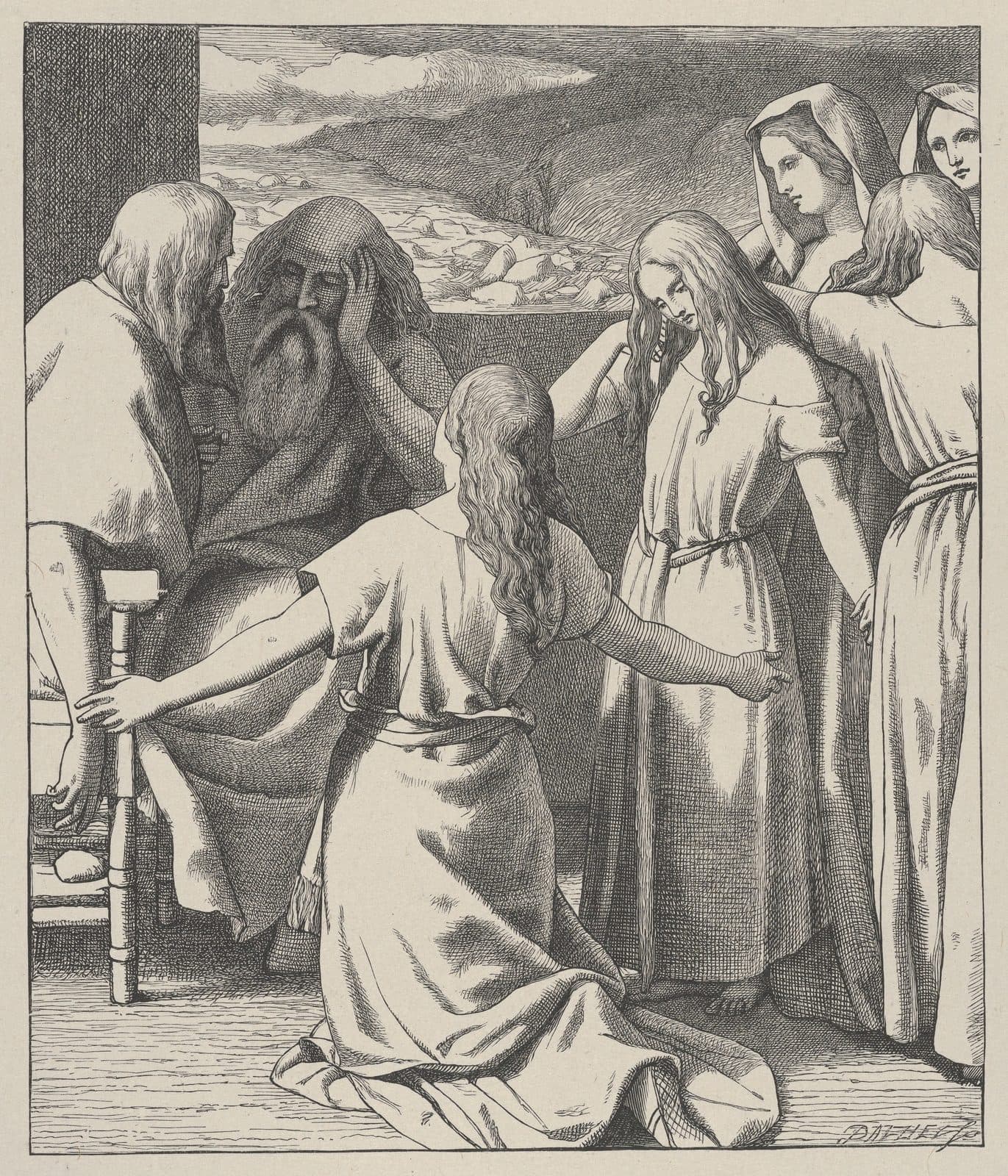
After Frederick Richard Pickersgill, The Daughters of Zelophehad, engraved by the Brothers Dalziel for Dalziels' Bible Gallery, 1865 to 1881, Metropolitan Museum of Art. CC0, via Wikimedia Commons.
THE ARTWORKFrederick Richard Pickersgill drew one sister on her knees before two old men while her four sisters stand behind her. In Numbers 27:2 the sisters stood before Moses, Eleazar the priest, the leaders and the congregation.
Summary
The daughters of Zelophehad, of the tribe of Manasseh, received their father's inheritance by the LORD's own ruling (Numbers 27:7).
- Their names are Mahlah, Noah, Hoglah, Milcah and Tirzah (Numbers 26:33).
- Numbers 26, 27 and 36, Joshua 17 and 1 Chronicles 7 all name their father.
- The heads of their clan later asked that the land stay in the tribe of Manasseh, and the daughters married within it (Numbers 36:1 to 12).
- Joshua gave them their land west of the Jordan, and Manasseh received ten shares there (Joshua 17:4 to 5).
Five Sisters at the Tent of Meeting
Numbers 27, Numbers 36 and Joshua 17 tell the account in three scenes.
Near the end of the forty years in the wilderness, Israel camped on the plains of Moab by the Jordan, across from Jericho. Moses and Eleazar the priest counted the people by clans, and the LORD said the land would be shared out by lot according to the names counted (Numbers 26:53 to 55).
Zelophehad of the clan of Hepher, in the tribe of Manasseh, had died in the wilderness and left five daughters and no son. His daughters made their plea in public, before all of Israel's leaders.
“Our father died in the wilderness, but he was not among the followers of Korah who gathered together against the LORD. Instead, he died because of his own sin, and he had no sons. Why should the name of our father disappear from his clan because he had no sons? Give us property among our father’s brothers.”The daughters rest their claim on two grounds, their father's record and the survival of his name.
Moses took the case to the LORD, and the LORD granted the request. He then gave Moses a rule of heirs for every Israelite who died without a son (Numbers 27:8 to 11).
The second scene comes near the end of the book. The heads of the clan of Gilead came to Moses with a question the ruling had left open. If the daughters married men of another tribe, their land would pass with their sons into that tribe.
This is what the LORD has commanded concerning the daughters of Zelophehad: They may marry anyone they please, provided they marry within a clan of the tribe of their father. No inheritance in Israel may be transferred from tribe to tribe, because each of the Israelites is to retain the inheritance of the tribe of his fathers.The LORD answers the clan's fear and leaves the daughters free to choose a husband within the tribe.
The five married cousins on their father's side, within the clans of Manasseh (Numbers 36:10 to 12).
The third scene comes after the crossing of the Jordan, when the land west of the river was divided by lot.
They approached Eleazar the priest, Joshua son of Nun, and the leaders, and said, “The LORD commanded Moses to give us an inheritance among our brothers.” So Joshua gave them an inheritance among their father’s brothers, in keeping with the command of the LORD.The daughters hold Joshua to the word given to Moses, and Joshua keeps it.
Barnes and Henry on what the daughters askedAlbert Barnes on Numbers 27:1; Matthew Henry on Numbers 27:7
“Women in Israel had not, up to the present time, enjoyed any distinct right of inheritance. Yet a father, whether sons had been born to him or not, had the power, either before or at his death, to cause part of his estate to pass to a daughter; in which case her husband married into her family rather than she into his, and the children were regarded as of the family from which the estate had come.”
Albert Barnes · Notes, Explanatory and Practical, on the Old and New Testaments (1832-1869) · on Numbers 27:1Evangelical
“It should seem, by the particular notice taken of it, that it was a singular case, and that the like did not at this time occur in all Israel, that the head of a family had no sons, but daughters only. Their case is again debated ( ch. xxxvi. ) upon another article of it; and, according to the judgments given in their case, we find them put in possession, Josh. xvii.”
Matthew Henry · Commentary on the Whole Bible · on Numbers 27:7Puritan
What the Text Says and What Is Often Said
Three common retellings set beside the verses, and three Hebrew words the account turns on.
“THEY ASKED TO BE COUNTED AS SONS”
They asked for property among their father's brothers so that his name would stay in his clan. Their request served his name and his land.
“CHAPTER 36 TOOK BACK WHAT CHAPTER 27 GAVE”
The daughters kept their land, and the ruling of Numbers 36 bound every heiress in Israel to marry within a clan of her father's tribe.
“DAUGHTERS IN ISRAEL NEVER HELD LAND”
Job gave his daughters an inheritance among their brothers, and the law of Numbers 27:8 gave a daughter her father's land where he left no son.
| Word | Its sense in this account | Where |
|---|---|---|
| achuzzah (h272) | A possession, the word of the daughters' request and of the LORD's answer. | Numbers 27:4 and 27:7 |
| nachalah (h5159) | An inheritance, the land a family holds through its generations. | Numbers 27:7 to 11; 36:2 to 9 |
| gara (h1639) | To be withdrawn. The daughters use it of their father's name, and the clan uses it of the tribe's land. | Numbers 27:4; 36:3 to 4 |
Why Numbers records the caseJamieson, Fausset & Brown, Commentary Critical and Explanatory (1871), on Numbers 27:4
“A distribution of the promised land was about to be made; and it is interesting to know the legal provision made in these comparatively rare cases for preserving a patrimony from being alienated to another tribe.”
Jamieson, Fausset & Brown · Commentary Critical and Explanatory on the Whole Bible · on Numbers 27:4Reformed
Land by Tribe, Clan and Name
Numbers 26 tied each share of the land to a counted name, and Leviticus 25 kept each share in its clan.
The second census was taken by the houses of the fathers, and the land was to pass by lot according to the names of the tribes of their fathers (Numbers 26:2 and 26:55). A man with no son had no one to carry his name into that reckoning. The name of Zelophehad still stands among the descendants of Manasseh in 1 Chronicles 7:15, as the man who had only daughters.
Eleazar stands as priest beside Moses in Numbers 27:2, so the petition came after Aaron died on Mount Hor in the fortieth year after the exodus (Numbers 20:28; 33:38). Rashi makes the same reckoning in his commentary on Numbers 27:2, after the midrash Sifrei.
The land must not be sold permanently, because it is Mine, and you are but foreigners and residents with Me.The LORD states why a family's share could never be sold for good.
The clan's appeal names the Jubilee, the fiftieth year when each man returned to his property and his clan (Leviticus 25:10).
Rashi on the Jubilee in Numbers 36:4Rashi on Numbers 36:4, in the Rosenbaum and Silbermann translation (1929 to 1934)
Rashi explains that an inheritance is no sale of land, so the Jubilee would not send it back to its first tribe. On his reading the Jubilee would make the loss permanent.
Sforno on the lot and on the marriagesSforno on Numbers 36:2, 36:10 and 36:12, in the translation of Eliyahu Munk
Sforno, in his commentary on the Torah, observes that land passing from one tribe to another would undo the purpose of dividing the land by lot. He reads the five marriages as obedience, since the daughters chose their uncles' sons when the ruling let them marry anyone in the tribe.
What the Text Leaves Unsaid
The account leaves two questions about the five daughters open.
How old were the daughters?Numbers 26:33 and 36:11
The text gives no age for any of the five. Numbers 36 shows that none of them had married when the clan appealed.
Whom did each daughter marry?Numbers 36:11 to 12
Numbers names none of the five husbands, so which man each daughter married is unknown.
Heirs According to the Promise
Paul and Peter speak of heirs and an inheritance in Christ.
Each share of the land passed from one generation to the next in a family's name. The daughters wanted their father's name kept in Israel, and the LORD kept it through them.
There is neither Jew nor Greek, slave nor free, male nor female, for you are all one in Christ Jesus. And if you belong to Christ, then you are Abraham’s seed and heirs according to the promise.Paul names every believer, man or woman, an heir of the promise made to Abraham.
Wesley on the purpose of the rulingJohn Wesley on Numbers 36:8 (1765)
“And the principal reason why God was solicitous to preserve tribes and families unmixed was, that the tribe and family too, out of which the Messiah was to come, and by which he should be known, might be evident and unquestionable.”
John Wesley · Explanatory Notes upon the Old Testament · on Numbers 36:8Evangelical
How the Commentators Read the Case
Three teachers from the fourth century to the eighteenth, each in his own words.
Eusebius on the law of Numbers 36 and Mary's tribeEusebius of Caesarea, Ecclesiastical History 1.7
“Now, since the genealogy of Joseph is so traced, Mary also appears virtually to have been of the same tribe as he, since, according to the law of Moses, intermarriages between different tribes were not permitted. For it was commanded to join in marriage with one of the same family and of the same people, so that the inheritance of the race might not be changed from tribe to tribe.”
Eusebius of Caesarea · Ecclesiastical History 1.7 · on Numbers 36:6Patristic
Calvin on God answering when he was askedJohn Calvin, Commentaries, on Numbers 36:1
“What, then, can be the meaning of the objection, that God only half considered what was right? In my opinion, He so arranged His replies, that only when inquired of He assigned to each one his rights. The daughters of Zelophehad come, and demand justice of Moses and the elders, and God complies with their prayers.”
John Calvin · Commentaries · on Numbers 36:1Reformed
Henry on the choice the ruling left themMatthew Henry, Commentary on the Whole Bible (1710), on Numbers 36:5
“Now the matter is thus accommodated: these heiresses must be obliged to marry, not only within their own tribe of Manasseh, but within the particular family of the Hepherites, to which they did belong. They are not determined to any particular persons; there was choice enough in the family of their father: Let them marry to whom they think best.”
Matthew Henry · Commentary on the Whole Bible · on Numbers 36:5Puritan
Where the Readers Divide
Three questions divide careful readers of this account: what the father's sin was, why the names change order, and whether the law of heirs was new.
His own sinNumbers 27:3, with Numbers 14:44 and 15:32
The daughters say only that their father died because of his own sin, and Numbers names no act of his. Albert Barnes, in his Notes on Numbers 27:3, reads his own sin as the sentence passed on the whole older generation. He holds that the daughters claimed, by Numbers 14:31, that the sentence did not reach the children. Rashi reports from the Talmud, Shabbat 96b, two rabbis who name a single act. Rabbi Akiba named Zelophehad as the man found gathering wood on the Sabbath (Numbers 15:32), and Rabbi Simeon named him among those who went up the hill country against the word of Moses (Numbers 14:44).
The order of the namesNumbers 26:33, 27:1 and 36:11, and Joshua 17:3
| List | The order of the names |
|---|---|
| Numbers 26:33 | Mahlah, Noah, Hoglah, Milcah, Tirzah |
| Numbers 27:1 | Mahlah, Noah, Hoglah, Milcah, Tirzah |
| Numbers 36:11 | Mahlah, Tirzah, Hoglah, Milcah, Noah |
| Joshua 17:3 | Mahlah, Noah, Hoglah, Milcah, Tirzah |
Three lists agree, and Numbers 36:11 moves Tirzah to second place and Noah to fifth. Rashi, on Numbers 27:1, reads the changed order as a sign that the five were of equal worth, after the midrash Sifrei. On Numbers 36:11 he adds that this list follows their ages, since they married in the order of their birth. John Gill, in his Exposition on Numbers 36:11, reports Aben Ezra the other way: the census gives the order of birth and Numbers 36:11 the order of marriage.
A new law, or one revealedNumbers 27:5 to 11
John Gill, on Numbers 27:8, reads the ruling as a law made on the occasion of this case. Rashi, on Numbers 27:5 and 27:7, reads a law already written before God and brought out through the daughters' merit, citing the midrash Sifrei and the Talmud, Bava Batra 119a. He adds, after Midrash Tanchuma, that their eye saw what the eye of Moses did not see.
The Great Books on This Story
Commentary on the Whole Bible
Matthew Henry · 1710
Henry's commentary adds that Joshua did not object that the daughters had not served in the wars of Canaan when he gave them their land (Joshua 17:4).
Read it free at CCELNotes on the Old and New Testaments
Albert Barnes · 1832 to 1869
Barnes explains the setting of each verse, such as the door of the tent as the place where the leaders met while they took the census (Numbers 27:2).
Read it free at CCELExplanatory Notes upon the Old Testament
John Wesley · 1765
Wesley answers questions the text raises in short notes, such as how a daughter's first son might carry her father's name (Numbers 27:4).
Read it free at CCELAn Inheritance Kept in the Family Name
“The daughters of Zelophehad speak correctly. You certainly must give them property as an inheritance among their father’s brothers, and transfer their father’s inheritance to them.The LORD's verdict closes the case and is the verse to hold in memory from the account.
Blessed be the God and Father of our Lord Jesus Christ! By His great mercy He has given us new birth into a living hope through the resurrection of Jesus Christ from the dead, and into an inheritance that is imperishable, undefiled, and unfading, reserved in heaven for you,Peter tells believers that their inheritance through the risen Christ is kept in heaven.
The daughters had no brother to speak for them, so they brought their own case.
The text asks the reader to bring a hard case before the LORD as they did, and to value the inheritance he gives.
Keep studying
Places1
Doctrines6
Peoples and groups1