
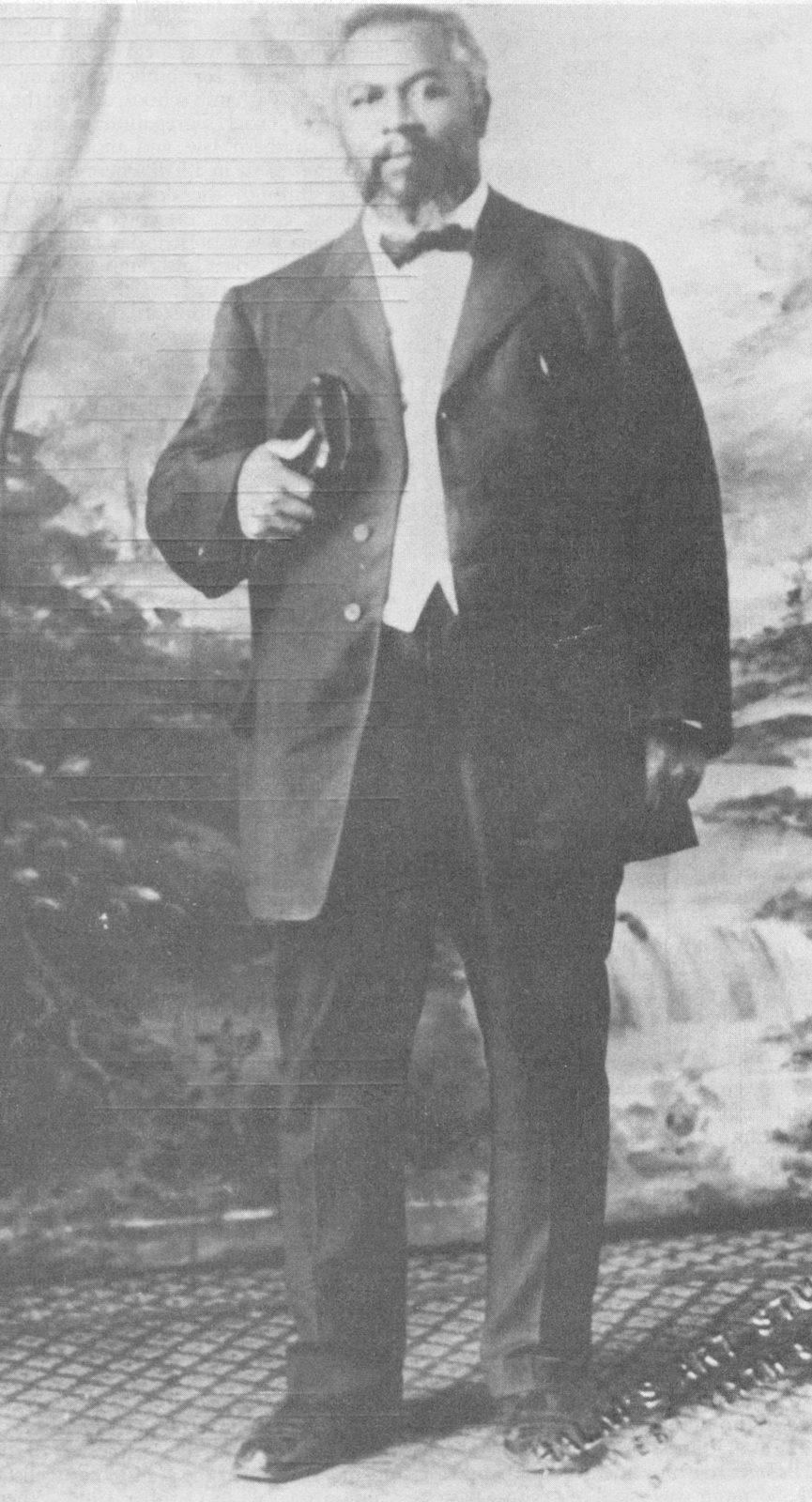
Unknown photographer, William Joseph Seymour, early 1910s. Public domain.
Louisiana, Houston and Los Angeles, to 1922 · Person · Featured Study
William Seymour
He led the Apostolic Faith Mission at 312 Azusa Street in Los Angeles for sixteen years, until his death in 1922.
On the day of the San Francisco earthquake, the Los Angeles Daily Times called his meetings a weird babel of tongues.
And they were all filled with the Holy Spirit and began to speak in other tongues as the Spirit enabled them.
And they were all filled with the Holy Spirit and began to speak in other tongues as the Spirit enabled them.
- Born
- 2 May 1870 at Centerville, Louisiana (probable)
- Died
- 28 September 1922 (probable)
- Family
- father: Simon; mother: Phyllis; wife: Jennie Evans Moore
- Places
- Centerville, Indianapolis, Houston, Los Angeles
Summary
William Seymour was a holiness preacher whose parents had been slaves. He took Charles Parham's teaching on the baptism with the Holy Ghost from Houston to California. The meetings he led there drew seekers from across the world. The mission's paper carried its report free to its readers.
- His wife, Jennie Evans Moore, led the mission after his death.
- In 1915 he wrote a Discipline that kept the mission's offices for people of color.
- His teacher Parham broke with the mission within months. By December the paper had disowned his leadership.
As the Spirit Gave Utterance
Acts 2:4 names the evidence he preached, and Mark 16:20 the signs he looked for.
Seymour's own account of his call rests on the second chapter of Acts, where the disciples spoke in tongues as the Spirit gave utterance.
The question of this life is how a preacher shut out of his first pulpit came to lead a mission that people crossed the world to see. It is also what he made of the divisions that followed.
And they went out and preached everywhere, and the Lord worked through them, confirming His word by the signs that accompanied it.He wrote that the messengers of the atonement should preach all of it, with signs following.
The Life in Order
The mission's own paper fixes the early dates, and later historians the rest.
He was thirty-five when he reached Los Angeles.
- 2 May 1870Born at Centerville, LouisianaEspinosa
- 1905Parham's Bible school in HoustonSarah Parham; Espinosa
- 22 February 1906Arrival in Los AngelesRobeck; Espinosa
- 9 April 1906The outpouring at the cottageThe Apostolic Faith, December 1906
- 18 April 1906The Los Angeles Daily Times reportThe Times, as the ark transcribes it
- September 1906First number of The Apostolic FaithThe Apostolic Faith
- Summer 1908The paper's masthead reads PortlandThe Apostolic Faith
- 2 May 1911Durham locked out of the missionBartleman
- 1915The Doctrines and DisciplineSeymour
- 28 September 1922His deathSynan
Each step of the life stands with its witness.
Summer 1908, 2 May 1911, 1915, 28 September 1922
From Centerville to Azusa Street
His own paper tells the first year, and later historians fill in the years before and after.
William Joseph Seymour was born in Louisiana to parents who had been slaves, lost the sight of one eye to smallpox, and learned Pentecostal doctrine in Houston in 1905 under Texas segregation law. Lucy Farrow, a Black woman of Houston, had a hand in getting him into Parham's school, Robeck writes.
Invited to preach in Los Angeles, he was locked out of the mission that had invited him soon after he began to preach the evidence of Acts 2.
He kept preaching in a house on Bonnie Brae Street, then moved into a run-down building at 312 Azusa Street. What happened there ran for three years, three services a day, with Black and white and Mexican and Chinese worshipers kneeling at the same altar.
By 1915, Espinosa writes, Azusa missionaries had carried it to more than fifty countries.
Seymour spent his last years pastoring the same mission and died in 1922.
The Apostolic Faith
The mission printed its own news and sent it out without charge.
The first number came out in September under the headline Pentecost Has Come, with the line Subscription Free. It said the work began among the colored people, and that Ethiopians, Chinese, Indians, Mexicans and other nationalities worshipped together.
By the paper's own count it printed 5,000 copies of the first number, 10,000 of the second, and 30,000 each of the third and fourth.
The issue of July and August 1908 bears the heading Portland, Oregon.
In Their Own Words
Four sayings, from his paper's first year to his Discipline nine years later.
William J. Seymour (1870 to 1922)
"Bro. Seymour's Call", The Apostolic Faith 1:1, page 1, in the Apostolic Faith Church's transcription
They locked the door against me
“The Lord sent the means, and I came to take charge of a mission on Santa Fe Street, and one night they locked the door against me, and afterwards got Bro. Roberts, the president of the Holiness Association, to come down and settle the doctrine of the Baptism with the Holy Ghost, that it was simply sanctification. He came down and a good many holiness preachers with him, and they stated that sanctification was the baptism with the Holy Ghost. But yet they did not have the evidence of the second chapter of Acts, for when the disciples were all filled with the Holy Ghost, they spoke in tongues as the Spirit gave utterance. After the president heard me speak of what the true baptism of the Holy Ghost was, he said he wanted it too, and told me that when I had received it to let him know. So I received it and let him know. The beginning of the Pentecost started in a cottage prayer meeting at 214 Bonnie Brae.”
Pentecostal
About this saying1 paragraph
He told the story of his call in the paper's opening issue, in 1906.
William J. Seymour
"The Precious Atonement", The Apostolic Faith 1:1, in the Apostolic Faith Church's transcription of the article signed W. J. Seymour
Preach all of it
“We that are the messengers of this precious atonement ought to preach all of it, justification, sanctification, healing, the baptism with the Holy Ghost, and signs following.”
Pentecostal
About this saying1 paragraph
In the same number of 1906 he set out the whole gospel he preached.
William J. Seymour
"Counterfeits", The Apostolic Faith 1:4 (Los Angeles, December 1906), in the Apostolic Faith Church's transcription of the article signed W. J. Seymour, vol. 1, no. 4
The real and the counterfeit
“God has told us in His precious word that we should know a tree by its fruit. Wherever we find the real, we find the counterfeit also. But praise God for the real.”
Pentecostal
About this saying1 paragraph
In December 1906 he wrote on false manifestations.
William J. Seymour
The Doctrines and Discipline of the Azusa Street Apostolic Faith Mission, the Constitution, Article C
People of color
“The bishop, vice bishop and trustees must be people of color.”
Pentecostal
About this saying1 paragraph
The constitution of his Discipline of 1915 set this rule for the officers.
The People Around Him
His teacher, his hosts, his wife and the preachers who came and went.
His teacher and his strongest early supporter both broke with him.
| Person | Tie to Seymour | The witness |
|---|---|---|
| Lucy Farrow | Sold into slavery as a girl, she came to Los Angeles from Houston in 1906. | The Apostolic Faith |
| Charles Parham | His teacher, called God's leader in September 1906 and disowned in December. | The Apostolic Faith |
| Julia Hutchins | The pastor who sent him away on 4 March 1906. | Espinosa |
| J. M. Roberts | President of the Holiness Association, sent to settle the doctrine. | Seymour; Robeck |
| Richard and Ruth Asberry | Their home at 214 Bonnie Brae held the prayer meetings. | Robeck |
| Jennie Evans Moore | She was in the cottage meeting, married him, and led the mission after him. | The Apostolic Faith; Synan |
| Frank Bartleman | A participant who wrote his memoir in 1925. | Bartleman |
| W. H. Durham | He praised him in 1907, and was locked out in 1911. | The Apostolic Faith; Bartleman |
Frank Bartleman, W. H. Durham
The Places of His Life
He came north from Louisiana, then west to California.
A cottage, a mission and a paper made Azusa Street known.
| Place | What the witnesses say | The witness |
|---|---|---|
| Centerville, Louisiana | His birthplace. | Espinosa |
| Indianapolis | He was born again at the Simpson Chapel Methodist Episcopal Church. | Espinosa |
| Houston | The city of Parham's short school. | Espinosa |
| Santa Fe Street, Los Angeles | The mission that shut him out. | Seymour |
| 214 Bonnie Brae Street | The Asberrys' cottage. | Seymour; Robeck |
| 312 Azusa Street | An old frame building, once a Methodist church and lately a store for lumber. | Bartleman |
| Portland, Oregon | The paper's home from 1908. | The Apostolic Faith |
Tongues and the Evidence
The mission's teaching on the sign of the baptism changed in his lifetime.
The paper's first numbers held tongues to be the evidence of the baptism. A column of 1907 in the same paper said that tongues are not the real evidence of the baptism in everyday life.
In his Discipline Seymour warned that a work which knew the baptism only by the evidence of tongues would lie open to spiritualism. Larry Martin's edition of 2000 prints the passage.
How the Key Verse Was Taught
John Calvin, John Wesley and Jennie Evans Moore read the tongues of Pentecost.
John Calvin (1509 to 1564)
Commentary upon the Acts of the Apostles, volume 1, on Acts 2:4
John Calvin held that the disciples truly spoke in other tongues, so that the miracle was in them and not in the hearers.
“But we must first note that the disciples spoke indeed with strange tongues; otherwise the miracle had not been wrought in them, but in the hearers. So that the similitude should have been false whereof he made mention before; neither should the Spirit have been given so much to them as to others.”
Reformed
John Wesley (1703 to 1791)
Explanatory Notes upon the New Testament
John Wesley saw in the tongues a pledge that the whole world would praise God.
“And this family praising God together, with the tongues of all the world, was an earnest that the whole world should in due time praise God in their various tongues. As the Spirit gave them utterance - Moses, the type of the law, was of a slow tongue; but the Gospel speaks with a fiery and flaming one.”
on Acts 2:4Evangelical
Jennie Evans Moore (died 1936)
her testimony, The Apostolic Faith 1:8 (Los Angeles, May 1907), signed J. M., 312 Azusa St., in the Apostolic Faith Church's transcription, vol. 1, no. 8
Jennie Evans Moore told how the gift came to her at Bonnie Brae.
“As I thought thereon and looked to God, it seemed as if a vessel broke within me and water surged up through my being, which when it reached my mouth came out in a torrent of speech in the languages which God had given me.”
Revival witness
What the Witnesses Leave Open
Readers differ on where he sat in Houston and on who founded the movement.
Where he sat in Parham's schoolSarah Parham; Cecil M. Robeck Jr.; Gaston Espinosa
Sarah Parham, writing in 1930, says that because Texas law kept the races apart, Seymour was given a place in the class. Robeck wrote in 2005 that he is said to have been separated from the white students. Espinosa wrote in 2024 that he was asked to sit in the hallway or an adjacent room.
Parham or SeymourJames R. Goff; Cecil M. Robeck Jr.
Goff argued in 1988 that the movement began with Parham, more than with Seymour, at Topeka in 1901. Robeck answers from Los Angeles, where in April 1906 almost no one but Seymour knew Parham's teaching, and where the revival that spread began.
Books to Read Next
The Apostolic Faith
The Apostolic Faith Mission, Los Angeles · 1906 to 1908
The mission's own paper holds his call, his articles and the reports of the meetings.
Read the fifteen numbers free at the Apostolic Faith ChurchThe Doctrines and Discipline of the Azusa Street Apostolic Faith Mission
William J. Seymour · 1915
It gives his own rule for the mission, with its constitution.
Read the constitution free at azusastreet.orgWhat Seymour Left
Seymour left a mission that sent preachers across the world, a paper that told what happened there, and a Discipline that recorded what divided it.
Sources
Scripture is the Berean Standard Bible.
- The Holy Bible, Berean Standard Bible (read 2026)
- The Apostolic Faith (Los Angeles, September 1906 to May 1908; Portland, July and August 1908), in the Apostolic Faith Church's transcriptions.
- William J. Seymour, The Doctrines and Discipline of the Azusa Street Apostolic Faith Mission (1915), the constitution.
- Cecil M. Robeck Jr., "The Past: Historical Roots of Racial Unity and Division in American Pentecostalism", Cyberjournal for Pentecostal-Charismatic Research 14 (2005)
- Gaston E. Espinosa, "Crossing Barriers: William J. Seymour and the Azusa Street Revival", Christian History 153 (2024), page 18.
- Frank Bartleman, How Pentecost Came to Los Angeles (Los Angeles, 1925)
- John Calvin, Commentary upon the Acts of the Apostles, volume 1, on Acts 2:4.
- John Wesley, Explanatory Notes upon the New Testament (1755), on Acts 2:4.
Keep Studying
People and groups5
Doctrines1