
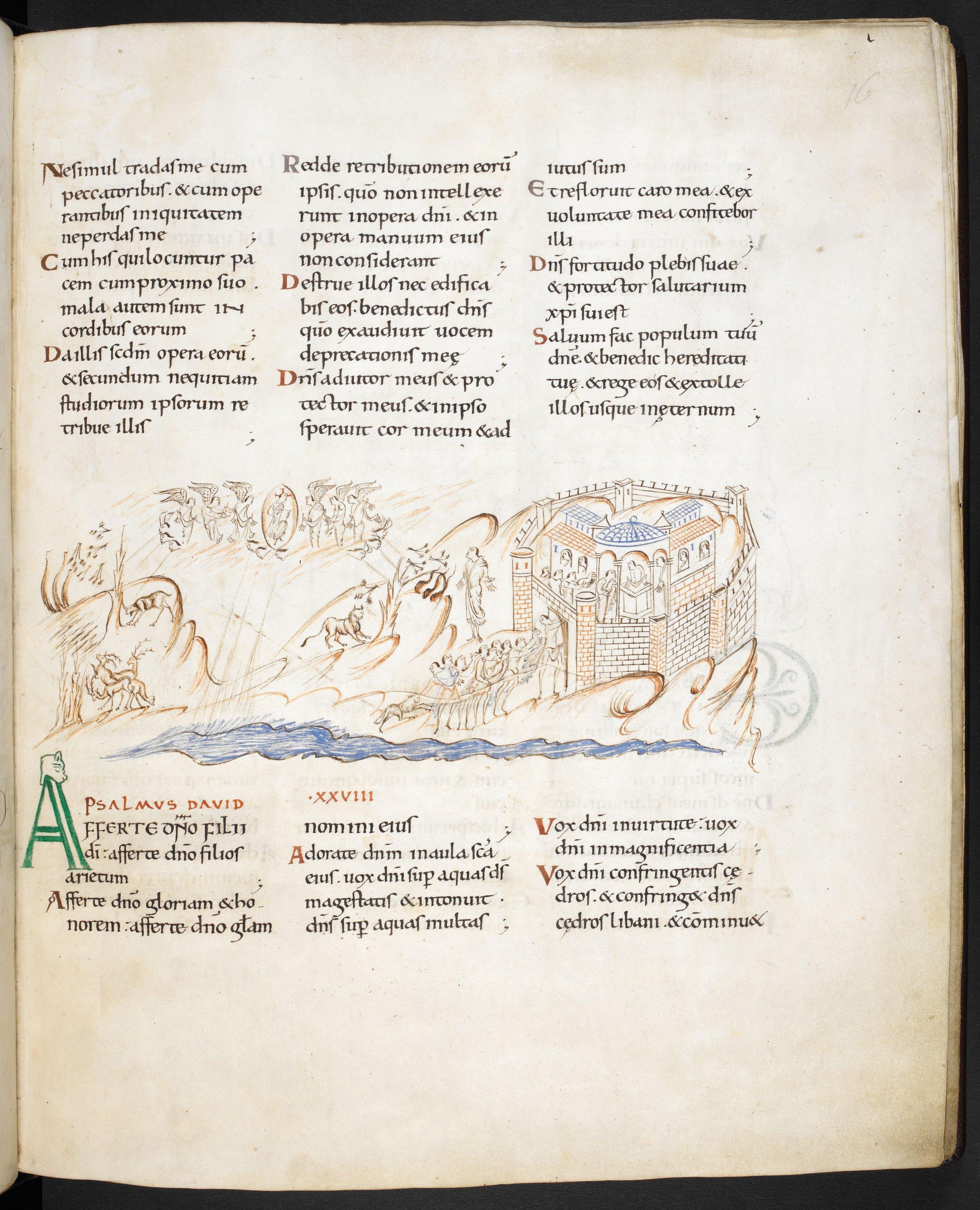
The Harley Psalter, British Library Harley MS 603, 1000 to 1050. Public domain.
Psalms 29, 89, 97, 103, 138 and 148 · Doctrine · Featured Study
The Sons of God and the Heavenly Court
Four psalms name the beings of heaven around God's throne, and six more set the LORD above every being called a god.
Angels and hosts are summoned to bless the LORD.
In the council of the holy ones, God is greatly feared, and awesome above all who surround Him.
- First taught
- Psalm 29:1 “Ascribe to the LORD, O heavenly beings, ascribe…”
- Fullest statement
- Psalm 89:5 to 8 “The heavens praise Your wonders, O LORD— Your…”
Summary
The court of heaven is told to praise, to serve and to fear the LORD. The Psalms also weigh the gods of the nations and find them idols, and readers still differ over who the gods of Psalm 138:1 are.
- The Hebrew behind heavenly beings is bene elim, which Delitzsch renders sons of God.
- None of the court compares with the LORD.
- Delitzsch, Calvin and Spurgeon read the gods of the Psalms in three ways.
The Court Around the Throne
Psalms 29 and 89 speak to and of a company of heavenly beings.
Ascribe to the LORD, O heavenly beings, ascribe to the LORD glory and strength. Ascribe to the LORD the glory due His name; worship the LORD in the splendor of His holiness.The rest of the psalm describes the voice of the LORD in a storm.
Psalm 89 compares the LORD with them.
For who in the skies can compare with the LORD? Who among the heavenly beings is like the LORD?The question expects the answer that none is like Him.
Psalm 82 shows God judging among the gods.
The Names of the Court
Four names run through six verses of the Psalter.
Each name, its Hebrew word and what the psalms have the court do.
| Berean text | Hebrew | What the court does |
|---|---|---|
| Heavenly beings | bene elim, sons of God | Is called to give the LORD glory, at Psalm 29:1, and none of it is like Him, at Psalm 89:6 |
| The holy ones | qedoshim, holy ones, in an assembly, qahal, and a council, sod, a company in close counsel | Stands in the assembly where the heavens praise Him, at Psalm 89:5, and meets in council around God, at Psalm 89:7 |
| His angels | malakh, messenger | Carries out His word, at Psalm 103:20, and is called to praise from the heights, at Psalm 148:2 |
| His hosts | tsaba, army | Serves Him and does His will, at Psalm 103:21, and praises Him, at Psalm 148:2 |
Called to Praise
Two psalms call the court of heaven to praise the LORD.
Psalm 103 closes by turning its call to bless the LORD outward to heaven.
The LORD has established His throne in heaven, and His kingdom rules over all. Bless the LORD, all His angels mighty in strength who carry out His word, who hearken to the voice of His command. Bless the LORD, all His hosts, you servants who do His will. Bless the LORD, all His works in all places of His dominion. Bless the LORD, O my soul!The throne comes first, and the court's praise follows from it.
Psalm 148 starts its call in the heavens.
Praise Him, all His angels; praise Him, all His heavenly hosts. Praise Him, O sun and moon; praise Him, all you shining stars. Praise Him, O highest heavens, and you waters above the skies. Let them praise the name of the LORD, for He gave the command and they were created.The call to heaven comes before the call to the earth in Psalm 148:7.
Psalm 29:9 hears the cry of Glory in His temple.
Above All Gods
The Psalter weighs the gods of the nations against the LORD.
Psalms 86, 95, 96, 97 and 135 set the LORD above the gods or say that none of them is like Him, and Psalm 136:2 calls Him the God of gods.
For great is the LORD, and greatly to be praised; He is to be feared above all gods. For all the gods of the nations are idols, but it is the LORD who made the heavens.In Psalm 96:5 the Hebrew for idols is elilim, which Strong's lexicon defines as good for nothing.
All worshipers of images are put to shame— those who boast in idols. Worship Him, all you gods! Zion hears and rejoices, and the towns of Judah exult because of Your judgments, O LORD. For You, O LORD, are Most High over all the earth; You are exalted far above all gods.Delitzsch reads these gods as superhuman powers that the nations deified.
What the Psalter Leaves Unsaid
No psalm lists the members of the court.
The Psalter names no angel and never uses the word seraph.
It gives the court no ranks.
Its three cherubim verses speak of the LORD's throne and His flight, at Psalm 18:10, Psalm 80:1 and Psalm 99:1.
Voices on the Court
Matthew Henry commented on the angels as God's attendants.
Matthew Henry (1662 to 1714)
Commentary on the Whole Bible
Henry read the verse as a sight of the world above.
“That there is above us a world of blessed angels by whom God is praised, an innumerable company of them. Thousand thousands minister unto him, and ten thousand times ten thousand stand before him; and it is his glory that he has such attendants, but much more his glory that he neither needs them, nor is, nor can be, any way benefited by them.”
on Psalm 148:2Puritan
Angels, Rulers or Idols?
Readers give three answers to who the gods of Psalm 138:1 are.
I give You thanks with all my heart; before the gods I sing Your praises.The Greek translation reads before the angels, Delitzsch notes, and he sets that reading aside.
Jamieson, Fausset and Brown, in their Commentary Critical and Explanatory of 1871, name all three readings of this verse and leave the choice open.
Heavenly beings, the angelsFranz Delitzsch on Psalms 29 and 89; John Calvin on Psalm 138:1
Franz Delitzsch takes the heavenly beings of Psalm 29:1 and the holy ones of Psalm 89 to be the angels.
“The praise David speaks of is that which is of a public kind. The solemn assembly is, so to speak, a heavenly theater, graced by the presence of attending angels; and one reason why the cherubim overshadowed the Ark of the Covenant was to let God's people know that the angels are present when they come to worship in the sanctuary.”
John Calvin · Commentaries · on Psalm 138:1Reformed
Against this reading, Delitzsch doubts that the Hebrew uses elohim for angels with nothing added to define it.
Rulers of the earthJohn Calvin on Psalm 29:1; Franz Delitzsch on Psalm 138:1
Calvin reads the sons of the mighty in Psalm 29:1 as the princes of this world, whom David calls to humble themselves before God. Delitzsch reads the gods of Psalm 138:1 as the rulers and great men of the earth.
Against this reading, Calvin prefers angels at Psalm 138:1, because believers at worship rise to fellowship with angels.
The gods of the nationsHengstenberg, Hupfeld and Hitzig, as Delitzsch reports them; Charles Spurgeon on Psalm 97:9
Delitzsch reports that Hengstenberg, Hupfeld and Hitzig read the gods of Psalm 138:1 as the gods of the peoples, the idols of Psalm 96:5.
“For thou, Lord, art high above all the earth. And therefore do we rejoice to see the idols abolished and to see all mankind bending at thy throne. There is but one God, there cannot be another, and he is and ever must be over all. Thou art exalted far above all gods. As much as all is exalted above nothing, and perfection above folly.”
Charles Spurgeon · The Treasury of David, Vol. 4 · on Psalm 97:9Particular Baptist
Against this reading, Calvin holds that the gods told to worship in Psalm 97:7 are properly the angels, and the false gods only less properly.
Books to Read Next
Both commentaries are in the public domain, and each has a free copy to read.
Biblical Commentary on the Psalms
Franz Delitzsch, translated by Francis Bolton · 1871
Delitzsch writes on the heavenly beings in volume 1, page 368, and on the gods before whom David sings in volume 3, page 339.
Read at the Internet ArchiveCommentary on the Book of Psalms
John Calvin, translated by James Anderson · 1845
The first volume gives his reading of Psalm 29 on pages 475 to 476.
Read at the Internet ArchiveWho Is Like the LORD?
Psalm 89 turns from the council to the LORD Himself.
O LORD God of Hosts, who is like You? O mighty LORD, Your faithfulness surrounds You.The psalm asks for the third time who is like the LORD.
Sources
Scripture is the Berean Standard Bible.
- Franz Delitzsch, Biblical Commentary on the Psalms, translated by Francis Bolton, T. and T. Clark, 1871, vol. 1 p. 368, vol. 3 pp. 36, 95 and 339.
- John Calvin, Commentary on the Book of Psalms, translated by James Anderson, Calvin Translation Society, vol. 1 (1845) pp. 475 to 476, vol. 4 (1847) pp. 64 to 65, vol. 5 (1849) p. 199.
- Jamieson, Fausset and Brown, Commentary Critical and Explanatory on the Whole Bible, 1871, on Psalm 138:1.
- Charles Spurgeon, The Treasury of David, vol. 4, 1874, on Psalm 97:9.
- Matthew Henry, Commentary on the Whole Bible, 1710, on Psalm 148:2.
Keep Studying
Read it4
Go further1
People and groups4
Values1