
Exodus 12 · Leviticus 23 · Subject · Featured Study
The Passover and the First Month
The first month of Israel's year held the Passover, the seven days of unleavened bread and the sheaf of firstfruits.
The LORD set the calendar by the night He brought His people out of Egypt.
- Books
- Exodus, Leviticus, Numbers, Deuteronomy, John, 1 Corinthians
- Hold in memory
- Exodus 12:2, Leviticus 23:5 to 6
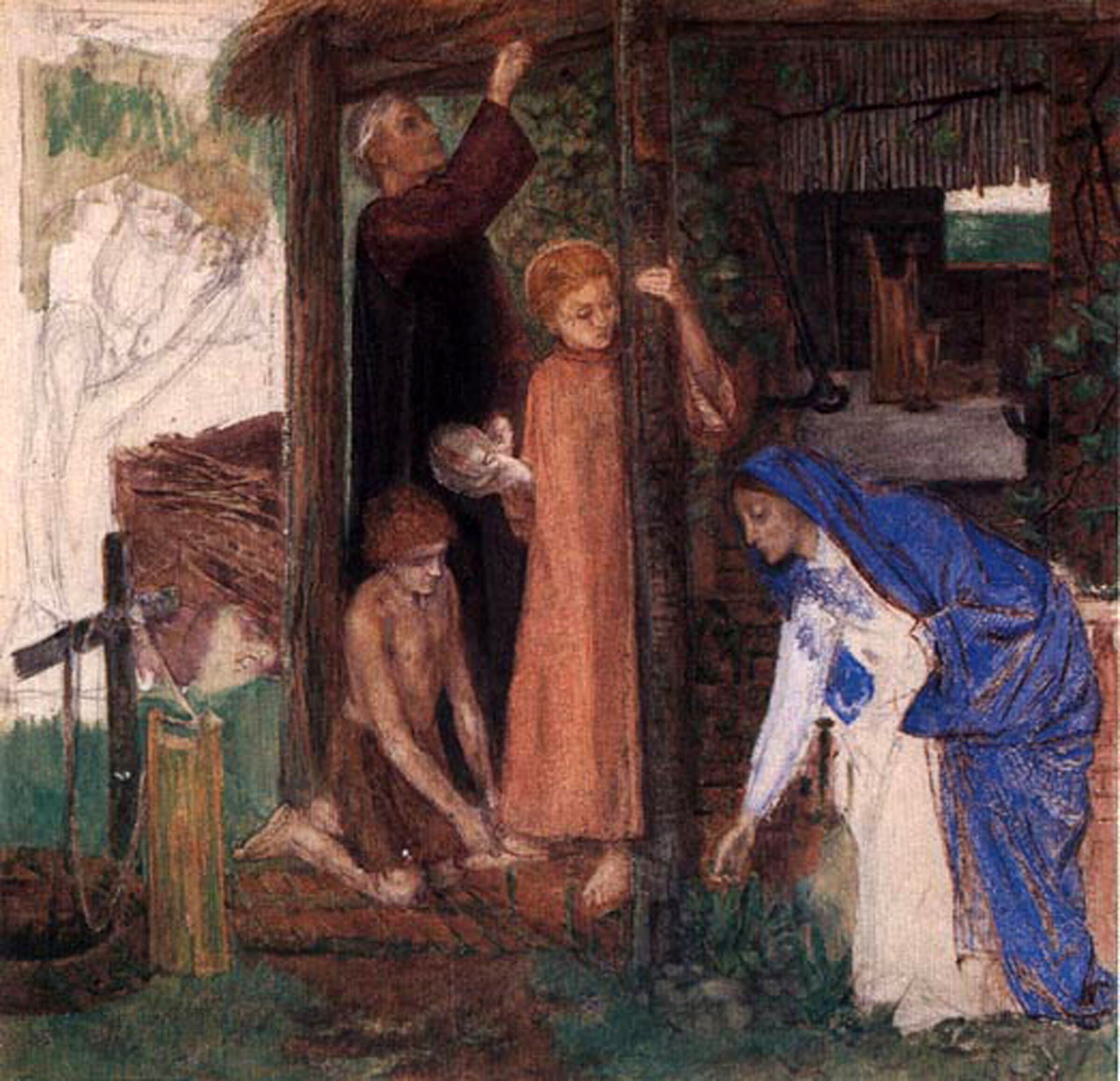
Dante Gabriel Rossetti, The Passover in the Holy Family: Gathering Bitter Herbs, 1855 to 1856, watercolour on paper, Tate Britain N03156. Public domain (made before 1930), via Wikimedia Commons, File:Dante_Gabriel_Rossetti_-_The_Passover_in_the_Holy_Family.jpg.
THE ARTWORKRossetti set the household of Nazareth at the Passover, with an older man reaching up to mark the lintel while Mary, in blue, stoops to gather herbs.
Summary
Exodus 12 made the month of the Passover the beginning of months for Israel.
- The Passover fell on the fourteenth day, and the Feast of Unleavened Bread filled the seven days after it.
- Numbers 9 gave a second Passover, a month later, to those who were kept from the first.
- Later books call the month Nisan, and the Mishnah counts it the new year for kings and festivals.
- Readers divide over which Sabbath Leviticus 23:11 means and over the day of the month on which Christ died.
- Paul calls Christ our Passover lamb and the firstfruits of those who have fallen asleep.
The Beginning of Months
Exodus 12, Exodus 13 and Deuteronomy 16 name the month and tell Israel to keep it.
The LORD gave this command to Moses and Aaron in the land of Egypt, before the last plague fell and before the law was given at Sinai. Matthew Henry, in his Commentary on the Whole Bible on Deuteronomy 16:1, wrote that the year had before been reckoned to begin in September.
“This month is the beginning of months for you; it shall be the first month of your year.Every later date of the law, from the Passover to the Day of Atonement, is counted from the month this verse sets first.
You are also to keep the Feast of Harvest with the firstfruits of the produce from what you sow in the field. And keep the Feast of Ingathering at the end of the year, when you gather your produce from the field.The law still names the autumn ingathering the end of the year, so the older reckoning stands beside the new one.
Today, in the month of Abib, you are leaving.Moses dates the departure by the month's old name on the very day Israel left.
Observe the month of Abib and celebrate the Passover to the LORD your God, because in the month of Abib the LORD your God brought you out of Egypt by night.The command to observe the month of Abib makes the month itself a thing to keep, as well as the feast within it.
The First Month, Day by Day
Exodus, Leviticus, Numbers and Joshua date what happened in the first and second months.
The first month's dates run from day 1 to day 21, and the second Passover falls a month after the first.
To scale: 8 of 10 stops dated; a bar is a span; a mark that would lie on another stands in a lane under the axis.
- The tabernacle is set up, in the second yearDay 1Exodus 40:17
- Each household chooses a lamb and keeps itDay 10Exodus 12:3
- Forty years on, Israel comes up from the Jordan to GilgalDay 10Joshua 4:19
- The lamb is slaughtered and the Passover beginsDay 14, at twilightLeviticus 23:5
- The lamb is eaten, and the LORD strikes down the firstborn of EgyptThe night of day 14 to day 15Exodus 12:12
- A sacred assembly opens the Feast of Unleavened BreadDay 15Leviticus 23:6 to 7
- The priest waves the sheaf of firstfruits from the first harvest in the landThe day after the Sabbath: the sixteenth, or the Sunday after the weekly SabbathLeviticus 23:10 to 11
- In Hezekiah's first year the priests finish consecrating the templeDay 162 Chronicles 29:17
- A second sacred assembly closes the seven daysDay 21Leviticus 23:8
- Those unclean from a dead body or far away keep the PassoverDay 14 of the second monthNumbers 9:10 to 11
Ten numbered stops, each with the verse that dates it; the eight dated by the days of the first month are marked on the scale.
John Gill, in his Exposition of the Old Testament on Exodus 12:8, reckoned that the meal after dark already belonged to the fifteenth, since the Hebrew reckoning began each new date at evening.
On the fifteenth day of the first month, on the day after the Passover, the Israelites set out from Rameses. They marched out defiantly in full view of all the Egyptians,The list of Israel's camps puts the departure on the fifteenth, so the exodus falls on the first day of unleavened bread.
The Month Kept in Israel's History
Moses, Joshua, Hezekiah, Josiah and the returned exiles each kept the feast on a dated day.
| Who kept it, and where | Month | Day |
|---|---|---|
| Israel under Moses, in the Wilderness of Sinai | First, in the second year | 14 |
| Israel under Joshua, at Gilgal on the plains of Jericho | First, by Joshua 4:19 | 14 |
| Hezekiah and the assembly, in Jerusalem | Second | 14 |
| Josiah, in Jerusalem in his eighteenth year | First | 14 |
| The exiles returned from Babylon, in Jerusalem | First | 14 |
The day after the Passover, on that very day, they ate unleavened bread and roasted grain from the produce of the land.Israel first ate the produce of Canaan on the day after the Passover, so the first harvest of the land joined the feast.
Hezekiah's assembly kept the feast in the second month, the month Numbers 9 had given, because too few priests had consecrated themselves in time for the first.
They began the consecration on the first day of the first month, and on the eighth day of the month they reached the portico of the LORD. For eight more days they consecrated the house of the LORD itself, finishing on the sixteenth day of the first month.The cleansing of the temple ran from the first day to the sixteenth, so the house of the LORD was still being made holy on the day of the Passover.
The Passover in the Second Month
Numbers 9 answers men who were unclean on the fourteenth day of the first month.
and said to Moses, “We are unclean because of a dead body, but why should we be excluded from presenting the LORD’s offering with the other Israelites at the appointed time?”The law had no answer yet to their question, and the second month is the LORD's reply to it.
But if a man who is ceremonially clean and is not on a journey still fails to observe the Passover, he must be cut off from his people, because he did not present the LORD’s offering at its appointed time. That man will bear the consequences of his sin.The law that opens the second month to the unclean also cuts off the man who was clean and near and still did not keep the feast.
Numbers 9:12 binds the later date to all the statutes of the first.
Nisan and the Four New Years
Later books call the first month Nisan, and the Mishnah sets three other new years beside it.
In the twelfth year of King Xerxes, in the first month, the month of Nisan, the Pur (that is, the lot) was cast before Haman to determine a day and month. And the lot fell on the twelfth month, the month of Adar.The later name stands here beside the law's number for the month, so the two ways of naming it meet in one verse.
Now in the month of Nisan, in the twentieth year of King Artaxerxes, when wine was set before him, I took the wine and gave it to the king. I had never been sad in his presence,Nehemiah dates his request to Artaxerxes by the same name, in the king's twentieth year.
Josephus wrote in his Antiquities that Moses made Nisan the first month for the festivals and kept the older order of the months for buying, selling and other ordinary affairs.
Rashi, the commentator of eleventh-century France, read the law's first month as Nisan itself, so that Iyar is the second and Sivan the third.
| Date | The new year for |
|---|---|
| 1 Nisan | Kings, whose reigns are counted from it, and the order of the festivals |
| 1 Elul | The tithe of animals, which Rabbi Elazar and Rabbi Shimon set on 1 Tishrei |
| 1 Tishrei | Years, sabbatical years and jubilees, planting, and the tithe of vegetables |
| 1 Shevat | Trees, in the school of Shammai, while the school of Hillel set it on 15 Shevat |
The Words of the Month
Two Hebrew words and one phrase of Exodus 12 and 13 name the month, its first day and the hour of the lamb.
AVIV
Brown, Driver and Briggs give fresh young ears of barley, and the month of ear-forming in which Israel left Egypt.
CHODESH
Brown, Driver and Briggs give the new moon and the lunar month, so one word names both the month and its first day.
BEIN HA'ARBAYIM
Klein gives twilight for the phrase, which sets the hour at which the lamb was slaughtered.
What the Text Leaves Unsaid
The text dates the days of the month and leaves five matters open.
Exodus 12 gives no reason for choosing the lamb on the tenth day, and it does not say how the new moon was fixed. Leviticus 23:11 does not say which Sabbath it means. Numbers 9:9 to 14 gives the second month the lamb, the bread and the bitter herbs, and it commands no seven days of unleavened bread.
Rashi, in his commentary on Exodus 12:6, held that the keeping from the tenth day was commanded only for the Passover in Egypt. Mishnah Pesachim 9:5 lists the tenth day among the marks of that first Passover.
Six days before the Passover, Jesus came to Bethany, the hometown of Lazarus, whom He had raised from the dead.The crowd meets Jesus the next day, and whether that was the tenth, the day the lamb was chosen, turns on how the six days are counted.
Christ in the First Month
John and Paul read the death and the rising of Christ by the days of this month.
Now these things happened so that the Scripture would be fulfilled: “Not one of His bones will be broken.”John reads the unbroken legs of Jesus by the rule of Exodus 12:46 for the Passover lamb.
Get rid of the old leaven, that you may be a new unleavened batch, as you really are. For Christ, our Passover lamb, has been sacrificed.Paul names Christ the Passover lamb and draws from the feast the putting out of the old leaven.
But Christ has indeed been raised from the dead, the firstfruits of those who have fallen asleep.Paul calls the risen Christ the firstfruits, the name Leviticus 23:10 gives to the sheaf of the first month.
Robert Jamieson, A. R. Fausset and David Brown, in their Commentary Critical and Explanatory on Leviticus 23:10, held that Christ rose from the dead on the very day the firstfruits were offered.
Voices on the Lamb and the Second Passover
Jerome, John Calvin and Matthew Henry wrote on the evening of the lamb and on the second Passover.
Jerome on the lamb killed at eveningExodus 12:6
“Why is this lamb offered up in the evening and not during the day? The reason is plain enough, for our Lord and Savior suffered his passion at the close of the ages. So John says in his letter: ‘Dear children, it is the last hour.’ Since, moreover, it is the last hour, it is the beginning of night, for day has come to an end. It must be understood, however, that as long as we are in this world, as long as we abide in Egypt, we are not in a clear light but in a dark mist.”
Jerome · HOMILY 91 · on Exodus 12:6Patristic
John Calvin on the men who were uncleanNumbers 9:6
“Hence arose a kind of discrepancy; because, whilst the unclean were not permitted to approach the sacred feast, it was sinful to neglect this exercise of religion. Even Moses confessed that he was perplexed as to this matter, since he sought for time to inquire of God.”
John Calvin · Commentaries · on Numbers 9:6Reformed
Matthew Henry on the day of the second PassoverNumbers 9:10 to 11
“This secondary passover was to be kept on the same day of the month with the first, because the ordinance was a memorial of their deliverance on that day of the month.”
Matthew Henry · Commentary on the Whole Bible · on Numbers 9:10 to 11Puritan
The Disputed Dates of the Sheaf and the Cross
Leviticus 23:11 and John 19:14 each admit two dates within the month.
The Sabbath read as the first day of the feastJosephus, Antiquities 3.10.5; Mishnah Menachot 10:3
Josephus, in The Antiquities of the Jews, Book 3, chapter 10, dated the first sheaf to the sixteenth. The Mishnah has the court reap the sheaf as the first festival day closed, even when it closed on a Sabbath, so that the sixteenth would be kept.
On this reading the Sabbath of Leviticus 23:11 is the fifteenth, a day of sacred assembly on which no regular work is done.
The Sabbath read as the weekly SabbathThe Boethusians in Mishnah Menachot 10:3
The Mishnah reports that the Boethusians would reap the sheaf at the close of the first festival day only when that day ended a weekly Sabbath.
From the day after the Sabbath, the day you brought the sheaf of the wave offering, you are to count off seven full weeks. You shall count off fifty days until the day after the seventh Sabbath, and then present an offering of new grain to the LORD.This verse is the plainest support of the weekly reading, since it counts in whole weeks.
Christ died on the fourteenthAdam Clarke, Commentary on the Bible (1832), on John 19:14
Adam Clarke, in his Commentary on John 19:14, read the day of Preparation for the Passover as the time when the lamb was about to be killed. He noted that critics differ widely on the day of the crucifixion.
Then they led Jesus away from Caiaphas into the Praetorium. By now it was early morning, and the Jews did not enter the Praetorium, to avoid being defiled and unable to eat the Passover.The Jews kept out of the Praetorium to stay fit to eat the Passover, so on this reading the meal was still ahead on the morning of the trial.
Christ died on the fifteenthJohn Gill, Exposition of the New Testament; John Wesley, Explanatory Notes upon the New Testament (1755)
John Gill, in his Exposition on John 19:14, held that the Passover lamb had been eaten the night before the cross, so the Preparation of John 19:14 was not the preparation of the lamb. John Wesley, in his Explanatory Notes on John 19:31, wrote that the Sabbath after the cross was also the second day of unleavened bread.
On the first day of the Feast of Unleavened Bread, when the Passover lamb was to be sacrificed, Jesus’ disciples asked Him, “Where do You want us to prepare for You to eat the Passover?”Mark sets the disciples' question about the supper on the day the Passover lamb was sacrificed, which makes the supper the Passover meal.
Books on the Calendar of the Feasts
Three works set out the calendar of the month, and each can be read free online.
The Antiquities of the Jews
Flavius Josephus, translated by William Whiston · AD 93 to 94
Book 3, chapter 10 sets out the feasts of the year in the order the Temple kept them.
Read it at Project GutenbergMishnah Rosh Hashanah, Pesachim and Menachot
Compiled under Rabbi Judah the Prince · about AD 200
Its tractates describe the new years, the marks of the lamb in Egypt and the harvest rite of the sheaf.
Read it at SefariaPentateuch with Rashi's Commentary: Exodus
Rashi, translated by M. Rosenbaum and A. M. Silbermann · 1929 to 1934
Rashi explains Exodus 12 verse by verse and names the Mekhilta and tractate Pesachim of the Talmud as his sources.
Read it at SefariaA Year That Begins With Redemption
Paul applies the feast to the church at Corinth.
The month that opens Israel's year holds both the death of the lamb on the fourteenth and the sheaf of the first harvest.
Christ died and rose in that month, so the text asks the reader to keep the feast with Paul in the whole of life.
Therefore let us keep the feast, not with the old bread, leavened with malice and wickedness, but with the unleavened bread of sincerity and of truth.Paul sets the old bread against the unleavened bread, and the contrast names what the believer puts away and what he keeps.
Keep studying
Studies5
Symbols1
Doctrines15
Peoples and groups1