
Doctrine · Featured Study
The Solas of the Reformation
The Protestant case of the sixteenth century on authority and salvation, set out phrase by phrase with the texts each reads.
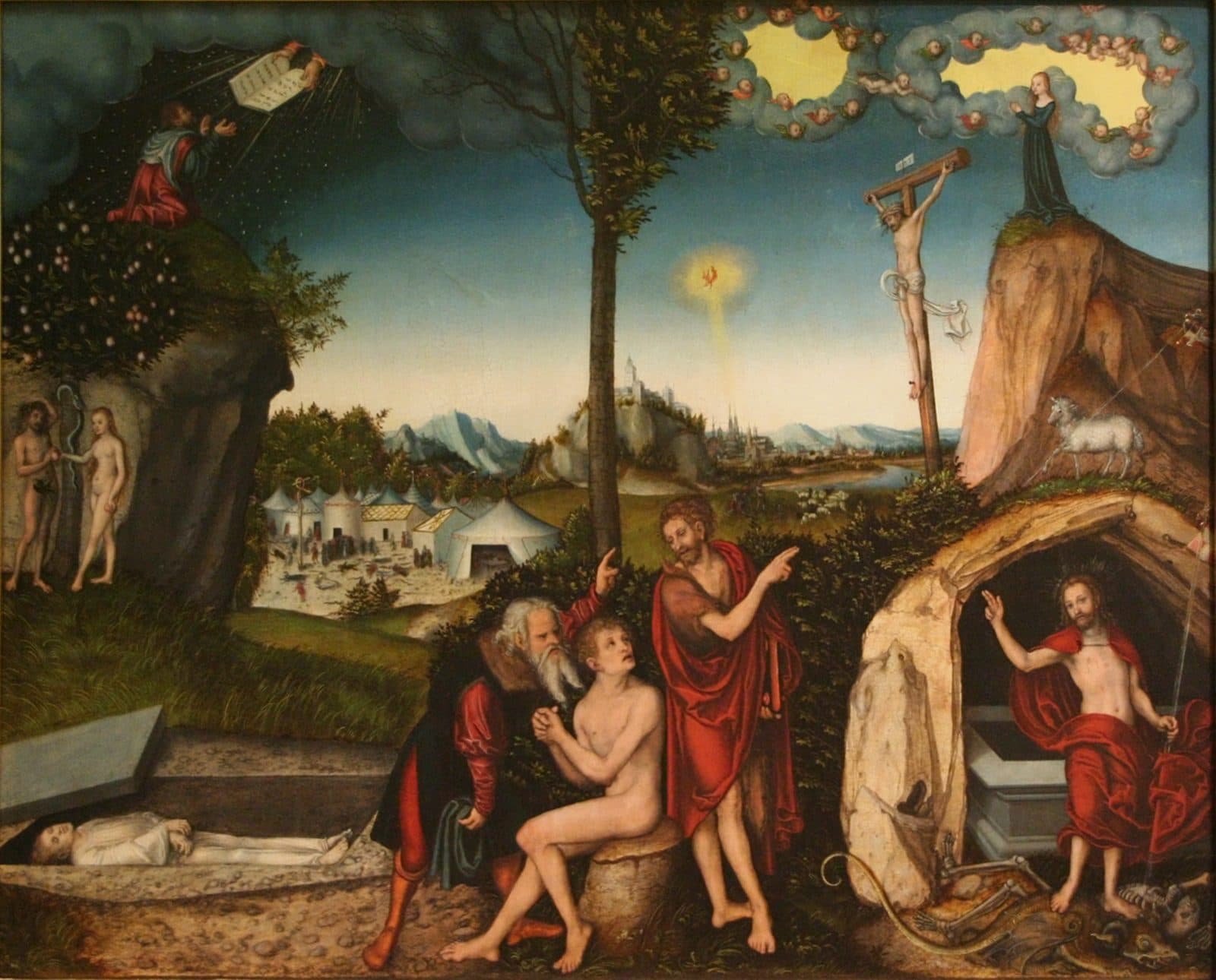
Lucas Cranach the Elder, The Law and the Gospel, c. 1529. Public domain, via Wikimedia Commons.
THE ARTWORKCranach painted this panel in Wittenberg as a lesson in Luther's teaching. Under Moses and the Law a dead man lies in his grave, and in the middle a prophet and John the Baptist point a living man to Christ crucified, the gift received by faith.
When Luther put Romans into German in 1522, he added the word allein to Paul's line on faith. Whether a sinner is justified by faith alone has divided the churches for five centuries.
Summary
The five solas are Scripture alone, grace alone, faith alone, Christ alone, and to God alone the glory.
- The Reformers argued them from 1517, and the Protestant creeds wrote them in between 1530 and 1647.
- They answered what the church of the late Middle Ages taught on indulgences, merit, the saints and the pope.
- Engelder named three of them in 1916, and a declaration of 1996 set out all five.
- Rome answered at the Council of Trent, and the Orthodox at a synod in Jerusalem in 1672.
- Besides justification, the churches still differ most on whether Tradition stands beside Scripture.
Abraham Believed, and Paul Explains
The first text the solas read and the fullest, in the Berean text.
Abram believed the LORD, and it was credited to him as righteousness.Paul builds his case for faith on this verse in Romans 4 and Galatians 3.
For it is by grace you have been saved through faith, and this not from yourselves; it is the gift of God, not by works, so that no one can boast.Three of the five phrases rest on this one sentence of Paul's.
The Five Across the Canon
Eight more texts, in the order of the canon, each beside the phrase it supports.
- What it says
- The psalmist turns the glory away from Israel and gives it to God's name
- Phrase
- Glory
- What it says
- Isaiah sends the people to the law and the testimony rather than to the mediums
- Phrase
- Scripture
- What it says
- The LORD keeps His glory for Himself and shares it with no idol
- Phrase
- Glory
- What it says
- The righteous will live by faith, the line Paul quotes in Romans and Galatians
- Phrase
- Faith
- What it says
- Jesus names Himself the one way to the Father
- Phrase
- Christ
- What it says
- Peter tells the council there is no other name under heaven by which we must be saved
- Phrase
- Christ
- What it says
- Paul sets grace and works apart as two grounds that cannot be mixed
- Phrase
- Grace
- What it says
- After facing Peter at Antioch, Paul writes that Jews by birth also have believed in Christ Jesus, to be justified by faith in Christ
- Phrase
- Faith
Each numbered card opens its verse in the reader.
The Five, One by One
Each phrase with its text and a Reformation writing behind it.
SCRIPTURE ALONE
Paul teaches that all Scripture is God-breathed, so that the man of God may be fully equipped for every good work. At the Diet of Worms in 1521 Luther would recant only if shown wrong by Scripture or by plain reason.
GRACE ALONE
Paul teaches that those who believe are justified freely by God's grace, through the redemption in Christ. Luther's Ninety-five Theses teach that a Christian who truly repents has full remission of penalty and guilt, even without letters of pardon.
FAITH ALONE
Paul teaches that a man is justified by faith apart from works of the law. Luther's Open Letter on Translating of 1530 defended his allein as the sense of Paul's words.
CHRIST ALONE
Paul teaches that there is one mediator between God and men. The Augsburg Confession, Article XXI, teaches that Scripture sets before us Christ alone as mediator and propitiation.
TO GOD ALONE THE GLORY
Paul closes his argument in Romans 11 by saying that all things are from Him and through Him and to Him. The Westminster Shorter Catechism of 1647 opens by saying that man's chief end is to glorify God and to enjoy Him forever.
Each phrase guards the others. Scripture is the rule by which the other four are known; grace is the source, faith the means, Christ the ground, and God's glory the end.
Faith and Deeds
The words faith alone stand once in the Berean text, in James.
The Council of Trent quotes James 2:24 in session 6, chapter 10, as it teaches that the justified grow in righteousness through good works.
As you can see, a man is justified by his deeds and not by faith alone.The Reformers read it with verse 17, where faith by itself, if it does not result in action, is dead.
Calvin's answer to Trent in 1547 put the Reformers' reading in one line: faith alone justifies, and the faith that justifies is never alone.
For in Christ Jesus neither circumcision nor uncircumcision has any value. All that matters is faith, expressed through love.The Reformers set this verse beside James, because Paul writes it in Galatians, the letter that argues hardest against the works of the law.
The Church of 1517, and Where the List Began
What the church taught when Luther wrote, and who first set the phrases in a list.
In the late medieval church, a baptized Christian was made righteous over a lifetime by grace working through the sacraments and good works. The merits of the saints and the prayers of the church were held to help. The faithful called on the saints, and the Mass was offered as a sacrifice for the living and the dead. The pope and the councils had the last word on what Scripture meant. The pope could grant indulgences from the treasury of the merits of Christ and the saints, and they were sold to shorten the punishment of the dead for a payment. Luther's Ninety-five Theses of 1517 were written against that sale.
Each phrase removed one of those supports and gave the work to God alone. The Council of Trent sat from 1545 to 1563 and gave the Catholic answer, condemning the Reformers' teaching point by point in its canons.
The Lutheran theologian Theodore Engelder named three principles of the Reformation in 1916: Scripture, grace and faith. The Cambridge Declaration of the Alliance of Confessing Evangelicals set out all five as five theses in 1996.
How the Churches Answer Grace, Christ and the Glory
Rome and the Orthodox on three of the phrases, each in the words of its own councils.
| Phrase | Rome | The Orthodox | Held in common |
|---|---|---|---|
| Grace | Justification begins from God's prevenient grace, apart from any merit, and the will cooperates (Trent, session 6, chapter 5) | Grace goes before every good work, and the free will works with it (Synod of Jerusalem, decree 3) | No one turns to God without grace |
| Christ | Mary's role flows from the merits of Christ (Lumen Gentium 60) | The saints intercede for us before Christ (decree 8) | Christ's death is the one ransom for sin |
| Glory | Honour to the saints and their images (Trent, session 25) | Veneration to the icons (Second Council of Nicaea, 787) | Worship belongs to God alone |
- Phrase
- Grace
- Rome
- Justification begins from God's prevenient grace, apart from any merit, and the will cooperates (Trent, session 6, chapter 5)
- The Orthodox
- Grace goes before every good work, and the free will works with it (Synod of Jerusalem, decree 3)
- Held in common
- No one turns to God without grace
- Phrase
- Christ
- Rome
- Mary's role flows from the merits of Christ (Lumen Gentium 60)
- The Orthodox
- The saints intercede for us before Christ (decree 8)
- Held in common
- Christ's death is the one ransom for sin
- Phrase
- Glory
- Rome
- Honour to the saints and their images (Trent, session 25)
- The Orthodox
- Veneration to the icons (Second Council of Nicaea, 787)
- Held in common
- Worship belongs to God alone
Four Voices, Irenaeus to Wesley
Four voices from the second century to the eighteenth, on tradition, grace, faith and the glory of God.
Irenaeus, writing about 180, speaks for the case Rome and the Orthodox make from tradition. The other three speak for the Protestant side.
“Faithfully and strenuously shalt thou resist them in defence of the only true and life-giving faith, which the Church has received from the apostles and imparted to her sons. For the Lord of all gave to His apostles the power of the Gospel, through whom also we have known the truth, that is, the doctrine of the Son of God; to whom also did the Lord declare: ‘He that heareth you, heareth Me; and he that despiseth you, despiseth Me, and Him that sent Me.’”
Irenaeus · Against Heresies Book III · on Luke 10:16Patristic
“That word of God took hold of my heart, Ye are justified freely by His grace, through the redemption that is in Christ Jesus. Rom. iii. 24. But oh! what a turn it made upon me!”
John Bunyan · Grace Abounding to the Chief of Sinners · on Romans 3:24English Puritan
“We must not assume the glory of it to ourselves, but ascribe it wholly to God. We must not imagine that we do any thing for God by our own strength, or deserve any thing from God by our own righteousness; but all the good we do is done by the power of his grace, and all the good we have is the gift of his mere mercy, and therefore he must have all the praise.”
Matthew Henry · Commentary on the Whole Bible · on Psalm 115:1Puritan
“We conclude then that a man is justified by faith - And even by this, not as it is a work, but as it receives Christ; and, consequently, has something essentially different from all our works whatsoever.”
John Wesley · Explanatory Notes upon the New Testament · on Romans 3:28Evangelical
Where the Churches Divide
Four positions on authority and justification, each with its holders and the strongest objection.
Rome, the Orthodox and the Protestant churches all hold that Scripture is inspired by God and that true faith bears works. The Wesleyan-Pentecostal tradition holds the first and the third positions below, as Wesley's Articles of Religion of 1784 state them in Articles V and IX. In the Joint Declaration, the Catholic Church and the Lutheran World Federation call the differences that remain between them on justification acceptable.
Scripture alone is the final ruleLuther, the Formula of Concord, the Westminster Confession
The Formula of Concord of 1577 calls the Scriptures the only rule and norm by which all teachers are judged. The creeds and the councils are received as far as they agree with Scripture, and the fathers are read as witnesses under it.
The objection rests on 2 Thessalonians 2:15, where Paul tells the brothers to stand firm and cling to the traditions taught by speech or by letter.
Scripture and Tradition, read by the ChurchThe Council of Trent, the Synod of Jerusalem
The Council of Trent, in session 4 in 1546, receives Scripture and the unwritten apostolic traditions with equal reverence and leaves their true sense to the Church to judge. The Synod of Jerusalem, in decree 2, believes Scripture as the Catholic Church has interpreted it and names one Holy Spirit the author of both.
The objection rests on Mark 7:13, where Jesus says a tradition handed down nullifies the word of God.
Justified by faith aloneThe Augsburg Confession, the Westminster Confession
The Augsburg Confession, Article IV, confesses that people are justified freely for Christ's sake through faith. The righteousness that justifies is Christ's, counted to the sinner, and faith is the hand that receives it; works follow as fruit.
The objection rests on James 2:24, read above beside Galatians 5:6.
Justified by faith working through loveThe Council of Trent, the Synod of Jerusalem
The Council of Trent, in session 6, chapter 8, calls faith the beginning of justification, and its canon 9 condemns justification by faith alone with nothing else required. Grace makes the sinner inwardly righteous, and faith justifies together with the hope and love grace gives. The Synod of Jerusalem holds this position in decree 13.
The objection rests on Romans 4:5, where faith is credited as righteousness to the one who does not work but believes.
Books to Read Next
The primary texts of the Protestant, Catholic and Orthodox churches, earliest first.
The Freedom of a Christian
Martin Luther · 1520
Luther wrote this short statement of faith, grace and good works for a lay reader.
Institutes of the Christian Religion
John Calvin · 1559
Book three sets out justification by faith at length, in the final Latin edition.
Read it free at CCELThe Book of Concord
The Lutheran confessions · 1580
This volume holds the Augsburg Confession and the Formula of Concord, the Lutheran statement of the solas.
The Canons and Decrees of the Council of Trent
Council of Trent, trans. J. Waterworth · 1848
Session four sets out Scripture and Tradition, and session six sets out justification with thirty-three canons.
The Acts and Decrees of the Synod of Jerusalem
The Synod of Jerusalem, trans. J. N. W. B. Robertson · 1899
The synod gives the Orthodox answer to the Reformation, with the Confession of Dositheus in full.
The Joint Declaration on the Doctrine of Justification
The Lutheran World Federation and the Catholic Church · 1999
In paragraph 15 the two churches confess together that salvation is by grace alone.
In print: find it wherever books are sold.
Whatever You Do
Where the solas lead in the believer's daily life.
The fifth phrase gives the glory to God alone, and Paul makes that a rule for ordinary days.
So whether you eat or drink or whatever you do, do it all to the glory of God.Paul gives this rule as he answers the question of food offered to idols.
Keep studying
Studies6