
Psalm 13 · Passage · Featured Study
The Lament Form in the Psalter
Psalms 6, 13, 22, 44 and 88 show where a lament turns from complaint to trust, and where it never turns.
Psalm 13 asks the LORD how long four times and ends by saying that He has been good to me.
- The passage
- Psalm 13:1 to 6, Psalm 22:1 to 24, Psalm 88:1 to 18
- Book
- Psalms
- Hold in memory
- Psalm 13:5, Psalm 62:8
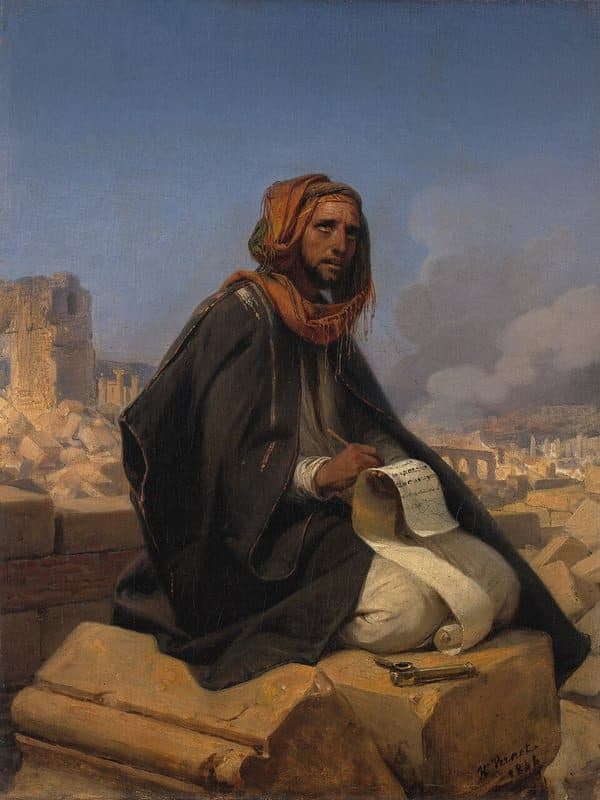
Horace Vernet, Jeremiah on the Ruins of Jerusalem, 1844, Amsterdam Museum. Public domain, via Wikimedia Commons.
THE ARTWORKVernet painted Jeremiah writing among the fallen stones of Jerusalem with smoke rising over the city. Psalm 79 laments the same ruin, a Jerusalem reduced to rubble.
Summary
A psalm of lament is a prayer from trouble that speaks to God, complains to Him, asks Him to act and turns to trust. Psalm 13 holds every part in six verses.
- Verses 1 and 2 complain, verses 3 and 4 ask the LORD to answer, and verses 5 and 6 trust Him and promise praise.
- The turn rests on the LORD's loving devotion.
- Some laments speak for one person and some for the whole people, as Psalm 44 does.
- Psalm 88 complains and prays to its eighteenth verse, which ends in darkness.
- Jesus cried the first line of Psalm 22, a lament, from the cross.
Psalm 13 in Six Verses
Psalm 13:1 to 6, the shortest whole lament
The first two verses are the address and the complaint. The complaint is put to God as a question.
How long, O LORD? Will You forget me forever? How long will You hide Your face from me? How long must I wrestle in my soul, with sorrow in my heart each day? How long will my enemy dominate me?The complaint moves from God to the psalmist's own soul and then to his enemy.
The next two verses are the petition, a plea for God to answer.
Consider me and respond, O LORD my God. Give light to my eyes, lest I sleep in death, lest my enemy say, “I have overcome him,” and my foes rejoice when I fall.The petition gives God reasons to act, and each reason is a danger the psalmist names.
The last two verses turn from complaint to trust and close with a vow to sing.
But I have trusted in Your loving devotion; my heart will rejoice in Your salvation. I will sing to the LORD, for He has been good to me.The dangers named in verses 3 and 4 still stand when the turn comes.
The Hebrew text counts the heading of the psalm as its first verse, so Rashi's comment on Psalm 13:2 is a comment on the first verse of the Berean text.
The Parts in Five Psalms
One row for each psalm, with the verse that carries its complaint, its petition and its turn
| Psalm | The complaint | The petition | The turn |
|---|---|---|---|
| Psalm 13 | How long, O LORD? (verse 1) | Consider me and respond (verse 3) | But I have trusted in Your loving devotion (verse 5) |
| Psalm 6 | How long, O LORD, how long? (verse 3) | Turn, O LORD, and deliver my soul (verse 4) | The LORD accepts my prayer (verse 9) |
| Psalm 22 | Why have You forsaken me? (verse 1) | Come quickly to help me (verse 19) | You have answered me! (verse 21) |
| Psalm 44 | But You have rejected and humbled us (verse 9) | Rise up; be our help! (verse 26) | None; it ends on the petition |
| Psalm 88 | My soul is full of troubles (verse 3) | Incline Your ear to my cry (verse 2) | None; it ends in darkness (verse 18) |
- Psalm
- Psalm 13
- The complaint
- How long, O LORD? (verse 1)
- The petition
- Consider me and respond (verse 3)
- The turn
- But I have trusted in Your loving devotion (verse 5)
- Psalm
- Psalm 6
- The complaint
- How long, O LORD, how long? (verse 3)
- The petition
- Turn, O LORD, and deliver my soul (verse 4)
- The turn
- The LORD accepts my prayer (verse 9)
- Psalm
- Psalm 22
- The complaint
- Why have You forsaken me? (verse 1)
- The petition
- Come quickly to help me (verse 19)
- The turn
- You have answered me! (verse 21)
- Psalm
- Psalm 44
- The complaint
- But You have rejected and humbled us (verse 9)
- The petition
- Rise up; be our help! (verse 26)
- The turn
- None; it ends on the petition
- Psalm
- Psalm 88
- The complaint
- My soul is full of troubles (verse 3)
- The petition
- Incline Your ear to my cry (verse 2)
- The turn
- None; it ends in darkness (verse 18)
Where the Turn Comes
Psalm 22:21 to 22, Psalm 77:7 to 11 and the refrain of Psalms 42 and 43
In Psalm 22 the turn falls in the middle of a verse. A plea for rescue becomes a report that God has answered, and the vow follows at once.
Save me from the mouth of the lion; at the horns of the wild oxen You have answered me! I will proclaim Your name to my brothers; I will praise You in the assembly.The cry of verse 1 is answered here, twenty verses later.
In Psalm 77 the turn comes by memory.
“Will the Lord spurn us forever and never show His favor again? Is His loving devotion gone forever? Has His promise failed for all time? Has God forgotten to be gracious? Has His anger shut off His compassion?” Selah So I said, “I am grieved that the right hand of the Most High has changed.” I will remember the works of the LORD; yes, I will remember Your wonders of old.Five questions about God's favor, devotion and promise end in a resolve to remember.
Psalms 42 and 43 make the turn three times in one refrain.
Why are you downcast, O my soul? Why the unease within me? Put your hope in God, for I will yet praise Him, my Savior and my God.The psalmist speaks to himself and holds to the praise he has not yet given.
What the Text Says and What Is Often Said
Three common claims about the laments, each with the verse that answers it
COMPLAINT TO GOD
It is often said that to complain to God is to doubt Him. Psalm 142 calls its own prayer a complaint poured out before the LORD.
THE ENDING
It is often said that every lament ends in praise. Psalm 88 prays to its last verse and never turns to trust.
THE TURN
It is often said that the turn comes when the trouble ends. Psalm 6 turns while its enemies still stand, and their shame is yet to come.
Laments of One and of Many
The single voice of Psalm 13 and the people's voice of Psalm 44
Psalm 44 keeps another order than Psalm 13: it remembers what God did for the fathers, then complains that He has rejected His people, and only then pleads.
Wake up, O Lord! Why are You sleeping? Arise! Do not reject us forever. Why do You hide Your face and forget our affliction and oppression? For our soul has sunk to the dust; our bodies cling to the earth. Rise up; be our help! Redeem us on account of Your loving devotion.The people rest their plea on God's loving devotion, the ground of the turn in Psalm 13.
Psalms 74, 79 and 80 also speak for the people: Psalm 74 asks why, Psalm 79 asks how long, and Psalm 80 asks God to make His face shine on them.
The headings give Psalms 13 and 22 to David and Psalm 88 to Heman the Ezrahite, whom Rashi names as one of the musicians. No lament in the Psalter carries a date.
What the Text Leaves Unsaid
Three things the laments leave open
The Psalter gives the lament no name and lists no parts; the address, the complaint, the petition and the turn are a pattern readers find in the psalms. Psalm 13 does not say what happened between its fourth verse and its fifth, whether an answer came or only trust.
Psalm 88 gives no cause for its trouble and names no end to it.
The Lament on the Lips of Jesus
Matthew 27:46, Hebrews 5:7 and the cries of the New Testament
On the cross Jesus took the first words of Psalm 22 as his own prayer.
About the ninth hour Jesus cried out in a loud voice, “Eli, Eli, lema sabachthani?” which means, “My God, My God, why have You forsaken Me?”The psalm whose first line Jesus prays goes on to its turn and its praise in the assembly.
During the days of Jesus’ earthly life, He offered up prayers and petitions with loud cries and tears to the One who could save Him from death, and He was heard because of His reverence.Hebrews says the Son prayed as the lament prays.
The New Testament keeps the lament's questions and groans. The souls under the altar cry how long, O Lord, and Paul says the Spirit intercedes for believers with groans too deep for words.
Teachers on the Laments
Charles Spurgeon, Matthew Henry, John Wesley, Albert Barnes and John Calvin
Spurgeon counts the four questions of Psalm 13 and hears in them both anguish and the risk of impatience.
“‘How long?’ This question is repeated no less than four times. It betokens very intense desire for deliverance, and great anguish of heart. And what if there be some impatience mingled therewith; is not this the more true a portrait of our own experience? It is not easy to prevent desire from degenerating into impatience. O for grace that, while we wait on God, we may be kept from indulging a murmuring spirit! ‘How long?’ Does not the oft-repeated cry become a very howling? And what if grief should find no other means of utterance?”
Charles Spurgeon · The Treasury of David, Vol. 1 · on Psalm 13:1
Henry finds the source of the psalm's last verses in faith in God's mercy.
“His faith in God's mercy filled his heart with joy in his salvation; for joy and peace come by believing, Rom. xv. Believing, you rejoice, 1 Pet. i. Having put his trust in the mercy of God, he is fully assured of salvation, and that his heart, which was now daily grieving, should rejoice in that salvation.”
Matthew Henry · Commentary on the Whole Bible · on Psalm 13:5 to 6Puritan
Spurgeon reads the last line of Psalm 13 as the answer to its first.
“The Psalm closes with a sentence which is a refutation of the charge of forgetfulness which David had uttered in the first verse, ‘He hath dealt bountifully with me.’ So shall it be with us if we wait awhile. The complaint which in our haste we utter shall be joyfully retracted, and we shall witness that the Lord hath dealt bountifully with us.”
Charles Spurgeon · The Treasury of David, Vol. 1 · on Psalm 13:6
Wesley on the vow of Psalm 13Explanatory Notes upon the Old Testament, on Psalm 13:6
Wesley explains why the psalmist can sing of a deliverance he has not yet seen. David and the prophets, he says, speak of future deliverances as if they were already come, to show that they are certain.
Barnes on the words of Psalm 13Notes on Psalm 13:1 and 13:5
Barnes notes that the Hebrew behind how long reads literally until when. He reads the salvation of verse 5 as rescue from the present trouble rather than the life to come.
Spurgeon on the turn of Psalm 22The Treasury of David, on Psalm 22:22 to 31
Spurgeon reads the second half of Psalm 22 as Christ's thoughts on the cross after the darkness passed.
“The transition is very marked; from a horrible tempest all is changed into calm. The darkness of Calvary at length passed away from the face of nature, and from the soul of the Redeemer, and beholding the light of his triumph and its future results the Saviour smiled. We have followed him through the gloom, let us attend him in the returning light. It will be well still to regard the words as a part of our Lord's soliloquy upon the cross, uttered in his mind during the last few moments before his death.”
Charles Spurgeon · The Treasury of David, Vol. 1 · on Psalm 22:22 to 31
Spurgeon on the one light of Psalm 88The Treasury of David, on Psalm 88:1
Spurgeon finds the hope of Psalm 88 in the name the psalmist calls God by in its first line.
“O Lord God of my salvation. This is a hopeful title by which to address the Lord, and it has about it the only ray of comfortable light which shines throughout the Psalm. The writer has salvation, he is sure of that, and God is the sole author of it. While a man can see God as his Saviour, it is not altogether midnight with him. While the living God can be spoken of as the life of our salvation, our hope will not quite expire.”
Charles Spurgeon · The Treasury of David, Vol. 4 · on Psalm 88:1
But to You, O LORD, I cry for help; in the morning my prayer comes before You.The psalmist keeps praying each morning though no turn comes.
Calvin on the fathers in Psalm 44Commentaries, on Psalm 44:1
Calvin weighs the people's appeal to what they heard from their fathers.
“The expression, We have heard with our ears, is not to be considered as a redundant form of speech, but one of great weight. It is designed to point out that the grace of God towards their fathers was so renowned, that no doubt could be entertained respecting it.”
John Calvin · Commentaries · on Psalm 44:1Reformed
Two Questions the Laments Raise
Whether the complaint is a fault, and whose voice speaks
The complaint is an infirmity the psalm retractsMatthew Henry, Commentary on the Whole Bible; Charles Spurgeon, The Treasury of David
Henry says David took his trouble as God's unkindness and calls the thought his infirmity. Spurgeon asks whether God can forget and answers that He cannot.
The objection: the psalmist brings the charge to God Himself and asks Him to answer it, which is itself an act of trust.
The complaint is pleading made to GodAlbert Barnes, Notes on the Old Testament; John Calvin, Commentaries on the Psalms
Barnes, on Psalm 44:24, calls such language solemn petition and affectionate pleading rather than complaint. Calvin sets the believer's prayer against the ungodly, who come to God with murmurs, howling rather than praying.
The objection: Psalm 13 itself retracts its charge that God forgets, so the psalm treats the charge as something to be left behind.
Christ speaks in the lamentAugustine, Exposition on Psalm 88; Jerome, Homily 65
Augustine hears the voice of Christ singing in the psalm, and Jerome agrees.
“‘O Lord, the God of my salvation.’ This psalm is spoken in the person of the Savior, that is, in the person of that servant whom He deigned to take upon Himself. Whatever, therefore, is spoken humbly is narrated in the human person, because it profits human salvation. ‘I have cried in the day, and in the night before thee.’ Though I cried by night, yet the awareness of virtues was light to me.”
Jerome · Homily 65, on Psalm 87 (Alternate Series) · on Psalm 88:1Patristic
The objection: Henry says only that some make the psalmist a type of Christ, and reads the psalm first as the prayer of its own author.
Israel speaks as one manRashi, Commentary on Psalms
Rashi reads the four questions of Psalm 13 as the four kingdoms, Babylon, Persia, Greece and Edom, and says the psalm is stated concerning all Israel. On Psalm 22 he says the psalmist speaks of all Israel as one man.
The objection: Psalm 13 speaks of my enemy and my soul, the words of one person.
Where the readings part: Hebrews 2:12 gives the vow of Psalm 22:22 to Christ. The Christian reading therefore hears Christ in the psalm where Rashi hears Israel.
Pour Out Your Hearts before Him
Psalm 62:8
Trust in Him at all times, O people; pour out your hearts before Him. God is our refuge. SelahPsalm 62:8 commands the pouring out of the heart before God that every lament performs.
The lament asks the reader to bring trouble to God in words, to ask Him plainly and to hold to His loving devotion before the answer comes. Those who follow Christ may pray these psalms after him.
Keep studying
Studies8