
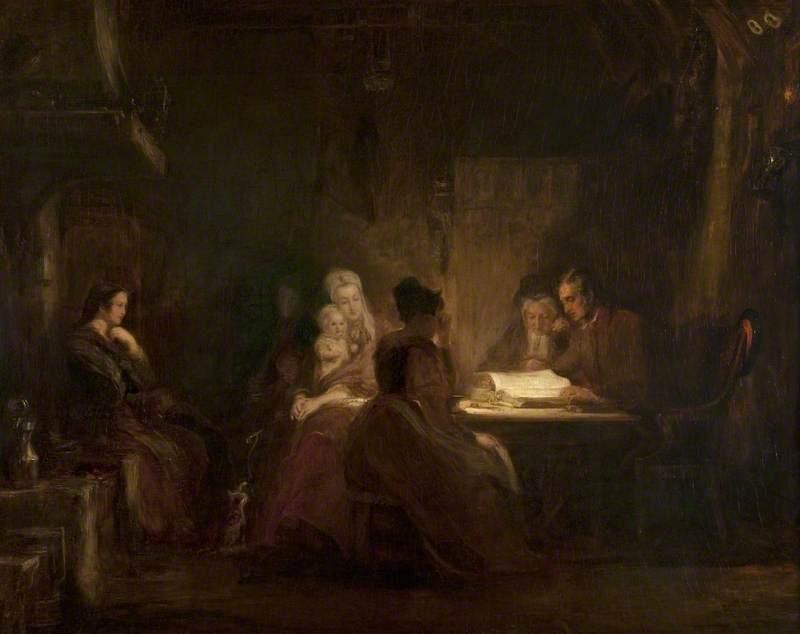
David Wilkie, The Cottar's Saturday Night, by 1841. Public domain.
Ecclesiastes 12 and Deuteronomy 6 · Passage · Featured Study
The Whole Duty of Man
Most of the texts that sum up God's demand join a fear or a love of God to the keeping of His commandments.
When all has been heard, the conclusion of the matter is this: Fear God and keep His commandments, because this is the whole duty of man.
- The passage
- Ecclesiastes 12:13, Deuteronomy 6:1 to 2, Deuteronomy 6:20, Deuteronomy 6:24 to 25, Job 2:3, Jeremiah 35:18, John 14:15
- Books
- Ecclesiastes, Deuteronomy, Job, Jeremiah, John
- Hold in memory
- Deuteronomy 6:2
When a son asks what the commandments mean, Deuteronomy 6 gives the father's answer, and it opens with the words “We were slaves of Pharaoh in Egypt.”
Summary
Ecclesiastes ends with a charge: fear God and keep His commandments. The Teacher calls this the whole duty of man. Moses gave Israel the same pair before it entered the land. Jesus and John join love to the keeping in the same way.
- Deuteronomy 6 names the fear of the LORD at its start, near its middle and at its end.
- Jeremiah 35:19 promises that Jonadab will never lack a man to stand before the LORD.
- Job 28:28 calls the fear of the Lord wisdom.
The Charge
Ecclesiastes closes its search with a charge, and Deuteronomy 6 opens with one.
The Whole Duty of Man reads the last charge of Ecclesiastes beside Deuteronomy 6 and the other texts that sum up what God asks.
These are the commandments and statutes and ordinances that the LORD your God has instructed me to teach you to follow in the land that you are about to enter and possess, so that you and your children and grandchildren may fear the LORD your God all the days of your lives by keeping all His statutes and commandments that I give you, and so that your days may be prolonged.Moses gives the aim of the commandments before he gives the commandments themselves.
Deuteronomy 6:10 to 12 warns that the gift of the land is the danger. Cities, houses, wells and vineyards that Israel did not make could lead it to forget the LORD.
What God Asks
The texts come from Moses, Job, the close of Ecclesiastes, Jesus and John.
Moses speaks four of the eight texts, more than any other speaker.
- Who speaks
- Moses
- What it joins
- Fear and keeping
- Who speaks
- Moses
- What it joins
- Fear, service and oaths
- Who speaks
- Moses
- What it joins
- Keeping and fear
- Who speaks
- Moses
- What it joins
- Fear, walking, love, service and keeping
- Who speaks
- God, speaking to man
- What it joins
- Fear and turning from evil
- Who speaks
- The close of Ecclesiastes
- What it joins
- Fear and keeping
- Who speaks
- Jesus
- What it joins
- Love of God and love of neighbor
- Who speaks
- John
- What it joins
- Love and keeping
Deuteronomy 10:12 to 13 names five duties, more than any other text of the eight.
Matthew 22:37 to 40, 1 John 5:3
Deuteronomy 6 Around the Shema
The statutes are named before the Shema and again in the last paragraph of Deuteronomy 6.
Read The Shema, on Deuteronomy 6:4 to 9
In the future, when your son asks, “What is the meaning of the decrees and statutes and ordinances that the LORD our God has commanded you?”A question from the next generation opens the last paragraph of the chapter.
And the LORD commanded us to observe all these statutes and to fear the LORD our God, that we may always be prosperous and preserved, as we are to this day. And if we are careful to observe every one of these commandments before the LORD our God, as He has commanded us, then that will be our righteousness.”The answer closes on righteousness, a word Deuteronomy 6 uses only here.
Who Kept It
Job feared God, and the Rechabites kept a father's command.
Then the LORD said to Satan, “Have you considered My servant Job? For there is no one on earth like him, a man who is blameless and upright, who fears God and shuns evil. He still retains his integrity, even though you incited Me against him to ruin him without cause.”The second time the LORD speaks of Job, He repeats Job 1:8 word for word before He adds a clause.
Then Jeremiah said to the house of the Rechabites: “This is what the LORD of Hosts, the God of Israel, says: ‘Because you have obeyed the command of your forefather Jonadab and have kept all his commandments and have done all that he charged you to do,The promise that follows in Jeremiah 35:19 is the reward for this obedience.
Where the Charge Leads
Fear, obedience and love are each taught as a value.
The first duty of the charge is the fear of God.
The second duty is keeping His commandments.
Love for God is the first commandment of Matthew 22:38.
How the Teachers Read It
Calvin and Henry wrote on Deuteronomy, and Clarke on the close of Ecclesiastes.
John Calvin (1509 to 1564)
Calvin read an order in the duties Moses names.
“Hence it is more evident why He has just declared that there is One God, viz., that He alone may be undividedly worshipped; for unless our minds are fixed on Him alone, religion is torn, as it were, into divers parts, and this is soon followed by a labyrinth of errors. But, first, he calls for reverence, and then for the worship which may testify and demonstrate it.”
John Calvin · Commentaries · on Deuteronomy 10:13Reformed
Matthew Henry (1662 to 1714)
Henry drew from Deuteronomy 6:2 a rule for nations as well as households.
“The entail of religion in a family, or country, is the best entail: it is highly desirable that not we only, but our children, and our children's children, may fear the Lord. Religion and righteousness advance and secure the prosperity of any people.”
Matthew Henry · Commentary on the Whole Bible · on Deuteronomy 6:2Puritan
Adam Clarke, in his Commentary on the Bible (1832), called the charge the sum of the great business of human life. He drew from it three duties: to know that God is, to reverence Him and to love Him.
Love and Keeping
Jesus spoke these words in the conversation in which Thomas and Philip question Him (John 14:5 and John 14:8).
If you love Me, you will keep My commandments.Sources
Scripture is the Berean Standard Bible.
- John Calvin, Commentaries (1554), on Deuteronomy 10:13.
- Matthew Henry, Commentary on the Whole Bible (1710), on Deuteronomy 6:2.
- Adam Clarke, Commentary on the Bible (1832), on Ecclesiastes 12:13.
Keep Studying
Read it5
Studies7
People and groups1
Trials of life1
Doctrines1
Go further3