
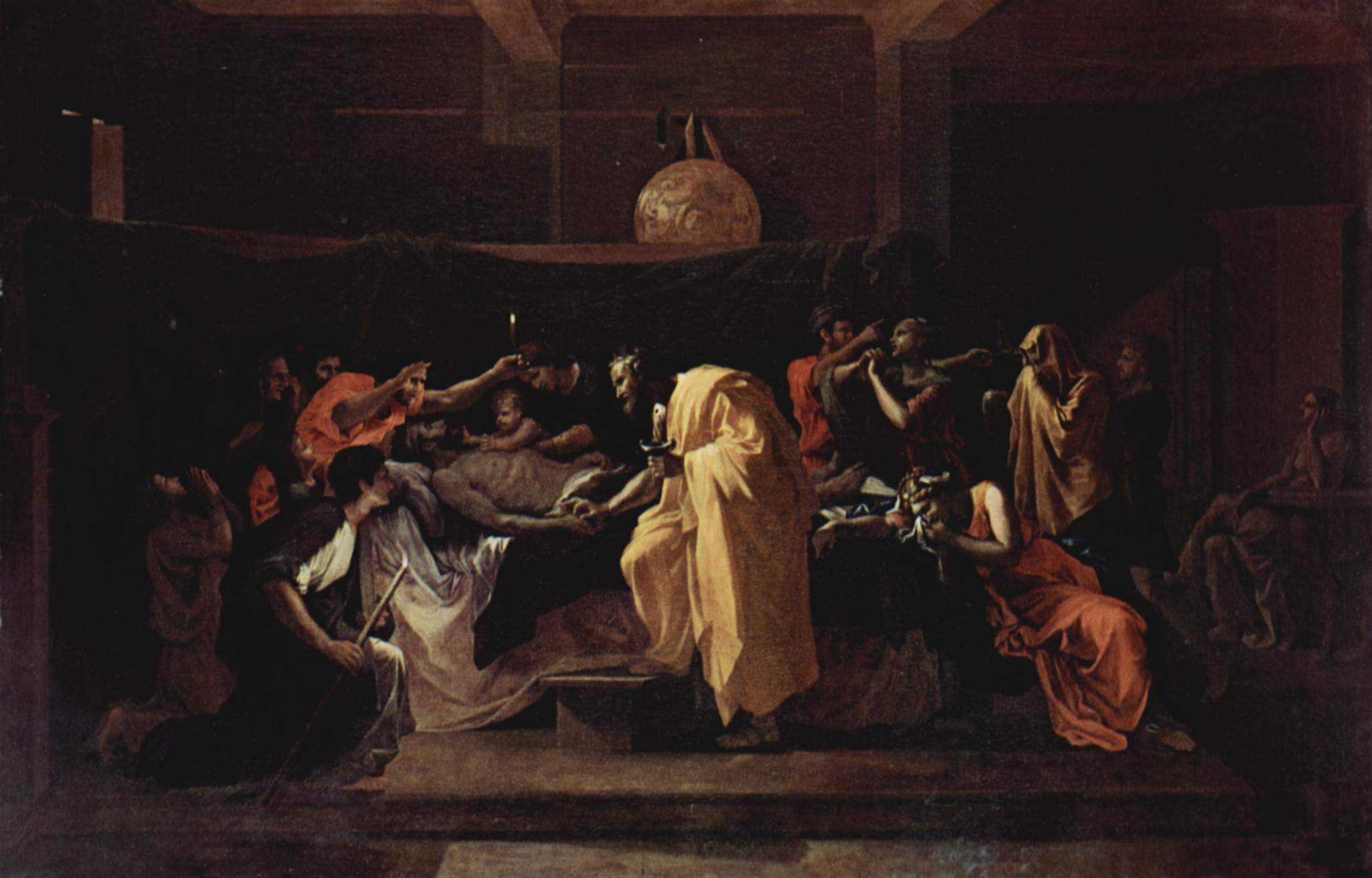
James 5:13 to 16 · Passage · Illness and Pain
Is Any One of You Sick?
James 5:13 to 16 names what the suffering, the cheerful and the sick are each to do.
The verb James uses for the sick man's recovery in James 5:15 is the verb of the letter's last verse, where a sinner turned back is saved from death.
Is any one of you sick? He should call the elders of the church to pray over him and anoint him with oil in the name of the Lord.
- The passage
- James 5:13 to 16, James 5:17 to 18, Mark 6:13, Luke 10:34, John 9:3
- Books
- James, Mark, Luke, John
- Hold in memory
- James 5:15, James 5:16
Summary
James 5:13 to 16 gives the church its order for a sick believer, set among commands for every state of life. The prayer of the elders and the anointing in the Lord's name stand together, and the promise of recovery rests on the Lord, who answers prayer offered in faith. The passage closes the letter and leaves the outcome of every sickness with God.
- The sick believer is the one who sends, and the men he calls are the elders of his own church.
- James joins the forgiveness of sins to the recovery with an if, so he leaves room for sickness that no sin of the sick man caused.
- Readers have taken the oil as a medicine, as a sign of the Lord's work, as a sacrament for the dying and as a gift for the apostles' day.
- James proves the power of prayer from Elijah, whom he calls a man just like us.
The Sick Call the Elders
The Greek verbs show who acts first when a believer falls sick.
Is Any One of You Sick? reads James 5:13 to 16, with James 5:17 to 18 as its close. It is one of the texts the church has read in the trial of illness and pain.
The question it answers is what James asks of the sick believer, of the elders and of the whole church, and what he promises them. It gives the order of the passage and the Greek of the words for restoring and raising up. It weighs what the oil was and the tie James draws between sin and sickness.
Is any one of you suffering? He should pray. Is anyone cheerful? He should sing praises.The verse opens the passage with hardship and cheer, so sickness in the next verse is one state of life among others.
The first verb of James 5:13 is kakopathei, glossed “Is suffering hardships”, and the second is euthumei, “Is cheerful”. Each question is answered by a command in the third person.
James 5:14 keeps the form. Its verb for the sick man is asthenei, from astheneo, to be feeble in any sense. The command that follows, proskalesastho, he should call near, puts the first step in the sick man's hands. The men he sends for are the presbyteroi of the church, its elders.
The elders do two things together. They pray over him, and the participle aleipsantes, having anointed, tells what they do as they pray, with elaion, olive oil, under the Lord's name.
From the Sufferer to Elijah
James names who prays in each state of life and closes with the prophet who prayed for drought and for rain.
James widens prayer from one believer to the elders and the whole church, and grounds it in a prophet.
| Step | Verse | Who acts | What James asks or promises |
|---|---|---|---|
| 1 Suffering | James 5:13 | the believer in hardship | He brings his hardship to God in prayer. |
| 2 Cheer | James 5:13 | the cheerful believer | He turns his gladness into songs of praise. |
| 3 Sickness | James 5:14 | the sick believer and the elders | He sends for the elders, who pray over him and anoint him. |
| 4 The promise | James 5:15 | the Lord | He restores the sick man and forgives him, if there is sin. |
| 5 Confession | James 5:16 | the whole church | Believers confess their sins to one another and pray for healing. |
| 6 The example | James 5:17 to 18 | Elijah | His prayers shut the sky for years and then brought the rain. |
Restore and Raise Up
Two Greek verbs carry the promise of James 5:15, and both have the sick man as their object.
And the prayer offered in faith will restore the one who is sick. The Lord will raise him up. If he has sinned, he will be forgiven.The verse holds the promise of the passage, and its two verbs carry the weight of the section.
The verb rendered “will restore” is sozo, glossed to save, that is, to deliver or protect, literally or figuratively. It stands 105 times in the New Testament, five of them in James. The Berean gives it as “save” in James 1:21, where the word planted in you “can save your souls”, and as “restore” for the sick man here.
The second verb, egeirei, is from egeiro, to waken or rouse. Its gloss names the ways a man is raised, from sleep, from sitting or lying, from disease and from death.
James names the sick man differently in the two verses. In James 5:14 he is the one who is feeble, and in James 5:15 he is ton kamnonta, the one who is worn out. Kamno means to toil and so to tire, faint or sicken, and it stands in only two other verses, Hebrews 12:3 and Revelation 2:3.
The prayer itself is euche, a word glossed as a wish expressed as a petition to God.
Sin and Sickness
Paul and Jesus each speak to the tie between sin and sickness.
James writes the forgiveness with an if, as a condition. Scripture records sickness that followed sin. Paul told the Corinthians that their abuse of the Lord's Supper was the reason “many among you are weak and sick” (1 Corinthians 11:30). Jesus told the man healed at Bethesda, “Stop sinning, or something worse may happen to you” (John 5:14).
Jesus answered, “Neither this man nor his parents sinned, but this happened so that the works of God would be displayed in him.Jesus answers the disciples' question about a man born blind by denying that his blindness came from his own sin or his parents' sin.
James holds both cases in one sentence. The sick man is anointed and prayed for whether or not he has sinned, and if he has, the forgiveness comes with the recovery.
Therefore confess your sins to each other and pray for each other so that you may be healed. The prayer of a righteous man has great power to prevail.James draws the conclusion of the passage with Therefore and ties confession to healing.
The command to confess is exomologeisthe, and the healing is iathete, an aorist passive. Confession and prayer pass between believers, to each other and for each other.
Patience Before Prayer
The passage follows James's call to patient endurance and closes his letter.
The verses before the passage call the brothers to be patient “until the Lord's coming” (James 5:7) and give Job's perseverance as the example of patience in affliction (James 5:11). Those who suffer, rejoice or fall sick in James 5:13 to 14 are the same patient believers, and prayer is what James gives them to do while they wait.
The letter ends two verses after Elijah with a brother who wanders from the truth and is brought back (James 5:19 to 20). Prayer for the sick body and care for the straying soul stand side by side at the close of the letter.
Elijah, a Man Like Us
The prophet's story stands in 1 Kings 17 and 18, and Jesus gives the same length of drought.
Elijah was a man just like us. He prayed earnestly that it would not rain, and it did not rain on the land for three and a half years. Again he prayed, and the heavens gave rain, and the earth yielded its crops.James closes his teaching on prayer with an example from the history of the kings.
Elijah told Ahab there would be “neither dew nor rain in these years except at my word” (1 Kings 17:1). The word of rain came “in the third year of the drought” (1 Kings 18:1). Elijah then climbed Carmel and “put his face between his knees” (1 Kings 18:42).
Jesus gives the shut sky the same length as James does (Luke 4:25). The history in 1 Kings records the drought and the rain at Elijah's word, and James reads both as answers to prayer.
How the Passage Has Been Taught
Augustine of Hippo and Adam Clarke on the confession and prayer of James 5:16.
died 430 · Augustine of Hippo
Augustine of Hippo grounded the duty of praying for one another in Christ's own prayer.
The reading1 paragraph
Augustine of Hippo, in his Tractates on the Gospel of John (tractate 58), took up James's command to confess and pray. He reasoned, “For if He who neither has, nor had, nor will have any sin, prays for our sins,” then believers ought all the more to pray for one another and forgive one another.
1762 to 1832 · Adam Clarke
Adam Clarke read the command as a rule for the common life of believers.
The reading1 paragraph
Adam Clarke, in his Commentary on the Bible (1832), called it “a good general direction to Christians who endeavor to maintain among themselves the communion of saints”. He added, “This social confession tends much to humble the soul, and to make it watchful.”
What the Oil Is
A Church council, a medieval theologian and Protestant commentators give their answers, each met by an objection.
A medicine applied with prayerAlbert Barnes
Albert Barnes, in his Notes on the New Testament, held that “the anointing with oil was, in accordance with a common custom, regarded as medicinal”. The Samaritan of Jesus' parable used oil on a stranger's wounds.
He went to him and bandaged his wounds, pouring on oil and wine. Then he put him on his own animal, brought him to an inn, and took care of him.The Samaritan's oil shows olive oil used as a remedy for the body in the Gospels.
The objection came from Matthew Henry, in his Commentary on the Whole Bible (1710). He observed “that the saving of the sick is not ascribed to the anointing with oil, but to prayer”.
A sign of the Lord's workJamieson, Fausset and Brown
Jamieson, Fausset and Brown wrote of James 5:15 in their Commentary Critical and Explanatory on the Whole Bible (1871). “He does not say the oil shall save: it is but the symbol.” The Twelve anointed the sick on the mission Jesus sent them on.
They also drove out many demons and healed many of the sick, anointing them with oil.The Twelve's anointing of the sick is the other place in the New Testament where the sick are anointed with oil and healed.
The objection came from the Council of Trent. Its first canon on the rite condemned anyone who called it “only a rite received from the Fathers, or a human figment”.
A gift of healing for the apostles' dayJohn Calvin
John Calvin, in his Institutes of the Christian Religion (book 4, chapter 19), wrote that James spoke “agreeably to the time when the Church still enjoyed this blessing from God”.
The objection came from John Wesley, in his Explanatory Notes upon the New Testament (1755). He called the anointing with prayer “the whole process of physic in the Christian church, till it was lost through unbelief.”
A sacrament of the sick in danger of deathThe Council of Trent; Bonaventure
The Council of Trent, in its fourteenth session, taught that “this sacred unction of the sick was instituted by Christ our Lord”. It called the rite “truly and properly a sacrament of the new law”, “promulgated to the faithful by James the Apostle”. It added that the unction belongs to the sick, “but to those especially who lie in such danger as to seem to be about to depart this life”.
Bonaventure, in his Breviloquium, had called extreme unction “the Sacrament of those departing from this life”.
The objection came from John Calvin, in the same chapter of the Institutes. He concluded that “their unction is no sacrament”.
The Lord Who Raises
James puts the sick believer inside a praying church.
The raising up belongs to the Lord, and care for the body goes on beside the prayer.
Sources
Scripture is the Berean Standard Bible.
- STEP Bible, Translators Amalgamated Greek New Testament (Tyndale House, Cambridge), CC BY 4.0.
- STEP Bible brief lexicons of Extended Strongs for Greek (Tyndale House, Cambridge), CC BY 4.0, with the Strong's glosses.
- The Canons and Decrees of the Sacred and Oecumenical Council of Trent, Session 14, on extreme unction, chapters I and III and canon I, ed. and trans. J. Waterworth (London: Dolman, 1848)
- John Calvin, Institutes of the Christian Religion, book 4, chapter 19, sections 19 and 20, trans. Henry Beveridge (first published 1845)
- Albert Barnes, Notes, Explanatory and Practical, on the New Testament (1832 to 1869), on James 5:14.
- Robert Jamieson, A. R. Fausset and David Brown, Commentary Critical and Explanatory on the Whole Bible (1871), on James 5:15.
- Bonaventure, Breviloquium (1257), part 6.
- John Wesley, Explanatory Notes upon the New Testament (1755), on James 5:14.
- Matthew Henry, Commentary on the Whole Bible (1710), on James 5:14 to 15.
- Adam Clarke, Commentary on the Bible (1832), on James 5:16.
- Augustine of Hippo, Tractates on the Gospel of John, tractate 58, trans. John Gibb, Nicene and Post-Nicene Fathers, First Series, vol. 7 (1888)
Keep Studying
Read it1
People and groups13
Show the next 6 titles
Show the next 1 title
In this trial5
Trials of life1