
Acts 15 · Featured Study
The Jerusalem Council
One sentence out of Judea nearly ended the Gentile mission before it started: except ye be circumcised, ye cannot be saved. Everything the church would become depended on the answer, and the answer was not obvious: the men asking the question had Moses on their side and nothing in writing against them. Acts 15 is the chapter where the church decided that the gospel is free of the yoke, and it decided it in public, in order, and in a letter.
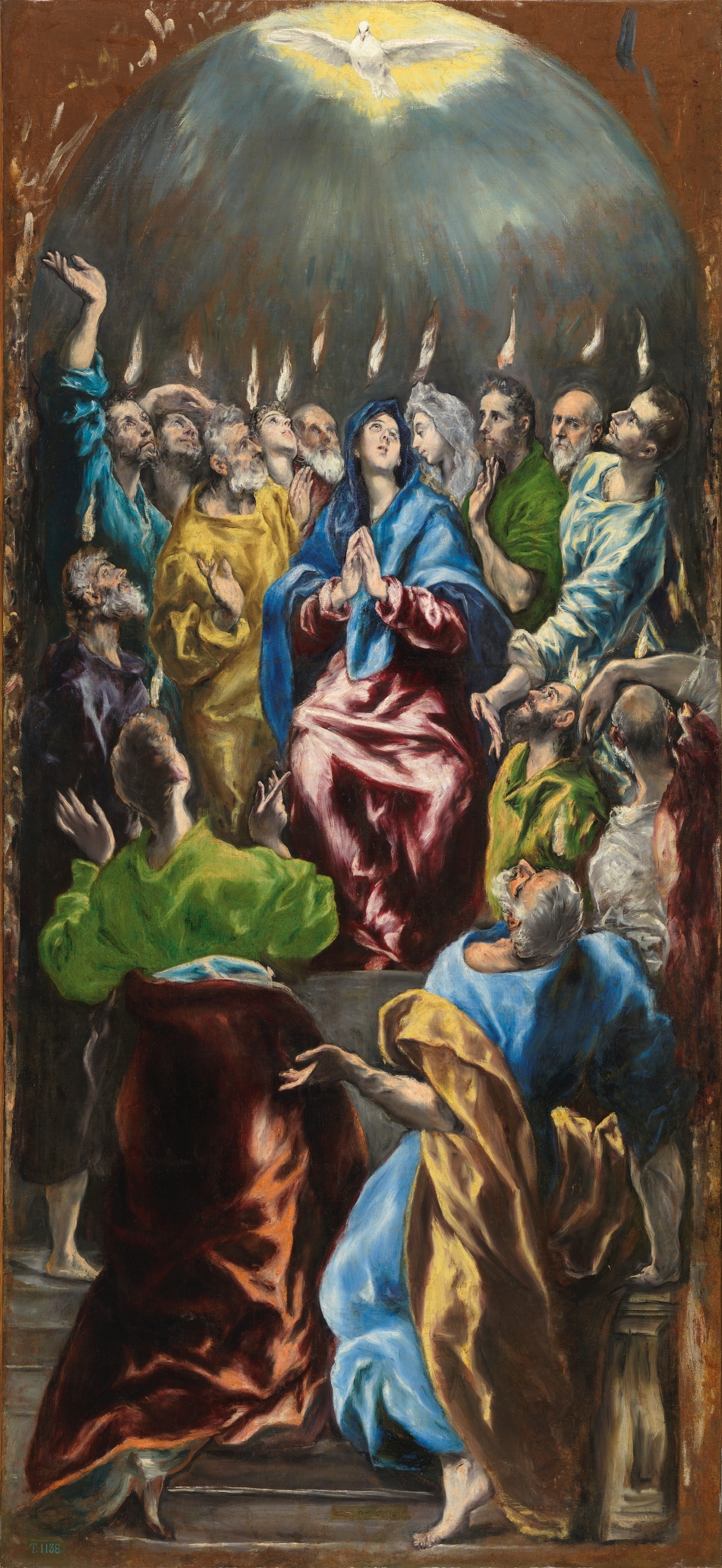
El Greco, Pentecost (c. 1600) — public domain.
THE ARTWORKEl Greco paints the fire the Spirit gave without distinction , the same gift Peter points to at the Council as his whole argument: God, who knows the heart, bore witness to the Gentiles by giving them the Holy Spirit, exactly as He gave it to us (15:8). The painting is Pentecost; the chapter is the church working out what Pentecost meant.
Summary
Acts 15 is walked as four turns of debate, the believing Pharisees' motion, Peter's argument from what God did, Barnabas and Paul's evidence, and James's argument from Amos, ending in the letter that freed Gentile believers from circumcision. The page also traces what changed before and after, and names where the evidence is genuinely contested.
- Four speeches are heard in a fixed order: experience first, evidence second, and Scripture decides
- James's proof-text is Amos 9:11-12, read from the Greek wording that carries his argument
- The letter itself is walked clause by clause, with what each of the four abstentions actually asks of Gentile believers
- A before-and-after section shows what changed: terms of entry, who accommodates whom, and where authority sits
- Contested points are given both readings at full strength, including whether Galatians 2 describes this same meeting
The Question
what walked into Jerusalem from Antioch
“Unless you are circumcised according to the custom of Moses, you cannot be saved.”
— Acts 15:1 (BSB) →Where it started
Antioch , the mixed Jewish-and-Gentile church that had just sent out the first missionary journey and had Gentile converts in the room when the visitors arrived.
Why it could not be ignored
It is a salvation claim, not a preference. If it is true, every uncircumcised believer Paul and Barnabas had left behind in Galatia is lost, and the mission has been building on sand.
What was actually at stake
Whether the gospel is grace received by faith or grace plus a covenant sign , and therefore whether the church is a renewed Israel that Gentiles may join or a new people in whom Jew and Gentile stand on identical ground.
The Four Turns
a motion, then experience, then evidence, then Scripture , and the order is the argument
“It is needful to circumcise them, and to charge them to keep the law of Moses.”
Note who is speaking: not opponents of the gospel but men Luke describes as believers. Their case is not absurd. God gave the covenant sign to Abraham and the law through Moses, neither has been revoked in writing, and every Christian in the room to that point had kept both. If Gentiles are now joining the people of God, the obvious question is on what terms , and the obvious answer, for anyone who had read the Old Testament and not yet worked out the implications of the cross, was: on the terms God has already published.
“Now then, why do you test God by placing on the necks of the disciples a yoke that neither we nor our fathers have been able to bear?”
Peter does not argue from principle; he argues from Caesarea. God, who knows the heart, bore the Gentiles witness by giving them the Holy Spirit exactly as He gave it to us, and made no distinction, cleansing their hearts by faith. The theology is drawn out of an event nobody in the room could deny , and Peter finishes by reversing the direction everyone expected: we shall be saved through the grace of the Lord Jesus, in like manner as they. Not they like us. Us like them.
“The whole assembly fell silent as they listened to Barnabas and Paul describing the signs and wonders God had done among the Gentiles through them.”
The shortest speech in the chapter, and Luke does not even give us the words , only the silence it produced. The two men who had just come back from Cyprus and Galatia simply report what happened. There is no appeal to office or to argument: God had been at work among uncircumcised people on a scale that made the theoretical question look small. Luke's ordering of the names here, Barnabas before Paul, is the Jerusalem church's ordering, not Antioch's.
“It is my judgment, therefore, that we should not cause trouble for the Gentiles who are turning to God.”
The Lord's brother, the most rigorously observant figure in the leadership, is the one who closes the door on the requirement. He begins where Peter ended : God visited the Gentiles to take out of them a people for his name , and then does the thing that settles it for a Jewish assembly: he shows that the prophets said so. Amos had written of a rebuilt tabernacle of David so that the residue of men might seek after the Lord, and all the Gentiles upon whom God's name is called. The Gentile mission is not an emergency improvisation; it is the published plan.
James's Proof-Text
Amos 9:11–12 , why a Jewish assembly could hear this and agree
“After this I will return and rebuild the fallen tent of David. Its ruins I will rebuild, and I will restore it,”
“so that the remnant of men may seek the Lord, and all the Gentiles who are called by My name, says the Lord who does these things”
James is quoting the Greek Old Testament, and the Greek wording is what carries his point: the residue of men seeking after the Lord, with the nations called by God's name. The Hebrew text of Amos runs differently, and the difference has been discussed for centuries , but the church of Acts read the Septuagint, and on any reading the prophet has Gentiles inside the restored house of David rather than queued outside it. The decisive argument in the room was not a new revelation. It was an old text, finally read in the light of what God had just done.
The Letter
the decision as it left the room : Acts 15:23–29
The finding
“It seemed good to the Holy Spirit and to us not to burden you with anything beyond these essential requirements.”
— Acts 15:28 (BSB) →- 01
From the pollutions of idols
Meat that had been through a pagan temple , the single most common social entanglement in a Greek city.
- 02
From fornication
The one clause everyone agrees is moral and permanent; in a Gentile world it also named the sexual practice attached to temple worship.
- 03
From what is strangled
An animal killed without draining the blood , a Jewish scruple of very long standing.
- 04
From blood
The prohibition that predates Moses and is given to Noah, which is why many read the whole list as the terms of shared table rather than a new law.
Four requests, and not one of them is circumcision. Read the list against the motion it answers and the omission is the whole verdict.
Who signed it
The apostles and the elders, with the whole church : Luke is careful to say the congregation was party to the decision, not merely informed of it.
Who carried it
Judas called Barsabbas and Silas, sent alongside Paul and Barnabas so that the ruling did not arrive only in the mouths of the men it vindicated.
How it landed
They read it at Antioch and rejoiced for the consolation (15:31). The word Luke chooses is comfort, not compliance.
Where it travelled
Paul delivers the decrees to the cities on the next journey, and Luke closes the panel with the refrain: the churches increased in number daily (16:4–5).
What Changed
before the council, and after it
The terms of entry
Before
A Gentile who wanted in became a proselyte: circumcision, the law of Moses, and a new ethnic identity attached to a new faith.
After
A Gentile who believes is in. Full membership, no covenant surgery, no change of nationality , because the heart is cleansed by faith, and God had already demonstrated it by giving them the same Spirit.
Who has to accommodate whom
Before
The assumption in the room was that the newcomers would adapt to the existing church's practice.
After
The four abstentions ask the Gentile churches for four courtesies, not for conversion , and the burden of the doctrinal question falls entirely on the older party, who are the ones told to stop troubling people.
Where authority sits
Before
A dispute in Antioch had no obvious forum; two apostles and a local church were simply arguing with visitors from Judea.
After
A question is brought, heard, debated, decided with the whole church present, and issued in writing with named couriers. This is the first church council, and its procedure has been copied ever since.
What It Feeds
Acts 15 is the narrative; Romans and Galatians are the doctrine
Everything the epistles argue about justification is already decided here as a matter of church practice. Peter's phrase : cleansing their hearts by faith, is Romans in a clause; James's refusal to trouble the Gentiles is Galatians in a sentence. What Acts 15 settles by ruling, Paul then has to establish by argument, congregation by congregation, for the rest of his life. The Council is the verdict; the epistles are the reasoning published afterwards, because a ruling that is not understood does not survive its first serious challenge.
And downstream of that
- Every later church council takes its procedure from this one: a question brought, heard, decided in assembly, published in writing.
- Every missionary generation has to re-fight it in its own terms , how much of the sending culture travels with the message.
- And the letter's own instinct survives as the test: does this requirement serve the gospel, or does it lay a burden the people imposing it never carried?
Contested Points
both readings at full strength, and where the site actually stands
Is Galatians 2 the same meeting?
One reading
Yes , the Council. Galatians 2:1–10 describes Paul going up to Jerusalem, laying his gospel before the pillars, and Titus not being compelled to be circumcised. The subject matter is identical, and the outcome is identical: no additional requirement on Gentiles.
The other
No , the earlier famine visit of Acts 11:30. Paul in Galatians describes a private meeting, cites a revelation as his reason for going, and never mentions a decree that would have won his argument outright. If Galatians were written before the Council, its silence about the letter is explained rather than awkward.
Where the evidence leaves it: The famine-visit identification sits more naturally with an early chronology, and with a Galatians written before the Council. The case for identifying the two meetings is serious, and the evidence underdetermines it either way , the two accounts share a subject and diverge on setting, occasion, and outcome-language.
What are the four abstentions?
One reading
Terms of table fellowship. The list is practical, not soteriological: four things that would make it impossible for Jewish believers to eat with Gentile ones. The letter itself says the aim is that no greater burden be laid , which is the language of accommodation, not of law.
The other
Standing moral requirements. Three of the four appear in the Noahic covenant, which is pre-Mosaic and universal, and the fourth , fornication , is plainly moral. On this reading the Council did not suspend God's requirements; it identified which ones were never merely Jewish.
Where the evidence leaves it: The two readings are not as far apart as they look, since both agree the list is not a back door for justification by law. The letter states its own purpose , lay no greater burden , and Scripture elsewhere keeps the sexual clause as a standing moral requirement.
Did it actually hold?
One reading
Yes. Paul carries the decrees through the cities (16:4), and the churches are strengthened and increase daily : Luke's own refrain closes the panel.
The other
Not everywhere, and not immediately. Paul's letters spend years fighting the same battle; there is a confrontation at Antioch over exactly this question; and men are still coming from James into Gentile congregations. A ruling is not the same as a settled church.
Where the evidence leaves it: Both, which is what makes it real history. The Council settled the doctrine and did not settle the sociology, and the New Testament is candid about the gap.
The Keynote Words
the Greek of the chapter
The Voices
the roster on Acts 15 : Marcus Brown's commentary leads above all
Homilies on the Acts of the Apostles (public domain)
Chrysostom is struck by the restraint of the proceeding , that Peter, who had the strongest personal claim, argues rather than rules, and that James, the strictest man present, is the one who pronounces the release. He reads the whole chapter as a lesson in how authority behaves when it is genuine.
Commentary upon the Acts of the Apostles (public domain)
Calvin's interest is in what the Council does not do: it does not invent a compromise doctrine, and it does not legislate consciences. He treats the four abstentions as charity toward the weaker party rather than as a new code, and warns against every later attempt to read them as a precedent for adding to the gospel.
Commentary on the Whole Bible, on Acts 15 (public domain)
Henry dwells on the yoke: a burden neither the fathers nor the present generation had been able to bear, laid on the necks of new converts by people who had failed under it themselves. His pastoral point is that religious requirements are almost always heaviest when imposed by those who have stopped noticing the weight.
Explanatory Notes upon the New Testament, on Acts 15 (public domain)
Wesley reads the Council as the working out of God is no respecter of persons , the principle stated at Cornelius's house in chapter 10 turned into church policy in chapter 15. Grace first, and the practice reorganised around it.
Learn the Bible in 24 Hours; the Acts commentary (Koinonia House)
Missler's emphasis falls on James's proof-text: the rebuilding of David's fallen tabernacle read as a programme with an order to it, and the Gentile ingathering as the phase Acts 15 recognises the church is standing in.
Bruchko
Olson's account of taking the gospel to the Motilone supplies the Acts 15 question in modern dress: how much of the missionary's own culture travels with the message, and what happens when the Spirit gets to a people before the church's assumptions do.
Each voice is summarised here with its specific work named, so you can go to the commentary itself and read the argument in full.
Notable art
— click a piece to enlargeKeep studying
On this page
Studies6
People1
Symbols1