
2 Peter 2 · Jude 1:4 to 18 · Debate · Featured Study
Jude and 2 Peter
Jude 1:4 to 18 runs parallel to the second chapter of 2 Peter and the opening of its third.
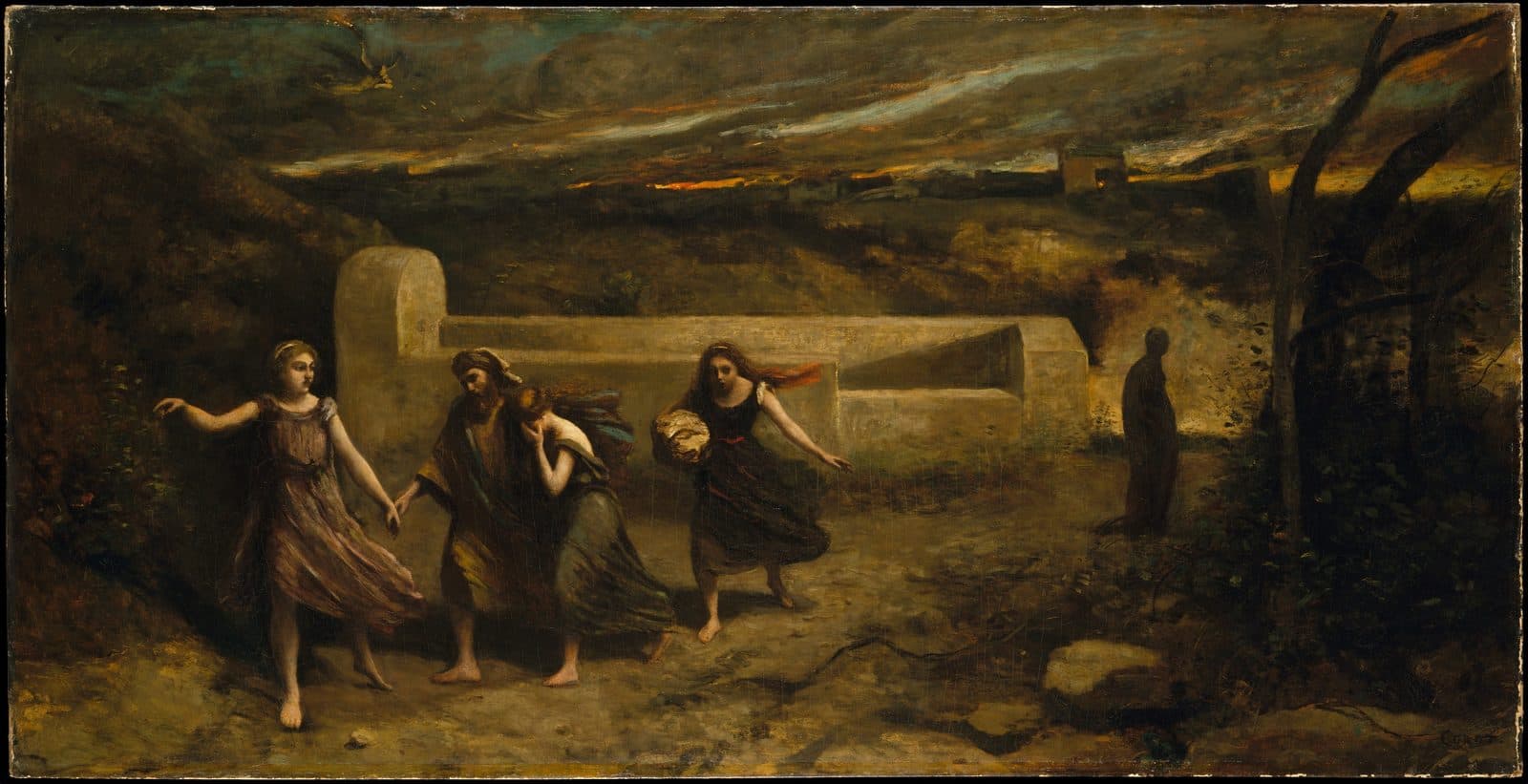
Camille Corot, The Burning of Sodom (formerly The Destruction of Sodom), 1843 and 1857, Metropolitan Museum of Art. Public domain (CC0 dedication), via Wikimedia Commons.
THE ARTWORKCorot painted Lot and three women hurrying down a stony road at dusk while the city burns on the horizon. A dark figure stands at the right under a smoky sky.
Readers have asked since the early Greek commentators which of the two letters was written first.
Summary
Three readings stand: Jude wrote first, 2 Peter wrote first, or both drew on teaching the apostles shared.
- Both letters name the angels who sinned, Sodom and Gomorrah, and Balaam, and both reserve the blackest darkness for the false teachers.
- Mayor argued in 1907 that Jude came first, and Bigg in 1901 that 2 Peter did.
- The early churches received both letters slowly, and some of their readers doubted each one.
The Readings Question by Question
Each question the order turns on, with the answer each reading gives
| Question | Jude wrote first | 2 Peter wrote first | Both drew on shared teaching |
|---|---|---|---|
| Whose words are the scoffers of Jude 1:18? | A saying of the apostles that Peter also used. | A quotation of Peter's warning, named as apostolic. | A warning the apostles preached in common, which Peter and Jude each recall. |
| Where does the darkness clause belong? | With Jude's wandering stars; Mayor called its place in 2 Peter a convincing proof that Jude came first. | With 2 Peter's springs; Jude moved it onto stars. | Barnes's note is silent on the clause. |
| Which wording reads as the earlier? | The tight cluster of images at Jude 1:12 to 13. | Peter's reminder at 2 Peter 1:12, which Jude 1:5 gives in a hastier form, as Bigg judged. | Barnes's note is silent on the wording. |
| What is the strongest objection to it? | Jude 1:17 to 18 names the scoffer warning as words already spoken. | The cluster of images at Jude 1:12 to 13 is tighter than its parts in 2 Peter. | The chains of the fallen angels match too closely in both letters for two writers drawing apart on one source, as Bigg judged. |
- Jude wrote first
- A saying of the apostles that Peter also used.
- 2 Peter wrote first
- A quotation of Peter's warning, named as apostolic.
- Both drew on shared teaching
- A warning the apostles preached in common, which Peter and Jude each recall.
- Jude wrote first
- With Jude's wandering stars; Mayor called its place in 2 Peter a convincing proof that Jude came first.
- 2 Peter wrote first
- With 2 Peter's springs; Jude moved it onto stars.
- Both drew on shared teaching
- Barnes's note is silent on the clause.
- Jude wrote first
- The tight cluster of images at Jude 1:12 to 13.
- 2 Peter wrote first
- Peter's reminder at 2 Peter 1:12, which Jude 1:5 gives in a hastier form, as Bigg judged.
- Both drew on shared teaching
- Barnes's note is silent on the wording.
- Question
- What is the strongest objection to it?
- Jude wrote first
- Jude 1:17 to 18 names the scoffer warning as words already spoken.
- 2 Peter wrote first
- The cluster of images at Jude 1:12 to 13 is tighter than its parts in 2 Peter.
- Both drew on shared teaching
- The chains of the fallen angels match too closely in both letters for two writers drawing apart on one source, as Bigg judged.
Each Reading in Its Own Terms
The case for each order, as its holders state it
Jude wrote firstJ. B. Mayor, 1907
Mayor compared the two letters line by line in the introduction to his Greek commentary. He held that 2 Peter split Jude's waterless clouds into two pictures, springs without water and mists driven by a storm.
Mayor listed Neander, Ewald, Holtzmann, Harnack, Weiss, Salmon and Chase as holding the same order.
2 Peter wrote firstCharles Bigg, 1901
Bigg held, in his International Critical Commentary, that one writer certainly borrowed from the other, and he named Zahn and Spitta among the defenders of his order.
He weighed the future tense of 2 Peter 2:1 against Jude 1:4, where the men have already crept in, and judged that Jude may have written very shortly after Peter.
Oecumenius, in his commentary on Jude, concluded from Jude 1:17 to 18 that Jude wrote last, after the apostles had died.
Andreas of Caesarea held that Jude took those verses from 2 Peter, where Peter speaks of Paul's letters.
Both drew on shared teachingAlbert Barnes, on 2 Peter 3:3
Barnes took the scoffers of 2 Peter 3:3 as a subject so well understood by all the apostles that each of them taught it.
What Each Letter Has Alone
The examples one letter gives and the other leaves out
NOAH AND THE FLOOD
Only 2 Peter sets the flood beside the angels, with Noah protected among the eight.
LOT RESCUED
Only 2 Peter tells of righteous Lot, rescued from Sodom.
THE DONKEY THAT SPOKE
Only 2 Peter tells how a donkey rebuked Balaam.
MICHAEL AND THE BODY OF MOSES
Only Jude names the archangel and his dispute with the devil.
CAIN AND KORAH
Only Jude sets Cain and Korah beside Balaam.
ENOCH'S PROPHECY
Only Jude quotes Enoch, the seventh from Adam.
How the Church Received the Two Letters
What Eusebius, Jerome, Bede and Calvin record of the letters' reception
Eusebius placed Jude and 2 Peter among the disputed writings, which he said were nevertheless recognized by many.
Jerome recorded that many doubted 2 Peter because its style differs from the first letter.
Bede, in the eighth century, wrote that Jude writes against the same corruptors of the faith whom both Peter and John condemn in their letters.
Calvin received both letters. He answered the doubt over style by proposing that a disciple wrote 2 Peter at Peter's command.
The Question Through the Centuries
Readers of the order from Luther to Döllinger
Bigg wrote that Luther held the priority of 2 Peter, and that since Eichhorn the opposite view had gained ground.
Mayor recorded that Döllinger first held 2 Peter to be earlier and later told Plummer he could no longer hold it.
What the Letters Leave Unsaid
The silences every reading of the order works around
Neither letter names the other, and neither says when or where it was written.
Eusebius records that Peter was crucified at Rome under Nero, so a letter from his hand comes before that death. Every reading of the order rests on the wording of the two texts.
Jude gives no name to the book that carried Enoch's prophecy.
Enoch, the seventh from Adam, also prophesied about them: “Behold, the Lord is coming with myriads of His holy ones to execute judgment on everyone, and to convict all the ungodly of every ungodly act of wickedness and every harsh word spoken against Him by ungodly sinners.”These verses are 1 Enoch 1:9 in a shorter form, as R. H. Charles showed in his edition of 1912.
Augustine took Enoch for a prophet on Jude's word and still set aside the writings that carry his name.
“Does not the canonical epistle of Jude the apostle openly declare that Enoch spoke as a prophet? It is true that his alleged writings have never been accepted as authoritative, either by Jews or Christians, but that is because their extreme antiquity makes us afraid of handing out as authentic works those which may be forgeries.”
Augustine of Hippo · City of God 18.38 · on Jude 1:14Patristic
The Lord Knows How to Rescue
The point both letters make with their examples
God judged the angels who sinned and the cities of the plain, and He will judge those who turn His grace into license.
Peter draws the comfort out of the warning in one sentence.
if all this is so, then the Lord knows how to rescue the godly from trials and to hold the unrighteous for punishment on the day of judgment.The “all this” is the angels, the flood, Sodom and the rescue of Lot, told in the verses before it.
Jude ends on the same keeping, turned toward his readers.
Now to Him who is able to keep you from stumbling and to present you unblemished in His glorious presence, with great joy— to the only God our Savior be glory, majesty, dominion, and authority through Jesus Christ our Lord before all time, and now, and for all eternity. Amen.Jerome on Jude's Place in Scripture
Many in the fourth century rejected the letter, and the church kept it
Jerome ties the doubt to Jude's quotation from Enoch, and the letter's standing to its age and use.
“Jude the brother of James, left a short epistle which is reckoned among the seven catholic epistles, and because in it he quotes from the apocryphal Book of Enoch it is rejected by many. Nevertheless by age and use it has gained authority and is reckoned among the Holy Scriptures.”
Jerome · De Viris Illustribus (On Illustrious Men), Section 4 · on Jude 1:1Patristic
Contend for the Faith
What Jude asks of every reader
Jude urges his readers to contend for the faith entrusted once for all to the saints.
But you, beloved, by building yourselves up in your most holy faith and praying in the Holy Spirit, keep yourselves in the love of God as you await the mercy of our Lord Jesus Christ to bring you eternal life.