
Judges 13 to 16 · Person · Featured Study
Samson
The last judge whose life the book of Judges tells, in Judges 13 to 16.
Samson was given to Israel before his birth to begin its deliverance from the Philistines, and he died in their hands at Gaza.
- Died
- at Gaza, in the temple of Dagon
- Family
- father: Manoah; mother: the wife of Manoah, unnamed; wife: the woman of Timnah; loved: Delilah
- Places
- Zorah, Eshtaol, Timnah, Ashkelon, Etam, Lehi, Gaza, Hebron, Sorek
- First named
- Judges 13:24
- Last named
- Hebrews 11:32
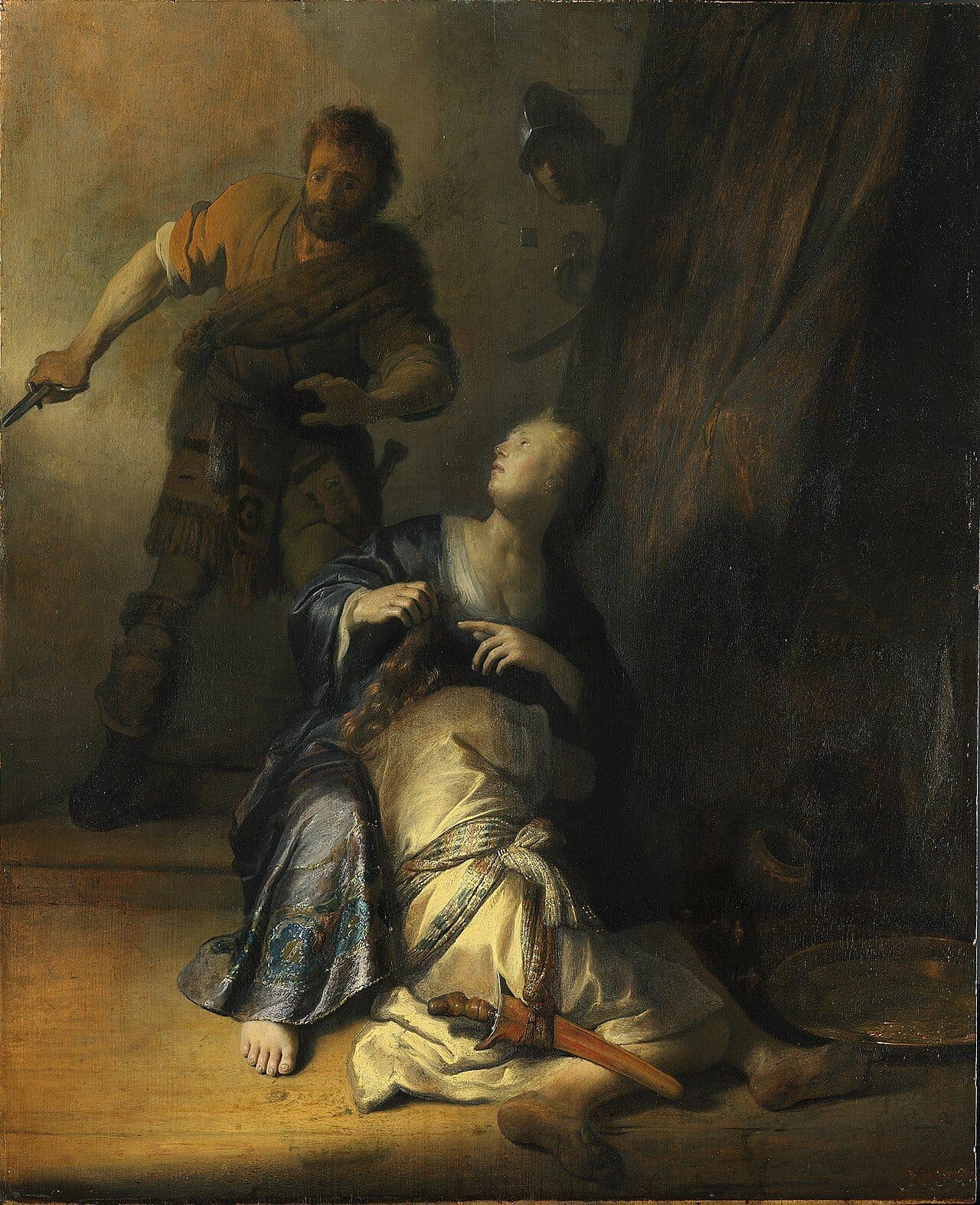
Rembrandt van Rijn, Samson and Delilah, 1629 to 1630, Gemäldegalerie Berlin. Public domain, via Wikimedia Commons.
THE ARTWORKRembrandt painted Delilah turning to the man she has called to shave the seven braids while Samson sleeps on her knees.
Summary
Samson son of Manoah, of the clan of the Danites, was a Nazirite from the womb who judged Israel twenty years while the Philistines ruled it.
- The Spirit of the LORD began to stir him and then came upon him three times, more than upon any other judge.
- His marriage to a Philistine woman of Timnah opened his war with her people.
- Delilah drew out the secret of his uncut hair and sold it to the Philistine lords.
- His last prayer brought the temple of Dagon down on the lords and on himself.
- Hebrews names him among the faithful.
Where Samson Stands in Scripture
Four chapters of Judges and one line of Hebrews
No other judge is given more chapters, though Gideon's account runs four verses longer.
So the woman gave birth to a son and named him Samson. The boy grew, and the LORD blessed him.Judges records the LORD's blessing on the boy before it records any deed of his.
And what more shall I say? Time will not allow me to tell of Gideon, Barak, Samson, Jephthah, David, Samuel, and the prophets,Hebrews places Samson between Barak and Jephthah, out of the order in which Judges tells them.
The Life, Turn by Turn
Seventeen turns from Zorah to the grave between Zorah and Eshtaol
- The angel appears to his motherZorah, Judges 13:3
- The Spirit begins to stir himMahaneh-dan, Judges 13:25
- Asks for a Philistine wifeTimnah, Judges 14:2
- The Spirit comes upon him; he tears a young lion apartthe vineyards of Timnah, Judges 14:6
- Eats honey from the carcassthe road to Timnah, Judges 14:9
- Puts his riddle to thirty companionsthe wedding feast, Judges 14:12
- The Spirit comes upon him; he strikes down thirty menAshkelon, Judges 14:19
- Burns the grain with foxes and torchesthe Philistine fields, Judges 15:5
- Handed over by three thousand men of Judahthe rock of Etam, Judges 15:11
- The Spirit comes upon him; he breaks the ropes and kills a thousandLehi, Judges 15:14
- Cries out for waterEn-hakkore, Judges 15:18
- Carries off the city gateGaza to the hill facing Hebron, Judges 16:3
- Falls in love with Delilahthe Valley of Sorek, Judges 16:4
- Shaved, and left by the LORDDelilah's house, Judges 16:19
- Blinded and set to grind grainthe prison at Gaza, Judges 16:21
- Brings down the temple of DagonGaza, Judges 16:30
- Buried in his father's tombbetween Zorah and Eshtaol, Judges 16:31
Twelve of the seventeen turns come before Delilah, and the last five take him from the Valley of Sorek to his grave.
From Zorah to Gaza
Judges 13 to 16, a chapter to each part of the life
The angel of the LORD comes twice to a barren woman of Zorah. Before her son is conceived he lays two charges on the boy, a vow and a work.
Grown, he goes down to Timnah for a wife, and the seven days of his wedding feast end with his riddle betrayed.
From there the quarrel becomes a private war of burned fields and slaughter, until the men of Judah give him up to the Philistines.
In the Valley of Sorek Delilah asks him four times for his secret until he tells her the truth, and the Philistines take him.
The angel at ZorahJudges 13
For behold, you will conceive and give birth to a son. And no razor shall come over his head, because the boy will be a Nazirite to God from the womb, and he will begin the deliverance of Israel from the hand of the Philistines.”The word begin is the ground for saying that Samson started Israel's deliverance and did not finish it.
“Why do you ask my name,” said the angel of the LORD, “since it is beyond comprehension?”The Hebrew word behind beyond comprehension is pil'i, the word Adam Clarke builds on.
Adam Clarke sets the word beside the name Wonderful that Isaiah gives the child to be born, and notes that some take the visitor to be the Lord Himself.
“We are going to die,” he said to his wife, “for we have seen God!” But his wife replied, “If the LORD had intended to kill us, He would not have accepted the burnt offering and the grain offering from our hands, nor would He have shown us all these things or spoken to us this way.”His wife reads the accepted offering as a sign that the LORD meant them good.
Timnah and the riddleJudges 14
But his father and mother replied, “Can’t you find a young woman among your relatives or among any of our people? Must you go to the uncircumcised Philistines to get a wife?” But Samson told his father, “Get her for me, for she is pleasing to my eyes.”Samson overrides his parents with a reason of his own, the one the Talmud later holds against him.
So he said to them: “Out of the eater came something to eat, and out of the strong came something sweet.” For three days they were unable to explain the riddle.Only Samson knew of the lion and the honey, so no guest could answer without help from his bride.
Before sunset on the seventh day, the men of the city said to Samson: “What is sweeter than honey? And what is stronger than a lion?” So he said to them: “If you had not plowed with my heifer, you would not have solved my riddle!”His reply shows that he knew his bride had given the answer away.
Lehi and the springJudges 15
When Samson arrived in Lehi, the Philistines came out shouting against him. And the Spirit of the LORD came mightily upon him. The ropes on his arms became like burnt flax, and the bonds broke loose from his hands. He found the fresh jawbone of a donkey, reached out his hand and took it, and struck down a thousand men.The third coming of the Spirit frees him from the ropes the men of Judah had tied.
And being very thirsty, Samson cried out to the LORD, “You have accomplished this great deliverance through Your servant. Must I now die of thirst and fall into the hands of the uncircumcised?” So God opened up the hollow place in Lehi, and water came out of it. When Samson drank, his strength returned, and he was revived. That is why he named it En-hakkore, and it remains in Lehi to this day.Samson's first recorded prayer comes in need after a victory, and God answers it as He will answer his last.
Delilah and the temple of DagonJudges 16
Samson told her all that was in his heart: “My hair has never been cut, because I have been a Nazirite to God from my mother’s womb. If I am shaved, my strength will leave me, and I will become as weak as any other man.”Samson ties his strength to his vow in his own words, so he told Delilah knowing what it would cost.
Then she called out, “Samson, the Philistines are here!” When Samson awoke from his sleep, he thought, “I will escape as I did before and shake myself free.” But he did not know that the LORD had departed from him.The four chapters turn on this verse, where Samson trusts a strength the LORD has already withdrawn.
Then Samson called out to the LORD: “O Lord GOD, please remember me. Strengthen me, O God, just once more, so that with one vengeful blow I may pay back the Philistines for my two eyes.”The strength Samson had used at will he now asks of God, and the next two verses record the answer.
Under the Philistines
The border towns of Judah and Dan, and the cities of the Philistine lords
Judges sets the whole life inside forty years of Philistine rule. Scripture gives no year for that rule, and the date of his life is not known.
Zorah and Eshtaol are listed among the towns of Judah's foothills and again in the land given to Dan, and Timnah lies on Judah's border. Gaza and Ashkelon were two of the five cities of the Philistine lords.
Josephus on SamsonAntiquities, Book 5, chapter 8
Josephus retells the four chapters in the first century AD and closes by admiring Samson's courage, his strength and his magnanimity at his death. He puts the snare of a woman down to human nature. He knew the same text, so he adds a reading and no independent record.
The Family of Samson
Six ties, each with its verse
| Person | Tie to Samson | Verse |
|---|---|---|
| Manoah | His father, a man of Zorah of the clan of the Danites. | Judges 13:2 |
| His mother | Barren until the angel came; Judges never gives her name. | Judges 13:3 |
| The woman of Timnah | His Philistine wife, given to his companion. | Judges 14:20 |
| Her father | Burned with her by the Philistines. | Judges 15:6 |
| Delilah | The woman of the Valley of Sorek he loved. | Judges 16:4 |
| His brothers | With his father's family, they carried his body home. | Judges 16:31 |
- Person
- Manoah
- Tie to Samson
- His father, a man of Zorah of the clan of the Danites.
- Verse
- Judges 13:2
- Person
- His mother
- Tie to Samson
- Barren until the angel came; Judges never gives her name.
- Verse
- Judges 13:3
- Person
- The woman of Timnah
- Tie to Samson
- His Philistine wife, given to his companion.
- Verse
- Judges 14:20
- Person
- Her father
- Tie to Samson
- Burned with her by the Philistines.
- Verse
- Judges 15:6
- Person
- Delilah
- Tie to Samson
- The woman of the Valley of Sorek he loved.
- Verse
- Judges 16:4
- Person
- His brothers
- Tie to Samson
- With his father's family, they carried his body home.
- Verse
- Judges 16:31
The Places of His Life
Eight places in the order Judges reaches them
| Place | What happened there | Verse |
|---|---|---|
| Zorah | His parents' town, where the angel came. | Judges 13:2 |
| Mahaneh-dan | Between Zorah and Eshtaol, the Spirit began to stir him. | Judges 13:25 |
| Timnah | He saw the Philistine woman he married. | Judges 14:1 |
| Ashkelon | He killed thirty men to pay the wager. | Judges 14:19 |
| The rock of Etam | He stayed in its cave until Judah came for him. | Judges 15:8 |
| Lehi | He named the place Ramath-lehi and the spring En-hakkore. | Judges 15:17 to 19 |
| Gaza | He escaped an ambush there, and later died there in the temple of Dagon. | Judges 16:1 to 3 and 16:21 to 30 |
| Hebron | He carried the gate of Gaza to the hill facing it. | Judges 16:3 |
- Place
- Zorah
- What happened there
- His parents' town, where the angel came.
- Verse
- Judges 13:2
- Place
- Mahaneh-dan
- What happened there
- Between Zorah and Eshtaol, the Spirit began to stir him.
- Verse
- Judges 13:25
- Place
- Timnah
- What happened there
- He saw the Philistine woman he married.
- Verse
- Judges 14:1
- Place
- Ashkelon
- What happened there
- He killed thirty men to pay the wager.
- Verse
- Judges 14:19
- Place
- The rock of Etam
- What happened there
- He stayed in its cave until Judah came for him.
- Verse
- Judges 15:8
- Place
- Lehi
- What happened there
- He named the place Ramath-lehi and the spring En-hakkore.
- Verse
- Judges 15:17 to 19
- Place
- Gaza
- What happened there
- He escaped an ambush there, and later died there in the temple of Dagon.
- Verse
- Judges 16:1 to 3 and 16:21 to 30
- Place
- Hebron
- What happened there
- He carried the gate of Gaza to the hill facing it.
- Verse
- Judges 16:3
Questions the Life Raises
Four questions, each answered from Scripture or its commentators
Was his strength in his hair?Adam Clarke; Albert Barnes
“If I be shaven, then my strength will go from me - The miraculous strength of Samson must not be supposed to reside either in his hair or in his muscles, but in that relation in which he stood to God as a Nazarite, such a person being bound by a solemn vow to walk in a strict conformity to the laws of his Maker. It was a part of the Nazarite’s vow to permit no razor to pass on his head; and his long hair was the mark of his Nazirate, and of his vow to God.”
Adam Clarke · Commentary on the Bible · on Judges 16:17Evangelical
“The possession of his extraordinary strength is ascribed (e. g. Jdg 13:25) to the presence of the Spirit of the Lord. Now the Lord, or the Spirit of the Lord, had departed from him, and so his strength had gone too. The practical lesson against the presumption of self-dependence, and the all-importance of a hearty dependence upon God’s Holy Spirit, must not be overlooked.”
Albert Barnes · Notes, Explanatory and Practical, on the Old and New Testaments (1832-1869) · on Judges 16:20Evangelical
Did he break his vow before the hair was cut?Numbers 6; Matthew Henry
Numbers forbids a Nazirite to go near a dead body, and Samson took honey from the lion's carcass and hid where it came from. Matthew Henry, writing on the wedding feast that followed, finds no breach in the feast itself.
“Though he was a Nazarite, he did not affect, in a thing of this nature, to be singular, but did as the young men used to do upon such occasions. It is no part of religion to go contrary to the innocent usages of the places where we live: nay, it is a reproach to religion when those who profess it give just occasion to others to call them covetous, sneaking, and morose.”
Matthew Henry · Commentary on the Whole Bible · on Judges 14:10Puritan
Judges itself names no breach before the razor, and it ties the loss of his strength to the shaving alone.
Numbers sets out the vow as one a man or woman takes for a set time. Samson's was laid on him before his birth.
But he said to me, ‘Behold, you will conceive and give birth to a son. Now, therefore, do not drink wine or strong drink, and do not eat anything unclean, because the boy will be a Nazirite to God from the womb until the day of his death.’”His mother's words carry the vow to the day of his death, which the angel's charge in Judges 13:5 does not say.
How was the marriage from the LORD?Matthew Henry; the Talmud, Sotah 9b
Judges says both that Samson chose the woman because she pleased his eyes and that the match was from the LORD.
“It was not a thing evil in itself for him to marry a Philistine. It was forbidden because of the danger of receiving hurt by idolaters; where there was not only no danger of that kind, but an opportunity hoped for of doing that hurt to them which would be good service to Israel, the law might well be dispense with.”
Matthew Henry · Commentary on the Whole Bible · on Judges 14:4Puritan
The Babylonian Talmud, in tractate Sotah, reads the same verses the other way: Samson rebelled with his eyes, so the Philistines put out his eyes. It grants that God was at work against the Philistines and holds that Samson still followed his own desire.
What does the name Samson mean?The lexicon; the Talmud
The site's lexicon gives the name Shimshon no meaning of its own. Rabbi Yochanan, in tractate Sotah of the Talmud, ties the name to a verse of the Psalms. The Talmud then calls the name a likeness of God's name and not God's name itself.
For the LORD God is a sun and a shield; the LORD gives grace and glory; He withholds no good thing from those who walk with integrity.The word sun in this verse is the shemesh that Rabbi Yochanan hears in the name Shimshon.
What the Text Leaves Unsaid
Four things Judges 13 to 16 does not record
Judges records no wine at his lips. It calls Delilah a woman of the Valley of Sorek and gives no nation for her.
It records the hair growing back in prison and says nothing of what passed in his heart there. It records his last prayer answered and passes no verdict on his death.
Why Hebrews Names Him
Hebrews 11:32 to 34 and the readings it drew
John Calvin, in his commentary on the passage, names the fault of each judge in the list and says that Samson, overcome by a woman, betrayed the safety of the whole people.
“Thus, in all the saints, something reprehensible is ever to be found; yet faith, though halting and imperfect, is still approved by God.”
John Calvin · Commentaries on the Epistle of Paul the Apostle to the Hebrews, on Hebrews 11:32 · on Hebrews 11:32Reformed
who through faith conquered kingdoms, administered justice, and gained what was promised; who shut the mouths of lions, quenched the raging fire, and escaped the edge of the sword; who gained strength from weakness, became mighty in battle, and put foreign armies to flight.Hebrews credits these deeds to faith, so Samson's place rests on what he did trusting God.
“Samson called unto the Lord - It was in consequence of his faith in God that he should be strengthened to overthrow his enemies and the enemies of his country, that he is mentioned, Heb 11:32, among those who were remarkable for their faith.”
Adam Clarke · Commentary on the Bible · on Judges 16:28Evangelical
Samson as a type of ChristMatthew Henry; John Wesley; Caesarius of Arles
Matthew Henry draws the likeness from the birth and John Wesley from the death. Caesarius of Arles held the same reading in his Sermon 118, in the sixth century, and asked its hardest question himself: was Christ overcome by the flattery of a woman? Hebrews names Samson only in its list and draws no figure from him.
“Now herein Samson was a type of Christ, (1.) As a Nazarite to God, a Nazarite from the womb. For, though our Lord Jesus was not a Nazarite himself, yet he was typified by the Nazarites, as being perfectly pure from all sin, not so much as conceived in it, and entirely devoted to his Father's honour.”
Matthew Henry · Commentary on the Whole Bible · on Judges 13:4 to 5Puritan
Voices on Samson, Earliest First
Four teachers in their own words, from Ambrose to Spurgeon
“After the spirit of the Hebrews had been so subdued by the pressure of a long subjection that no one dared with a manly spirit to rouse them to liberty, Samson, fore-ordained by the Divine oracle, was raised up to them. A great man he was, not one of the multitude, but first among the few, and beyond controversy far excelling all in bodily strength.”
Ambrose of Milan · Letter 19.10-11 · on Judges 13:2 to 7Patristic
“He soon found in himself some change, we have reason to think so, and yet wist not that the Lord had departed from him: he did not consider that this was the reason of the change. Note, Many have lost the favourable presence of God and are not aware of it; they have provoked God to withdraw from them, but are not sensible of their loss, nor ever complain of it.”
Matthew Henry · Commentary on the Whole Bible · on Judges 16:20Puritan
“The hair - This circumstance, though in itself inconsiderable, is noted as a sign of the recovery of God's favour, and his former strength, in some degree, upon his repentance, and renewing his vow with God, which was allowed for Nazarites to do.”
John Wesley · Explanatory Notes upon the Old Testament · on Judges 16:22Evangelical
“The first remark arising out of the story of Manoah and his wife is this—that oftentimes we pray for blessings which will make us tremble when we receive them. Manoah had asked that he might see the Angel and he saw Him—in answer to His request the Wonderful One condescended to reveal Himself a second time, but the consequence was that the good man was filled with astonishment and dismay. And turning to His wife, he exclaimed, ‘We shall surely die, because we have seen God.’”
Charles Spurgeon · The Metropolitan Tabernacle Pulpit, Sermon No. 1340: “Manoah's Wife and Her Excellent Argument” (lightly modernized text, CCEL edition) · on Judges 13:22 to 23
Was His Death a Suicide?
Three readings of Judges 16:28 to 30, each with its holders
The question turns on whether a death asked for in prayer and granted by God is a taking of one's own life.
Samson said, “Let me die with the Philistines.” Then he pushed with all his might, and the temple fell on the lords and all the people in it. So in his death he killed more than he had killed in his life.Every reading of the death must answer this verse, where Samson's own death and the fall of the temple are one act.
Directed by GodAugustine of Hippo; John Wesley
Augustine, in the City of God, makes Samson an exception to his rule against taking one's own life, and John Wesley holds the same reading in his notes. The objection: Judges records no command to bring the temple down.
“Samson, too, who drew down the house on himself and his foes together, is justified only on this ground, that the Spirit who wrought wonders by him had given him secret instructions to do this.”
Augustine of Hippo · The City of God, Book 1, chapter 21 · on Judges 16:30Patristic
“Moreover, Samson did this by Divine direction, as God's answer to his prayer manifests, and that he might be a type of Christ, who by voluntarily undergoing death, destroyed the enemies of God, and of his people.”
John Wesley · Explanatory Notes upon the Old Testament · on Judges 16:30Evangelical
A judge's actJamieson, Fausset and Brown; John Wesley
This reading rests on the office of judge that Judges 15:20 and 16:31 record. The objection: his own words ask for vengeance for his two eyes.
“Samson called unto the Lord--His penitent and prayerful spirit seems clearly to indicate that this meditated act was not that of a vindictive suicide, and that he regarded himself as putting forth his strength in his capacity of a public magistrate.”
Jamieson, Fausset & Brown · Commentary Critical and Explanatory on the Whole Bible · on Judges 16:28Reformed
“Samson called - This prayer was not an act of malice and revenge, but of faith and zeal for God, who was there publickly dishonoured; and justice, in vindicating the whole common- wealth of Israel, which was his duty, as he was judge.”
John Wesley · Explanatory Notes upon the Old Testament · on Judges 16:28Evangelical
The revenge of its ageAlbert Barnes
This reading takes the prayer for what it asks. The objection: God answered the prayer.
“At once avenged - ‘i. e. with one final revenge.’ These words do not breathe the spirit of the Gospel, but they express a sentiment, natural to the age, knowledge, and character of Samson.”
Albert Barnes · Notes, Explanatory and Practical, on the Old and New Testaments (1832-1869) · on Judges 16:28Evangelical
Books to Read Next
Four works, from the first century to the eighteenth
The City of God
Augustine of Hippo · fifth century
Augustine wrote Book 1 to answer those who blamed the sack of Rome on the Christians.
READ IT FREE AT NEW ADVENT →Commentaries on the Epistle to the Hebrews
John Calvin · 1853 translation
Calvin reads every name of Hebrews 11 in turn, from Abel to the prophets.
READ IT FREE AT CCEL →Antiquities of the Jews
Flavius Josephus · first century
Josephus sets Samson between the judges before him and Eli after him.
READ IT FREE AT PROJECT GUTENBERG →Commentary on the Whole Bible
Matthew Henry · 1710
Henry goes verse by verse through Judges 13 to 16.
READ IT FREE AT CCEL →Remember Me
The strength was never Samson's own, and the four chapters end with a blind man asking God to remember him.
The life asks the reader to hold God's gifts as His, to keep faith with what He has set apart, and to call on Him even after a fall.
Let us fix our eyes on Jesus, the author and perfecter of our faith, who for the joy set before Him endured the cross, scorning its shame, and sat down at the right hand of the throne of God.Hebrews names Jesus the perfecter of faith right after its witnesses, so the halting faith of Samson points past him.