
Haggai 1 and 2 · Zechariah 1 and 7 · Debate · Featured Study
The Dated Messages of Haggai and Zechariah
Haggai and Zechariah spoke in Jerusalem to the governor Zerubbabel, the high priest Joshua and the people who had returned from exile.
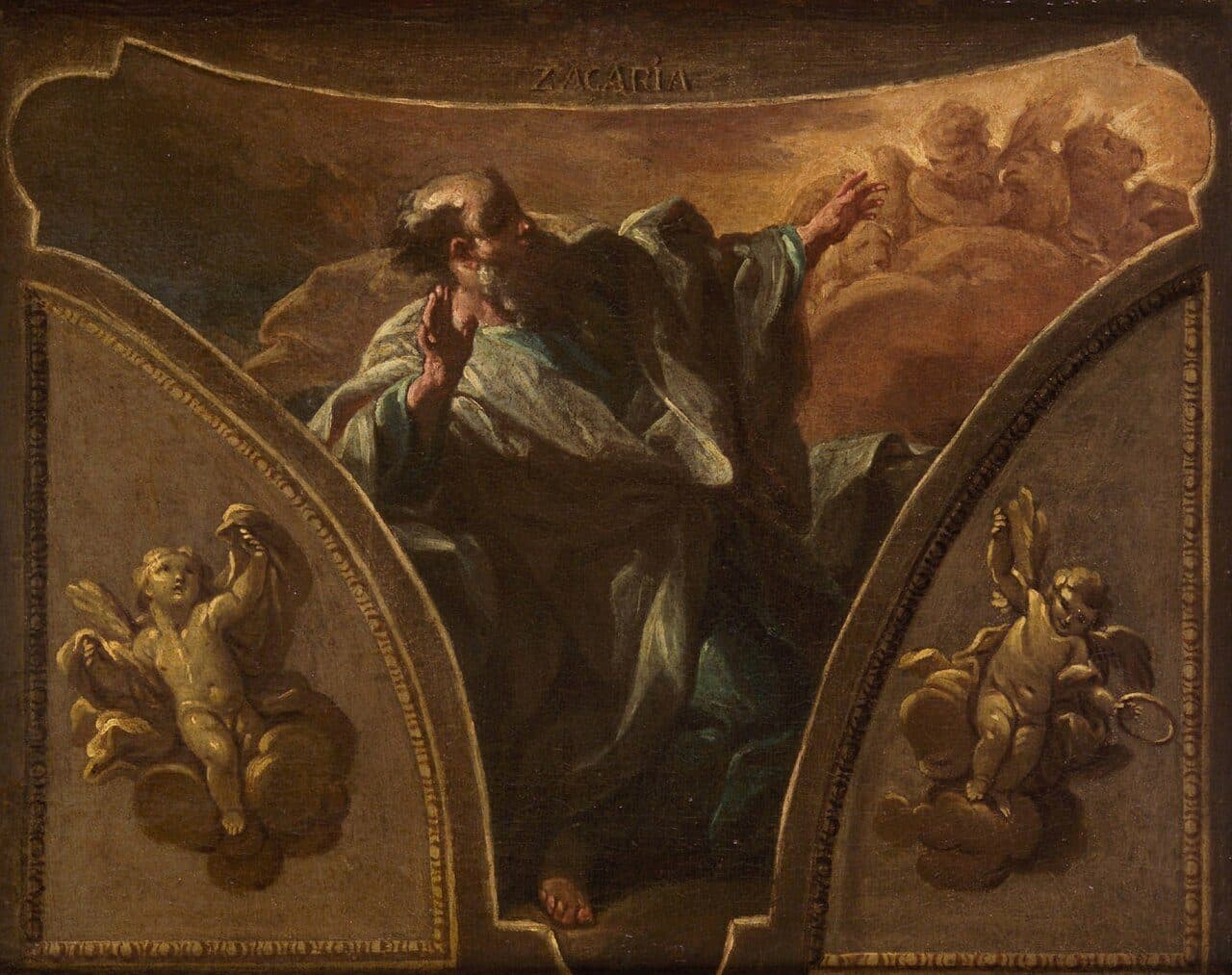
Workshop of Corrado Giaquinto, The Prophet Zechariah, about 1750, oil on canvas, Kunsthistorisches Museum, Vienna. Public domain, via Wikimedia Commons.
THE ARTWORKGiaquinto's workshop painted Zechariah as a design for the corner of a dome, his hands raised toward the angels of his visions.
The prophets spoke to a people who had let the LORD's house lie in ruins while they built their own.
Summary
Haggai and Zechariah dated seven of their messages, six of them to the day and five by the year of King Darius, and Ezra dates the finished temple by the same king's year.
- Haggai spoke first on the first day of the sixth month of Darius's second year.
- The people began work on the temple twenty-three days later.
- Zechariah's night visions came on the twenty-fourth day of the eleventh month.
- The temple was finished on the third of Adar in Darius's sixth year.
- Readers differ over which foundation Haggai dates and which seventy years Zechariah counts.
The Dates in the Text
the dated verses of the two prophets and of Ezra
In the second year of the reign of Darius, on the first day of the sixth month, the word of the LORD came through Haggai the prophet to Zerubbabel son of Shealtiel, governor of Judah, and to Joshua son of Jehozadak, the high priest, statingHaggai's first word, to Zerubbabel and Joshua, is the earliest dated message of the two prophets.
on the twenty-fourth day of the sixth month, in the second year of King Darius.The people began the work on the house on this day, twenty-three days after Haggai's first word.
On the twenty-first day of the seventh month, the word of the LORD came through Haggai the prophet, saying:Haggai's second word, the promise of the latter glory of the house, is dated to this day.
On the twenty-fourth day of the ninth month, in the second year of Darius, the word of the LORD came to Haggai the prophet, saying,Haggai's question to the priests on what is clean and unclean is dated to this day.
For the second time that day, the twenty-fourth day of the month, the word of the LORD came to Haggai, saying,Haggai's fourth dated word, the promise to Zerubbabel of the signet ring, is dated in this verse.
In the eighth month of the second year of Darius, the word of the LORD came to the prophet Zechariah son of Berechiah, the son of Iddo, saying:Zechariah's first word, the call to return to the LORD, falls between Haggai's second and third words.
On the twenty-fourth day of the eleventh month, the month of Shebat, in the second year of Darius, the word of the LORD came to the prophet Zechariah son of Berechiah, the son of Iddo.The night visions that follow, from Zechariah 1:8 to 6:8, stand under this one date.
In the fourth year of King Darius, the word of the LORD came to Zechariah on the fourth day of the ninth month, the month of Chislev.The question from Bethel about the fast of the fifth month is dated to this day.
Thus the construction of the house of God in Jerusalem ceased, and it remained at a standstill until the second year of the reign of Darius king of Persia.This verse closes Ezra's account of the opposition that halted the work, and Ezra 5:1 brings in Haggai and Zechariah.
And this temple was completed on the third day of the month of Adar, in the sixth year of the reign of King Darius.This verse closes the account of the rebuilding that Ezra 4:24 opens with the stop.
The Rebuilding Month by Month
eight dates of the rebuilding, from Haggai's first word to the finished house
| Date in the text | Julian date | Verse |
|---|---|---|
| Year 2, month 6, day 1 | 29 August 520 BC | Haggai 1:1 |
| Year 2, month 6, day 24 | 21 September | Haggai 1:15 |
| Year 2, month 7, day 21 | 17 October | Haggai 2:1 |
| Year 2, month 8 | 27 October to 24 November | Zechariah 1:1 |
| Year 2, month 9, day 24 | 18 December | Haggai 2:10 |
| Year 2, month 11 (Shebat), day 24 | 15 February 519 BC | Zechariah 1:7 |
| Year 4, month 9 (Chislev), day 4 | 6 December 518 BC | Zechariah 7:1 |
| Year 6, month 12 (Adar), day 3 | 12 March 515 BC | Ezra 6:15 |
- Date in the text
- Year 2, month 6, day 1
- Julian date
- 29 August 520 BC
- Verse
- Haggai 1:1
- Date in the text
- Year 2, month 6, day 24
- Julian date
- 21 September
- Verse
- Haggai 1:15
- Date in the text
- Year 2, month 7, day 21
- Julian date
- 17 October
- Verse
- Haggai 2:1
- Date in the text
- Year 2, month 8
- Julian date
- 27 October to 24 November
- Verse
- Zechariah 1:1
- Date in the text
- Year 2, month 9, day 24
- Julian date
- 18 December
- Verse
- Haggai 2:10
- Date in the text
- Year 2, month 11 (Shebat), day 24
- Julian date
- 15 February 519 BC
- Verse
- Zechariah 1:7
- Date in the text
- Year 4, month 9 (Chislev), day 4
- Julian date
- 6 December 518 BC
- Verse
- Zechariah 7:1
- Date in the text
- Year 6, month 12 (Adar), day 3
- Julian date
- 12 March 515 BC
- Verse
- Ezra 6:15
Which Foundation Haggai Dates
three readings of the foundation verse, each with its holders
Ezra places a foundation in the second year after the return, which Jamieson, Fausset and Brown date to April 536 BC.
Consider carefully from this day forward—from the twenty-fourth day of the ninth month, the day the foundation of the LORD’s temple was laid—consider carefully:Whether its two phrases of time name one day or two decides between the three readings.
When the builders had laid the foundation of the temple of the LORD, the priests in their apparel with trumpets, and the Levites (the sons of Asaph) with cymbals, took their positions to praise the LORD, as David king of Israel had prescribed.Every reading of Haggai 2:18 has to account for this earlier foundation.
The foundation of Cyrus's reignC. F. Keil, The Twelve Minor Prophets
Keil reads the two phrases as two separate points in time. The lean years, on his reading, ran from Cyrus's reign to the day of this word, and the blessing begins then.
He holds that to make that day the foundation day sets Haggai against his own words about stone laid on stone.
The objection is the plain order of the verse, which names the day and the foundation in one breath.
The work resumed on old foundationsAlbert Barnes, Notes, Explanatory and Practical; Hugo Grotius, as Jamieson, Fausset and Brown report him in their Commentary Critical and Explanatory
Albert Barnes answers from a parallel in Zechariah.
“From the day that the foundation of the Lord’s house - Zechariah, in a passage corresponding to this, uses the same words Zec 8:9, ‘the day that the foundation of the house of the Lord of hosts was laid, that the temple might be built,’ not of the first foundation, but of the work as resumed in obedience to the words by ‘the mouth of the prophets,’ Haggai and himself, which, Ezra also says, was Ezr 4:24; Ezr 5:1. ‘in the second year of Darius.’ But that work was resumed, not now at the time of this prophecy, but three months before, on the 24th of the sixth month. Since then the word translated here, from, is in no case used of the present time, Haggai gives two dates, the resumption of the work, as marked in these words, and the, actual present. He would then say, that even in these last months, since they had begun the work, there were as yet no signs for the better. There was yet no ‘seed in the barn,’ the harvest having been blighted and the fruit-trees stripped by the hail before the close of the sixth month, when they resumed the work. Yet though there were as yet no signs of change, no earnest that the promise should be fulfilled, God pledges His word, ‘from this day I will bless you.’ Thenceforth, from their obedience, God would give them those fruits of the earth, which in His Providence had been, during their negligence, withheld. ‘God,’ said Paul and Barnabas, Act 14:17. ‘left not Himself without witness, in that He did good, and gave us rain from heaven and fruitful seasons, filling our hearts with food and gladness.’ All the Old and New Testament, the Law, the prophets and the Psalms, the Apostles and our Lord Himself, bear witness to the Providence of God who makes His natural laws serve to the moral discipline of His creature, man. […]”
Albert Barnes · Notes, Explanatory and Practical, on the Old and New Testaments (1832-1869) · on Haggai 2:18Evangelical
Jamieson, Fausset and Brown set the readings of Grotius and Maurer side by side.
“Or, translate, ‘From this day on which the temple is being begun,’ namely, on the foundations long ago laid [GROTIUS]. MAURER translates, ‘Consider . . . from the four and twentieth day . . . to (the time which has elapsed) from the day on which the foundation . . . was laid.’ The Hebrew supports English Version.”
Jamieson, Fausset & Brown · Commentary Critical and Explanatory on the Whole Bible · on Haggai 2:18Reformed
The elders' answer to Tattenai supports this reading.
So this Sheshbazzar came and laid the foundation of the house of God in Jerusalem, and from that time until now it has been under construction, but it has not yet been completed.”On this account the work of 520 BC built on the foundation already laid under Cyrus.
The objection is Ezra 4:24, which says the work stood still until Darius's second year.
A new foundation in Darius's second yearFerdinand Hitzig and August Koehler, as C. F. Keil reports them in The Twelve Minor Prophets
Hitzig and Koehler read the second phrase as a restatement of the first. On their reading the day Haggai names was itself the day the foundation was laid.
They read Zechariah's words to the builders, in Zechariah 8:9 and Zechariah 4:9, the same way.
This is what the LORD of Hosts says: “Let your hands be strong, you who now hear these words spoken by the prophets who were present when the foundations were laid to rebuild the temple, the house of the LORD of Hosts.Barnes reads this same verse of the work resumed, so the one verse serves two readings.
The objection is Ezra 3:10, which records a foundation laid in the reign of Cyrus.
What the Dates Show
the spans between the dates, and the feast of Haggai's second word
FROM FIRST WORD TO LAST
Haggai's last two words share one date, 111 days after his first.
FOUR AND A HALF YEARS
From the day the work began to the day the house was finished was about 1,633 days.
TWO MONTHS APART
John Wesley, on Zechariah 1:1, sets Zechariah's first word two months after Haggai began to call the people to build.
Albert Barnes explains what the date meant to those who heard Haggai.
“In the seventh month, in the one and twentieth day of the month - This was the seventh day of the feast of tabernacles, Lev 23:34, Lev 23:36, Lev 23:40-42. and its close. The eighth day was to be a sabbath, with its ‘holy convocation,’ but the commemorative feast, the dwelling in booths, in memory of God’s bringing them out of Egypt, was to last seven days. The close then of this feast could not but revive their sadness at the glories of their first deliverance by God’s ‘mighly hand and outstretched arm,’ and their present fewness and poverty.”
Albert Barnes · Notes, Explanatory and Practical, on the Old and New Testaments (1832-1869) · on Haggai 2:1Evangelical
The Calendar Behind the Dates
lunar months counted from the first crescent, and a Persian king's regnal years
In the Persian period a month began when the thin crescent of the new moon was first seen at sunset. A thirteenth month was added in some years to keep the new year in spring.
Richard Parker and Waldo Dubberstein set out the first day of every Babylonian month of the period in Babylonian Chronology (1942). By their table, Darius's second year began on 3 April 520 BC.
They say about 70 percent of their dates are exact to the day. At Jerusalem the crescent could be seen a little earlier than at Babylon, so a month there might begin a day sooner.
Zechariah names two months, Shebat and Chislev, and Ezra names Adar. The Jerusalem Talmud records the saying of Rabbi Hanina that the names of the months came up with the people from Babylon.
Darius took the throne in the autumn of 522 BC, when he killed Bardiya, who had seized the empire that July. Babylon rose against him twice before the end of 521 BC.
Two Questions of Chronology
the king the dates name, and the year the house was finished
Which DariusJohn Calvin, Commentaries; C. F. Keil, The Twelve Minor Prophets; Albert Barnes, Notes, Explanatory and Practical
Keil names the king as Darius Hystaspes, whose reign he counts from 521 to 486 BC. He sets aside Darius Nothus, a later king, because Zerubbabel and Joshua had led the return under Cyrus and would not have lived so long.
Albert Barnes on Haggai 1:1 names Darius Hystaspes as well. John Calvin, in the sixteenth century, gives the account the histories of his day held: Cambyses, the first-born son of Cyrus, had no male heir.
“Hence it was that his brother being slain by the consent of the nobles, the kingdom came to Darius. He, then, as we may learn from histories, was the third king of the Persians.”
John Calvin · Commentaries · on Haggai 1:1Reformed
515 or 516 BCAlbert Barnes, Notes, Explanatory and Practical; Richard A. Parker and Waldo H. Dubberstein, Babylonian Chronology
Darius's sixth year began in the spring of 516 BC, and Albert Barnes, in his Notes on Ezra 6:15, gives it as 516 to 515 BC. The house was finished in the last month of that reckoning, so its Julian year is 515 BC.
What the Text Leaves Unsaid
four things the dated verses leave open
The Prophets in Ezra's Account
Ezra 6:14, on the elders, the prophets and the kings
So the Jewish elders built and prospered through the prophesying of Haggai the prophet and Zechariah son of Iddo. They finished building according to the command of the God of Israel and the decrees of Cyrus, Darius, and Artaxerxes, kings of Persia.Here Ezra gives the prophets their part in the finished house.
Two Voices on Zechariah's Dates
why the night visions and the question about fasting came when they did
Albert Barnes dates the visions by the builders' work.
“On the twenty-fourth day - Exactly five months after the building of the temple was resumed Hag 2:15, and two months after Haggai’s last prophecy Hag 2:20. The series of visions, leading onward, from the first deliverance from the enemies who oppressed them, to the Coming of Christ, is given as a reward to their first whole-hearted endeavor to restore their worship of Him. The visions are called the ‘word of the Lord,’ because they were prophecy, made visible to the eye, conveying the revelation to the soul, and in part explained by Him.”
Albert Barnes · Notes, Explanatory and Practical, on the Old and New Testaments (1832-1869) · on Zechariah 1:7Evangelical
Adam Clarke says why the men of Bethel asked about the fast when they did.
“When they had sent - Sherezer and Regem-melech - To inquire whether the fasts should be continued, which they had hitherto observed on account of their ruined temple; and the reason why they inquired was, that they were rebuilding that temple, and were likely to bring it to a joyful issue.”
Adam Clarke · Commentary on the Bible · on Zechariah 7:2Evangelical
Which Seventy Years
the span the angel names in the night visions and the LORD names in the answer on fasting
The two passages stand nearly two years apart, from February 519 BC to December 518 BC, and both name seventy years.
Then the angel of the LORD said, “How long, O LORD of Hosts, will You withhold mercy from Jerusalem and the cities of Judah, with which You have been angry these seventy years?”Readers date the start of these seventy years from Jeremiah's prophecy or from the burning of the temple, and Barnes allows both.
“Ask all the people of the land and the priests, ‘When you fasted and mourned in the fifth and seventh months for these seventy years, was it really for Me that you fasted?A reading of the span has to fit the fasts of this verse as well as the angel's plea.
Jeremiah's seventy yearsJohn Calvin, Commentaries on Zechariah; Jamieson, Fausset and Brown, Commentary Critical and Explanatory
Calvin reads the angel as pleading the term of seventy years that God had fixed through Jeremiah for the exile.
For this is what the LORD says: “When Babylon’s seventy years are complete, I will attend to you and confirm My promise to restore you to this place.Calvin's reading stands on this promise, which Jeremiah sent by letter to the exiles.
Jamieson, Fausset and Brown hold the same term and say why the angel prays now.
“Re 6:10, ‘How long,’ &c. Heretofore it was vain to pray, but now that the divinely appointed ‘threescore and ten years’ (Jer 25:11; 29:10) are elapsed, it is time to pray to Thee for the fulfilment of Thy promise, seeing that Thy grace is not yet fully manifested, nor Thy promise fulfilled.”
Jamieson, Fausset & Brown · Commentary Critical and Explanatory on the Whole Bible · on Zechariah 1:12Reformed
The objection is the date: the angel speaks in 519 BC, after the exiles had gone home under Cyrus.
From the burning of the templeAdam Clarke, Commentary on the Bible; John Owen, in his translation of Calvin
Adam Clarke takes the angel to be Christ and counts the years another way.
“Then the angel of the Lord - He who was among the myrtles - the Lord Jesus. O Lord of hosts, how long - Jesus Christ was not only the ‘Lamb slain from the foundation of the world,’ but was always the sole Mediator and intercessor between God and man. These threescore and ten years? - This cannot mean the duration of the captivity for that was nearly twenty years past. It must mean simply the time that had elapsed from the destruction of the temple to the time in which the angel spoke.”
Adam Clarke · Commentary on the Bible · on Zechariah 1:12Evangelical
John Owen, in a note to his translation of Calvin, finds three periods of seventy years and holds that this one runs from the burning of the temple to Darius's second year.
On the seventh day of the fifth month, in the nineteenth year of Nebuchadnezzar’s reign over Babylon, Nebuzaradan captain of the guard, a servant of the king of Babylon, entered Jerusalem. He burned down the house of the LORD, the royal palace, and all the houses of Jerusalem—every significant building.By the Babylonian tables this day fell in August 586 BC, about sixty-seven years before the angel's question.
Keil gives 588 or 587 BC for the burning.
Three of the fasts Zechariah names kept the days of Jerusalem's fall: the siege in the tenth month, the breach of the wall in the fourth and the burning in the fifth.
“This is what the LORD of Hosts says: The fasts of the fourth, the fifth, the seventh, and the tenth months will become times of joy and gladness, cheerful feasts for the house of Judah. Therefore you are to love both truth and peace.”This is the one verse that names all four fasts by their months.
John Wesley names the event the fast of the seventh month kept.
“Unto all the people - By their messengers. And seventh - For the murder of Gedaliah, slain by Ishmael. Even to me - You pleased yourselves in it, not me; you wept more for the inconveniences of the thing than the sinfulness of it.”
John Wesley · Explanatory Notes upon the Old Testament · on Zechariah 7:5Evangelical
The objection is that Jeremiah counts his seventy years for Babylon's rule, which began before the temple burned.
Both spans at onceAlbert Barnes, Notes, Explanatory and Practical
Albert Barnes weighs the two spans and quotes Cyril on the angel's prayer.
“And the Angel of the Lord answered - the implied longing, by intercession with God. As the angel-interpreter in Job had ‘the office of no mere created angel, but one, anticipative of His, who came at once to redeem and justify,’ so the Angel of the Lord, in whom God was, exercised at once a mediatorial office with God, typical of our Lord’s high priest’s prayer John 17, and acted as God. These seventy years - The seventy years of the captivity, prophesied by Jeremiah Jer 25:11-12; Jer 29:10, were on the eve of their conclusion at the time of Daniel’s great prayer of intercession Dan 9:2; they ended with the capture of Babylon, and the edict of Cyrus, permitting the Jews to return 2Ch 36:22-23; Ezr 1:1. Yet there seems to have been a secondary fulfillment, from the destruction of the temple and city, in Zedekiah’s eleventh year 2Ki 25:2, 2Ki 25:8-9, 588 b.c. to the second year of Darius, 519 b.c. Such double fulfillments of prophecy are not like alternative fulfillments. They are a more intricate and fuller, not an easier fulfillment of it. Yet ‘these 70 years’ do not necessitate such a double fulfillment. It might express only a reverent wonder, that the 70 years being accomplished, the complete restoration was not yet brought to pass. Cyril: ‘God having fixed the time of the captivity to the 70th year, it was necessary to be silent, so long as the time was not yet come to an end, that he might not seem to oppose the Lord’s will. But, when the time was now come to a close and the fear of offending was removed, he, knowing that the Lord cannot lie, entreats and ventures to enquire whether His anger has come to an end, as had those who sinned; or whether, fresh sins having accrued, there shall be a further delay, and their forlorn estate shall be yet further extended. […]”
Albert Barnes · Notes, Explanatory and Practical, on the Old and New Testaments (1832-1869) · on Zechariah 1:12Evangelical
Books on the Dates
the Babylonian tables, Keil and Calvin, each free to read
Babylonian Chronology, 626 B.C. to A.D. 45
Richard A. Parker and Waldo H. Dubberstein · 1942
Its Darius I table, on page 28, covers every year from 521 to 486 BC.
Read at the Internet ArchiveThe Twelve Minor Prophets, volume 2
C. F. Keil · 1868
Keil comments on every verse of Haggai and Zechariah from the Hebrew text.
Read at the Internet ArchiveCommentaries on the Twelve Minor Prophets: Zechariah and Malachi
John Calvin, translated by John Owen · 1849
Calvin comments verse by verse, and Owen's footnotes add the chronology of later scholars.
Read at the Christian Classics Ethereal LibraryThe Kingdom That Cannot Be Shaken
the second word's promise, carried into the New Testament
Haggai gave this promise to builders nearly a month into their work, when the new house seemed nothing beside the old one.
For this is what the LORD of Hosts says: “Once more, in a little while, I will shake the heavens and the earth, the sea and the dry land. I will shake all the nations, and they will come with all their treasures, and I will fill this house with glory, says the LORD of Hosts.Hebrews 12:26 quotes the first line of this promise.
At that time His voice shook the earth, but now He has promised, “Once more I will shake not only the earth, but heaven as well.” The words “Once more” signify the removal of what can be shaken—that is, created things—so that the unshakable may remain. Therefore, since we are receiving an unshakable kingdom, let us be filled with gratitude, and so worship God acceptably with reverence and awe.The writer applies Haggai's promise to believers in Christ.
Keep studying
Read it5
Studies8