
Leviticus 17 · Subject · Featured Study
The blood rule after the cross
Leviticus 17, with Genesis 9:4 before Sinai, the council's letter in Acts 15 and 21, and Hebrews 9 on the blood of Christ.
For the life of the flesh is in the blood, and I have given it to you to make atonement for your souls upon the altar.
- Books
- Leviticus, Genesis, Deuteronomy, 1 Samuel, Acts, Hebrews
- Hold in memory
- Leviticus 17:11, Acts 15:29
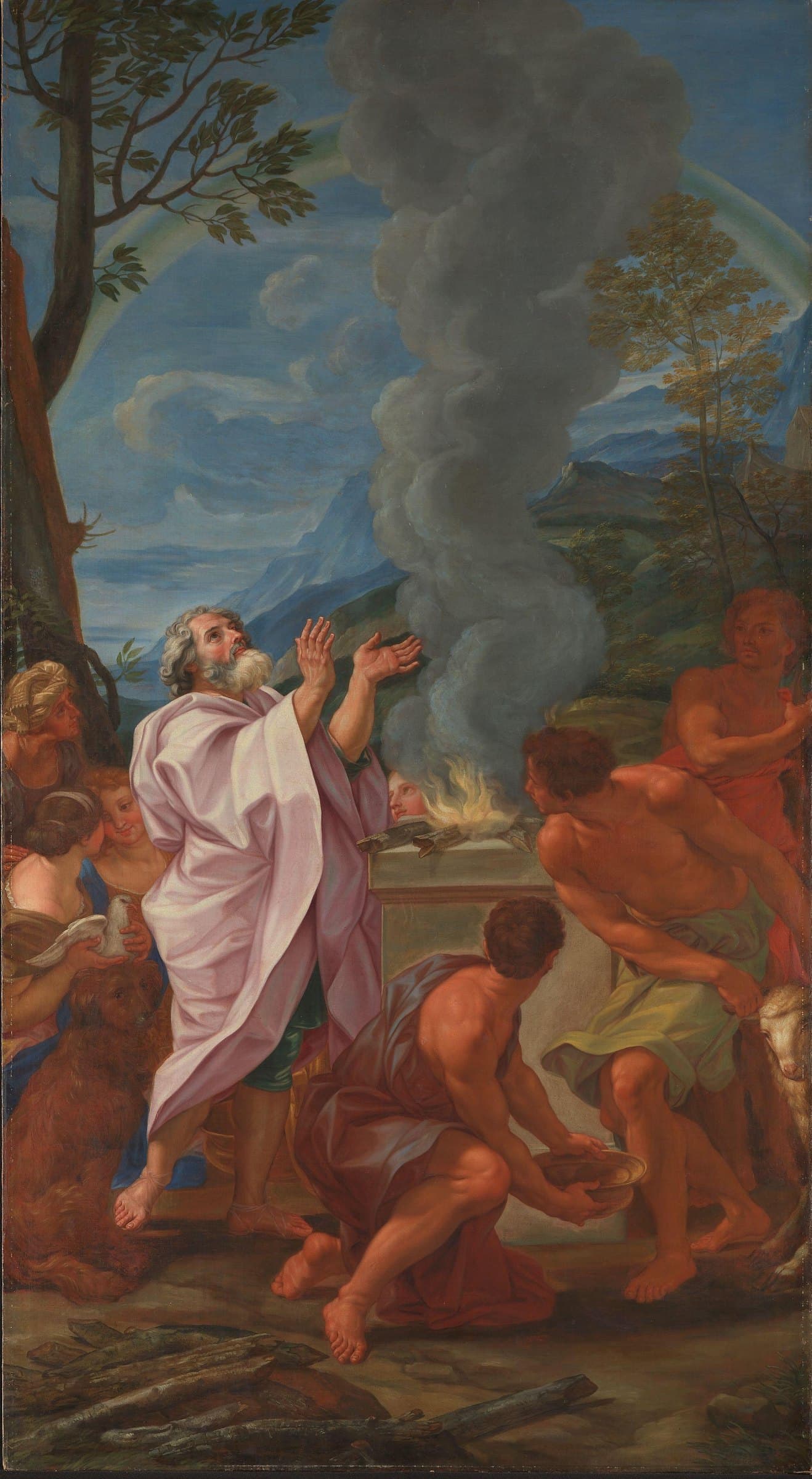
Giovanni Battista Gaulli, The Sacrifice of Noah, between 1660 and 1709, National Museum of Art, Architecture and Design, Oslo, NG.M.03497. Public domain (painted before 1930), via Wikimedia Commons, File:Giovanni Battista Gaulli - The Sacrifice of Noah - NG.M.03497 - National Museum of Art, Architecture and Design.jpg.
THE ARTWORKGaulli painted Noah at his altar after the flood, under the rainbow, where God next gave him the flesh of animals for food and kept back the blood (Genesis 8:20 to 9:4).
Summary
Scripture forbids eating blood from Noah to the Jerusalem council, and the church has read the rule's force after the cross in more than one way.
- God forbade Noah and his sons to eat meat with its lifeblood still in it (Genesis 9:4).
- One verse of Leviticus 17 states the rule's reason, and it ties that reason to the sacrifices.
- The council at Jerusalem kept the rule for Gentile believers beside three other abstentions (Acts 15:20 and 29).
- Tertullian reports Christians refusing blood at their meals, and the Council in Trullo of 692 made the rule canon law.
- Augustine, Calvin and Matthew Henry read the rule as a measure for its time, and Wesley held it binding on every nation since Noah.
The Rule and Its Reason
Leviticus 17:10 to 14 forbids blood to Israel and to the foreigner, and states why.
If anyone from the house of Israel or a foreigner living among them eats any blood, I will set My face against that person and cut him off from among his people. For the life of the flesh is in the blood, and I have given it to you to make atonement for your souls upon the altar; for it is the blood that makes atonement for the soul. Therefore I say to the Israelites, ‘None of you may eat blood, nor may any foreigner living among you eat blood.’The law binds the foreigner living in Israel as well as the native-born, and it sets its reason between two commands.
And if any Israelite or foreigner living among them hunts down a wild animal or bird that may be eaten, he must drain its blood and cover it with dirt. For the life of all flesh is its blood. Therefore I have told the Israelites, ‘You must not eat the blood of any living thing, because the life of all flesh is its blood; whoever eats it must be cut off.’The hunter drains the blood of game and covers it with dirt, so the rule reaches meat that never comes to the altar.
Albert Barnes, on Leviticus 17:10, counted seven places in the Pentateuch that forbid blood. He found two grounds in this passage: blood is the fluid of life, and it is consecrated in sacrificial worship.
Before SinaiGenesis 9:3 to 4
Everything that lives and moves will be food for you; just as I gave you the green plants, I now give you all things. But you must not eat meat with its lifeblood still in it.God gives Noah every living thing for food and keeps back the blood, so the rule is older than Israel.
Barnes, on 1 Samuel 14:33, wrote that the prohibition was older than the Law of Moses and set Genesis 9:4 beside Acts 15:20 and 29.
Fat and blood in every dwellingLeviticus 3:17; 7:26 to 27
This is a permanent statute for the generations to come, wherever you live: You must not eat any fat or any blood.”Leviticus 3 closes the law of the peace offering with this rule, so blood is held back from the worshipper's meal before its reason is given.
You must not eat the blood of any bird or animal in any of your dwellings. If anyone eats blood, that person must be cut off from his people.’”Eating the blood of any bird or animal carries the penalty of being cut off from the people.
The Rule from Noah to the Council
Seven stations of the rule in Scripture, and three readings of why the council kept it.
- Who is bound, and what the text says
- Everyone who eats meat after the flood.
- Who is bound, and what the text says
- Israel in every dwelling, with fat and blood named together.
- Who is bound, and what the text says
- Israel and the foreigner: the life is in the blood, given for atonement on the altar.
- Who is bound, and what the text says
- Israel slaughtering at home pours the blood on the ground like water.
- Who is bound, and what the text says
- Hungry troops eat with the blood, and Saul calls it sinning against the LORD.
- Who is bound, and what the text says
- Gentile believers receive four essential requirements, blood among them.
- Who is bound, and what the text says
- Hebrews: without the shedding of blood there is no forgiveness.
Seven stations, each with its verse, who it binds and what the text says at that point.
| Reading | What the four items are taken to be | Held by |
|---|---|---|
| A rule for its time, to keep the peace | A concession so that Jewish and Gentile believers could eat together. | Augustine, John Calvin, Matthew Henry and Albert Barnes |
| Practices of the idol's temple | Practices of pagan worship, from idol meat to blood at the altar. | Adam Clarke |
| A rule for every nation since Noah | A rule given to every nation before Sinai. | John Wesley and the Council in Trullo |
The Council Keeps the Rule
Acts 15 sets the blood rule among four abstentions, and Acts 21 repeats them.
It is my judgment, therefore, that we should not cause trouble for the Gentiles who are turning to God. Instead, we should write and tell them to abstain from food polluted by idols, from sexual immorality, from the meat of strangled animals, and from blood.James asks that the Gentiles turning to God not be troubled, and names four things they should avoid, blood the last.
For Moses has been proclaimed in every city from ancient times and is read in the synagogues on every Sabbath.”James grounds the four in the law their Jewish neighbours heard, and the reading of a rule for its time leans on that ground.
It seemed good to the Holy Spirit and to us not to burden you with anything beyond these essential requirements: You must abstain from food sacrificed to idols, from blood, from the meat of strangled animals, and from sexual immorality. You will do well to avoid these things. Farewell.The letter claims the Holy Spirit's agreement and calls the four essential, the phrase any reading that sets the rule aside must answer.
James's list puts food polluted by idols first and blood last. The letter's list puts blood second and sexual immorality last.
Repeated to PaulActs 21:25
As for the Gentile believers, we have written to them our decision that they must abstain from food sacrificed to idols, from blood, from the meat of strangled animals, and from sexual immorality.”The elders in Jerusalem restate the decree to Paul after his mission among the Gentiles, so it still stood then.
How the Church Kept the Rule
Writers from the third century to the eighteenth record the rule kept, relaxed and kept again.
Tertullian, in his Apology, told the pagans that Christians did not eat even the blood of animals and abstained from things strangled. He said they tempted Christians with sausages of blood because they knew Christians held it unlawful.
Clement of Alexandria read the decree as the one exception to Paul's rule for the meat market.
“For the apostle says, ‘All other things buy out of the shambles, asking no questions,’ with the exception of the things mentioned in the Catholic epistle of all the apostles, ‘with the consent of the Holy Ghost,’ which is written in the Acts of the Apostles, and conveyed to the faithful by the hands of Paul himself.”
Clement of Alexandria · The Stromata Book 4 · on Acts 15:29Patristic
Origen on what the decree leaves outOrigen, Commentary on Romans 9.28
Origen noticed that the decree forbids neither murder nor adultery nor theft, which divine and human laws punish. So the four cannot be a full code of conduct for Gentile believers.
Augustine on the thrushesAugustine, Reply to Faustus 32.13
Augustine reported two readings of the word in his day: meat from which the blood has not been poured out, and the crime of murder. In his own church, he wrote, no Christian felt bound to abstain from thrushes or small birds whose blood had not been poured out.
The Council in TrulloCanon 67, A.D. 692
The council cited the divine Scripture's command to abstain from blood, from things strangled and from fornication. It ruled that a clergyman who ate the blood of an animal be deposed and a layman be cut off.
Wesley on the churches outside RomeJohn Wesley on Acts 15:29
John Wesley wrote that the bishop of Rome repealed the decree about the middle of the eighth century. In the churches that never acknowledged his authority, Wesley said, eating blood was never allowed and was not allowed in his day.
Blood at the Altar and Among the Nations
Deuteronomy, Samuel and Ezekiel apply the rule, and older commentators tie it to idol worship.
Only be sure not to eat the blood, because the blood is the life, and you must not eat the life with the meat. You must not eat the blood; pour it on the ground like water.Moses repeats the rule for meat eaten far from the sanctuary and gives the reason in four words: the blood is the life.
So they rushed greedily to the plunder, taking sheep, cattle, and calves. They slaughtered them on the ground and ate meat with the blood still in it. Then someone reported to Saul: “Look, the troops are sinning against the LORD by eating meat with the blood still in it.” “You have broken faith,” said Saul. “Roll a large stone over here at once.”The rule held in the camp of Israel's first king, where hunger after battle was no excuse for breaking it.
Therefore tell them that this is what the Lord GOD says: ‘You eat meat with the blood in it, lift up your eyes to your idols, and shed blood. Should you then possess the land?Ezekiel joins eating meat with the blood to lifting the eyes to idols and shedding blood in one charge.
Blood and the idolatersHenry on Deuteronomy 12:25; Jamieson, Fausset and Brown on Leviticus 17:10
Matthew Henry gives Bishop Patrick's reason for the rule's strictness.
“Bishop Patrick thinks one reason why they were forbidden thus strictly the eating of blood was to prevent the superstitions of the old idolaters about the blood of their sacrifices, which they thought their demons delighted in, and by eating of which they imagined that they had communion with them.”
Matthew Henry · Commentary on the Whole Bible · on Deuteronomy 12:25Puritan
Jamieson, Fausset and Brown describe what the Zabians did where the blood was poured out.
“The Zabians, or worshippers of the heavenly host, were accustomed, in sacrificing animals, to pour out the blood and eat a part of the flesh at the place where the blood was poured out (and sometimes the blood itself) believing that by means of it, friendship, brotherhood, and familiarity were contracted between the worshippers and the deities.”
Jamieson, Fausset & Brown · Commentary Critical and Explanatory on the Whole Bible · on Leviticus 17:10Reformed
The Words for Blood and Life
Four words carry the rule in Hebrew and in Greek.
DAM (H1818)
Blood of man or animal, defined in the lexicon as that which when shed causes death.
NEPHESH (H5315)
A breathing creature, rendered both life and soul within the one verse of Leviticus 17 that gives the rule's reason.
HAIMA (G129)
Blood of men or animals, and in the lexicon also the atoning blood of Christ.
PNIKTOS (G4156)
An animal choked to death and not bled, the strangled meat of the decree.
What the Text Leaves Unsaid
Genesis, Acts and Paul leave three matters about the rule unsaid.
The command to Noah gives no reason for the rule, and the reason waits for Leviticus 17. Acts gives no term for the four requirements and records no repeal of them.
When Paul answers the Corinthians about food offered to idols, he argues from conscience and the weak and does not quote the letter of Acts 15 (1 Corinthians 8:7 to 9; 10:25 to 28).
The Blood That Makes Atonement
Hebrews reads the altar's blood as pointing to the blood of Christ.
He did not enter by the blood of goats and calves, but He entered the Most Holy Place once for all by His own blood, thus securing eternal redemption.Christ entered once for all by His own blood, which ends the sacrifices the altar rule served.
According to the law, in fact, nearly everything must be purified with blood, and without the shedding of blood there is no forgiveness.The writer states the law's principle of purifying by blood, the principle the altar rule of Leviticus 17 grounds.
Wesley read the blood that makes atonement in Leviticus 17 as a type of the blood of Christ, by which atonement is really made. Henry, on the command to Noah, tied the rule to the continuance of the law of sacrifices, while blood was not to be treated as a common thing.
Drinking His bloodJohn 6:53 to 54
So Jesus said to them, “Truly, truly, I tell you, unless you eat the flesh and drink the blood of the Son of Man, you have no life in you. Whoever eats My flesh and drinks My blood has eternal life, and I will raise him up at the last day.Jesus speaks of eating His flesh and drinking His blood, words a reader of Leviticus 17 will set beside the rule.
Voices on the Blood Rule
Wesley on the rule since Noah, and Henry on James's judgment.
From Noah to MosesJohn Wesley on Acts 15:29
Wesley traces the prohibition from the first grant of flesh to the law of Moses.
“From Adam to Noah no man ate flesh at all; consequently no man then ate blood. When God allowed Noah and his posterity to eat flesh, he absolutely forbade them to eat blood; and accordingly this, with the other six precepts of Noah, was delivered down from Noah to Moses. God renewed this prohibition by Moses, which was not repealed from the time of Moses till Christ came.”
John Wesley · Explanatory Notes upon the New Testament · on Acts 15:29Evangelical
The burden sparedMatthew Henry on Acts 15:19
Henry names what the Gentiles were to be trained in instead.
“The kingdom of God, in which they are to be trained up, is not meat and drink, neither the opposition nor the imposition of indifferent things, which will but trouble them; but it is righteousness, and peace, and joy in the Holy Ghost, which we are sure will trouble nobody.”
Matthew Henry · Commentary on the Whole Bible · on Acts 15:19Puritan
Why the Council Kept the Rule, and Whether It Binds
Three readings of the council's reason, each with its holders and the objection to it.
A rule for its time, to keep the peaceAugustine; John Calvin; Matthew Henry; Albert Barnes
Augustine held that the apostles consulted the time in choosing an easy observance that Gentiles and Israelites might have in common. John Calvin granted that the law was given to all the world after the flood, yet called the command but temporal, kept to cure offence. Henry, on Acts 15:20, wrote that blood and strangled things were not designed to be always abstained from. Barnes, on Acts 15:21, wrote that the Jewish converts would not soon learn that their ceremonial law had ceased to bind, so no needless offence was given.
The objection rests on the word essential in Acts 15:28 and on the elders' restating of the decree in Acts 21:25.
Practices of the idol's templeAdam Clarke
Adam Clarke, on Acts 15:20, read the first item as forbidding any share in the sacred feasts of idolaters.
The objection is that Leviticus and Deuteronomy forbid blood at ordinary meals, in the hunt and at home, far from any altar (Leviticus 17:13; Deuteronomy 12:24).
A rule for every nation since NoahJohn Wesley; the Council in Trullo
Wesley, on Acts 15:20, wrote that God commanded Noah, and in him all his posterity, to abstain from the blood of every creature killed for food. The Eastern canon of Trullo binds the rule on clergy and laity alike.
The objection rests on Mark 7:19, where all foods are declared clean, and on 1 Timothy 4:4, where nothing received with thanksgiving is to be rejected.
Books on the Blood Rule
Four works on the council's decree, three free to read online.
Apology
Tertullian, translated by S. Thelwall (Ante-Nicene Fathers, volume 3) · 1885
Chapter 9 records Christians refusing blood at their meals while their neighbours tested them with it.
Read on New AdventReply to Faustus the Manichaean
Augustine, translated by Richard Stothert (Nicene and Post-Nicene Fathers, First Series, volume 4) · 1887
Book 32 weighs the decree against the practice of the church Augustine knew.
Read on New AdventCommentary upon the Acts of the Apostles, volume 2
John Calvin, translated by Christopher Fetherstone, edited by Henry Beveridge (Calvin Translation Society) · 1844
Calvin's note on the decree holds together the Noahic origin of the rule and its temporary force.
Read on CCELExplanatory Notes upon the New Testament
John Wesley · 1755
Wesley's note on the council's letter sets out in six points his case that the rule still binds.
To the Glory of God
Romans 14 and 1 Corinthians 10 speak to the reader's own table.
The rule began at Noah's table, stood in the law of the altar and reached the council's letter. Paul asks every believer to eat with a clear conscience, to give thanks and to eat for the glory of God.
I am convinced and fully persuaded in the Lord Jesus that nothing is unclean in itself. But if anyone regards something as unclean, then for him it is unclean.Paul is persuaded in the Lord Jesus that nothing is unclean in itself, and he still guards the conscience of the one who thinks otherwise.
So whether you eat or drink or whatever you do, do it all to the glory of God.Eating and drinking are to be done to the glory of God, whatever a believer's table holds.
Keep studying
Places1
Symbols2
Doctrines10
Peoples and groups1