
Isaiah to Revelation · Doctrine · Featured Study
The New Creation
The new creation of Paul's letters, read beside the new heavens of the prophets and the new things of John's vision.
Paul gave the believer in Christ a two-word name. Readers since the fourth century have asked whether he meant a person, a world, or both.
- First taught
- Isaiah 65:17
- Fullest statement
- 2 Corinthians 5:17
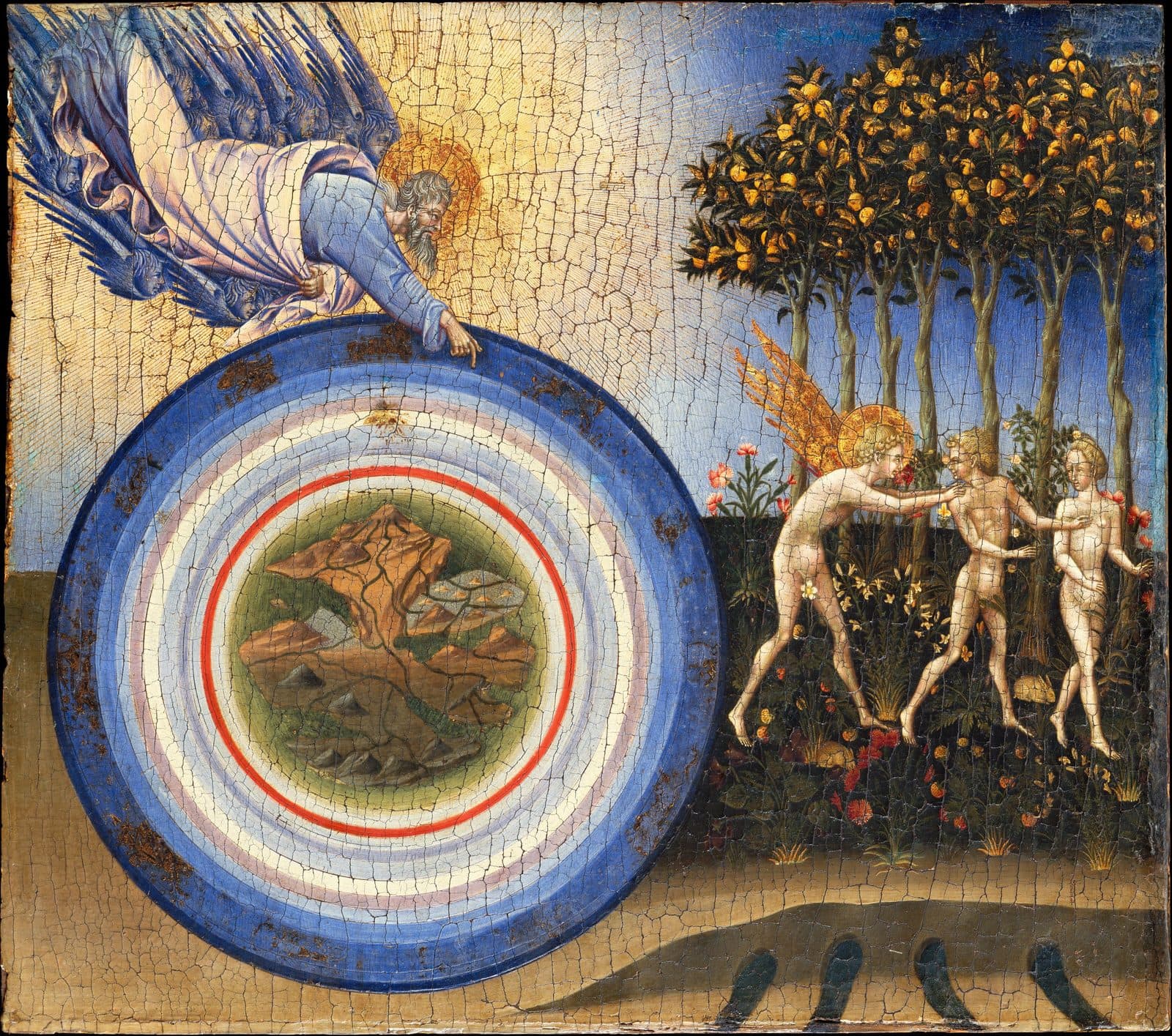
Giovanni di Paolo, The Creation of the World and the Expulsion from Paradise, 1445, tempera and gold on wood, Metropolitan Museum of Art. Public domain, via Wikimedia Commons.
THE ARTWORKGiovanni di Paolo set the first creation beside its loss: God points to the new-made world, and an angel drives Adam and Eve from Eden. The prophets and the apostles answer that loss with a new creation.
Summary
New creation is Paul's name for what God makes of anyone who is in Christ, and the prophets use the same language of new heavens and a new earth.
- Paul writes the words new creation to the Corinthians and to the Galatians.
- Isaiah uses the Hebrew verb for create three times in two verses of his promise of new heavens.
- In Revelation the One seated on the throne says that He makes all things new.
- The church fathers read the phrase both of the believer and of the whole creation.
- Christians differ on whether the present world will be renewed or replaced.
Paul's Two Verses
Paul uses the phrase in a letter to Corinth and in a letter to Galatia.
Therefore if anyone is in Christ, he is a new creation. The old has passed away. Behold, the new has come!In the Greek the two words kainē ktisis stand with no verb, and the Berean Standard Bible supplies the words he is.
For neither circumcision nor uncircumcision means anything. What counts is a new creation.The Galatian verse uses the same two Greek words, kainē ktisis.
From Isaiah to Revelation
Eight texts across the canon speak of what God makes new.
| Text | Who speaks, and to whom | What God makes new |
|---|---|---|
| Isaiah 43:19 | The LORD through Isaiah, to Israel | a new thing now springing up, a way in the wilderness and streams in the desert |
| Isaiah 65:17 | The LORD through Isaiah, to His people | new heavens and a new earth, with the former things no longer remembered |
| Romans 8:21 | Paul, to the saints in Rome | a creation set free from its bondage to decay into the freedom of the children of God |
| 2 Corinthians 5:17 | Paul, to the church of God in Corinth | a new creation in anyone who is in Christ, the old passed away and the new come |
| Galatians 6:15 | Paul, to the churches of Galatia | a new creation that counts where circumcision and uncircumcision count for nothing |
| Ephesians 2:15 | Paul, to the saints in Ephesus | one new man created in Christ out of the two, Jew and Gentile, making peace |
| 2 Peter 3:13 | Peter, to believers awaiting the day of God | a new heaven and a new earth where righteousness dwells, as God promised |
| Revelation 21:5 | The One seated on the throne, to John | all things, made new by the One seated on the throne |
- Text
- Isaiah 43:19
- Who speaks, and to whom
- The LORD through Isaiah, to Israel
- What God makes new
- a new thing now springing up, a way in the wilderness and streams in the desert
- Text
- Isaiah 65:17
- Who speaks, and to whom
- The LORD through Isaiah, to His people
- What God makes new
- new heavens and a new earth, with the former things no longer remembered
- Text
- Romans 8:21
- Who speaks, and to whom
- Paul, to the saints in Rome
- What God makes new
- a creation set free from its bondage to decay into the freedom of the children of God
- Who speaks, and to whom
- Paul, to the church of God in Corinth
- What God makes new
- a new creation in anyone who is in Christ, the old passed away and the new come
- Text
- Galatians 6:15
- Who speaks, and to whom
- Paul, to the churches of Galatia
- What God makes new
- a new creation that counts where circumcision and uncircumcision count for nothing
- Text
- Ephesians 2:15
- Who speaks, and to whom
- Paul, to the saints in Ephesus
- What God makes new
- one new man created in Christ out of the two, Jew and Gentile, making peace
- Text
- 2 Peter 3:13
- Who speaks, and to whom
- Peter, to believers awaiting the day of God
- What God makes new
- a new heaven and a new earth where righteousness dwells, as God promised
- Text
- Revelation 21:5
- Who speaks, and to whom
- The One seated on the throne, to John
- What God makes new
- all things, made new by the One seated on the throne
The Case, Text by Text
Isaiah, Paul and John, read in turn.
“Do not call to mind the former things; pay no attention to the things of old. Behold, I am about to do something new; even now it is coming. Do you not see it? Indeed, I will make a way in the wilderness and streams in the desert.Spoken to Israel, beside the promise to send to Babylon for her sake.
For behold, I will create new heavens and a new earth. The former things will not be remembered, nor will they come to mind. But be glad and rejoice forever in what I create; for I will create Jerusalem to be a joy and its people to be a delight.The promise that John's vision takes up at the end of the canon.
In Isaiah 65:17 and 18 the verb bara, to create, stands three times, and each time God is its subject. The same verb opens Genesis.
Paul reaches the phrase by an argument from the death of Christ in the verses before it, and he follows it with the work of reconciliation in the verses after it. In Galatians the phrase comes in the closing lines, after Paul says he writes with his own hand and after his boast in the cross.
For Christ’s love compels us, because we are convinced that One died for all, therefore all died. And He died for all, that those who live should no longer live for themselves, but for Him who died for them and was raised again. So from now on we regard no one according to the flesh. Although we once regarded Christ in this way, we do so no longer.These verses lead into the phrase.
‘He will wipe away every tear from their eyes,’ and there will be no more death or mourning or crying or pain, for the former things have passed away.” And the One seated on the throne said, “Behold, I make all things new.” Then He said, “Write this down, for these words are faithful and true.”John records this vision of the end near the close of the canon.
What the Words Say
The Hebrew and Greek words for new, and the words translations add.
Isaiah's word for new, in the new thing and the new heavens, is chadash. The word for new in Paul's two verses and in Revelation is kainos. The lexicon glosses it as new in freshness, and it sets neos beside it as new in age.
Jamieson, Fausset and Brown read the new things of Revelation as changed from the old rather than recent. The gloss marks a shade of meaning, so no doctrine rests on the word alone.
The Greek of the Corinthian verse ends with behold, new things have come into being. The King James Version reads all things are become new, and the Berean Standard Bible reads the new has come, with no words for all things.
The World Behind the Phrase
Jewish writings before and after Paul used the language of new creation.
The Book of Jubilees speaks of the day of the new creation, when the heavens and the earth shall be renewed. R. H. Charles, who edited it in 1902, dated it between 135 and 105 BC.
The rabbis spoke of a convert in the same terms. Genesis Rabbah, a midrash on Genesis from the land of Israel, says that whoever brings an idolater near is as though he created him. Tractate Yevamot of the Babylonian Talmud says that a convert who has just converted is like a child just born.
Sefaria dates Genesis Rabbah to about AD 400 and Yevamot to between 450 and 550, so both were written down after Paul. They show a way of speaking about a person brought into God's people, which helps a reader of Galatians, and give no evidence that Paul borrowed from them.
What the Text Leaves Unsaid
Paul names the new creation and leaves its timetable open.
Paul does not say when the renewal of the whole creation comes, and Isaiah and John do not say what the new earth is made of. Isaiah 65:20 still speaks of a death at a hundred years, and readers explain that verse in different ways.
The texts do not say that a new creation in Christ stops sinning. In 2 Corinthians 12 Paul still fears he will find quarreling and unrepented sin among the believers he writes to.
A Person, a World, or Both
Three readings of the phrase, and two of the end of the present world.
The person renewed
John Chrysostom, in his eleventh homily on 2 Corinthians, says the believer has come to another creation, born again by the Spirit. Gregory of Nyssa calls the new creature the indwelling of the Holy Spirit in a pure soul.
Therefore if any one be in Christ - A true believer in him. There is a new creation - Only the power that makes a world can make a Christian. And when he is so created, the old things are passed away - Of their own accord, even as snow in spring.
John Wesley · Explanatory Notes upon the New Testament · on 2 Corinthians 5:17Evangelical
The objection is that the Galatian verse sets the phrase against circumcision, which marked a people rather than a soul.
The world renewed, begun in Christ
Theodoret of Cyrus, on the Galatian verse, takes the strict meaning to be the transformation of all things after the resurrection. Oecumenius reads it as a new creation of all things, in which circumcised and uncircumcised believers stand alike.
The objection is that Paul ties the phrase to anyone in Christ, and that in Romans 8:22 the creation still groans.
Both, in order
John Calvin reads the Corinthian verse against the new heavens and new earth of Isaiah 65. Because the kingdom of Christ is spiritual, he says, the change takes place chiefly in the Spirit, and Paul rightly begins with it.
Charles Spurgeon preached the believer's position as being in Christ and his character as a new creature. In a later sermon he said Isaiah's promise will be fulfilled when the whole creation has been renewed.
The objection from both sides is that this reading joins two things Paul names with one phrase, and a reader must still decide which he meant in each letter.
The creation renewed at the end
Irenaeus held that neither the substance nor the essence of the creation is annihilated, and that only the fashion of the world passes away. Augustine, in the City of God, says the world, remade into something better, will become fit for people now remade. Andreas of Caesarea reads Revelation 21:1 as the renewal of creation into something better rather than its obliteration.
The creation replaced at the end
The Lutheran theologian Johann Andreas Quenstedt held that the end of the world is the reduction of its substance to nothing. He cited 2 Peter 3:10, where the elements are destroyed by fire, with Psalm 102:26 and Revelation 20:11.
Books to Read Next
Four older works a student can read free of charge.
Commentary on the Second Epistle to the Corinthians
John Calvin · sixteenth century
Calvin expounds the whole letter verse by verse.
Read at CCELHomilies on Second Corinthians, Homily 11
John Chrysostom · fourth century
Chrysostom preached the verse as a call to live for the One who died and rose.
Read at New AdventAgainst Heresies, Book 5
Irenaeus of Lyons · second century
Irenaeus ends Against Heresies with the new heavens and the new earth.
Read at New AdventThe Book of Jubilees
R. H. Charles, editor · 1902
Charles gives the book in English with a note on each verse and an introduction on its date.
Read at the Internet ArchiveMade New in Christ
God, who created the heavens and the earth, makes anyone in Christ new and has promised to renew the whole creation.
Paul asks the reader to be reconciled to God and to live as one made new in Christ. John asks the reader to trust the promise of the One on the throne.
Keep studying
Read it4
Symbols1