
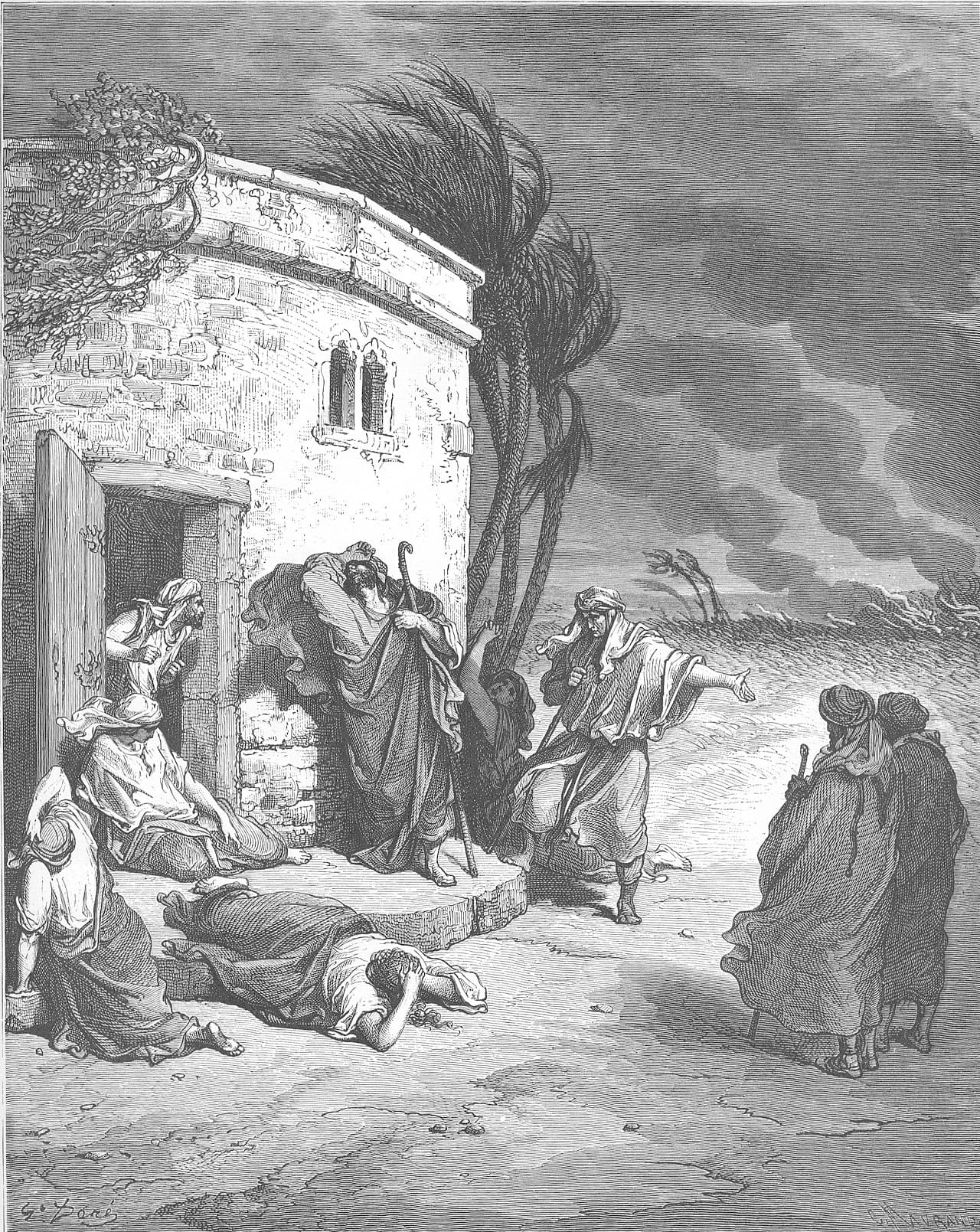
Job Hears of His Misfortunes, Gustave Doré, 1866. Public domain.
Old Testament · Book 18 of 66
Job
Job tells of a righteous man who loses his wealth, his children and his health. He argues with three friends over why he suffers, and the book ends with God speaking from the whirlwind and restoring Job.
Job tells of a righteous man who loses his wealth, his children and his health. He argues with three friends over why he suffers, and the book ends with God speaking from the whirlwind and restoring Job.
What is Job about?
Job is a blameless man in the land of Uz who loses his herds, his ten children and his health, and the reason is hidden from him. Three friends come to comfort him and end by accusing him, sure that suffering is the wage of sin. Job protests his innocence and calls on God to meet him. A younger man, Elihu, speaks next and no one answers him. Then the LORD answers Job out of the whirlwind with the world he made and rules. Job bows, the friends are rebuked, and his estate is restored double. The book teaches the fear of the LORD when no reason is given.
All 42 chapters
Every chapter of the book, in one grid. Each cell opens that chapter.
- The prologueJob 1 to 2
- The debateJob 3 to 31
- ElihuJob 32 to 37
- The LORD answersJob 38 to 41
- The epilogueJob 42
The colour is the movement of the book the chapter stands in, and every cell opens that chapter's Study level.
Who wrote it, where, when, for whom, and why?
The book names no author. Its narrator tells the story from outside it, and the only words it gives as written are the ones Job wishes were inscribed in a book and cut into rock for ever (19:23 and 24). The rest of Scripture names Job himself: Ezekiel sets him beside Noah and Daniel as a man whose righteousness saved his own life (Ezekiel 14:14 and 20), and James holds up his perseverance to the churches (James 5:11).
See how blessed we consider those who have persevered. You have heard of Job’s perseverance and have seen the outcome from the Lord. The Lord is full of compassion and mercy.
James 5:11, Berean Standard Bible.
The story is set in the land of Uz (1:1), and Job is the greatest man of all the people of the East (1:3). His three friends come from Teman, Shuah and Naamah (2:11), and Elihu is a Buzite (32:2). Lamentations places the land of Uz with Edom (Lamentations 4:21), and Teman is a clan of Edom (Genesis 36:11). The raiders who take Job's herds are Sabeans and Chaldeans (1:15 and 17).
The text gives no year and names no king. Job counts his wealth in flocks, herds and servants (1:3), rises early to offer burnt offerings for his children himself (1:5), and lives a hundred and forty years after his restoration, seeing four generations (42:16). The book mentions no law of Moses, no tabernacle and no Israel. How these marks date the story and the writing is set out under Where do readers disagree.
The book is written for anyone who fears God and meets suffering the fear of God does not explain. Its question is put by the accuser at the start, whether Job fears God for nothing (1:9), and its answer is given to every reader who keeps faith and loses everything anyway.
The book says what wisdom is: the fear of the Lord, and to turn away from evil (28:28). It ends with the LORD's verdict that the friends did not speak of him accurately, as his servant Job did (42:7), and with Job saying that now his eyes have seen him (42:5).
Sources. Job 1:1, 1:3, 1:5, 1:9, 1:15 and 17, 2:11, 19:23 and 24, 28:28, 32:2, 42:5, 42:7 and 42:16; Genesis 36:11; Lamentations 4:21; Ezekiel 14:14 and 20; James 5:11. Every verse is read in the Berean Standard Bible.
How is Job arranged, and what is it for?
The five movements the book falls into, what it teaches and what it was written to do, and every speech in one grid.
- The prologueChapters 1 to 2, 35 verses
A blameless man, two scenes in heaven, four messengers in one day, and three friends who sit with him in silence.
The turn: Job blesses the name of the LORD after the first loss (1:21).
- The debateChapters 3 to 31, 724 verses
Job curses his day, the friends answer in three cycles, a hymn asks where wisdom is found, and Job swears his innocence.
The turn: Job declares that his Redeemer lives (19:25).
- ElihuChapters 32 to 37, 165 verses
A younger man, angry at Job and at the friends, speaks four times and no one answers him.
The turn: Elihu names a mediator who finds a ransom (33:23 and 24).
- The LORD answersChapters 38 to 41, 129 verses
Two speeches from the storm walk Job through creation and its creatures, Behemoth and Leviathan last.
The turn: The LORD answers Job out of the whirlwind (38:1).
- The epilogueChapter 42, 17 verses
Job answers, the friends are rebuked and prayed for, the estate is doubled and the daughters are named.
The turn: Job says that now his eyes have seen God (42:5).
The theme
A righteous man suffers for a reason he is never told, and the book tests every answer given for it. The friends hold that God pays each man what he deserves, so Job must have sinned; Job holds that he has not, and asks God to answer. God answers by showing himself as maker and ruler of all things, and he declares that Job spoke rightly and the friends did not.
The purpose
Job was written so that a reader who fears God would keep fearing him when the reason for suffering stays hidden. It sets the fear of the LORD as the whole of wisdom, puts the friends' rule of reward and punishment under God's rebuke, and brings Job from hearing of God to seeing him.
Who speaks, where, and for how long
What the grid shows
The friends speak 90 verses in the first cycle, 85 in the second and 36 in the third, where Bildad's speech is the shortest in the book and Zophar does not speak.
Job answers with 183, 101 and 79, then speaks 124 more alone in chapters 28 to 31, so across the third cycle and his closing speeches he holds 85 percent of the words.
The friends run out of answers before Job runs out of protest. Elihu then speaks alone, and the LORD speaks last.
- The debate
- Elihu
- The LORD answers
- The epilogue
The prologue, Job 1 to 2
What the text says in these 2 chapters, and the pages they open on.
Job lives in Uz, blameless and upright, with seven sons, three daughters and great herds, and he offers sacrifices for his children in case they have sinned. In heaven the sons of God present themselves before the LORD, and Satan asks whether Job fears God for nothing. In one day four messengers bring word that the herds are taken and the children are dead, and Job worships. At a second council Satan is given Job's body, and Job is struck with boils. His wife tells him to curse God and die, and he refuses. Three friends come and sit with him seven days in silence.
saying: “Naked I came from my mother’s womb, and naked I will return. The LORD gave, and the LORD has taken away. Blessed be the name of the LORD.”
- Study
Job 1the blameless man, the first council, four messengers, Job worshipsShow the summary and 6 pagesShow summary, 6 pagesHide the summary
Job of Uz ('blameless and upright, fearing God and shunning evil') is greatest of all the children of the east: seven sons, three daughters, herds in thousands, and burnt-offerings offered early in case his children sinned in their hearts. Then the scene lifts to the throne, where the sons of God present themselves before Jehovah and Satan comes among them: 'Does Job fear God for nothing?' Four messengers arrive in one day: Sabeans, the fire of God, Chaldeans, a great wind from the wilderness. Job rends his robe and worships: 'The LORD gave, and the LORD has taken away. Blessed be the name of the LORD' (1:21).
On this chapter (6)
- The question of suffering
Why the righteous suffer, read from Job to the cross.
- The divine council
The sons of God who present themselves before the LORD.
- Satan
The accuser from the prologue of Job to Revelation.
- Who is the satan of the prologue?
Answered under Where do readers disagree, lower on this page, with each reading and who holds it.
- When did Job live, and who wrote the book?
Answered under Where do readers disagree, lower on this page, with each reading and who holds it.
- Job 1:21
The verse on its own page, with the commentators on it by era.
- The question of suffering
- Study
Job 2the second council, the boils, his wife, the friends' silenceShow the summary and 2 pagesShow summary, 2 pagesHide the summary
The council convenes again, and Jehovah says Job 'still retains his integrity, even though you incited Me against him to ruin him without cause.' Satan raises the stake ('Skin for skin! … A man will give up all he owns in exchange for his life') and Job is struck with sore boils from the sole of his foot to his crown. He takes a potsherd to scrape himself and sits among the ashes. His wife says, 'Do you still retain your integrity? Curse God and die!' He answers, 'Should we accept from God only good and not adversity?' Eliphaz, Bildad, and Zophar come and sit seven days in silence.
On this chapter (2)
- What did Job's wife mean?
Answered under Where do readers disagree, lower on this page, with each reading and who holds it.
- Job 2:10
The verse on its own page, with the commentators on it by era.
- What did Job's wife mean?
Two scenes in heaven, two blows on earth
- 1, in heavenThe first council, 1:6 to 12Satan asks whether Job fears God for nothing, and is given all Job has, but not Job himself.
- 2, on earthThe first blow, 1:13 to 22Four messengers in one day: the oxen and donkeys, the sheep, the camels, and the ten children.
- 3, in heavenThe second council, 2:1 to 6Satan is given Job's body, and Job's life is kept from him.
- 4, on earthThe second blow, 2:7 to 10Boils from head to foot, and his wife's word to curse God and die.
Characters (6)
Who the text follows. A name with a page carries its door.
- Job
A blameless and upright man of Uz who feared God and shunned evil.
- Satan, the accuser
Comes among the sons of God and asks whether Job fears God for nothing.
- Job's wife
Buries the same children, and tells Job to curse God and die.
- Eliphaz
The Temanite, who speaks first in each cycle and appeals to a vision in the night.
Show the next 2
- Bildad
The Shuhite, who appeals to the wisdom of the fathers.
- Zophar
The Naamathite, who speaks twice and has no third speech.
Places (2)
Where the chapters stand.
- Uz
Job's land, which Lamentations places with Edom.
- The East
The people among whom Job is the greatest man.
Themes (3)
What these chapters raise, each on its own page where one stands.
- Suffering
The righteous man who suffers for a reason he is never told.
- The divine council
The sons of God presenting themselves before the LORD.
- The fear of the LORD
What wisdom is, by the book's own hymn.
Where the New Testament uses these chapters (1)each marked as a quotation or an allusion, with the evidence
- Explicit quotationThe perseverance of Job, Job 1 to 2 and 42 at James 5:11. James names Job and his perseverance and the outcome the Lord gave, the one place the New Testament names him. Held by James.
The debate, Job 3 to 31
What the text says in these 29 chapters, and the pages they open on.
Job breaks the silence by cursing the day he was born. Eliphaz answers first, then Bildad, then Zophar, and Job replies to each in turn, three times over. The friends hold that God punishes the wicked and rewards the upright, so Job must repent of a hidden sin. Job holds to his innocence, longs for a mediator between himself and God, and declares that his Redeemer lives. In the third cycle Bildad speaks six verses and Zophar does not speak at all. A hymn asks where wisdom can be found and answers with the fear of the Lord. Job recalls his past honour, laments his present shame, and swears an oath of innocence.
But I know that my Redeemer lives, and in the end He will stand upon the earth.
- Study
Job 3Job curses the day of his birth and longs for deathShow the summary and 1 pageShow summary, 1 pageHide the summary
Job breaks the silence, not with a curse on God, but on his own birthday. 'May the day of my birth perish, and the night it was said, ‘A boy is conceived.’' (3:3). Let darkness and the shadow of death claim it; why did he not die from the womb? He looks toward the grave as a strange mercy: 'There the wicked cease from raging, and there the weary find rest' (3:17), small and great alike, the servant free from his master. Why is light given to the bitter in soul? It closes in honest confession: the thing he feared has come upon him.
On this chapter (1)
- Job 3:1
The verse on its own page, with the commentators on it by era.
- Job 3:1
- Study
Job 4Eliphaz's vision in the night: can a man be righteous?Show the summary and 1 pageShow summary, 1 pageHide the summary
Eliphaz the Temanite opens the first cycle, gently and then not. He recalls how Job once strengthened weak hands, then presses the retribution axiom: 'Who, being innocent, has ever perished? Or where have the upright been destroyed?' (4:7): 'those who plow iniquity and those who sow trouble reap the same' (4:8). He stakes his authority on a night vision: a thing secretly brought to him, dread and trembling, 'a spirit glided past my face, and the hair on my body bristled' (4:15), and a still voice asking, 'Can a mortal be more righteous than God, or a man more pure than his Maker?' (4:17). Even God's angels, he adds, are charged with folly.
On this chapter (1)
- Job 4:1
The verse on its own page, with the commentators on it by era.
- Job 4:1
- Study
Job 5the fool's end, and the man whom God correctsShow the summary and 2 pagesShow summary, 2 pagesHide the summary
Eliphaz finishes his first speech. Call now. Which of the holy ones will answer? Vexation kills the foolish man; affliction springs not from the dust, for 'man is born to trouble as surely as sparks fly upward' (5:7). His counsel is to seek God, who does great things past finding out, gives rain, sets the lowly on high, and 'catches the wise in their craftiness'. The one line of Job that Paul quotes outright (1 Corinthians 3:19). Then the promise that will curdle in Job's mouth: 'Blessed indeed is the man whom God corrects … For He wounds, but He also binds' (5:17-18), with death at a full age like a shock of grain gathered in season.
On this chapter (2)
- Do the friends speak truth, and why does the LORD rebuke them?
Answered under Where do readers disagree, lower on this page, with each reading and who holds it.
- Job 5:17
The verse on its own page, with the commentators on it by era.
- Do the friends speak truth, and why does the LORD rebuke them?
- Study
Job 6Job's grief outweighs the sand, and his friends fail himShow the summary and 1 pageShow summary, 1 pageHide the summary
Job replies to Eliphaz. Weigh my vexation against the sand of the seas: 'the arrows of the Almighty are within me, the poison whereof my spirit drinketh up.' The wild ass does not bray over grass; his cry has a cause. He asks one thing only: that God would let loose his hand and cut him off, and still he would not have denied the words of the Holy One. Then the wound that stings worst. His friends are a brook that runs full with ice and vanishes in the heat, while the caravans of Tema and Sheba look for water and are ashamed. Teach me, and I will hold my peace.
On this chapter (1)
- Job 6:1
The verse on its own page, with the commentators on it by era.
- Job 6:1
- Study
Job 7life a breath, and the watch God keeps over himShow the summary and 1 pageShow summary, 1 pageHide the summary
Job turns from his friends to God. Man's life is a hard-served warfare, his nights measured out with tossing; 'My days are swifter than a weaver’s shuttle; they come to an end without hope.' (7:6). He will not refrain his mouth, he will speak in the anguish of his spirit. Am I a sea, or a sea-monster, that you set a watch over me? Then Psalm 8 turned inside out: 'What is man that You should exalt him … that You attend to him every morning'? (7:17-18). Let me alone; my days are vanity. Why have you set me as a mark for you, so that I am a burden to myself?
On this chapter (1)
- Job 7:1
The verse on its own page, with the commentators on it by era.
- Job 7:1
- Study
Job 8Bildad's appeal to the fathers: God does not reject the blamelessShow the summary and 1 pageShow summary, 1 pageHide the summary
Bildad the Shuhite speaks first time, blunter than Eliphaz: how long shall the words of your mouth be like a mighty wind? 'Does God pervert justice? Does the Almighty pervert what is right?' (8:3). Then the cruelest sentence yet spoken to a bereaved father: if your children sinned, he delivered them into the hand of their transgression. Bildad appeals to the former age: can the rush grow up without mire? So perish the paths of all that forget God, 'His confidence is fragile; his security is in a spider’s web.' (8:14). Yet God will not cast away a perfect man: 'He will yet fill your mouth with laughter, and your lips with a shout of joy.'
On this chapter (1)
- Job 8:1
The verse on its own page, with the commentators on it by era.
- Job 8:1
- Study
Job 9how can a man be right with God? no mediatorShow the summary and 1 pageShow summary, 1 pageHide the summary
Job answers Bildad, granting the premise and finding it unbearable: 'how can a mortal be righteous before God?' (9:2). He removes mountains, shakes the earth from its place, commands the sun, stretches out the heavens, and 'He is the Maker of the Bear and Orion, of the Pleiades and the constellations of the south.' He passes by and I see him not. If I wash myself with snow water, you will plunge me in the ditch. The heart of Job's trouble is that his Judge is also the other party in the case: 'He is not a man like me … Nor is there a mediator between us, to lay his hand upon us both' (9:32-33). A cry the incarnation answers.
On this chapter (1)
- Job 9:1
The verse on its own page, with the commentators on it by era.
- Job 9:1
- Study
Job 10why was I born? Job's plea to his makerShow the summary and 1 pageShow summary, 1 pageHide the summary
Job's reply continues, now addressed straight to God. 'I loathe my own life; I will express my complaint and speak in the bitterness of my soul.' Do not condemn me; show me wherefore you contend with me. Is it good to you that you should oppress the work of your hands? Then a tender argument from creation: 'Your hands shaped me and altogether formed me': poured me out as milk, curdled me like cheese, clothed me with skin and flesh, knit me with bones and sinews. Life and lovingkindness you have granted, yet this was hid in your heart. He asks a little comfort before he goes to 'a land of darkness and gloom'.
On this chapter (1)
- Job 10:1
The verse on its own page, with the commentators on it by era.
- Job 10:1
- Study
Job 11Zophar: God exacts less than your guilt deservesShow the summary and 1 pageShow summary, 1 pageHide the summary
Zophar the Naamathite enters, harshest of the three: 'Should this stream of words go unanswered and such a speaker be vindicated?' He wishes God would speak and show Job the secrets of wisdom, adding that God exacts of Job less than his iniquity deserves. His great question is genuinely great even inside a bad argument: 'Can you fathom the deep things of God or discover the limits of the Almighty?' (11:7), high as heaven, deeper than Sheol, longer than the earth, broader than the sea. Then the standard offer: put away iniquity, set your heart aright, 'then indeed you will lift up your face without shame;' and none shall make you afraid.
On this chapter (1)
- Job 11:1
The verse on its own page, with the commentators on it by era.
- Job 11:1
- Study
Job 12wisdom and power belong to God, not to the friendsShow the summary and 1 pageShow summary, 1 pageHide the summary
Job's answer to Zophar opens in scorn: 'Truly then you are the people with whom wisdom itself will die!' (12:2). He is a laughingstock to his neighbor, a just and perfect man laughed to scorn, and he sees the wicked at ease: 'The tents of robbers are safe'. Ask now the beasts, the birds, the fishes: they will teach you that the hand of Jehovah wrought this; in his hand is the soul of every living thing. Then Job out-preaches his friends on sovereignty and turns it terrible: he looses the bond of kings, leads counsellors away stripped, pours contempt upon princes, 'reveals the deep things of darkness', increases nations and destroys them.
On this chapter (1)
- Job 12:1
The verse on its own page, with the commentators on it by era.
- Job 12:1
- Study
Job 13though he slay me, I will hope in himShow the summary and 2 pagesShow summary, 2 pagesHide the summary
Job finishes his reply and moves toward trial. What you know, I know also: 'Yet I desire to speak to the Almighty and argue my case before God. You, however, smear with lies; you are all worthless physicians' (13:3-4). Oh that you would altogether hold your peace. It would be your wisdom. Will you speak unrighteously for God, and be partial to him? Then the book's famous crux: 'Though He slay me, I will hope in Him. I will still defend my ways to His face.' (13:15), which the KJV renders, 'Though he slay me, yet will I trust in him.' Wherefore do you hold me for your enemy?
On this chapter (2)
- What does 13:15 read, "though He slay me" or "He will slay me; I have no hope"?
Answered under Where do readers disagree, lower on this page, with each reading and who holds it.
- Job 13:15
The verse on its own page, with the commentators on it by era.
- What does 13:15 read, "though He slay me" or "He will slay me; I have no hope"?
- Study
Job 14man born of woman, few days, and hope for a treeShow the summary and 1 pageShow summary, 1 pageHide the summary
Job's speech ends in a lament over mortality. 'Man, who is born of woman, is short of days and full of trouble. Like a flower, he comes forth, then withers away' (14:1-2). His days are determined; look away from him that he may rest. There is hope of a tree (cut down, it sprouts again at the scent of water) but man lieth down and riseth not till the heavens be no more. Out of that comparison rises the great question: 'When a man dies, will he live again?' (14:14). Job answers it with waiting: all the days of his warfare, till his release come; you shall call, and I will answer you.
On this chapter (1)
- Job 14:1
The verse on its own page, with the commentators on it by era.
- Job 14:1
- Study
Job 15Eliphaz again: Job's own mouth condemns himShow the summary and 1 pageShow summary, 1 pageHide the summary
Eliphaz opens the second cycle with the courtesy gone: should a wise man fill himself with the east wind? You do away with fear and hinder devotion before God; your own mouth condemneth you. 'Were you the first man ever born? Were you brought forth before the hills?' (15:7). He repeats his night-vision theology as settled fact: God 'puts no trust in His holy ones, if even the heavens are not pure in His eyes'. How much less a man that drinketh iniquity like water. The rest is a portrait of the wicked travailing in pain all his days, dread sounds in his ears, his branch never green.
On this chapter (1)
- Job 15:1
The verse on its own page, with the commentators on it by era.
- Job 15:1
- Study
Job 16miserable comforters, and a witness in heavenShow the summary and 1 pageShow summary, 1 pageHide the summary
Job answers Eliphaz with the line every sufferer has borrowed since: 'I have heard many things like these; miserable comforters are you all.' (16:2). I also could speak as you do, if your soul were in my soul's stead: I could heap up words and shake my head at you. Instead he describes being hunted: God has worn him out, gnashed upon him, set him up for a mark, cleaved his reins asunder, run upon him like a giant. His face is red with weeping, 'yet my hands are free of violence and my prayer is pure.' Yet mid-agony his faith flares: 'Even now my witness is in heaven, and my advocate is on high.' (16:19).
On this chapter (1)
- Job 16:1
The verse on its own page, with the commentators on it by era.
- Job 16:1
- Study
Job 17my spirit is broken, the grave awaitsShow the summary and 1 pageShow summary, 1 pageHide the summary
Job's reply closes in exhaustion. 'My spirit is broken; my days are extinguished; the grave awaits me' (17:1). Mockers are with him, and his eye abides on their provocation. He asks God to post the bond no man will post: give now a pledge, be surety for me with thyself; who else will strike hands with me? You have hid their heart from understanding. He has been made a byword of the people, one in whose face men spit. If Sheol is the house he looks for, if he has said to corruption, You are my father, and to the worm, My mother: 'where then is my hope?'
On this chapter (1)
- Job 17:1
The verse on its own page, with the commentators on it by era.
- Job 17:1
- Study
Job 18Bildad: the lamp of the wicked is put outShow the summary and 1 pageShow summary, 1 pageHide the summary
Bildad's second speech, all wrath and no counsel: how long will you lay snares for words? Wherefore are we counted as beasts in your sight? Then twenty verses on the fate of the wicked, aimed at a man who has just buried ten children. 'Indeed, the lamp of the wicked is extinguished' (18:5); his own counsel casts him down; he is caught by heel and snare and trap; 'Terrors frighten him on every side and harass his every step' (18:11). Disease devours his skin ('the firstborn of death', 18:13) and he is torn from the tent he trusted and brought to 'the king of terrors' (18:14). He has neither son nor son's son among his people.
On this chapter (1)
- Job 18:1
The verse on its own page, with the commentators on it by era.
- Job 18:1
- Study
Job 19my kinsmen have failed me, and my Redeemer livesShow the summary and 3 pagesShow summary, 3 pagesHide the summary
Job's reply, and the summit of the book. 'How long will you torment me and crush me with your words?' Ten times they have reproached him. Brethren are far off, acquaintance estranged, his breath strange to his wife. 'My skin and flesh cling to my bones; I have escaped by the skin of my teeth.' (19:20). Have pity upon me, O you my friends. He wishes his words graven with an iron pen in the rock for ever. And gets his wish: 'I know that my Redeemer lives, and in the end He will stand upon the earth … yet in my flesh I will see God' (19:25-26), read by the church toward the risen Christ.
On this chapter (3)
- The kinsman redeemer
The go'el who buys back and stands up for his own.
- What does 19:25 to 27 say, and does Job expect to see God in the flesh?
Answered under Where do readers disagree, lower on this page, with each reading and who holds it.
- Job 19:25
The verse on its own page, with the commentators on it by era.
- The kinsman redeemer
- Study
Job 20Zophar: the triumph of the wicked is briefShow the summary and 1 pageShow summary, 1 pageHide the summary
Zophar's second and final speech, provoked and unrepentant. His premise is ancient and absolute: 'the triumph of the wicked has been brief and the joy of the godless momentary' (20:5). Though he mount up to the heavens, he shall perish for ever; the eye that saw him shall see him no more. Though wickedness be sweet in his mouth and he hide it under his tongue, his food is turned in his bowels to the gall of asps: 'he shall suck the poison of asps.' He swallowed down riches and shall vomit them up again; 'the heavens shall reveal his iniquity.' Then Zophar falls silent for the rest of the book.
On this chapter (1)
- Job 20:1
The verse on its own page, with the commentators on it by era.
- Job 20:1
- Study
Job 21why do the wicked live on and prosper?Show the summary and 1 pageShow summary, 1 pageHide the summary
Job answers Zophar by looking at the world instead of the theory. Suffer me, and I also will speak. Then mock on. 'Why do the wicked live on, growing old and increasing in power?' (21:7). Their houses are safe from fear, their children dance, they take the timbrel and harp; 'they spend their days in prosperity, and in a moment they go down to Sheol': the very men who say to God, Depart from us. How often is the lamp of the wicked actually put out? One dies in full strength, another in bitterness of soul, and they lie down alike in the dust. Your answers, he tells them, leave only falsehood.
On this chapter (1)
- Job 21:1
The verse on its own page, with the commentators on it by era.
- Job 21:1
- Study
Job 22Eliphaz names Job's sins and calls him to returnShow the summary and 1 pageShow summary, 1 pageHide the summary
Eliphaz's third and last speech trades insinuation for indictment. 'Can a man be of use to God?': your righteousness gains him nothing, so the trial cannot be about that: 'Is not your wickedness great? Are not your iniquities endless?' (22:5). He then invents crimes to fit the sentence: pledges taken of your brother for nought, the naked stripped, water withheld from the weary and bread from the hungry, widows sent away empty. Is not God in the height of heaven: do you say, How does God know? Yet the speech ends in real gold, wrongly aimed: 'Reconcile now and be at peace with Him' (22:21).
On this chapter (1)
- Job 22:1
The verse on its own page, with the commentators on it by era.
- Job 22:1
- Study
Job 23if only I knew where to find himShow the summary and 1 pageShow summary, 1 pageHide the summary
Job replies, and his complaint becomes a search. 'If only I knew where to find Him, so that I could go to His seat. I would plead my case before Him and fill my mouth with arguments.' (23:3-4). Certain that God would give heed and not merely overwhelm him with power. Then the search fails in every direction: 'If I go east, He is not there, and if I go west, I cannot find Him.' Out of that blindness comes one of Scripture's great confessions of faith in the dark: 'Yet He knows the way I have taken; when He has tested me, I will come forth as gold' (23:10).
On this chapter (1)
- Job 23:1
The verse on its own page, with the commentators on it by era.
- Job 23:1
- Study
Job 24the wrongs of the earth that God leaves unpunishedShow the summary and 1 pageShow summary, 1 pageHide the summary
Job continues into a protest about God's timing: 'Why does the Almighty not reserve times for judgment? Why may those who know Him never see His days?' (24:1). Then a documentary of unpunished cruelty: men remove landmarks, drive away the flock of the fatherless, take the widow's ox for a pledge, turn the needy out of the way. The poor go naked in the cold and hungry among the sheaves. The murderer rises with the light; the adulterer waits for the twilight, saying, No eye shall see me; 'they are of them that rebel against the light.' Yet God prolongs the mighty by his power. If it be not so, who will prove me a liar?
On this chapter (1)
- Job 24:1
The verse on its own page, with the commentators on it by era.
- Job 24:1
- Study
Job 25Bildad's six verses: how can man be righteous before God?Show the summary and 1 pageShow summary, 1 pageHide the summary
Bildad's third speech, six verses, and the friends' case has nothing left. He begins where right theology begins: 'Dominion and fear are with him; he maketh peace in his high places. Is there any number of his armies?' Then the old question one final time: 'How then can a man be just before God? How can one born of woman be pure?' (25:4). Even the moon has no brightness and the stars are not pure in his sight; how much less man, that is a worm. It is true and it is useless (majesty with no door in it) and after this the three fall silent.
On this chapter (1)
- Job 25:1
The verse on its own page, with the commentators on it by era.
- Job 25:1
- Study
Job 26the fringes of his ways and the thunder of his powerShow the summary and 1 pageShow summary, 1 pageHide the summary
Job answers with cutting thanks. How have you helped him that is without power, how saved the arm that has no strength! Then he preaches God's majesty better than Bildad just did. The shades tremble beneath the waters; 'Sheol is naked before God, and Abaddon has no covering.' 'He stretches out the north over empty space; He hangs the earth upon nothing.' (26:7). He binds up the waters in his thick clouds, marks out the horizon on the face of the waters, stills the sea, pierces the swift serpent. And all of it is only the fringe: 'these are but the fringes of His ways … Who then can understand the thunder of His power?'
On this chapter (1)
- Job 26:1
The verse on its own page, with the commentators on it by era.
- Job 26:1
- Study
Job 27Job keeps his integrity, and the portion of the wickedShow the summary and 1 pageShow summary, 1 pageHide the summary
Job takes an oath, the hinge of his integrity. 'As surely as God lives, who has deprived me of justice … my lips will not speak wickedness, and my tongue will not utter deceit. I will never say that you are right; I will maintain my integrity until I die' (27:2-5). His heart shall not reproach him so long as he lives. Then he describes the portion of the wicked man with God, using his friends' own doctrine on his own terms: children multiplied for the sword, the silver he heaps as dust worn by the just, his house built like a moth's, terrors overtaking him like waters in the night.
On this chapter (1)
- Job 27:1
The verse on its own page, with the commentators on it by era.
- Job 27:1
- Study
Job 28the refrain where can wisdom be found (28:12, 20), and its answerShow the summary and 3 pagesShow summary, 3 pagesHide the summary
A poem standing alone in the book. A search for where wisdom is quarried. Men know how to find everything else: 'there is a mine for silver and a place where gold is refined', iron out of the earth and copper molten from the stone; the miner sets an end to darkness, overturns mountains by the roots, and his eye sees every precious thing. 'But where can wisdom be found, and where does understanding dwell?' (28:12). The deep says, It is not in me; the sea says, It is not with me. God alone understands its way. 'Behold, the fear of the Lord, that is wisdom, and to turn away from evil is understanding' (28:28).
On this chapter (3)
- The fear of the LORD
The beginning of wisdom, from Job 28 to Proverbs.
- Christ our wisdom
The wisdom of God, from Proverbs 8 to Christ.
- Job 28:28
The verse on its own page, with the commentators on it by era.
- The fear of the LORD
- Study
Job 29the days when God watched over him and the city honoured himShow the summary and 1 pageShow summary, 1 pageHide the summary
Job's closing defense begins in memory. 'How I long for the months gone by, for the days when God watched over me, when His lamp shone above my head' (29:2-3), when the Almighty was yet with him and his children were about him. He sat in the gate; young men hid themselves and princes refrained from talking; the ear that heard him blessed him. The reason follows, answering Eliphaz's invented charges: 'I delivered the poor that cried, the fatherless also, that had none to help him'; he put on righteousness as clothing, and 'I served as eyes to the blind and as feet to the lame' (29:15).
On this chapter (1)
- Job 29:1
The verse on its own page, with the commentators on it by era.
- Job 29:1
- Study
Job 30now the young mock him and God is cruel to himShow the summary and 1 pageShow summary, 1 pageHide the summary
'But now they mock me, men younger than I am' (30:1): sons of men whose fathers he would have disdained to set with the dogs of his flock. Now he is their song and their byword; they spit in his face. He turns to God: you are turned to be cruel to me; 'I cry out to You for help, but You do not answer' (30:20). I know you will bring me to death, to the house appointed for all living. His skin is black and falls from him, his bones burned with heat. 'My harp is tuned to mourning and my flute to the sound of weeping.'
On this chapter (1)
- Job 30:1
The verse on its own page, with the commentators on it by era.
- Job 30:1
- Study
Job 31the oath of innocence, and the words of Job are endedShow the summary and 1 pageShow summary, 1 pageHide the summary
Job's final oath of innocence, sworn clause by clause: the ancient world's fullest ethic of the heart. 'I have made a covenant with my eyes. How then could I gaze with desire at a virgin?' (31:1). Let me be weighed in an even balance. He calls down curses on himself if he has walked with falsehood, despised the cause of his servant ('did not he that made me in the womb make him?') withheld the poor from their desire, made gold his hope, secretly kissed his hand to the sun, or eaten his land's fruit without wages paid. Sign the indictment, he demands, and he will wear it as a crown. 'The words of Job are ended.'
On this chapter (1)
- Job 31:1
The verse on its own page, with the commentators on it by era.
- Job 31:1
Every speech of the three cycles stands in the grid of the speeches above, speaker by speaker. The hymn on wisdom in chapter 28 asks its question twice, at 28:12 and again at 28:20, and answers it at 28:28.
Characters (4)
Who the text follows. A name with a page carries its door.
- Job
A blameless and upright man of Uz who feared God and shunned evil.
- Eliphaz
The Temanite, who speaks first in each cycle and appeals to a vision in the night.
- Bildad
The Shuhite, who appeals to the wisdom of the fathers.
- Zophar
The Naamathite, who speaks twice and has no third speech.
Places (3)
Where the chapters stand.
- Teman
Eliphaz's home, a clan and region of Edom.
- Shuah and Naamah
The homes of Bildad and Zophar.
- Uz
Job's land, which Lamentations places with Edom.
Themes (4)
What these chapters raise, each on its own page where one stands.
- The retribution principle
The friends' rule that suffering is always the wage of sin.
- The Redeemer
The kinsman who stands up for his own at the last.
- Wisdom
Hidden from every mine and known to God alone.
- The fear of the LORD
What wisdom is, by the book's own hymn.
Where the New Testament uses these chapters (2)each marked as a quotation or an allusion, with the evidence
- Explicit quotationHe catches the wise in their craftiness, Job 5:13 at 1 Corinthians 3:19. Paul introduces the line with "As it is written" and quotes Eliphaz's words of Job 5:13. Held by Paul.
- Probable allusionBlessed is the man whom God corrects, Job 5:17 at Hebrews 12:5. Hebrews quotes Proverbs 3:11, whose words on the discipline of the LORD stand close to Eliphaz's at Job 5:17; the quotation is Proverbs, and Job stands beside it as a reading. Held by the writer of Hebrews.
Elihu, Job 32 to 37
What the text says in these 6 chapters, and the pages they open on.
When the three friends fall silent, Elihu son of Barachel speaks. He is angry with Job for justifying himself rather than God, and angry with the friends for finding no answer. He speaks four times. God speaks through dreams and through pain, he says, and a mediator may stand beside a man and find a ransom for him. God does no wrong, Job has spoken without knowledge, and God is greater than anyone can know. As he speaks, a storm gathers, and no one answers him.
to be gracious to him and say, ‘Spare him from going down to the Pit; I have found his ransom,’
- Study
Job 32Elihu's anger at Job and at the threeShow the summary and 2 pagesShow summary, 2 pagesHide the summary
A fourth voice, unannounced until now: 'the anger of Elihu son of Barachel the Buzite' is kindled: against Job for justifying himself rather than God, and against the three friends for finding no answer and yet condemning him. He waited because they were older, but age has failed: 'I thought that age should speak, and many years should teach wisdom. But there is a spirit in a man, the breath of the Almighty, that gives him understanding.' (32:7-8). Not one of you convinced Job. 'Behold, my belly is like unvented wine; it is about to burst like a new wineskin.'. And he will give flattering titles to no man.
On this chapter (2)
- Is Elihu's speech a later addition?
Answered under Where do readers disagree, lower on this page, with each reading and who holds it.
- Job 32:2
The verse on its own page, with the commentators on it by era.
- Is Elihu's speech a later addition?
- Study
Job 33God speaks in dreams and pain, and a ransom foundShow the summary and 1 pageShow summary, 1 pageHide the summary
Elihu's first argument, addressed to Job by name. 'I am just like you before God; I was also formed from clay.'. No terror from me shall make you afraid. Job said he is clean and God counts him an enemy; in this you are not just, 'for God is greater than man.' Then Elihu's real contribution: God does speak, only man does not perceive it: 'For God speaks in one way and in another, yet no one notices' (33:14). In a dream, in a vision of the night, in pain upon the bed. And where an interpreting angel stands by, God says, 'Spare him from going down to the Pit; I have found his ransom'.
On this chapter (1)
- Job 33:1
The verse on its own page, with the commentators on it by era.
- Job 33:1
- Study
Job 34God does no wrong, and Job speaks without knowledgeShow the summary and 1 pageShow summary, 1 pageHide the summary
Elihu turns to the wise men listening and puts Job's words on trial: 'I am righteous, yet God has deprived me of justice': what man is like Job, who drinketh up scoffing like water? His answer is the impossibility of injustice in God: 'Far be it from God to do wrong, and from the Almighty to act unjustly' (34:10), for the work of a man he will render to him. If God gathered to himself his spirit and his breath, all flesh would perish together and man turn again to dust. But the verdict hardens: 'Job speaks without knowledge; his words lack insight.'
On this chapter (1)
- Job 34:1
The verse on its own page, with the commentators on it by era.
- Job 34:1
- Study
Job 35Job's righteousness gives God nothing, and the empty cryShow the summary and 1 pageShow summary, 1 pageHide the summary
Elihu's third turn answers the claim that righteousness gains nothing. Do you think this to be right, that you say, My righteousness is more than God's? Look to the heavens, and behold the clouds which are higher than you: 'If you sin, what do you accomplish against Him? … If you are righteous, what do you give Him'? (35:6-7). Your wickedness may hurt a man as you are. Men cry out under oppression and are not answered, he says, because they cry as animals cry: 'no one asks … Where is God my Maker, who gives us songs in the night' (35:10). God will not hear an empty cry.
On this chapter (1)
- Job 35:1
The verse on its own page, with the commentators on it by era.
- Job 35:1
- Study
Job 36God is great, beyond our knowledgeShow the summary and 1 pageShow summary, 1 pageHide the summary
Elihu asks a little more patience: 'I have yet somewhat to say on God's behalf.' God is mighty and despiseth not any; he withdraweth not his eyes from the righteous, and if men are bound in cords of affliction he opens their ear to instruction. The chapter's thesis, that suffering can be a teacher and not only a sentence: 'God rescues the afflicted by their affliction and opens their ears in oppression' (36:15). Remember to magnify his work, whereof men have sung. Then the doxology rises and his tone shifts toward the storm already gathering: 'Indeed, God is great … the number of His years is unsearchable' (36:26).
On this chapter (1)
- Job 36:1
The verse on its own page, with the commentators on it by era.
- Job 36:1
- Study
Job 37the thunder, the snow, the storm, and God's majestyShow the summary and 1 pageShow summary, 1 pageHide the summary
Elihu's last words, spoken with thunder building over him: 'At this my heart also pounds and leaps from its place.' God thundereth marvellously with his voice, doing great things which we cannot comprehend. 'He says to the snow … Fall on the earth'; by the breath of God ice is given. He asks whether Job knows how the clouds are balanced, or why his garments are warm when the earth is still by the south wind. 'Listen to this, O Job; stand still and consider the wonders of God.' (37:14). Out of the north cometh golden splendor; God has upon him terrible majesty, and touching the Almighty, we cannot find him out.
On this chapter (1)
- Job 37:1
The verse on its own page, with the commentators on it by era.
- Job 37:1
Elihu speaks four times
- Speech 1, 32:6 to 33:3350 versesWhy he has waited, and God speaking through dreams, pain and a mediator.
- Speech 2, 3437 versesGod does no wrong, and Job has spoken without knowledge.
- Speech 3, 3516 versesJob's righteousness gives God nothing, and the proud cry goes unheard.
- Speech 4, 36 to 3757 versesGod is great beyond knowing, and the storm gathers.
Characters (2)
Who the text follows. A name with a page carries its door.
- Elihu
Son of Barachel the Buzite, younger than the rest and angry with them all.
- Job
A blameless and upright man of Uz who feared God and shunned evil.
Places (1)
Where the chapters stand.
- Buz
The family line of Elihu.
Themes (2)
What these chapters raise, each on its own page where one stands.
- The retribution principle
The friends' rule that suffering is always the wage of sin.
- The Redeemer
The kinsman who stands up for his own at the last.
Where the New Testament uses these chapters. No New Testament passage quotes or names these chapters.
The LORD answers, Job 38 to 41
What the text says in these 4 chapters, and the pages they open on.
The LORD answers Job out of the whirlwind. He asks where Job was when the foundations of the earth were laid, and walks him through the sea, the morning, the storehouses of snow and the stars. He names the lion and the raven, the mountain goat, the wild donkey and the wild ox, the ostrich, the horse and the hawk. Job puts his hand over his mouth. The LORD speaks again and asks whether Job would condemn God to justify himself, then shows him Behemoth and Leviathan, creatures no man can master.
Then the LORD answered Job out of the whirlwind and said:
- Study
Job 38the LORD answers from the whirlwind: the earth, sea and starsShow the summary and 1 pageShow summary, 1 pageHide the summary
'Then the LORD answered Job out of the whirlwind' (38:1). And answers not one of Job's questions, asking scores of his own. 'Who is this who obscures My counsel by words without knowledge? Now brace yourself like a man … Where were you when I laid the foundations of the earth?'. When the morning stars sang together and all the sons of God shouted for joy, when the sea was shut up with doors and swaddled in thick darkness. Have you commanded the morning since your days began? Has the rain a father? 'Can you bind the chains of the Pleiades or loosen the belt of Orion?' (38:31). Who provideth for the raven his prey?
On this chapter (1)
- Job 38:4
The verse on its own page, with the commentators on it by era.
- Job 38:4
- Study
Job 39the goat, the donkey, the ox, the ostrich, the horse, the hawkShow the summary and 1 pageShow summary, 1 pageHide the summary
Jehovah's questioning continues, and the whole curriculum is wild animals. Creatures no man manages, all of them fed and free. Do you know when the wild goats of the rock bring forth? Who sent out the wild ass free, who scorneth the shouting of the driver? Will the wild-ox consent to sleep by your crib? The ostrich leaves her eggs in the earth, deprived of wisdom by God himself, yet she scorneth the horse and his rider. Then the war-horse, clothed with a quivering mane, mocking at fear and swallowing the ground: 'At the blast of the horn, he snorts with fervor. He catches the scent of battle from afar' (39:25). The hawk soars and the eagle mounts up. By whose wisdom?
On this chapter (1)
- Job 39:1
The verse on its own page, with the commentators on it by era.
- Job 39:1
- Study
Job 40Job's hand over his mouth, and BehemothShow the summary and 2 pagesShow summary, 2 pagesHide the summary
Jehovah pauses for an answer: 'Will the faultfinder contend with the Almighty? Let him who argues with God give an answer.' Job's first reply is short and right: 'Behold, I am insignificant. How can I reply to You? I place my hand over my mouth' (40:4). But silence is not yet repentance, so the voice speaks a second time out of the whirlwind: 'Would you really annul My justice? Would you condemn Me to justify yourself?' Deck thyself with excellency and dignity, then, and abase every proud one. Then the first monster: 'Look at Behemoth, which I made along with you. He feeds on grass like an ox': chief of the ways of God.
On this chapter (2)
- Are Behemoth and Leviathan animals or something else?
Answered under Where do readers disagree, lower on this page, with each reading and who holds it.
- Job 40:15
The verse on its own page, with the commentators on it by era.
- Are Behemoth and Leviathan animals or something else?
- Study
Job 41Leviathan, which no man can tameShow the summary and 1 pageShow summary, 1 pageHide the summary
The whole chapter is leviathan, and every question is about who is master. 'Can you pull in Leviathan with a hook or tie down his tongue with a rope?' Will he make many supplications to you, or speak soft words? Will you play with him as with a bird? Lay your hand upon him, remember the battle, and do so no more. If none dare stir him up, 'who is able to stand against Me? Who has given to Me that I should repay him?' (41:10-11), a line Paul takes up in Romans 11:35. Then the portrait: burning torches out of his mouth, breath that kindles coals. 'he is king over all the proud.'
On this chapter (1)
- Job 41:1
The verse on its own page, with the commentators on it by era.
- Job 41:1
What the LORD names from the storm, in order
- 1The sea38:8, first speech
- 2The morning38:12, first speech
- 3The lion38:39, first speech
- 4The raven38:41, first speech
- 5The mountain goat39:1, first speech
- 6The wild donkey39:5, first speech
- 7The wild ox39:9, first speech
- 8The ostrich39:13, first speech
- 9The horse39:19, first speech
- 10The hawk39:26, first speech
- 11The eagle39:27, first speech
- 12Behemoth40:15, second speech
- 13Leviathan41:1, second speech
Characters (1)
Who the text follows. A name with a page carries its door.
- Job
A blameless and upright man of Uz who feared God and shunned evil.
Places (1)
Where the chapters stand.
- Uz
Job's land, which Lamentations places with Edom.
Themes (3)
What these chapters raise, each on its own page where one stands.
- Wisdom
Hidden from every mine and known to God alone.
- The fear of the LORD
What wisdom is, by the book's own hymn.
- Suffering
The righteous man who suffers for a reason he is never told.
Where the New Testament uses these chapters (1)each marked as a quotation or an allusion, with the evidence
- Probable allusionWho has first given to God, Job 41:11 at Romans 11:35. Paul's question closes his doxology in the words of the LORD's question at Job 41:11, without a citation formula. Held by Paul.
The epilogue, Job 42
What the text says in this chapter, and the pages it opens on.
Job answers the LORD that he spoke of things too wonderful for him, and that now his eyes have seen God. He retracts his words and repents in dust and ashes. The LORD tells Eliphaz that his wrath burns against the three friends, because they have not spoken of him accurately as Job has, and sends them to Job to offer sacrifices and be prayed for. The LORD restores Job and gives him twice as much as before. He has seven sons and three daughters again, the daughters are named, and Job lives to see four generations.
My ears had heard of You, but now my eyes have seen You.
- Study
Job 42Job sees God, the friends rebuked, the estate doubledShow the summary and 3 pagesShow summary, 3 pagesHide the summary
Job answers Jehovah and the case closes: 'I know that You can do all things and that no plan of Yours can be thwarted … things too wonderful for me to know' (42:2-3). The turn is not information but sight: 'My ears had heard of You, but now my eyes have seen You. Therefore I retract my words, and I repent in dust and ashes' (42:5-6). Then the unexpected verdict, to Eliphaz: 'you have not spoken about Me accurately, as My servant Job has.' Job prays for his accusers, and Jehovah turns his captivity: flocks doubled, seven sons, three daughters named Jemimah, Keziah, and Keren-happuch. James points here for 'Job’s perseverance' (James 5:11).
On this chapter (3)
- Repentance
Turning back to God, from Job's dust and ashes onward.
- Do the friends speak truth, and why does the LORD rebuke them?
Answered under Where do readers disagree, lower on this page, with each reading and who holds it.
- Job 42:7
The verse on its own page, with the commentators on it by era.
- Repentance
The estate before and after
- Before, 1:2 and 3
- After, 42:12 and 13
- Sheep, doubled
- Before7000After14000
- Camels, doubled
- Before3000After6000
- Yoke of oxen, doubled
- Before500After1000
- Female donkeys, doubled
- Before500After1000
- Sons, the same
- Before7After7
- Daughters, the same
- Before3After3
Characters (3)
Who the text follows. A name with a page carries its door.
- Job
A blameless and upright man of Uz who feared God and shunned evil.
- Eliphaz
The Temanite, who speaks first in each cycle and appeals to a vision in the night.
- Jemimah, Keziah and Keren-happuch
The daughters of the restoration, named and given an inheritance.
Places (1)
Where the chapters stand.
- Uz
Job's land, which Lamentations places with Edom.
Themes (2)
What these chapters raise, each on its own page where one stands.
- Repentance
Job retracts his words and repents in dust and ashes.
- Suffering
The righteous man who suffers for a reason he is never told.
Where the New Testament uses these chapters. No New Testament passage quotes or names these chapters.
- Author
- Anonymous. Talmudic tradition names Moses (Bava Batra 14b); internal features (patriarchal setting, no Mosaic Law reference, Job sacrificing as family head, *qesitah* currency of Gen 33:19) suggest patriarchal-era composition or at least tradition-origin.
- Date
- Traditional: patriarchal period, c. 2000–1800 BC. Critical proposals scatter across pre-exilic to post-exilic. Both are surfaced.
- Audience
- The wisdom-literature community within Israel; all readers confronting the question of the righteous sufferer.
Where do readers disagree?
Eight questions: the readings with their holders, and what the evidence does not settle.
When did Job live, and who wrote the book?
- Moses as writer, with Job in the days of Moses. Held by Rabbi Levi bar Lahma in the Babylonian Talmud, Bava Batra 15a, beside the teaching recorded on 14b that Moses wrote his own book, the portion of Balaam, and Job.
- An early setting, with the date of writing left open. Held by John E. Hartley, The Book of Job (1988), in the New International Commentary on the Old Testament.
- A later writer telling an older story. Held by Marvin H. Pope, Job (1965), in the Anchor Bible, and by David J. A. Clines, Job 1 to 20 (1989), in the Word Biblical Commentary.
What the evidence does not settle: The story and the writing are two dates, and the text fixes neither; Ezekiel 14:14 shows only that Job was already a byword for righteousness by the sixth century BC.
The argument in full
Moses as writer, with Job in the days of Moses. Job's wealth is counted in herds, he offers sacrifice as head of his household with no priest, he lives a further hundred and forty years, and the book names no law, tabernacle or Israel.
An early setting, with the date of writing left open. The name Job is attested in the second millennium in the Amarna Letters and the Execration Texts, which fits the book's own setting, while the Hebrew of the poetry does not fix when it was written.
A later writer telling an older story. The vocabulary, with its Aramaic colouring, and the book's argument with a settled wisdom tradition are read as the marks of a writer of Israel's later centuries.
Who is the satan of the prologue?
Satan→- The devil, later named in full. Held by Matthew Henry, An Exposition of the Old and New Testaments (1708).
- An office in the heavenly court. Held by David J. A. Clines, in the Word Biblical Commentary on Job, and by Michael S. Heiser, The Unseen Realm (2015).
What the evidence does not settle: Whether the article marks an office only or the office of a being later Scripture names; both readings agree that he acts only by the LORD's leave (1:12 and 2:6).
The argument in full
The devil, later named in full. The accuser who stands before God and seeks leave to afflict matches the accuser of the brothers in Revelation 12:10, and the Berean text itself reads Satan at 1:6.
An office in the heavenly court. The Hebrew carries the article, the satan, a title rather than a name, and the figure acts as a prosecutor among the sons of God under the LORD's authority.
Do the friends speak truth, and why does the LORD rebuke them?
- True doctrine wrongly applied. Held by John Calvin, Sermons on Job (1574), who judged that the friends argue a bad cause with good arguments while Job argues a good cause badly.
- The rule itself is false. Held by Tremper Longman III, Job (2012), in the Baker Commentary on the Old Testament Wisdom and Psalms.
What the evidence does not settle: Where the line falls between the true things the friends say and the false conclusion they draw; the rebuke at 42:7 names what they said about God without listing the sentences.
The argument in full
True doctrine wrongly applied. Much of what the friends say about God is true, and Paul quotes Eliphaz at 1 Corinthians 3:19, but they apply it to Job as though his suffering proved his sin.
The rule itself is false. The friends make reward and punishment a rule without exception, which the prologue has already shown false in Job's case, and at 42:7 the LORD says they did not speak of him accurately.
Is Elihu's speech a later addition?
- Part of the book, preparing for the LORD. Held by Matthew Henry, in his Exposition of the Old and New Testaments.
- Added by the same author later. Held by Robert Gordis, The Book of God and Man (1965).
- Added by another hand. Held by Marvin H. Pope, in the Anchor Bible commentary on Job.
What the evidence does not settle: No manuscript lacks chapters 32 to 37, so the question rests on style and structure alone, and the silence of 42:7 about Elihu is read both ways.
The argument in full
Part of the book, preparing for the LORD. Elihu is not rebuked at 42:7, his last speech describes the storm the LORD then speaks from, and his mediator who finds a ransom answers Job's own plea.
Added by the same author later. The speeches differ in style from the dialogue, yet share its language and themes, which fits a writer returning to his own work.
Added by another hand. Elihu is absent from the prologue and the epilogue, and the story runs from Job's last word in 31:40 straight to the whirlwind in 38:1.
What does 19:25 to 27 say, and does Job expect to see God in the flesh?
The kinsman redeemer→- Bodily resurrection and the sight of God. Held by Matthew Henry, in his Exposition of the Old and New Testaments.
- Vindication seen apart from the flesh. Held by Marvin H. Pope, in the Anchor Bible commentary on Job.
What the evidence does not settle: The Hebrew of 19:26 is among the hardest lines in the book, and the preposition carries both senses.
The argument in full
Bodily resurrection and the sight of God. Job says his Redeemer will stand upon the earth at the end and that in his flesh he will see God with his own eyes, after his skin has been destroyed.
Vindication seen apart from the flesh. The Hebrew preposition of 19:26 can read from my flesh or without my flesh, and Pope reads Job as hoping for a vindication he will see after death rather than a raised body.
Are Behemoth and Leviathan animals or something else?
- The hippopotamus and the crocodile. Held by Samuel Bochart, Hierozoicon (1663).
- Chaos powers of the unseen realm. Held by Michael S. Heiser, The Unseen Realm (2015).
- Great animals now extinct. Held by Henry M. Morris, The Remarkable Record of Job (1988).
What the evidence does not settle: How much of the scale belongs to the creature and how much to the poetry; the speech's point, that God masters what no man can, stands on every reading.
The argument in full
The hippopotamus and the crocodile. The whole speech parades created animals before Job, and these two are the largest and fiercest of the Nile, described in the high poetry the speech uses throughout.
Chaos powers of the unseen realm. Leviathan is a many-headed sea creature God crushes in Psalm 74:14 and slays in Isaiah 27:1, and the Ugaritic texts name a like creature, Litan.
Great animals now extinct. Behemoth's tail sways like a cedar (40:17), which Morris reads as too large for a hippopotamus and fitting a creature the fossil record preserves.
What does 13:15 read, "though He slay me" or "He will slay me; I have no hope"?
- Though He slay me, I will hope in Him. Held by John Gill, An Exposition of the Old Testament (1748 to 1763), on the read text, the qere, which the King James Version (1611) and the Berean Standard Bible follow.
- He will slay me; I have no hope. Held by the written consonants, the ketiv, followed by the American Standard Version (1901) and by David J. A. Clines, in the Word Biblical Commentary on Job.
What the evidence does not settle: The two Hebrew words sound alike and differ in one letter; the written text and the read text disagree, and both are ancient.
The argument in full
Though He slay me, I will hope in Him. The word read aloud is lo spelled with a vav, to him, so the line is a confession of hope in God even to death.
He will slay me; I have no hope. The word written is lo spelled with an aleph, not, so the line is Job's resolve to argue his case to God's face though he expects to die.
What did Job's wife mean?
- A temptation, speaking for the accuser. Held by John Calvin, Sermons on Job (1574), who called her an instrument of Satan.
- Grief asking for an end. Held by Ellen van Wolde, "Mrs Job as Catalyst", in A Feminist Companion to Wisdom Literature (1995).
What the evidence does not settle: She speaks one sentence and the book gives her no other line, and the verb translated curse is the Hebrew for bless, used as a euphemism at 1:5, 1:11 and 2:5.
The argument in full
A temptation, speaking for the accuser. Her word to curse God is the very outcome Satan predicted at 1:11 and 2:5, and Job answers that she speaks as a foolish woman.
Grief asking for an end. She has buried the same ten children, and her word may ask for death as a mercy; her question about Job's integrity also opens the question the rest of the book pursues.
The pages Job opens on
Studies45
- The Question of Suffering
- Satan Across the Testaments
- The Divine Council
- The Kinsman Redeemer
- The Fear of the LORD
- Christ Our Wisdom
Show the next 6 titles
- Repentance
- Wisdom and the Poets
- Lamentations: the Study Guide
- The Patience of Job
- Sackcloth
- The Retribution Teaching and Its Limits
Show the next 6 titles
- The Stars
- Walking on Water: Matthew 14:22-33
- Typology of Christ
- Obadiah: the Study Guide
- Mazzaroth
- The Goodness of God and the Problem of Evil
Show the next 6 titles
- In All Circumstances
- The Nephilim and the Giants
- The Names of Satan
- The Dynastic-Ruler Reading of the Sons of God
- Forgiveness and Health
- Numbered Sayings: Three Things, Then Four
Show the next 6 titles
Sources for this page
The painting in the band is Job Hears of His Misfortunes, Gustave Doré, 1866. Public domain. The movements, the chapter entries, the figures and the Context are read off the text of Job, and every count is the store's verse count. The works behind the readings under Where do readers disagree are the Babylonian Talmud, Bava Batra 14b and 15a; Gill, An Exposition of the Old Testament (1748 to 1763); Bochart, Hierozoicon (1663); Henry, An Exposition of the Old and New Testaments (1708); Calvin, Sermons on Job (1574); Pope, Job, Anchor Bible (1965); Gordis, The Book of God and Man (1965); Hartley, The Book of Job, New International Commentary on the Old Testament (1988); Morris, The Remarkable Record of Job (1988); Clines, Job 1 to 20, Word Biblical Commentary (1989); van Wolde, "Mrs Job as Catalyst", A Feminist Companion to Wisdom Literature (1995); Longman, Job, Baker Commentary on the Old Testament Wisdom and Psalms (2012); and Heiser, The Unseen Realm (2015); with the King James Version (1611) and the American Standard Version (1901) on 13:15. Every verse quoted on this page is the Berean Standard Bible, read from the store.