
Genesis 17:9 to 14 · Debate · Featured Study
Infant Baptism and Believers' Baptism
Three readings of who should be baptized, with the teachers and confessions that hold each and the verses each one reads.
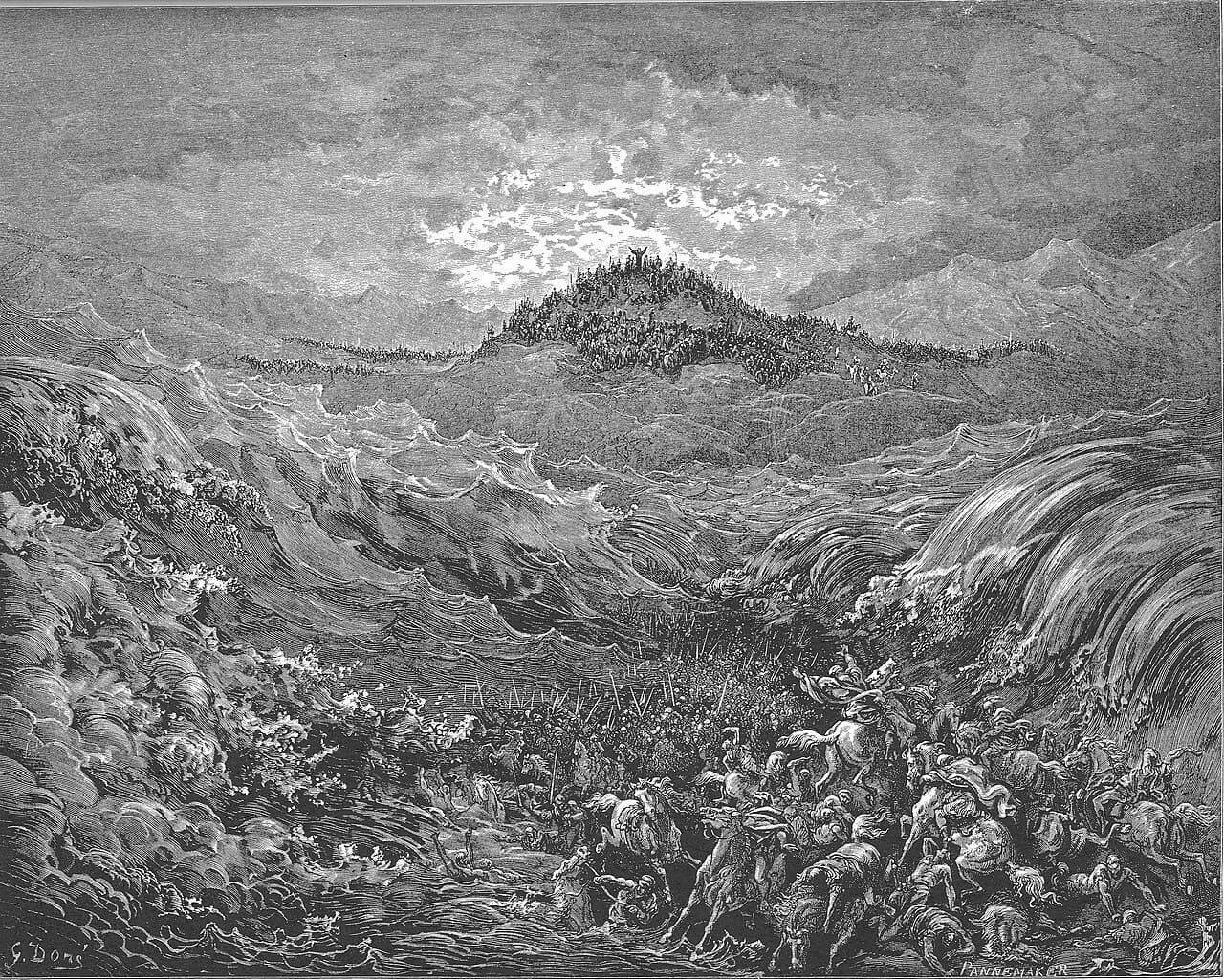
Gustave Doré, The Egyptians Drown in the Sea, La Grande Bible de Tours, 1866. Public domain.
THE ARTWORKDoré engraved the sea closing over Pharaoh's army after the people of Israel had crossed to the far shore.
God gave the sign of His covenant to the sons of Abraham's house at eight days old, and the church has asked ever since whether baptism is given the same way.
Summary
Christians agree that Christ commanded baptism and disagree over whether it belongs to the infants of believers or only to those who confess faith.
- Covenant infant baptism, held by John Calvin and the Reformed and Presbyterian churches, gives the children of believers the sign of the covenant as circumcision was given in Genesis 17.
- Sacramental infant baptism, held in the Catholic, Orthodox and Lutheran churches, receives the infant into God's grace through the washing of baptism.
- Believers' baptism, held by the Anabaptists, the Baptists and most Pentecostal churches, gives baptism to those who have repented and confessed faith.
- Scripture records the baptism of whole households in Acts 16 and 1 Corinthians 1, and the positions divide over who those households held.
The Texts Every Side Reads
Six passages, from the covenant with Abraham to the commission of Christ, carry the weight of the question.
Generation after generation, every male must be circumcised when he is eight days old, including those born in your household and those purchased from a foreigner—even those who are not your offspring.Infant baptism begins its case here, with a covenant sign given to sons of eight days who could not yet profess faith.
In Him you were also circumcised, in the putting off of your sinful nature, with the circumcision performed by Christ and not by human hands. And having been buried with Him in baptism, you were raised with Him through your faith in the power of God, who raised Him from the dead.Paul sets the circumcision performed by Christ beside burial in baptism and names faith as the means of the raising.
Peter replied, “Repent and be baptized, every one of you, in the name of Jesus Christ for the forgiveness of your sins, and you will receive the gift of the Holy Spirit. This promise belongs to you and your children and to all who are far off—to all whom the Lord our God will call to Himself.”Peter's call joins repentance to baptism, and every side gives its own account of the promise that follows the call.
At that hour of the night, the jailer took them and washed their wounds. And without delay, he and all his household were baptized.Luke tells what came before the jailer's baptism and what came after it, and every side reads his household through those verses.
But when Jesus saw this, He was indignant and told them, “Let the little children come to Me, and do not hinder them! For the kingdom of God belongs to such as these.Jesus rebuked the disciples for turning the children away, and every side claims His words for its practice.
Therefore go and make disciples of all nations, baptizing them in the name of the Father, and of the Son, and of the Holy Spirit,The commission joins making disciples to baptizing them, and the believers' reading holds that the disciple comes first.
Three Answers to One Question
Covenant infant baptism, sacramental infant baptism and believers' baptism each answer three questions in their own way.
| The question | Covenant infant baptism | Sacramental infant baptism | Believers' baptism |
|---|---|---|---|
| Who is baptized? | Believers who were not baptized as children, and the children of believers. | Believers who were not baptized as children, and infants brought by the church. | Those who have repented and confessed faith in Christ for themselves. |
| What is baptism? | The sign and seal of the covenant of grace, as circumcision was. | The washing of regeneration, by which God receives the one baptized into His grace. | An act of obedience in which the believer confesses union with Christ in His death and resurrection. |
| Its first text | Genesis 17:9 to 14 read with Colossians 2:11 to 12 and Acts 2:39. | Titus 3:5 and John 3:5, read with the promise of Acts 2:39. | Matthew 28:19 and Acts 2:38 to 41, read with Romans 6:3 to 4. |
- The question
- Who is baptized?
- Covenant infant baptism
- Believers who were not baptized as children, and the children of believers.
- Sacramental infant baptism
- Believers who were not baptized as children, and infants brought by the church.
- Believers' baptism
- Those who have repented and confessed faith in Christ for themselves.
- The question
- What is baptism?
- Covenant infant baptism
- The sign and seal of the covenant of grace, as circumcision was.
- Sacramental infant baptism
- The washing of regeneration, by which God receives the one baptized into His grace.
- Believers' baptism
- An act of obedience in which the believer confesses union with Christ in His death and resurrection.
- The question
- Its first text
- Covenant infant baptism
- Genesis 17:9 to 14 read with Colossians 2:11 to 12 and Acts 2:39.
- Sacramental infant baptism
- Titus 3:5 and John 3:5, read with the promise of Acts 2:39.
- Believers' baptism
- Matthew 28:19 and Acts 2:38 to 41, read with Romans 6:3 to 4.
Each Position in Its Own Words
Each of the three positions rests on a reading of the covenant, of baptism and of faith.
Covenant infant baptismCalvin, Matthew Henry
The covenant reading starts from the promise of Genesis 17:7, made to Abraham and to his offspring after him. It holds that the covenant of grace is one covenant in both Testaments, and that Colossians 2:11 to 12 sets baptism where circumcision stood. Peter's promise to his hearers and their children carries the children into the new covenant with their parents.
John Calvin taught this reading, and Matthew Henry gives its account of why the sign changed.
“Now, (1.) Circumcision was a bloody ordinance; for all things by the law were purged with blood, Heb. ix. But, the blood of Christ being shed, all bloody ordinances are now abolished; circumcision therefore gives way to baptism. (2.) It was peculiar to the males, though the women were also included in the covenant, for the man is the head of the woman.”
Matthew Henry · Commentary on the Whole Bible · on Genesis 17:10Puritan
Sacramental infant baptismAugsburg, Ambrose of Milan
The sacramental reading holds that baptism does what it signifies. It joins the one baptized to the death and resurrection of Christ and gives new birth, so the church brings infants to it. The Augsburg Confession teaches that children are to be baptized and that, offered to God through baptism, they are received into His grace. The Roman Catholic and Orthodox churches baptize infants as well.
Ambrose of Milan, a bishop of the fourth century, speaks for this reading.
“So likewise in baptism, since it is a likeness of death, without a doubt, when you are immersed and rise again, it becomes a likeness of resurrection. Therefore, according to the interpretation of the apostle Peter, just as that resurrection was a regeneration, so is this resurrection a regeneration.”
Ambrose of Milan · On the Sacraments, Book 3, Chapter 1 · on Romans 6:4Patristic
Believers' baptismSpurgeon, Tertullian
The believers' reading holds that the New Testament knows baptism as the act of one who has heard the gospel, repented and believed. Charles Spurgeon preached that baptism and the Lord's Supper belong to believers and to none but believers.
Those who embraced his message were baptized, and about three thousand were added to the believers that day.Luke names the baptized at Pentecost as those who embraced the message, and the believers' reading takes the verse as its pattern.
Tertullian held that baptism is to be given with care, and he answered those who pointed to the eunuch's quick baptism.
“If Philip so ‘easily’ baptized the chamberlain, let us reflect that a manifest and conspicuous evidence that the Lord deemed him worthy had been interposed. The Spirit had enjoined Philip to proceed to that road: the eunuch himself, too, was not found idle, nor as one who was suddenly seized with an eager desire to be baptized; but, after going up to the temple for prayer's sake, being intently engaged on the divine Scripture, was thus suitably discovered-to whom God had, unasked, sent an apostle, which one, again, the Spirit bade adjoin himself to the chamberlain's chariot.”
Tertullian · On Baptism · on Acts 8:26Patristic
The site's tradition is Wesleyan-Pentecostal, and its two streams stand on opposite sides of this question. John Wesley, from whom the Wesleyan stream comes, held the covenant reading, and the classical Pentecostal churches baptize believers on their confession of faith. Scripture leaves this question open to more than one reading, and the site gives no verdict between the three positions.
The Households and the Children
Four groups of texts name households or children, and the infant-baptizing readings and the believers' reading take each group differently.
Lydia and StephanasActs 16:14 to 15 and 1 Corinthians 1:16
Among those listening was a woman named Lydia, a dealer in purple cloth from the city of Thyatira, who was a worshiper of God. The Lord opened her heart to respond to Paul’s message. And when she and her household had been baptized, she urged us, “If you consider me a believer in the Lord, come and stay at my house.” And she persuaded us.Luke names Lydia's faith and not her household's, and Albert Barnes took that as a strong presumptive proof of household baptism.
Yes, I also baptized the household of Stephanas; beyond that I do not remember if I baptized anyone else.Later in the letter, at 1 Corinthians 16:15, Paul calls this household the first converts in Achaia and says they devoted themselves to the service of the saints.
Jamieson, Fausset & Brown read Lydia's household as Barnes did.
“Here also is the first mention of a Christian household. Whether it included children, also in that case baptized, is not explicitly stated; but the presumption, as in other cases of household baptism, is that it did.”
Jamieson, Fausset & Brown · Commentary Critical and Explanatory on the Whole Bible · on Acts 16:15Reformed
The households that believedActs 16:31 to 34 and Acts 18:8
They replied, “Believe in the Lord Jesus and you will be saved, you and your household.” Then Paul and Silas spoke the word of the Lord to him and to everyone in his house.The believers' reading notes that the message came to the whole family before the water did.
Then he brought them into his home and set a meal before them. So he and all his household rejoiced that they had come to believe in God.The household that was baptized is the household that rejoiced in its new faith, and the believers' reading rests on this verse.
Adam Clarke read the jailer's family as those of the house who were capable of receiving instruction, and who showed their faith by being baptized at once.
Crispus, the synagogue leader, and his whole household believed in the Lord. And many of the Corinthians who heard the message believed and were baptized.Luke gives here a household that believed, which the believers' reading sets beside the households baptized in Acts 16.
Your children are holy1 Corinthians 7:14
For the unbelieving husband is sanctified through his believing wife, and the unbelieving wife is sanctified through her believing husband. Otherwise your children would be unclean, but now they are holy.Paul calls the children of one believing parent holy, and the covenant reading takes the word as standing within the covenant.
Jamieson, Fausset & Brown read the verse through the promise of Genesis 17:7 and held that the faith of one Christian parent gives the children a near relationship to the church. Matthew Henry drew the same line from the verse to the church.
“Thus Christians are called commonly saints; such they are by profession, separated to be a peculiar people of God, and as such distinguished from the world; and therefore the children born to Christians, though married to unbelievers, are not to be reckoned as part of the world, but of the church, a holy, not a common and unclean seed.”
Matthew Henry · Commentary on the Whole Bible · on 1 Corinthians 7:14Puritan
John Gill read the verse as Paul's reason why the believing and the unbelieving spouse should go on living together. The believers' reading follows him, since the unbelieving husband is called sanctified in the same verse and is not baptized.
Let the little children comeMark 10:13 to 16
And He took the children in His arms, placed His hands on them, and blessed them.Every side notes that the scene ends in prayer and touch and that no water is mentioned.
Basil of Caesarea drew a rule for the age at which the church receives its members.
“The apostle praised one [Timothy] who had known the holy Scripture from infancy. He also instructed that children be reared ‘in the discipline and correction of the Lord.’ So we consider every time of life, even the very earliest, suitable for receiving persons into the community of faith.”
Basil of Caesarea · The Long Rules 15 · on Mark 10:14Patristic
John Gill held that the children brought to Jesus in Matthew 19:13 were old enough to walk alone and to receive instruction.
Circumcision and Baptism
The covenant reading sets Genesis 17, Romans 4 and 1 Corinthians 10 beside baptism.
Adam Clarke tied the eighth day of Genesis 17:12 to the law of Leviticus 12, under which a newborn son was first counted clean and then consecrated to God.
Whether they are born in your household or purchased, they must be circumcised. My covenant in your flesh will be an everlasting covenant. But if any male is not circumcised, he will be cut off from his people; he has broken My covenant.”The covenant reading draws its weight from these verses, which bind the sign to the whole household and make it a duty.
And he received the sign of circumcision as a seal of the righteousness that he had by faith while he was still uncircumcised. So then, he is the father of all who believe but are not circumcised, in order that righteousness might be credited to them.Paul's account of Genesis 17 here is the verse every side of the question has to answer.
The covenant reading notes that the seal of faith was still given to infants who had no faith yet, and the believers' reading notes that Abraham himself believed first. John Calvin, in his commentary on Acts 16:3, held that circumcision was commanded to continue only until the coming of Christ.
Ambrose of Milan answered readers who were troubled that the command of Genesis 17 had ceased.
“I know that this part of the text is disturbing to many. Indeed, if circumcision is a good thing, it should be maintained today as well. If it is useless, it never should have been mandated in the first place, particularly not by divine precept. But, inasmuch as the apostle said, ‘Abraham received the sign of circumcision,’ certainly the sign is not the reality itself but points to another reality. That is, it is not the truth but points to the truth.”
Ambrose of Milan · On Abraham · on Genesis 17:11Patristic
I do not want you to be unaware, brothers, that our forefathers were all under the cloud, and that they all passed through the sea. They were all baptized into Moses in the cloud and in the sea.Moses told Pharaoh in Exodus 10:9 that Israel would go with its sons and daughters, so the people baptized into Moses in the sea were parents and children together.
Adam Clarke read the baptism into Moses as a typical baptism into the covenant of which Moses was the mediator, as Christians are baptized into Christ.
How the Question Came Down
Thirteen dated marks trace the question from the first century to the twentieth.
From the Didache to Cyprianfour marks, the late first century to AD 253
- Late first centuryThe Didache, chapter 7, It orders baptism in the name of the Father, the Son and the Holy Spirit, in running water where it can be had, after fasting by the one baptized.
- About AD 200Tertullian, On Baptism 18, He counsels that the baptism of little children be delayed.
- Early third centuryHippolytus, The Apostolic Tradition, The church order bids that the little children be baptized first, with their parents answering for those who cannot speak.
- AD 253Cyprian and a council at Carthage, Letter 64 to Fidus, They answer that an infant need not wait for the eighth day, as circumcision did, before baptism is given.
A timeline of four dated marks from the early church, each row naming the writer, the work and what it says of baptism.
From Zurich to the twentieth centurynine marks, 1525 to 1967
- 21 January 1525Conrad Grebel in Zurich, Grebel baptizes George Blaurock on his confession of faith, and the Swiss Brethren begin.
- 1527The Schleitheim Confession, article 1, Baptism is given to those who have learned repentance and amendment of life.
- 1530The Augsburg Confession, article 9, The Lutheran confession teaches the baptism of children in its ninth article.
- 1559John Calvin, Institutes, book 4, chapter 16, Calvin argues the baptism of infants from the circumcision of Genesis 17.
- 1646The Westminster Confession, chapter 28.4, The infants of one or both believing parents are to be baptized.
- 1689The Second London Baptist Confession, chapter 29, Those who profess repentance toward God and faith in Christ are the only proper subjects of baptism.
- 1756John Wesley, A Treatise on Baptism, Wesley publishes his abridgement of his father Samuel Wesley's defence of infant baptism.
- 1960 to 1963Joachim Jeremias and Kurt Aland, Jeremias argues in Infant Baptism in the First Four Centuries that the early church baptized infants, and Aland answers in Did the Early Church Baptize Infants?
- 1967Karl Barth, Church Dogmatics IV/4, The Reformed theologian argues for the baptism of believers and against the baptism of infants.
A timeline of nine dated marks from the Reformation to the twentieth century, each row naming the writer or the body, the work and what it says of baptism.
What the Text Leaves Unsaid
The New Testament leaves three questions about children and baptism without an answer.
Scripture names no infant who was baptized, and it names no child of a believer who was refused baptism. The households of Lydia, the jailer and Stephanas are baptized whole, and their members are never listed. The New Testament also records no baptism of a child raised in a believing home, at any age, so neither practice is shown being given to the second generation.
What Every Side Holds
The positions share four teachings about baptism and about Christ.
ONE BAPTISM
Every side confesses the one baptism Paul names beside one Lord and one faith.
BAPTIZED INTO CHRIST
Every side teaches that those baptized into Christ have clothed themselves with Christ.
A CLEAR CONSCIENCE
Every side reads with Peter that the baptism that saves is the pledge of a clear conscience toward God through the resurrection of Jesus Christ.
NEWNESS OF LIFE
Every side holds that burial with Christ through baptism leads to a walk in newness of life.
The duty that Colossians 2:12 lays on the baptized is one that every church on this question asks of them.
“But the thing signified by our baptism is that we are buried with Christ, as baptism is the seal of the covenant and an obligation to our dying to sin; and that we are raised with Christ, as it is a seal and obligation to our living to righteousness, or newness of life.”
Matthew Henry · Commentary on the Whole Bible · on Colossians 2:12Puritan
The Three Positions Weighed
Each position faces one objection from the text that the other positions press hardest.
| Position | Held by | Tradition | Representative work |
|---|---|---|---|
| Covenant infant baptism | John Calvin; the Westminster Assembly; John Wesley; Matthew Henry | Reformed, Presbyterian, Anglican and Methodist churches | Calvin, Institutes 4.16 (1559); the Westminster Confession 28.4 (1646) |
| Sacramental infant baptism | Cyprian; Augustine; Ambrose of Milan; Martin Luther and the Augsburg confessors | The Catholic, Orthodox and Lutheran churches | Cyprian, Letter 64 to Fidus (253); the Augsburg Confession, article 9 (1530) |
| Believers' baptism | Conrad Grebel and the Swiss Brethren; the Particular Baptists; Charles Spurgeon; Karl Barth | Anabaptist and Baptist churches; most Pentecostal churches | The Schleitheim Confession, article 1 (1527); the Second London Confession, chapter 29 (1689); Barth, Church Dogmatics IV/4 (1967) |
- Position
- Covenant infant baptism
- Held by
- John Calvin; the Westminster Assembly; John Wesley; Matthew Henry
- Tradition
- Reformed, Presbyterian, Anglican and Methodist churches
- Representative work
- Calvin, Institutes 4.16 (1559); the Westminster Confession 28.4 (1646)
- Position
- Sacramental infant baptism
- Held by
- Cyprian; Augustine; Ambrose of Milan; Martin Luther and the Augsburg confessors
- Tradition
- The Catholic, Orthodox and Lutheran churches
- Representative work
- Cyprian, Letter 64 to Fidus (253); the Augsburg Confession, article 9 (1530)
- Position
- Believers' baptism
- Held by
- Conrad Grebel and the Swiss Brethren; the Particular Baptists; Charles Spurgeon; Karl Barth
- Tradition
- Anabaptist and Baptist churches; most Pentecostal churches
- Representative work
- The Schleitheim Confession, article 1 (1527); the Second London Confession, chapter 29 (1689); Barth, Church Dogmatics IV/4 (1967)
The objection to covenant infant baptism
The gathered churches object that in every account Luke gives, hearing and believing come before the water, and that Colossians 2:12 places the raising with Christ through faith. Jerome held that the nations are first taught and the instructed are then immersed, and Adam Clarke read the burial of Colossians 2:12 and Romans 6:4 as the immersion of adults.
The objection to sacramental infant baptism
Matthew Henry, who held the covenant reading, wrote that the circumcision of Christ consists in putting off the whole body of sin, and he denied that it lies in outward rites. Charles Spurgeon preached a sermon against baptismal regeneration, and in 1864 he answered the replies it drew from the Church of England.
For Christ did not send me to baptize, but to preach the gospel, not with words of wisdom, lest the cross of Christ be emptied of its power.Paul says Christ sent him to preach the gospel, and the objection reads his words as a limit on what the water gives apart from the word.
The objection to believers' baptism
John Wesley, in his Explanatory Notes upon the New Testament on Acts 16:15, asked who could believe that in so many families there was no infant. He held too that Jews long used to circumcising their children would now give them to God and have them baptized.
Read the Great Books
These six works state the three positions in the words of their own holders, from Tertullian to Spurgeon.
On Baptism
Tertullian · about AD 200
Tertullian asks those about to be baptized to pray, fast and confess their past sins before they enter the water.
The Augsburg Confession
Philip Melanchthon and the Lutheran princes · 1530
The evangelical princes presented it to Emperor Charles V at the Diet of Augsburg.
READ IT FREE →The Schleitheim Confession
The Swiss Brethren · 1527
The Swiss Brethren wrote it two years after the first baptisms on confession of faith in Zurich.
READ IT FREE →The Second London Baptist Confession
The Particular Baptist churches · 1689
It first appeared in London in 1677, twelve years before the edition that gives it its name.
READ IT FREE →Commentary on the Whole Bible
Matthew Henry · 1710
Henry comments on Genesis 17, Colossians 2, 1 Corinthians 7 and Mark 10 as a Puritan who held the covenant reading.
Children Brought to Christ, and Not to the Font
Charles Spurgeon · 1864
Spurgeon preached it at the Metropolitan Tabernacle on Mark 10:13 to 16, and it sets out a Baptist reading of the children Jesus blessed.
Buried with Him, Raised with Him
Every side of the question calls the baptized to repentance, to faith and to a new life in Christ.
Whenever a reader was baptized, the text asks the same of each one. Peter calls every hearer to repent and to be baptized in the name of Jesus Christ. Paul tells the baptized to count themselves dead to sin and alive to God in Christ Jesus. The children Jesus took in His arms became His lesson to the disciples who had tried to send them away.
Truly I tell you, anyone who does not receive the kingdom of God like a little child will never enter it.”Keep studying
Read it2
Studies7
Doctrines13
Peoples and groups1