
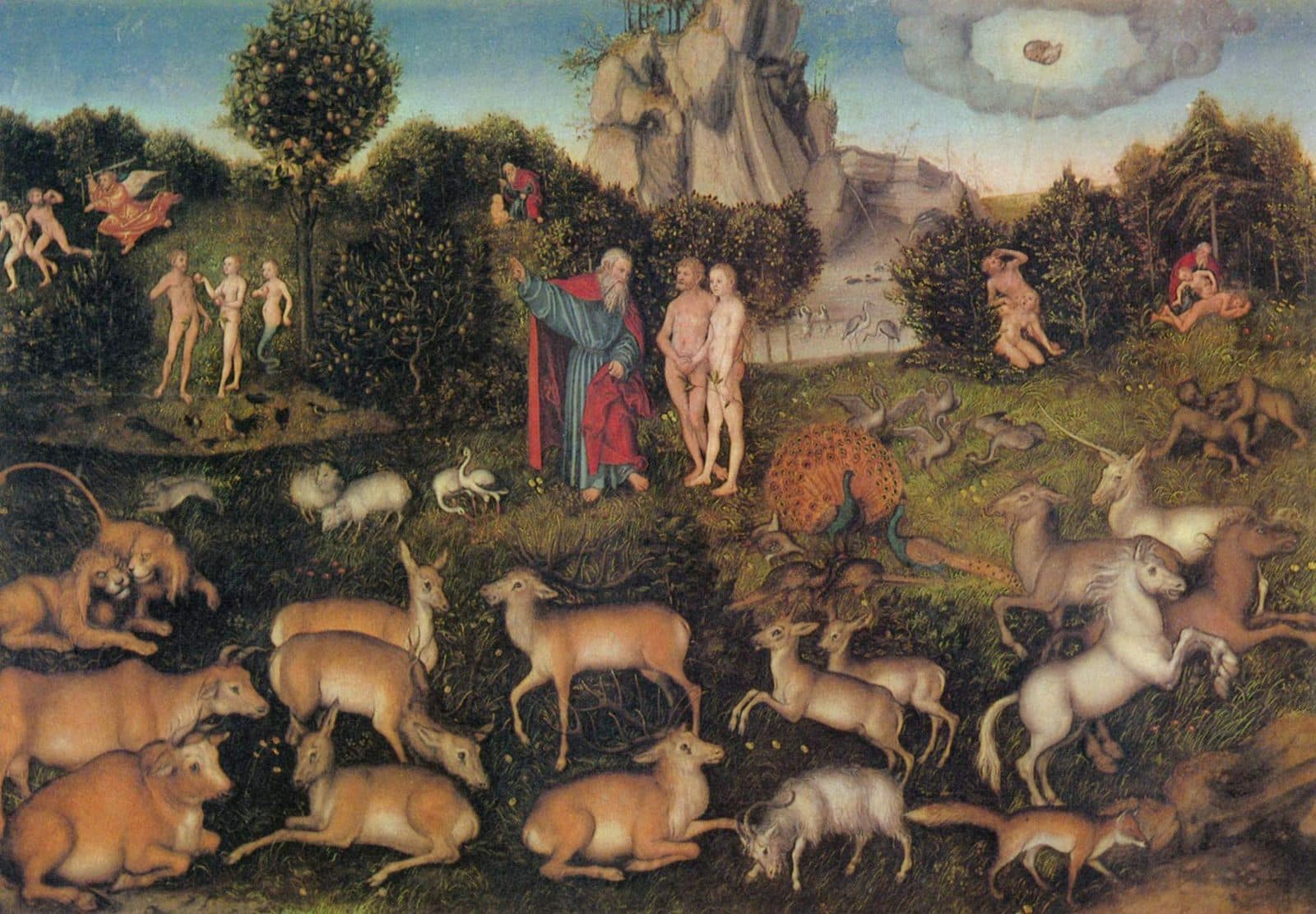
Lucas Cranach the Elder, Paradise, 1530. Public domain.
Genesis 1 to 3 and Revelation 19 to 22 · Symbol · Featured Study
Creation to New Creation
A symbol study of Genesis 1 to 3 and Revelation 19 to 22: the mirror pairs, the stages of God's dwelling and the readings in dispute.
The Bible begins in a garden and ends in a city, and the city has the garden in the middle of it.
In the beginning God created the heavens and the earth.
- The word
- καινός (kainos), G2537
- First appears
- Genesis 1:1 “In the beginning God created the heavens and…”
The Bible begins in a garden and ends in a city, and the city has the garden in the middle of it.
Summary
The closing chapters of Revelation take up words of the opening chapters of Genesis. The curse, the night, the sea and the barred tree of the beginning stand at the end as no curse, no night, no sea and the tree open.
- Seven pairs of words join Genesis 1 to 3 and Revelation 19 to 22, and 1,182 chapters stand between them.
- Eden is read by many as the first sanctuary, where God walked with man.
- God's dwelling with His people is restored by stages, from the tabernacle to the city.
- The word for new in Revelation 21:5 is kainos, new in kind, and Irenaeus, Barnes and Wesley read the creation as renewed.
- The same chapters that open the tree of life also name the second death.
The First Pages and the Last
Genesis 1:1 and Revelation 21:5 stand at the two ends of Scripture.
In the beginning God created the heavens and the earth.Every pair below starts from the creation this verse names.
And the One seated on the throne said, “Behold, I make all things new.” Then He said, “Write this down, for these words are faithful and true.”Each mirror pair keeps the promise of this verse.
And the One seated on the throne said, “Behold, I make all things new.” Then He said, “Write this down, for these words are faithful and true.”Each mirror pair keeps the promise of this verse.
The Sabbath restGenesis 2:2 to 3 and Hebrews 4:9 to 11
And by the seventh day God had finished the work He had been doing; so on that day He rested from all His work. Then God blessed the seventh day and sanctified it, because on that day He rested from all the work of creation that He had accomplished.There remains, then, a Sabbath rest for the people of God. For whoever enters God’s rest also rests from his own work, just as God did from His. Let us, therefore, make every effort to enter that rest, so that no one will fall by following the same pattern of disobedience.Hebrews 4:9 to 11 joins Genesis 2:2 to 3 to a promise that still waits for believers. The last chapters of Revelation do not name this echo of the beginning.
The bright morning starNumbers 24:17 and Revelation 22:16
I see him, but not now; I behold him, but not near. A star will come forth from Jacob, and a scepter will arise from Israel. He will crush the skulls of Moab and strike down all the sons of Sheth.“I, Jesus, have sent My angel to give you this testimony for the churches. I am the Root and the Offspring of David, the bright Morning Star.”Jesus claims Balaam's star and the root of Jesse from Isaiah 11:1 in one line, near the end of the book that opened with light.
The Seven Mirror Pairs
Seven words of Genesis 1 to 3 and their seven answers in Revelation 19 to 22, each pair joined by one bracket, and the stations of God's dwelling between them.
The pairing follows Chuck Missler's commentaries on Genesis and on Revelation (Koinonia House); each paired rung opens its verse in the reader.
God's dwelling with His people stands at seven stations from Eden to the new Jerusalem; each station opens its verse.
1Eden
- Text
- Genesis 3:8
- What the stage changes
- God walks in the garden, and the sin of Genesis 3 drives the man and woman out
- Text
- Exodus 25:8
- What the stage changes
- Israel camps around the tent of meeting, and a veil closes the Most Holy Place
- Text
- 1 Kings 6:20
- What the stage changes
- the dwelling is fixed at Jerusalem, and the high priest enters the Most Holy Place once a year
- Text
- John 1:14
- What the stage changes
- the Word becomes flesh and dwells among us
- Text
- Matthew 27:51
- What the stage changes
- the veil of the temple is torn at the death of Christ
- Text
- 1 Corinthians 3:16
- What the stage changes
- the Spirit dwells in a people
- Text
- Revelation 21:3
- What the stage changes
- God dwells with His people, and the city needs no temple
1. Night and no nightGenesis 1:5 and Revelation 22:5
God called the light “day,” and the darkness He called “night.” And there was evening, and there was morning—the first day.There will be no more night in the city, and they will have no need for the light of a lamp or of the sun. For the Lord God will shine on them, and they will reign forever and ever.Isaiah 60:19 to 20 stands between: the sun is no longer the light, and the Lord is an everlasting light. The God who divided light from darkness in Genesis 1:4 lights the city in Revelation 21:23, where the glory of God illuminates the city and the Lamb is its lamp. G. K. Beale traces the thread in A New Testament Biblical Theology (2011).
2. Seas and no seaGenesis 1:10 and Revelation 21:1
God called the dry land “earth,” and the gathering of waters He called “seas.” And God saw that it was good.Then I saw a new heaven and a new earth, for the first heaven and earth had passed away, and the sea was no more.Psalm 74:13 speaks of God dividing the sea and breaking the heads of the sea monsters, and Job 38:8 of the sea shut in with doors at creation.
3. The tree barred and the tree openGenesis 3:24 and Revelation 22:14
So He drove out the man and stationed cherubim on the east side of the Garden of Eden, along with a whirling sword of flame to guard the way to the tree of life.Blessed are those who wash their robes, so that they may have the right to the tree of life and may enter the city by its gates.Revelation 22:2 names the tree of life again, with twelve kinds of fruit and leaves for the healing of the nations. The cherubim that bar the tree in Genesis 3:24 stand again over the mercy seat in Exodus 25:18. The Trees page follows the same word through Scripture.
4. The curse and no curseGenesis 3:17 and Revelation 22:3
And to Adam He said: “Because you have listened to the voice of your wife and have eaten from the tree of which I commanded you not to eat, cursed is the ground because of you; through toil you will eat of it all the days of your life.No longer will there be any curse. The throne of God and of the Lamb will be within the city, and His servants will worship Him.Galatians 3:13 cites Deuteronomy 21:23 for the one hanged on a tree; Paul's word there is xylon, the word Revelation 22:2 uses.
5. The garden and the garden cityGenesis 2:8 and Revelation 21:2
And the LORD God planted a garden in Eden, in the east, where He placed the man He had formed.I saw the holy city, the new Jerusalem, coming down out of heaven from God, prepared as a bride adorned for her husband.Now a river flowed out of Eden to water the garden, and from there it branched into four headwaters:Then the angel showed me a river of the water of life, as clear as crystal, flowing from the throne of God and of the LambEzekiel 47:1 stands between: a river flows from under the threshold of the temple. Ezekiel 47:12 gives the trees on its banks fruit every month and leaves for healing, the nearest source of Revelation 22:2. The city of Revelation 21:12 to 14 has twelve gates for the tribes and twelve foundations for the apostles.
6. The marriage and the marriage supperGenesis 2:24 and Revelation 19:7
For this reason a man will leave his father and mother and be united to his wife, and they will become one flesh.Let us rejoice and be glad and give Him the glory. For the marriage of the Lamb has come, and His bride has made herself ready.Then the angel told me to write, “Blessed are those who are invited to the marriage supper of the Lamb.” And he said to me, “These are the true words of God.”In Revelation 22:17 the Spirit and the bride say, Come, and the canon closes on a marriage. Isaiah 54:5 calls Israel's Maker her husband, and Hosea 2:23 joins the marriage to the covenant words, my people and my God. Bernard of Clairvaux, in his Sermons on the Song of Songs, reads the Song as the bride's love for Christ. His reading belongs to the allegorical tradition of the medieval church.
7. God walking and God dwellingGenesis 3:8 and Revelation 21:3
Then the man and his wife heard the voice of the LORD God walking in the garden in the breeze of the day, and they hid themselves from the presence of the LORD God among the trees of the garden.And I heard a loud voice from the throne saying: “Behold, the dwelling place of God is with man, and He will dwell with them. They will be His people, and God Himself will be with them as their God.Ezekiel 37:27 promises His dwelling place with them. Patrick Fairbairn treats the pattern in The Typology of Scripture (1845).
Heaven and Earth Joined Again
God's dwelling moves from Israel's camp to the new Jerusalem.
Set apart from and set apart toLeviticus 11 to 15 and Revelation 21:27
Holiness has two directions in the law. The clean and unclean laws of Leviticus 11 to 15 train Israel to be set apart from defilement, and the sacrifices, the priesthood and the Sabbath train them to be set apart to God's presence. The new Jerusalem is holy in both directions: nothing defiled enters it, and God Himself dwells with His people there.
But nothing unclean will ever enter it, nor anyone who practices an abomination or a lie, but only those whose names are written in the Lamb’s Book of Life.The city as the Most Holy Place1 Kings 6:20 and Revelation 21:16 to 22
The inner sanctuary was twenty cubits long, twenty cubits wide, and twenty cubits high. He overlaid the inside with pure gold, and he also overlaid the altar of cedar.The city lies foursquare, with its width the same as its length. And he measured the city with the rod, and all its dimensions were equal—12,000 stadia in length and width and height.But I saw no temple in the city, because the Lord God Almighty and the Lamb are its temple.Beale makes this reading in The Temple and the Church's Mission (2004): the city is a cube like the Most Holy Place, so the whole city is the place of God's presence.
Eden as a Sanctuary
Six features of Eden that return in the tabernacle and the temple.
Each row opens its Eden verse in the reader.
| Feature | Eden | Tabernacle and temple |
|---|---|---|
| God walks | Genesis 3:8 | Leviticus 26:12, the same verb for God among Israel |
| To work and keep | Genesis 2:15 | Numbers 3:7 to 8, the verbs of the Levites' service |
| Cherubim | Genesis 3:24 | Exodus 26:31, cherubim worked into the veil |
| The tree at the centre | Genesis 2:9 | Exodus 25:31 to 40, the lampstand made with branches and blossoms |
| Rivers flow out | Genesis 2:10 | Ezekiel 47:1, a river from the temple; Revelation 22:1, a river from the throne |
| Gold and onyx | Genesis 2:11 to 12 | Exodus 28:9 to 20, the onyx stones and the high priest's breastpiece |
Gordon Wenham drew these parallels in Sanctuary Symbolism in the Garden of Eden Story (1986), and each sanctuary is entered from the east. The Story of Genesis traces how access to God is restored, in four movements from the creation to the covenant family.
Matthew Henry on the river of EdenCommentary on the Whole Bible, on Genesis 2:10 to 14
“In the heavenly paradise there is a river infinitely surpassing these; for it is a river of the water of life, not coming out of Eden, as this, but proceeding out of the throne of God and of the Lamb.”
Matthew Henry · Commentary on the Whole Bible (1710), on Genesis 2:10 to 14Puritan
Kainos and Xylon
Kainos and neos, the two Greek words for new, and the three words for the tree of life.
kainos
new in kind, renewed
neos
new in time, recent
ʿēṣ
tree, wood
xylon
wood, tree, the cross
zōē
life
The lexicon in full1 table or figure, 1 quotation, 2 verses, 2 paragraphs
Each row opens its verse in the reader.
| Word | Sense | Where it stands |
|---|---|---|
| kainos, G2537 | new in kind, renewed | Revelation 21:1 and 21:5; John 13:34; 2 Corinthians 5:17 |
| neos, G3501 | new in time, recent | the new self, Colossians 3:10 |
| ʿēṣ, H6086 | tree, wood | the tree of life, Genesis 2:9 |
| xylon, G3586 | wood, tree, the cross | Revelation 22:2; Galatians 3:13 |
| zōē, G2222 | life | the tree of life and the water of life, Revelation 22:1 to 2 |
The tree of life in the SeptuagintGenesis 2:9 and Revelation 22:2
Out of the ground the LORD God gave growth to every tree that is pleasing to the eye and good for food. And in the middle of the garden were the tree of life and the tree of the knowledge of good and evil.down the middle of the main street of the city. On either side of the river stood a tree of life, bearing twelve kinds of fruit and yielding a fresh crop for each month. And the leaves of the tree are for the healing of the nations.The Septuagint of Genesis 2:9 reads xylon tēs zōēs, and Revelation 22:2 reads xylon zōēs. H6086 and G3586 share no Strong's number, so the link is the Septuagint's choice of word.
Jamieson, Fausset and Brown on Revelation 21:5Commentary Critical and Explanatory, 1871
Jamieson, Fausset and Brown read the new of Revelation 21:5 as kaina, changed from the old, and not nea, recent. They see the first share of that renewal in the soul born again.
“An earnest of this regeneration and transfiguration of nature is given already in the regenerate soul.”
Jamieson, Fausset & Brown · Commentary Critical and Explanatory on the Whole Bible (1871), on Revelation 21:5Evangelical
What the Text Leaves Unsaid
The limits of the mirror reading.
Scripture does not say that one human author set Genesis and Revelation as a mirror, and the two books were written about fifteen centuries apart. Some words of Genesis 1 to 3 have no answer in Revelation. Revelation 21 and 22 do not say whether the river and the tree are places, signs, or both.
The Second Death and the Final State
Genesis 2:17 and Revelation 20:14 to 21:8, the warning of death and its end, and the state that follows the thousand years.
but you must not eat from the tree of the knowledge of good and evil; for in the day that you eat of it, you will surely die.”Then Death and Hades were thrown into the lake of fire. This is the second death—the lake of fire.The canon answers Eden's warning twice: Revelation 22:14 opens the tree, and Revelation 21:8 names those whose share is the second death. The joy of the new creation stands on the far side of the judgment that the same chapters describe.
Those shut out of the cityRevelation 21:8
Many interpreters read the exclusion as final, against the universal salvation some traditions hold.
But to the cowardly and unbelieving and abominable and murderers and sexually immoral and sorcerers and idolaters and all liars, their place will be in the lake that burns with fire and sulfur. This is the second death.”The eternal state after the thousand yearsRevelation 20 and 21
Revelation 21 and 22 describe the eternal state, and the thousand years of Revelation 20 come before it. John Wesley, in his Explanatory Notes on Revelation 21:1, sets the new heaven and new earth after the resurrection and the general judgment. Jamieson, Fausset and Brown make the same distinction: death is abolished in Revelation 21:4, so the verse cannot describe the millennium, in which death still works until Revelation 20:14.
Voices on the New Creation
Two voices, of the second century and the eighteenth, on the city and God's presence in it.
died 202 · Irenaeus
“Of this Jerusalem the former one is an image-that Jerusalem of the former earth in which the righteous are disciplined beforehand for incorruption and prepared for salvation. And of this tabernacle Moses received the pattern in the mount; and nothing is capable of being allegorized, but all things are stedfast, and true, and substantial, having been made by God for righteous men's enjoyment. For as it is God truly who raises up man, so also does man truly rise from the dead, and not allegorically, as I have shown repeatedly.”
Irenaeus · Against Heresies Book V · on Revelation 21:5Patristic
1662 to 1714 · Matthew Henry
“The presence of God with his church is the glory of the church. It is matter of wonder that a holy God should ever dwell with any of the children of men. The presence of God with his people in heaven will not be interrupted as it is on earth, but he will dwell with them continually.”
Matthew Henry · Commentary on the Whole Bible · on Revelation 21:3Puritan
Four Questions Readers Dispute
Each reading with its holders, its work and the objection it meets.
Renewal or replacementIrenaeus, Albert Barnes, John Wesley; Tertullian
The renewal reading holds that the same creation is made new, as Romans 8:21 says the creation itself will be set free. Irenaeus holds it in Against Heresies, book 5, and Albert Barnes in his Notes on Revelation 21:1. John Wesley, on 2 Peter 3:13, sees the new heavens raised out of the ashes of the old.
For behold, I will create new heavens and a new earth. The former things will not be remembered, nor will they come to mind.“For just as the new heavens and the new earth, which I will make, will endure before Me,” declares the LORD, “so your descendants and your name will endure.The creation waits in eager expectation for the revelation of the sons of God. For the creation was subjected to futility, not by its own will, but because of the One who subjected it, in hope that the creation itself will be set free from its bondage to decay and brought into the glorious freedom of the children of God. We know that the whole creation has been groaning together in the pains of childbirth until the present time. Not only that, but we ourselves, who have the firstfruits of the Spirit, groan inwardly as we wait eagerly for our adoption as sons, the redemption of our bodies.But in keeping with God’s promise, we are looking forward to a new heaven and a new earth, where righteousness dwells.The replacement reading takes 2 Peter 3:10 and the passing away of Revelation 21:1 at their plain sense. Tertullian, in Against Hermogenes, writes that heaven will come to nothing with the earth. Its objection is Romans 8:21.
But the Day of the Lord will come like a thief. The heavens will disappear with a roar, the elements will be destroyed by fire, and the earth and its works will be laid bare.Whether the sea is a power of chaosHermann Gunkel, John Day, Jon Levenson; David Tsumura
Hermann Gunkel, in Schöpfung und Chaos (1895), John Day (1985) and Jon Levenson (1988) read the sea as a hostile power. They point to the deep of Genesis 1:2, the divided sea of the Exodus and the sea monsters of Psalm 74:13. On their reading the end of the sea in Revelation 21:1 is the end of that threat.
David Tsumura, in Creation and Destruction (2005), argues that tehom means the deep and carries no combat myth. Genesis 1:10 calls the seas good, so on his reading the end of the sea is the end of separation.
Whether Eden was a templeGordon Wenham, G. K. Beale; Daniel Block
Gordon Wenham and G. K. Beale read the walking of Genesis 3:8 and the dwelling of Revelation 21:3 as one thread, so Eden is the first sanctuary. Beale makes the case in The Temple and the Church's Mission (2004). Beale and Mitchell Kim carry it on in God Dwells Among Us (2014), and T. D. Alexander in From Eden to the New Jerusalem (2008).
Daniel Block, in Eden: A Temple? A Reassessment (2013), argues that the temple parallels are read back into Genesis and overstated.
Whether the mirror is one designChuck Missler; Samuel Sandmel
Chuck Missler, in his verse by verse commentaries on Genesis and on Revelation (Koinonia House), reads the two books as the matched first and last chapters of one design. The objection is Samuel Sandmel's, in Parallelomania (Journal of Biblical Literature, 1962): likeness of words does not prove intent.
Books to Read Next
Four public domain works a student reads next.
Commentary on the Whole Bible
Matthew Henry · 1708 to 1710
His notes run verse by verse through Genesis and Revelation alike.
READ AT CCEL →Commentary on Genesis
John Calvin · 1554
On Genesis 2:9 he calls the tree of life a symbol and memorial of the life God gave Adam, and with Augustine a figure of Christ.
READ AT CCEL →The Old Testament in Greek
H. B. Swete, editor · 1909
It prints the Greek of Genesis 2:9 that Revelation 22:2 echoes.
READ AT ARCHIVE.ORG →The Septuagint with Apocrypha: Greek and English
Sir Lancelot Brenton, translator · 1851
It sets the Greek beside an English rendering.
READ AT ARCHIVE.ORG →All Things New
The end of the Bible gives back what the beginning lost, and more, because Christ bore the curse of Genesis 3 on the cross.
The last chapters ask the reader to answer the invitation that closes the canon.
The Spirit and the bride say, “Come!” Let the one who hears say, “Come!” And let the one who is thirsty come, and the one who desires the water of life drink freely.Sources
Scripture is the Berean Standard Bible.
- Matthew Henry, Commentary on the Whole Bible, 1708 to 1710, on Genesis 2:10 to 14.
- John Calvin, Commentary on Genesis, 1554, on Genesis 2:9.
- Jamieson, Fausset and Brown, Commentary Critical and Explanatory on the Whole Bible, 1871, on Revelation 21:5.
- John Wesley, Explanatory Notes upon the New Testament, 1755, on Revelation 21:1.
- John Wesley, Explanatory Notes upon the New Testament, 1755, on 2 Peter 3:13.
- Albert Barnes, Notes, Explanatory and Practical, on Revelation 21:1.
- Irenaeus, Against Heresies, book 5, on Revelation 21:5.
- Tertullian, Against Hermogenes, translated by Peter Holmes, Ante-Nicene Fathers volume 3, 1885.
- Matthew Henry, Commentary on the Whole Bible, on Revelation 21:3.
- Matthew Henry, Commentary on the Whole Bible, on Romans 8:21.
- H. B. Swete, The Old Testament in Greek according to the Septuagint, 1909, Genesis 2:9.
- Sir Lancelot Brenton, The Septuagint with Apocrypha: Greek and English, 1851.
- James Strong, Exhaustive Concordance of the Bible, 1890, the entries of the twenty-six words the page names.
- The chapter and verse counts of the Berean Standard Bible, 66 books, 1,189 chapters.
- Gordon Wenham, Sanctuary Symbolism in the Garden of Eden Story, 1986.
- G. K. Beale, The Temple and the Church's Mission, 2004; A New Testament Biblical Theology, 2011; with Mitchell Kim, God Dwells Among Us, 2014.
- T. D. Alexander, From Eden to the New Jerusalem, 2008.
- Daniel Block, Eden: A Temple? A Reassessment of the Biblical Evidence, 2013.
- Samuel Sandmel, Parallelomania, 1962.
- Hermann Gunkel, Schöpfung und Chaos, 1895; John Day, God's Conflict with the Dragon and the Sea, 1985; Jon Levenson, Creation and the Persistence of Evil, 1988; David Tsumura, Creation and Destruction, 2005.
- Chuck Missler, commentaries on Genesis and on Revelation.
- Patrick Fairbairn, The Typology of Scripture, 1845.
- Bernard of Clairvaux, Sermons on the Song of Songs, twelfth century.
Keep Studying
Studies12
People and groups2
Symbols8
Doctrines10
Subjects2