
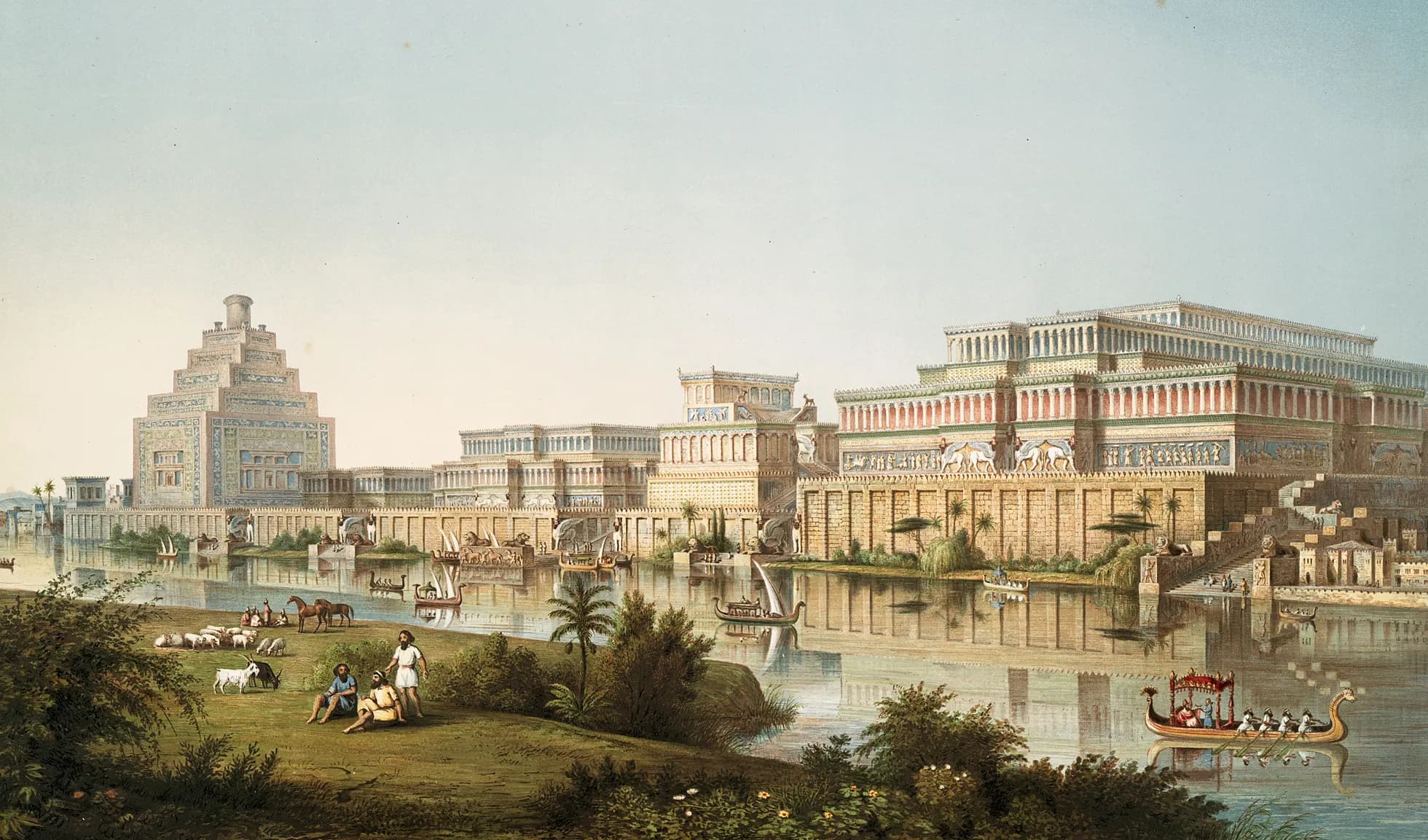
The Palaces of Nimroud Restored, Austen Henry Layard, 1853, British Museum. Public domain.
Old Testament · Book 34 of 66
Nahum
Nahum announces the fall of Nineveh, the capital of Assyria, in three chapters of poetry. It declares that the LORD is slow to anger and will judge the city that oppressed his people.
Nahum announces the fall of Nineveh, the capital of Assyria, in three chapters of poetry. It declares that the LORD is slow to anger and will judge the city that oppressed his people.
What is Nahum about?
Nahum is the burden against Nineveh, the capital of Assyria, given to Judah. It opens with a hymn on the jealous and avenging God who is slow to anger and never clears the guilty, and in the middle of the storm it says: “The LORD is good, a stronghold in the day of distress” (1:7). The second chapter tells the siege and fall of the city as if it were seen. The third pronounces woe on the city of blood and asks whether Nineveh is better than Thebes, which fell with all her allies.
All 3 chapters
Every chapter of the book, in one grid. Each cell opens that chapter.
- The LORD who avengesChapter 1
- The scatterer comes upChapter 2
- Woe to the city of bloodChapter 3
The colour is the movement of the book the chapter stands in, one movement to each chapter, and every cell opens that chapter's Study level.
Who wrote it, where, when, for whom, and why?
The book names itself the burden against Nineveh, the book of the vision of Nahum the Elkoshite (1:1). Scripture says nothing more of Nahum: his town, Elkosh, is named only here, and no king, father or companion is given beside him. The book calls itself a book as well as a vision, a word written down.
This is the burden against Nineveh, the book of the vision of Nahum the Elkoshite:
Nahum 1:1, Berean Standard Bible.
The burden is spoken over Nineveh, the capital of Assyria (1:1, 3:18), and heard in Judah, the people told to keep their feasts (1:15). The book names Bashan, Carmel and Lebanon (1:4), the river gates of Nineveh (2:6), and Thebes by the Nile with Cush, Egypt, Put and Libya (3:8 to 9).
The book gives no king and no year. It speaks of Thebes as already fallen and taken into captivity (3:8 to 10) and of Nineveh as still standing, so it was written after Thebes fell and before Nineveh did; that order is secure from the text, and the years are uncertain from the text alone. Nineveh had been spared once before, when it turned at Jonah's preaching (Jonah 3:10), and Jonah son of Amittai prophesied in the reign of Jeroboam II (2 Kings 14:25), so Nahum stands later than Jonah.
Nineveh is addressed in the second person throughout (1:11, 2:13, 3:5), but the people who hear the book are Judah, afflicted and now promised relief: I will afflict you no longer (1:12), and the wicked will never again march through you (1:15).
The book gives its reason in the LORD's own words and in the charges against the city: a plotter of evil against the LORD (1:11), a city of blood full of lies and plunder (3:1), a mistress of sorcery who sold nations (3:4), and a cruelty that every people has felt (3:19). Against it stands the LORD who is slow to anger and great in power (1:3), and good to those who trust him (1:7).
The book shows a city of chariots, horses and spears (2:3 to 4, 3:2 to 3), of silver and gold without end (2:9), of merchants more than the stars (3:16), and of a king whose shepherds and officers sleep (3:18). It compares Nineveh to a lions' den filled with prey (2:11 to 12), and it names Thebes, a city with water for a wall, as the proof that such a city can fall (3:8 to 10).
Sources. Nahum 1:1, 1:3, 1:4, 1:7, 1:11, 1:12, 1:15, 2:3 to 4, 2:6, 2:9, 2:11 to 13, 3:1 to 5, 3:8 to 10, 3:16, 3:18 and 3:19; Jonah 3:10; 2 Kings 14:25. Every verse is read in the Berean Standard Bible.
How is Nahum arranged, and what is it for?
The three movements the book falls into, one chapter each, then what it teaches and what it was written to do.
- The LORD who avengesChapter 1, 15 verses, the turn at 1:7
The jealous and avenging God, slow to anger and great in power, a refuge to those who trust him, and good news for Judah on the mountains.
- The scatterer comes upChapter 2, 13 verses, the turn at 2:6
The siege told as it happens: red shields, flashing chariots, the river gates opened, the city drained and plundered, the lions' den emptied.
- Woe to the city of bloodChapter 3, 19 verses, the turn at 3:8
The charge of blood, lies and plunder, the taunt of Thebes that fell with all her allies, and the wound that cannot be healed.
The theme
The LORD is jealous for his people and takes vengeance on those who crush them, and his patience is not a pardon: he is slow to anger and will by no means leave the guilty unpunished (1:3). The same God is good, a stronghold in the day of distress for those who trust him (1:7). Nineveh, the city of blood that sold nations and plundered without end, falls as Thebes fell, and the peoples it hurt clap their hands (3:19). For Judah the fall of the oppressor is the good news of peace (1:15).
The purpose
Nahum was given to Judah, under the yoke of Assyria, to say that the yoke would be broken (1:13) and that Nineveh would fall and not rise again. The book sets the reason in the character of the LORD, so that a people who had waited long under a cruel empire would know that God had not overlooked it, and would keep their feasts and their vows (1:15).
One city, two prophets: the Nineveh that turned and the Nineveh that fell
When God saw their actions—that they had turned from their evil ways—He relented from the disaster He had threatened to bring upon them.
So he prayed to the LORD, saying, “O LORD, is this not what I said while I was still in my own country? This is why I was so quick to flee toward Tarshish. I knew that You are a gracious and compassionate God, slow to anger, abounding in loving devotion—One who relents from sending disaster.Jonah 4:2
The LORD is slow to anger and great in power; the LORD will by no means leave the guilty unpunished. His path is in the whirlwind and storm, and clouds are the dust beneath His feet.Nahum 1:3
There is no healing for your injury; your wound is severe. All who hear the news of you applaud your downfall, for who has not experienced your constant cruelty?
The LORD who avenges, Nahum 1
What the text says in these 15 verses, and the pages they open on.
The book opens as the burden against Nineveh, the vision of Nahum the Elkoshite (1:1). A hymn follows on who the LORD is: jealous and avenging, full of wrath toward his foes, slow to anger and great in power, and one who will by no means leave the guilty unpunished (1:2 to 3). The sea dries up at his rebuke, Bashan, Carmel and Lebanon wither, and the mountains quake (1:4 to 6). In the middle of the storm the LORD is good, a stronghold in the day of distress, and he cares for those who trust in him (1:7). Then the words turn by turns to Nineveh and to Judah. Nineveh's plotter against the LORD will be cut down and its name will have no descendants (1:11 to 14). Judah's yoke will be broken (1:13), and a messenger on the mountains brings the good news of peace: Judah may keep its feasts, for the wicked will never again march through it (1:15).
The LORD is good, a stronghold in the day of distress; He cares for those who trust in Him.
- Study
Nahum 1the hymn of the LORD who avenges, the refuge of 1:7, and the good news on the mountainsShow the summary and 4 pagesShow summary, 4 pagesHide the summary
'The burden of Nineveh': a century after Jonah, the verdict Jonah feared has come due. The chapter opens with a partial acrostic hymn on the character of God, holding both hands open at once: 'Jehovah is a jealous God and avengeth… Jehovah is slow to anger, and great in power, and will by no means clear the guilty.' His way is in the whirlwind and the storm, and the clouds are the dust of his feet; the mountains quake, the hills melt. 'Who can stand before his indignation?' And inside the storm, the shelter: 'The LORD is good, a stronghold in the day of distress; He cares for those who trust in Him' (1:7). Then feet on the mountains, publishing peace.
- The LORD is jealous and avenging, slow to anger and great in power (1:2 to 3).
- The LORD is good, a stronghold in the day of distress (1:7).
- Judah's yoke is broken, and a messenger brings good news of peace (1:13, 1:15).
On this chapter (4)
- The day of the LORD
The day the prophets say the LORD comes against his enemies.
- Where was Elkosh, the town of Nahum the Elkoshite?
Answered under Where do readers disagree, lower on this page, with each reading and who holds it.
- Is 1:2 to 8 an acrostic, and why does it stop at kaph?
Answered under Where do readers disagree, lower on this page, with each reading and who holds it.
- Nahum 1:7
The verse on its own page, with the commentators on it by era.
The hymn of 1:2 to 8, and the letters its lines open with
| Verse | The Berean text | The letters its lines open with |
|---|---|---|
| 1:2 |
|
|
| 1:3 |
|
|
| 1:4 |
|
|
| 1:5 |
|
|
| 1:6 |
|
|
| 1:7 |
|
|
| 1:8 |
|
|
Characters (3)
Who the text names. A name with a page carries its door.
- Nahum the Elkoshite
The prophet whose vision the book is (1:1).
- The plotter from Nineveh
A counselor of wickedness who plots evil against the LORD (1:11).
- Judah
The people told to keep their feasts, whose yoke will be broken (1:13, 1:15).
Places (5)
Where the chapter stands.
- Nineveh
The city the burden is against (1:1).
- Elkosh
The prophet's town, named once (1:1).
- Bashan
Its pastures wither at the LORD's rebuke (1:4).
- Carmel
Withers with Bashan (1:4).
Show the next 1
- Lebanon
Its flower wilts (1:4).
Themes (3)
What the chapter raises, each on its own page where one stands.
- The wrath and the goodness of the LORD
Slow to anger yet never clearing the guilty (1:3), and good to those who trust him (1:7).
- Vengeance and refuge
The LORD takes vengeance on his foes and is a stronghold for his own (1:2, 1:7).
- The good news of peace
The feet on the mountains of one who proclaims peace (1:15).
Where the New Testament uses these chapters (1)each marked as a quotation or an allusion, with the evidence
- Later Christian readingNahum 1:15 at Romans 10:15. Paul writes as it is written and quotes the line of Isaiah 52:7 about the feet of those who bring good news. Nahum 1:15 carries the same line about the feet on the mountains of one who brings good news and proclaims peace. Held by Robert Jamieson, A. R. Fausset and David Brown on 1:15, who read Nahum's herald as a type of the gospel's heralds, and by Matthew Henry on 1:15, who says the apostle quotes the words from Isaiah and Nahum. Romans carries How beautiful, which stands in Isaiah 52:7 and not in Nahum 1:15.
The scatterer comes up, Nahum 2
What the text says in these 13 verses, and the pages they open on.
One who scatters comes up against Nineveh, and the city is told in mockery to guard the fortress and watch the road (2:1). The LORD will restore the splendour of Jacob (2:2). The attackers' shields are red, their chariots flash like fire and dash through the streets like lightning (2:3 to 4). Nineveh's nobles stumble as they run to the wall (2:5). The river gates are thrown open and the palace collapses (2:6). The city is carried away and her maidservants moan like doves (2:7). Nineveh drains like a pool while the people run and no one turns back (2:8), the silver and gold are plundered (2:9), and every heart melts (2:10). The chapter ends on a taunt: where now is the lions' den that was filled with prey? The LORD of Hosts is against her, and her chariots will go up in smoke (2:11 to 13).
The river gates are thrown open and the palace collapses.
- Study
Nahum 2the siege and the fall told station by station, and the empty lions' denShow the summary and 3 pagesShow summary, 3 pagesHide the summary
The siege filmed in close-up. 'One who scatters advances against you … Guard the fortress! Watch the road!', futile orders. Shields dyed red, warriors in scarlet, chariots flashing like steel, raging in the streets and running like the lightnings; officers stumbling in their haste to the wall. Then the collapse in one line: 'The river gates are thrown open and the palace collapses.' The queen is carried off, her handmaids moaning like doves and beating on their breasts; Nineveh drains away as her people flee: 'Stop! Stop! … they cry, but no one turns back.' Take the spoil of silver, the spoil of gold: 'She is emptied! Yes, she is desolate and laid waste!'
- One who scatters comes up against Nineveh (2:1).
- The river gates are thrown open and the palace collapses (2:6).
- The lions' den that was filled with prey stands empty (2:11 to 13).
On this chapter (3)
- Assyria
The empire whose capital falls in this chapter.
- How did Nineveh fall, and was there a flood at the river gates of 2:6?
Answered under Where do readers disagree, lower on this page, with each reading and who holds it.
- Nahum 2:6
The verse on its own page, with the commentators on it by era.
The siege of 2:1 to 10 in 10 stations
- 1The scatterer2:1
“One who scatters advances against you”
- 2The shields2:3
“The shields of his mighty men are red”
- 3The chariots2:4
“The chariots dash through the streets”
- 4The nobles2:5
“they stumble as they advance”
- 5The river gates2:6
“The river gates are thrown open”
The turn of the siege
- 6The palace2:6
“the palace collapses”
- 7The city carried away2:7
“It is decreed that the city be exiled and carried away”
- 8The flight2:8
“but no one turns back”
- 9The plunder2:9
“There is no end to the treasure”
- 10The hearts that melt2:10
“Hearts melt, knees knock”
Characters (3)
Who the text names. A name with a page carries its door.
- The scatterer
The one who advances against Nineveh (2:1).
- The nobles of Assyria
Summoned to the wall, they stumble as they go (2:5).
- The city carried away
The Berean text reads It is decreed; the King James reads a name, Huzzab, often taken as the queen (2:7).
Places (3)
Where the chapter stands.
- Nineveh
Like a pool of water draining away (2:8).
- The river gates
Thrown open as the palace collapses (2:6).
- Jacob and Israel
Whose splendour the LORD will restore (2:2).
Themes (3)
What the chapter raises, each on its own page where one stands.
- The fall of the oppressor
The lions' den that was filled with prey stands empty (2:11 to 12).
- Assyria
The empire whose capital falls in this chapter.
- The day of the LORD
The LORD of Hosts against a city (2:13).
No New Testament passage quotes or names this chapter.
Woe to the city of blood, Nahum 3
What the text says in these 19 verses, and the pages they open on.
The last chapter opens with a woe on the city of blood, full of lies and plunder (3:1). The battle comes back in short cries of whips, wheels, horses and heaps of the slain (3:2 to 3), because of the harlot's sorceries that sold nations (3:4). The LORD is against her and will show her shame to the nations, and none will grieve for her (3:5 to 7). Then the taunt: is Nineveh better than Thebes by the Nile, whose strength was Cush and Egypt and whose allies were Put and Libya? Thebes went into captivity all the same (3:8 to 10). Nineveh's fortresses are ripe figs that fall into the mouth of the eater (3:12). Its merchants, guards and scribes will fly off like locusts (3:15 to 17), its shepherds slumber (3:18), and its wound cannot be healed. All who hear the news clap their hands, for who has not felt its cruelty (3:19)?
Are you better than Thebes, stationed by the Nile with water around her, whose rampart was the sea, whose wall was the water?
- Study
Nahum 3the woe on the city of blood, the taunt of Thebes, and the wound that cannot be healedShow the summary and 4 pagesShow summary, 4 pagesHide the summary
'Woe to the city of blood, full of lies, full of plunder, never without prey.' The battle noise stacks syllable on syllable: the whip, the rattling wheels, prancing horses, bounding chariots, the charging horseman, flashing sword and glittering spear, and 'heaps of slain, mounds of corpses, dead bodies without end'. Nineveh is arraigned as a sorceress and a harlot who sold nations, and will be publicly stripped before them. Then the historical argument: Thebes sat among the rivers with Ethiopia and Egypt for strength, and went into captivity all the same. Her fortresses are fig trees that drop their first-ripe fruit into the eater's mouth at a shake; her hurt has no assuaging.
- Woe to the city of blood, full of lies and plunder (3:1).
- Thebes fell with all her allies, and Nineveh is no better (3:8 to 10).
- The wound cannot be healed, and all who hear clap their hands (3:19).
On this chapter (4)
- The imprecatory Psalms
The prayers that ask God to judge the oppressor.
- When was Nahum written, and how close to the fall of Nineveh?
Answered under Where do readers disagree, lower on this page, with each reading and who holds it.
- Is Nahum's joy at Nineveh's fall nationalism, and how do Jonah and Nahum read together?
Answered under Where do readers disagree, lower on this page, with each reading and who holds it.
- Nahum 3:8
The verse on its own page, with the commentators on it by era.
Thebes and Nineveh: the city that fell, and the city that will
Characters (3)
Who the text names. A name with a page carries its door.
- The king of Assyria
Whose shepherds slumber and whose people are scattered (3:18).
- The shepherds and officers
Asleep while the people scatter on the mountains (3:18).
- The harlot, mistress of sorcery
Nineveh pictured as selling nations by her witchcraft (3:4).
Places (4)
Where the chapter stands.
- Thebes
Stationed by the Nile, taken into captivity all the same (3:8 to 10).
- Cush and Egypt
Thebes' boundless strength (3:9).
- Put and Libya
Thebes' allies (3:9).
- Assyria
The land whose gates stand open to its enemies (3:13, 3:18).
Themes (3)
What the chapter raises, each on its own page where one stands.
- The end of Assyria
No healing for the wound (3:19).
- Justice and righteousness
Judgment on constant cruelty (3:19).
- The prayers against the enemy
The Psalms that ask God to judge the oppressor.
No New Testament passage quotes or names this chapter.
- Author
- Nahum the Elkoshite (1:1)
- Date
- Between 663 BC (the fall of Thebes, 3:8) and 612 BC (Nineveh's actual fall)
- Audience
- Judah, under Assyrian pressure, hearing that the pressure will not last
Where do readers disagree?
One list: the readings with their holders, and what the evidence does not settle.
Where was Elkosh, the town of Nahum the Elkoshite?
- A village in Galilee. Held by Jerome, as Matthew Henry reports him in Commentary on the Whole Bible, on 1:1: the town called Elkes or Elcos, which Jerome says was in Galilee.
- A village in the land of the Jews. Held by Cyril of Alexandria in his Commentary on Nahum, on 1:1, who takes of Elkosh as from a place and not from a father, and calls it a village somewhere in the land of the Jews.
What the evidence does not settle: The book names Elkosh once (1:1) and no other verse of Scripture names it. The Lives of the Prophets, a Jewish work usually dated to the first century AD, places Nahum in the territory of Simeon; Calvin reports that the Jewish interpreters of his day took Elkosh as the name of Nahum's father. Al-Qush north of Mosul, where a tomb of Nahum is shown, and Capernaum, whose name means the village of Nahum, are also proposed, and the store names no holder with a work for either.
The argument in full
A village in Galilee. Elkoshite is read as the name of a town, and Jerome places that town in Galilee.
A village in the land of the Jews. Cyril says he has the reading from tradition, and the book speaks to Judah (1:15).
Is 1:2 to 8 an acrostic, and why does it stop at kaph?
The acrostics of the Bible→- A partial alphabetic hymn stands in the received text. Held by Hermann Gunkel, 'Nahum 1', Zeitschrift für die alttestamentliche Wissenschaft 13 (1893).
- One description of the LORD's coming, read without the letters. Held by Adam Clarke on 1:4, who reads the third to the sixth verse as one description of the coming of the LORD.
What the evidence does not settle: Read from the store's Hebrew, the run holds aleph to kaph with one letter missing: at 1:4, where dalet is expected, the word begins with aleph, and the zayin and the kaph stand as the second and third words of their lines. The text does not say why the run stops at kaph, the eleventh letter of twenty-two.
The argument in full
A partial alphabetic hymn stands in the received text. Read in Hebrew, the lines of 1:2 to 8 open with the letters from aleph toward kaph in order, which marks the hymn as one poem set at the front of the book.
One description of the LORD's coming, read without the letters. The hymn is read as a theophany, the LORD coming in storm, and its meaning stands whatever its letters.
When was Nahum written, and how close to the fall of Nineveh?
- In the days of Hezekiah, near Sennacherib's invasion. Held by Matthew Henry on 1:1, who dates the book about 710 BC and reads the plotter of 1:11 as Sennacherib and the yoke of 1:13 as the tribute laid on Hezekiah.
- After Assyria took Thebes, and before Nineveh fell. Held by Albert Barnes on 3:10, who names Assyria as the author of Thebes' captivity. The years come from Ashurbanipal's annals for Thebes, 663 BC, and from the Babylonian Chronicle, BM 21901, for Nineveh, 612 BC.
- Thebes fell earlier, to Sargon. Held by Robert Jamieson, A. R. Fausset and David Brown on 3:8, who say the blow on No-amon was probably by the Assyrian Sargon.
What the evidence does not settle: The text gives no year. It sets Thebes' fall in the past (3:8 to 10) and Nineveh's in the future, which fixes the order and not the distance between them.
The argument in full
In the days of Hezekiah, near Sennacherib's invasion. The plotter against the LORD (1:11) and the broken yoke (1:13) fit Sennacherib's campaign against Judah and Hezekiah.
After Assyria took Thebes, and before Nineveh fell. Nahum 3:8 to 10 speaks of Thebes as already taken, and the whole book speaks of Nineveh as still standing.
Thebes fell earlier, to Sargon. If the fall of 3:10 is an earlier blow, the book can stand earlier than 663 BC.
How did Nineveh fall, and was there a flood at the river gates of 2:6?
Assyria→- The river rose and broke the wall. Held by Adam Clarke on 1:8 and 2:6, following Bishop Newcome and Diodorus Siculus, and by John Wesley on 2:6, who writes that a mighty deluge overthrew part of the wall during the siege.
- The gates on the Tigris were forced. Held by Matthew Henry on 2:6, who reads the gates of Nineveh that open on the Tigris as forced by, or betrayed to, the enemy.
- The sluices of the city's water barrier. Held by Robert Jamieson, A. R. Fausset and David Brown on 2:6, who read the gates as dams for regulating the water that surrounded the city.
What the evidence does not settle: The Babylonian Chronicle, BM 21901, as C. J. Gadd published it, records the siege and the fall in the fourteenth year of Nabopolassar and reports no flood. At the Halzi Gate, excavated in 1989 and 1990 by David Stronach's expedition, human remains and arrowheads lay in the gate passage, the picture of a gate fought over (3:13).
The argument in full
The river rose and broke the wall. The overwhelming flood of 1:8 and the river gates thrown open at 2:6 read as the water that let the besiegers in.
The gates on the Tigris were forced. The river gates are gates in the wall, and the enemy enters by them.
The sluices of the city's water barrier. The city was ringed by water it could control, and the verse names that system giving way.
Is Nahum's joy at Nineveh's fall nationalism, and how do Jonah and Nahum read together?
Jonah→- The same creed, the other side of it. Held by Albert Barnes on 1:3, who says Nahum takes up the words of Jonah 4:2 about God's attributes toward Nineveh to show the other side of them.
- A later Nineveh went back to what an earlier one left. Held by Barnes on 1:1, who writes that Nineveh, after repenting at the preaching of Jonah, fell back into its sins, and by Jamieson, Fausset and Brown on 1:1, who place Nahum a hundred and fifty years after Jonah.
- The joy of every people the oppressor hurt. Held by Adam Clarke on 3:19, who reads the clapping of hands as all nations rejoicing at the fall of a universal oppressor.
What the evidence does not settle: The book records no word to Nineveh's people and no call to repent, so whether mercy was still open to them the text does not say. The charge that the book is narrow nationalism stands in early twentieth century critical commentary; the store names no holder with a work for it.
The argument in full
The same creed, the other side of it. Jonah shows the LORD slow to anger giving time to repent; Nahum shows that the same patience is not a pardon of the guilty (1:3).
A later Nineveh went back to what an earlier one left. The mercy shown at Jonah's preaching was given to the people who turned, and nothing in it binds the city's later rulers.
The joy of every people the oppressor hurt. The last verse gives the reason for the joy in the city's cruelty to all, not in Judah's rank (3:19).
The Text and the Spade
- Kuyunjik and Nebi Yunus, the mounds of Nineveh at Mosulexcavated from 1847 onward
Austen Henry Layard's work, published as Nineveh and Its Remains (1849), and the excavations that followed uncovered the Southwest Palace of Sennacherib, the North Palace of Ashurbanipal, and the library of cuneiform tablets that made Assyriology possible. Two things bear directly on this book. The reliefs show the siege machinery, chariots, and cavalry that chapter 2 describes at speed. And the palaces carry the lion imagery that Nahum turns into a charge at 2:11-12, since the lion was the Assyrian royal emblem and the Ashurbanipal lion hunt reliefs are the finest surviving examples of it.
- The Halzi Gate on Nineveh's eastern wallexcavated 1989-1990 by David Stronach's expedition
The gate passage had been narrowed, apparently in a hurry, and the excavators found human remains and arrowheads inside it. The picture is a defended gate that was fought over and lost, which fits the assault of 612 BC and gives 3:13 something concrete to sit against: 'The gates of your land are wide open to your enemies; fire consumes their bars.'
- The Babylonian Chronicle tablet BM 21901Neo-Babylonian cuneiform tablet, published 1923
The single most important outside witness to the events this book predicts. C. J. Gadd published it as The Fall of Nineveh (1923). It records the campaigns of 616 to 609 BC in dry annalistic prose: the Medes take Asshur in 614, the Medes and Babylonians besiege and take Nineveh in the fourteenth year of Nabopolassar, and the remnant of Assyria retreats to Haran. It supplies the date of 612 BC that every chronology of this book depends on, and it reports no flood.
- The Lachish reliefs from Sennacherib's Southwest Palacecarved c. 700 BC; now in the British Museum
A wall-length Assyrian record of the capture of a Judean city in 701 BC, showing siege ramps, archers, battering rams, impaled prisoners, and families driven into exile. The reliefs are the visual record of what Judah had suffered from Nineveh, and they were carved inside the palace Nahum announces the burning of. They are background to the whole book rather than to a single verse.
The pages Nahum opens on
Studies14
People and groups6
Places7
Show the next 1 title
Sources for this page
The movements, the chapter entries, the figures and the Context are read off the text of Nahum, with Jonah and 2 Kings beside it. The Hebrew letters of the hymn are read from the store's word data for 1:2 to 8. The works behind the readings under Where do readers disagree are Cyril of Alexandria, Commentary on Nahum; Jerome, as Matthew Henry reports him; the Lives of the Prophets; John Calvin, Commentaries on the Twelve Minor Prophets; Matthew Henry, Commentary on the Whole Bible (1710); John Wesley, Explanatory Notes upon the Old Testament (1765); Adam Clarke, Commentary on the Bible (1832), with Diodorus Siculus, Bibliotheca Historica, book 2, as Clarke cites him; Albert Barnes, Notes on the Old Testament, 1832 to 1869; Robert Jamieson, A. R. Fausset and David Brown, Commentary Critical and Explanatory on the Whole Bible (1871); Hermann Gunkel, ‘Nahum 1’, Zeitschrift für die alttestamentliche Wissenschaft 13 (1893); C. J. Gadd, The Fall of Nineveh (1923), on the Babylonian Chronicle, BM 21901; and the report of David Stronach's expedition at the Halzi Gate, 1989 and 1990. Every verse quoted on this page is the Berean Standard Bible, read from the store.