
Genesis 25 to 50 · Person · Featured Study
Jacob
The life of Jacob from his birth beside his brother Esau to his burial at Machpelah, told in Genesis 25 to 50 and recalled by Hosea, Malachi, John, Paul and Hebrews.
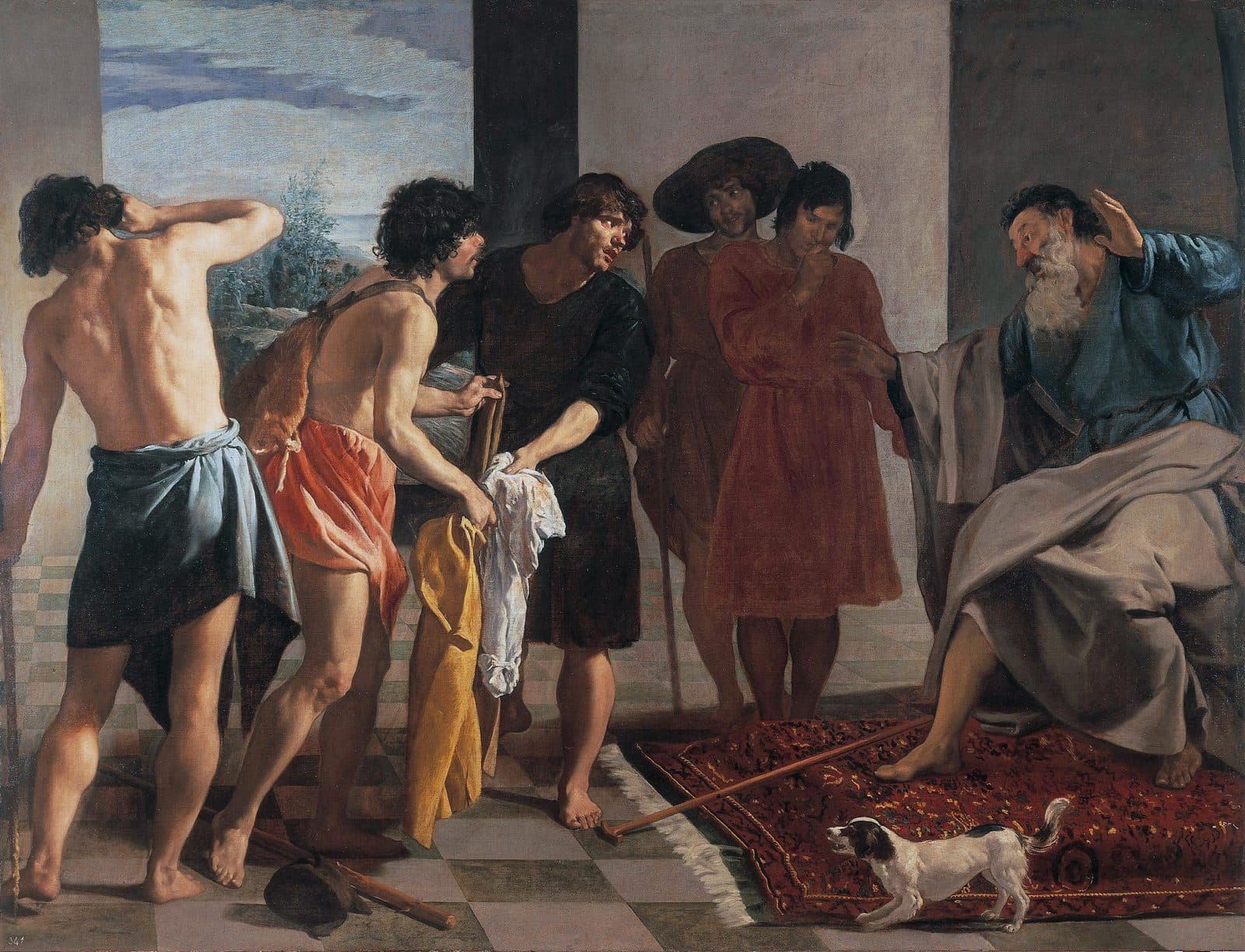
Diego Velázquez, Joseph's Bloody Coat Brought to Jacob, 1630, Monasterio de El Escorial. Public domain by date (painted before 1930), via Wikimedia Commons, File:Diego_Velázquez_065.jpg.
THE ARTWORKVelázquez painted the moment of Genesis 37:32, the brothers holding out the robe while their father draws back, with his staff fallen on the carpet at his feet.
God gave Jacob the name Israel, and his twelve sons became the twelve tribes that carry it.
Summary
Jacob, the son of Isaac and Rebekah and the younger twin of Esau, bought his brother's birthright, took his father's blessing by deceit, and served his uncle Laban twenty years before returning to Canaan.
- On the night before he met Esau he wrestled with a man at the ford of the Jabbok until daybreak.
- He mourned Joseph as dead for about twenty-two years before he learned that his son ruled in Egypt.
- He died in Egypt at 147, and his sons buried him in the cave at Machpelah with Abraham and Isaac.
Where Jacob Stands in Scripture
His birth in Genesis, his faith in Hebrews and the prophets' words of him
Genesis names him at his birth, the second of the twins born to Isaac and Rebekah.
After this, his brother came out grasping Esau’s heel; so he was named Jacob. And Isaac was sixty years old when the twins were born.The birth answers the oracle Rebekah received in Genesis 25:23 about the older and the younger.
Hebrews sets him among the people of faith in its eleventh chapter.
By faith Jacob, when he was dying, blessed each of Joseph’s sons and worshiped as he leaned on the top of his staff.Of all his life, Hebrews chooses the blessing he gave as he was dying.
The Life, Turn by Turn
Each turn with the place where it happened or the time Genesis gives for it
- Born holding Esau's heelIsaac aged sixtyGenesis 25:26
- Buys the birthright for bread and stewafter the boys grew upGenesis 25:33
- Takes the blessing meant for EsauIsaac's tent, in Isaac's old ageGenesis 27:19
- Dreams of the ladderBethel, on the road from BeershebaGenesis 28:12
- Marries Leah, then RachelHaranGenesis 29:28
- Leaves Laban after twenty yearstoward the hill country of GileadGenesis 31:21
- Meets the camp of GodMahanaimGenesis 32:2
- Wrestles until daybreak and is named IsraelPeniel, at the ford of the JabbokGenesis 32:30
- Meets Esau againon the way to SuccothGenesis 33:4
- Buys a plot of ground and builds an altarShechemGenesis 33:19
- Hears God confirm the name IsraelBethelGenesis 35:10
- Buries Rachel after Benjamin's birthon the way to EphrathGenesis 35:19
- Buries Isaac with EsauMamre, near HebronGenesis 35:29
- Mourns Joseph as deadthe Valley of HebronGenesis 37:34
- Goes down to Egyptfrom BeershebaGenesis 46:3
- Blesses PharaohEgypt, age 130Genesis 47:10
- Crosses his hands over Joseph's sonsEgyptGenesis 48:14
- DiesEgypt, age 147Genesis 49:33
- Is carried home by his sonsCanaan, near MamreGenesis 50:13
The timeline draws nineteen turns of the life.
From Beersheba to Machpelah
Genesis 25:19 to 50:13
Jacob was born after twenty years of his parents' marriage and grew up in his father's household beside his twin.
He left for his mother's family in Haran under his brother's threat, and he came home with two wives, two maidservants, eleven sons, a daughter and large flocks.
In Canaan he lived through the attack on his daughter at Shechem, the death of Rachel and the loss of Joseph, whom he believed a wild animal had killed.
When the famine came his sons went down to Egypt to buy grain, and in the end he followed them there with all his household.
The twins and the birthrightGenesis 25:21 to 34
When the boys grew up, Esau became a skillful hunter, a man of the field, while Jacob was a quiet man who stayed at home. Because Isaac had a taste for wild game, he loved Esau; but Rebekah loved Jacob.The parents' divided love stands on the record before the birthright or the blessing changes hands.
Esau came in from the field famished and asked for the red stew, and Jacob asked for the birthright in exchange.
The blessing taken from IsaacGenesis 27:5 to 29
Rebekah overheard Isaac send Esau out for game and told Jacob to bring two choice young goats so that she could make the dish herself.
What if my father touches me? Then I would be revealed to him as a deceiver, and I would bring upon myself a curse rather than a blessing.”Jacob's objection to his mother's plan is the risk of being found out and cursed.
Jacob said to his father, “I am Esau, your firstborn. I have done as you told me. Please sit up and eat some of my game, so that you may bless me.”He gives his father his brother's name and his brother's rank in one sentence.
Bethel and the years in HaranGenesis 28 to 31
On the first night of the flight God met him in a dream at Bethel and promised to bring him back to the land.
So Jacob served seven years for Rachel, yet it seemed but a few days because of his love for her.These seven years are the first of the three terms he served Laban.
Laban gave him Leah on the wedding night, and Jacob served seven more years for Rachel and six for the flocks.
Then the LORD said to Jacob, “Go back to the land of your fathers and to your kindred, and I will be with you.”God sends him home with the promise of His presence that He first gave at Bethel.
The night at the Jabbok and Esau's welcomeGenesis 32 and 33
Then Jacob declared, “O God of my father Abraham, God of my father Isaac, the LORD who told me, ‘Go back to your country and to your kindred, and I will make you prosper,’ I am unworthy of all the kindness and faithfulness You have shown Your servant. Indeed, with only my staff I came across the Jordan, but now I have become two camps.His prayer before the meeting pleads God's own command to return and admits that he is unworthy.
That night he sent his wives, his children and all he owned across the Jabbok and stayed behind alone.
The sun rose above him as he passed by Penuel, and he was limping because of his hip.He goes on toward his brother lamed by the night's struggle.
Esau, however, ran to him and embraced him, threw his arms around his neck, and kissed him. And they both wept.The meeting he had prepared for with gifts and prayer ends in tears.
Rashi, the eleventh-century commentator of Troyes, notes that the Hebrew word for the kiss is written with dots above its letters. He reports that some read the dots to mean that Esau did not kiss Jacob with his whole heart. Rabbi Simeon son of Yohai held that Esau's pity was roused and he kissed Jacob with his whole heart.
Jacob's words to Esau in Genesis 33:10 echo the name he gave Peniel the night before, where he said he had seen God face to face.
“It is a very high compliment that he passes upon him: I have seen thy face, as though I had seen the face of God, that is, ‘I have seen thee reconciled to me, and at peace with me, as I desire to see God reconciled.’ Or the meaning is that Jacob saw God's favour to him in Esau's: it was a token for good to him that God had accepted his prayers.”
Matthew Henry · Commentary on the Whole Bible · on Genesis 33:10 to 11Puritan
Shechem, Bethel and Rachel's deathGenesis 33:18 to 35:29
And the plot of ground where he pitched his tent, he purchased from the sons of Hamor, Shechem’s father, for a hundred pieces of silver. There he set up an altar and called it El-Elohe-Israel.His altar's name, El-Elohe-Israel, carries the name he received at Peniel.
After his sons Simeon and Levi killed the men of Shechem for the rape of their sister Dinah, God sent Jacob back to Bethel.
So Jacob told his household and all who were with him, “Get rid of the foreign gods that are among you. Purify yourselves and change your garments.Before he goes up to Bethel he has his household give up the gods they had carried from Haran.
And God said to him, “Though your name is Jacob, you will no longer be called Jacob. Instead, your name will be Israel.” So God named him Israel.God Himself confirms the name the man at the Jabbok had given.
On the road from Bethel Rachel died giving birth to Benjamin, and later Jacob and Esau buried their father Isaac.
Joseph lost and foundGenesis 37; 42 to 45
Then Jacob tore his clothes, put sackcloth around his waist, and mourned for his son many days. All his sons and daughters tried to comfort him, but he refused to be comforted. “No,” he said. “I will go down to Sheol mourning for my son.” So his father wept for him.The sons who deceived him with the robe are among the comforters he refuses.
Their father Jacob said to them, “You have deprived me of my sons. Joseph is gone and Simeon is no more. Now you want to take Benjamin. Everything is going against me!”The losses he counts here are the road by which God would keep his family alive in the famine.
However, when they relayed all that Joseph had told them, and when he saw the wagons that Joseph had sent to carry him back, the spirit of their father Jacob was revived. “Enough!” declared Israel. “My son Joseph is still alive! I will go to see him before I die.”The narrator gives him the name Israel at the moment his hope returns.
Egypt and the last blessingsGenesis 46 to 50
“I am God,” He said, “the God of your father. Do not be afraid to go down to Egypt, for I will make you into a great nation there. I will go down with you to Egypt, and I will surely bring you back. And Joseph’s own hands will close your eyes.”This is the last time God speaks to him in Genesis, and He promises to go down with him and bring him back.
“My travels have lasted 130 years,” Jacob replied. “My years have been few and hard, and they have not matched the years of the travels of my fathers.”Abraham lived 175 years and Isaac 180, so at 130 Jacob counts his own years short.
Rashi reads the word for his travels as the days of being a stranger, since all his days he had lived in other people's lands.
He blessed his twelve sons, charged them to bury him with his fathers, and died, and his sons carried him to Canaan as he had charged them.
“He would be buried in Canaan, not because Canaan was the land of his nativity, but in faith, because it was the land of promise, which he desired thus, as it were to keep possession of 'till the time should come when his posterity should be masters of it: and because it was a type of heaven, that better country, which he was in expectation of.”
John Wesley · Explanatory Notes upon the Old Testament · on Genesis 47:29Evangelical
From the Birthright to Succoth
Six records from Genesis 25 to 33
A SALE UNDER OATH
Esau swore to the sale of the birthright before he ate, and Genesis says that Esau despised it.
TWO GOODS TAKEN ON TWO OCCASIONS
Esau names the birthright and the blessing as two separate things Jacob took from him.
THE LORD'S NAME IN THE LIE
Asked how he found the game so quickly, Jacob answered that the LORD his father's God had brought it to him.
HARD SERVICE FOR LABAN
Jacob bore the loss of every animal torn by wild beasts, and Laban made him pay for what was stolen by day or night.
HE LEFT LABAN IN SECRET
Jacob deceived Laban the Aramean by not telling him that he was running away.
HE WENT TO SUCCOTH
Jacob told Esau he would follow him slowly to Seir, and after Esau left he went on to Succoth.
The World Behind the Story
The birthright and the blessing, the Aramean family, the household idols and Jacob's well
The birthright and the blessing
The Hebrew words are close in sound: bekorah is the birthright and berakah the blessing. Esau joins the two words in his cry of Genesis 27:36.
Instead, he must acknowledge the firstborn, the son of his unloved wife, by giving him a double portion of all that he has. For that son is the firstfruits of his father’s strength; the right of the firstborn belongs to him.The birthright Esau sold is defined in law only later, under Moses.
Adam Clarke lists four rights of the firstborn, among them authority over the family, the father's particular blessing and, before Aaron, the priesthood. John Wesley notes that Esau never asked his father to undo the bargain and confirmed it by his neglect.
Laban and the Aramean family
Rebekah was the sister of Laban the Aramean of Paddan-aram, and Isaac sent Jacob there to take a wife from his mother's family.
and you are to declare before the LORD your God, “My father was a wandering Aramean, and he went down to Egypt few in number and lived there and became a great nation, mighty and numerous.Israel's confession at the offering of firstfruits remembers its father as a wandering Aramean who went down to Egypt.
The household idols
Rachel stole her father's household idols, the teraphim, when the family fled, and hid them in her camel's saddlebag while Laban searched the tent. At Shechem Jacob buried the foreign gods of his household under the oak.
Jacob's well at Sychar
So He came to a town of Samaria called Sychar, near the plot of ground that Jacob had given to his son Joseph. Since Jacob’s well was there, Jesus, weary from His journey, sat down by the well. It was about the sixth hour.John sets the meeting with the Samaritan woman beside the ground Jacob gave to Joseph.
The woman at the well calls him our father Jacob, and Cyril of Alexandria gives two reasons for the claim.
“The Samaritans then were aliens (for they were colonists of the Babylonians), but they call Jacob their father for two reasons. For as inhabiting a country bordering on, and the neighbour of the Jews' land, they were taking a little impression themselves of their worship, and were accustomed to boast of the Jews' ancestors. Besides, it was really true that the greater number of the inhabitants of Samaria were sprung from the root of Jacob.”
Cyril of Alexandria · Commentary on the Gospel of John, Book 2 · on John 4:12Patristic
The Family of Jacob
Twelve sons and a daughter, by Leah, Rachel, Bilhah and Zilpah
The Places of His Life
Nine places, from Genesis 28:10 to 50:13
From Beersheba to Haran and back, and at last to Egypt and the cave at Machpelah.
- Located: the site is known
- The route, in the order the text gives
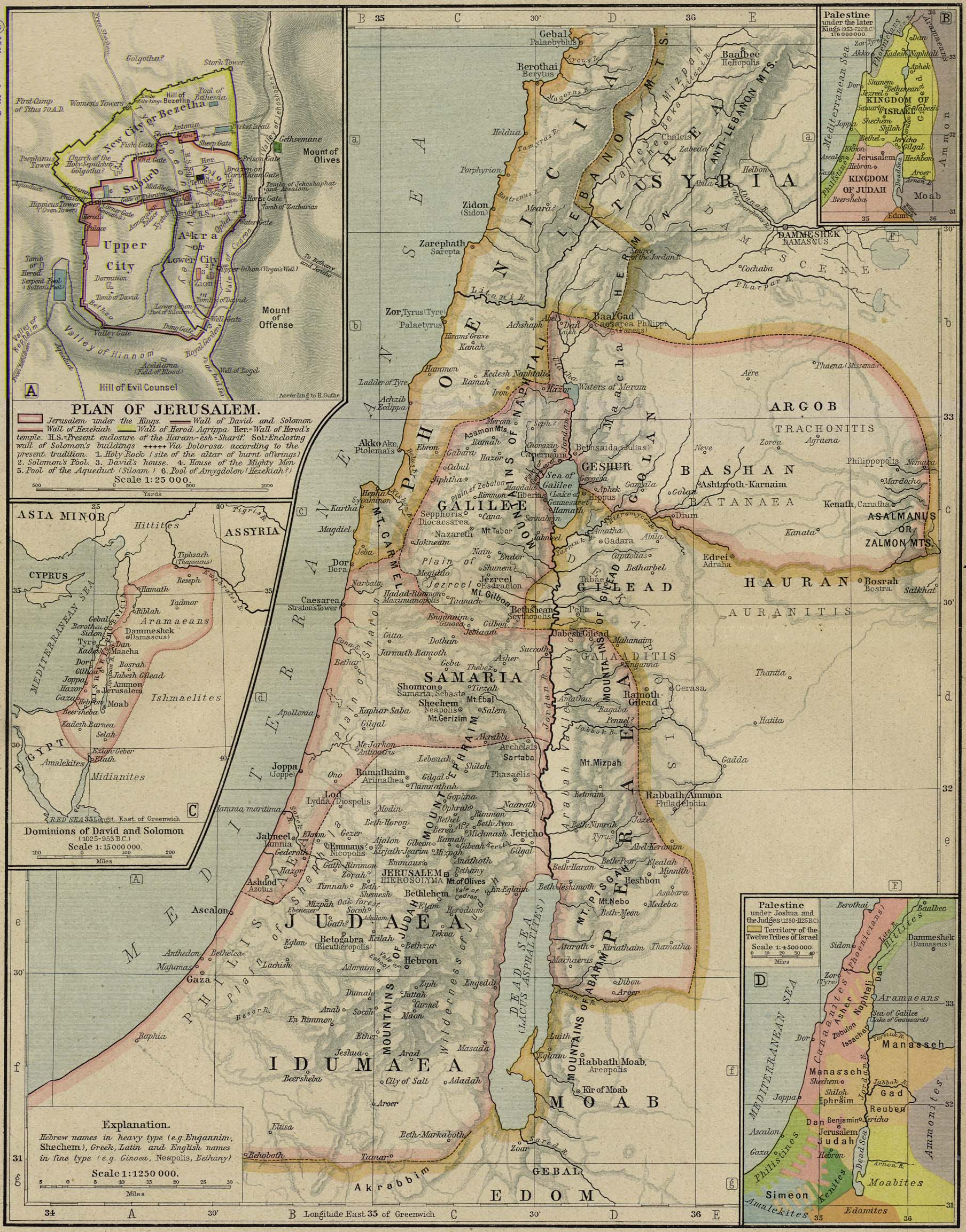
- 1Beersheba, He left Beersheba and set out for Haran. Genesis 28:10
- 2Bethel, He set up his stone pillar and poured oil on it. Genesis 28:19
- 3Haran, He met Rachel at the well and worked for her father. Genesis 29:10
- 4Peniel, He named the place for seeing God face to face. Genesis 32:30
- 5Shechem, He camped outside the city on his return from Paddan-aram. Genesis 33:18
- 6Bethlehem, Benjamin was born on the road near Ephrath. Genesis 35:18
- 7Hebron, He came back to Isaac at Mamre, where Abraham and Isaac had stayed. Genesis 35:27
- 8Goshen, His family acquired property there and increased greatly. Genesis 47:27
- 9Machpelah, Abraham bought the field from Ephron the Hittite as a burial site. Genesis 50:13
Base map: Reference map of ancient Palestine, Rand McNally reference map (1926), public domain. Each place stands at its place page's coordinates, set on the plate by Jerusalem and Damascus, as the plate prints them.
He built altars at Shechem and at Bethel on his way back.
Questions the Life Raises
Four questions answered from their verses
What does the name Jacob mean?Genesis 25:26
The Hebrew name is Yaaqob and the word for heel is aqeb, and the two words share the same three consonants.
Does Genesis stop calling him Jacob after he is named Israel?Genesis 35:10; 46:2
And that night God spoke to Israel in a vision: “Jacob, Jacob!” He said. “Here I am,” replied Jacob.In one verse the narrator calls him Israel and God calls him Jacob twice.
Genesis goes on using both names until its last chapter, and the two often stand in the same passage.
How long did he mourn Joseph before he learned he was alive?Genesis 37:2; 41:46; 41:53; 45:6
Genesis gives no single number. Joseph was seventeen when he was sold and thirty when he entered Pharaoh's service. Seven years of plenty followed, and the famine had run two years when he made himself known. Thirteen, seven and two make about twenty-two years.
Why was Joseph buried at Shechem?Genesis 48:22; 50:25; Joshua 24:32; Acts 7:16
Joseph made his brothers swear to carry his bones up from Egypt, and Jacob had already told him, as one who is above his brothers, that he gave him the ridge of land.
“These lands he settled upon Joseph; mention is made of this grant, John iv. Pursuant to it, this parcel of ground was given to the tribe of Ephraim as their right, and the lot was never cast upon it; and in it Joseph's bones were buried, which perhaps Jacob had an eye to as much as to any thing in this settlement.”
Matthew Henry · Commentary on the Whole Bible · on Genesis 48:22Puritan
Their bones were carried back to Shechem and placed in the tomb that Abraham had bought from the sons of Hamor at Shechem for a price he paid in silver.Stephen's speech gives the purchase at Shechem to Abraham, where Joshua 24:32 gives it to Jacob.
What the Text Leaves Unsaid
His conscience over the deceit, Dinah's voice and Rebekah's death
Genesis records no confession by Jacob of the deceit of his father and no word from God rebuking it. What it records is Laban giving him the older daughter in place of the younger, and his own sons deceiving him with Joseph's robe dipped in a young goat's blood.
Genesis gives no word spoken by Dinah, and her chapter ends with her brothers' question to their father.
Rebekah sent Jacob away for a while, until his brother's fury passed, and she does not appear in the story again. Genesis records the death of her nurse Deborah near Bethel and names Rebekah's burial only in Jacob's last charge to his sons.
The God of Jacob
Six New Testament texts that name him, and three blessings in his story
THE GENEALOGY OF JESUS
Isaac was the father of Jacob, and Jacob the father of Judah and his brothers.
THE BANQUET OF THE KINGDOM
Many will come from the east and the west to share the banquet with Abraham, Isaac, and Jacob.
THE GOD OF THE LIVING
Jesus answers the Sadducees with the God of Abraham, the God of Isaac, and the God of Jacob.
THE HOUSE OF JACOB
Gabriel tells Mary that her Son will reign over the house of Jacob forever.
A DWELLING FOR THE GOD OF JACOB
Stephen recalls that David asked to provide a dwelling place for the God of Jacob.
GODLESSNESS REMOVED FROM JACOB
Paul writes that the Deliverer will come from Zion and remove godlessness from Jacob.
The blessing and the promised offspringGenesis 27:29; 28:14
The blessing Jacob took ends with the words God spoke to Abraham in Genesis 12:3 about those who bless and those who curse. At Bethel God tells Jacob that all the families of the earth will be blessed through him and his offspring.
“It must amount to an entail of the promise of the Messiah, and of the church; this was, in the patriarchal dialect, the blessing: something spiritual, doubtless, is included in it. First, That from him should come the Messiah, who should have a sovereign dominion on earth. It was that top-branch of his family which people should serve and nations bow down to.”
Matthew Henry · Commentary on the Whole Bible · on Genesis 27:29Puritan
The scepter promised to JudahGenesis 49:10
The scepter will not depart from Judah, nor the staff from between his feet, until Shiloh comes and the allegiance of the nations is his.His last words over Judah promise a ruler from that tribe until Shiloh comes.
The crossed handsGenesis 48:14; Hebrews 11:21
The crossed hands of Genesis 48:14 were read in the eighth century as a figure of the cross.
“The tree of life that was planted by God in paradise prefigured this honorable cross, for, since death came by a tree, it was necessary for life and the resurrection to be bestowed by a tree. It was Jacob who first prefigured the cross, when he adored the top of the rod of Joseph. And when he blessed Joseph's sons with his hands crossed, he most clearly described the sign of the cross.”
John Damascene · Orthodox Faith 4.11 · on Hebrews 11:21Patristic
Voices on Jacob
Five passages, from the third century to the eighteenth
Ambrose warns parents against loving one child and esteeming another less. Henry finds fear and faith together in Jacob before the meeting with Esau.
“But we shouldn't leave his parents without excuse for having preferred their younger son to the elder. At the same time we must take care so that no one, in turning to their example, would make an unfair judgment between his sons or suppose that he should love the one and esteem the other less. From this line of conduct fraternal hatreds are aroused and the crime of fratricide is contrived to gain a worthless sum of money. Let children be nurtured with an equal measure of devotion.”
Ambrose of Milan · On Jacob and the Blessed Life, Book 2, Chapter 2, Sections 5-6 · on Genesis 27:41Patristic
“Jacob, though a man of great faith, yet was now greatly afraid. Note, A lively apprehension of danger, and a quickening fear arising from it, may very well consist with a humble confidence in God's power and promise. Christ himself, in his agony, was sorely amazed.”
Matthew Henry · Commentary on the Whole Bible · on Genesis 32:7Puritan
Three more passagesMatthew Henry, John Wesley, Origen of Alexandria
Henry draws Hosea's lesson for Jacob's descendants. Wesley counts the seventeen years in Egypt against the seventeen years Joseph lived at home. Origen reads the names Jacob and Israel as names of Christ, who supplanted the adversary.
“Jacob was poor, and low, and a fugitive; therefore his posterity ought not to be proud. He was a plain man, dwelling in tents, and keeping sheep; therefore balances of deceit ill became them. He served for a wife that was not a Canaanitess, as Esau's wives were; therefore it was a shame for them to degenerate into Canaanites, and mingle with the nations.”
Matthew Henry · Commentary on the Whole Bible · on Hosea 12:3Puritan
“Jacob lived seventeen years after he came into Egypt, far beyond his own expectation: seventeen years he had nourished Joseph, for so old he was when he was sold from him, and now, seventeen years Joseph nourished him.”
John Wesley · Explanatory Notes upon the Old Testament · on Genesis 47:28Evangelical
“In addition, because [Christ] supplanted the activity of the adversary and because he alone sees the Father, he is ‘Jacob’ and ‘Israel’ when he has become man. As we become light because he is the light of the world, so we become Jacob because he is called ‘Jacob’ and Israel because he is named ‘Israel.’”
Origen of Alexandria · Commentary on the Gospel of John 1.260 · on Genesis 25:26Patristic
Jacob and Esau in Romans 9 and Malachi 1
Whether Malachi and Paul speak of two men or of two nations
“I have loved you,” says the LORD. But you ask, “How have You loved us?” “Was not Esau Jacob’s brother?” declares the LORD. “Yet Jacob I have loved, but Esau I have hated, and I have made his mountains a wasteland and left his inheritance to the desert jackals.”Malachi answers Israel's doubt of the LORD's love with the ruin of Edom's land.
Yet before the twins were born or had done anything good or bad, in order that God’s plan of election might stand, not by works but by Him who calls, she was told, “The older will serve the younger.” So it is written: “Jacob I loved, but Esau I hated.”Paul quotes Malachi in his argument on who belongs to the line of promise.
Two persons, chosen before birthJohn Calvin; Theophylact of Ohrid
Calvin, in his Commentary on Romans at 9:13, reads the rule of Jacob and the servitude of Esau as a sign of the spiritual condition of each. He holds that Jacob received the favor by the kindness of God apart from any merit of his own.
“One was chosen and loved, and the other hated, so that everything might be the work of God and of His election and foreknowledge, and not from works, but from Him who calls.”
Theophylact of Ohrid · Commentary on Romans · on Romans 9:12Patristic
The objection to this reading is that Malachi 1:3 speaks of Esau's mountains and inheritance, the land of a people.
Two peoples, chosen for a place in historyJohn Wesley; Albert Barnes; Matthew Henry
Wesley, in his Explanatory Notes upon the New Testament at Romans 9:13, says the words do not concern the eternal state of either brother or of their descendants. Barnes, in his Notes on Romans 9:13, reads Jacob there as the posterity of Jacob. The covenant reading takes the love of Malachi 1:2 as the gift of the covenant to Jacob and his line.
“Esau was Jacob's brother, his twin-brother: ‘ Yet I loved Jacob and I hated Esau, that is, took Jacob into covenant, and entailed the blessing on him and his, but refused and rejected Esau.’ Note, Those that are taken into covenant with God, that have the lively oracles and the means of grace committed to them, have reason to look upon these as tokens of his love.”
Matthew Henry · Commentary on the Whole Bible · on Malachi 1:2Puritan
The objection to this reading is that Paul goes on to speak of God's mercy and hardening toward one man, Pharaoh, in Romans 9:17 to 18.
Books to Read Next
Five books, from the eleventh century to the twentieth
Commentary on Genesis
Rashi · the eleventh century
Rashi comments on the words of Genesis verse by verse and cites the earlier sages, as in his note on Genesis 33:4.
READ IT FREE AT SEFARIA →Commentaries on the First Book of Moses Called Genesis
John Calvin · 1554
Calvin's second volume covers Genesis 24 to 50.
READ IT FREE AT CCEL →Commentary on the Whole Bible
Matthew Henry · 1706
Henry's first volume covers Genesis to Deuteronomy.
READ IT FREE AT CCEL →Genesis
Nahum M. Sarna · 1989
Sarna's volume sets the traditional Hebrew text of Genesis beside the new JPS translation.
In print: find it wherever books are sold.
Genesis 16 to 50
Gordon J. Wenham · 1994
Wenham's commentary on Genesis 16 to 50 holds the whole of Jacob's life.
In print: find it wherever books are sold.
The Shepherd of His Whole Life
At the end of his life Jacob called God the shepherd who had kept him all his days and the angel who had redeemed him from all harm.
Psalm 46:7 calls the God of Jacob our fortress. The life asks the reader to trust that God as Jacob learned to, through Jesus Christ, who was born of his line through Judah.
Keep studying
Studies8
Places11
Symbols2
Doctrines5
Peoples and groups1