
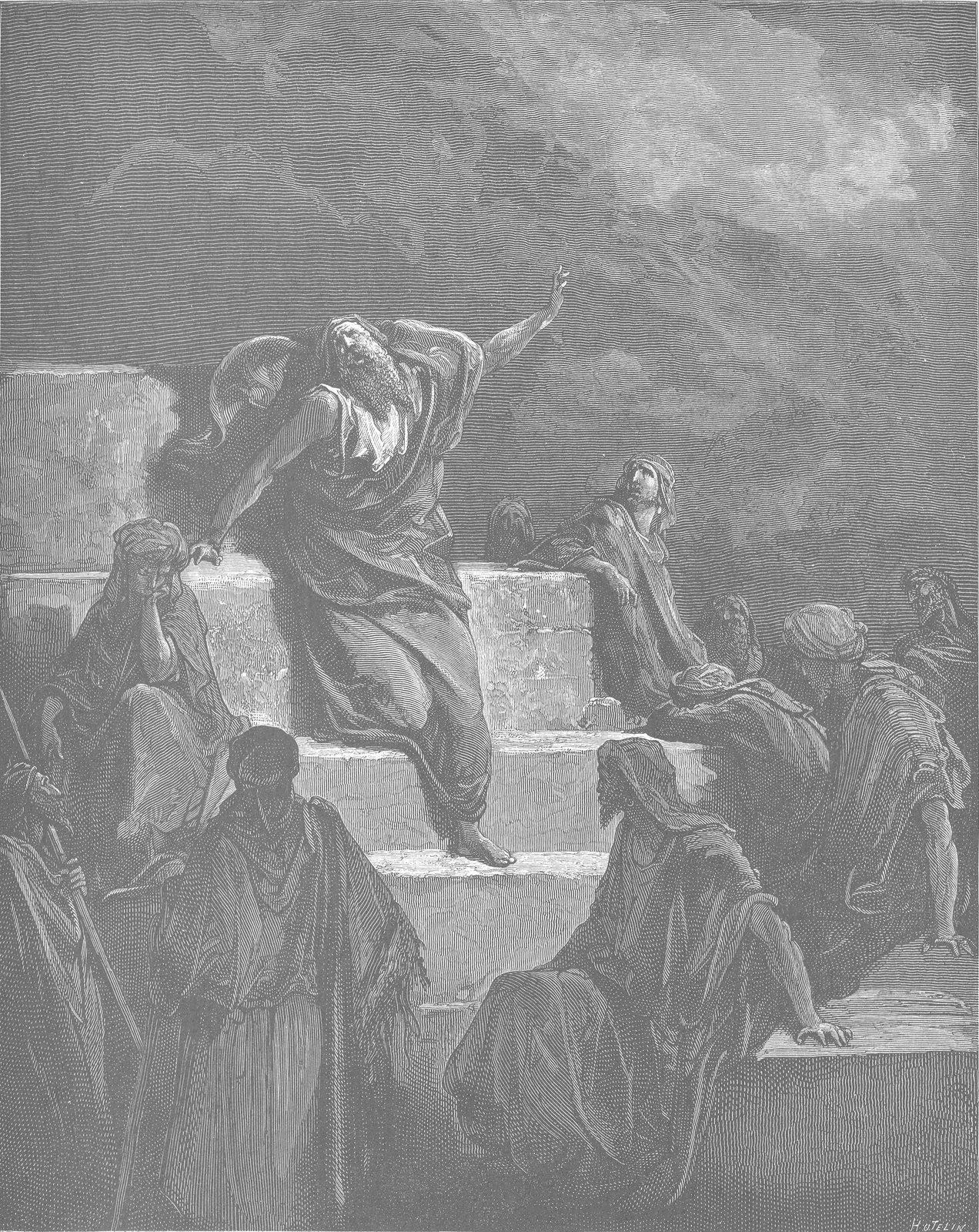
Gustave Doré, The Prophet Jeremiah, 1866. Public domain.
Lamentations 5:22 · Subject · Featured Study
The Last Verse of Lamentations
The closing verse of the book is rendered as a condition, a statement, a question or a denial.
When Lamentations is read aloud in the synagogue, its last verse is followed by the verse before it.
unless You have utterly rejected us and remain angry with us beyond measure.
- Books
- Lamentations, Genesis, Jeremiah
- Hold in memory
- Lamentations 5:21
Summary
The last verse of Lamentations opens with two small Hebrew words. Their reading decides whether the book ends in hope or in loss.
- The BSB and six older commentaries read them as unless.
- Three older Bibles read a plain statement.
- One scholar reads them as even though.
The Prayer That Ends the Book
Lamentations 5:19 to 21 praise the LORD, ask why, and plead before the last line.
You, O LORD, reign forever; Your throne endures from generation to generation.Why have You forgotten us forever? Why have You forsaken us for so long?Restore us to Yourself, O LORD, so we may return; renew our days as of old,Five Older Renderings
Each edition prints its own words for the close of the book.
Five older renderings of Lamentations 5:22 read its opening words three ways.
| Edition | Its words | How it reads |
|---|---|---|
| The Septuagint, the old Greek translation, in Brenton's English | “For thou hast indeed rejected us; thou hast been very wroth against us.” | A statement |
| The Vulgate, the Latin Bible of the Western church, in the Douay-Rheims English | “But thou hast utterly rejected us, thou art exceedingly angry against us.” | A statement |
| The American Standard Version, as the King James | “But thou hast utterly rejected us; Thou art very wroth against us.” | A statement |
| Keil and Delitzsch, their own translation | “Or, hast Thou indeed utterly rejected us? art thou very wroth against us?” | A question |
| The Jewish Publication Society, 1917 | “Thou canst not have utterly rejected us, and be exceeding wroth against us!” | A denial |
Four Readings of the Close
Each reading changes how the book ends.
Unless: a fear named and set asideThe BSB; the Cambridge Bible; Ellicott; the Pulpit Commentary; Barnes' Notes; Jamieson, Fausset and Brown
The Cambridge Bible calls the sentence an hypothesis not to be accepted as fact. Ellicott reads it as said of the impossible: God has not rejected His people, and so He will renew them.
Barnes' Notes calls the very supposition an indirect expression of hope. On this reading the book ends on a plea that still expects an answer.
A statement of rejectionBrenton's Septuagint; the Douay-Rheims; the American Standard Version; Adam Clarke
Adam Clarke, reading the King James wording, wrote that it seemed as if God had sealed their final reprobation, their rejection for good. He added that God heard the prayer and restored them after seventy years.
Read this way, the close stands in the depth of the loss, with the plea of Lamentations 5:21 against it.
A questionKeil and Delitzsch, in their translation
Keil and Delitzsch print the verse as a question. In their note they explain it as unless, a case stated only as a possibility.
Even thoughRobert Gordis, Journal of Biblical Literature, 1974
The United Bible Societies' Handbook on Lamentations reports that Robert Gordis read the words as even though. On his reading the verse finishes the plea of Lamentations 5:21: renew our days, even though You were very angry.
The Plea Read Again
Rashi and the manuscripts record the custom.
The Jewish commentator Rashi gives the reason: the book closes on words of reproof. He names Isaiah, the Twelve Prophets and Ecclesiastes as books that close the same way.
Keil and Delitzsch and Ellicott report that many Hebrew manuscripts write Lamentations 5:21 a second time at the end. Keil and Delitzsch add that the last verse, rightly understood, did not require it.
“As they go forth, they will see the corpses of the men who have rebelled against Me; for their worm will never die, their fire will never be quenched, and they will be a horror to all mankind.”And he will turn the hearts of the fathers to their children, and the hearts of the children to their fathers. Otherwise, I will come and strike the land with a curse.”Two Small Words
Genesis 32 uses the pair ki im in two senses.
Strong's lexicon, a numbered list of the Bible's words, calls ki and im very widely used. In Genesis 32:26 the pair means unless, and in Genesis 32:28 it means but.
Then the man said, “Let me go, for it is daybreak.” But Jacob replied, “I will not let you go unless you bless me.”Then the man said, “Your name will no longer be Jacob, but Israel, because you have struggled with God and with men, and you have prevailed.”The verb that follows is doubled, ma'os me'astanu, rejecting You have rejected us. Jeremiah 14:19 doubles the same verb, ma'as, in a question.
Have You rejected Judah completely? Do You despise Zion? Why have You stricken us so that we are beyond healing? We hoped for peace, but no good has come, and for the time of healing, but there was only terror.What the Book Leaves Open
The book ends on the prayer and records no reply.
The book does not say whether the people were restored.
Restore Us, and We Will Return
Lamentations 5:21 echoes Ephraim's prayer in Jeremiah.
It asks the LORD to bring His people back, hashivenu, so that they may return, venashuvah. Jeremiah 31:18 has both verbs in the singular.
I have surely heard Ephraim’s moaning: ‘You disciplined me severely, like an untrained calf. Restore me, that I may return, for You are the LORD my God.Voices on the Close
Matthew Henry and Jamieson, Fausset and Brown wrote on the closing prayer.
Matthew Henry (1662 to 1714)
“For converting grace to prepare and qualify them for mercy: Turn us to thee, O Lord! They had complained that God had forsaken and forgotten them, and then their prayer is not, Turn thou to us, but, Turn us to thee, which implies an acknowledgment that the cause of the distance was in themselves.”
Matthew Henry · Commentary on the Whole Bible · on Lamentations 5:22Puritan
Jamieson, Fausset & Brown (1802 to 1910)
“The perpetuity of God's rule over human affairs, however He may seem to let His people be oppressed for a time, is their ground of hope of restoration.”
Jamieson, Fausset & Brown · Commentary Critical and Explanatory on the Whole Bible · on Lamentations 5:19Reformed
The Readings Weighed
Each reading meets an objection in the sources.
The objection to unless1 paragraph
Three of the five older renderings in the table print no condition.
The objection to the statement1 paragraph
Ellicott, the Cambridge Bible and the Pulpit Commentary each correct but to unless. The Pulpit Commentary does so because the poet found rejection at odds with the covenant.
The objection to the question1 paragraph
No other rendering in the table reads a question.
The objection to even though1 paragraph
The Handbook replies that wherever else ki im means even though, that clause comes before the main clause.
Books to Read Next
Two older commentaries read Lamentations 5 verse by verse.
Biblical Commentary on the Old Testament: Lamentations
Carl Friedrich Keil and Franz Delitzsch · 1857 to 1878
It reads each verse of Lamentations from the Hebrew.
Read it free at BibleHubCommentary Critical and Explanatory on the Whole Bible
Robert Jamieson, A. R. Fausset and David Brown · 1871
It follows John Calvin on the closing prayer.
Read it free at BibleHubFaint, Yet Pursuing
The Pulpit Commentary says the book closes on a hope, faint yet pursuing.
Barnes' Notes sets the fear of the last verse beside Psalm 30:5.
For His anger is fleeting, but His favor lasts a lifetime. Weeping may stay the night, but joy comes in the morning.Sources
Scripture is the Berean Standard Bible.
- The American Standard Version (1901), Lamentations 5:22.
- The Hebrew text of Lamentations 5:21 to 22, Genesis 32:26 and 28, Jeremiah 14:19 and 31:18, word by word, with Strong's numbers.
- Strong's lexicon entries h3988, h3588 and h518, STEP Bible TBESH (Tyndale House, CC BY 4.0)
- The Septuagint in English, Sir Lancelot C. L. Brenton, Lamentations 5:22.
- The Douay-Rheims Bible, Lamentations 5:22, with the Latin Vulgate.
- The Holy Scriptures according to the Masoretic Text, Jewish Publication Society, 1917, Lamentations 5:22.
- Carl Friedrich Keil and Franz Delitzsch, Biblical Commentary on the Old Testament (1857 to 1878), on Lamentations 5:21 to 22; public domain.
- The Cambridge Bible for Schools and Colleges, on Lamentations 5:22; public domain.
- The Pulpit Commentary, on Lamentations 5:22; public domain.
- Ellicott's Commentary for English Readers, on Lamentations 5:22; public domain.
- Barnes' Notes on the Old Testament, on Lamentations 5:22.
- Adam Clarke, Commentary on the Bible (1832), on Lamentations 5:22.
- Rashi on Lamentations 5:22, in The Metsudah Five Megillot (Lakewood, N.J., 2001), cite-only.
- William D. Reyburn, A Handbook on Lamentations (United Bible Societies, 1992), on Lamentations 5:22, reporting Robert Gordis, Journal of Biblical Literature 93 (1974); cite-only.
- Matthew Henry, Commentary on the Whole Bible (1710), on Lamentations 5:21 to 22.
- Jamieson, Fausset and Brown, Commentary Critical and Explanatory on the Whole Bible (1871), on Lamentations 5:19 and 5:22.
- Jamieson, Fausset and Brown, Commentary Critical and Explanatory on the Whole Bible (1871), on Lamentations 5:21.
Keep Studying
Read it4
Studies5
People and groups3
Places1
Doctrines1
Symbols1
Subjects1