
Deuteronomy 11 · Subject · Featured Study
The early and the latter rain
Moses promised Israel two rains a year in their season, one in autumn and one in spring.
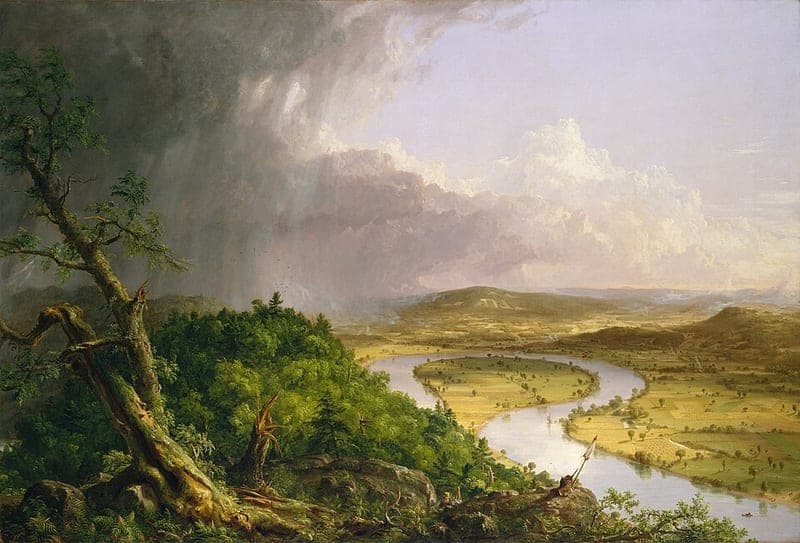
Thomas Cole, View from Mount Holyoke, Northampton, Massachusetts, after a Thunderstorm (The Oxbow), 1836, The Metropolitan Museum of Art. Public domain (PD-old-100-expired; PD-Art), via Wikimedia Commons, file Cole_Thomas_The_Oxbow_(The_Connecticut_River_near_Northampton_1836).jpg.
THE ARTWORKCole painted rain falling from a storm cloud over the hill on the left while clearing sky lights the fields along the river on the right. The view is of the Connecticut River valley in New England, and it stands here for farmland that lives by the rain from the sky.
In Canaan no river watered the fields, so every harvest waited on rain from the sky.
Summary
Deuteronomy 11 makes the yoreh and the malqosh a covenant promise, given while Israel loves and serves the LORD.
- The autumn rain softened the ground for ploughing and sowing, and the spring rain filled the grain before harvest.
- The same chapter warns that the LORD will shut the heavens if Israel turns aside to other gods.
- Elijah shut the heavens by his word in Ahab's reign and saw them opened after his prayer on Carmel.
- The prophets made the two rains a picture of the LORD coming to His people, and Joel set the outpouring of the Spirit after them.
- James points the church to the farmer who waits for both rains as it waits for the Lord's coming.
A Land That Drinks the Rain
Moses sets the promise of rain beside the warning of drought
Moses spoke these words in the land of Moab, before Israel crossed the Jordan.
For the land that you are entering to possess is not like the land of Egypt, from which you have come, where you sowed your seed and irrigated on foot, like a vegetable garden. But the land that you are crossing the Jordan to possess is a land of mountains and valleys that drinks in the rain from heaven.The contrast explains why the next verses tie the rain to obedience.
The promise comes two verses later.
So if you carefully obey the commandments I am giving you today, to love the LORD your God and to serve Him with all your heart and with all your soul, then I will provide rain for your land in season, the autumn and spring rains, that you may gather your grain, new wine, and oil.This is the promise of rain that the prophets and James take up.
The warning follows in the same speech.
But be careful that you are not enticed to turn aside to worship and bow down to other gods, or the anger of the LORD will be kindled against you. He will shut the heavens so that there will be no rain, nor will the land yield its produce, and you will soon perish from the good land that the LORD is giving you.Rain withheld is the first loss Moses names after the anger of the LORD.
The Year of the Two Rains
The rains and the farm work of one year, from the seventh month round to the sixth
The two rains open and close the growing year, and the summer between harvest and sowing is dry.
One month; the bands of cells along the top and foot mark the twelve months
- The autumn rainMonths 7 to 9, September to early DecemberDeuteronomy 11:14
- The winter rainsMonths 10 to 12; the ninth month is already the rainy seasonEzra 10:9 to 13
- The spring rainMonths 1 and 2, March and AprilJeremiah 5:24
- The dry summerMonths 3 to 6; rain at harvest is out of placeProverbs 26:1
- Ploughing and sowingMonths 8 and 9, with the autumn rain, as Wesley and Clarke give itDeuteronomy 11:14
- The barley harvestFrom Passover, the fourteenth day of the first monthLeviticus 23:5 to 10
- The wheat harvestTo the Feast of Weeks, fifty days onExodus 34:22
- The ingatheringAt the end of the year, the sixth monthExodus 23:16
One month; the bands of cells along the top and foot mark the twelve months
The months run from the seventh to the sixth, counted from the first month, which Wesley takes as March. Scripture gives the first month for Passover and the barley sheaf, fifty days to the Feast of Weeks, the ninth month in the rainy season and the seventh month for the feast after the ingathering. The months of the two rains are the commentators' months.
One year in twelve month cells, with the rains in the upper rows and the farm work in the lower rows, each span numbered with its verse.
The months each commentator givesRashi; Jamieson, Fausset and Brown; Albert Barnes; Adam Clarke; John Wesley
| Commentator, on the verse | The autumn rain | The spring rain |
|---|---|---|
| Jamieson, Fausset and Brown, on Deuteronomy 11:14 | September and October | March and April |
| Albert Barnes, on Deuteronomy 11:14 | October and November | March and April |
| Adam Clarke, on Deuteronomy 11:14 | About November | About April |
| Adam Clarke, on Jeremiah 3:3 | The beginning of November, or a little sooner | The middle of April |
| Rashi, on Jeremiah 3:3 | Not given | Nisan |
| Jamieson, Fausset and Brown, on Jeremiah 5:24 | The middle of October to the beginning of December | March and April |
| John Wesley, on Joel 2:23 | Not given | The first month, which he takes as March |
| Adam Clarke, on the farmer of James 5 | About the beginning of November | Towards the end of April |
The harvest weeksAdam Clarke; Jamieson, Fausset and Brown
Adam Clarke, on Jeremiah 5:24, places the appointed weeks of the harvest between Passover and Pentecost. Jamieson, Fausset and Brown, on Job 29:23, say the spring rain brings the harvest forward to ripen in May or June.
Is it not the wheat harvest today? I will call on the LORD to send thunder and rain, so that you will know and see what a great evil you have committed in the sight of the LORD by asking for a king.” So Samuel called to the LORD, and on that day the LORD sent thunder and rain. As a result, all the people greatly feared the LORD and Samuel.Thunder and rain in the wheat harvest were a sign because rain did not fall in that season.
The Rains Through Scripture
From the blessings of Deuteronomy 28 to the prophet Zechariah
| Verse | Who speaks | What the rain stands for |
|---|---|---|
| Deuteronomy 28:12 | Moses, in the blessings | The LORD's storehouse in the heavens, opened in season |
| Deuteronomy 32:2 | Moses, in his song | His teaching, falling on the people like rain on new grass |
| 1 Kings 17:1 | Elijah, to Ahab | Rain held back at the prophet's word |
| Job 29:23 | Job | His words, waited for like spring showers |
| Proverbs 16:15 | Solomon, in his proverbs | The king's favour, like a rain cloud in spring |
| Jeremiah 3:3 | The LORD, through Jeremiah | Spring rain withheld from an unfaithful people |
| Jeremiah 5:24 | The LORD, through Jeremiah | The rains in season, from a God the people do not fear |
| Hosea 6:3 | Israel, returning | The LORD's appearing to a people who return to Him |
| Joel 2:23 | Joel | Both rains given again after the locusts |
| Zechariah 10:1 | Zechariah | Rain to be asked of the LORD in springtime |
Elijah and the shut heavensRashi on 1 Kings 17:1; Matthew Henry
Rashi, on 1 Kings 17:1, gives the setting from the Talmud, Sanhedrin 113a. Elijah and Ahab had gone to comfort Hiel, whose sons died as Joshua had said the rebuilder of Jericho's sons would (1 Kings 16:34). Ahab asked how the curse of Moses' disciple could come to pass while the warning of Moses in Deuteronomy 11:17 had not, though all Israel served idols, and Elijah answered him with the drought.
Elijah's drought began at his word and ended when the LORD sent rain.
- Elijah's word to AhabNeither dew nor rain, except at his word1 Kings 17:1
- The third year of the droughtThe LORD tells Elijah He will send rain1 Kings 18:1
- Prayer on CarmelElijah bends to the ground and the servant looks seven times1 Kings 18:42 to 43
- The small cloudA cloud as small as a man's hand rises from the sea1 Kings 18:44
- The heavy rainAhab rides to Jezreel with Elijah running ahead1 Kings 18:45 to 46
Five stops from 1 Kings 17 to 18, each with its verse.
Elijah was a man just like us. He prayed earnestly that it would not rain, and it did not rain on the land for three and a half years. Again he prayed, and the heavens gave rain, and the earth yielded its crops.James sets Elijah before the church as a man whose prayer was heard.
Matthew Henry draws the lesson for the reader's own prayer.
“In prayer we must not look to the merit of man, but to the grace of God. Only in this we should copy after Elijah, that he prayed earnestly, or, as it is in the original, in prayer he prayed. It is not enough to say a prayer, but we must pray in prayer.”
Matthew Henry · Commentary on the Whole Bible · on James 5:17 to 18Puritan
Rain as life to the worldRashi on Deuteronomy 32:2 and Hosea 6:3
Rashi, on Deuteronomy 32:2, reads the verse as saying that the Torah given to Israel is life to the world, as the rain is life to the world. On Hosea 6:3 he reads the LORD's coming as rain which comes to be life for the world, for He will come to teach life.
What the Text Says
Three verses of the law on the rain, with Rashi's reading of each
A LAND IN THE LORD'S CARE
The land is under the LORD's eyes from the beginning of the year to its end, so both seasons of rain come from His care.
THE PROMISE OF SINAI REPEATED
The covenant at Sinai already promised rains in their season for keeping the commandments, with the trees bearing fruit.
DUST IN PLACE OF RAIN
The curse goes beyond a dry sky, because the rain of the land itself is turned into dust and powder.
God's part and Israel's partRashi on Deuteronomy 11:12 to 14
Rashi, Rabbi Shlomo Yitzchaki of Troyes (1040 to 1105), the standard medieval Jewish commentator on the Torah, joins the promise of verse 13 to the rain of heaven in verse 11. On verse 14 he gives God's side of the covenant: when Israel has done what fell to it, He will do what falls to Him.
On verse 12 he asks whether God cares for every land. He answers from the Sifrei that God cares for this land alone and, through that care, for all other lands with it.
Rain on the eve of the SabbathRashi on Leviticus 26:4
Rashi reads rain in its season as rain at times when people stay at home, such as the nights before the Sabbath. He cites the Sifra and the Talmud, Taanit 23a.
A wind after the rainRashi on Deuteronomy 28:24
Rashi, after the Talmud, Taanit 3b, reads the rain turned to dust as a scant rain followed by wind. The rain does not lay the dust, the wind drives the dust onto the wet leaves, and the plants rot under the dried mud.
Egypt's River and the Hills of Canaan
Why a farmer in Canaan watched the sky
Jamieson, Fausset and Brown describe the Egypt Israel had left behind.
“A widely extending plain forms the cultivated portion of Egypt, and on the greater part of this low and level country rain never falls. This natural want is supplied by the annual overflow of the Nile, and by artificial means from the same source when the river has receded within its customary channel. Close by the bank the process of irrigation is very simple.”
Jamieson, Fausset & Brown · Commentary Critical and Explanatory on the Whole Bible · on Deuteronomy 11:10 to 12Reformed
Adam Clarke adds that water was gathered in ponds and led in small channels to the fields the flood did not reach.
On Jeremiah 3:3, John Gill, in his Exposition of the Old Testament, says rain fell in common at two seasons of the year, and Adam Clarke says there was scarcely any rain during the summer.
The Words for the Rains
Four Hebrew words and two Greek words, as the STEP Bible lexicon of Tyndale House glosses them
MATAR, RAIN (HEBREW, H4306)
The lexicon gives rain and counts thirty-eight uses, and this verse uses it for the rain the LORD will shut off.
YOREH, THE AUTUMN RAIN (HEBREW, H3138)
The lexicon gives a sprinkling, the autumnal showers, and counts two uses, the first of them in this verse.
MALQOSH, THE SPRING RAIN (HEBREW, H4456)
The lexicon gives the spring rain and counts eight uses, one of them in this verse.
MOREH, EARLY RAIN OR TEACHER (HEBREW, H4175)
The lexicon gives an archer, a teacher or teaching, and the early rain, and Joel uses the word twice in this verse.
PROIMOS AND OPSIMOS, EARLY AND LATE (GREEK, G4406 AND G3797)
The lexicon gives dawning, and so autumnal, for the first and later, and so vernal, for the second. This verse is the only use of each in the New Testament.
What the Text Leaves Unsaid
Three questions the passages leave open
Deuteronomy 11 gives no month for either rain.
Whether every dry year in the land was a judgment is left unstated.
How long after the rains the Spirit would come is left unstated in Joel's promise, which opens with the word afterward.
The Rain and the Spirit
Joel's promise after the rains, and Peter's reading of it at Pentecost
Joel sets the outpouring of the Spirit five verses after the return of the rains, in the same chapter.
And afterward, I will pour out My Spirit on all people. Your sons and daughters will prophesy, your old men will dream dreams, your young men will see visions. Even on My menservants and maidservants, I will pour out My Spirit in those days.The promise reaches every age and station in Israel, down to the servants.
Peter answered the crowd in Jerusalem on the day of Pentecost from this chapter of Joel.
No, this is what was spoken by the prophet Joel: ‘In the last days, God says, I will pour out My Spirit on all people. Your sons and daughters will prophesy, your young men will see visions, your old men will dream dreams.Peter places the outpouring inside the last days.
What was poured outMatthew Henry on Joel 2:28
Matthew Henry takes Peter's reading as settling the promise and names the gift.
“That was the gift of the Spirit, which, according to this prediction, was to come, and we are not to look for any other, any more than for another accomplishment of the promise of the Messiah. The blessing itself here promised is the pouring out of the Spirit of God, his gifts, graces, and comforts, which the blessed Spirit is the author of.”
Matthew Henry · Commentary on the Whole Bible · on Joel 2:28Puritan
A latter rain still to comeJamieson, Fausset and Brown on Zechariah 10:1
“Though God has begun to bless us, we are not to relax our prayers. The former rain of conversion may have been given, but we must also ask for the latter rain of ripened sanctification. Though at Pentecost there was a former rain on the Jewish Church, a latter rain is still to be looked for, when the full harvest of the nation's conversion shall be gathered in to God.”
Jamieson, Fausset & Brown · Commentary Critical and Explanatory on the Whole Bible · on Zechariah 10:1Reformed
Voices on the Rains
Three voices on the warning, the prayer for rain and the spring cloud
Matthew Henry applies the warning of verses 16 and 17 beyond Israel.
“All that forsake God to set their affection upon, or pay their devotion to, any creature, will find themselves wretchedly deceived to their own destruction; and this will aggravate it that it was purely for want of taking heed.”
Matthew Henry · Commentary on the Whole Bible · on Deuteronomy 11:16 to 17Puritan
John Calvin joins the prayer for rain to the prayer Christ gave His church.
“He bids them to ask rain of Jehovah. They ought indeed to have done this of themselves without being reminded; for though Christ has delivered to his Church a form of prayer, it ought yet to be as it were the dictate of nature to seek of God our daily bread; and it is not without reason that he claims to himself the name of a Father.”
John Calvin · Commentaries · on Zechariah 10:1Reformed
Barnes explains the proverb from the farmer's year.
“The ‘latter rain’ is that which falls in March or April just before the harvest. The ‘cloud’ which brings it, immediately screening people from the scorching sun, and bringing plenty and blessing, is a fit type of the highest favor.”
Albert Barnes · Notes, Explanatory and Practical, on the Old and New Testaments (1832-1869) · on Proverbs 16:15Evangelical
Where Readers Disagree
Two Hebrew phrases in Joel's verse on the rains, each read two ways with its holders
What hammoreh litsedakah meansRashi; John Gill; Albert Barnes; Adam Clarke; Jamieson, Fausset and Brown; John Wesley
The first reading takes the word as a teacher. Rashi glosses it the teacher for justification, the prophets who teach Israel to return to God. John Gill, on verse 28, says the outpouring comes after the teacher of righteousness has been sent. Albert Barnes, on the same verse, speaks of the coming of the Teacher of righteousness.
The second reading takes it as the autumn rain. Adam Clarke renders it the former rain in righteousness, that is, in due time and in just proportion, and John Wesley reads it as the autumn rain that fits the earth for the corn. The Berean text renders it the autumn rains for your vindication.
Jamieson, Fausset and Brown press the objection to the first reading: the same Hebrew word is the former rain in the next clause and cannot be translated differently here. Against the second, the STEP Bible lexicon of Tyndale House gives teacher and teaching among the senses of moreh, and Barnes notes that the word joined to it means righteousness wherever it occurs.
What barishon meansJohn Wesley; the Syriac and William Newcome, as Adam Clarke reports them
Read as in the first month, the word dates the spring rain: Clarke reports that the Syriac renders it in the month Nisan, and Wesley takes the first month as March.
Read as before, it promises the rains as they used to fall. Clarke reports that Bishop Newcome renders it as aforetime, and the Berean text reads as before.
Books to Read Next
Three commentaries in the public domain that explain the rains verse by verse
Commentary on the Bible
Adam Clarke · 1832
Clarke gives the months of both rains, and the Hebrew of Joel's verse on the rains with the old versions beside it.
Pentateuch with Rashi's Commentary
Rashi, translated by M. Rosenbaum and A. M. Silbermann · 1929 to 1934
Rashi reads the promise of rain verse by verse with the Sifrei and the Talmud beside him.
Rashi on Deuteronomy 11 at SefariaCommentary on the Whole Bible
Matthew Henry · 1710
Henry reads the rains of Deuteronomy, Joel and James for the life of prayer and patience.
The Farmer Who Waits
The farmer of Deuteronomy 11 could plough and sow, but he could not bring either rain.
Be patient, then, brothers, until the Lord’s coming. See how the farmer awaits the precious fruit of the soil—how patient he is for the fall and spring rains. You, too, be patient and strengthen your hearts, because the Lord’s coming is near.James gives the farmer's waiting to the church as the pattern for waiting on Christ.
The reader is asked to strengthen the heart and wait for Christ's coming, trusting the One who gives the rains in their season.
Keep studying
Doctrines13