
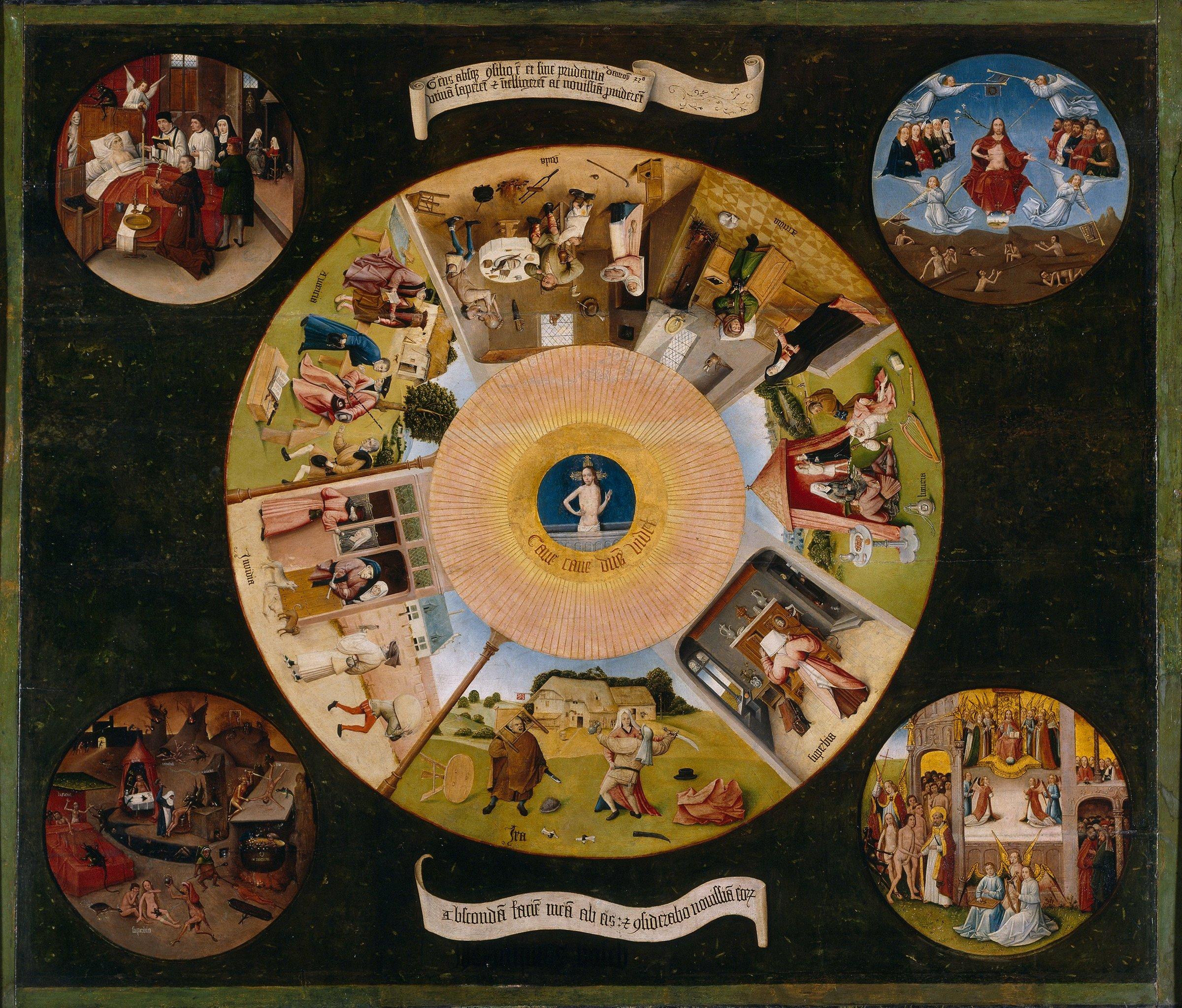
Hieronymus Bosch or a follower, The Seven Deadly Sins, 1505 to 1510. Public domain.
Romans 3:23; Romans 6:23 · Doctrine · Featured Study
Sin: What the Bible Means by It
Scripture finds sin in every person and traces it to the heart, and God forgives those who confess it.
The Hebrew verb for sin also describes a slinger whose stone does not miss.
Everyone who practices sin practices lawlessness as well. Indeed, sin is lawlessness.
- First taught
- Genesis 4:7 “…to do what is right, sin is crouching…”
- Fullest statement
- Romans 6:23 “For the wages of sin is death,…”
Summary
The Bible names sin with several words. Its wage is death, and God's gift in Christ is eternal life.
- Hebrew and Greek each have several words for sin, among them missing the mark, iniquity, revolt and lawlessness.
- Augustine, Aquinas, the Westminster Shorter Catechism and Wesley each define sin.
- Jesus placed the source of sin in the heart.
- Christian traditions differ over whether some sins are mortal and others venial.
What the Bible Means by Sin
The Bible first names sin when the LORD warns Cain at his door.
The LORD spoke to Cain before Cain killed his brother Abel.
If you do what is right, will you not be accepted? But if you refuse to do what is right, sin is crouching at your door; it desires you, but you must master it.”The LORD's warning comes before the murder of Genesis 4:8.
Sin Across the Canon
Four texts from Exodus to Romans name sin and find it in every person.
Scripture names sin, finds it in everyone, and promises its forgiveness.
- What it says of sin
- The LORD forgives iniquity, transgression and sin.
- What it says of sin
- David confesses his sin as done against God.
- What it says of sin
- Iniquities build barriers between people and God.
- What it says of sin
- All have sinned and fall short of God's glory.
Each link names the verse that carries it.
The same three words of Exodus 34:7 return in Psalm 32, where David moves from silence to confession.
Then I acknowledged my sin to You and did not hide my iniquity. I said, “I will confess my transgressions to the LORD,” and You forgave the guilt of my sin. SelahConfession ends the silence of Psalm 32:3 to 4.
Spurgeon, in The Treasury of David on Psalm 51:4, placed the poison of sin in its opposition to God.
Where Sin Comes From
Jesus spoke of where sin comes from and of its hold on a person.
Jesus taught that what defiles a person comes from within.
For from within the hearts of men come evil thoughts, sexual immorality, theft, murder, adultery, greed, wickedness, deceit, debauchery, envy, slander, arrogance, and foolishness. All these evils come from within, and these are what defile a man.”The list follows His saying that what comes out of a man defiles him.
He also described sin as a master that holds its servant, and Paul writes of that rule broken.
Jesus replied, “Truly, truly, I tell you, everyone who sins is a slave to sin. A slave is not a permanent member of the family, but a son belongs to it forever. So if the Son sets you free, you will be free indeed.Jesus answers those who said they had never been slaves.
For sin shall not be your master, because you are not under law, but under grace.Grace is the reason given.
Scripture also counts as sin what a person fails to do, and what he does without faith.
Anyone, then, who knows the right thing to do, yet fails to do it, is guilty of sin.This verse is the plainest case of a sin of omission.
But the one who has doubts is condemned if he eats, because his eating is not from faith; and everything that is not from faith is sin.Paul writes this about food and conscience.
How sin entered the world through Adam, and what the traditions teach passed from him to his children, is taught on the page of the Fall.
Romans 6:14, James 4:17, Romans 14:23
The Words for Sin
Three Hebrew words and three Greek words carry most of what Scripture says about sin.
Each word with its sense and the number of times it occurs.
| Word | Language | Sense | Occurrences |
|---|---|---|---|
| chata | Hebrew | To miss a goal or a way, to go wrong, to sin | 238 |
| avon | Hebrew | Iniquity, guilt, or the punishment of iniquity | 231 |
| pesha | Hebrew | A revolt, national, moral or religious | 93 |
| hamartia | Greek | A failing to hit the mark, by omission or by commission | 173 |
| anomia | Greek | Lawlessness, the violation of law | 15 |
| parabasis | Greek | A going over; a disregarding or violating | 7 |
Among all these soldiers there were 700 select left-handers, each of whom could sling a stone at a hair without missing.Without missing translates the verb chata.
How the Traditions Define Sin
Four teachers and confessions each define sin against the law of God.
Aquinas preferred Augustine's measure, the eternal law, to the measure of reason.
| Teacher or confession | Tradition | The definition |
|---|---|---|
| Augustine, Reply to Faustus 22.27 | The early church | Any transgression in deed, word or desire of the eternal law, which is the will of God. |
| Thomas Aquinas, Summa, I-II q.71 a.6 | Roman Catholic | A bad human act, voluntary, and chiefly an offense against God. |
| Westminster Shorter Catechism, question 14 | Reformed | Any want of conformity unto, or transgression of, the law of God. |
| John Wesley, A Plain Account of Christian Perfection | Wesleyan | Sin properly so called is a willed breach of a known law; a fault not willed still needs the atoning blood. |
Christian perfection, the teaching Wesley built on that distinction, has its own page.
How Sin Has Been Taught
Augustine, Calvin and Jamieson, Fausset and Brown wrote on what sin is.
Augustine of Hippo (died 430)
Ten Homilies on 1 John 4
Augustine held that sin and iniquity name one thing.
“‘Every one that doeth sin, doeth also iniquity.’ Let no man say, Sin is one thing, iniquity another: let no man say, I am a sinful man, but not a doer of iniquity. For, ‘Every one that doeth sin, doeth also iniquity. Sin is iniquity.’”
on 1 John 3:4Patristic
John Calvin (1509 to 1564)
Commentaries
Calvin read Isaiah 59:2 as true of every age.
“Hence we infer that our sins alone deprive us of the grace of God, and cause separation between us and him; for what the Prophet testifies as to the men of his time is applicable to all ages; since he pleads the cause of God, against the slanders of wicked men.”
on Isaiah 59:2Reformed
Jamieson, Fausset & Brown (1802 to 1910)
Commentary Critical and Explanatory on the Whole Bible
Jamieson, Fausset and Brown read the Greek of 1 John 3:4 as a missing of the mark.
“The Greek having the article to both, implies that they are convertible terms. The Greek ‘sin’ (hamartia) is literally, ‘a missing of the mark.’ God's will being that mark to be ever aimed at. ‘By the law is the knowledge of sin.’ The crookedness of a line is shown by being brought into juxtaposition with a straight ruler.”
on 1 John 3:4Reformed
Is Every Sin Alike?
1 John 5:16 to 17 speaks of a sin that leads to death, and the traditions read it in different ways.
If anyone sees his brother committing a sin not leading to death, he should ask God, who will give life to those who commit this kind of sin. There is a sin that leads to death; I am not saying he should ask regarding that sin. All unrighteousness is sin, yet there is sin that does not lead to death.This is the verse the traditions divide over.
Mortal and venial sinThomas Aquinas; the Catechism of the Catholic Church
Aquinas wrote that “mortal and venial are mutually opposed as reparable and irreparable.” The Catechism of the Catholic Church holds that the distinction is already evident in Scripture.
On this reading a sin is mortal when its matter is grave and it is done with full knowledge and deliberate consent.
Every sin deserves deathMatthew Henry
Matthew Henry, on Romans 6:23, denied that any sin is venial by its own nature.
“Death is as due to a sinner when he hath sinned as wages are to a servant when he hath done his work. This is true of every sin. There is no sin in its own nature venial.”
Matthew Henry · Commentary on the Whole Bible · on Romans 6:23Puritan
What the sin that leads to death isAlbert Barnes; John Gill; the Cambridge Bible
Albert Barnes lists four readings he found. Some took it as the sin against the Holy Spirit, and some as a great sin such as murder or idolatry. Others took it as a sin punished by death under the law of Moses, or as a sin that brought excommunication. John Gill takes it as the sin against the Holy Ghost. The Cambridge Bible notes that John speaks of a sin leading to death and does not call it mortal.
Jesus spoke of the one sin that will not be forgiven.
Therefore I tell you, every sin and blasphemy will be forgiven men, but the blasphemy against the Spirit will not be forgiven. Whoever speaks a word against the Son of Man will be forgiven, but whoever speaks against the Holy Spirit will not be forgiven, either in this age or in the one to come.Gill reads this saying as the one John means.
The Wage and the Gift
Paul sets two masters side by side through Romans 6.
For the wages of sin is death, but the gift of God is eternal life in Christ Jesus our Lord.The chapter ends with what each master pays.
If we confess our sins, He is faithful and just to forgive us our sins and to cleanse us from all unrighteousness.John includes himself: if we confess.
Sources
Scripture is the Berean Standard Bible.
- Hebrew and Greek word tags for Judges 20:16 and 1 John 3:4.
- Strong's Concordance, Brown-Driver-Briggs and Thayer's Greek Lexicon, entries H2398, H5771, H6588, G266, G458 and G3847.
- The Westminster Shorter Catechism, question 14.
- Augustine of Hippo, Reply to Faustus the Manichaean 22.27.
- Thomas Aquinas, Summa Theologiae, I-II q.71 a.6 and q.88 a.1.
- John Wesley, A Plain Account of Christian Perfection.
- Catechism of the Catholic Church, paragraphs 1854 to 1863.
- On 1 John 5:16: Barnes' Notes; Gill's Exposition; the Cambridge Bible.
- Augustine of Hippo, Ten Homilies on the First Epistle of John 4.
- Jamieson, Fausset and Brown, Commentary Critical and Explanatory on the Whole Bible, 1871, on 1 John 3:4.
- Charles Spurgeon, The Treasury of David, volume 2, 1870, on Psalm 51:4.
- John Calvin, Commentary on Isaiah, on Isaiah 59:2.
- Matthew Henry, Commentary on the Whole Bible, 1710, on Romans 6:23.
Keep Studying
People and groups4
Symbols1
Doctrines9