
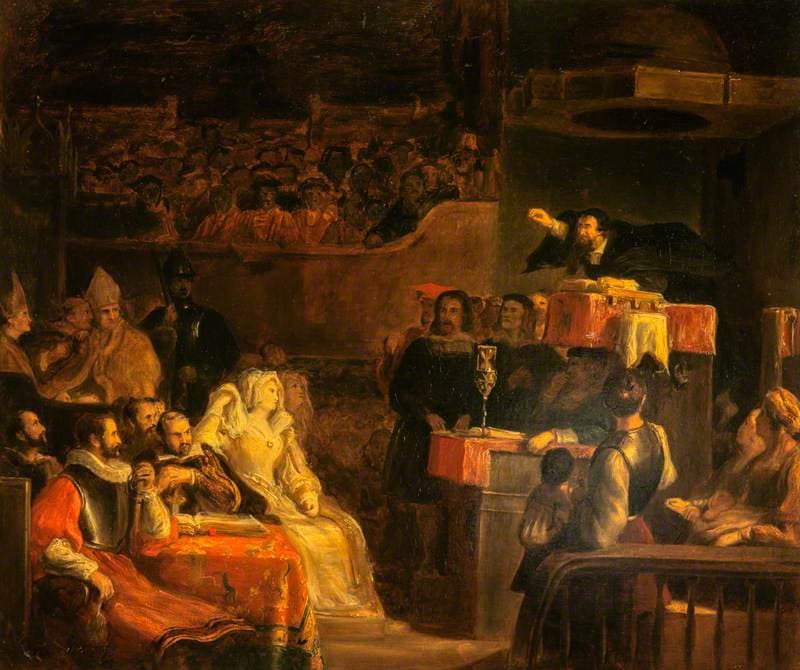
David Wilkie, The Preaching of John Knox before the Lords of the Congregation, 1832. Public domain.
Scotland and Geneva, to 1572 · Person · Featured Study
John Knox
He rowed in the French galleys, studied at Geneva and led the Reformation in Scotland.
Sick on a French galley off the Scottish coast, he said he would preach again in the same place, and he did.
Now this is eternal life, that they may know You, the only true God, and Jesus Christ, whom You have sent.
- Born
- 1513 to 1515, by Hay Fleming as Andrew Lang reports him; McCrie gives 1505 (proposed)
- Died
- 24 November 1572 at Edinburgh
- Family
- wife: Marjory Bowes; second wife: a daughter of Lord Ochiltree
- Places
- Haddington, St Andrews, Berwick, Geneva, Edinburgh
Summary
John Knox was a Scottish priest who joined the reformers and was taken at St Andrews in 1547. He spent nineteen months in the French galleys, preached in England, fled to Geneva, and came home in May 1559. Parliament adopted the Scots Confession in 1560, and he preached at Edinburgh until he died in 1572.
- His own History of the Reformation in Scotland tells much of the story in his own Scots.
- His First Blast of the Trumpet of 1558 argued against the rule of women.
- An early form of "Give me Scotland or I die" gives the words to John Welsh.
His First Anchor
John 17 was read at his bedside, and 2 Timothy 3 stands under the Scots Confession.
On the day he died Knox told his wife, "Go, read where I cast my first anchor," and she read the seventeenth chapter of John.
The question of this life is how far one preacher moved a nation, and how much of what is told of him comes from his own pen. Thomas McCrie told the life at length, and Andrew Lang in 1905 disputed his date for Knox's birth and wrote hard of the treatment of Catholics.
All Scripture is God-breathed and is useful for instruction, for conviction, for correction, and for training in righteousness,The Scots Confession rests the authority of the Scriptures on God, and this verse says they are God-breathed.
The Life in Order
Knox's History and McCrie's Life give the dates, and Lang corrects them where he can.
The twelve years after 1547 took him abroad, and the last thirteen he spent in Scotland.
- 1505 or 1513 to 1515He was born near HaddingtonMcCrie; Lang, after Hay Fleming
- 1545 and 1546He bore the sword before George WishartMcCrie
- 1547He preached at St Andrews, and the castle fell to the FrenchKnox, History; McCrie
- 1547 to 1549He spent nineteen months in the galleysMcCrie, against Calderwood's print
- 1549 to 1553He preached at Berwick and became a royal chaplainMcCrie
- 9 December 1556He wrote from Geneva to Mrs LockeLaing, volume 4
- 1558The First Blast of the Trumpet appearedLaing, volume 4; Lang
- May 1559He returned to ScotlandMcCrie
- 1560Parliament ratified the Confession of FaithMcCrie
- 1563Queen Mary wept before him in her cabinetKnox, History
- 24 November 1572He died at EdinburghMcCrie, from Bannatyne
Each step of the life stands with its witness.
1558, May 1559, 1560, 1563, 24 November 1572
From the Galleys to St Giles
His History gives his own part, and McCrie and Lang test it from the other records.
Knox had carried a sword before George Wishart. He was preacher to the men holding the castle at St Andrews when a French fleet took it in 1547, and he was sent to the galleys and chained to an oar.
Off the Scottish coast, very sick, he was asked if he knew the land. He said he saw the steeple of the place where God first opened his mouth in public, and that he would not die until his tongue glorified God's name in that same place. His own History tells this.
Freed, he preached in England under Edward VI and fled to the continent when Mary I took the throne. In Geneva he found in Calvin's city what he called the most perfect school of Christ since the apostles.
He came home to Scotland, and within a year Parliament had adopted a confession of faith he helped write. He and his colleagues also drew a plan for a school in every parish and care for the poor, and the council never formally ratified it.
He argued often with the young Catholic queen, Mary Stuart, and gave her no ground. Some of what he published against women rulers embarrassed his own allies. The Presbyterian Church of Scotland grew out of his work.
He died at Edinburgh, and at his grave in the churchyard of St. Giles, McCrie reports, the regent Morton said, "There lies he, who never feared the face of man."
The First Blast
He published against the rule of women in 1558, with a Catholic queen on the English throne.
The book opens by saying that for a woman to rule any nation is "repugnant to Nature; contumelie to God". Lang says it carried neither the author's nor the printer's name.
Lang wrote that Knox "could predict vengeance on Mary Tudor". He added that Knox either failed to see the harm to his cause once Elizabeth succeeded or, "seeing it, he stood to his guns". Lang says Calvin soon found it had given grave offence to Queen Elizabeth.
In Their Own Words
These passages stand in his own Scots, as David Laing printed them, and one stands on a report.
John Knox (1514 to 1572)
The History of the Reformation in Scotland, Book I
From the galley
“I am fullie persuaded, how weak that ever I now appear, that I shall nott departe this lyif, till that my toung shall glorifie his godlie name in the same place.”
Reformed
About this saying1 paragraph
His History gives this answer on the galley off St Andrews, between 1547 and 1549, as Sir James Balfour reported it.
John Knox
Letter to Mrs Anne Locke, Geneva, 9 December 1556
The most perfect school
“whair I nether feir nor eschame to say is the maist perfyt schoole of Chryst that ever was in the erth since the dayis of the Apostillis.”
Reformed
About this saying1 paragraph
He wrote to a friend in London in 1556 about the city where he now served.
John Knox
The History of the Reformation in Scotland, Book IV, The Works of John Knox, volume 2, p. 389
To the queen in tears
“Madam, in Goddis presence I speak: I never delyted in the weaping of any of Goddis creatures; yea, I can skarslie weill abyd the tearis of my awin boyes whome my awin hand correctis, much less can I rejoise in your Majesties weaping.”
Reformed
About this saying1 paragraph
His History gives this answer to Queen Mary in 1563.
John Knox
The First Blast of the Trumpet against the Monstrous Regiment of Women, the opening
The opening proposition
“To promote a Woman to beare rule, superioritie, dominion, or empire above any Realme, Nation, or Citie, is repugnant to Nature; contumelie to God, a thing most contrarious to his reveled will and approved ordinance; and finallie, it is the subversion of good Order, of all equitie and justice.”
Reformed
About this saying1 paragraph
He printed this without his name in 1558.
The Scots Confession on the Scriptures1 quotation, 1 paragraph
This is the nineteenth article of the confession of 1560, on the authority of the Scriptures.
The People Around Him
The witnesses name his teacher, his wife, his queen and those who buried him.
He learned from Wishart and from Calvin, and he opposed two queens.
| Person | Tie to Knox | The witness |
|---|---|---|
| George Wishart | Knox waited on him and bore the sword before him. | McCrie |
| John Calvin | Knox studied and served under him at Geneva. | Knox to Mrs Locke; Schaff |
| Marjory Bowes | He met her at Berwick, and she became his wife. | McCrie |
| Mary Tudor | His First Blast had her rule in view. | Lang; Laing, volume 4 |
| Mary, Queen of Scots | She wept before him in 1563. | Knox, History |
| John Erskine of Dun | He stood by at that interview and tried to calm the queen. | Knox, History |
| Richard Bannatyne | As Knox's servant he recorded the last days. | McCrie |
| The regent Morton | He spoke at the grave. | McCrie |
Richard Bannatyne, The regent Morton
The Places of His Life
His life ran from East Lothian by sea and exile to Edinburgh.
Exile gave him the years between St Andrews and Edinburgh.
| Place | What the witnesses say | The witness |
|---|---|---|
| Haddington | He went to the grammar school there. | McCrie |
| St Andrews | He first preached in public there, and the castle fell in 1547. | Knox, History; McCrie |
| Rouen and the galleys | The French carried the chief prisoners up the Seine, and the rest stayed at the oars. | Knox, History |
| Berwick | He preached there and met Marjory Bowes. | McCrie |
| Geneva | He ministered to the English congregation here. | Knox to Mrs Locke |
| Edinburgh | He preached at St Giles, and he was buried in its churchyard. | McCrie |
What the Book of Discipline Asked
It asked for a school in every parish, and those who held the church's lands resisted it.
McCrie reports that the compilers of the First Book of Discipline proposed a school in every parish and a college in every notable town. They looked to the old church's revenues to pay for them.
McCrie adds that those who held the lands of the church had private bargains to protect. "Hence their aversion to have the Book of Discipline ratified," he writes, "hence the poverty and the complaints of the ministers."
How the Key Verse Was Taught
John Chrysostom, Matthew Henry and Albert Barnes read the knowledge that is eternal life.
John Chrysostom (died 407)
Homily on the Gospel of John 80
John Chrysostom preached on the only true God at Antioch.
“‘And this is life eternal, that they might know Thee the only true God, and Jesus Christ whom Thou hast sent.’ ‘The only true God,’ He saith, by way of distinction from those which are not gods; for He was about to send them to the Gentiles. But if they will not allow this, but on account of this word ‘only’ reject the Son from being true God, in this way as they proceed they reject Him from being God at all. For He also saith, ‘Ye seek not the glory which is from the only God.’ (c. v. 44.) Well then; shall not the Son be God? But if the Son be God, and the Son of the Father who is called the Only God, it is clear that He also is true, and the Son of Him who is called the Only true God.”
on John 17:3Patristic
Matthew Henry (1662 to 1714)
Commentary on the Whole Bible
Matthew Henry wrote that those who know God and Christ stand in the suburbs of eternal life.
“We are therefore concerned to know Christ as our Redeemer, by whom alone we can now have access to God; it is life eternal to believe in Christ; and this he has undertaken to give to as many as were given him. Those that are acquainted with God and Christ are already in the suburbs of life eternal.”
on John 17:3Puritan
Albert Barnes (1798 to 1870)
Notes, Explanatory and Practical, on the Old and New Testaments, on John 17:3
Albert Barnes turned the verse toward the believer's present joy.
“The knowledge of God and of his Son Jesus Christ is itself a source of unspeakable and eternal joy.”
Presbyterian
What the Witnesses Leave Open
Readers differ on the year of his birth, on the galley months and on how the Catholics fared after 1560.
The year of his birthMcCrie; Andrew Lang, after David Hay Fleming
McCrie wrote that he was born in 1505, and Schaff calls him five years older than Calvin. Lang wrote in 1905, "Dr. Hay Fleming has pointed out that his natal year was probably 1513-15, not 1505."
His time in the galleysMcCrie; Calderwood's printed text
McCrie takes nineteen months from Calderwood's manuscript. He notes that the printed Calderwood limits it to nine months, which he calls a mistake.
The treatment of Catholics after 1560Andrew Lang; the First Book of Discipline
Lang notes that the Book of Discipline regrets the rarity of learned and godly men of Knox's persuasion. He writes that Catholics were threatened with "confiscation, exile, and death" if they clung to the only creed they had been taught.
Books to Read Next
The Works of John Knox, volume 1
David Laing, editor · 1846
Laing's first volume holds the opening books of his History of the Reformation in Scotland.
Read volume 1 free at Project GutenbergThe Life of John Knox
Thomas McCrie · 1831
McCrie gives the whole life from the records.
Read McCrie free at the Internet ArchiveJohn Knox and the Reformation
Andrew Lang · 1905
Lang writes as a critic of Knox and of his History.
Read Lang free at the Internet ArchiveWhat Knox Left
Knox left his History, his letters, a confession still read and a plan for schools that Parliament did not make law.
Sources
Scripture is the Berean Standard Bible.
- The Holy Bible, Berean Standard Bible (read 2026)
- John Knox, The History of the Reformation in Scotland, edited by David Laing, The Works of John Knox, volumes 1 and 2, in the set from 1846.
- John Knox, The First Blast of the Trumpet (1558) and the letter to Mrs Locke of 9 December 1556, in Laing's edition of his Works, volume 4 (1855)
- The Scots Confession, article 19, in Philip Schaff, The Creeds of Christendom, volume 3 (1877)
- Thomas McCrie, The Life of John Knox (1831 printing)
- Andrew Lang, John Knox and the Reformation (1905)
- John Chrysostom, Homily on the Gospel of John 80, on John 17:3.
- Matthew Henry, Commentary on the Whole Bible (1710), on John 17:3.
- Albert Barnes, Notes on the Old and New Testaments (1832 to 1869), on John 17:3.
Keep Studying
People and groups7