
Deuteronomy 17 to 18 · The Offices Fulfilled in Christ
Prophet, Priest and King: The Threefold Office of Christ
Deuteronomy 17 and 18 give the rules for a king Israel may one day ask for and the share of its priests, and they promise a prophet like Moses.
Hebrews opens by giving the Son a prophet's word, a priest's cleansing and a king's seat at God's right hand.
- First taught
- Deuteronomy 18:15
- Fullest statement
- Hebrews 7:11 to 28
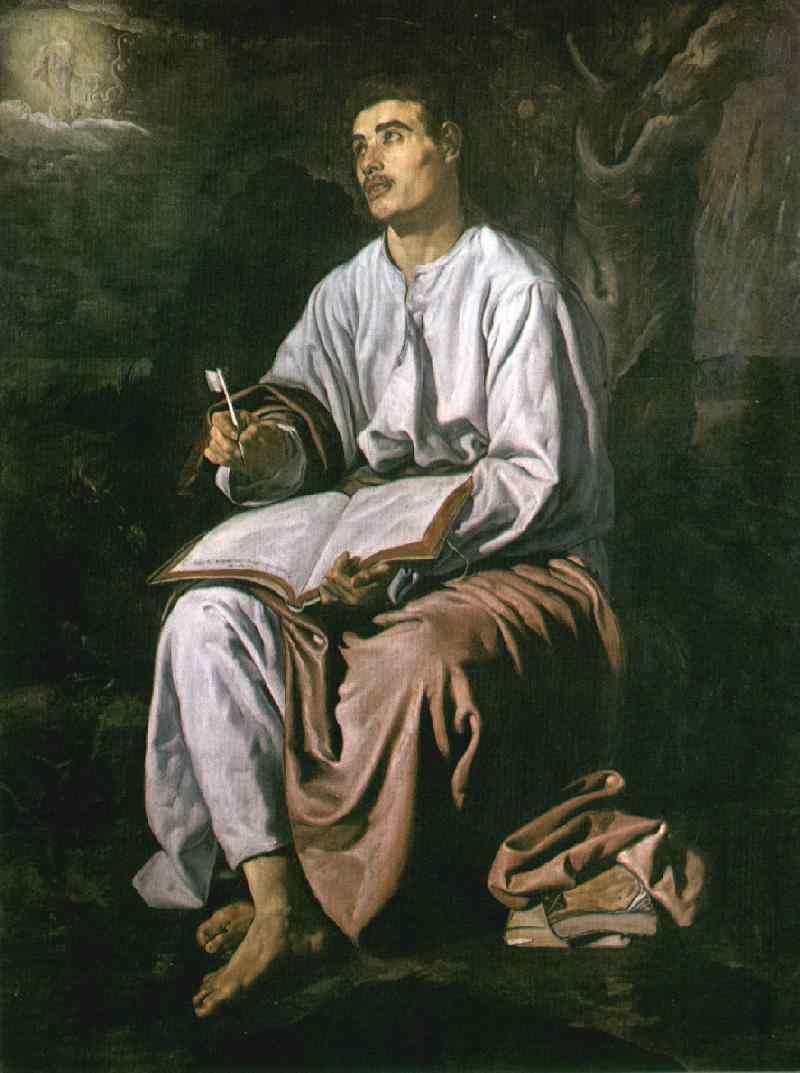
Diego Velázquez, Saint John the Evangelist on the Island of Patmos, 1618 to 1619, National Gallery, London (NG6264). Public domain by date (the painter died in 1660), via Wikimedia Commons (File:Diego Velázquez - St John the Evangelist at Patmos - WGA24356.jpg, from the Web Gallery of Art).
THE ARTWORKVelázquez painted John on Patmos with his pen lifted as he looks up at the vision he is about to write down. In Revelation 1:5 that same writer names Jesus Christ the faithful witness and the ruler of the kings of the earth. In the next verse he adds that Christ has made us to be a kingdom, priests to His God and Father.
Summary
The threefold office is the church's name for the work of Christ as prophet, priest and king.
- Deuteronomy 17:14 to 20 rules that Israel's king must copy God's instruction and read it all his life.
- Deuteronomy 18:1 to 8 gives the tribe of Levi no land, because the LORD is its inheritance.
- Psalm 110 and Hebrews 7 call the Messiah a king at God's right hand and a priest forever in the order of Melchizedek.
The Offices Moses Set in Place
Moses gave these laws to Israel east of the Jordan, in the land of Moab, before the people entered the land.
When you enter the land that the LORD your God is giving you and have taken possession of it and settled in it, and you say, “Let us set a king over us like all the nations around us,” you are to appoint over yourselves the king whom the LORD your God shall choose. Appoint a king from among your brothers; you are not to set over yourselves a foreigner who is not one of your brothers.The first rule of the king's law keeps the throne within Israel.
When he is seated on his royal throne, he must write for himself a copy of this instruction on a scroll in the presence of the Levitical priests. It is to remain with him, and he is to read from it all the days of his life, so that he may learn to fear the LORD his God by carefully observing all the words of this instruction and these statutes.After the three limits of verses 16 and 17, this is the duty the law lays on the king.
The Levitical priests—indeed the whole tribe of Levi—shall have no portion or inheritance with Israel. They are to eat the offerings made by fire to the LORD; that is their inheritance. Although they have no inheritance among their brothers, the LORD is their inheritance, as He promised them.The law of the priests follows the law of the king without a break.
For the LORD your God has chosen Levi and his sons out of all your tribes to stand and minister in His name for all time.The priesthood belongs to one family by God's appointment, and Hebrews 7 sets the priesthood of Jesus against that rule.
The LORD your God will raise up for you a prophet like me from among your brothers. You must listen to him.This is the promise the New Testament takes up, and the doctrine of Christ the prophet rests on it.
Each office is filled by God's choice: the LORD chooses the king, chooses Levi for the priesthood and raises up the prophet.
Six Texts from Moses to the Son
The three offices pass from the law of Moses through a psalm of David and the preaching of Peter to the letter to the Hebrews.
- Office
- King
- What it adds
- Even the throne stands under God's instruction
- Office
- Priest
- What it adds
- Levi's line is set apart to serve in the name of the LORD
- Office
- Prophet
- What it adds
- God will put His words in the prophet's mouth
- Office
- King and priest
- What it adds
- David calls the coming king his Lord
- Office
- Prophet
- What it adds
- Peter quotes Moses' promise and applies it to Jesus
- Office
- Prophet, priest and king
- What it adds
- All three offices meet in one person
Six texts in canon order, each with the office it names and what it adds to the case.
The Offices in Their Texts
The law gave each office its own rule, and the later texts give all three rules one fulfilment.
1. Deuteronomy 17:14 to 20, the king under the law2 passages, 2 quotations
But the king must not acquire many horses for himself or send the people back to Egypt to acquire more horses, for the LORD has said, ‘You are never to go back that way again.’ He must not take many wives for himself, lest his heart go astray. He must not accumulate for himself large amounts of silver and gold.These three limits guard the king's heart, which verse 17 names as the thing that could go astray.
Then his heart will not be exalted above his countrymen, and he will not turn aside from the commandment, to the right or to the left, in order that he and his sons may reign many years over his kingdom in Israel.This verse gives the purpose of the daily reading of verses 18 and 19.
Matthew Henry reads the law as a permission granted if Israel asked for a king.
“Their having a king is neither promised as a mercy nor commanded as a duty (nothing could be better for them than the divine regimen they were under), but it is permitted them if they desired it.”
Matthew Henry · Commentary on the Whole Bible · on Deuteronomy 17:14 to 15Puritan
Jamieson, Fausset & Brown find in the rule of verse 15 a king who would be a type of Christ.
“He was to possess certain indispensable requisites. He was to be an Israelite, of the same race and religion, to preserve the purity of the established worship, as well as be a type of Christ, a spiritual king, one of their brethren.”
Jamieson, Fausset & Brown · Commentary Critical and Explanatory on the Whole Bible · on Deuteronomy 17:14Reformed
2. Deuteronomy 18:1 to 8, the priests of Levi3 passages
This shall be the priests’ share from the people who offer a sacrifice, whether a bull or a sheep: the priests are to be given the shoulder, the jowls, and the stomach. You are to give them the firstfruits of your grain, new wine, and oil, and the first wool sheared from your flock.The people's sacrifices and firstfruits feed the priests who hold no land.
Now if a Levite moves from any town of residence throughout Israel and comes in all earnestness to the place the LORD will choose, then he shall serve in the name of the LORD his God like all his fellow Levites who stand there before the LORD.A Levite from any town has the same right to serve as those already there, because the right comes from his tribe.
The Chronicler records what happened when a king of Judah took up the priest's work.
But when Uzziah grew powerful, his arrogance led to his own destruction. He was unfaithful to the LORD his God, for he entered the temple of the LORD to burn incense on the altar of incense. Then Azariah the priest, along with eighty brave priests of the LORD, went in after him. They took their stand against King Uzziah and said, “Uzziah, you have no right to offer incense to the LORD. Only the priests, the descendants of Aaron, are consecrated to burn incense. Leave the sanctuary, for you have acted unfaithfully; you will not receive honor from the LORD God.”This account shows that under the law a king could not also serve as a priest.
3. Deuteronomy 18:15 to 22, the prophet like Moses2 passages, 1 quotation
This is what you asked of the LORD your God at Horeb on the day of the assembly, when you said, “Let us not hear the voice of the LORD our God or see this great fire anymore, so that we will not die!” Then the LORD said to me, “They have spoken well.The promise answers the people's own request at Horeb for a go-between.
I will raise up for them a prophet like you from among their brothers. I will put My words in his mouth, and he will tell them everything I command him. And I will hold accountable anyone who does not listen to My words that the prophet speaks in My name.These verses add a warning to the command to listen, since God will require an account from anyone who ignores the prophet.
John Wesley, on Deuteronomy 18:15, finds the likeness between Moses and Christ in Christ being a prophet, a king, a priest and a mediator.
Matthew Henry compares Christ with Moses as lawgiver and deliverer as well as teacher.
“Moses was such a prophet as was a law-giver to Israel and their deliverer out of Egypt, and so was Christ: he not only teaches, but rules and saves. Moses was the founder of a new dispensation by signs and wonders and mighty deeds, and so was Christ, by which he proved himself a teacher come from God.”
Matthew Henry · Commentary on the Whole Bible · on Deuteronomy 18:15Puritan
4. Psalm 110, the king who is a priest2 passages
The LORD said to my Lord: “Sit at My right hand until I make Your enemies a footstool for Your feet.” The LORD extends Your mighty scepter from Zion: “Rule in the midst of Your enemies.”These verses give David's Lord the throne, the office the psalm names before the priesthood.
The LORD has sworn and will not change His mind: “You are a priest forever in the order of Melchizedek.”This is the oath Hebrews 7:21 quotes as the ground of the priesthood of Jesus.
Jesus quoted the first verse of this psalm to ask the Pharisees how David could call the Christ his Lord, in Matthew 22:41 to 45.
5. Acts 3:22 to 23, Peter names the prophet3 passages, 2 quotations
For Moses said, ‘The Lord your God will raise up for you a prophet like me from among your brothers. You must listen to Him in everything He tells you. Everyone who does not listen to Him will be completely cut off from among his people.’Peter sets this promise near the close of his sermon at the temple, after his call to repent.
This is the same Moses who told the Israelites, ‘God will raise up for you a prophet like me from among your brothers.’Stephen cites the same promise in the speech he gave before the Sanhedrin.
When the people saw the sign that Jesus had performed, they began to say, “Truly this is the Prophet who is to come into the world.” Then Jesus, realizing that they were about to come and make Him king by force, withdrew again to a mountain by Himself.In one scene the crowd names Jesus the Prophet and tries to make Him king, which shows the two hopes already joined.
Chrysostom reads Moses as handing his disciples on to Christ.
“Christ sent the Jews back to Moses so that, through Moses, he might draw them to himself. In the same way, Moses hands over his disciples to his teacher and commands them to believe him in all things.”
John Chrysostom · Against the Anomoeans 12.5 · on Acts 3:22Patristic
Matthew Henry sets Moses the servant beside Christ the Son.
“Moses was faithful as a servant, Christ as a Son. Moses was murmured against by Israel, defied by Pharaoh, yet God owned him, and ratified his commission. Moses was a pattern of meekness and patience, so is Christ.”
Matthew Henry · Commentary on the Whole Bible · on Acts 3:22Puritan
6. Hebrews 7, a priest of another order3 passages, 1 quotation
He of whom these things are said belonged to a different tribe, from which no one has ever served at the altar. For it is clear that our Lord descended from Judah, a tribe as to which Moses said nothing about priests.This fact rules out the line of Aaron for Jesus and calls for a priest of another order.
And this point is even more clear if another priest like Melchizedek appears, one who has become a priest not by a law of succession, but by the power of an indestructible life. For it is testified: “You are a priest forever in the order of Melchizedek.”Hebrews draws its second proof of a changed priesthood from these verses.
Now there have been many other priests, since death prevented them from continuing in office. But because Jesus lives forever, He has a permanent priesthood.The permanence of the priesthood of Jesus answers the weakness of a line that death kept breaking.
Theodoret of Cyrus sees the kingly tribe of Judah given the priesthood through Christ.
“The mystery of the divine plan is worthy of admiration: as Christ the Lord, eternal king as he is, was styled our high priest, so the tribe of Judah, which was formerly kingly, attained the priesthood through the Lord.”
Theodoret of Cyrus · Interpretation of Hebrews 7 · on Hebrews 7:11 to 12Patristic
Anointed for Office
Two texts and two words show what anointing meant for Israel's offices.
He also poured some of the anointing oil on Aaron’s head and anointed him to consecrate him.Moses anoints Aaron at the start of Israel's priesthood.
You are also to anoint Jehu son of Nimshi as king over Israel and Elisha son of Shaphat from Abel-meholah to succeed you as prophet.This command shows that a king and a prophet could both be installed by anointing.
Adam Clarke, in his Commentary on the Bible on Exodus 29:7, names three occasions for anointing with oil: the installation of prophets, priests and kings into their offices.
The Hebrew word mashiach (H4899) means anointed. The Greek word christos (G5547) also means anointed, and it is the title Christ that the New Testament gives to Jesus.
The Offices in the Confessions
A church historian, a Reformer and two Reformed catechisms set out the three offices in their own words.
| Formulation | Tradition | What it says of the offices |
|---|---|---|
| Eusebius of Caesarea, Church History, book 1, chapter 3 | Patristic | Israel's anointed priests, kings and prophets were types, and all of them point to Christ, the one high priest, king and chief prophet. |
| John Calvin, Institutes of the Christian Religion, book 2, chapter 15 | Reformed | The office Christ received from the Father has three parts, and the name Christ refers to all three anointings. |
| The Heidelberg Catechism, Question 31 | Reformed | Christ is anointed with the Holy Spirit to be the chief Prophet and Teacher, the only High Priest and the eternal King. |
| The Westminster Shorter Catechism, Questions 23 to 26 | Reformed | Christ carries out all three offices both in His humiliation and in His exaltation, and one answer is given to each office. |
What the Law Leaves Open
Deuteronomy 17 and 18 leave three questions open.
From which tribe will the king come? Deuteronomy 17:15 asks that the LORD choose him from among the people's brothers, and it names no tribe.
When will the prophet like Moses come? Moses gives no time, and verses 21 and 22 give Israel a test for every prophet who speaks in the meantime.
May one man hold two of the offices? Neither chapter gives any man more than one, and the joining of king and priest waits for Psalm 110:4.
One Person, Three Offices
The New Testament and the commentators join the three offices in the person of the Son.
- ProphetFulfilled inChristActs 3:22
- PriestFulfilled inChristHebrews 7:24
- KingFulfilled inChristPsalm 110:1
- ProphetDistinct fromPriest
- PriestDistinct fromKing
- KingDistinct fromProphet
All three at once: Hebrews 1:1 to 3
Each office is joined to Christ by a solid line and set apart from the other two by a dashed line.
All three at once: Hebrews 1:1 to 3
Each office is joined to Christ by a solid line and set apart from the other two by a dashed line.
On many past occasions and in many different ways, God spoke to our fathers through the prophets. But in these last days He has spoken to us by His Son, whom He appointed heir of all things, and through whom He made the universe. The Son is the radiance of God’s glory and the exact representation of His nature, upholding all things by His powerful word. After He had provided purification for sins, He sat down at the right hand of the Majesty on high.The whole letter to the Hebrews argues from the Son these verses introduce.
Adam Clarke, on 2 Corinthians 5:19, observes that Israel had men who held two of the offices, and he holds that none but Christ sustained all three in his own person.
The Offices in the Church's Teaching
Theodoret of Cyrus, John Chrysostom and Charles Spurgeon speak of the offices Christ holds.
Theodoret ties the name Christ to the anointing and sets Moses' promise beside the titles.
“He is named Christ from being as man anointed with the Holy Spirit, and called our high priest, apostle, prophet and king. Long ago the divine Moses exclaimed, ‘The Lord your God will raise up to you a prophet, from the midst of you, of …”
Theodoret of Cyrus · LETTER 146 · on Psalm 110:3 to 4Patristic
Chrysostom teaches that the Spirit's anointing gives believers a share in all three offices.
“And what is, ‘anointed,’ and ‘sealed?’ Gave the Spirit by Whom He did both these things, making at once prophets and priests and kings, for in old time these three sorts were anointed. But we have now not one of these dignities, but all three preeminently. For we are both to enjoy a kingdom and are made priests by offering our bodies for a sacrifice, (for, saith he, ‘present your members a living sacrifice unto God;) and withal we are constituted prophets too: for what things ‘eye hath not seen, nor ear heard,’ (1 Cor. ii. 9) these have been revealed unto us.”
John Chrysostom · Homily on 2 Corinthians 3 · on 2 Timothy 2:11Patristic
Spurgeon joins the king and the priest of Psalm 110 in one title.
“We have now reached the heart of the psalm, which is also the very centre and soul of our faith. Our Lord Jesus is a Priest King by the ancient oath of Jehovah: ‘he glorified not himself to be made an high priest, ‘but was ordained there unto from of old, and was called of God an high priest after the order of Melchizedek.”
Charles Spurgeon · The Treasury of David, Vol. 5 · on Psalm 110:4
One Prophet or a Line of Prophets
Readers divide over whether Moses' promise speaks of one prophet or of a succession of prophets.
Christ alone is the promised prophet
Albert Barnes reads the promise as Messianic and points to John 5:45 to 47.
“The ancient fathers of the Church and the generality of modern commentators have regarded our Lord as the prophet promised in these verses. It is evident from the New Testament alone that the Messianic was the accredited interpretation among the Jews at the beginning of the Christian era (compare the marginal references, and Joh 4:25); nor can our Lord Himself, when He declares that Moses ‘wrote of Him’ Joh 5:45-47, be supposed to have any other words more directly in view than these, the only words in which Moses, speaking in his own person, gives any prediction of the kind.”
Albert Barnes · Notes, Explanatory and Practical, on the Old and New Testaments (1832-1869) · on Deuteronomy 18:15Evangelical
The objection: Moses sets the promise among laws for the prophets Israel would hear in the land, followed at once by the test of a false prophet in verses 20 to 22.
The succession of prophets, with Christ first in view
Henry measures the later prophets against Moses before he turns to Christ.
“These prophets were like unto Moses in some respects, though far inferior to him, Deut. xxxiv. Whether a succession of prophets be included in this promise or not, we are sure that it is primarily intended as a promise of Christ, and it is the clearest promise of him that is in all the law of Moses.”
Matthew Henry · Commentary on the Whole Bible · on Deuteronomy 18:15Puritan
The prophets who followed Moses
Rashi, Rabbi Shlomo Yitzchaki of Troyes (1040 to 1105), in his commentary on Deuteronomy, reads the verse as a prophet raised up in Moses' stead, and so from prophet to prophet in every age.
At this point Rashi's reading names no Messiah, and it parts from the apostles, who apply the verse to Jesus.
The objection: Deuteronomy 34:10 records that no prophet like Moses had risen in Israel, so the prophets after him did not match the promise.
Drawing Near Through the Priest
Hebrews 7:25 says Jesus saves those who draw near to God through Him, and 1 Peter 2:9 calls His people a royal priesthood.
Therefore He is able to save completely those who draw near to God through Him, since He always lives to intercede for them.This verse is the reason the priest's office matters to the reader today.
But you are a chosen people, a royal priesthood, a holy nation, a people for God’s own possession, to proclaim the virtues of Him who called you out of darkness into His marvelous light.This is where the offices of Christ reach the believers who follow Him.
Keep studying
Studies8
People8
Doctrines14
Peoples and groups1