
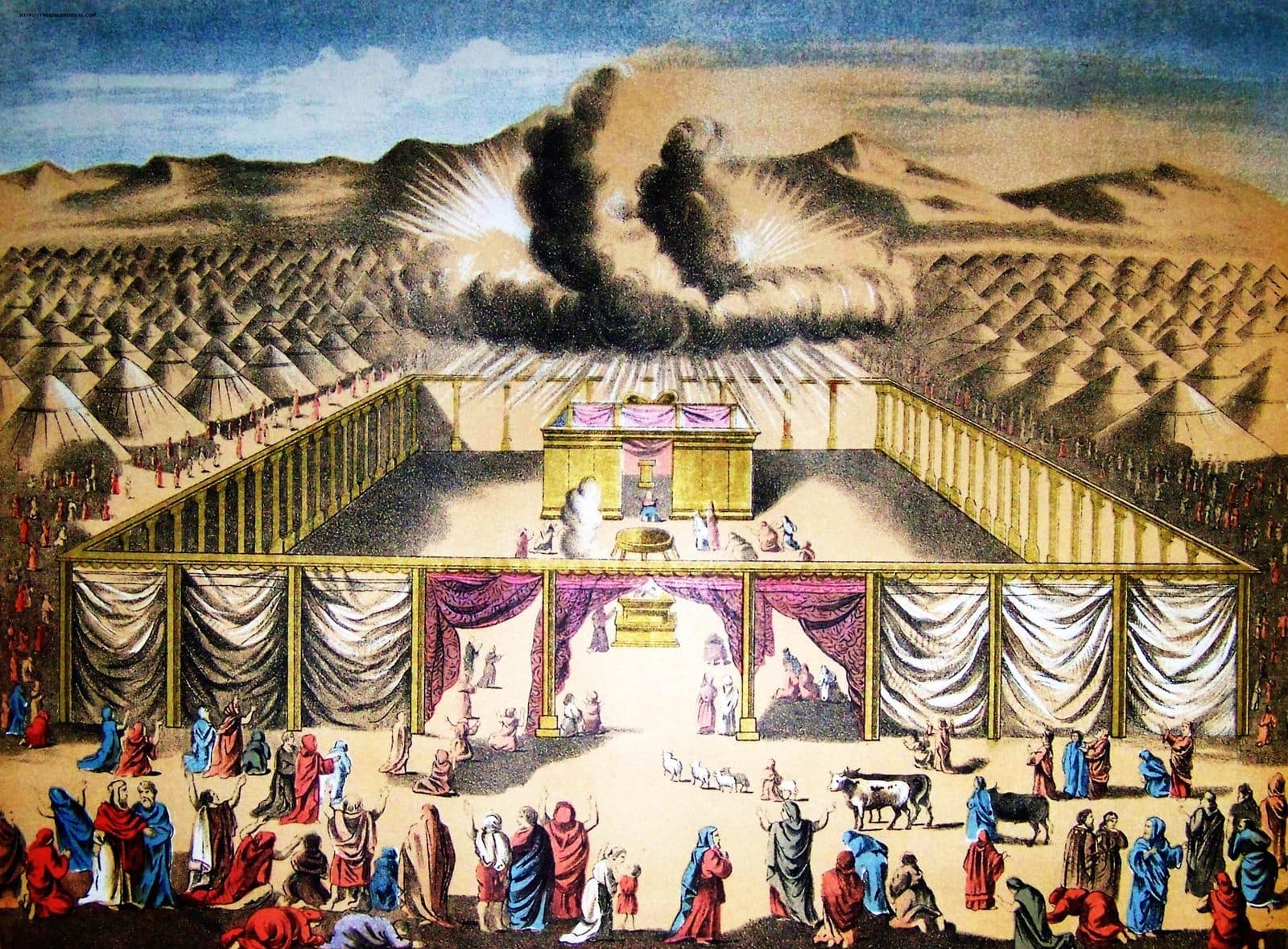
illustrators of the 1890 Holman Bible, The Tabernacle in the Wilderness, 1890. Public domain.
Exodus 25–40, Leviticus 16 and Hebrews 8–10 · Place · Featured Study
The Tabernacle
The tent God asked Israel to build at Sinai so that He might dwell among them: three zones, eight pieces of furniture, and one veil, carried through the wilderness and pitched at Shiloh and Gibeon.
The Word tabernacled among us.
And they are to make a sanctuary for Me, so that I may dwell among them. You must make the tabernacle and design all its furnishings according to the pattern I show you.
- Today
- No fixed site: a portable tent, later pitched at Shiloh, at Nob and at Gibeon
- Region
- The Sinai wilderness, then the hill country of Ephraim and Benjamin
- First named
- Exodus 25:9 “You must make the tabernacle and design…”
- Last named
- Hebrews 9:21 “…he sprinkled with blood the tabernacle and all…”
The Word tabernacled among us.
Summary
For forty years Israel carried a tent through the desert, built to a plan God gave Moses down to the last board and curtain.
- Moses set up the tabernacle on the first day of the first month of the second year, and the glory of the LORD filled it.
- Its court held the bronze altar and the laver; its tent held two rooms, and behind the veil stood the ark with the mercy seat.
- After the conquest it stood at Shiloh, and in David's reign it stood at the high place in Gibeon.
- Solomon's priests brought the Tent of Meeting and its furnishings up into the temple.
The tent where God chose to dwell
Three verses on why the tent was made and who could enter it.
The tent showed Israel how a holy God lets people come near Him. Every step inward from the gate passed an altar or a basin, and only blood opened the innermost room.
Walk it from the gate to the innermost room and you walk the gospel, laid out in furniture.
And they are to make a sanctuary for Me, so that I may dwell among them. You must make the tabernacle and design all its furnishings according to the pattern I show you.God asks for a sanctuary so that He may dwell among His people, and He gives the pattern Himself.
Then the cloud covered the Tent of Meeting, and the glory of the LORD filled the tabernacle. Moses was unable to enter the Tent of Meeting because the cloud had settled on it, and the glory of the LORD filled the tabernacle.When the work was finished, the cloud covered the tent and the glory filled it, and even Moses could not go in.
And the LORD said to Moses: “Tell your brother Aaron not to enter freely into the Most Holy Place behind the veil in front of the mercy seat on the ark, or else he will die, because I appear in the cloud above the mercy seat.The inner room was closed to Aaron except as the LORD appointed, because the LORD appeared above the mercy seat.
The tent showed Israel how a holy God lets people come near Him. Every step inward from the gate passed an altar or a basin, and only blood opened the innermost room.
Walk it from the gate to the innermost room and you walk the gospel, laid out in furniture.
Then the cloud covered the Tent of Meeting, and the glory of the LORD filled the tabernacle. Moses was unable to enter the Tent of Meeting because the cloud had settled on it, and the glory of the LORD filled the tabernacle.When the work was finished, the cloud covered the tent and the glory filled it, and even Moses could not go in.
And the LORD said to Moses: “Tell your brother Aaron not to enter freely into the Most Holy Place behind the veil in front of the mercy seat on the ark, or else he will die, because I appear in the cloud above the mercy seat.The inner room was closed to Aaron except as the LORD appointed, because the LORD appeared above the mercy seat.
The plan of the tent
Three zones entered from the east gate, with the furniture of each.
- The court, 100 by 50 cubits (Exodus 27:18)
- The Holy Place, 20 by 10 cubits (Exodus 26:33)
- The Most Holy Place, 10 by 10 cubits (Exodus 26:33-34)
- The gate, 20 cubits, on the east (Exodus 27:16)
- 1Bronze Altar, The court Exodus 27:1
- 2Bronze Laver, The court Exodus 30:18
- 3Table of Showbread, The Holy Place Exodus 25:30
- 4Golden Lampstand, The Holy Place Exodus 25:31
- 5Altar of Incense, The Holy Place Exodus 30:7
- 6The Veil, Between the rooms Exodus 26:31
- 7Ark of the Covenant, The Most Holy Place Exodus 25:10
- 8Mercy Seat, The Most Holy Place Exodus 25:22
Drawn to the measures of Exodus 26 and 27 at about 18 inches to the cubit. The tent stands where the common reconstruction sets it, with the ark at the centre of the western half.
The bronze altar and the laver stand in the court, and the table, the lampstand and the altar of incense stand in the first room. The ark with the mercy seat stands alone behind the veil.
Ark of the Covenant, Mercy Seat
Eight studies of the tent as a whole each have a page of their own.
| Study | What it holds |
|---|---|
| The three zones | Three boundaries mark the holiness, each closed to more people than the last. |
| The Day of Atonement | Once a year the high priest passed the veil, with blood. |
| The High Priest | He alone crossed every boundary, and he carried the people's names with him. |
| The heavenly pattern | Moses copied something shown to him on the mountain. |
| The Shekinah glory | The cloud of glory filled the tent as the sign of the LORD present with Israel. |
| Scarlet in the tent | Scarlet yarn is woven into the gate screen, the curtains, the veil and the priest's garments. |
| Hebrews 8 to 10 | Hebrews reads the tent as a copy of the heavenly sanctuary. |
| The Word tabernacled | John's Gospel gives Jesus the verb of the tent. |
Hebrews 8 to 10, The Word tabernacled
The measured plan: the size of the tent and its furniture8 figures · Exodus 25 to 30
A cubit is about 18 inches or 45 cm. The ancient cubit varied from about 17.5 to 20.6 inches, so the cubits are the text's figure and the metric is an approximation.
The outer court: 100 × 50 cubits, 5 high, about 150 × 75 ft (Exodus 27:18).
The tent itself: 30 × 10 cubits, about 45 × 15 ft (Exodus 26:15-25).
The Holy Place: 20 × 10 cubits, about 30 × 15 ft (Exodus 26:33).
The inner room: a cube of 10 cubits, about 15 ft each way (Exodus 26:33).
The bronze altar: 5 × 5 cubits, 3 high, about 7.5 × 7.5 ft (Exodus 27:1).
The ark: 2½ × 1½ × 1½ cubits, about 3.75 × 2.25 ft (Exodus 25:10).
The table of showbread: 2 × 1 cubits, 1½ high, about 3 × 1.5 ft (Exodus 25:23).
The altar of incense: 1 × 1 cubit, 2 high, about 1.5 × 1.5 ft (Exodus 30:2).
The tent as the painters saw it4 depictions
Four works made between AD 81 and 1902 show the tent or its furniture.
Gerard Hoet engraved his reconstruction in Figures de la Bible (1728), and the Holman Bible printed The Tabernacle in the Wilderness (1890). James Tissot painted Moses and Joshua in the Tabernacle (c. 1896–1902), and the menorah relief on the Arch of Titus in Rome dates from AD 81.
The Holman plate shows the linen court, its gate, the altar, the basin and the tent under the cloud.
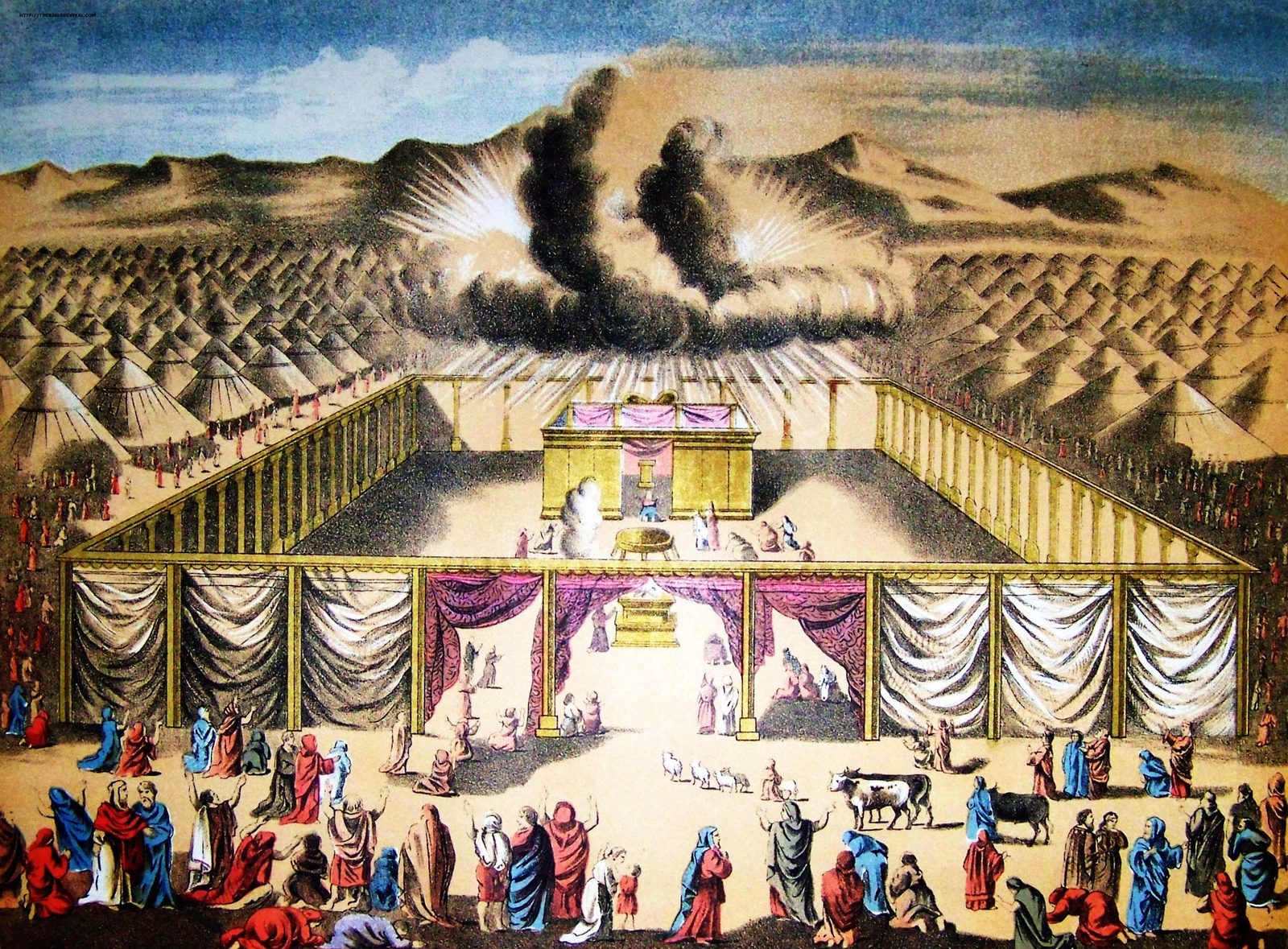
- The cloudExodus 40:34
- The campNumbers 2:2
- The tentExodus 26:1
- The postsExodus 27:10
- The altarExodus 27:1
- The basinExodus 30:18
- The linen curtainsExodus 27:9
- The gateExodus 27:16
illustrators of the 1890 Holman Bible, The Tabernacle in the Wilderness, 1890. Public domain.
Read from the gate inward.
What happened at the tent, in order
The tent served from the pattern at Sinai until Solomon brought it into the temple.
The tent was planned and built at Sinai, filled with the glory, carried through the wilderness, pitched at Shiloh, and last named at Gibeon before Solomon brought it up to the temple.
- The pattern givenMount SinaiExodus 25:9
- The tent set up and filled with glorySinai, the second yearExodus 40:17
- The LORD speaks from itSinaiLeviticus 1:1
- The Day of AtonementBehind the veilLeviticus 16:2
- The cloud lifts, the march beginsThe wildernessNumbers 10:11
- Pitched in the landShilohJoshua 18:1
- At the high placeGibeon1 Chronicles 21:29
- Brought into the templeJerusalem1 Kings 8:4
At the high place, Brought into the temple
Where the tent stood: Shiloh, Nob and Gibeon
The text places the tent at Shiloh and at Gibeon, and probably at Nob.
Shiloh is known: the whole congregation set up the Tent of Meeting there after the land was subdued, and Elkanah went up to it year after year in Eli's day.
Then the whole congregation of Israel assembled at Shiloh and set up the Tent of Meeting there. And though the land was subdued before them, there were still seven tribes of Israel who had not yet received their inheritance.The end at Shiloh1 paragraph
Psalm 78 and Jeremiah 7 remember that the LORD abandoned the tabernacle of Shiloh; neither says how the site was left.
Nob1 verse, 1 paragraph
Nob is probable: David found Ahimelech the priest there with the Bread of the Presence, which belonged on the tent's table, though the text never names the tent at Nob.
So the priest gave him the consecrated bread, since there was no bread there but the Bread of the Presence, which had been removed from before the LORD and replaced with hot bread on the day it was taken away.Gibeon1 verse, 1 paragraph
Gibeon is known: the Chronicler places the tabernacle Moses made and its bronze altar at the high place in Gibeon in the reigns of David and Solomon.
And Solomon and the whole assembly went to the high place at Gibeon because it was the location of God’s Tent of Meeting, which Moses the servant of the LORD had made in the wilderness.The seven stations
A priest walked past seven stations from the east gate inward, and Exodus gives the measures of each in cubits.
The New Testament itself reads the veil, the ark and the mercy seat, and later teachers read the other pieces.
East gate (the screen)station 1 of 7 · Exodus 27:16
Footprint: 20 cubits wide.
Height: 5 cubits.
Material: blue, purple and scarlet yarn with fine twisted linen, on 4 pillars with bronze bases and silver tops.
The court has one door, on the east side, facing the tent.
Source: Exodus 27:16.
Bronze altar (of burnt offering)station 2 of 7 · a tradition reads it so · Exodus 27:1-8; 38:1-7
Footprint: 5 × 5 cubits, square.
Height: 3 cubits.
Material: acacia wood overlaid with bronze, with four horns, a bronze grating and poles.
It is the first thing inside the gate, so no one comes nearer without a sacrifice.
Hebrews 13:10 says that believers have an altar.
Andrew Jukes (1847) reads it as the cross, where the sacrifice is consumed.
Sources: Exodus 27:1-8 and 38:1-7, Hebrews 13:10, Jukes 1847.
Bronze laverstation 3 of 7 · a tradition reads it so · Exodus 30:17-21; 38:8
Footprint: not given in the text.
Height: not given in the text.
Material: bronze, on a bronze stand, made from the mirrors of the women who served at the entrance.
The priests washed their hands and feet here before they served. Scripture gives no size for it.
Titus 3:5 and Ephesians 5:26 speak of the washing of regeneration and the washing by the word.
Ada Habershon (1898) reads it as the washing of regeneration.
Sources: Exodus 30:17-21 and 38:8, Titus 3:5, Habershon 1898.
Golden lampstand (menorah)station 4 of 7 · a tradition reads it so · Exodus 25:31-40; 37:17-24
Footprint: not given in the text.
Height: not given in the text.
Material: one talent of pure gold, about 34 kg, in hammered work, with seven lamps and cups shaped like almond blossoms.
It was the only light in the Holy Place and stood on the south side. Zechariah 4 sets a lampstand between two olive trees.
In John 8:12 Jesus calls Himself the light of the world.
Jukes (1847) and Habershon (1898) read it as Christ the light of the world and as a tree of light.
Sources: Exodus 25:31-40 and 37:17-24, John 8:12, Jukes 1847.
Table of the Presence (showbread)station 5 of 7 · a tradition reads it so · Exodus 25:23-30; 37:10-16
Footprint: 2 × 1 cubits.
Height: 1.5 cubits.
Material: acacia wood overlaid with pure gold, with a gold molding around it.
It stood on the north side, with twelve loaves always before the LORD.
In John 6:35 Jesus calls Himself the bread of life.
Habershon (1898) reads it as Christ the bread of life.
Sources: Exodus 25:23-30 and 37:10-16, John 6:35, Habershon 1898.
Altar of incensestation 6 of 7 · a tradition reads it so · Exodus 30:1-10; 37:25-28
Footprint: 1 × 1 cubit, square.
Height: 2 cubits.
Material: acacia wood overlaid with pure gold, with four horns.
It stood just before the veil, and its rising incense is read as prayer.
Hebrews 7:25 says Christ always lives to intercede, and Revelation 8:3-4 joins the incense to the prayers of the saints.
Habershon (1898) reads it as Christ's ceaseless intercession.
Sources: Exodus 30:1-10 and 37:25-28, Hebrews 7:25, Habershon 1898.
The veil, the ark and the mercy seatstation 7 of 7 · Scripture makes the link · Exodus 26:31-33; 25:10-22; 37:1-9
Footprint: the ark 2.5 × 1.5 cubits, and the mercy seat the same.
Height: the ark 1.5 cubits; the height of the mercy seat is not given.
Material of the veil: blue, purple and scarlet yarn with fine linen, worked with cherubim and hung on four pillars overlaid with gold, set in silver bases.
Material of the ark and mercy seat: the ark is acacia wood overlaid with pure gold inside and out, and the mercy seat is pure gold with two cherubim of hammered gold.
In the innermost room God speaks from between the two cherubim (Exodus 25:22). The room is a cube of 10 cubits, a figure derived from the boards.
Hebrews 10:20 names the curtain as Christ's body, Hebrews 9:4-5 lists what the ark held, and Romans 3:25 sets Christ forth as the mercy seat (hilastērion).
Hebrews reads the torn veil as His flesh opening the way, and Habershon (1898) reads the ark as the place where law and mercy meet.
Sources: Exodus 26:31-33, 25:10-22 and 37:1-9, Hebrews 9:4-5 and 10:20, Romans 3:25.
The cube of the inner room, derived from the boards2 rooms · Exodus 26:15-33
From the boards (each 10 × 1.5 cubits, Exodus 26:15-16) and the place of the veil, the usual reconstruction gives a tent 30 × 10 × 10 cubits. The veil divides it into a Holy Place of 20 cubits and an inner room that is a cube of 10 cubits. Solomon's inner sanctuary (1 Kings 6:20) and the New Jerusalem (Revelation 21:16) take the same form.
This measure is calculated: Exodus gives the sizes of the boards, and the size of each room follows from them.
The metals climb toward God3 metals · Exodus 25 to 38
Bronze stands in the court: the gate pillars, the altar and the laver.
Silver marks the thresholds: the bases, the tops of the pillars and the redemption money (Exodus 38:25-28).
Gold fills the Holy Place and the inner room: the lampstand, the table, the incense altar, the ark and the mercy seat.
Source: Exodus 25 to 38.
The tent's names, the Hebrews quotations and the dwelling thread
How Scripture itself names the tent and reads it, from Eden to the New Jerusalem.
Ten Hebrew and Greek words name the tent and its furniture.
Three of them form a chain from Moses to the last book: mishkan in Exodus, skēnoō in John's Gospel and skēnē in Revelation.
Each of the ten words is given with its sense and its place in the tent.
| Word | Sense | Its place in the tent |
|---|---|---|
| mishkan (H4908) | tabernacle, dwelling-place | The building's own name, from shakan, to dwell (Exodus 25:9). |
| kapporet (H3727) | mercy seat, atonement-cover | The lid of the ark, where God met Israel (Exodus 25:22). The Greek Old Testament renders it hilastērion. |
| shakan (H7931) | to dwell, settle, tabernacle | The verb of Exodus 25:8, that I may dwell, and the root of mishkan and of the later word Shekhinah. |
| zahav (H2091) | gold | The metal of the two rooms, first named in Eden (Genesis 2:11). |
| kerub (H3742) | cherub | The guardians east of Eden (Genesis 3:24), over the mercy seat and on the veil. |
| nechosheth (H5178) | bronze, copper | The metal of the court: the gate pillars, the altar and the laver. |
| menorah (H4501) | lampstand | The golden lampstand of seven branches (Exodus 25:31). |
| skēnē (G4633) | tent, tabernacle | The Greek word for the tent in Hebrews 8:2 and 9:11. |
| skēnoō (G4637) | to tabernacle, dwell | The Word tabernacled among us (John 1:14), and God will dwell with them (Revelation 21:3). |
| hilastērion (G2435) | mercy seat, propitiation | Used twice in the New Testament: for the mercy seat itself (Hebrews 9:5) and for Christ set forth as it (Romans 3:25). |
menorah (H4501), skēnē (G4633), skēnoō (G4637), hilastērion (G2435)
Five Old Testament texts Hebrews quotes about the tent5 texts · Hebrews 8 to 10
Hebrews argues from the tent by quoting the Old Testament in five places.
Exodus 25:40 in Hebrews 8:5: the tent was made to the pattern shown on the mountain, so it copies a heavenly sanctuary.
See to it that you make everything according to the pattern shown you on the mountain.Jeremiah 31:31 in Hebrews 8:8: the promise of a new covenant, quoted through Hebrews 8:12, turns the argument from the old tent to the new. It is the longest Old Testament quotation in the New Testament.
Behold, the days are coming, declares the LORD, when I will make a new covenant with the house of Israel and with the house of Judah.Exodus 24:8 in Hebrews 9:20: the blood of the covenant, sprinkled on the people.
So Moses took the blood, sprinkled it on the people, and said, “This is the blood of the covenant that the LORD has made with you in accordance with all these words.”Psalm 40:6 in Hebrews 10:5: Hebrews follows the Greek form of the psalm, which speaks of a body prepared, and sets Christ's body in place of sacrifice and offering.
Sacrifice and offering You did not desire, but my ears You have opened. Burnt offerings and sin offerings You did not require.Jeremiah 31:33 in Hebrews 10:16: the law written on the heart, the new covenant repeated as the argument closes, perfecting the worshippers.
“But this is the covenant I will make with the house of Israel after those days, declares the LORD. I will put My law in their minds and inscribe it on their hearts. And I will be their God, and they will be My people.Where God dwells, from Eden to the New Jerusalem9 texts · Genesis 3 to Revelation 21
Scripture opens with God walking in the garden and closes with His dwelling among His people, and the tabernacle stands between. G. K. Beale, The Temple and the Church's Mission (2004), traces that line through the tabernacle, the temple, Christ and the church to the New Jerusalem.
Genesis 3:8: God walks in the garden, and the man and his wife hide from Him.
Exodus 13:21: the pillar of cloud and fire leads Israel out.
Exodus 40:34: the glory fills the finished tent.
1 Kings 8:10: the glory fills Solomon's house.
Ezekiel 10 and 11: the glory (kabod) departs eastward in stages and leaves the sanctuary empty.
Luke 1:35: the power of the Most High overshadows Mary, the new dwelling.
John 1:14: the Word tabernacles (skēnoō) among us.
1 Corinthians 6:19: the believer's body is a temple of the Holy Spirit.
Revelation 21:3: God's dwelling (skēnē) is with His people.
The witnesses
died 458 · Theodoret of Cyrus
Hebrews reads the tent first, and the church's teachers read it after.
Theodoret of Cyrus was a bishop of the fifth century, Bede a monk of the eighth and John Calvin a reformer of the sixteenth.
The place where they serve is a copy and shadow of what is in heaven. This is why Moses was warned when he was about to build the tabernacle: “See to it that you make everything according to the pattern shown you on the mountain.”Hebrews calls the tent a copy and shadow of the heavenly sanctuary.
“The divine apostle, by ‘shadow of the heavenly things’ referred to the worship according to the law and confirms his statement with a scriptural testimony.”
Theodoret of Cyrus · Interpretation of Hebrews 8 · on Hebrews 8:5Patristic
died 735 · Bede
“Now the golden urn in the ark holding the manna is the holy soul in Christ that contains in itself all the fullness of divinity.”
Bede · On the Tabernacle 1.4.17Patristic
1509 to 1564 · John Calvin
“Then the old tabernacle was not the empty inventions of man, but the effigy of the heavenly tabernacle.”
John Calvin · Commentaries, on Hebrews 8:2Reformed
Sir Robert Anderson, in Types in Hebrews (1886), reads the priesthood, the sacrifices and the tent through the letter to the Hebrews.
Hebrews walks the two rooms1 text · Hebrews 9:2-5
A tabernacle was prepared. In its first room were the lampstand, the table, and the consecrated bread. This was called the Holy Place. Behind the second curtain was a room called the Most Holy Place, containing the golden altar of incense and the gold-covered ark of the covenant. Inside the ark were the gold jar of manna, Aaron’s staff that had budded, and the stone tablets of the covenant. Above the ark were the cherubim of glory, overshadowing the mercy seat. But we cannot discuss these things in detail now.Hebrews walks the two rooms in order and names the furniture of each.
Where the reading is contested
Two readings of the tent are debated among its teachers.
The first reads each piece of furniture as a picture of Christ, and the second reads Eden as the first sanctuary.
Each piece of furniture pictures Christheld by Habershon and Jukes · 3 texts the New Testament names
The typological tradition reads the laver as regeneration, the showbread as the bread of life, the lampstand as the light of the world and the incense altar as intercession. In this reading the furniture is a full portrait of Christ (Habershon 1898; Jukes 1847).
The objection: Fairbairn (1845) and, in the modern discussion, Goppelt (1982) separate the types the New Testament itself names from the readings a tradition adds. G. K. Beale draws the same line in his Handbook on the New Testament Use of the Old Testament (2012).
Fairbairn's rule, in The Typology of Scripture (1845–47), is that a type must be divinely intended and not merely resembling.
In their terms the New Testament names the tent a copy and shadow (Hebrews 8:5), the veil Christ's flesh (Hebrews 10:20) and Christ the mercy seat (Romans 3:25), and the other readings are edifying tradition.
Sources: Hebrews 8:5 and 10:20, Romans 3:25, Fairbairn 1845, Goppelt 1982.
The tabernacle repeats Eden, the first sanctuaryheld by Wenham and Beale · 5 parallels
Wenham (1986) and Beale (2004) read Eden as the first sanctuary. Cherubim guard the way to the tree of life east of Eden (Genesis 3:24) as they guard the mercy seat (Exodus 25:18), and both Eden and the tent open to the east. The gold and onyx of Eden (Genesis 2:11-12) return in the tent and on the high priest's ephod (Exodus 25:7), and gold (zahav) returns again in the temple and the New Jerusalem. The tree of life becomes the lampstand of seven branches (Exodus 25:31), and Adam's charge to work and keep the garden (Genesis 2:15) is a priest's charge.
Sacred materials mark sacred space.
In their reading, later temple imagery looks back on Eden as holy space.
The objection: Daniel Block, Eden: A Temple? A Reassessment (2013), argues that the parallels are overdrawn, and Samuel Sandmel's Parallelomania (JBL 81, 1962) warns against stacking loose verbal parallels into a system.
Sources: Wenham 1986, Beale 2004, Block 2013, Sandmel 1962.
Books to Read Next
On the Tabernacle
Bede · c. 730
Bede reads the tent piece by piece toward Christ and the church.
The Temple: Its Ministry and Services
Alfred Edersheim · 1874
Edersheim traces the worship the tent began into the temple of Jesus' day.
Biblical Commentary on the Old Testament: The Pentateuch
C. F. Keil and F. Delitzsch · 1864
Keil and Delitzsch worked through Exodus 25 to 40 verse by verse from the Hebrew, the measures and the materials first.
Draw near
The tent taught Israel that God dwells with His people and that the way in is by blood, one room at a time.
Hebrews draws the conclusion for the reader: since the way is opened through the curtain of Christ's body, draw near with a sincere heart.
Therefore, brothers, since we have confidence to enter the Most Holy Place by the blood of Jesus, by the new and living way opened for us through the curtain of His body, and since we have a great priest over the house of God, let us draw near with a sincere heart in full assurance of faith, having our hearts sprinkled to cleanse us from a guilty conscience and our bodies washed with pure water.The one place the New Testament names the curtain as a type, the body of Christ, and the call to draw near through it.
Sources
Scripture is the Berean Standard Bible.
- Strong's lexicon and the tagged Hebrew and Greek text, CC BY 4.0.
- H. B. Swete, The Old Testament in Greek, for kapporet rendered hilastērion at Exodus 25:17.
- Ada R. Habershon, The Study of the Types (Morgan & Scott, 1898)
- Andrew Jukes, The Law of the Offerings in Leviticus I to VII (Nisbet, 1847)
- Andrew Jukes, The Types of Genesis (Longmans, Green, 1898 edition)
- Sir Robert Anderson, Types in Hebrews (1886)
- Patrick Fairbairn, The Typology of Scripture (1845 to 1847)
- Jonathan Edwards, Types of the Messiah and Images of Divine Things (1740s)
- G. K. Beale, The Temple and the Church's Mission (2004)
- Gordon J. Wenham, Sanctuary Symbolism in the Garden of Eden Story (1986)
- Daniel I. Block, Eden: A Temple? A Reassessment (2013)
- Samuel Sandmel, Parallelomania (JBL 81, 1962)
- Leonhard Goppelt, TYPOS (English translation 1982)
- The Holman Bible, The Tabernacle in the Wilderness (1890), public domain.
- The Berean Standard Bible: Exodus 25 to 31 and 35 to 40, Hebrews 8 to 10, Romans 3:25, John 1:14, 6:35 and 8:12, Revelation 21.
- Alfred Edersheim, The Temple: Its Ministry and Services (1874)
- C. F. Keil and F. Delitzsch, Biblical Commentary on the Old Testament: The Pentateuch (1864)
- Theodoret of Cyrus, Interpretation of Hebrews; Bede, On the Tabernacle; John Calvin, Commentaries on Hebrews.
Keep Studying
Read it5
Studies8
People and groups9
Show the next 3 titles
Places10
Symbols28
Words10
Doctrines29
- The Day of Atonement
- God Dwelling with His People, from Eden to the New Jerusalem
- The High-Priestly Line
- The Mosaic Covenant
- Once for All: the Finished Sacrifice
- The Sacrificial System
Show the next 6 titles
- The Feast of Tabernacles
- The Blood
- The Glory Departed: Ezekiel 8-11
- The Glory That Filled the House
- The Golden Calf: Covenant Made, Broken, Remade
- The Half Shekel and the Temple Tax