
Nahum 1:2 to 8 · Doctrine · Featured Study
The Patience and the Wrath of God
Nahum 1:3 repeats over Nineveh the words the LORD spoke of Himself to Moses at Sinai.
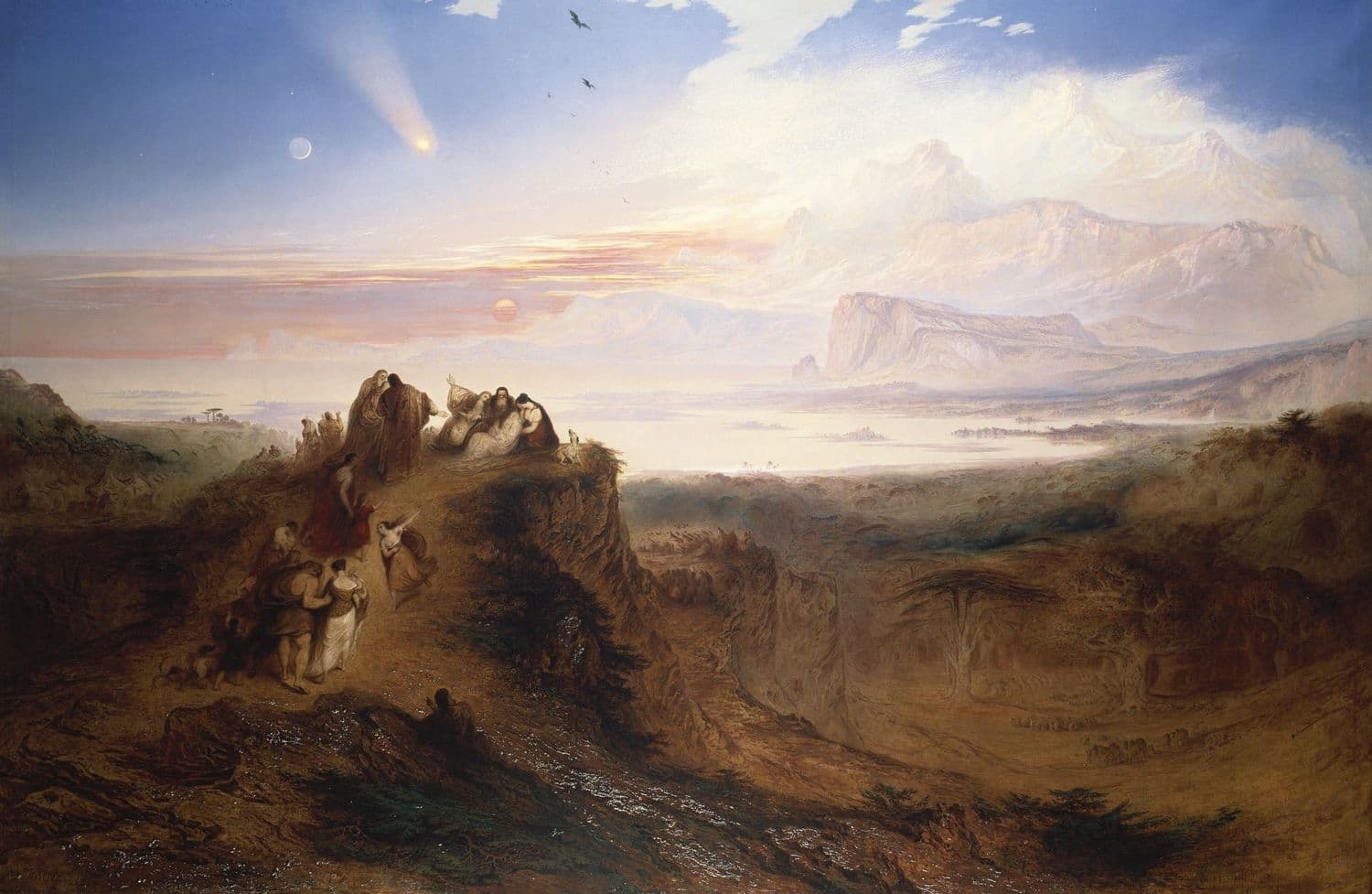
John Martin, The Eve of the Deluge, 1840, Royal Collection. Public domain, via Wikimedia Commons.
THE ARTWORKJohn Martin painted the last evening before the Flood, with a family gathered on a hilltop under a comet and a setting sun above a calm sea. He shows the last hour of patience before the waters rise, the order Exodus 34 sets out and Nahum repeats over Nineveh.
The LORD who spared Nineveh when it repented under Jonah judged the same city in the days of Nahum.
Summary
God's patience and His wrath are two sides of one character.
- In Exodus 34 the LORD who is slow to anger is the LORD who will by no means leave the guilty unpunished.
- Joel and Jonah quote the mercy of the LORD's name in Exodus 34 and stop before the clause on the guilty.
- Nineveh fell in 612 BC, as a Babylonian chronicle records.
- Paul writes that God's kindness leads you to repentance, and Peter that the Lord is patient, not wanting anyone to perish but everyone to come to repentance.
- Paul says God presented Christ as the atoning sacrifice so as to be just and to justify the one who has faith in Jesus.
Slow to Anger and Great in Power
Nahum opens his oracle against Nineveh with a hymn on the character of the LORD.
The LORD is a jealous and avenging God; the LORD is avenging and full of wrath. The LORD takes vengeance on His foes and reserves wrath for His enemies. The LORD is slow to anger and great in power; the LORD will by no means leave the guilty unpunished. His path is in the whirlwind and storm, and clouds are the dust beneath His feet.The two verses prove that the God who avenges and the God who is slow to anger are one God.
The Hebrew behind slow to anger is 'erek 'appayim, long of nostril, an idiom for anger that is slow to rise. The lexicon gives 'aph as the nose, and by extension the hard breathing of wrath.
The clause that follows doubles the verb naqah, to clear or to hold innocent. Jamieson, Fausset and Brown render it word for word as will not acquitting acquit, and John Calvin as by clearing he will not clear.
The words of verse 2qanno, naqam, natar
Verse 2 calls the LORD qanno, jealous, a word related to the qanna of Exodus 20:5. It uses naqam, to avenge or to punish, three times, and natar, to guard or keep, for the wrath He reserves for His enemies.
Rabbi Simon on the three vengeancesRashi on Nahum 1:2, after Seder Olam
Rashi records Rabbi Simon's reading that the three vengeances of verse 2 answer the three exiles Sennacherib brought on Israel.
One Name in Six Texts
The name proclaimed at Sinai returns in Numbers, Joel, Jonah, Micah and Nahum.
| Text | Its words on the LORD's anger | The occasion |
|---|---|---|
| Exodus 34:6 to 7 | Slow to anger ... Yet He will by no means leave the guilty unpunished | The covenant renewed at Sinai |
| Numbers 14:18 | Slow to anger ... Yet He will by no means leave the guilty unpunished | Moses pleads for Israel after the spies' report |
| Joel 2:13 | Slow to anger ... And He relents from sending disaster | A call to rend the heart and return |
| Jonah 4:2 | Slow to anger ... One who relents from sending disaster | Jonah's prayer of protest outside the city |
| Micah 7:18 | Who does not retain His anger forever | Micah's closing praise of the God who pardons |
| Nahum 1:3 | Slow to anger and great in power; the LORD will by no means leave the guilty unpunished | The oracle against Nineveh |
- Text
- Exodus 34:6 to 7
- Its words on the LORD's anger
- Slow to anger ... Yet He will by no means leave the guilty unpunished
- The occasion
- The covenant renewed at Sinai
- Text
- Numbers 14:18
- Its words on the LORD's anger
- Slow to anger ... Yet He will by no means leave the guilty unpunished
- The occasion
- Moses pleads for Israel after the spies' report
- Text
- Joel 2:13
- Its words on the LORD's anger
- Slow to anger ... And He relents from sending disaster
- The occasion
- A call to rend the heart and return
- Text
- Jonah 4:2
- Its words on the LORD's anger
- Slow to anger ... One who relents from sending disaster
- The occasion
- Jonah's prayer of protest outside the city
- Text
- Micah 7:18
- Its words on the LORD's anger
- Who does not retain His anger forever
- The occasion
- Micah's closing praise of the God who pardons
- Text
- Nahum 1:3
- Its words on the LORD's anger
- Slow to anger and great in power; the LORD will by no means leave the guilty unpunished
- The occasion
- The oracle against Nineveh
From Sinai to Nineveh
Exodus 34, Jonah 4, Romans 2 and 2 Peter 3 on the name and the delay it grants.
The LORD proclaimed His name at Sinai after Israel made the golden calf, to a people who had just broken the covenant. Its mercy and its justice were spoken in the same breath.
Jonah knew the name and quoted it in anger when Nineveh was spared.
Then the LORD passed in front of Moses and called out: “The LORD, the LORD God, is compassionate and gracious, slow to anger, abounding in loving devotion and faithfulness, maintaining loving devotion to a thousand generations, forgiving iniquity, transgression, and sin. Yet He will by no means leave the guilty unpunished; He will visit the iniquity of the fathers on their children and grandchildren to the third and fourth generations.”So he prayed to the LORD, saying, “O LORD, is this not what I said while I was still in my own country? This is why I was so quick to flee toward Tarshish. I knew that You are a gracious and compassionate God, slow to anger, abounding in loving devotion—One who relents from sending disaster.The New Testament names the purpose of the delay, in Paul's letter to Rome and in Peter's second letter.
Or do you disregard the riches of His kindness, tolerance, and patience, not realizing that God’s kindness leads you to repentance? But because of your hard and unrepentant heart, you are storing up wrath against yourself for the day of wrath, when God’s righteous judgment will be revealed.The Lord is not slow in keeping His promise as some understand slowness, but is patient with you, not wanting anyone to perish but everyone to come to repentance.What the Text Says and What Is Said of It
Four questions readers bring to God's patience and wrath, answered from Scripture and from the early church.
IS PATIENCE INDIFFERENCE?
A judge who postpones a sentence still means to pass it, and Paul names the day it is passed.
A WRATHFUL GOD OF THE OLD TESTAMENT?
Paul calls God just at the present time, in the gospel age itself.
IS GOD'S ANGER A LOSS OF TEMPER?
Nahum 1:2 says the LORD reserves wrath for His enemies, so His anger has a fixed object.
DID NINEVEH'S REPENTANCE COUNT FOR NOTHING?
Nahum 3:1 indicts the city for the blood and plunder of its own generation.
Tertullian answers Marcion from NinevehAgainst Marcion, book 2
Marcion taught that the just and angry Creator of the Old Testament was a different god from the good Father of Jesus.
Tertullian replied that the God who averted the ruin already announced against Nineveh, when its people repented, is most patient over the wicked. That God is also most generous to those who mourn their sins, so He is both judge and good.
Jerome and Theodoret on the patience shown to NinevehCommentaries on Nahum 1:3
Jerome read Nahum 1:3 as God's long endurance of the Assyrians' wrongs, borne with the strength of His magnanimity while He called them to repentance.
Theodoret of Cyrus read the same verse to the Ninevites themselves: they had repented and found salvation, so they were witnesses that God punishes only after long patience.
Nineveh Between Jonah and Nahum
Assyrian annals and a Babylonian chronicle bracket the years in which Nahum wrote, and Jewish tradition reads his book as the sequel to Jonah.
Jonah son of Amittai prophesied in the reign of Jeroboam II of Israel. Jamieson, Fausset and Brown place Nahum's prophecy about a hundred and fifty years after Jonah's.
Nahum speaks of the fall of Thebes in Egypt as past. Ashurbanipal of Assyria records in his annals that he took the city and carried off its treasure, and Zénaïde Ragozin dates the end of that Egyptian campaign to 665 or 664 BC.
A Babylonian chronicle in the British Museum, No. 21,901, dates the fall of Nineveh to 612 BC. Nahum describes that fall as still to come.
Rashi, the eleventh-century French commentator, quotes the paraphrase of the Targum of Jonathan: Jonah prophesied over Nineveh and the city repented, and when its people went on sinning, Nahum prophesied over it again.
This Jeroboam restored the boundary of Israel from Lebo-hamath to the Sea of the Arabah, according to the word that the LORD, the God of Israel, had spoken through His servant Jonah son of Amittai, the prophet from Gath-hepher.Are you better than Thebes, stationed by the Nile with water around her, whose rampart was the sea, whose wall was the water? Cush and Egypt were her boundless strength; Put and Libya were her allies. Yet she became an exile; she went into captivity. Her infants were dashed to pieces at the head of every street. They cast lots for her dignitaries, and all her nobles were bound in chains.What the Text Leaves Unsaid
Each of the three silences touches the length or the reach of God's patience.
Scripture gives no measure of how long God's patience runs before judgment falls, for a city or for a person.
Jonah 3 says Nineveh turned from its evil ways and God relented, and it leaves unsaid whether the city came to saving faith.
Nahum records no prophet sent to Nineveh in his own day, and his oracle is heard in Judah.
Why Patience and Wrath Belong Together
Spurgeon, Calvin and Wesley read Nahum 1, and Paul writes of vengeance in Romans 12 and of the atoning sacrifice in Romans 3.
Charles Spurgeon, preaching on Nahum 1:3, took great in power as the link between the two halves of the verse. He said the LORD is slow to anger because His power includes power over Himself, and that the same power makes it sure He will not acquit the wicked.
John Calvin read the verse as a concession aimed at those who presume on mercy. God is slow to wrath, Calvin wrote, yet the ungodly may not take His patience for weakness, since He remits no sin that He has not first condemned.
For the oppressed, the same justice is good news. John Wesley read the avenger of verse 2 as a governor whose office binds him to right the oppressed and to punish the oppressor.
The LORD is good, a stronghold in the day of distress; He cares for those who trust in Him.It shows that the wrath which falls on Nineveh is protection for those who trust in Him.
Do not avenge yourselves, beloved, but leave room for God’s wrath. For it is written: “Vengeance is Mine; I will repay, says the Lord.”Paul turns God's office as avenger into the believer's duty to wait on Him, quoting Deuteronomy 32:35.
The cross answers the question Nahum raises, how the God of Nahum 1:3 can forgive anyone.
God presented Him as the atoning sacrifice through faith in His blood, in order to demonstrate His righteousness, because in His forbearance He had passed over the sins committed beforehand. He did this to demonstrate His righteousness at the present time, so as to be just and to justify the one who has faith in Jesus.Paul joins in one act of God the two things Nahum 1:2 to 3 sets side by side, slowness to anger and justice.
How Nahum 1 Has Been Taught
Four commentaries of the eighteenth and nineteenth centuries on the hymn of Nahum 1.
John GillEighteenth century
Gill gives the slowness of verse 3 the same purpose Paul and Peter give God's patience.
“The Lord is slow to anger,.... He is not in haste to execute it; he takes time for it, and gives men space for repentance.”
John Gill · Exposition of the Old Testament (1748-1763) · on Nahum 1:3Reformed
John WesleyEighteenth century
Wesley marks verse 8 as the point where the hymn on the LORD's character becomes a sentence on one city.
“An over-running flood - His judgments like a mighty flood that overflows all banks, shall swallow up Assyria. Thereof - Of Nineveh, that is Nineveh itself.”
John Wesley · Explanatory Notes upon the Old Testament · on Nahum 1:8Evangelical
Adam ClarkeNineteenth century
Clarke answers the reader who fears the threats of the hymn.
“The Lord is good - In the midst of judgment he remembers mercy; and among the most dreadful denunciations of wrath he mingles promises of mercy. None that trust in him need be alarmed at these dreadful threatenings; they shall be discriminated in the day of wrath, for the Lord knoweth them that trust in him.”
Adam Clarke · Commentary on the Bible · on Nahum 1:7Evangelical
Jamieson, Fausset and BrownNineteenth century
Jamieson, Fausset and Brown explain how jealousy can belong to a God of love.
“jealous--In this there is sternness, yet tender affection. We are jealous only of those we love: a husband, of a wife; a king, of his subjects' loyalty. God is jealous of men because He loves them.”
Jamieson, Fausset & Brown · Commentary Critical and Explanatory on the Whole Bible · on Nahum 1:2Reformed
Where Readers Differ
Readers differ on whether anger in God is a feeling, and on the reign in which Nahum wrote.
Anger in God is as real as His loveLactantius, On the Anger of God · Early Latin apologetics
Lactantius wrote against philosophers who denied that God feels anger or kindness. He argued that a God who is never angry with the wicked cannot be said to love the righteous, and that God's patience is perfect because His virtue is perfect.
The objection is Augustine's: God's decisions are as unchanging as His foreknowledge is certain, so no emotion moves Him.
Anger in God is His settled judgmentAugustine, The City of God, book 15, chapter 25 · Latin theology
Augustine wrote that the anger of God is a judgment by which sin is punished, and that it leaves His tranquillity unchanged. Scripture speaks of anger, he said, to reach the proud and the careless where they are.
The objection is Lactantius', in his eighteenth chapter: faults cannot be punished without anger, so a judgment against sin carries anger in it.
Nahum prophesied under HezekiahJamieson, Fausset and Brown, Introduction to Nahum; John Wesley, Notes on Nahum · Protestant commentary
Jamieson, Fausset and Brown date Nahum to about 720 to 714 BC, reading Nahum 1:9 to 12 as Sennacherib's attack on Jerusalem. Wesley also places him in Hezekiah's reign.
Jamieson, Fausset and Brown meet the Thebes date, decades after Sennacherib's attack, by holding that Sargon took the city earlier, a capture they know from Nahum alone.
Nahum prophesied under ManassehRashi, after Seder Olam · Rabbinic commentary
Rashi says Nahum prophesied about the descendants of Sennacherib in the time of Manasseh.
The objection is Jamieson, Fausset and Brown's: the many phrases Nahum shares with Isaiah place him in Isaiah's generation, under Hezekiah.
Books to Read Next
Five works on Nahum 1, on anger in God and on the fall of Nineveh, each free to read online.
Commentaries on the Twelve Minor Prophets, volume 3, translated by John Owen
John Calvin · 1847
Calvin explains the hymn of Nahum 1 verse by verse in these lectures.
Read at the Christian Classics Ethereal LibraryMercy, Omnipotence, and Justice
Charles Spurgeon · 1857
Spurgeon preached this sermon on 21 June 1857, and it was printed in The New Park Street Pulpit.
Read at the Christian Classics Ethereal LibraryA Treatise on the Anger of God, translated by William Fletcher
Lactantius · 1886
Lactantius addressed this treatise to Donatus.
Read at New AdventThe City of God, translated by Marcus Dods
Augustine · 1887
The translation stands in the Nicene and Post-Nicene Fathers, First Series, volume 2.
Read at New AdventThe Fall of Nineveh
C. J. Gadd · 1923
Gadd edits and translates the Babylonian chronicle of Nineveh's fall.
Read at the Internet ArchiveRefuge in the LORD and Repentance Before Him
God's patience is real and has a purpose, and His justice is sure and keeps its time.
Nahum says the LORD cares for those who trust in Him, and Paul asks the reader to turn from a hard heart while God's kindness still waits.
Keep studying
Studies6
Places2
Symbols2