
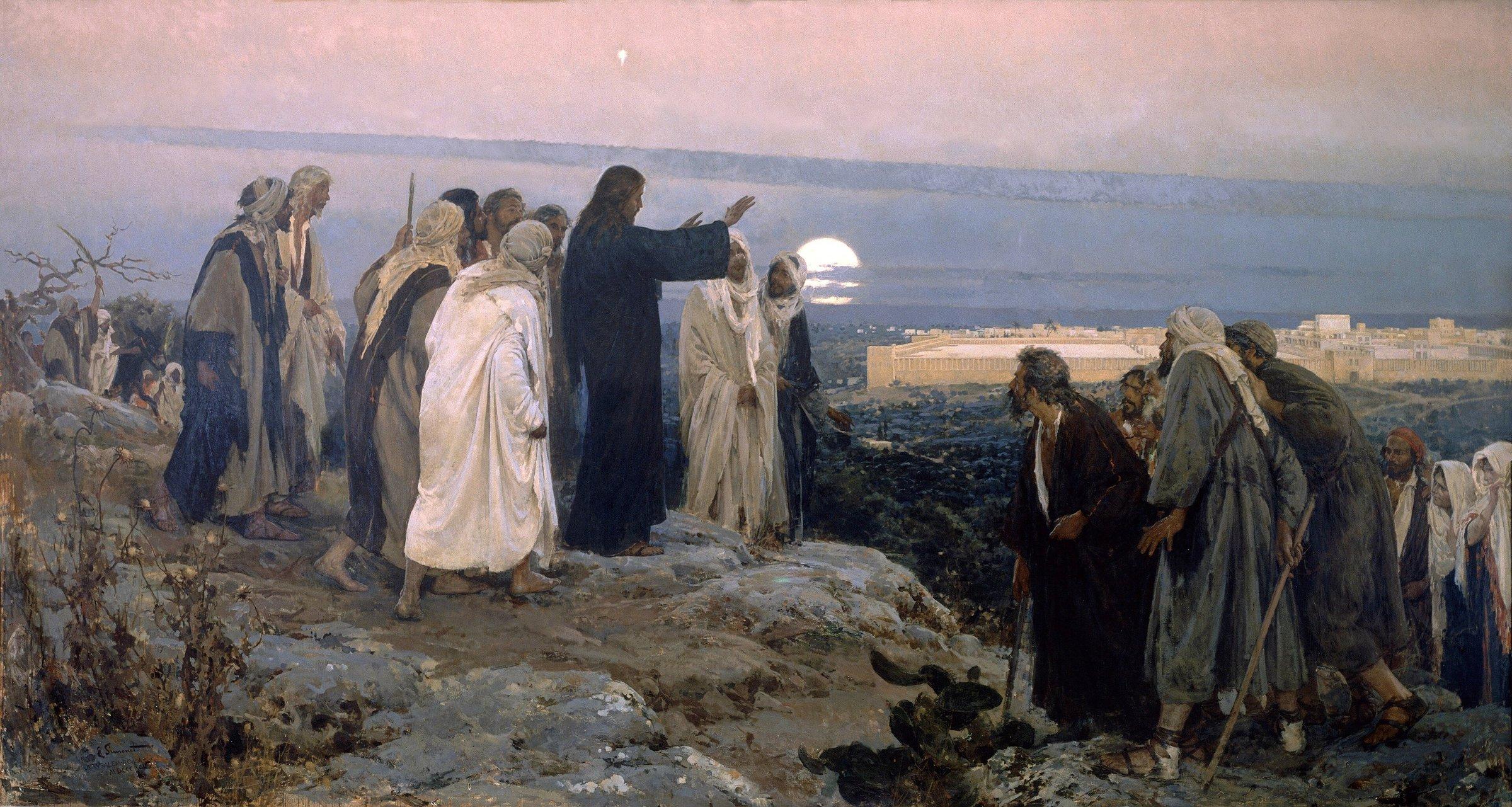
Enrique Simonet, Flevit super illam, 1892. Public domain.
Deuteronomy 30, Ephesians 2 and Philippians 2 · Debate · Featured Study
Free Will in the Bible
Christians agree that people make real choices and answer to God for them, and they differ over how grace moves a fallen will.
And you were dead in your trespasses and sins,
- The question
- Can a person fallen in sin choose to turn to God, or must God's grace first free the will?
- The texts
- Deuteronomy 30:19, Ephesians 2:1, Philippians 2:12 to 13
The words free will appear once in the Berean text, at Philemon 1:14, where they describe a kindness given without compulsion.
Summary
Free will is the power to choose. Augustine, Luther, Calvin, Wesley and the Council of Trent all held that a fallen will needs grace before it can turn to God.
- Augustine answered Pelagius, who held that not sinning lies within a person's power.
- Luther wrote that free will is a divine term that belongs to God alone.
- John of Damascus held that it is in our power to abide in virtue or to stray.
The Texts Both Sides Read
Four texts set a call to choose beside a will bound by sin.
I call heaven and earth as witnesses against you today that I have set before you life and death, blessing and cursing. Therefore choose life, so that you and your descendants may live,Moses makes the choice Israel's own.
Jesus replied, “Truly, truly, I tell you, everyone who sins is a slave to sin. A slave is not a permanent member of the family, but a son belongs to it forever. So if the Son sets you free, you will be free indeed.Jesus answers those who said they had never been slaves.
because the mind of the flesh is hostile to God: It does not submit to God’s law, nor can it do so. Those controlled by the flesh cannot please God.Paul says twice here what the flesh cannot do.
Therefore, my beloved, just as you have always obeyed, not only in my presence, but now even more in my absence, continue to work out your salvation with fear and trembling. For it is God who works in you to will and to act on behalf of His good purpose.Paul joins the believer's work to God's work in him.
Romans 8:7 to 8, Philippians 2:12 to 13
Four Answers
Each tradition answers in the words of its own confession or teachers.
The answers part on what grace does first and whether it can be refused.
| The question | Reformed | Wesleyan-Arminian | Roman Catholic | Chrysostom, Cassian and John of Damascus |
|---|---|---|---|---|
| Can the fallen will choose God unaided? | No: it has wholly lost all ability of will to any spiritual good accompanying salvation. | No: man has not saving grace of himself, nor of the energy of his free will. | No: without the grace of God it cannot move itself unto justice. | No: without God's co-operation and help we cannot will or do any good thing. |
| What does grace do first? | It quickens, heals and bends the will, and it does not take the will away. | Grace given to every person comes first and frees the will to answer. | It moves the will, and the will is not merely passive. | Grace works with the will at every step. |
| Can grace be refused? | No: those He effectually calls come most freely, being made willing by His grace. | Yes: the grace is not irresistible. | Yes: the will is able to reject it. | Yes: we can stray and follow the devil, who summons but cannot compel. |
Each Position in Its Own Words
Each position is quoted from the confessions and teachers who hold it.
The will bound until grace frees itMartin Luther; the Westminster Confession; the Canons of Dort; Jonathan Edwards
Luther pictured the will as a beast between two riders: when God sits on it, “it wills and goes where God will,” and when Satan sits on it, “it wills and goes as Satan will.”
The Westminster Confession grants the will a natural liberty, so that it is “neither forced, nor by any absolute necessity of nature determined to good or evil.”
The Canons of Dort say that the grace of regeneration “does not treat men as senseless stocks and blocks, nor take away their will and its properties.”
Jonathan Edwards separated two kinds of inability. A person is naturally unable to do a thing when he cannot do it if he wills, and morally unable when the inability “consists in the opposition or want of inclination.”
Grace goes before every person and frees the willJames Arminius; the Remonstrance; John Wesley
Arminius taught that in his lapsed and sinful state “man is not capable, of and by himself, either to think, to will, or to do that which is really good.”
He wrote that the whole controversy turns on one question: “is the grace of God a certain irresistible force?”
The Remonstrance answered in its fourth article that, as respects the mode of its operation, this grace “is not irresistible.”
Wesley wrote that salvation “begins with what is usually termed (and very properly) preventing grace; including the first wish to please God.”
He held that “there is no man, unless he has quenched the Spirit, that is wholly void of the grace of God.”
The will moved by grace co-operatesThe Council of Trent
At its sixth session the council held that a man receiving grace is not utterly without doing anything, “forasmuch as he is also able to reject it.”
Its fifth canon condemns anyone who says that since Adam's sin the free will of man is lost and extinguished.
Grace and the will working togetherJohn Chrysostom; John Cassian; John of Damascus
John Cassian wrote that “the grace of God always co-operates with our will for its advantage.”
Chrysostom read the Father's drawing of John 6:44 as help given to the will.
“The Manichaeans spring upon these words, saying, ‘that nothing lies in our own power’; yet the expression showeth that we are masters of our will. ‘For if a man cometh to Him,’ saith some one, ‘what need is there of drawing?’ But the words do not take away our free will, but show that we greatly need assistance. And He implieth not an unwilling comer, but one enjoying much succor.”
John Chrysostom · Homily on the Gospel of John 46 · on John 6:44Patristic
How the Question Was Argued
Augustine and Pelagius, Erasmus and Luther, and the Remonstrants and the Synod of Dort each disputed the question.
Augustine and PelagiusAugustine, On Nature and Grace and On Grace and Free Will
Against Pelagius, Augustine held both that “there is in a man a free choice of will” and that the will needs God's grace to choose the good.
Erasmus and LutherMartin Luther, The Bondage of the Will, translated by Henry Cole
Erasmus defined free will as a power of the human will by which a person may turn toward the things that lead to eternal salvation or away from them.
Luther quotes that definition in The Bondage of the Will, which he wrote as his answer.
The Remonstrants and the Synod of DortThe Remonstrance and the Canons of Dort, in Philip Schaff, The Creeds of Christendom, volume 3
The followers of Arminius set out five articles in the Remonstrance. The Synod of Dort answered them in its canons on five heads of doctrine, and its third and fourth heads speak of the will.
What the Text Leaves Unsaid
The doctrine takes its name from words the Bible uses of gifts.
The single word freewill stands in 22 verses of the Berean text, each time of an offering.
How the Teachers Read It
Augustine, Theodoret, Calvin and Matthew Henry read the texts of choosing and of bondage.
Augustine of Hippo (died 430)
ON GRACE AND FREE WILL 32
Augustine wrote on Philippians 2:13, one of the four texts both sides read.
“It is certain that it is we that will when we will, but it is He who makes us will what is good, of whom it is said (as he has just now expressed it), ‘The will is prepared by the Lord.’ Of the same Lord it is said, ‘The steps of a man are ordered by the Lord, and his way doth He will.’ Of the same Lord again it is said, ‘It is God who worketh in you, even to will!’ It is certain that it is we that act when we act; but it is He who makes us act, by applying efficacious powers to our will, who has said, ‘I will make you to walk in my statutes, and to observe my judgments, and to do them.’”
on Philippians 2:13Patristic
Theodoret of Cyrus (died 458)
INTERPRETATION OF THE LETTER TO THE ROMANS
Theodoret of Cyrus wrote on Romans 6:17, where Paul gives thanks for his readers' obedience.
“You who once were slaves to sin have broken away from it by the free will of your mind and have embraced spiritual teaching instead.”
on Romans 6:17Patristic
John Calvin (1509 to 1564)
Commentaries
Calvin wrote on Ephesians 2:1, which opens the passage that says it is by grace you have been saved.
“But what has this to do with the kingdom of God? What has it to do with a happy life, so long as every sentiment of the mind, and every act of the will, is death? Let this, then, be held as a fixed principle, that the union of our soul with God is the true and only life; and that out of Christ we are altogether dead, because sin, the cause of death, reigns in us.”
on Ephesians 2:1Reformed
Matthew Henry (1662 to 1714)
Commentary on the Whole Bible
Matthew Henry wrote on Ezekiel 18:32, the LORD's call to repent and live.
“What an absurd thing it is for you to choose death and damnation rather than life and salvation. Note, The reason why sinners die is because they will die; they will go down the way that leads to death, and not come up to the terms on which life is offered. Herein sinners, especially sinners of the house of Israel, are most unreasonable and act most unaccountably.”
on Ezekiel 18:32Puritan
The Positions Weighed
Each position meets an objection from Scripture or from the church's teachers.
Four positions stand in the debate.
| Position | Held by | Tradition | Representative work |
|---|---|---|---|
| The will bound until grace frees it | Augustine; Luther; Calvin; Edwards | Reformed and Lutheran | Edwards, Freedom of the Will |
| Grace goes before every person | Arminius; the Remonstrants; Wesley | Wesleyan-Arminian | Wesley, Sermon 85, On Working Out Our Own Salvation |
| The will moved by grace co-operates | The Council of Trent | Roman Catholic | The Council of Trent, Session 6 |
| Grace and the will working together | John Chrysostom; John Cassian; John of Damascus | Chrysostom, Cassian and John of Damascus | John of Damascus, Exposition of the Orthodox Faith, book 2 |
Against the bound will1 paragraph
Augustine himself asked of the commands of Scripture, “How does He make this requisition, if there is no free will?”
Against preventing grace1 verse, 1 paragraph
Ephesians 2 says the reader was dead in sin before God acted.
But because of His great love for us, God, who is rich in mercy, made us alive with Christ even when we were dead in our trespasses. It is by grace you have been saved!Paul answers Ephesians 2:1 within the same passage.
Against Trent's teaching1 paragraph
The Formula of Concord holds that in spiritual things the understanding and reason of man are altogether blind.
Against Chrysostom, Cassian and John of Damascus1 paragraph
The Council of Orange held, in 529, that no one can love God as he ought unless divine mercy goes before him.
Books to Read Next
Four of the works this question rests on are free to read.
On Grace and Free Will
Augustine of Hippo · 426 or 427
Augustine holds free will and grace together against the Pelagian teaching.
Read at New AdventThe Bondage of the Will
Martin Luther · 1525
Luther answers the Diatribe of Erasmus, here in Henry Cole's translation.
Read at the Christian Classics Ethereal LibraryFreedom of the Will
Jonathan Edwards · 1754
Edwards sets out natural and moral inability in the first part.
Read at the Christian Classics Ethereal LibrarySermon 85, On Working Out Our Own Salvation
John Wesley · 1872 edition
Wesley sets out preventing grace from Philippians 2:12 to 13.
Read at the Wesley Center OnlineCome and Drink
Scripture closes with an invitation to whoever desires to come.
The Spirit and the bride say, “Come!” Let the one who hears say, “Come!” And let the one who is thirsty come, and the one who desires the water of life drink freely.Deuteronomy 30:19 called Israel to choose, and this verse calls whoever desires.
Sources
Scripture is the Berean Standard Bible.
- Augustine of Hippo, On Grace and Free Will, chapters 2 and 4.
- Augustine of Hippo, On Nature and Grace, chapter 57.
- The Council of Orange (529), the conclusion.
- Martin Luther, The Bondage of the Will, translated by Henry Cole.
- Jonathan Edwards, Freedom of the Will, part 1, section 4.
- The Westminster Confession of Faith, chapters 9 and 10.
- Philip Schaff, The Creeds of Christendom, volume 3: the Remonstrance, articles 3 and 4, and the Canons of Dort, third and fourth heads, article 16.
- James Arminius, Declaration of Sentiments, in The Works of James Arminius, volume 1.
- John Wesley, Sermon 85, On Working Out Our Own Salvation.
- The Council of Trent, Session 6, chapter 5 and canon 5, translated by J. Waterworth (1848)
- The Formula of Concord, Epitome, article 2, Of Free Will.
- John Cassian, Conference 13, chapter 13.
- John of Damascus, Exposition of the Orthodox Faith, book 2, chapter 30.
- John Chrysostom, Homilies on the Gospel of John 46.
- Augustine of Hippo, On Grace and Free Will 32.
- Theodoret of Cyrus, Interpretation of the Letter to the Romans, on Romans 6:17.
- John Calvin, Commentary on Ephesians, on Ephesians 2:1.
- Matthew Henry, Commentary on the Whole Bible, 1710, on Ezekiel 18:32.
Keep Studying
People and groups8
Doctrines8