
The Letters of John · Doctrine
Those Who Denied Christ Came in the Flesh
The word antichrist occurs in the New Testament only in 1 John and 2 John.
John gave the churches one question to put to every teacher: does he confess that Christ has come in the flesh?
- First taught
- 1 John 2:22
- Fullest statement
- 1 John 4:2 to 3
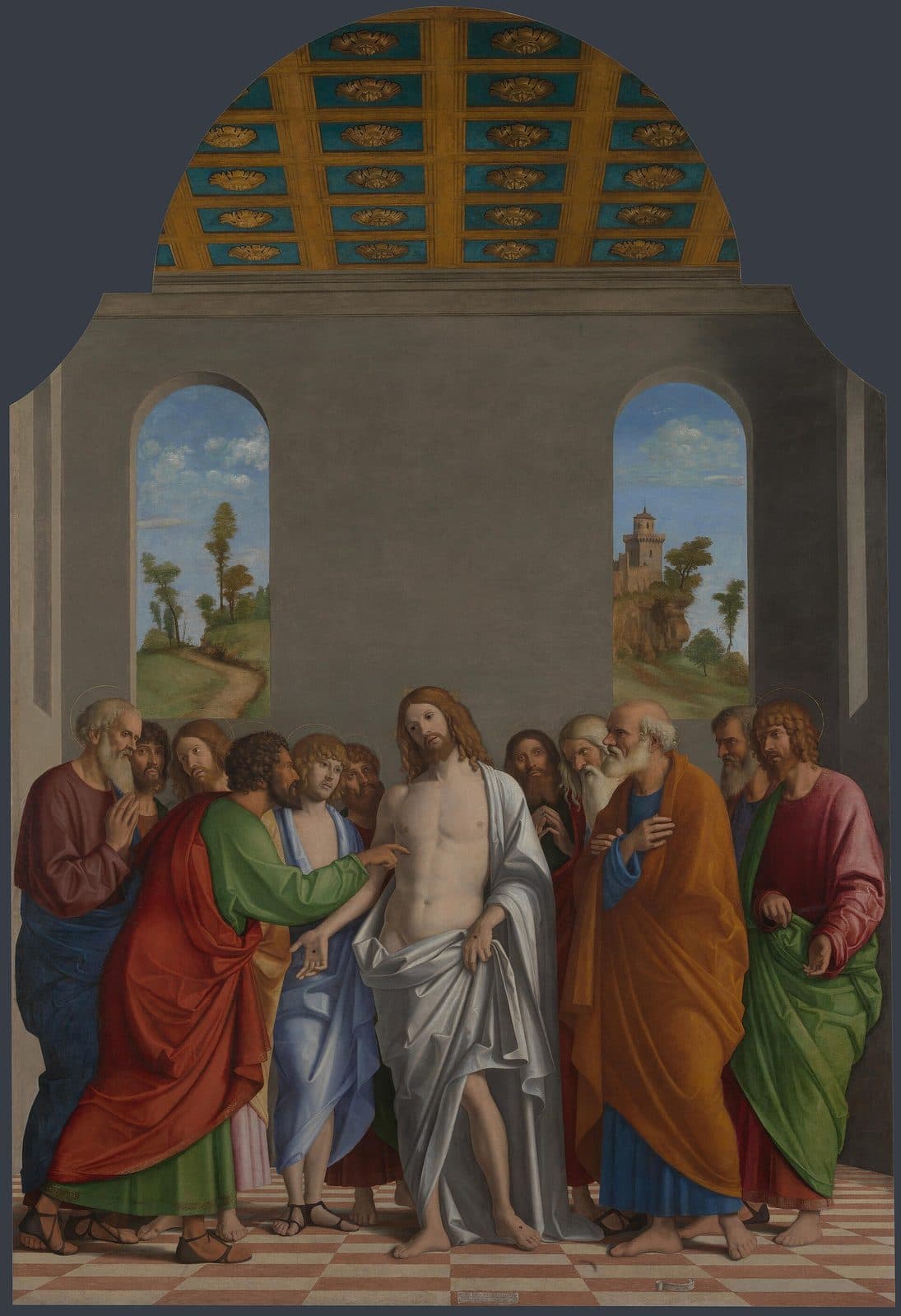
Cima da Conegliano, The Incredulity of Saint Thomas, about 1502 to 1504, National Gallery, London. Public domain, via Wikimedia Commons.
THE ARTWORKCima painted the risen Christ opening his robe so that Thomas could touch the wound in his side, with the apostles gathered round him under a coffered vault.
Summary
1 John 2:19 says the teachers went out from John's churches, and their departure made it clear that none of them belonged.
- Ignatius, Polycarp and Irenaeus report two errors: a Christ whose suffering was only an appearance, and a Christ who left the man Jesus before the cross.
- Irenaeus names one of the teachers, Cerinthus.
- Readers still divide over who the teachers were, what the present tense of the second letter means and how 1 John 4:3 reads.
The Test in Two Letters
Two verses state the test in full.
By this you will know the Spirit of God: Every spirit that confesses that Jesus Christ has come in the flesh is from God, and every spirit that does not confess Jesus is not from God. This is the spirit of the antichrist, which you have heard is coming and which is already in the world at this time.The test first answers how a church can tell which spirit speaks through a prophet.
For many deceivers have gone out into the world, refusing to confess the coming of Jesus Christ in the flesh. Any such person is the deceiver and the antichrist.Here the test passes from spirits to persons, so a church can apply it to the teachers it meets.
Four Verses Where the Word Antichrist Stands
In three of the four verses the antichrist is known by what he denies or will not confess.
| Verse | The passage it stands in |
|---|---|
| 1 John 2:18 | The warning of the last hour |
| 1 John 2:22 | The same warning, on the one who denies the Son |
| 1 John 4:3 | The testing of the spirits |
| 2 John 1:7 | The letter to the chosen lady |
- Verse
- 1 John 2:18
- The passage it stands in
- The warning of the last hour
- Verse
- 1 John 2:22
- The passage it stands in
- The same warning, on the one who denies the Son
- Verse
- 1 John 4:3
- The passage it stands in
- The testing of the spirits
- Verse
- 2 John 1:7
- The passage it stands in
- The letter to the chosen lady
What the Test Asks
The Greek verb for confess, homologeō, means to assent or acknowledge.
In 2 John 1:9 the one who remains in the teaching of Christ has both the Father and the Son.
The rule of the house in 2 John 1:10 to 11
If anyone comes to you but does not bring this teaching, do not receive him into your home or even greet him. Whoever greets such a person shares in his evil deeds.The reason in verse 11 shows that the rule guards the church against a false teacher's work.
“He says, ‘If any come unto you and bring not this doctrine, receive him not into your house, neither bid him God speed; for he that bids him God speed is partaker of his evil deeds.’ He forbids us to salute such, and to receive them to our hospitality. For this is not harsh in the case of a man of this sort. But he admonishes them neither to confer nor dispute with such as are not able to handle divine things with intelligence, lest through them they be seduced from the doctrine of truth, influenced by plausible reasons. Now, I think that we are not even to pray with such, because in the prayer which is made at home, after rising from prayer, the salutation of joy is also the token of peace.”
Clement of Alexandria · From the Latin Translation of Cassiodorus · on 2 John 1:10Patristic
Two more Greek words in the testAbbott-Smith, Manual Greek Lexicon of the New Testament
John's word for deceiver, planos, names an impostor or misleader. His word for flesh, sarx, can name the body, and it can name a human being as such.
The Teachers in the Early Witnesses
Writers of the next generations describe what the deniers taught.
Ignatius of Antioch wrote his letters on the way to his death at Rome, which fell between 98 and 117. He warns the church at Smyrna against teachers who said Christ only seemed to suffer.
They would not confess that he had a real body, and they kept away from the Eucharist because they did not confess it to be his flesh.
Polycarp of Smyrna takes up John's test in his letter to the church at Philippi.
Irenaeus, who was sent to Rome in 177 or 178 and then became bishop of Lyons, names a teacher. Cerinthus taught that Jesus was the son of Joseph and Mary, that the Christ came down on him at his baptism, and that the Christ left him before he suffered.
Irenaeus says John wrote his Gospel to remove that error. From those who had heard Polycarp, he adds that John ran out of a bath-house at Ephesus when he found Cerinthus inside.
Jerome, in his Dialogue against the Luciferians, writes that while the apostles were still in Judea some already called the Lord's body a phantom.
The Flesh in the Creeds
A creed of the church and two councils kept John's test in their own words.
| Confession | Its words on the flesh of Christ |
|---|---|
| The Apostles' Creed | born of the Virgin Mary, suffered under Pontius Pilate, was crucified, dead, and buried |
| The Creed of Nicaea, 325 | came down and was incarnate and was made man; he suffered, and the third day he rose again |
| The Definition of Chalcedon, 451 | very God and very man, of a reasonable soul and body, consubstantial with us as touching his manhood |
- Confession
- The Apostles' Creed
- Its words on the flesh of Christ
- born of the Virgin Mary, suffered under Pontius Pilate, was crucified, dead, and buried
- Confession
- The Creed of Nicaea, 325
- Its words on the flesh of Christ
- came down and was incarnate and was made man; he suffered, and the third day he rose again
- Confession
- The Definition of Chalcedon, 451
- Its words on the flesh of Christ
- very God and very man, of a reasonable soul and body, consubstantial with us as touching his manhood
The Definition of Chalcedon also condemns those who say that the form of a servant he took was of a heavenly substance, or of any substance other than the one taken from us.
What the Text Leaves Unsaid
Three matters about the teachers stand outside John's words.
John gives no name, city or school for the teachers. Neither the name Cerinthus nor the word docetism appears in his letters, and the heading that names the Docetae in the English edition of Polycarp's letter is the editors' own.
Whether any of the teachers doubted that a man named Jesus had lived, the letters leave unsaid.
The bath-house story rests on Irenaeus alone.
Why the Flesh Is the Test
Writers from Ignatius to Wesley explain why the flesh decides the test.
John Calvin finds three things in the confession. The word came shows that the Son was with the Father before. The words in the flesh show that he became a real man of our nature. The coming also had a cause, the work the Father sent him to do.
In his letter to the Trallians, Ignatius asked why he was in chains, and whether he would die in vain, if the passion of Christ were not real.
John Wesley wrote that this coming presupposes, contains and draws after it the whole doctrine of Christ.
That which was from the beginning, which we have heard, which we have seen with our own eyes, which we have gazed upon and touched with our own hands—this is the Word of life.It shows that John's authority over the teachers rests on his own witness of Christ's body.
This is the One who came by water and blood, Jesus Christ—not by water alone, but by water and blood. And it is the Spirit who testifies to this, because the Spirit is the truth.It places the death of Christ within his coming, so the cross belongs to the confession.
Then Jesus said to Thomas, “Put your finger here and look at My hands. Reach out your hand and put it into My side. Stop doubting and believe.”It answers a Christ who only seemed to have a body with the body of the resurrection.
Now since the children have flesh and blood, He too shared in their humanity, so that by His death He might destroy him who holds the power of death, that is, the devil,It answers why the Son took flesh at all: the death that saves required a body.
Four Voices on the Test
Each speaks in his own words, from the second century to the fifth.
The flesh of the risen Christ
“For I know that after His resurrection also He was still possessed of flesh, and I believe that He is so now. When, for instance, He came to those who were with Peter, He said to them, ‘Lay hold, handle Me, and see that I am not an incorporeal spirit.’ And immediately they touched Him, and believed, being convinced both by His flesh and spirit. For this cause also they despised death, and were found its conquerors. And after his resurrection He did eat and drink with them, as being possessed of flesh, although spiritually He was united to the Father.”
Ignatius of Antioch · Epistle of Ignatius to the Smyrnaeans · on Luke 24:39 to 43Patristic
The test, with the cross added
“‘For whosoever does not confess that Jesus Christ has come in the flesh, is antichrist;’ and whosoever does not confess the testimony of the cross, is of the devil; and whosoever perverts the oracles of the Lord to his own lusts, and says that there is neither a resurrection nor a judgment, he is the first-born of Satan.”
Polycarp of Smyrna · Epistle to the Philippians 7 · on 1 John 4:3Patristic
The antichrists of John's letter
“But in his epistle he especially designates those as ‘Antichrists’ who ‘denied that Christ was come in the flesh,’ and who refused to think that Jesus was the Son of God.”
Tertullian · The Prescription Against Heretics · on 1 John 4:3Patristic
A denial made in deeds
“‘How,’ sayest thou, ‘do I deny in deeds?’ Because the end for which Christ came in the flesh, was, that He might die for us. He died for us, because therein He taught much charity. ‘Greater charity than this hath no man, that a man lay down his life for his friends.’ Thou hast not charity, seeing thou for thine own honor dividest unity. Therefore by this understand ye the spirit that is from God. Give the earthen vessels a tap, put them to the proof, whether haply they be cracked and give a dull sound: see whether they ring full and clear, see whether charity be there. Thou takest thyself away from the unity of the whole earth, thou dividest the Church by schisms, thou rendest the Body of Christ. He came in the flesh, to gather in one, thou makest an outcry to scatter abroad.”
Augustine of Hippo · Ten Homilies on 1 John 6 · on 1 John 4:2 to 3Patristic
Seven Positions Readers Hold
The holders run from Ignatius in the early second century to Jamieson, Fausset and Brown in 1871.
The teachers held that the Christ rested on Jesus and left himIrenaeus, Against Heresies 1.26.1 and 3.16.8 · the church fathers
Irenaeus reads both letters against those who say that Jesus was one and the Christ another. He quotes 2 John 1:7 to 8 and 1 John 4:1 to 3 together, as words of John's epistle.
The objection is that the teachers Ignatius met at Smyrna denied the body itself, which a parting of Jesus from the Christ does not explain.
The teachers held that his body and suffering only seemed realIgnatius, Epistle of Ignatius to the Smyrnaeans 2 and 5; Jerome, The Dialogue against the Luciferians 23 · the church fathers
Ignatius and Jerome hold it on the strength of their own reports.
The objection is that the one teacher Irenaeus names held Jesus to be a real man.
The teachers were GnosticsAdam Clarke, Commentary on the Bible, 1832 · Methodist
Adam Clarke takes the deceivers of 2 John 1:7 to have been Gnostics, since they denied that Jesus came in the flesh.
The objection is that the reports which give the teachers a system were all written after John.
The coming in 2 John 1:7 is his coming at the incarnationJohn Wesley, Explanatory Notes, 1755 · Methodist
In 1 John 4:2 the Greek has a perfect participle, elēluthota, having come; in 2 John 1:7 it has a present one, erchomenon, which the Berean text renders the coming.
John Wesley renders the clause of the Christ that came in the flesh.
The objection is the tense: John could have repeated the perfect of his first letter and chose the present.
The coming in 2 John 1:7 takes in both adventsJamieson, Fausset and Brown, Commentary, 1871 · Anglican and Scottish Presbyterian
Jamieson, Fausset and Brown read the present participle as covering both the first and the second advent of Christ, so that the deniers refused his coming in the flesh past and to come.
The objection is the parallel in the first letter, where the same confession speaks of a coming already made.
1 John 4:3 as the Greek manuscripts give itAdam Clarke, Commentary on the Bible, 1832 · Methodist
Adam Clarke lists the Alexandrian and Vatican manuscripts and the old versions as lacking the words is come in the flesh in this verse.
The objection is the age of the other reading, attested in the second century.
1 John 4:3 as Irenaeus, Socrates and Augustine quote itIrenaeus, Against Heresies 3.16.8; Socrates, Church History 7.32; Augustine, Ten Homilies on 1 John, Homily 6 · the church fathers and the Latin text
Irenaeus's words are every spirit which separates Jesus Christ, and Augustine's Latin reads solvit, undoes, to the same effect. The Greek verb behind separates is lyō, to loosen or dissolve.
Socrates, the church historian, writes that the ancient copies read so, and that the words were changed by those who wished to part the divinity of Christ from his manhood.
The objection is the Greek manuscripts themselves.
Books on the Teachers
A reader can open each of these five works for free.
Against Heresies
Irenaeus of Lyons · second century
Irenaeus wrote five books against the teachers of his day, and his first and third books carry his account of Cerinthus.
Read it at New AdventEpistle of Ignatius to the Smyrnaeans
Ignatius of Antioch · early second century
Ignatius writes to the church at Smyrna on the true passion of Christ, the subject of the letter's second chapter.
Read the 1885 translationEpistle to the Philippians
Polycarp of Smyrna · early second century
Polycarp sent this letter to Philippi with the letters of Ignatius, which he had gathered.
Read the 1885 translationTen Homilies on 1 John
Augustine of Hippo · early fifth century
Augustine preached through the letter, and his sixth homily takes up 1 John 4:1 to 3.
Read the 1888 translationCommentaries on the Catholic Epistles
John Calvin · translated 1855
Calvin reads 1 John 4:1 to 3 phrase by phrase, from the testing of the spirits to the spirit of the antichrist.
Read it at CCELConfessing Christ Come in the Flesh
The Son of God took a body that could be touched and wounded, and in that body he died and rose. John asks the reader to confess him so, and to remain in his teaching.
Keep studying
Studies8
Doctrines5
Go further1