
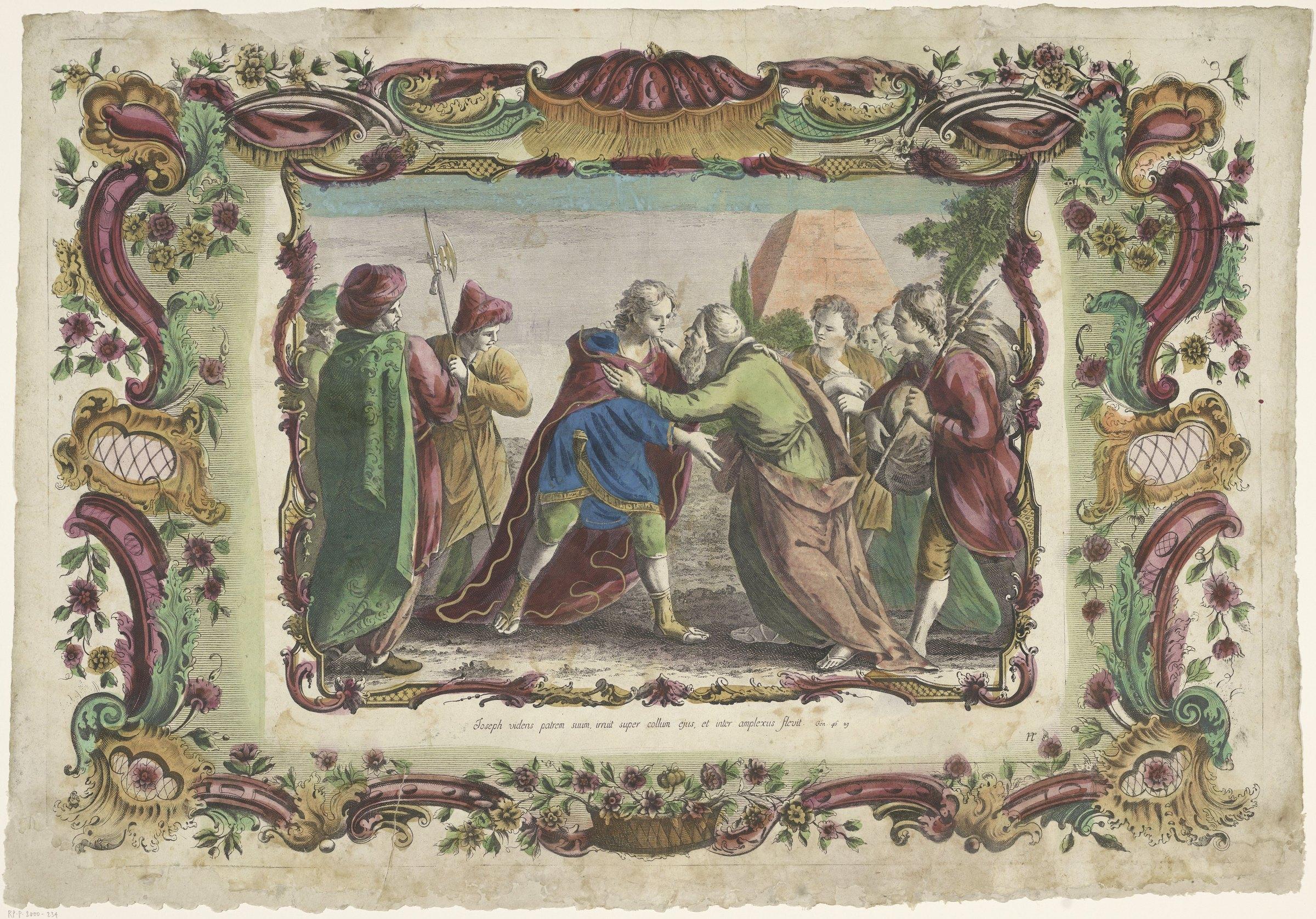
Joseph Meets His Father in Goshen, hand-coloured print, eighteenth century. Public domain.
Genesis 45 to Exodus 9 · Place · Featured Study
Goshen
Goshen was the district of Egypt where Pharaoh settled Jacob's family during the famine.
You shall settle in the land of Goshen and be near me—you and your children and grandchildren, your flocks and herds, and everything you own.
- Today
- The eastern Nile Delta, Egypt, on most proposals
- Region
- Lower Egypt, between the Nile and the eastern desert
- First named
- Genesis 45:10 “…settle in the land of Goshen and be…”
- Last named
- Exodus 9:26 “…was in the land of Goshen, where the…”
Pharaoh offered to put the ablest of Jacob's sons in charge of his own livestock.
Summary
Goshen was the land in Egypt where Israel lived from Jacob's arrival to the night of the exodus.
- Pharaoh called it the best part of the land, and Genesis 47:11 calls the same grant the district of Rameses.
- The Greek translation of Genesis calls it Gesem of Arabia.
- Four of the five proposals place it east of the Bubastic branch of the Nile, and no verse draws its border.
- Exodus records that the flies and the hail did not come on the land of Goshen.
The Best Part of the Land
Joseph promised his father Goshen before Pharaoh granted it.
the land of Egypt is before you; settle your father and brothers in the best part of the land. They may dwell in the land of Goshen. And if you know of any talented men among them, put them in charge of my own livestock.”Pharaoh's grant turns Joseph's promise into the king's own order.
Good for evilMatthew Henry
“But how shall he dispose of his brethren? Time was when they were contriving to get rid of him; now he is contriving to settle them to their satisfaction and advantage: this is rendering good for evil.”
Matthew Henry · Commentary on the Whole Bible · on Genesis 46:31Puritan
Goshen on the Delta Plate
Five proposed places for Goshen, each drawn with its certainty and the writer who placed it there.
Josephus, writing in the first century, sets Jacob's family at Heliopolis, near the head of the Delta, and the other proposals lie east of it.
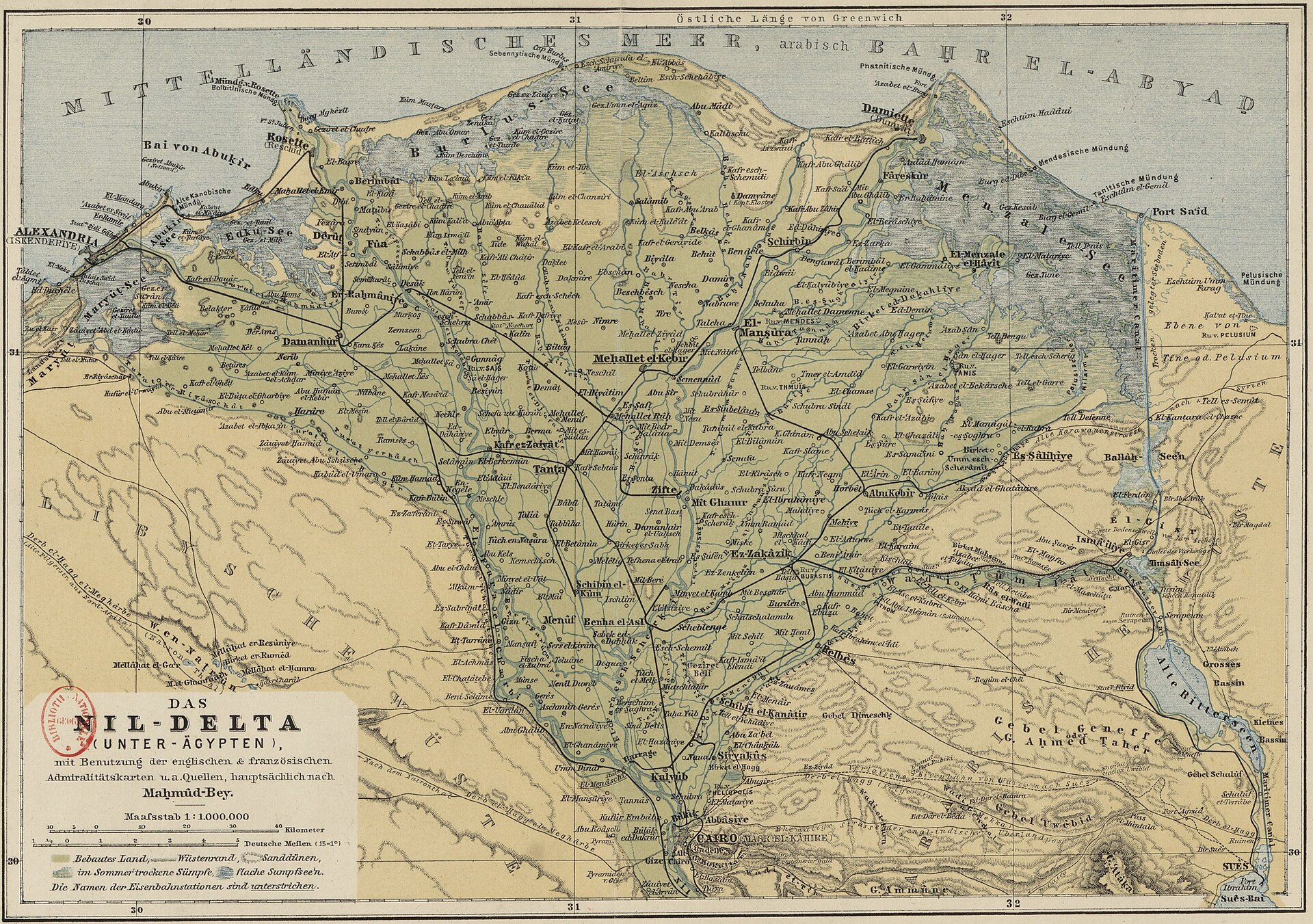
50 km (31 miles)
- 1?Saft el-Henna, Proposed, Pa Sopt, the town of Goshen and capital of the nome of Arabia; Edouard Naville Genesis 45:10
- 2?Faqus, Proposed, Phakousa, the nome's capital as it is usually placed; the International Standard Bible Encyclopedia of 1915 Genesis 47:4
- 3?Wadi Tumilat, Proposed, as a region, The valley between the eastern Delta and the border of Palestine; Easton's Bible Dictionary of 1897 Genesis 47:27
- 4?Heroonpolis, Proposed, The city of Heroes in the Greek Genesis, which the same encyclopedia places in that valley; drawn at Tell el-Maskhuta Genesis 46:28
- 5?Heliopolis, Proposed, The city where the king's shepherds had their pasture; Flavius Josephus Genesis 41:45
Base map: The Nile Delta (Lower Egypt), Ernst Debes, Wagner und Debes, Leipzig (19th century), public domain. Each place stands at the point cited for each, set on the plate by Bubastis and Suez, as the plate prints them.
Naville placed Phakousa at Saft, where the encyclopedia of point 2 places it at Faqus, so points 1 and 2 mark one disputed capital, and each point is a proposal.
From the Meeting to the Plagues
Each of ten verses gives Goshen a part in Israel's story.
Israel lived in Goshen from Joseph's promise until the night it set out from Rameses.
- Joseph sends word that his father shall settle in GoshenPromisedGenesis 45:10
- Judah goes ahead to get directions to Goshen, and Joseph meets Jacob thereThe meeting placeGenesis 46:28
- The brothers ask Pharaoh to let them settle in Goshen because of the famineAsked forGenesis 47:4
- Joseph gives his family property in the district of RamesesGrantedGenesis 47:11
- The Israelites acquire property and increase greatly in numberHomeGenesis 47:27
- The children and the flocks stay in Goshen while Jacob is buried in CanaanLeft behindGenesis 50:8
- The Israelites build Pithom and Rameses as store cities for PharaohForced labourExodus 1:11
- No swarms of flies are found in the land of GoshenSparedExodus 8:22
- It does not hail in the land of GoshenSparedExodus 9:26
- The Israelites set out from Rameses to SuccothLeftExodus 12:37
In the order of the books.
The Israelites build Pithom and Rameses as store cities for Pharaoh, No swarms of flies are found in the land of Goshen, It does not hail in the land of Goshen, The Israelites set out from Rameses to Succoth
Goshen, Rameses and Gesem
The Hebrew text and its Greek translation name the land and the place of meeting in different words.
Genesis gives the land two Hebrew names, and the Septuagint adds Arabia to one of them and names a city for the meeting.
| Name | Where it stands | Text |
|---|---|---|
| The land of Goshen | The first message to Jacob and the king's words | Genesis 45:10 and Genesis 47:6 |
| The district of Rameses | The property Joseph gave his family | Genesis 47:11 |
| Gesem of Arabia | The Greek translation of Joseph's promise and of his advice to his brothers | Genesis 45:10 and Genesis 46:34, Greek |
| The city of Heroes, in the land of Ramesses | The Greek translation of the place where Joseph met Jacob | Genesis 46:28 to 29, Greek |
Jerome on the Greek namesJerome, Hebrew Questions on Genesis
Jerome writes in his Hebrew Questions on Genesis that the Hebrew has no city of Heroum and no land of Ramesse in this verse, but only Gesen. He adds that some Jews said Gesen was now called the Thebaid.
Shepherds Apart From Egypt
Joseph's advice to his brothers made the Egyptians' view of shepherds the reason for settling them in Goshen.
you are to say, ‘Your servants have raised livestock ever since our youth—both we and our fathers.’ Then you will be allowed to settle in the land of Goshen, since all shepherds are detestable to the Egyptians.”The last clause of the verse gives the custom Joseph was counting on.
They separately served Joseph, his brothers, and the Egyptians. They ate separately because the Egyptians would not eat with the Hebrews, since that was detestable to them.Joseph's meal shows that the separation of Genesis 46:34 was already the custom before the family came down.
A confession that cost JosephJohn Calvin
John Calvin, in his commentary on Genesis 47:3, calls the brothers' confession humiliating to them and to Joseph, because the shepherd's life was held disgraceful among the Egyptians.
What the Text Leaves Unsaid
No verse draws Goshen's border, and Exodus names it in only two of the ten plagues.
The only place where it did not hail was in the land of Goshen, where the Israelites lived.The hail is the last plague in which Exodus names Goshen; for the darkness, Exodus 10:23 speaks of the dwellings of the Israelites instead.
A second Goshen in JudahJoshua 10:41 and Joshua 15:51
Joshua conquered the area from Kadesh-barnea to Gaza, and the whole region of Goshen as far as Gibeon.This Goshen lies in the south of Canaan, far from the Nile, and shares only its name with Jacob's land.
Goshen, Holon, and Giloh—eleven cities, along with their villages.This verse names a town, apart from the region of Joshua 10:41, so Judah had both.
A Distinction Between My People and Yours
The flies are the first plague in which Exodus says the LORD made a distinction for His people.
But on that day I will give special treatment to the land of Goshen, where My people live; no swarms of flies will be found there. In this way you will know that I, the LORD, am in the land. I will make a distinction between My people and your people. This sign will take place tomorrow.’”Pharaoh had asked in Exodus 5:2 who the LORD was, and this sign gives the answer in his own country.
Where Goshen Lay
Three readings place Goshen around Saft el-Henna, along the Wadi Tumilat or at Heliopolis.
So Joseph settled his father and brothers in the land of Egypt and gave them property in the best part of the land, the district of Rameses, as Pharaoh had commanded.Every reading has to account for the second name Genesis gives the grant, the district of Rameses.
The nome of Arabia around Saft el-HennaEdouard Naville
Edouard Naville published The Shrine of Saft el Henneh and the Land of Goshen for the Egypt Exploration Fund. He wrote that he had found "the land and town of Goshen, viz. the country around Saft, within the triangle formed by the village of Saft, Belbeis, and Tell el Kebir" (page 16). He took the town of Saft, Pa Sopt, for the capital of the nome of Arabia (page 21).
East of the Bubastic branch, with the Wadi TumilatThe International Standard Bible Encyclopedia; Easton's Bible Dictionary
The International Standard Bible Encyclopedia of 1915 writes, "It is generally agreed that Goshen was the region East of the Bubastic branch of the Nile". Easton's Bible Dictionary of 1897 writes that Goshen "has been identified with the modern Wady Tumilat".
Heliopolis, near the head of the DeltaFlavius Josephus; Adam Clarke
Josephus writes in the Antiquities of the Jews that Pharaoh gave Jacob "leave to live with his children in Heliopolis; for in that city the king's shepherds had their pasturage" (2.7.6 in Whiston's numbering). Adam Clarke's note on Genesis 46:34 gives the district of Heliopolis as well.
Books to Read Next
Four works on Goshen that a reader can open free, from Josephus to Naville's report.
The Shrine of Saft el Henneh and the Land of Goshen
Edouard Naville · 1885
On page 17 Naville cites the words terra Arabia, terra Gesse from Egeria.
READ IT FREE AT ARCHIVE.ORG →The Septuagint Version of the Old Testament
Lancelot C. L. Brenton, translator · 1851
Brenton gives the whole Greek Old Testament in English, with notes where it differs from the Hebrew.
READ IT FREE AT EBIBLE.ORG →Antiquities of the Jews
Flavius Josephus, translated by William Whiston · first century
Josephus covers in book 2 the years from the death of Isaac to the exodus out of Egypt.
READ IT FREE AT GUTENBERG →International Standard Bible Encyclopedia, Goshen
C. R. Conder · 1915
The article weighs the Greek names, Phakousa and the Wadi Tumilat.
READ IT FREE AT BIBLEHUB →Out of Egypt I Called My Son
Matthew 2:15 takes Hosea's words about Israel leaving Egypt and applies them to Jesus. The reader is asked to receive Him as the Son God called out of Egypt.
Sources
Scripture is the Berean Standard Bible.
- Edouard Naville, The Shrine of Saft el Henneh and the Land of Goshen, Egypt Exploration Fund, the copy whose title page reads 1885, pages 16 and 21.
- Lancelot C. L. Brenton, The Septuagint Version of the Old Testament (1851), Genesis 45:10, 46:28 to 29 and 46:34.
- Flavius Josephus, Antiquities of the Jews, translated by William Whiston, 2.7.5 and 2.7.6 in Whiston's numbering.
- International Standard Bible Encyclopedia (1915), Goshen, by C. R. Conder.
- M. G. Easton, Easton's Bible Dictionary (1897), Goshen.
- Adam Clarke, Commentary on the Bible (1832), on Genesis 46:34.
- Matthew Henry, Commentary on the Whole Bible (1710), on Genesis 46:31.
- John Calvin, Commentaries on Genesis, on Genesis 47:3.
- Jerome, Hebrew Questions on Genesis, on Genesis 46:28.
Keep Studying
Studies4
Places7