
Exodus 4 to 14 · Pharaoh's Heart
The Hardening of the Heart
Exodus speaks of a hardened heart in nineteen verses, from Moses' return to Egypt to the crossing of the sea.
Pharaoh watched the Nile turn to blood and eight more plagues fall on Egypt, and he let Israel go only after the death of the firstborn.
- First taught
- Exodus 4:21
- Fullest statement
- Romans 9:17 to 18
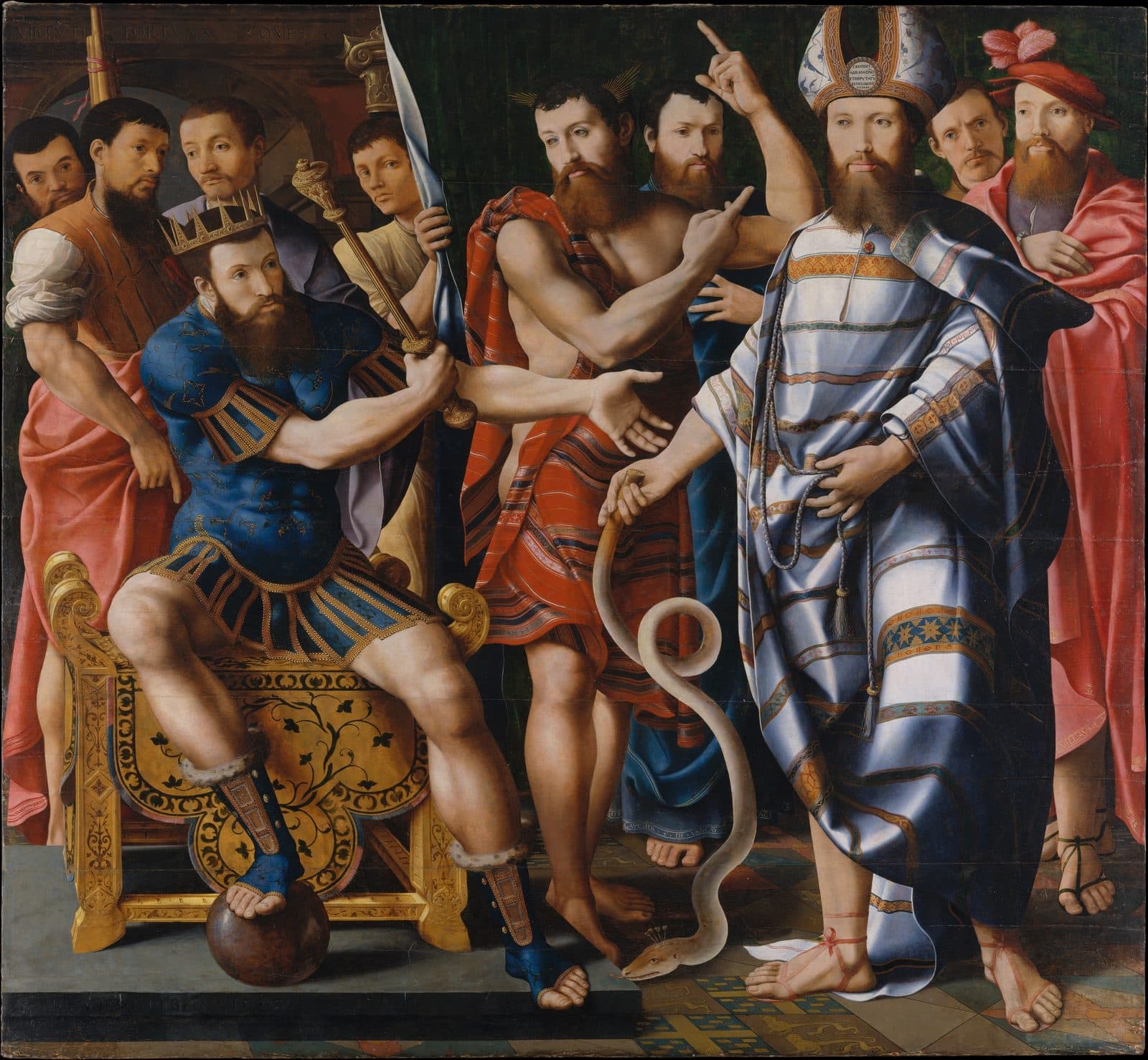
Master of the Dinteville Allegory, Moses and Aaron before Pharaoh: An Allegory of the Dinteville Family, oil on wood, 1537, The Metropolitan Museum of Art, New York, DT1462. Public domain (CC0), via Wikimedia Commons.
THE ARTWORKThe painter set Exodus 7:10, Aaron's staff become a serpent before Pharaoh, in the dress of a sixteenth-century court. It shows the first sign Pharaoh saw, and Exodus 7:13 says that his heart was hardened after it.
Summary
In Exodus 4 to 14 the LORD hardens Pharaoh's heart, Pharaoh hardens his own heart, and some verses say only that his heart was hardened.
- Three Hebrew verbs carry the hardening: chazaq, to make strong, kabed, to make heavy, and qashah, to make hard.
- The narrator first says that the LORD hardened Pharaoh's heart at the plague of boils in Exodus 9:12.
- Paul quotes the LORD's word to Pharaoh in Romans 9 and concludes that God hardens whom He wants to harden.
- Readers divide over who is the cause of the hardening and over how Paul applies Pharaoh.
The Word to Moses
The LORD announced the hardening twice before the plagues, and Paul draws on the account in Romans 9.
The LORD's first word on the hardening came in Midian, as Moses set out for Egypt with his wife and sons.
The LORD instructed Moses, “When you go back to Egypt, see that you perform before Pharaoh all the wonders that I have put within your power. But I will harden his heart so that he will not let the people go.The LORD's charge joins the wonders Moses will do to the refusal that will meet them.
After Pharaoh refused the first demand in Exodus 5:2, the LORD repeated His word as He sent Moses and Aaron back to him.
But I will harden Pharaoh’s heart, and though I will multiply My signs and wonders in the land of Egypt, Pharaoh will not listen to you. Then I will lay My hand on Egypt, and by mighty acts of judgment I will bring the divisions of My people the Israelites out of the land of Egypt. And the Egyptians will know that I am the LORD, when I stretch out My hand against Egypt and bring the Israelites out from among them.”The hardening here serves a purpose the LORD names for the Egyptians themselves.
In Romans 9 Paul sets the LORD's word to Pharaoh beside the word of mercy He spoke to Moses in Exodus 33:19.
For the Scripture says to Pharaoh: “I raised you up for this very purpose, that I might display My power in you, and that My name might be proclaimed in all the earth.” Therefore God has mercy on whom He wants to have mercy, and He hardens whom He wants to harden.Paul joins the LORD's mercy and His hardening in one sentence and takes Pharaoh as its proof.
Every Hardening in Exodus 4 to 14
Each verse of Exodus 4 to 14 that speaks of a hardened heart is set out with its occasion, its subject and its Hebrew verb.
| Verse | Occasion | Who hardens | Hebrew verb |
|---|---|---|---|
| Exodus 4:21 | On the way back to Egypt | The LORD, a promise | chazaq |
| Exodus 7:3 | Before the signs begin | The LORD, a promise | qashah |
| Exodus 7:13 | The staff that became a serpent | No one named | chazaq |
| Exodus 7:14 | The LORD's word before the first plague | No one named | kabed |
| Exodus 7:22 | The water turned to blood | No one named | chazaq |
| Exodus 8:15 | The frogs | Pharaoh | kabed |
| Exodus 8:19 | The gnats | No one named | chazaq |
| Exodus 8:32 | The flies | Pharaoh | kabed |
| Exodus 9:7 | The death of the livestock | No one named | kabed |
| Exodus 9:12 | The boils | The LORD | chazaq |
| Exodus 9:34 | The hail | Pharaoh | kabed |
| Exodus 9:35 | The hail | No one named | chazaq |
| Exodus 10:1 | Before the locusts | The LORD | kabed |
| Exodus 10:20 | The locusts | The LORD | chazaq |
| Exodus 10:27 | The darkness | The LORD | chazaq |
| Exodus 11:10 | Before the death of the firstborn | The LORD | chazaq |
| Exodus 14:4 | The camp by the sea | The LORD, a promise | chazaq |
| Exodus 14:8 | The pursuit | The LORD | chazaq |
| Exodus 14:17 | The Egyptians at the sea | The LORD, a promise | chazaq |
- Verse
- Exodus 4:21
- Occasion
- On the way back to Egypt
- Who hardens
- The LORD, a promise
- Hebrew verb
- chazaq
- Verse
- Exodus 7:3
- Occasion
- Before the signs begin
- Who hardens
- The LORD, a promise
- Hebrew verb
- qashah
- Verse
- Exodus 7:13
- Occasion
- The staff that became a serpent
- Who hardens
- No one named
- Hebrew verb
- chazaq
- Verse
- Exodus 7:14
- Occasion
- The LORD's word before the first plague
- Who hardens
- No one named
- Hebrew verb
- kabed
- Verse
- Exodus 7:22
- Occasion
- The water turned to blood
- Who hardens
- No one named
- Hebrew verb
- chazaq
- Verse
- Exodus 8:15
- Occasion
- The frogs
- Who hardens
- Pharaoh
- Hebrew verb
- kabed
- Verse
- Exodus 8:19
- Occasion
- The gnats
- Who hardens
- No one named
- Hebrew verb
- chazaq
- Verse
- Exodus 8:32
- Occasion
- The flies
- Who hardens
- Pharaoh
- Hebrew verb
- kabed
- Verse
- Exodus 9:7
- Occasion
- The death of the livestock
- Who hardens
- No one named
- Hebrew verb
- kabed
- Verse
- Exodus 9:12
- Occasion
- The boils
- Who hardens
- The LORD
- Hebrew verb
- chazaq
- Verse
- Exodus 9:34
- Occasion
- The hail
- Who hardens
- Pharaoh
- Hebrew verb
- kabed
- Verse
- Exodus 9:35
- Occasion
- The hail
- Who hardens
- No one named
- Hebrew verb
- chazaq
- Verse
- Exodus 10:1
- Occasion
- Before the locusts
- Who hardens
- The LORD
- Hebrew verb
- kabed
- Verse
- Exodus 10:20
- Occasion
- The locusts
- Who hardens
- The LORD
- Hebrew verb
- chazaq
- Verse
- Exodus 10:27
- Occasion
- The darkness
- Who hardens
- The LORD
- Hebrew verb
- chazaq
- Verse
- Exodus 11:10
- Occasion
- Before the death of the firstborn
- Who hardens
- The LORD
- Hebrew verb
- chazaq
- Verse
- Exodus 14:4
- Occasion
- The camp by the sea
- Who hardens
- The LORD, a promise
- Hebrew verb
- chazaq
- Verse
- Exodus 14:8
- Occasion
- The pursuit
- Who hardens
- The LORD
- Hebrew verb
- chazaq
- Verse
- Exodus 14:17
- Occasion
- The Egyptians at the sea
- Who hardens
- The LORD, a promise
- Hebrew verb
- chazaq
The Hardening, Plague by Plague
The account moves in three stages, from the first signs to the sea.
1. Exodus 7:13 to 8:19, the staff to the gnats2 passages, 1 quotation
When Pharaoh saw that there was relief, however, he hardened his heart and would not listen to Moses and Aaron, just as the LORD had said.This is the first verse that names Pharaoh as the one who hardens his own heart.
“This is the finger of God,” the magicians said to Pharaoh. But Pharaoh’s heart was hardened, and he would not listen to them, just as the LORD had said.The gnats were the first sign the magicians could not copy, and their failure changed nothing in Pharaoh.
The King James Version renders Exodus 7:13 as he hardened Pharaoh's heart. Adam Clarke, in his Commentary on the Bible, objects that its Hebrew is the same as that of Exodus 7:22, rendered there as was hardened. The Berean text reads was hardened in both verses. John Gill, in his Exposition of the Old Testament, gives heavy as the sense of the word in Exodus 7:14.
Matthew Henry draws from Exodus 8:15 a lesson on affliction and the renewed heart.
“Till the heart is renewed by the grace of God, the impressions made by the force of affliction do not abide; the convictions wear off, and the promises that were extorted are forgotten. Till the disposition of the air is changed, what thaws in the sun will freeze again in the shade. God's patience is shamefully abused by impenitent sinners.”
Matthew Henry · Commentary on the Whole Bible · on Exodus 8:15Puritan
2. Exodus 9:12 to 10:2, the boils to the locusts3 passages, 1 quotation
But the LORD hardened Pharaoh’s heart, and he would not listen to them, just as the LORD had said to Moses.From the boils on, the LORD is the subject of every hardening except Exodus 9:34 and Exodus 9:35.
When Pharaoh saw that the rain and hail and thunder had ceased, he sinned again and hardened his heart—he and his officials. So Pharaoh’s heart was hardened, and he would not let the Israelites go, just as the LORD had said through Moses.The fault now spreads through the court, and Exodus 9:35 ties the outcome to the word given through Moses.
Albert Barnes, in his Notes on the Old Testament, observes that Exodus 9:34 and Exodus 9:35 use two different Hebrew words. The first means made heavy, and the second is the stronger word and implies a stubborn resolve.
Then the LORD said to Moses, “Go to Pharaoh, for I have hardened his heart and the hearts of his officials, that I may perform these miraculous signs of Mine among them, and that you may tell your children and grandchildren how severely I dealt with the Egyptians when I performed miraculous signs among them, so that all of you may know that I am the LORD.”Here the LORD speaks of the hardening as His own act already done, and He gives it a purpose for Israel's children.
Matthew Henry reads Exodus 9:12 as a judgment that follows a man's own refusal.
“Note, Wilful hardness is commonly punished with judicial hardness. If men shut their eyes against the light, it is just with God to close their eyes. Let us dread this as the sorest judgment a man can be under on this side hell.”
Matthew Henry · Commentary on the Whole Bible · on Exodus 9:12Puritan
3. Exodus 14:4 to 18, the pursuit to the sea2 passages
And I will harden Pharaoh’s heart so that he will pursue them. But I will gain honor by means of Pharaoh and all his army, and the Egyptians will know that I am the LORD.” So this is what the Israelites did.After Pharaoh has let Israel go, the LORD says He will harden his heart once more and names the honor He will gain.
And I will harden the hearts of the Egyptians so that they will go in after them. Then I will gain honor by means of Pharaoh and all his army and chariots and horsemen. The Egyptians will know that I am the LORD when I am honored through Pharaoh, his chariots, and his horsemen.”The hardening reaches the hearts of the Egyptians, and the purpose is again that they know the LORD.
What the Text Leaves Unsaid
Exodus leaves two questions about the hardening open.
Exodus does not say how the LORD hardened Pharaoh's heart, whether by an act within him or through the signs and their removal.
The six verses that name no one do not say who hardened the heart, and readers fill the gap from the verses around them.
The Hardening Across Scripture
Later Scripture recalls Pharaoh's heart as a warning and names other hearts hardened by the LORD.
The Philistine priests recalled Pharaoh's heart when the ark of the LORD was in their land.
Why harden your hearts as the Egyptians and Pharaoh hardened theirs? When He afflicted them, did they not send the people on their way as they departed?Foreign priests use Egypt's hardening as a warning to their own people.
Psalm 95 uses the same language of God's own people.
For He is our God, and we are the people of His pasture, the sheep under His care. Today, if you hear His voice, do not harden your hearts as you did at Meribah, in the day at Massah in the wilderness,The psalm is addressed to Israel as it comes to worship, and its warning looks back to the wilderness.
Deuteronomy 2:30 and Joshua 11:20, the kings of Canaan2 passages
But Sihon king of Heshbon would not let us pass through, for the LORD your God had made his spirit stubborn and his heart obstinate, that He might deliver him into your hand, as is the case this day.The first Amorite ruler to bar Israel's way is given the same heart as Pharaoh.
For it was of the LORD to harden their hearts to engage Israel in battle, so that they would be set apart for destruction and would receive no mercy, being annihilated as the LORD had commanded Moses.Joshua's summary of the conquest says that the battles of Canaan came from the same work of God.
Isaiah 6:9 to 10 and John 12:39 to 40, the eyes and the heart2 passages
And He replied: “Go and tell this people, ‘Be ever hearing, but never understanding; be ever seeing, but never perceiving.’ Make the hearts of this people calloused; deafen their ears and close their eyes. Otherwise they might see with their eyes, hear with their ears, understand with their hearts, and turn and be healed.”The prophet's message itself makes the heart of the people calloused.
For this reason they were unable to believe. For again, Isaiah says: “He has blinded their eyes and hardened their hearts, so that they cannot see with their eyes, and understand with their hearts, and turn, and I would heal them.”John applies Isaiah's words to those who saw Jesus' signs and did not believe.
Voices on Pharaoh and the Potter
Origen and Jamieson, Fausset & Brown comment on Paul's argument from Pharaoh and the potter.
Origen reads the raising up of Pharaoh through God's foreknowledge of each will.
“But let us also see of what sort is this which is said to Pharaoh: ‘For this very purpose have I raised thee up, that I might show in thee my power.’ It is certain that God not only knows the purpose and will of each one, but even foreknows it. And knowing and foreknowing, as a good and just steward, he uses the impulses and purpose of each one for accomplishing those works which the mind and will of each one chooses.”
Origen of Alexandria · Commentary on the Epistle to the Romans · on Romans 9:17Patristic
Jamieson, Fausset & Brown hold that the potter of Romans 9:21 acts on sinful creatures.
“All are sinners, and have forfeited every claim to His mercy; it is therefore perfectly competent to God to spare one and not another, to make one vessel to honor and another to dishonor. But it is to be borne in mind that Paul does not here speak of God's right over His creatures as creatures, but as sinful creatures: as he himself clearly intimates in the next verses.”
Jamieson, Fausset & Brown · Commentary Critical and Explanatory on the Whole Bible · on Romans 9:21Reformed
Who Hardened Pharaoh's Heart
Readers give five answers, three on Exodus and two on Romans 9.
1. The LORD is the author of the hardening
John Calvin, in his Commentaries on the Four Last Books of Moses on Exodus 7:3, calls those who reduce the hardening to bare permission poor speculators. He holds that God executes a just judgment on the reprobate, while the blame rests with the men who blind themselves.
The objection is Origen's, in On First Principles 3.1.7, that a man hardened by God who sins through that hardening would bear no responsibility for his sin and would have no free will.
2. The hardness is Pharaoh's own, and God's acts are its occasion
Origen, in On First Principles 3.1.11, compares God's working to the sun, which by one heat melts wax and dries and hardens mud. He holds that the signs done by Moses made manifest a hardness Pharaoh had conceived in his own wickedness, and showed the obedience of the Egyptians who left with Israel.
The objection is Calvin's: Moses says that the king's mind was hardened by God in other ways besides the working of miracles.
3. The LORD gave up a man who first hardened himself
Adam Clarke, in his Commentary on the Bible, calls the hardening of Exodus 8:32 the effect of Pharaoh's own obstinacy and that of Exodus 9:34 an act of his own. On Exodus 10:1 and Exodus 14:4 he reads the LORD's hardening as His letting Pharaoh's natural obstinacy prevail and, at the sea, withholding any further restraining grace.
The objection is Calvin's, in his comment on Exodus 4:21, that God foretold the hardening as the work of His own secret counsel. On that reading the king's obstinacy did not run against His will.
4. Romans 9 speaks of the election and reprobation of persons
Calvin, in his Commentary on Romans on Romans 9:18, reads Paul as teaching that God illuminates some that they may be saved and blinds others that they may perish.
The objection is Adam Clarke's, who reads the verse of peoples in history. In his reading God showed mercy to the Jews of old and to the Gentiles of what he calls the present time. He left the Egyptians of old and the Jews of the present day to harden themselves.
5. Romans 9 speaks of the hardening of those who refuse mercy
John Wesley, in his Explanatory Notes upon the New Testament on Romans 9:21, holds that God shows mercy to none but true believers and hardens none but those who obstinately refuse His mercy.
The objection is Calvin's, who notes that Paul writes whom He wants twice and allows no cause for the difference beyond the will of God.
A Heart That Hears Today
Hebrews 3 applies the warning of Psalm 95 to believers.
Pharaoh's heart was hardened again three times as soon as relief came. It happened after the frogs died in Exodus 8:13 to 15, after the flies were removed in Exodus 8:31 to 32 and after the hail ceased in Exodus 9:33 to 34.
See to it, brothers, that none of you has a wicked heart of unbelief that turns away from the living God. But exhort one another daily, as long as it is called today, so that none of you may be hardened by sin’s deceitfulness.Hebrews names a remedy for the whole church to practise each day.
Keep studying
Read it1
Studies5
Symbols1