
1 Timothy, 2 Timothy, Titus · Passage · Featured Study
The Trustworthy Sayings
Five short sayings Paul vouches for, from 1 Timothy 1:15 to Titus 3:8.
Paul counts himself the worst of the sinners Christ came to save.
- The passage
- 1 Timothy 1:15, 1 Timothy 3:1, 1 Timothy 4:9, 2 Timothy 2:11 to 13, Titus 3:8
- Books
- 1 Timothy, 2 Timothy, Titus
- When
- February 155 (probable)
- Hold in memory
- 1 Timothy 1:15
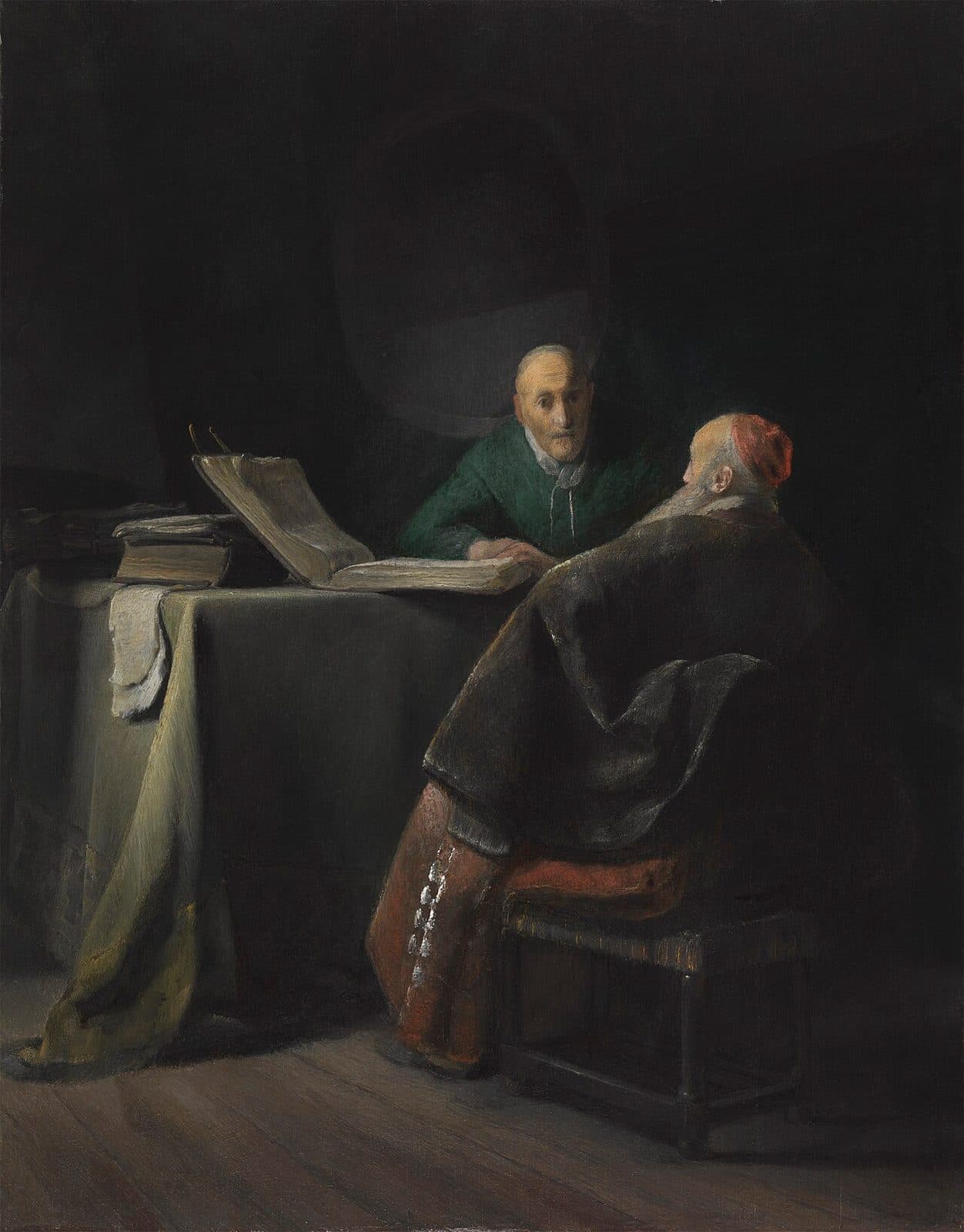
Circle of Jan Lievens, Two Old Men Disputing (St. Peter and St. Paul), about 1630, The Leiden Collection. Public domain, via Wikimedia Commons.
THE ARTWORKA painter of Jan Lievens' circle set two old men at a table in a dark study, one with his hand on a large open book while the other listens. The picture was once given to Rembrandt and has long been called Peter and Paul.
Summary
The Greek phrase pistos ho logos, this is a trustworthy saying, stands in the New Testament only in these three letters.
- The sayings are about Christ saving sinners, the work of an overseer, the profit of godliness, dying and reigning with Christ, and salvation by mercy.
- Two of them add that the saying is worthy of full acceptance.
- Readers divide over whether three of the formulas point to the words before them or after them.
- The fourth saying runs in four matched lines, and its last line is read as a warning or as a comfort.
The First Saying
1 Timothy 1:12 to 16, Paul's own story
Paul thanks Christ for appointing him to service, though he was once a blasphemer, a persecutor and a violent man. He says he was shown mercy because he acted in ignorance and unbelief.
This is a trustworthy saying, worthy of full acceptance: Christ Jesus came into the world to save sinners, of whom I am the worst.This verse holds the first saying, and the story told in the verses before it is its proof.
But for this very reason I was shown mercy, so that in me, the worst of sinners, Christ Jesus might display His perfect patience as an example to those who would believe in Him for eternal life.This verse gives the reason Paul's story matters to every later believer.
The Five Sayings
The letter, verse and subject of each
| Saying | Where | Its subject |
|---|---|---|
| First | 1 Timothy 1:15 | Christ Jesus came into the world to save sinners |
| Second | 1 Timothy 3:1 | If anyone aspires to be an overseer, he desires a noble task |
| Third | 1 Timothy 4:9 | Godliness is valuable in every way, holding promise for the present life and for the one to come |
| Fourth | 2 Timothy 2:11 | If we died with Him, we will also live with Him |
| Fifth | Titus 3:8 | He saved us according to His mercy |
- Saying
- First
- Where
- 1 Timothy 1:15
- Its subject
- Christ Jesus came into the world to save sinners
- Saying
- Second
- Where
- 1 Timothy 3:1
- Its subject
- If anyone aspires to be an overseer, he desires a noble task
- Saying
- Third
- Where
- 1 Timothy 4:9
- Its subject
- Godliness is valuable in every way, holding promise for the present life and for the one to come
- Saying
- Fourth
- Where
- 2 Timothy 2:11
- Its subject
- If we died with Him, we will also live with Him
- Saying
- Fifth
- Where
- Titus 3:8
- Its subject
- He saved us according to His mercy
Four Lines on Dying and Reigning
2 Timothy 2:9 to 13, the fourth saying and where Paul wrote it
The saying runs in four lines, each beginning with if, and in the first three the answer matches the deed. The fourth line breaks the pattern.
In the Greek the last line sets two words of one root side by side, apisteo, to be faithless, and pistos, faithful.
for which I suffer to the extent of being chained like a criminal. But the word of God cannot be chained!Paul's chains are the suffering the second line asks the reader to endure.
This is a trustworthy saying: If we died with Him, we will also live with Him; if we endure, we will also reign with Him; if we deny Him, He will also deny us;These verses give the three lines against which the fourth is read.
if we are faithless, He remains faithful, for He cannot deny Himself.This verse holds the line on which the warning and the comfort readings divide.
Worthy of Full Acceptance
The words of the formula and what they claim
The adjective pistos describes the saying here, and the lexicon gives its sense in this use as trustworthy. The noun logos means something said, with the thought behind it.
In the first and third sayings Paul adds a second phrase, pases apodoches axios, and its noun, apodoche, stands in the New Testament only in those two verses.
John Calvin, in his commentary on the letters to Timothy, says Paul used this preface for matters of great importance or hard to be believed. On 1 Timothy 1:15 he calls the saying a shield against doubt about the forgiveness of sins.
This is a trustworthy saying, worthy of full acceptance.Here the formula fills its verse alone, and the saying it vouches for stands outside it.
The Faithful Word in the Church
Where the sayings stood among the first churches
Polycarp, bishop of Smyrna, echoed the fourth saying when he wrote to the church at Philippi that if we live worthily of Christ we shall also reign together with Him. The Catholic Encyclopedia of 1911 gives February 155 as the probable date of his martyrdom.
He must hold firmly to the faithful word as it was taught, so that he can encourage others by sound teaching and refute those who contradict it.The word an elder must hold to is called faithful, as each of the five sayings is.
What the Text Leaves Unsaid
The source of the sayings and the name they carry
Who first spoke the sayings, and where Paul learned them, is left open. Charles Spurgeon guessed that they came from the early church's prophets, such as Agabus and the daughters of Philip.
The letters call them by one name, the trustworthy saying. Hymn and creed are later readers' words for them.
What the Sayings Teach
God's work first, and His people's after it
Paul's own story runs from mercy to service, and Titus 3 runs from mercy to good deeds.
He saved us, not by the righteous deeds we had done, but according to His mercy, through the washing of new birth and renewal by the Holy Spirit.This verse supplies the mercy that comes before the good deeds of the fifth saying.
This saying is trustworthy. And I want you to emphasize these things, so that those who have believed God will take care to devote themselves to good deeds. These things are excellent and profitable for the people.This verse holds the fifth saying, and its charge to good deeds closes the order the five keep.
Augustine on the First Saying
A sermon of the fifth century on a Latin wording
Augustine's Latin Bible differed from the Greek at the first saying, and he drew a lesson about Christ from the difference.
“We heard the blessed apostle Paul saying, ‘The word is human and worthy of total acceptance, that Christ Jesus came into the world to save sinners, of whom I am the foremost.’ So it's a human word, and worthy of total acceptance. Why human, and not divine? Without the slightest doubt, unless this word were also divine, it would not be worthy of total acceptance. But this word is both human and divine in the same sort of way that Christ himself is both man and God. So if we are right in understanding this word to be not only human but also divine, why did the apostle prefer to call it human rather than divine?… So the aspect he chose was the one by which Christ came into the world. He came, after all, insofar as he was man. Because insofar as he was God, he was always there.”
Augustine of Hippo · SERMONS 174.1 · on 1 Timothy 1:15Patristic
Before or After, and the Last Line
Three formulas that may point back, and one line read two ways
The first saying follows the formula directly. Calvin, Jamieson, Fausset and Brown, and Albert Barnes in his Notes on the New Testament read the fourth as following it too.
1 Timothy 3:1: the overseer, or the verse beforeJohn Chrysostom and Theophylact against John Calvin · Greek fathers and Reformed commentary
John Chrysostom looks back from the overseer to the mothers of chapter 2.
“‘This is a faithful saying.’ This relates to the present subject, not to what follows, respecting the office of a Bishop. For as it was doubted, he affirms it to be a true saying, that fathers may be benefited by the virtue of their children, and mothers also, when they have brought them up well. But what if she be herself addicted to wickedness and vice? Will she then be benefited by the bringing up of children? Is it not probable that she will bring them up to be like herself? It is not therefore of any woman, but of the virtuous woman, that it is said she shall receive a great recompense for this also.”
John Chrysostom · Homily on 1 Timothy 9 · on 1 Timothy 3:1Patristic
Theophylact of Ohrid follows Chrysostom and gives the doubt the saying answers.
“Since it was doubtful whether mothers could reap the fruits of the virtue of their children, the apostle says: ‘faithful is the word,’ that is, what has been said is not false, and let no one doubt. The instruction prescribed to Timothy concerning the bishop …”
Theophylact of Ohrid · Commentary on 1 Timothy · on 1 Timothy 3:1Patristic
John Calvin names Chrysostom's view and rejects it. He reads the formula as the preface to a new subject, the office of an overseer, and the Berean text sets its colon the same way.
Women, however, will be saved through childbearing, if they continue in faith, love, and holiness, with self-control.Chrysostom and Theophylact take this promise to be what the second saying vouches for.
1 Timothy 4:9: the promise of godliness, or the hope that followsJohn Chrysostom and John Calvin; Jamieson, Fausset and Brown
Chrysostom reads the saying as the claim of 1 Timothy 4:8, and Calvin calls it the conclusion of that argument.
“‘This is a faithful saying,’ that is, it is true that godliness is profitable both here and hereafter. Observe how everywhere he brings in this, he needs no demonstration, but simply declares it, for he was addressing Timothy. So then even here, we have good hopes? For he who is conscious to himself of no evil, and who has been fruitful in good, rejoices even here: as the wicked man on the other hand is punished here as well as hereafter. He lives in perpetual fear, he can look no one in the face with confidence, he is pale, trembling, and full of anxiety. Is it not so with the fraudulent, and with thieves, who have no satisfaction even in what they possess? Is not the life of murderers and adulterers most wretched, who look upon the sun itself with suspicion? Is this to be called life? No; rather a horrid death!”
John Chrysostom · Homily on 1 Timothy 12 · on 1 Timothy 4:9Patristic
Jamieson, Fausset and Brown read it both ways at once.
“This verse (Greek), ‘faithful is the saying, ‘ &c. confirms the assertion as to the ‘promise’ attached to ‘godliness,’ 1Ti 4:8, and forms a prefatory introduction to 1Ti 4:10, which is joined to 1Ti 4:9 by ‘For.’ So 2Ti 2:11.”
Jamieson, Fausset & Brown · Commentary Critical and Explanatory on the Whole Bible · on 1 Timothy 4:9Reformed
Titus 3:8: salvation by mercy, or good worksJerome and Jamieson, Fausset and Brown against Charles Spurgeon · Latin father, Reformed commentary and Baptist preacher
Jerome reads the formula as a seal on Titus 3:4 to 7.
“Faithful is the saying, and I wish to confirm (or affirm) you about these things, that those who believe in the Lord should have care to preside over good works. These things are good and useful for men. This saying, faithful is, must be joined to the preceding part, in which he said that, having been justified by his grace, we may become heirs in the hope of eternal life. For the saying about the inheritance of God is worthy of faith, and about the hope of eternal life.”
Jerome · Commentary on Titus · on Titus 3:8Patristic
Jamieson, Fausset and Brown take the same side.
“Greek, ‘faithful is the saying.’ A formula peculiar to the Pastoral Epistles. Here ‘the saying’ is the statement (Tit 3:4-7) as to the gratuitousness of God's gift of salvation.”
Jamieson, Fausset & Brown · Commentary Critical and Explanatory on the Whole Bible · on Titus 3:8Reformed
Spurgeon takes the fifth saying to be the charge that follows it, that believers show their faith by their lives.
2 Timothy 2:13: a warning, or a comfortJohn Chrysostom and John Calvin against John Wesley and Charles Spurgeon
Chrysostom and Calvin read the line as a warning, and Calvin adds that all who deny Christ are disowned by Him.
“And to show this, he has added, ‘If we believe not, He abideth faithful: He cannot deny Himself’: that is, if we believe not that He rose again, He is not injured by it. He is faithful and unshaken, whether we say so or not. If then He is not at all injured by our denying Him, it is for nothing else than for our benefit that He desires our confession. For He abideth the same, whether we deny Him or not. He cannot deny Himself, that is, His own Being. We may say that He is not; though such is not the fact. It is not in His nature, it is not possible for Him not to be, that is, to go into nonentity. His subsistence always abides, always is. Let us not therefore be so affected, as if we could gratify or could injure Him. But lest any one should think that Timothy needed this advice...”
John Chrysostom · Homily on 2 Timothy 5 · on 2 Timothy 2:13Patristic
John Wesley and Spurgeon read it as a comfort.
“If we believe not - That is, though some believe not, God will make good all his promises to them that do believe. He cannot deny himself - His word cannot fail.”
John Wesley · Explanatory Notes upon the New Testament · on 2 Timothy 2:13Evangelical
Those who read a warning point to the line before it, if we deny Him, He will also deny us. Between the third and fourth lines the verb changes from deny to be faithless.
To Read Next
Three works on the sayings, each free to read
Homilies on First and Second Timothy
John Chrysostom · fourth century
Chrysostom preached through the first letter to Timothy verse by verse, in eighteen homilies.
Read at New AdventCommentaries on Timothy, Titus and Philemon
John Calvin, translated by William Pringle · 1549 and 1556
Calvin comments on each of the five sayings and argues the direction of 1 Timothy 3:1.
Read at CCELEternal Faithfulness Unaffected by Human Unbelief, sermon 1453
Charles Spurgeon · 1879
Spurgeon walks through all five sayings before he preaches on the fourth.
Read at CCELWhat the Sayings Ask
The sayings ask three things of the reader: to accept the first saying fully, to endure with Christ through suffering, and to trust Him who remains faithful.