
Exodus 34 to Matthew 12 · Subject · Featured Study
Hesed, the LORD's Loving Devotion
A Hebrew noun found in 241 verses of twenty-eight books of the Old Testament, 127 of them in the Psalms.
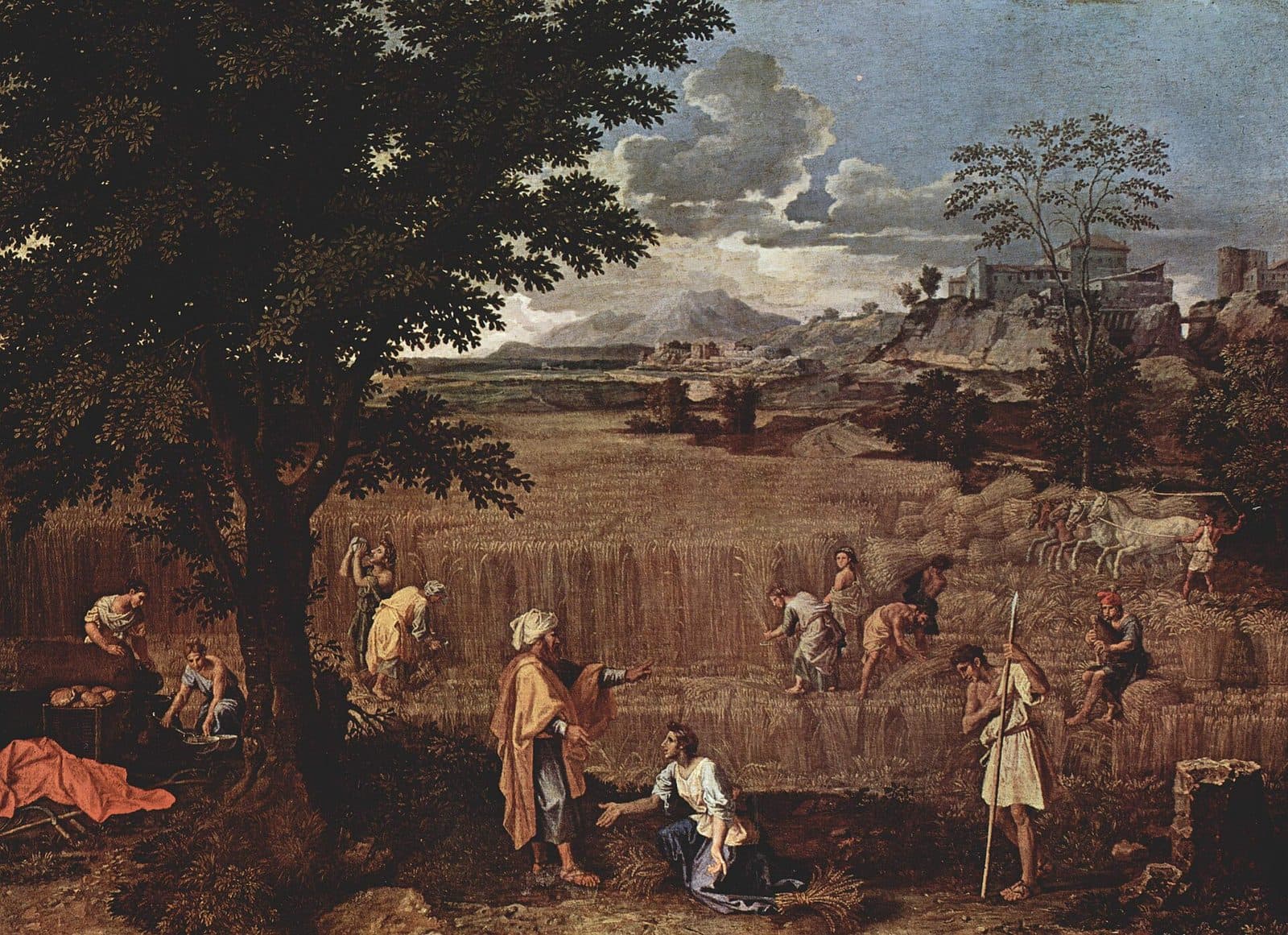
Nicolas Poussin, Summer, or Ruth and Boaz, 1660 to 1664, Musée du Louvre, Paris. Public domain, via Wikimedia Commons.
THE ARTWORKPoussin painted the harvest at Bethlehem as a wide summer scene of field, hill and town. Reapers cut and bind the wheat across the field, horses tread out grain on the right, and women set out bread in the shade of a tall tree. In the foreground Ruth kneels before Boaz, who points toward the reapers as he gives her leave to glean.
Ruth stayed with Naomi when she was free to go home, and Boaz called what she did hesed.
Summary
Hesed is the loyal love that keeps faith with another person.
- The LORD named Himself abounding in loving devotion and faithfulness when He renewed the covenant after the golden calf.
- The book of Ruth uses it three times, of the kindness of the LORD and of the kindness Ruth showed her family.
- Hosea charged the northern kingdom that the land had none, and Micah named it among the things the LORD requires.
- Jesus quoted Hosea twice to Pharisees who condemned others.
- Readers differ on whether hesed is a duty owed within a bond or a kindness given beyond any duty.
Hesed from Sinai to the Gospels
Ten passages from six books, five of them in the Old Testament.
Then the LORD passed in front of Moses and called out: “The LORD, the LORD God, is compassionate and gracious, slow to anger, abounding in loving devotion and faithfulness, maintaining loving devotion to a thousand generations, forgiving iniquity, transgression, and sin. Yet He will by no means leave the guilty unpunished; He will visit the iniquity of the fathers on their children and grandchildren to the third and fourth generations.”Numbers, Nehemiah, three psalms, Joel and Jonah repeat these words, so this is the name the later books return to.
Then Naomi said to her two daughters-in-law, “Go back, each of you to your mother’s home. May the LORD show you loving devotion, as you have shown to your dead and to me.The first hesed in Ruth is a person's, and Naomi asks the LORD to answer it with His own.
Then Naomi said to her daughter-in-law, “May he be blessed by the LORD, who has not withdrawn His kindness from the living or the dead.” Naomi continued, “The man is a close relative. He is one of our kinsman-redeemers.”Naomi traces her turn of fortune to the LORD's kindness when she learns whose field Ruth found.
Then Boaz said, “May the LORD bless you, my daughter. You have shown more kindness now than before, because you have not run after the younger men, whether rich or poor.Boaz ranks her latest kindness above her first, so the same person can show hesed again and in greater measure.
Hear the word of the LORD, O children of Israel, for the LORD has a case against the people of the land: “There is no truth, no loving devotion, and no knowledge of God in the land!This charge is the ground of Hosea's case, and the rest of his book answers it with judgment and with a promise.
For I desire mercy, not sacrifice, and the knowledge of God rather than burnt offerings.The LORD sets this desire against a loyalty that vanished like the morning mist, so what He asks is a love that lasts.
He has shown you, O man, what is good. And what does the LORD require of you but to act justly, to love mercy, and to walk humbly with your God?Micah answers a worshipper who offers rams, oil and even his firstborn.
Who is a God like You, who pardons iniquity and passes over the transgression of the remnant of His inheritance—who does not retain His anger forever, because He delights in loving devotion? He will again have compassion on us; He will vanquish our iniquities. You will cast out all our sins into the depths of the sea. You will show faithfulness to Jacob and loving devotion to Abraham, as You swore to our fathers from the days of old.Micah ends a book of charges against Israel and Judah with the LORD's delight in loving devotion, His last word over them.
Because of the loving devotion of the LORD we are not consumed, for His mercies never fail. They are new every morning; great is Your faithfulness!After Jerusalem falls, the poet of Lamentations finds the reason his people still live.
But go and learn what this means: ‘I desire mercy, not sacrifice.’ For I have not come to call the righteous, but sinners.”Jesus takes Hosea's word as His answer to those who objected to His eating with tax collectors and sinners.
Where Hesed Stands in Scripture
The word stands in the Law, the Prophets and the Writings alike.
- Genesis11Lot, spared by the angels.
- Exodus4The redeemed led by devotion.
- Leviticus1Its rare sense, disgrace.
- Numbers2Moses pleads after the spies' report.
- Deuteronomy3The Ten Commandments.
- Joshua2Rahab and the spies.
- Judges2The spies at Bethel.
- Ruth3Naomi's blessing.
- 1 Samuel4Saul spares the Kenites.
- 2 Samuel11Jabesh-gilead buries Saul.
- 1 Kings4Barzillai's sons at the table.
- 1 Chronicles4David's psalm at the ark.
- 2 Chronicles10Solomon thanks God for David.
- Ezra3The temple's foundation laid.
- Nehemiah5Nehemiah's prayer.
- Esther2Esther's favor with Hegai.
- Job3The kindness of a friend.
- Psalms127Entering the LORD's house.
- Proverbs10Bound around the neck.
- Isaiah7A throne in David's tent.
- Jeremiah6Israel's devotion as a bride.
- Lamentations2Mercies new every morning.
- Daniel2Daniel's favor with an official.
- Hosea6The betrothal of Israel.
- Joel1The call to return.
- Jonah2Those who cling to idols forsake it.
- Micah3To love mercy.
- Zechariah1Devotion to one another.
28 cells, 241 in all; each cell's length follows its count.
Each book name opens the first verse in that book that uses the word.
Six Places Where Hesed Teaches
A covenant, a king's table, a psalm, a prophet, a proverb and a Gospel each turn on the word.
THE COVENANT
Moses calls the LORD the faithful God who keeps His covenant of loving devotion for a thousand generations.
DAVID AND JONATHAN'S SON
David seeks a survivor of Saul's house to show him kindness for Jonathan's sake, and seats Mephibosheth at his table.
THE REFRAIN OF THE PSALMS
Every verse of Psalm 136 ends with the same line: His loving devotion endures forever.
THE PROPHET WHO FLED
Jonah says he fled toward Tarshish because he knew the LORD abounds in loving devotion and relents from sending disaster.
THE WISE
Proverbs says that by loving devotion and faithfulness iniquity is atoned for, and by the fear of the LORD a man turns from evil.
THE SABBATH FIELD
Jesus calls His disciples innocent when Pharisees condemn them for picking grain on the Sabbath.
The Kindness in Ruth and the Charge in Hosea
Ruth shows the word in a family's loyalty, and Hosea finds it missing from a nation.
Rashi wrote in France about 1075 to 1105. He took the last kindness of Ruth 3:10, greater than her care for her mother-in-law, to be her willingness to marry an older man to keep her husband's name alive.
Ruth's oath, Naomi's praise and the line of DavidRuth 1:16 to 17 and Ruth 4:17
But Ruth replied: “Do not urge me to leave you or to turn from following you. For wherever you go, I will go, and wherever you live, I will live; your people will be my people, and your God will be my God. Where you die, I will die, and there I will be buried. May the LORD punish me, and ever so severely, if anything but death separates you and me.”Ruth takes Naomi's God as her own, so her loyalty to a widow is also faith in the LORD.
On Ruth 2:20 Rashi read the LORD's kindness as His feeding of the living and His care for the needs of the dead.
At the end of the book the women of Bethlehem tell Naomi that Ruth is better to her than seven sons.
The neighbor women said, “A son has been born to Naomi,” and they named him Obed. He became the father of Jesse, the father of David.Ruth's kindness enters the line of David, to whose house the LORD later promised His loving devotion.
Hesed in Hosea's case against IsraelHosea 2:19 to 20, Hosea 10:12 and Hosea 12:6
Hosea uses the word six times, and three of the six look forward to a people restored.
So I will betroth you to Me forever; I will betroth you in righteousness and justice, in loving devotion and compassion. And I will betroth you in faithfulness, and you will know the LORD.”The LORD brings loving devotion to the betrothal as His own gift, so the restoration begins with what He gives.
Sow for yourselves righteousness and reap the fruit of loving devotion; break up your unplowed ground. For it is time to seek the LORD until He comes and sends righteousness upon you like rain.Hosea ties the harvest of loving devotion to seeking the LORD, so the people reap it only by turning to Him.
But you must return to your God, maintaining love and justice, and always waiting on your God.The word the land lacked in Hosea 4:1 is here what Israel must hold to as it returns.
The Times of Ruth, Hosea and Micah
Ruth lived long before the two prophets, whose work spans the fall of Samaria.
Hosea dates his work by four kings of Judah, from Uzziah to Hezekiah, and by Jeroboam son of Jehoash of Israel.
Micah dates his work by Jotham, Ahaz and Hezekiah of Judah, and his visions concern both Samaria and Jerusalem.
The king of Assyria took Samaria in the ninth year of Hoshea and carried the Israelites into exile.
The setting of RuthRuth 1:1
In the days when the judges ruled, there was a famine in the land. And a certain man from Bethlehem in Judah, with his wife and two sons, went to reside in the land of Moab.Ruth's loyalty is shown in an age when Israel had no king, the age the book of Judges marks by disorder.
Sargon's record of the cityLuckenbill, Ancient Records of Assyria, volume 2, section 55
Daniel Luckenbill's translation of the display inscription of Sargon II gives the king's own claim and count: he besieged and captured Samaria and carried off 27,290 of the people who lived there.
The Words Beside Hesed
Hesed and three words from the lexicon that stand with it or carry it into Greek.
HESED (HEBREW, H2617)
A noun the lexicon glosses as kindness, and toward God as piety.
EMETH (HEBREW, H571)
A noun for stability and trustworthiness, the word most often joined to hesed.
RAHAMIM (HEBREW, H7356)
A noun for compassion, from the word for the womb, set beside hesed where the LORD crowns His people with both.
ELEOS (GREEK, G1656)
A noun for mercy, which Jesus names with justice and faithfulness among the more important matters of the law.
How English Bibles render the wordthe Berean Standard Bible and the King James Version
The Berean renders hesed as loving devotion in 186 of the 241 verses that carry it, and elsewhere as kindness, mercy, loyalty or love. The King James Version has mercy in 139 of those verses and lovingkindness in 29.
Where the English words came fromSnaith, The Distinctive Ideas of the Old Testament, page 94
Norman Snaith credited the word lovingkindness to Miles Coverdale. He traced mercy to the Greek eleos of the Septuagint and the Latin misericordia of the Vulgate.
What the Text Leaves Unsaid
One silence in each of Ruth, Hosea and Micah.
The word covenant never appears in the book of Ruth.
Hosea leaves unrecorded whether his wife ever returned his love.
Micah 6:8 says nothing of its three requirements earning pardon.
What Hesed Teaches
Two lessons, one from the Law and one from the Prophets.
The name of Exodus 34 joins loving devotion to justice, so the LORD's mercy and His judgment belong to one character.
The prophets turn the word from the LORD to His people. What He shows to Israel, He asks Israel to show to one another.
Voices on Hesed
Three readings from Ambrose of Milan, Jamieson, Fausset and Brown, and Augustine.
“For the Word of God Himself tells us that He prefers the performance of His commandments to the offering of sacrifice. God proclaims this, Moses declares it to the people, Paul preaches it to the Gentiles. Do that which you understand is most profitable for the time. ‘I prefer mercy,’ it is said, ‘rather than sacrifice.’ Are they not, then, rather Christians in truth who condemn their own sin, than they who think to defend it? ‘The just is an accuser of himself in the beginning of his words.’”
Ambrose of Milan · Letter 51:15 · on Hosea 6:6 to 7Patristic
Jamieson, Fausset and Brown on Exodus 34:61871
“Being about to republish His law--the sin of the Israelites being forgiven and the deed of pardon about to be signed and sealed by renewing the terms of the former covenant--it was the most fitting time to proclaim the extent of the divine mercy which was to be displayed, not in the case of Israel only, but of all who offend.”
Jamieson, Fausset & Brown · Commentary Critical and Explanatory on the Whole Bible · on Exodus 34:6Reformed
Augustine on Micah 6:8Sermon 48
“You ask what you should offer: offer yourself. For what else does the Lord seek of you but you? Because of all earthly creatures he has made nothing better than you, he seeks yourself from yourself, because you have lost yourself.”
Augustine of Hippo · SERMON 48:2 · on Micah 6:8Patristic
Is Hesed Owed or Given, and Does Hosea Reject Sacrifice?
Two questions, each with two positions, their holders and the strongest objection.
Hesed keeps a bond already madeNorman Snaith · Twentieth-century Old Testament scholarship
Norman Snaith, in The Distinctive Ideas of the Old Testament (1944), held that hesed has no meaning apart from a covenant already made. He wrote that the LORD's love chose Israel and His hesed keeps the covenant in being.
Hesed gives beyond what is owedThe Babylonian Talmud, Sukkah 49b; Ruth Rabbah 2:14 · Rabbinic Judaism
The Babylonian Talmud, in tractate Sukkah, set down about 450 to 550, teaches that deeds of kindness are greater than charity. They are done with the body as well as with money, for the rich as well as the poor, and for the dead as well as the living.
Ruth Rabbah is a midrash on Ruth compiled between about 700 and 950. In it Rabbi Zeira says the book of Ruth holds no laws of clean and unclean, and was written to teach the reward of kindness.
Pirkei Avot, a tractate of the Mishnah compiled in the land of Israel about AD 190 to 230, gives a saying of Shimon the Righteous, one of the last of the Great Assembly. The world stands on three things, he said: on the Torah, on the worship, and on the bestowal of kindnesses.
Avot DeRabbi Natan, a companion to Pirkei Avot compiled between about 650 and 950, tells how Yohanan ben Zakkai saw the Temple in ruins after AD 70. When his disciple Joshua grieved for the place of atonement, he answered that deeds of kindness atone as well, and cited Hosea 6:6.
Christian teaching parts from this reading at the point of atonement. The letter to the Hebrews holds that Christ appeared once for all to do away with sin by the sacrifice of Himself.
The strongest objection is Snaith's count. Of the 43 pairings he found, only seven join hesed to a word for kindness, and thirty join it to faithfulness or covenant.
Therefore deal faithfully with your servant, for you have brought me into a covenant with you before the LORD. If there is iniquity in me, then kill me yourself; why should you bring me to your father?”David asks Jonathan for hesed on the ground of the covenant between them.
Hosea compares mercy and sacrificeAugustine, The City of God; John Calvin, Commentaries on the Twelve Minor Prophets · Patristic and Reformed commentary
Calvin read Hosea 6:6 as a comparison, and found the proof in its second line, where the knowledge of God is preferred to burnt offerings.
In his lectures on Hosea he took hesed in the verse as love toward the neighbour, set with faith toward God against outward ceremony.
Augustine set the verse beside Micah 6:8 and Hebrews 13:16 and read all three as one kind of sacrifice preferred to another.
The objection is Wellhausen's. Amos asked whether Israel brought sacrifices in the wilderness, and Hosea blamed the priests for tending the sacrifices in place of the Torah.
The prophets passed sentence on the sacrificesJulius Wellhausen · Nineteenth-century critical scholarship
Julius Wellhausen, in his Prolegomena to the History of Israel, held that Amos, Hosea, Isaiah and Micah agreed in passing sentence on the value of the sacrifices. In his reading the priests' calling was to spread the knowledge that God seeks truthfulness and love and no gifts.
The objection is Calvin's: God does not reject the sacrifices He enjoined in His own law.
Books to Read Next
Four works, three of them free to read online.
Commentaries on the Twelve Minor Prophets, volume 1
John Calvin · 1846 translation
Calvin lectures through Hosea verse by verse.
Read on CCELThe City of God
Augustine · about 426
Book 10 asks what sacrifice is and to whom it is owed.
Read on New AdventProlegomena to the History of Israel
Julius Wellhausen · 1885 translation
Its chapter on sacrifice sets out the critical history of Israel's worship.
Read on Project GutenbergThe Distinctive Ideas of the Old Testament
Norman H. Snaith · 1944
Its fifth chapter, The Covenant-Love of God, studies hesed across the Old Testament.
In print: find it wherever books are sold.
The Love That Keeps Faith
The LORD kept faith with a people who broke faith with Him.
Exodus 34 sets the LORD's loving devotion as the ground of pardon, and Hosea calls His people to return to Him.
Keep studying
Read it4
Symbols1