
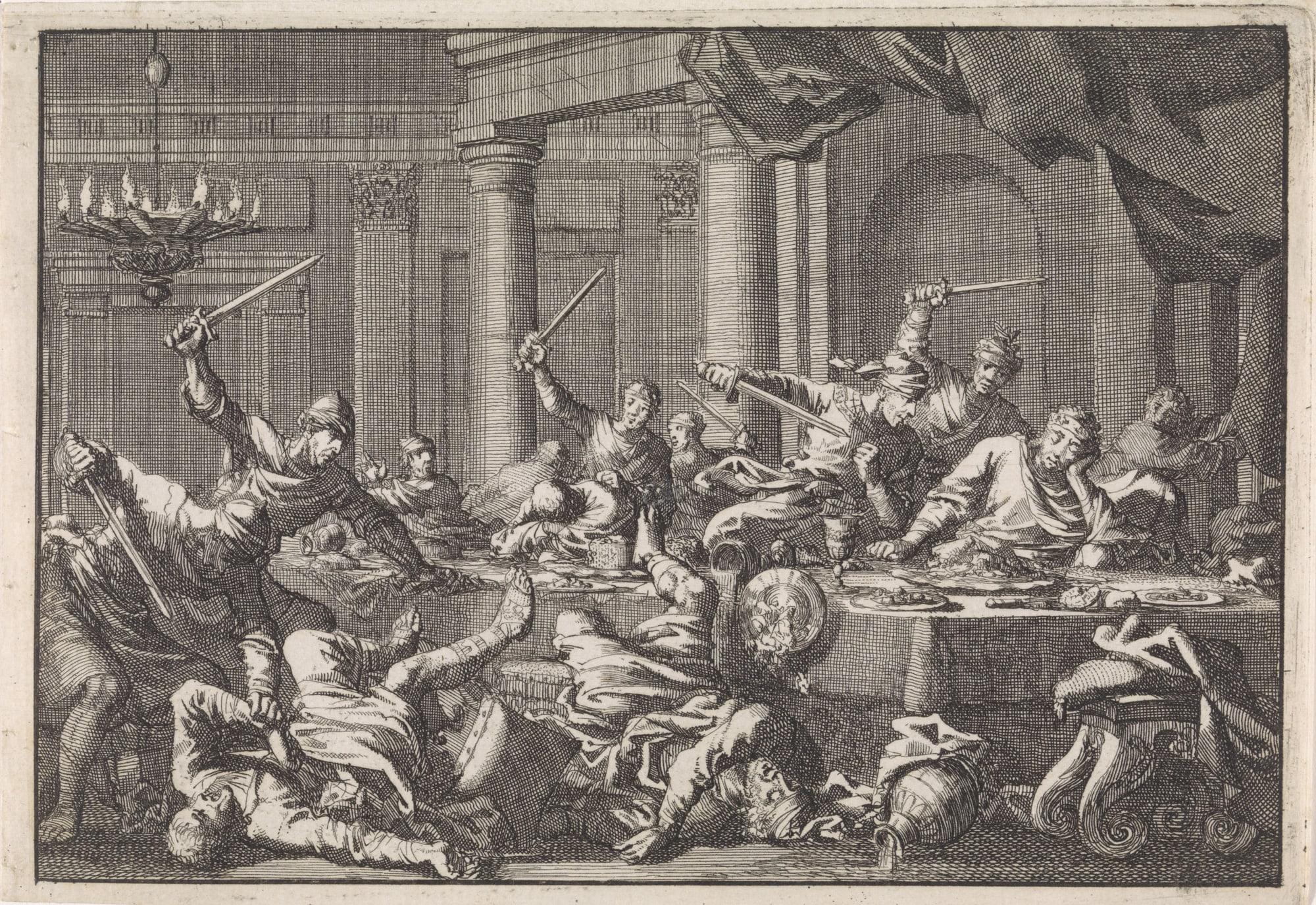
Jan Luyken, Gedaliah Murdered by Ishmael, 1704. Public domain.
Jeremiah 40 to 44 · Story · Featured Study
Gedaliah and the Remnant in Egypt
A killing at the governor's table sent the last of Judah's people into Egypt.
The LORD has told you, O remnant of Judah, ‘Do not go to Egypt.’ Know for sure that I have warned you today!
- Where
- Ramah, Mizpah, Gibeon, Bethlehem, Tahpanhes
- Who
- Gedaliah, Jeremiah, Ishmael Son Of Nethaniah, Johanan Son Of Kareah, Baruch
- When
- Gedaliah governed at Mizpah in the months after Jerusalem was burned
The commanders called the prophet's answer a lie and led the remnant into Egypt.
Summary
After Jerusalem fell, Babylon made Gedaliah governor of the poor who were left in Judah. Jeremiah went to live with him at Mizpah. Gedaliah would not believe a warning about Ishmael, and Ishmael killed him after a meal. The people asked Jeremiah what to do. He told them to stay, and they went to Egypt and took him with them.
- Gedaliah's trust in his guest has been praised and blamed.
- Ishmael filled King Asa's old cistern with the bodies of the men he killed.
- The Talmud links one of Zechariah's four fasts to his death.
The Governor at Mizpah
Jeremiah chose the land over Babylon, and scattered Jews came home for the harvest.
Nebuzaradan, the captain of the guard, found Jeremiah in chains at Ramah among the captives bound for Babylon. He freed him, gave him the choice of Babylon or the land, and sent him to Gedaliah with a ration and a gift.
Gedaliah swore to the army commanders who came to Mizpah that they need not fear to serve the Chaldeans.
As for me, I will stay in Mizpah to represent you before the Chaldeans who come to us. As for you, gather wine grapes, summer fruit, and oil, place them in your storage jars, and live in the cities you have taken.”Gedaliah set the commanders to the harvest and kept the dealings with Babylon for himself.
Jews who had fled to Moab, Ammon and Edom came home to him, and they gathered an abundance of wine grapes and summer fruit.
The study of the last kings of Judah tells the fall of the city before these months. It also gives the short account of them in Kings.
From Mizpah to Tahpanhes
The steps run from a warning refused to the stones buried in Egypt.
The road from Mizpah to Tahpanhes ran through a murder, a rescue, ten days of prayer and a refusal.
- Johanan warns Gedaliah, and Gedaliah calls the warning a lieMizpahJeremiah 40:16
- Ishmael eats with Gedaliah and strikes him downMizpahJeremiah 41:2
- Ishmael kills the mourners from Shechem, Shiloh and Samaria and spares tenMizpahJeremiah 41:7 to 8
- Ishmael takes the people captive toward the AmmonitesMizpahJeremiah 41:10
- Johanan overtakes him, and the captives go over to Johananthe great pool in GibeonJeremiah 41:12
- The remnant stops on the way to EgyptGeruth Chimham, near BethlehemJeremiah 41:17
- The word of the LORD comes to Jeremiah after ten daysthe place is not namedJeremiah 42:7
- Johanan takes the remnant, Jeremiah and Baruch to EgyptTahpanhesJeremiah 43:7
- Jeremiah buries large stones at the entrance to Pharaoh's palaceTahpanhesJeremiah 43:9
The steps of Jeremiah 40 to 43 in order, each with its place and its verse.
The word of the LORD comes to Jeremiah after ten days, Johanan takes the remnant, Jeremiah and Baruch to Egypt, Jeremiah buries large stones at the entrance to Pharaoh's palace
The Meal at Mizpah
Jeremiah records a shared meal, and Josephus adds a month's delay and a governor overcome by wine.
In the seventh month, Ishmael son of Nethaniah, the son of Elishama, who was a member of the royal family and one of the king’s chief officers, came with ten men to Gedaliah son of Ahikam at Mizpah, and they ate a meal together there.Clarke and Barnes write on the meal in this verse.
Adam Clarke notes that to share a meal was the same as making a solemn covenant. Whoever shared food with another was reckoned a friend. Albert Barnes notes that ten great men with their followers would have roused suspicion. The smallness of Ishmael's company, he writes, put Gedaliah off his guard.
Josephus, in his Antiquities of the Jews, has Ishmael come again after thirty days. Gedaliah feasted him at his table, gave him presents and drank until he fell asleep, and then Ishmael and his ten friends killed him.
The House of Shaphan
Gedaliah's father served King Josiah.
Ahikam son of Shaphan was among the men King Josiah sent to Hilkiah the priest when the Book of the Law was found.
Nevertheless, Ahikam son of Shaphan supported Jeremiah, so he was not handed over to the people to be put to death.Barnes builds his conjecture about Gedaliah's office on this verse.
Matthew Henry held it probable that Gedaliah had gone over to the Chaldeans on Jeremiah's advice. Henry thought he bore himself well enough to be trusted with the government. Albert Barnes conjectures that Jeremiah, grateful for Ahikam's help, recommended his son to Nebuzaradan.
Adam Clarke reads the office as no royal dignity, an overseer set to manage the men who worked the fields.
What the Text Leaves Unsaid
Jeremiah's account stops in Egypt with no end told for Ishmael, for the remnant or for Jeremiah.
Ishmael escaped to the Ammonites with eight men, and the text records nothing more of him.
The text says Baalis king of the Ammonites sent Ishmael and gives no reason. Albert Barnes suggests that Baalis, an ally of Zedekiah, bore a grudge against the house of Ahikam. He thinks Ishmael envied a subject who had opposed the war and now held power in place of the royal family.
Jeremiah's book tells nothing of his own death. Josephus writes that Nebuchadnezzar later fell on Egypt and carried the Jews he found there to Babylon.
The Fast of the Seventh Month
Two verses of Zechariah name the fasts kept through the exile.
“Ask all the people of the land and the priests, ‘When you fasted and mourned in the fifth and seventh months for these seventy years, was it really for Me that you fasted?The LORD's reply asks whom the fasts were for.
“This is what the LORD of Hosts says: The fasts of the fourth, the fifth, the seventh, and the tenth months will become times of joy and gladness, cheerful feasts for the house of Judah. Therefore you are to love both truth and peace.”The answer turns the days of mourning into days of joy.
The Babylonian Talmud, in Rosh Hashanah 18b, sets that fast on the third of Tishrei, the day Gedaliah son of Ahikam was killed. The Sages set it, the passage says, to teach that the death of the righteous is equal to the burning of the house of God.
Voices on Gedaliah
One voice from the sixteenth century is given on the murder.
John Calvin (1509 to 1564)
Commentaries
How this text has been taught
“Now Ishmael had sworn, as we have seen, that he would be faithful to Gedaliah. He was again received by him, and was treated hospitably; and from his table he rose up to slay the innocent man, who was his friend, and had acted towards him, as it has been stated, the part of a father.”
on Jeremiah 41:3Reformed
Should Gedaliah Have Listened to Johanan?
Gedaliah refused both the warning and the offer to kill Ishmael, and commentators judge him three ways.
Then Johanan son of Kareah spoke privately to Gedaliah at Mizpah. “Let me go and kill Ishmael son of Nethaniah,” he said. “No one will know it. Why should he take your life and scatter all the people of Judah who have gathered to you, so that the remnant of Judah would perish?”Each reading answers the offer made in this verse.
He was right to refuse a killingMatthew Henry
Matthew Henry holds that Johanan showed more courage and zeal than sense of justice. If it were lawful to kill for prevention, he asks, who could be safe, since malice always suspects the worst?
The objection: Henry speaks to the offer of a killing, and the next chapter proved the warning itself true.
A great soul who trusted too farAdam Clarke
Adam Clarke calls him a man of uncommon greatness of soul, who believed evil of no man because he felt none himself. He adds that a little more distrust would have saved his life.
The objection: Henry's point stands against the remedy Johanan offered, a killing in secret before any crime.
A mystery of providenceJamieson, Fausset and Brown
Jamieson, Fausset and Brown call it a mystery of providence that God let a righteous man rush into the trap in spite of warning.
The righteous perish, and no one takes it to heart; devout men are swept away, while no one considers that the righteous are guided from the presence of evil.The commentators find their answer to Gedaliah's death in this verse.
The objection: Isaiah 57:1 names no one, so the link to Gedaliah is the commentators' own.
Books to Read Next
Both works are in the public domain, and each has a free copy to read.
Notes, Explanatory and Practical, on the Old and New Testaments
Albert Barnes · 1832 to 1869
Barnes weighs the motives of Baalis and Ishmael and the meal at Mizpah.
Read at Bible HubBiblical Commentary on the Old Testament, on Jeremiah
C. F. Keil and F. Delitzsch · 1857 to 1878
Keil reads Jeremiah 40 and 41 verse by verse.
Read at Bible HubWhose Word Will Stand
The story ends in Egypt with the prophet and the people at odds.
Those who escape the sword will return from Egypt to Judah, few in number, and the whole remnant of Judah who went to dwell in the land of Egypt will know whose word will stand, Mine or theirs!Jeremiah set this word against the vows the women had made to the Queen of Heaven.
The LORD will return you to Egypt in ships by a route that I said you should never see again. There you will sell yourselves to your enemies as male and female slaves, but no one will buy you.”Matthew Henry reads the flight into Egypt as the last of these curses coming true.
Sources
Scripture is the Berean Standard Bible.
- Flavius Josephus, Antiquities of the Jews 10.9.1 to 10.9.7, translated by William Whiston.
- The Babylonian Talmud, Rosh Hashanah 18b, William Davidson Edition in English (CC-BY-NC)
- C. F. Keil and F. Delitzsch, Biblical Commentary on the Old Testament (1857 to 1878), on Jeremiah 40 and 41.
- Matthew Henry, Commentary on the Whole Bible (1710), on 2 Kings 25:22.
- Matthew Henry, Commentary on the Whole Bible (1710), on 2 Kings 25:26.
- Matthew Henry, Commentary on the Whole Bible (1710), on Jeremiah 40:15.
- Albert Barnes, Notes, Explanatory and Practical, on the Old and New Testaments (1832 to 1869), on 2 Kings 25:22.
- Albert Barnes, Notes, on Jeremiah 40:14.
- Albert Barnes, Notes, on Jeremiah 41:1.
- Adam Clarke, Commentary on the Bible (1832), on 2 Kings 25:22.
- Adam Clarke, Commentary on the Bible (1832), on Jeremiah 40:14 and Jeremiah 40:16.
- Adam Clarke, Commentary on the Bible (1832), on Jeremiah 41:1.
- Jamieson, Fausset and Brown, Commentary Critical and Explanatory on the Whole Bible (1871), on Jeremiah 40:16.
- John Calvin, Commentaries on Jeremiah, on Jeremiah 41:3.
Keep Studying
Read it6
Studies7
People and groups3
Subjects5