

Exodus 1–15 · Featured Study
The Exodus
Everything the Bible later says about being saved, it learned here. A people who cannot free themselves are freed, by a God who remembers, who names Himself before He acts, who judges the power that held them, who spares them under blood, who opens a sea they could not cross, and who does not consider the work finished until He is living among them. Every later rescue in Scripture, the return from exile, the cross, the last day, is told in this book's vocabulary.
Nicolas Poussin, The Crossing of the Red Sea (1633-1634) — Public domain, via Wikimedia Commons
Summary
This page walks the Exodus as redemption's master-type in six stages, from Israel's groan to the song at the sea, then traces the fixed grammar of salvation forward through Isaiah, the Gospels, Paul, and Revelation.
- Six stages from the groan in Egypt to the song at the sea, each with its own verse and what it establishes
- A four-part grammar of redemption (initiated, by blood, from and to, sealed by presence) set here and reused by the whole canon
- A timeline tracing the exodus pattern forward: Isaiah's new exodus, the Transfiguration, Paul's baptism-into-Moses, Revelation's last sea
- A word study on the Hebrew vocabulary Exodus gives the rest of Scripture
- Two hard questions about the Exodus asked at full strength, then answered
The Passage
six stages from the groan to the song
Four hundred years of silence end not with a hero but with a sound. Israel cries out under the brick quotas, and the narrator tells you what that cry reaches: not God's pity first, but God's memory.
So God heard their groaning, and He remembered His covenant with Abraham, Isaac, and Jacob.
Exodus 2:24 (BSB) →
What it establishesSalvation begins in God's covenant memory, not in Israel's condition.
A bush burns without burning up, and a fugitive shepherd is sent back to the empire he fled. Moses asks for credentials and is given a Name, and with it a promise stacked in seven first-person verbs: I will bring out, I will deliver, I will redeem, I will take.
I will redeem you with an outstretched arm and with mighty acts of judgment.
Exodus 6:6 (BSB) →
What it establishesThe Redeemer names Himself before He acts. The rescue rests on who He is.
Nine blows in three triads, escalating, each one dismantling something Egypt worshipped, the river, the herd, the sun. This is not God losing patience. It is a courtroom, and every plague is an exhibit.
I will execute judgment against all the gods of Egypt. I am the LORD.
Exodus 12:12 (BSB) →
What it establishesRedemption is not only rescue. It is judgment on the power that held the slaves.
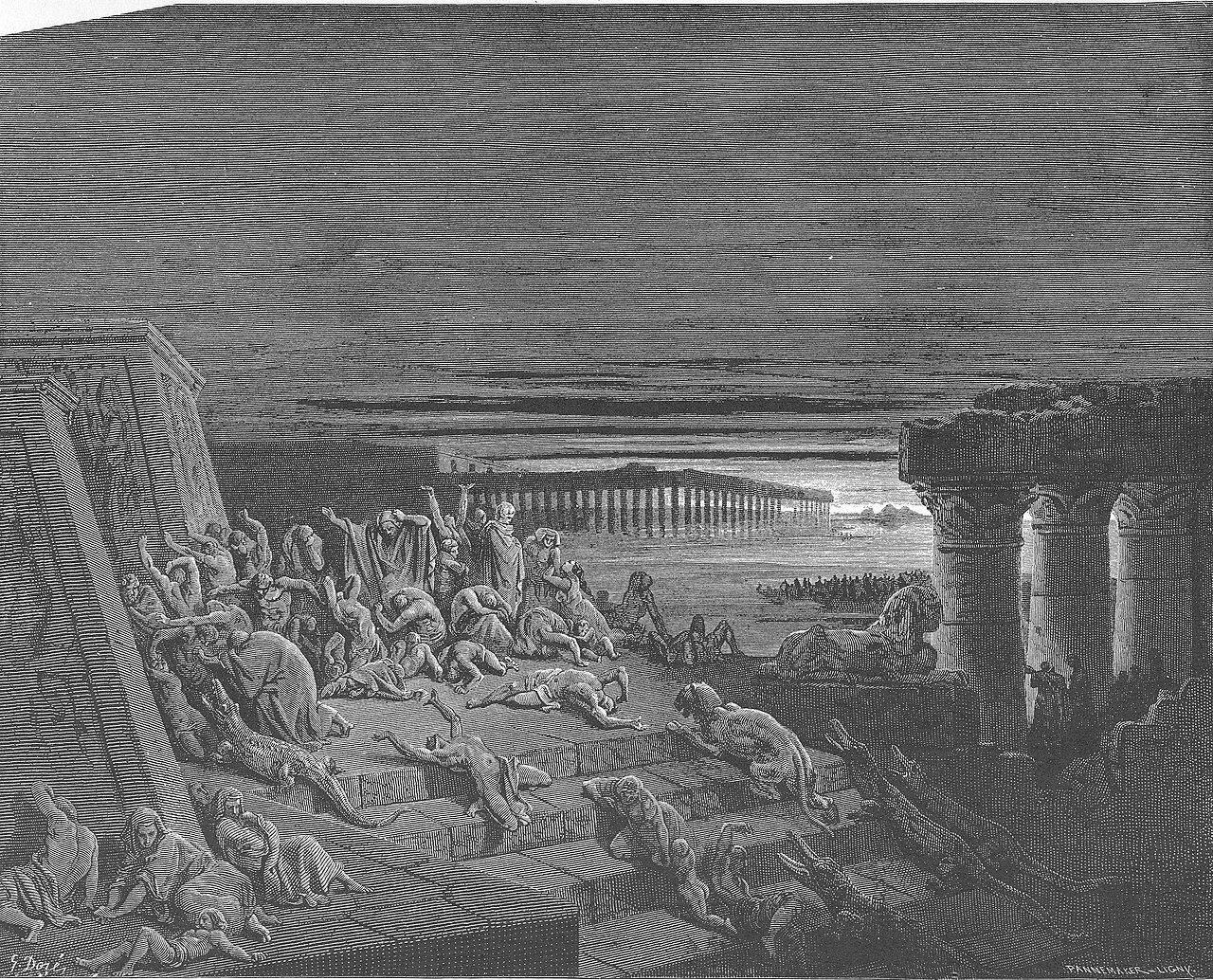
The tenth blow makes no distinction by nationality. Israel is not spared because it is Israel; it is spared because there is blood on the door. A lamb without blemish, its blood applied with hyssop, and a meal eaten dressed to travel.
When I see the blood, I will pass over you.
Exodus 12:13 (BSB) →
What it establishesThe blood of a substitute is what stands between a household and death.
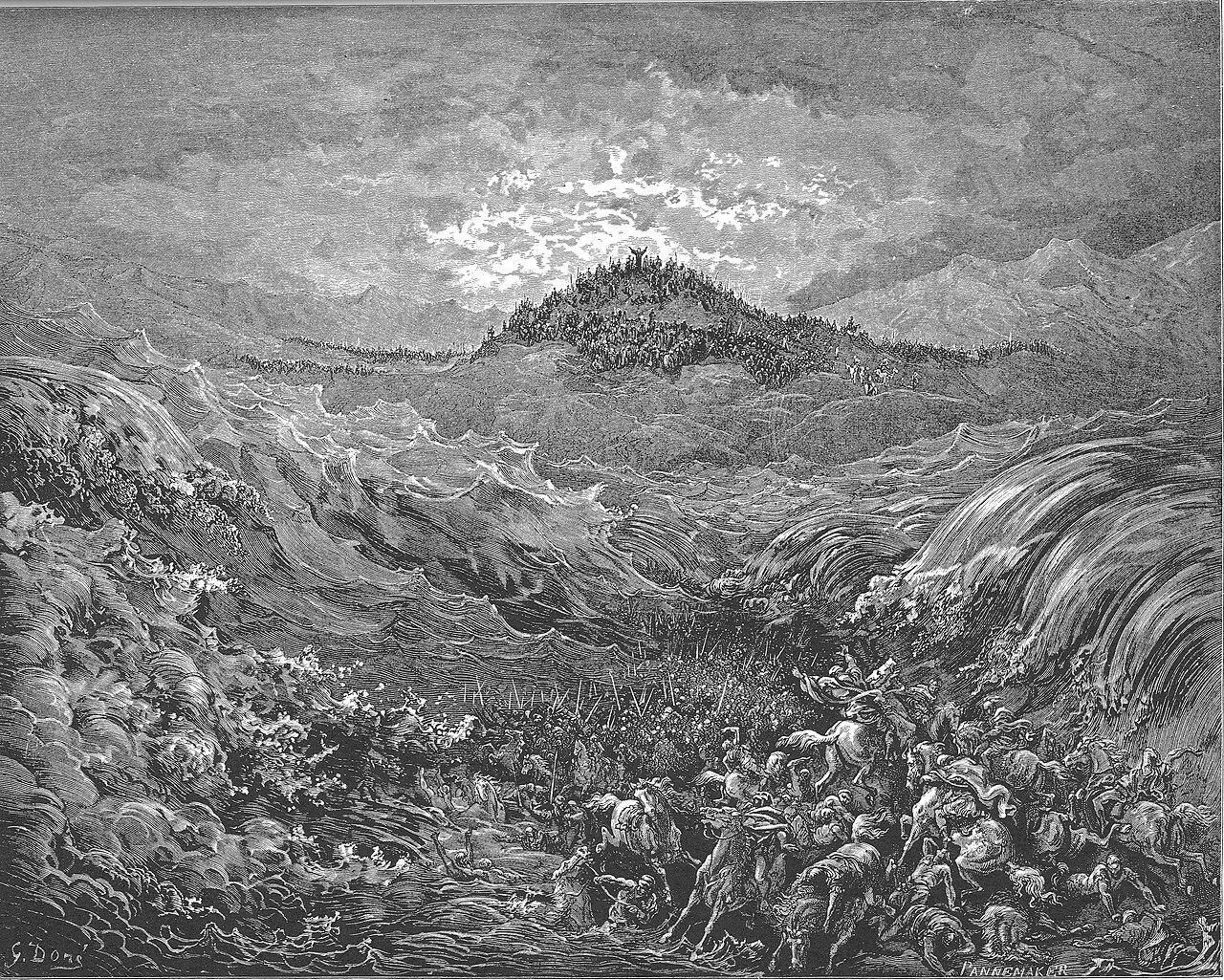
Freed slaves are trapped between water and chariots, and told to stand still. They walk out on dry ground between walls of water; the army that owned them does not. Egypt is not merely left behind, it is buried.
Do not be afraid. Stand firm and you will see the LORD’s salvation.
Exodus 14:13 (BSB) →
What it establishesThe people contribute nothing to their own deliverance except the walking.
One of the oldest poems in the Hebrew Bible, and the hinge of the whole book: after it, the story stops being about getting out of Egypt and starts being about getting to the mountain. It ends where the redeemed always end, at a sanctuary.
With loving devotion You will lead the people You have redeemed.
Exodus 15:13 (BSB) →
What it establishesRedemption ends in worship. The rescued people's first act as a nation is to sing.
The Sea
Exodus 14, the picture the whole Bible keeps returning to
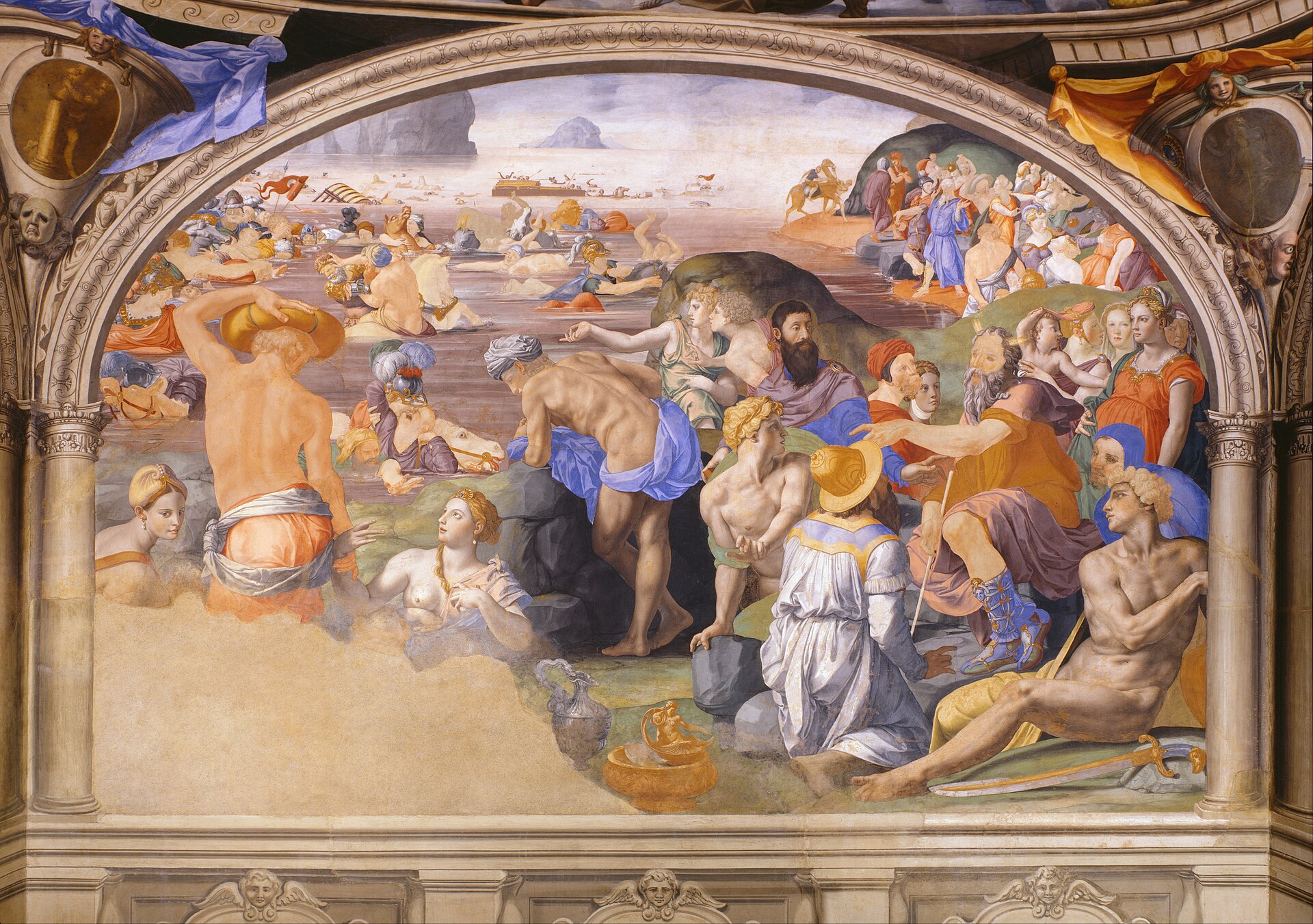
The trap is deliberate
God tells them where to camp so that Pharaoh will conclude they are lost (14:2–4). The corner Israel is backed into is not a failure of the plan; it is the plan.
Their part is to stand still
“The LORD will fight for you; you need only to be still” (14:14). Then: “Tell the Israelites to go forward.” Faith here is walking into a corridor you did not open.
Egypt does not merely release them
The army that owned them is drowned. Deliverance in this book is never negotiated with the old master, it is the end of him.
The Grammar of Redemption
four fixed elements, set here, and never changed afterwards
Initiated
God remembers His covenant before Israel prays rightly, the initiative is entirely His (2:24; 6:5).
“God commendeth his own love toward us, in that, while we were yet sinners, Christ died for us.”
Romans 5:8 →By blood
A lamb without blemish dies in the place of a household, and its blood is applied, not merely shed (12:5–7, 13).
“For our passover also hath been sacrificed, even Christ”, Paul names the type without hedging.
1 Corinthians 5:7 →From and to
“Let my people go, that they may serve me.” One Hebrew root covers slave-labour and worship, Israel changes masters, not status alone.
“Ye were bought with a price: glorify God therefore in your body.” Freedom is transfer of ownership.
1 Corinthians 6:20 →Sealed by presence
The rescue is not finished at the sea. It finishes when the glory fills the tent and God travels with them (25:8; 40:34).
“The Word became flesh, and dwelt among us”, the tent pitched in a body; and at the end, “the tabernacle of God is with men.”
John 1:14; Revelation 21:3 →The New Exodus
the echo running forward, prophets, Gospels, apostles, and the last sea
A type is only a type if the Bible itself reuses it. This one is reused relentlessly. Isaiah stages the return from Babylon as a second exodus and then says the new one will eclipse the old; Luke calls the cross a going-out in the hearing of Moses himself; Paul reads the sea as baptism; and John hears the redeemed of every nation singing Exodus 15 beside a sea of glass.
“With loving devotion You will lead the people You have redeemed.”
The event itself, and immediately, in its own song, already a template: the redeemed people led toward a sanctuary God has made.
“Prepare the way for the LORD in the wilderness.”
Isaiah's book of comfort opens by staging the return from Babylon as a second exodus, a highway through a desert, God leading His people home again.
“Behold, I am about to do something new… I will make a way in the wilderness.”
The astonishing move: having recalled the God who made a path through the sea, Isaiah says stop remembering it, because the next deliverance will make the first look small.
“Was it not You who dried up the sea, the waters of the great deep?”
A prayer that argues with God from His own résumé, do again what you did at the sea. The exodus becomes Israel's permanent ground of appeal.
“For you will not leave in a hurry nor flee in haste.”
Read against Exodus 12:11, belts fastened, sandals on, eaten in haste, this is deliberate contrast. The new exodus will be unhurried, because no one is chasing.
“…spoke about His departure, which He was about to accomplish at Jerusalem.”
On the mount of Transfiguration, with Moses himself standing there, the word Luke chooses for Jesus' death is exodos, a going-out. The cross is named as the exodus the first one was rehearsing.
“…and were all baptized unto Moses in the cloud and in the sea.”
Paul reads the crossing as the church's own baptism prefigured, the manna and the water as spiritual food and drink, “and the rock was Christ”, then warns that a redeemed people can still fall in the wilderness.
“And they sing the song of Moses the servant of God, and the song of the Lamb.”
Standing beside a sea of glass mingled with fire, the redeemed of every nation sing one song with two names. The last book of the Bible ends the exodus by singing Exodus 15 again.
Notice the shape of the rail. It does not run Egypt, then a series of unrelated rescues. It runs one rescue, told four more times at rising magnitude, out of Egypt, out of Babylon, out of death, out of the world, until the last verse of the pattern is a crowd from every nation singing a slave-song by a sea that no longer needs parting.
The Words of the Rescue
the vocabulary Exodus gives the whole Bible
Two different pictures of the same act. Ga'al is what a relative does: the kinsman with the right and the obligation to buy back what his family lost; the word that will later belong to Boaz. Padah is what a buyer does: a price handed over and a captive released. Exodus uses both of God, in the same breath, and apologizes for neither.
Two Honest Questions
asked at full strength, then answered
Which sea, and by what route?
The Hebrew yam suph is literally “sea of reeds”; “Red Sea” reaches English through the Greek Old Testament. Candidate crossings run from the Bitter Lakes and Lake Timsah to the Gulf of Suez and, at the popular level, the Gulf of Aqaba. Note what the lexical point does not settle: the text describes walls of water and a drowned army, and “reeds” does not mean “shallow.” The miracle is held; the map is left open.
Why is there no Egyptian record of it?
Because Egyptian royal inscription is triumphal propaganda, and a state that chiselled out the names of its own inconvenient pharaohs was never going to commemorate losing a slave force to a slave's God. Argument from silence cuts weakly here. What the record does show is the Delta full of Semitic populations and slaves, Egyptian loanwords and local colour woven accurately through the narrative, an archaic victory poem in chapter 15, and a covenant form at Sinai that fits the second millennium — the case Kitchen and Hoffmeier press as a ring of authenticity.
The historic Christian reading on both: the exodus is a real event in real history, and the evidentiary case is presented honestly, including what is missing, rather than tidied. The geography stays open; the miracle does not.
Word studies
The Hebrew and Greek under this study, each word in its own room.
Keep studying
Read it1
On this page
Studies5
People1
Places2