
Skip to content
mannafest.faith
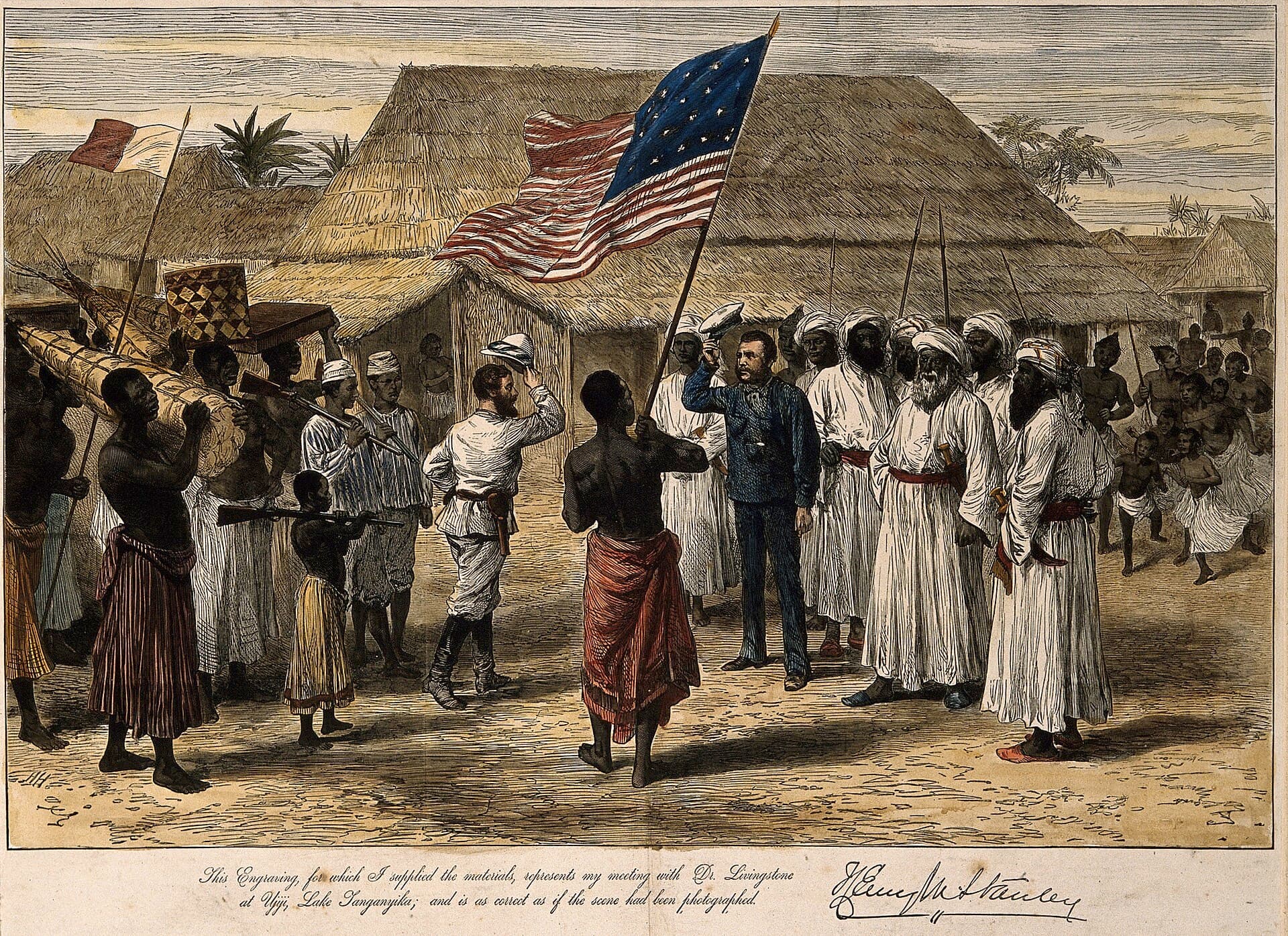
Stanley meets Livingstone at Ujiji

Stanley meets Livingstone at Ujiji, Wellcome Collection, CC BY 4.0

The Great Cloud of Witnesses, era 8 of 10 · Church history · Featured Study

The Missionary Century

Awakened people looked at a map and could not stay home. In a hundred and twenty years the gospel was carried, at enormous cost, to India, China, Africa, and the islands.

Span
1790–1910
Boundary
The span closes at 1910 with Edinburgh.

In little over a hundred years the churches went from no mission at all to presses, schools and Bibles in hundreds of tongues.

Summary

Those who went out often died young. The churches they left behind outlived the empires.

  • Carey preached at Nottingham in May 1792. The society was founded that October.
  • He sailed for India in 1793. The Serampore press printed Scripture in dozens of tongues.
  • Morrison reached China in 1807. Judson reached Burma in 1813.
  • Hudson Taylor began the China Inland Mission in 1865.
  • Edinburgh, 1910, closed the century and opened the modern mission talks.

The era's own voice

Why he wrote it: Carey was preaching to a room of Northamptonshire Baptist ministers who believed that the command to go had been given to the apostles and had lapsed with them. He was arguing them into founding a society, and they founded one five months later.

What else says so: The association's own minutes record the founding of the Baptist Missionary Society on 2 October 1792, and the earliest printed reports of the sermon give the shorter wording noted beside the quotation.

“Expect great things from God; attempt great things for God.”

William Carey · Carey preached this from Isaiah 54:2–3 to the Northamptonshire Baptist ministers; the sermon itself was never printed. The earliest reports of it give the shorter form, "Expect great things. Attempt great things." The words "from God" and "for God" appear in accounts written down decades later. The longer version is how the church has carried it, and it is faithful to what he meant, but the exact wording that day is not certain.

The turning points

The era hangs on these moments, each with a document a reader can open.

  1. 1792Carey publishes his case, and a society is bornIt argued from Scripture and from shipping routes at once, and the modern missionary movement dates from it.William Carey, An Enquiry into the Obligations of Christians to Use Means for the Conversion of the Heathens, 1792
  2. 1804The British and Foreign Bible SocietyIt made Scripture in the reader's own language the engine of the century, and the translation work followed the ships.The Society's own annual reports, from 1805
  3. 1854Hudson Taylor lands at ShanghaiHe went inland, wore Chinese dress and took no guaranteed salary, and the faith mission model spread from him across the world.Hudson Taylor, China's Spiritual Need and Claims, 1865
  4. 1865The China Inland Mission and the Salvation ArmyThe same year sent the gospel to inland China and into the slums of London, and the century's missionary energy turned on its own cities as well.William Booth, In Darkest England and the Way Out, 1890
  5. 1910EdinburghIt counted what the century had done, admitted what it had not, and is the starting point of both modern mission planning and the ecumenical movement.The World Missionary Conference, Edinburgh 1910 reports, nine volumes

The 5 turning points of The Missionary Century, 1790–1910, in order, each with the document that records it and why it earned its place.

The story

A young couple sailing for Burma in 1812 packed their belongings in a crate built like a coffin, because the odds of coming home were poor enough that the crate would have a second use. Adoniram and Ann Judson knew that when they boarded.

It began at a workbench. William Carey mended shoes in a Northamptonshire village, and above the bench he kept a homemade map of the world with everything he could learn about each place written on it, population, religion, whether anyone had ever gone. He taught himself Greek, Hebrew, and Dutch while he worked. When he told the older ministers that the church owed the world the gospel, one of them is said to have told him to sit down; the story may have grown in the telling, but the mood it describes was real.

“Enlarge the site of your tent, stretch out the curtains of your dwellings, do not hold back. Lengthen your ropes and drive your stakes in deep.
Isaiah 54:2BSB

Carey's text at Nottingham in 1792. He read "enlarge the place of thy tent" as a command with a promise attached, and the sermon on it launched the Baptist Missionary Society five months later.

So Carey made his case in print. The Enquiry of 1792 is mostly a list, country after country, with numbers, followed by a simple argument: we have ships, we have printers, we have men; we have no excuse. That October, thirteen ministers met in a back parlour at Kettering and pledged a little over thirteen pounds to send him. That meeting invented the era's engine: the voluntary society, funded by ordinary people giving small sums on purpose. Within thirty years there were dozens of them, and they were how the century worked.

The cost came due immediately. Carey lost a child in India, watched his wife's mind give way under the strain, and in 1812 saw his printing house burn with years of manuscript inside it. He started over. The Serampore team eventually had a hand in putting parts of Scripture into dozens of Indian languages, the traditional count is around forty, and honest historians note that some of those versions were rough and were later redone. That does not shrink the work. It only means he was first, not final.

Therefore go and make disciples of all nations, baptizing them in the name of the Father, and of the Son, and of the Holy Spirit,
Matthew 28:19BSB

The Great Commission. The whole argument of Carey's Enquiry is that this command was given to the church and never withdrawn, that "all nations" still means all of them.

In Burma, Adoniram Judson waited six years for one convert. During a war with Britain he was thrown into the prison at Ava for about seventeen months, part of it in irons and hung by the feet at night. Ann Judson walked to the prison with food, argued with officials for his life, and sewed his Burmese manuscript into a hard, lumpy pillow no guard wanted to steal. She died not long after he was freed. The Bible in that pillow is still read.

Africa took the highest toll. West Africa was known in that generation's own grim phrase as "the white man's grave," and it was said of missionaries there that they packed their belongings in coffins because they expected to need one, a saying repeated so often that it is hard now to trace to a particular family, but the burial registers behind it are real enough. On some stations the average survival was measured in months. People kept going anyway, which is either madness or faith, and they were clear about which.

How then can they call on the One in whom they have not believed? And how can they believe in the One of whom they have not heard? And how can they hear without someone to preach?
Romans 10:14BSB

The verse that turns conviction into a boat ticket: no preacher, no hearing. It was quoted from a thousand pulpits to explain why somebody had to actually go.

Out of that pressure came something new: the faith mission. George Müller in Bristol housed, fed, and schooled thousands of orphans across sixty years and refused on principle ever to ask a human being for money, he asked God and published the ledgers. Hudson Taylor took the same principle to inland China. The China Inland Mission would take unmarried women and workers without university degrees, wear Chinese clothes, live in Chinese houses, and tell its needs to no one but God. Both men were doing an experiment in public, and they meant everyone to check their books.

Women carried this century more than the plaques suggest. Ann Judson kept a translation and a husband alive in Burma. Mary Slessor, a Dundee mill girl who had worked at a loom from age eleven, lived alone among the Efik people of Calabar and made herself the enemy of the custom that killed twin infants, she took the babies home instead. Lottie Moon spent four decades in Shandong and wrote letters to Virginia that shamed her denomination into funding women properly; the Christmas offering named for her still runs. Amy Carmichael reached India in 1895 and began gathering children rescued from temple service into what became the Dohnavur family.

After this I looked and saw a multitude too large to count, from every nation and tribe and people and tongue, standing before the throne and before the Lamb. They were wearing white robes and holding palm branches in their hands.
Revelation 7:9BSB

The picture the whole century was working toward, a crowd from every nation, tribe, people, and tongue before the throne, and the reason a missionary could bury a wife in Africa and stay.

At home, the gospel went into the gutter. William and Catherine Booth left respectable ministry for London's East End in 1865 and built a movement of brass bands, soup, shelters, and open-air preaching among drunks, prostitutes, and the unemployable. Catherine preached, which scandalised people, and the Army commissioned women as officers on equal terms decades before most churches would consider it. In Darkest England (1890) argued that a man cannot hear a sermon over the noise of his own hunger, feed him, then preach.

The century's preaching heart beat in London. Charles Spurgeon came to New Park Street at nineteen and by 1861 was preaching to around five thousand people twice on a Sunday at the Metropolitan Tabernacle. What made him a missionary force was the press: a sermon printed every week for decades, sold for a penny, carried by ship and translated into many languages. Farmers in Australia and planters in the American South read the same sermon on the same month. He also trained pastors, ran an orphanage, and stood for the old gospel when it cost him friends.

The era's writings, 1 to 3 of 8: each with its date and one line on what it holds.

WritingDateWhat it holds
William Carey, An Enquiry into the Obligations of Christians to Use Means for the Conversion of the Heathens1792The little book that started the movement: a survey of the world's peoples, country by country, followed by the argument that the church has no excuse for staying home.
The Burmese Bible (Judson)1834, revised to 1840A whole Bible in a language that had never held one, made word by word over two decades, part of it while its translator was in chains.
Hudson Taylor, China's Spiritual Need and Claims1865A short, plain book of numbers and maps meant to make comfortable Christians feel the weight of inland China; it recruited a generation.

Underneath everything ran the Bible societies. The British and Foreign Bible Society (1804) and the American Bible Society (1816) existed to print Scripture cheaply and hand it off without argument about denomination. Missionaries reduced spoken languages to written ones, inventing alphabets, compiling the first dictionaries and grammars, and the societies printed the result by the shipload. A great deal of the world's literacy, and most of its Bible translations, trace back through this pipeline.

The era's writings, 4 to 6 of 8: each with its date and one line on what it holds.

WritingDateWhat it holds
David Livingstone, Missionary Travels and Researches in South Africa1857The bestseller that made Africa real to British readers, rivers, peoples, and the slave caravans he could not stop watching.
George Müller, A Narrative of Some of the Lord's Dealings with George Müllerfrom 1837, in several volumesMüller's running account of the orphan houses, with the money written down as it came, kept as public evidence that prayer alone had paid for everything.
Ira D. Sankey, Sacred Songs and Solosfrom 1873The songbook that carried the older hymnody into the revival meeting; Sankey sang for Moody, and the sales funded the campaigns.

By 1910 the church could look at a map and see itself on every continent for the first time since the apostles, and the century had spent itself doing it, in graves at Serampore and Calabar and Ilala. Edinburgh felt like a summing-up. It was actually a handoff: already the chapels of Wales had been full for months, and something else was gathering that would not be organized by any society.

The era's writings, 7 to 8 of 8: each with its date and one line on what it holds.

WritingDateWhat it holds
The New Park Street and Metropolitan Tabernacle Pulpit (Spurgeon's sermons)1855–1917A sermon printed every week for decades and sold for a penny, shipped worldwide and translated widely, preaching as a missionary force in its own right.
William Booth, In Darkest England and the Way Out1890The Salvation Army's plan for the poor of Britain: shelters, work, farms, and emigration, the gospel with a roof and a meal attached.

Romans 10:14, Revelation 7:9

Why these years

The span closes at 1910 with Edinburgh. That is where the sending churches first sat with delegates from the churches they had planted and heard what those delegates thought. It opens at 1790, just before Carey's sermon and the first society. The overlap with the Great Awakenings is deliberate: the men who went out were converted in the awakening, and a witness hangs where he was formed.

What did not change

The distance did not shrink in a way that mattered. A missionary in central Africa in 1900 still waited months for a reply, and the whole century's work was done by people making decisions alone.

The charge against the missionary century

These missionaries traveled on empire's ships, and some of them mistook British customs for Christian ones, dressed converts in European clothes, and were slow to hand leadership to the churches they planted. That is true, and Edinburgh in 1910 heard it said out loud by delegates from those churches.

But cynicism gets the story wrong. Livingstone spent his last years documenting the Arab-Swahili slave trade precisely to force Britain to act against it; Carey campaigned until the burning of widows was banned in 1829; Slessor fought a custom, not a people. Missionaries were frequently the empire's loudest critics on the ground, and the empire knew it.

What this page leaves out

This page follows the British and American societies and the men and women whose papers survive. It leaves out the Continental missions, the Catholic orders working the same fields, and the relationship between the missions and the empires that carried them, which is a real question and a page of its own.

What it handed the church

The voluntary society, ordinary Christians pooling small regular gifts to send someone they will never meet, became the church's normal way of doing anything large, and still is.

Most of the world's Bible translations descend from this era's work, along with a great deal of its literacy: missionaries wrote down languages that had never been written, and the Bible societies printed them.

Faith missions proved a point that outlived their founders: Müller's ledgers and Taylor's mission showed that a work can be funded by prayer and honest books without appeals or pressure.

The churches planted in this century became, within a hundred years, the numerical center of Christianity, which now lies in Africa, Asia, and Latin America rather than Europe.

Missions opened public ministry to women a generation or two before the home churches did, and the record of Judson, Slessor, Moon, and Carmichael is why.

The century left the church a permanent question, first pressed hard at Edinburgh in 1910: how do you carry the gospel across a culture without carrying your own culture as though it were part of it?

The dated line14 dated moments of the era in order, the turning points included

Every dated moment of The Missionary Century in order, 14 in all, the turning points included.

YearMomentWhat happened
1792A shoemaker publishes his case, and a society is bornIn May, William Carey printed An Enquiry into the Obligations of Christians to Use Means for the Conversion of the Heathens, 87 pages arguing that the Great Commission still binds the church. That October, thirteen ministers met in a back parlour at Kettering and founded the Baptist Missionary Society with a little over £13 pledged.
1793Carey sails for IndiaThe East India Company would not carry missionaries, so Carey went out in June on a Danish ship and reached Calcutta in November. He would serve forty-one years and never once come home.
1804The British and Foreign Bible SocietyFounded in London in March to put Scripture into every language at a price ordinary people could pay. Bible societies became the quiet engine of the whole century, the missionaries translated, and the societies printed and shipped.
1807The slave trade abolished, and Morrison reaches ChinaIn March, after twenty years of losing votes, William Wilberforce and his allies carried the bill that ended the British slave trade. The same year Robert Morrison arrived at Canton, where teaching a foreigner Chinese was a capital offence; he worked in secret and gave China its first Protestant Bible and dictionary.
1812The Judsons sail, and Serampore burnsAdoniram and Ann Judson left Salem in February, the first American foreign missionaries sent out by a board. In March a fire at Serampore destroyed Carey's printing house, type, paper, and years of manuscript. He wrote that the loss was heavy but the ground was already cleared, and began again.
1825George Müller is convertedA German student with a record of lying and petty theft went along to a small Saturday prayer meeting in a private house in Halle, mostly out of curiosity. He walked out changed, and spent the next seventy years proving in public that God answers prayer.
1840Livingstone sails, and the Burmese Bible is doneDavid Livingstone, a Scottish mill worker who studied medicine at night, left London in December for southern Africa; he had wanted China, but a war closed it and Robert Moffat's talk of "the smoke of a thousand villages" turned him south. That same year Judson finished revising his Burmese Bible, first completed in 1834, twenty-one years after he landed.
1854Hudson Taylor lands at ShanghaiHe was twenty-one, under-funded, and arrived in the middle of a civil war. Within a few years he had done what no missionary did, put on Chinese dress and gone inland, away from the treaty ports and the protection of gunboats.
1859The '59 Revival, and Spurgeon's foundation stoneAwakening ran through Ulster and Wales after a season of prayer meetings begun in New York two years earlier; contemporaries counted converts in the tens of thousands, though the figures were estimates made in the moment. In August the foundation stone was laid for Charles Spurgeon's Metropolitan Tabernacle, which opened in 1861 and seated around five thousand.
1865The China Inland Mission and the Salvation ArmyIn June, walking the beach at Brighton in anguish over inland China, Taylor wrote in his Bible that he was asking God for twenty-four workers, a mission that would ask no one but God for money. The same summer William and Catherine Booth opened a mission in London's East End; it took the name Salvation Army in 1878.
1873Livingstone dies on his kneesHe was found on the morning of May 1 at Chitambo's village, kneeling by his bed. His African companions Chuma and Susi buried his heart under a tree, dried his body, and carried it roughly a thousand miles to the coast so England could bury him in Westminster Abbey.
1885The Cambridge SevenSeven young men from Britain's most privileged circles, including the cricketer C. T. Studd, gave up sport, money, and careers and sailed for China with the Inland Mission. Their farewell tour of the universities sent a wave of students into missions on both sides of the Atlantic.
1904Clouds gathering over WalesIn the autumn a young miner named Evan Roberts began meetings at Loughor, and within months chapels across Wales were full night after night. Reports of about a hundred thousand converts in a year are the era's own estimate, not a count, but the world was watching, and the next era was already breaking.
1910EdinburghIn June, some 1,200 delegates met in Edinburgh for the World Missionary Conference under the chairmanship of John R. Mott. For the first time since the apostles the church could look at a map and say it was genuinely worldwide, and the delegates from the younger churches asked, politely and firmly, when they would be treated as equals.

1840, 1854, 1859, 1865, 1873, 1885, 1904, 1910

Books to Read Next

An Enquiry into the Obligations of Christians to Use Means for the Conversion of the Heathens
William Carey (1792)

The founding document, and short enough to read in an evening, start where the movement started. Free, public domain.

A Narrative of Some of the Lord's Dealings with George Müller
George Müller

Müller's own running account of the orphan houses, money written down as it arrived; read it as a seventy-year experiment in whether God answers prayer. Free, public domain.

Missionary Travels and Researches in South Africa
David Livingstone (1857)

Livingstone in his own voice, rivers, fevers, and the slave caravans he could not unsee. Free, public domain.

Hudson Taylor in Early Years: The Growth of a Soul
Howard and Geraldine Taylor (1911)

The classic life of Taylor by his son and daughter-in-law: admiring, but built on his letters and diaries. Free, public domain.

To the Golden Shore: The Life of Adoniram Judson
Courtney Anderson

The best-told single missionary biography of the era, Burma, the prison at Ava, and Ann Judson, at full length. Recommended reading, still in print.

A History of Christian Missions
Stephen Neill

One volume, the whole story, written by a bishop who had served in India and was willing to name the movement's failures as plainly as its heroes. Recommended reading.

Sources

Scripture is the Berean Standard Bible.

  1. Stephen Neill, A History of Christian Missions (Penguin History of the Church vol. 6, 1964)
  2. Kenneth Scott Latourette, A History of the Expansion of Christianity, vols. 4–6 (1941–1944), cited.
  3. Courtney Anderson, To the Golden Shore: The Life of Adoniram Judson (1956), cited.
  4. William Carey, An Enquiry into the Obligations of Christians to Use Means for the Conversion of the Heathens (1792), primary.
  5. George Müller, A Narrative of Some of the Lord's Dealings with George Müller (1837–1860), primary.
  6. David Livingstone, Missionary Travels and Researches in South Africa (1857), primary.
  7. Howard and Geraldine Taylor, Hudson Taylor in Early Years: The Growth of a Soul (1911)
  8. William Booth, In Darkest England and the Way Out (1890), primary.

Every cited work: the sources registry →