
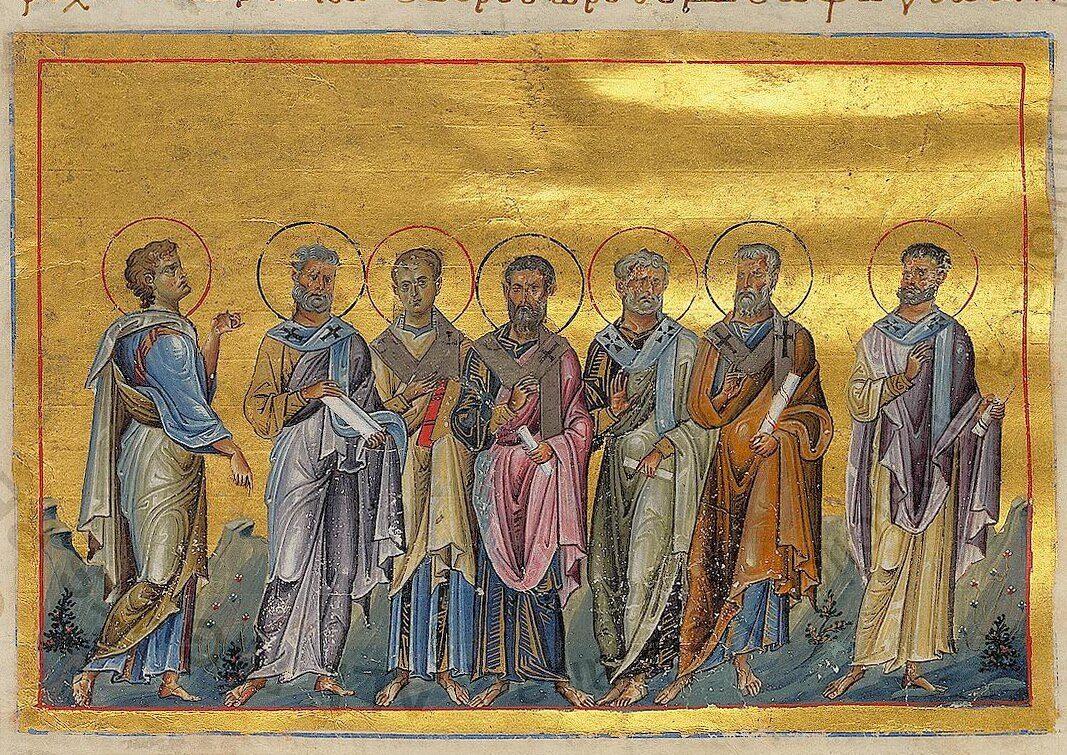
Sosthenes, Apollo, Cephas, Tychicus, Epaphroditus, about 985. Public domain.
Acts 18 · Person · Featured Study
Apollos
A Jewish teacher from Alexandria who carried on Paul's work at Corinth.
I planted the seed and Apollos watered it, but God made it grow.
- Family
- family: not named
- Places
- Alexandria, Ephesus, Achaia, Corinth
- First named
- Acts 18:24 “Meanwhile a Jew named Apollos, a native…”
- Last named
- Titus 3:13 “…equip Zenas the lawyer and Apollos, so that…”
Paul wrote that he planted the church at Corinth and Apollos watered it.
Summary
Apollos was a Jew born in Alexandria in Egypt. He knew the Scriptures well and spoke with skill. He came to Ephesus and then crossed to Corinth, where he helped the believers. Some at Corinth later made his name a party name.
- Paul calls Apollos his brother in 1 Corinthians 16:12.
- Henry Alford names Martin Luther as the apparent first to hold that Apollos wrote Hebrews.
- Philo put the Jews of Alexandria and the rest of Egypt at no fewer than a million.
Apollos in the New Testament
Luke names him in Acts 18 and 19, and Paul in seven verses of 1 Corinthians and one of Titus.
Luke and Paul show Apollos at his arrival, at his refusal to return to Corinth and at his travels late in Paul's life.
Meanwhile a Jew named Apollos, a native of Alexandria, came to Ephesus. He was an eloquent man, well versed in the Scriptures.Luke gives his people, his city and his two gifts in one verse.
Now about our brother Apollos: I strongly urged him to go to you with the brothers. He was not at all inclined to go now, but he will go when he has the opportunity.Paul's last word on Apollos to the Corinthians shows the two men still at peace.
Do your best to equip Zenas the lawyer and Apollos, so that they will have everything they need.Scripture names Apollos last in this verse.
Apollos From Alexandria to Crete
Six moments, from his home city to his last mention.
Apollos moved from Alexandria to Ephesus and Corinth, and Paul's letters follow him after that.
- Before EphesusAlexandriaBorn there, a JewActs 18:24
- At EphesusThe synagogueHe spoke boldly thereActs 18:26
- ThenAchaiaThe brothers wrote letters, and he helped the believersActs 18:27
- While at CorinthCorinthHe refuted the Jews in public from the ScripturesActs 18:28
- LaterAway from CorinthNot willing to go to Corinth yet1 Corinthians 16:12
- Last mentionCrete, where Titus wasTravelling with Zenas the lawyerTitus 3:13
Acts and Paul's letters give no year for any of these moments.
Alexandria lay across the sea from Ephesus and Corinth.
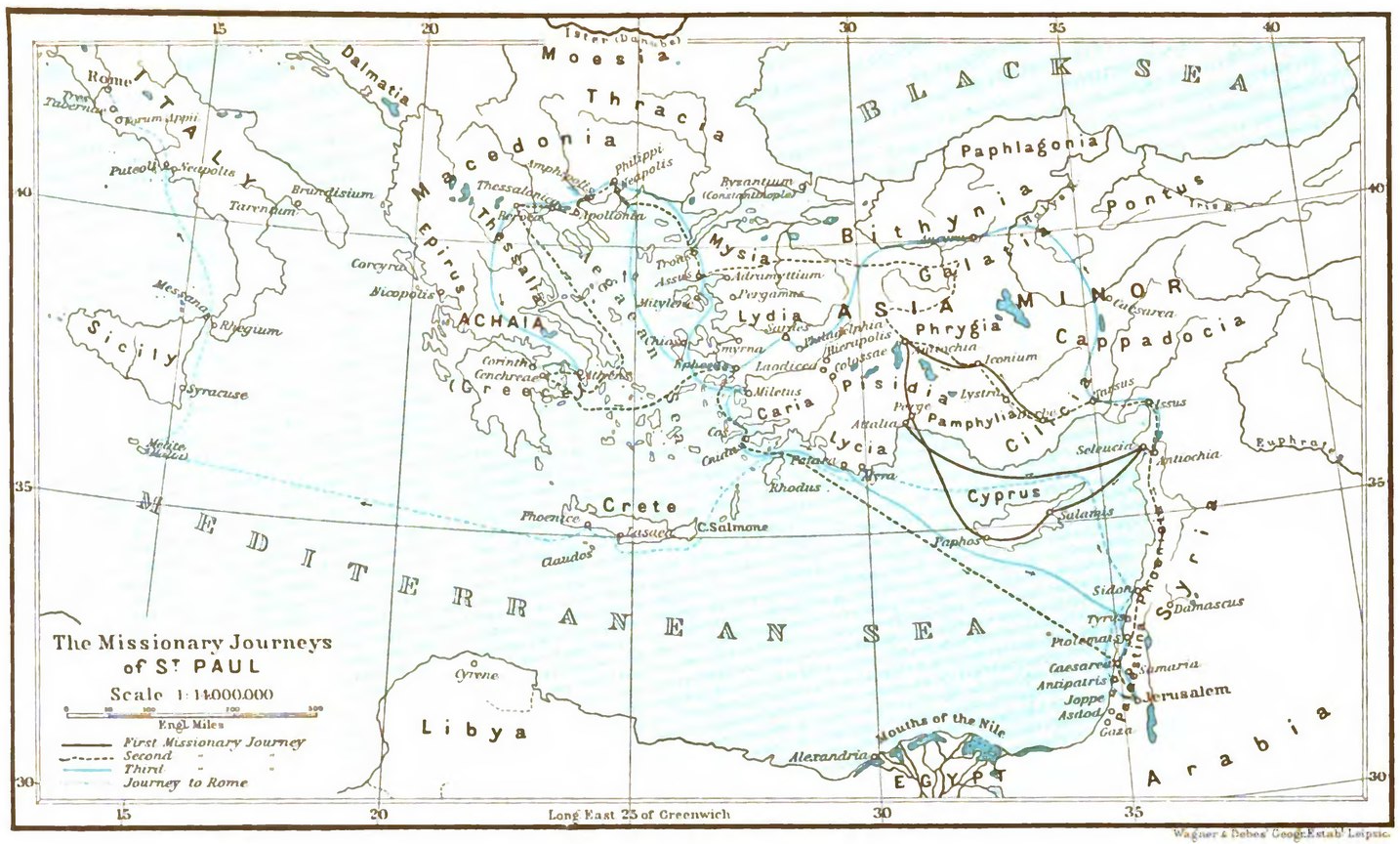
- 1Alexandria, His home city in Egypt Acts 18:24
- 2Ephesus, Where he first taught in the synagogue Acts 18:26
- 3Corinth, Where he helped the believers Acts 19:1
Base map: The missionary journeys of St. Paul, F. J. Knecht, Practical Commentary on Holy Scripture, public domain. Places with a place page stand at its coordinates and the others at the point cited for each, set on the plate by Corinth and Ephesus, as the plate prints them.
Three cities on Knecht's plate of Paul's journeys. Each scores 1,000 of 1,000 in the OpenBible identification data.
His Work at Ephesus and Corinth
Luke follows him from Ephesus to Corinth, and Paul takes up the story there.
When Priscilla and Aquila heard him in the synagogue at Ephesus, they took him in and explained the way of God more fully.
He had been instructed in the way of the Lord and was fervent in spirit. He spoke and taught accurately about Jesus, though he knew only the baptism of John.The gap Luke names here is the reason Priscilla and Aquila took him aside.
The believers at Ephesus wrote to the disciples in Achaia to welcome him.
For he powerfully refuted the Jews in public debate, proving from the Scriptures that Jesus is the Christ.Luke's last word on Apollos's own work tells what he did at Corinth.
Later some at Corinth said they followed Paul, and others said they followed Apollos.
Paul then wrote that he had applied these things to himself and Apollos, so the church would not take pride in one teacher over another.
What then is Apollos? And what is Paul? They are servants through whom you believed, as the Lord has assigned to each his role.Paul names both men here to end the parties at Corinth.
The Jews of Alexandria
Alexandria was a great Greek city of Egypt with a large Jewish community.
Philo, a Jewish writer of the same city and century, gave that count in his book Flaccus.
What the Texts Leave Unsaid
Scripture gives no family, no age and no death for Apollos.
Luke names no father and no wife, and no verse tells where or from whom Apollos learned the way of the Lord.
The Voices
Three teachers on the man from Alexandria and his work.
Ammonius of Alexandria (died 300)
CATENA ON THE ACTS OF THE APOSTLES 18.24
Learned and able to dispute
“He was learned in the Scriptures, able to dispute with those who questioned him and able to demonstrate that the recent events were in agreement with the Old Testament.”
on Acts 18:24Patristic
John Chrysostom (died 407)
Homily on 1 Corinthians 44
Paul spared Apollos when he would not come
“This man appears to have been both well-educated and also older than Timothy. Lest they should say then, ‘For what possible reason did he not send the man grown, but the youth instead of him?’ observe how he softens down this point also, both calling him a brother, and saying that he had besought him much. For lest he should seem to have held Timothy in higher honor than him and to have exalted him more, and on this account not to have sent him, and cause their envy to burst out more abundantly, he adds, ‘I besought him much to come.’ What then: did not the other yield nor consent? did he resist and show himself contentious? He saith not this, but that he might not excite prejudice against him, and also might make excuse for himself, he saith, ‘and it was not at all his will to come now.’ Then to prevent their saying that all this was an excuse and pretence, he added, ‘but he will come to you when he shall have opportunity.’ This was both an excuse for him, and a refreshment to them who desired to see him, by the hope which it gave of his coming.”
on 1 Corinthians 16:12Patristic
Theophylact of Ohrid (died 1107)
Commentary on 1 Corinthians
His teaching kept the seed from withering
“I, he says, was the first to sow the preaching; but Apollos, by his constant teaching, did not allow the seed to wither from the heat of the temptations of the evil one, but God made you grow.”
on 1 Corinthians 3:6Patristic
Where Readers Differ
Three questions about Apollos, with the writers who answer them.
Did Apollos write the letter to the Hebrews?2 paragraphs
In Alford's account the view began with Luther's commentary on Genesis 48:20. Alford lists later holders from Osiander to Bleek and Tholuck, and he held the view himself, because Luke's words on Apollos fit the writer of Hebrews.
Alford also names the objection that no tradition of the church points to Apollos. Tertullian knew a letter to the Hebrews under the name of Barnabas.
Were the disciples of Acts 19 baptized again with water?1 paragraph
Acts 19:1 to 7 tells of about twelve disciples Paul found at Ephesus who knew only John's baptism. John Calvin held that John's baptism and Christ's were one baptism. On Acts 19:5 he denied that these men were baptized again with water, and read the verse as a baptism with the Spirit. Luke says nothing of a second baptism for Apollos.
What did Luke mean by logios?1 paragraph
Thayer's lexicon gives the classical sense of the word as learned, a man of letters, and a second sense, eloquent. The Berean text reads eloquent, and Thayer notes that others take the verse in the first sense.
Books to Read Next
Two works, each free to read online.
The Greek Testament, volume 4, Prolegomena to Hebrews
Henry Alford · fourth edition
Alford traces the case for Apollos as the writer of Hebrews from Luther on.
Free at the Internet ArchiveHomilies on the First Epistle to the Corinthians
John Chrysostom, in the Nicene and Post-Nicene Fathers, first series, volume 12 · 1889
Chrysostom preaches on the parties at Corinth and on Paul's word about Apollos.
Free at the Christian Classics Ethereal LibraryWhat Apollos Shows
A gifted teacher took correction from two tentmakers and became Paul's fellow worker. His name stands beside Paul's and Cephas's in 1 Corinthians 3:22, where Paul tells the church that all its teachers belong to it.
Sources
Scripture is the Berean Standard Bible.
- The Holy Bible, Berean Standard Bible (read 2026)
- Henry Alford, The Greek Testament, volume 4, fourth edition (Boston: Lee and Shepard), Prolegomena to Hebrews, section 1.
- Tertullian, On Modesty 20, translated by S. Thelwall, The Ante-Nicene Fathers, volume 4.
- John Calvin, Commentary upon the Acts of the Apostles, volume 2, translated by Christopher Fetherstone, edited by Henry Beveridge.
- Philo, Flaccus 43, in The Works of Philo.
- Thayer's Greek-English Lexicon (1889), Strong's Greek 3052, logios.
- John Chrysostom, Homily 44 on 1 Corinthians, Nicene and Post-Nicene Fathers, first series.
- Ammonius of Alexandria, Catena on the Acts of the Apostles, on Acts 18:24.
- Theophylact of Ohrid, Commentary on 1 Corinthians.
- OpenBible.info, Bible-Geocoding-Data, ancient.jsonl.
- F. J. Knecht, Practical Commentary on Holy Scripture, the plate The Missionary Journeys of St. Paul.
Keep Studying
People and groups3
Subjects1