
Judges 6 to 8 · Person · Featured Study
Gideon
The life of Gideon in Judges 6 to 8, from his call at Ophrah to his burial there, and the reading of him in Hebrews 11.
Gideon told Israel that the LORD would rule them, and then set up a gold ephod that the whole nation came to worship.
- Died
- at a ripe old age, buried in his father's tomb at Ophrah
- Family
- father: Joash the Abiezrite; son: Jether; son: Abimelech; son: Jotham
- Places
- Ophrah, Harod, Jezreel, Succoth, Penuel, Shechem
- First named
- Judges 6:11
- Last named
- Hebrews 11:32
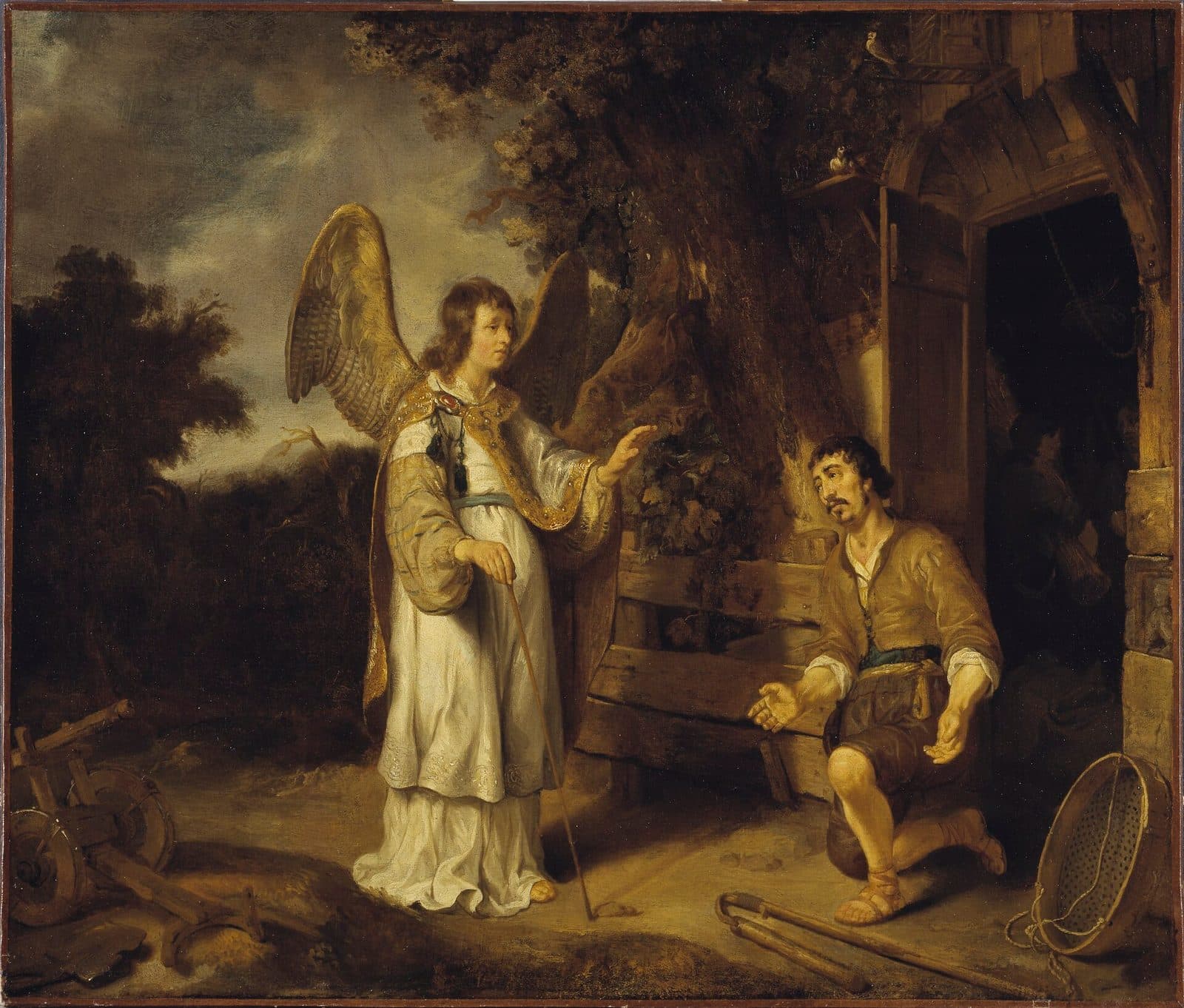
Gerbrand van den Eeckhout, The Angel and Gideon, 1640, Nationalmuseum Stockholm. Public domain, via Wikimedia Commons.
THE ARTWORKVan den Eeckhout painted the angel standing over Gideon at Ophrah, with the farmer's flail and sieve laid down in the dust.
Summary
Gideon son of Joash, of the clan of Abiezer in Manasseh, delivered Israel from seven years of raids by Midian, and the land had rest for forty years in his days.
- The angel of the LORD found him threshing wheat in a winepress to hide it from Midian.
- He tore down his father's altar to Baal by night and was named Jerubbaal for it.
- The LORD cut his army from thirty-two thousand men to three hundred.
- Hebrews 11 names him first among four judges who acted by faith.
Where Gideon Stands in Scripture
His first line in Judges and his last in Hebrews
Scripture names Gideon thirty-nine times in the Hebrew Bible and once in the New Testament.
Then the angel of the LORD came and sat down under the oak in Ophrah that belonged to Joash the Abiezrite, where his son Gideon was threshing wheat in a winepress to hide it from the Midianites.His first line in Scripture.
And what more shall I say? Time will not allow me to tell of Gideon, Barak, Samson, Jephthah, David, Samuel, and the prophets,His last line in Scripture.
The Life, Turn by Turn
Judges 6 to 8, from the winepress to the grave at Ophrah
- The angel calls him at his threshingOphrah, Judges 6:12
- Fire from the rock takes his offeringOphrah, Judges 6:21
- He tears down Baal's altar by nightOphrah, Judges 6:27
- The Spirit of the LORD comes upon himManasseh, Judges 6:34
- He asks the sign of the fleece twicethe threshing floor, Judges 6:37
- The army is cut to three hundredthe spring of Harod, Judges 7:7
- He hears a Midianite's dreamthe camp of Midian, Judges 7:13
- Horns, jars and torches in the nightthe valley by the hill of Moreh, Judges 7:20
- He pursues the kings across the JordanSuccoth and Penuel, Judges 8:5
- He refuses to rule Israelafter the victory, Judges 8:23
- He makes the gold ephodOphrah, Judges 8:27
- He dies at a ripe old ageOphrah, Judges 8:32
Twelve turns of Gideon's life in the order Judges tells them, each with its place and its verse.
From the Winepress to the Ephod
Judges 6:11 to 8:35
The angel of the LORD finds Gideon threshing in hiding at Ophrah and sends him to save Israel from Midian. He breaks his father's altar to Baal by night, and when Midian crosses the Jordan the Spirit of the LORD comes upon him.
The LORD sends home all but three hundred men, who rout the camp of Midian in the night with horns, jars and torches. Gideon pursues the two kings east of the Jordan, refuses Israel's offer of a dynasty, and makes the gold ephod that Israel worships at Ophrah.
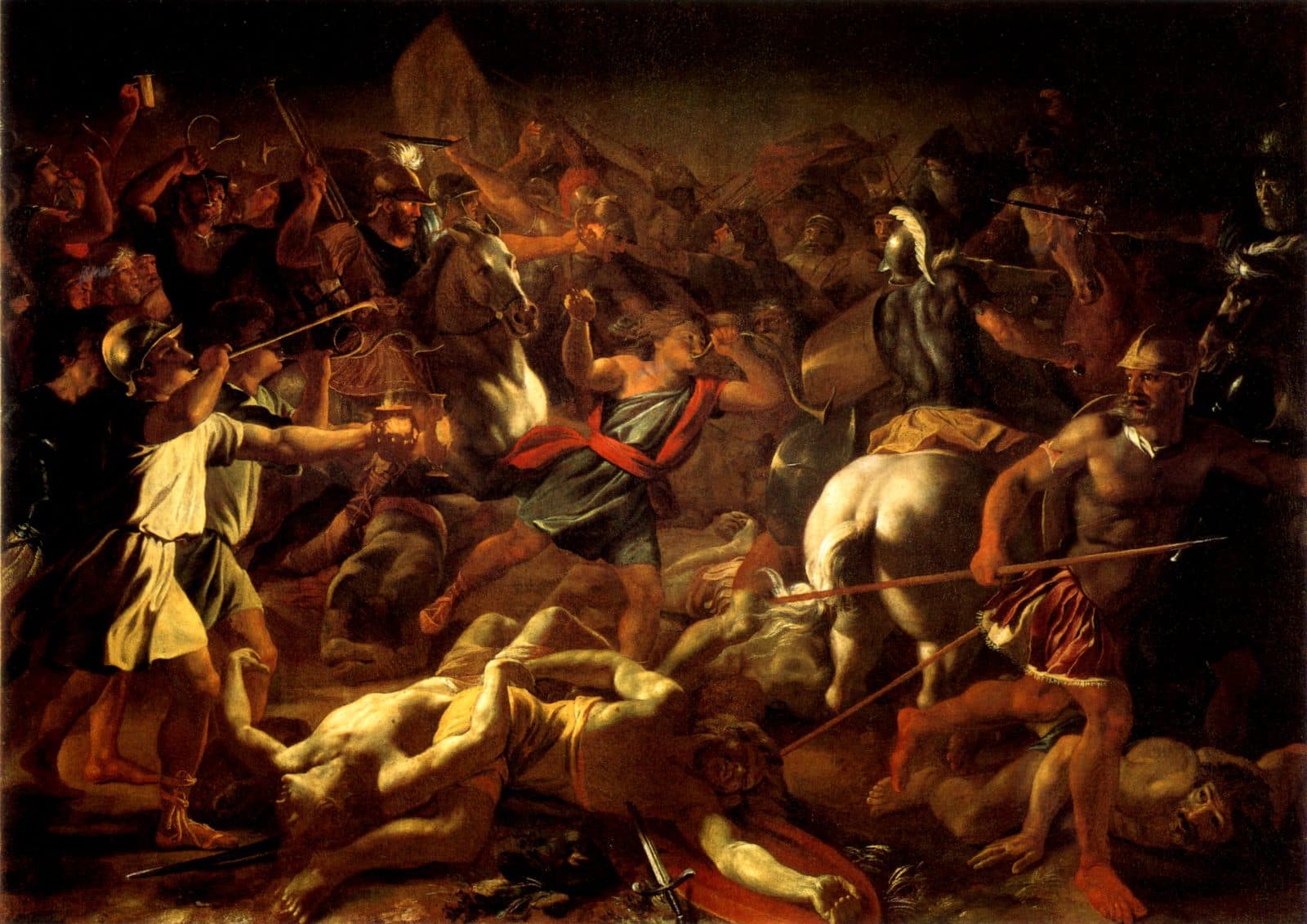
Nicolas Poussin, The Victory of Gideon over the Midianites, about 1625, Pinacoteca Vaticana. Public domain, via Wikimedia Commons.
Poussin filled the canvas with the rout itself: a horn blown at the centre, torches raised on the left, and Midian's men falling over one another.
The call at the winepress
The LORD turned to him and said, “Go in the strength you have and save Israel from the hand of Midian. Am I not sending you?” “Please, my Lord,” Gideon replied, “how can I save Israel? Indeed, my clan is the weakest in Manasseh, and I am the youngest in my father’s house.” “Surely I will be with you,” the LORD replied, “and you will strike down all the Midianites as one man.”The commission, his objection, and the promise that answers it.
Gideon asks for a sign and brings out a young goat and unleavened bread. The angel touches them with the tip of his staff, fire rises from the rock and consumes them, and the angel vanishes.
When Gideon realized that it was the angel of the LORD, he said, “Oh no, Lord GOD! I have seen the angel of the LORD face to face!” But the LORD said to him, “Peace be with you. Do not be afraid, for you will not die.” So Gideon built an altar to the LORD there and called it The LORD Is Peace. To this day it stands in Ophrah of the Abiezrites.His fear at seeing the angel face to face, and the altar he names The LORD Is Peace.
The altar of Baal and a new name
So Gideon took ten of his servants and did as the LORD had told him. But because he was too afraid of his father’s household and the men of the city, he did it by night rather than in the daytime.He obeys with ten servants, and does it by night for fear of his father's household.
In the morning the men of the city demand his death. Joash asks them whether they are contending for Baal, and tells them that a god should defend his own altar.
So on that day Gideon was called Jerubbaal, that is to say, “Let Baal contend with him,” because he had torn down Baal’s altar.The name Jerubbaal and the reason Judges gives for it.
Three hundred men
Then the LORD said to Gideon, “You have too many people for Me to deliver Midian into their hands, lest Israel glorify themselves over Me, saying, ‘My own hand has saved me.’The reason the LORD gives for cutting the army.
Twenty-two thousand who are afraid go home and ten thousand remain. At the water, three hundred lap with their hands to their mouths and the rest kneel to drink, and the LORD keeps the three hundred.
Sent down to the enemy camp by night, Gideon hears a man tell a dream of a barley loaf that flattens a tent, and his friend reads it as the sword of Gideon. Gideon bows in worship and wakes his men.
The three companies blew their horns and shattered their jars. Holding the torches in their left hands and the horns in their right hands, they shouted, “A sword for the LORD and for Gideon!” Each Israelite took his position around the camp, and the entire Midianite army fled, crying out as they ran. And when the three hundred rams’ horns sounded, the LORD set all the men in the camp against one another with their swords. The army fled to Beth-shittah toward Zererah as far as the border of Abel-meholah near Tabbath.The three companies break their jars, and the LORD turns the camp's swords on one another.
The pursuit east of the Jordan
The men of Ephraim seize the fords of the Jordan and kill the princes Oreb and Zeeb. They complain that Gideon did not call them sooner, and his soft answer turns their anger away.
Then Gideon and his three hundred men came to the Jordan and crossed it, exhausted yet still in pursuit.Succoth and Penuel refuse his men bread. He routs the army of the east at Karkor and captures Zebah and Zalmunna, then punishes the elders of Succoth with thorns and pulls down the tower of Penuel.
The crown refused and the ephod
Then the Israelites said to Gideon, “Rule over us—you and your son and grandson—for you have saved us from the hand of Midian.” But Gideon replied, “I will not rule over you, nor will my son. The LORD shall rule over you.”The offer of a dynasty, and his refusal.
He asks each man for a gold earring from the plunder, and the gold weighs 1,700 shekels besides the ornaments and purple robes of the kings.
From all this Gideon made an ephod, which he placed in Ophrah, his hometown. But soon all Israel prostituted themselves by worshiping it there, and it became a snare to Gideon and his household.What he made from the gold, and what it became.
What the Text Says Beside What Is Said
Two common sayings about Gideon, each set against its verse
THE FLEECE SHOWS HOW TO FIND GOD'S WILL
God had already told Gideon to go and promised to be with him before he laid out the fleece, and Gideon says so himself when he asks for the sign.
GIDEON ENDED AS A FAITHFUL JUDGE
As soon as Gideon was dead, Israel turned to the Baals and set up Baal-berith as its god.
The World Behind the Story
Midian's raids and the land they emptied
Whenever Israel planted, the Midianites, the Amalekites and other people of the east came up, camped on the land as far as Gaza, and left Israel no food and no livestock.
Israel made shelters in the mountains, caves and strongholds, and cried out to the LORD.
Josephus retells the raids in his Jewish Antiquities, written in the first century. He says the Midianites let Israel plough in winter and came at harvest to carry the crops away.
John Wesley notes that Gideon's Ophrah lay in Manasseh and was a different town from the Ophrah of Benjamin named in Joshua 18:23.
For the Midianites came with their livestock and their tents like a great swarm of locusts. They and their camels were innumerable, and they entered the land to ravage it.His Father, His Clan and His Sons
The family Judges names, each with the verse that names the tie
JOASH THE ABIEZRITE
His father, who kept an altar to Baal and then turned the town's anger away from his son.
THE CLAN OF ABIEZER
The first clan to answer the ram's horn when Gideon called Israel to arms.
HIS WIVES AND SEVENTY SONS
Judges gives him seventy sons by many wives and names none of the wives.
JETHER
His firstborn, who did not draw his sword on the kings of Midian because he was afraid and still a youth.
ABIMELECH
His son by a concubine who lived in Shechem.
JOTHAM
His youngest son, who hid and survived when Abimelech murdered his brothers on one stone.
The Places of His Life
Six places Judges names, from Ophrah to Penuel
OPHRAH
His hometown in Manasseh, where he was buried in the tomb of his father Joash.
THE SPRING OF HAROD
The spring beside which Gideon and his men camped early in the morning.
THE HILL OF MOREH
The hill near which Midian's camp lay in the valley, north of Gideon's men.
THE VALLEY OF JEZREEL
The broad valley where Midian, Amalek and the people of the east pitched their tents.
SUCCOTH
A town east of the Jordan, the first on his road after the kings of Midian.
PENUEL
A town with a tower, the next on the same road.
Questions the Life Raises
Three questions the life raises, with the readings that answer them
Why did Gideon ask where God's wonders were?
“Please, my Lord,” Gideon replied, “if the LORD is with us, why has all this happened to us? And where are all His wonders of which our fathers told us, saying, ‘Has not the LORD brought us up out of Egypt?’ But now the LORD has forsaken us and delivered us into the hand of Midian.”His answer to the greeting: if the LORD is with us, why has all this happened?
Jamieson, Fausset and Brown judge that his words show a want of reflection, since the chastisements God had brought on His people showed that He was still with them.
Rashi, the French Jewish commentator who lived from 1040 to 1105, cites the midrash of the Yalkut and sets the scene on the night of Passover. Gideon had heard his father recite the Hallel, with its psalm of the sea fleeing before Israel, and asked where those wonders had gone.
Why does Hebrews count him among the faithful?
John Calvin, in his commentary on Hebrews, says it seemed strange for Gideon to attack an immense host with three hundred men and to shake pitchers like a sham alarm.
Calvin answers that Gideon, Barak, Samson and Jephthah followed the guidance of God and acted on His promise, and so the Holy Spirit gives them a place in the roll of faith.
Why did Gideon kill Zebah and Zalmunna?
“They were my brothers,” Gideon replied, “the sons of my mother! As surely as the LORD lives, if you had let them live, I would not kill you.”They had killed his brothers, the sons of his mother, at Tabor.
John Wesley notes that the law did not bind Gideon to kill them, since they were not Canaanites, but that as the killers of his brothers he was by law the avenger of their blood.
Albert Barnes notes that the sons of my mother means a closer tie than brothers by the father only, and that Judges preserves no other hint of when the killing at Tabor happened.
What the Text Leaves Unsaid
Six things Judges does not tell
Judges does not say why the angel called a man in hiding a mighty man of valor, or whether asking for the signs was a sin.
It never says what the ephod was used for, or whether Gideon himself worshiped it.
It never calls Gideon a king, and it gives no year for his life.
What His Life Means
The Spirit's clothing, strength from weakness and the honour of a judge
At Judges 6:34 the Hebrew verb for the Spirit coming upon Gideon is labash, the common word for putting on a garment. John Wesley reads it as a robe put on him for honour and a coat of mail for defence.
Hebrews says of Gideon and those named with him that they gained strength from weakness.
The Babylonian Talmud, in tractate Rosh Hashanah, reads Samuel's list of deliverers to teach that Jerubbaal in his generation is owed the honour of Moses in his generation. A leader of lesser stature, once appointed, is to be heeded as the greatest would be.
How Gideon Has Been Taught
Four voices from the third century to the eighteenth, earliest first
The "land was at rest" as long as sin was at rest. But the land is said to be disturbed, meaning those who inhabit the land, when the souls of the people began to move and to dislocate in sin. This is why the text was written this way: "The land was at rest for forty years. And the sons of Israel did evil in the sight of the Lord, and the Lord delivered them into the hand of Midian for seven years. And Midian ruled over Israel."
Origen of Alexandria · Homilies on Judges 7.1 · on Judges 6:1Patristic
For the same reason was it that when Gideon was about to overcome the Midianites, he commanded three hundred men to take pitchers, and to hold lighted torches inside the pitchers, and trumpets in their right hands. Our predecessors have preserved the explanation received from the apostles, that the pitchers are our bodies, fashioned of clay, which do not know fear if they burn with the fervor of the grace of the Spirit, and bear witness to the passion of the Lord Jesus with a loud confession of the voice.
Ambrose of Milan · On the Holy Spirit 1.143-46 · on Judges 7:16-20Patristic
And they are brought to the river, to drink the waters; and whoever drank the waters with bended knees, were removed from the struggle of war. For by the waters is designated the doctrine of wisdom, but by the unbended knee righteous conduct. They therefore who are reported to have bent their knees, while drinking the water, retired from the strife of battles, having been forbidden; because Christ proceeds to battle against the enemies of the faith, with those who when they drink the streams of doctrine, distort not the uprightness of their actions.
Gregory the Dialogist · Morals on the Book of Job, Book 30.74 · on Judges 7:5-7Patristic
He that is faithful in a few things shall be ruler over many. Gideon was a man of a brave active spirit, and yet buried alive in obscurity, through the iniquity of the times; but he is here animated to undertake something great, like himself, with that word, The Lord is with thee, or, as the Chaldee reads it, the Word of the Lord is thy help.
Matthew Henry · Commentary on the Whole Bible · on Judges 6:12Puritan
Three Readings Still Argued
The lapping test, the refused crown and the ephod, each with its holders
The lappers were the alert
Jamieson, Fausset and Brown say that people on a journey or in haste do not kneel to drink but bend forward and throw the water up with the hand, as the three hundred did.
The objection: Judges records the sorting at the water and praises no quality in either group.
The lappers were the fearful
Josephus says God told Gideon to keep the men who drank tumultuously, as men afraid of the enemy, so that the victory would plainly be God's.
The objection: Judges names no fear in the three hundred, and in Josephus the instruction comes in a dream, where Judges has the LORD speak at the water.
A true refusal of the crown
Jamieson, Fausset and Brown hold that Gideon revered the principles of the theocracy too much to entertain the offer, and would act as judge while the LORD alone was King. Adam Clarke writes that few men with such power at their command would have acted as Gideon did.
The objection: Judges then gives him many wives, seventy sons and a son named Abimelech.
A ruler in all but name
Josephus says Gideon would have laid down the government but was persuaded to keep it, and judged the people for forty years.
John Wesley reads the name Abimelech as my father the king, given perhaps to please the concubine.
“Please ask all the leaders of Shechem, ‘Is it better for you that seventy men, all the sons of Jerubbaal, rule over you, or just one man?’ Remember that I am your own flesh and blood.”Abimelech's question to Shechem assumes Gideon's sons rule.
The objection: Gideon's own words in Judges 8:23 refuse rule for himself and for his son.
The ephod was a memorial
Rashi reads the ephod as a memorial of the great deliverance, showing how much gold Midian's nobles wore. He says Gideon meant it well and that Israel strayed after it only after his death.
The objection: the verse says the ephod became a snare to Gideon and his household, and it says Israel soon worshiped it.
The ephod was a sin of ignorance
Matthew Henry holds that Gideon sinned in making the ephod through ignorance or thoughtlessness, though he had a good intention in it.
The objection: Judges gives the ephod no motive, so any verdict on Gideon's intent goes beyond the text.
Books to Read Next
Four works from the first century to the eighteenth
Jewish Antiquities, Book 5
Flavius Josephus, translated by William Whiston · first century
Josephus retells the history of Israel in twenty books, and Gideon's story stands in Book 5.
READ IT FREE AT PROJECT GUTENBERG →On the Holy Spirit
Ambrose of Milan · 381
Ambrose wrote three books on the Holy Spirit and opens the first with the call of Gideon and the fleece.
READ IT FREE AT NEW ADVENT →Commentary on Hebrews
John Calvin · sixteenth century
Calvin comments on the whole letter to the Hebrews, chapter by chapter.
READ IT FREE AT CCEL →Commentary on the Whole Bible, Volume II (Joshua to Esther)
Matthew Henry · 1710
Henry goes through Judges 6 to 8 verse by verse.
READ IT FREE AT CCEL →The LORD Shall Rule Over You
Gideon's best words were his refusal: the LORD would rule Israel. Isaiah later promised that God would break Israel's yoke as on the day of Midian, and named the Son who would carry the government on His shoulders.
Paul says God puts His light in jars of clay so that the power is seen to be His, and that light is the glory of God in the face of Jesus Christ.
Gideon's life asks the reader to go in the strength God gives, to give Him the glory for the victory, and to refuse the gold that becomes a snare.
Keep studying
Read it4
Doctrines1
Peoples and groups3