
Egypt, fourth century · Story · Featured Study
Antony and the Desert Fathers
One verse heard in church, a life alone in Egypt, and a book that travelled.
A young Egyptian heard the Gospel read in church and, as Athanasius tells it, “went out immediately from the church.”
- Where
- Egypt, Alexandria
- Who
- Antony, Athanasius of Alexandria, Pachomius
- When
- the persecution of 303 to 311, and 338 (probable)
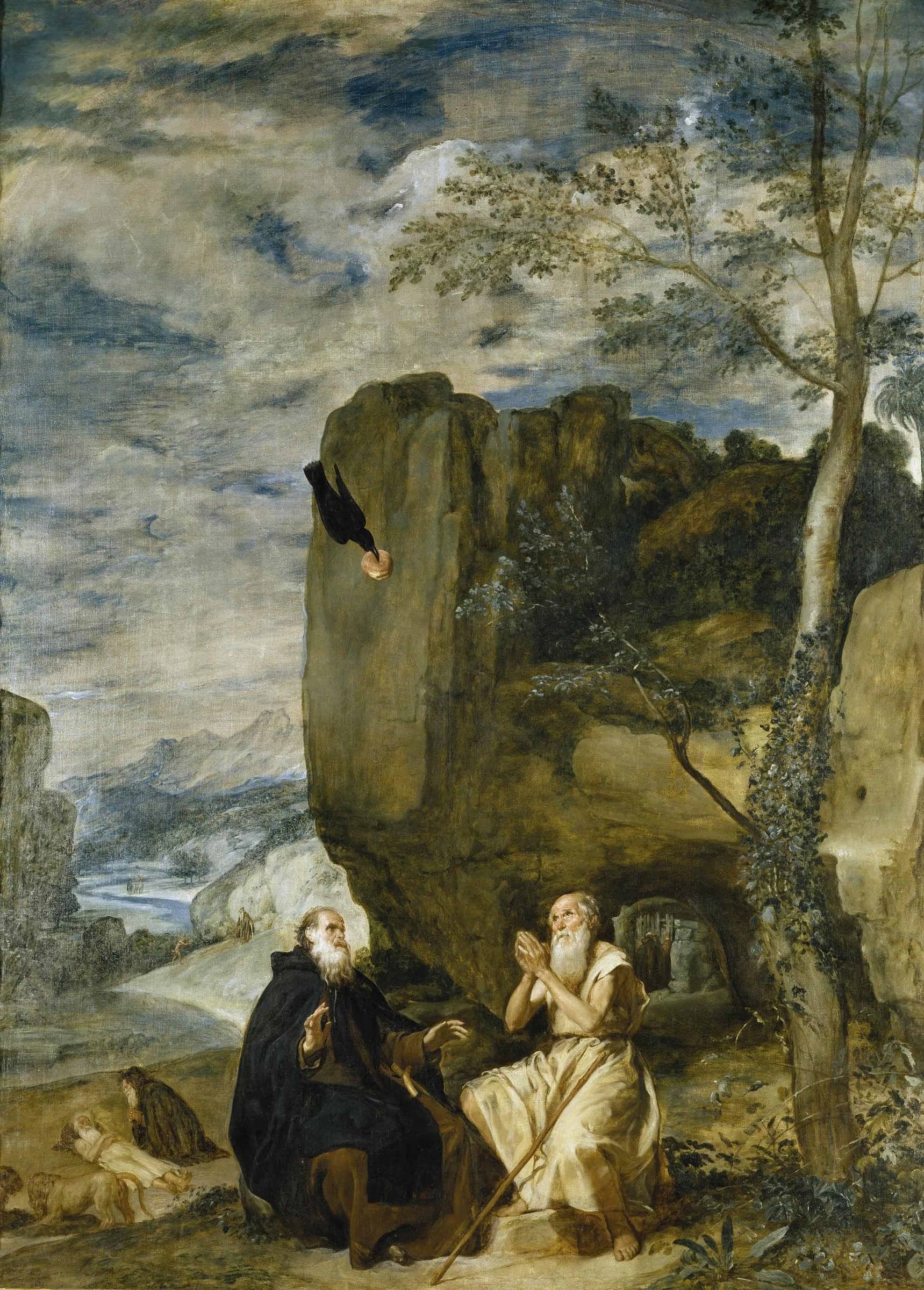
Diego Velázquez, Saint Anthony Abbot and Saint Paul the Hermit, about 1634. Public domain.
Jesus told him, “If you want to be perfect, go, sell your possessions and give to the poor, and you will have treasure in heaven. Then come, follow Me.”
Summary
Antony was a Christian of Egypt. As Athanasius's Life tells it, a verse of Matthew sent him to give away what he had, and he spent most of a long life alone in the desert. Others followed him there, and the Life was read as far as Trier.
- The one full account is the Life, written by his bishop and ally.
- He went to the city twice, once to help the confessors and once to speak against the Arians.
- Pachomius, in Egypt at the same time, gathered monks into one life under a rule.
The Readings That Sent Him Out
Two Gospel readings, and the struggle the Life sets in the tombs.
The Life ties Antony's first two steps to readings in church. The first was Matthew 19:21, and soon after came the word against anxiety for tomorrow.
Therefore do not worry about tomorrow, for tomorrow will worry about itself. Today has enough trouble of its own.On hearing this, the Life says, he gave the rest of his goods to the poor.
For our struggle is not against flesh and blood, but against the rulers, against the authorities, against the powers of this world’s darkness, and against the spiritual forces of evil in the heavenly realms.The Life tells his years in the tombs as a struggle against evil spirits.
The Places of the Life, in Order
From his village church to the inner mountain, by the Life's own chapters.
Antony moved farther from the villages at each stage, and twice came back to Alexandria.
| Place | Stage | Chapter |
|---|---|---|
| The church of his village | The call | 2 and 3 |
| The tombs | The first trial | 8 to 10 |
| A deserted fort across the river | The long seclusion | 12 to 14 |
| Alexandria, in the persecution | Service to the confessors | 46 |
| The inner mountain | His home | 49 and 50 |
| Alexandria, in 338 | Against the Arians | 69 and 70 |
| The mountain, at his death | His last charge | 89 to 92 |
The Life Told Plainly, From the Church to the Mountain
Each scene is Athanasius's report in the Life of Antony.
As a boy Antony would not learn letters or keep company with other boys. The Life says his parents “were of good family and possessed considerable wealth.”
After their death he heard the verse read in church and gave away what he had inherited. He left his sister with a company of virgins.
He shut himself in a tomb away from the village, with a friend to bring him bread. The Life tells of demons beating him there and of a light that came, and says he was “then about thirty-five years old.”
He crossed the river to a fort “full of creeping things” and stayed “for nearly twenty years” without going out.
When he came out, the Life says, “the desert was colonised by monks.”
In the persecution under Maximinus, which Robertson dates 303 to 311, he went to Alexandria. He “longed to suffer martyrdom,” and ministered to the confessors in the mines and in the prisons.
Then he went three days into the inner desert to a mountain with a spring. There, the Life says, “recognising it as his own home, he remained in that place.”
The world was not worthy of them. They wandered in deserts and mountains, and hid in caves and holes in the ground.It stands beside the inner mountain, the kind of place Hebrews names as the home of the faithful.
In 338, as the editor dates it, he came down from the mountain to Alexandria and denounced the Arians.
“Assuredly as many became Christians in those few days as one would have seen made in a year,” the Life says.
At the end he told his two companions that he was “near a hundred and five years old.”
“And no one knows to this day where it was buried,” the Life says of his body, “save those two only.”
The Desert Beside Antony
Pachomius's rule, Palladius's visit to Pispir and Budge's book of sayings.
Palladius, in the Lausiac History, tells that an angel bade Pachomius collect the young monks. The angel gave him “a brass tablet” with their rule written on it.
Palladius also visited Antony's monastery by the river at Pispir, where his disciples Macarius and Amatas lived, “who also buried him when he died.”
The sayings of the desert fathers were gathered later. Budge's English of 1907, The Paradise of the Holy Fathers, gives sayings under Antony's name from a Syriac collection. Its title page says Athanasius, Palladius, Jerome and others compiled it.
How the Life Reached Augustine
The story of Antony's call sent Augustine to Romans 13.
Augustine writes in the Confessions that a visitor, Ponticianus, told him of Antony. He told also of two officers at Trier who found “a book in which was written the life of Antony.”
Soon after, in the garden, he remembered Antony. Antony had heard the Gospel read and “received the admonition as if what was read were addressed to him.”
Let us behave decently, as in the daytime, not in carousing and drunkenness, not in sexual immorality and debauchery, not in dissension and jealousy. Instead, clothe yourselves with the Lord Jesus Christ, and make no provision for the desires of the flesh.Augustine read these verses in the garden and was converted, as he tells it in Confessions 8.12.
What the Record Leaves Unsaid
One full witness, a hidden grave, and no year of birth.
Athanasius, who wrote it, was Antony's admirer and his ally against the Arians, so each scene of the story is reported by one source.
Antony's grave was kept secret, and the Life gives no year of his birth. The Life's own date carries its editor's question mark.
How the Key Verse Was Taught
Four writers on the verse that called Antony, from the fourth century to the sixteenth.
John Chrysostom (died 407)
Homilies on the Gospel of Matthew 63, 2
John Chrysostom, preaching on Matthew, heard in the verse a race set before the young man with its prizes named.
“Seest thou how many prizes, how many crowns, He appoints for this race? If he had been tempting, He would not have told him these things.”
Patristic
Jerome (died 420)
Letter 66, to Pammachius, 8
Jerome, writing to Pammachius, read the condition as a call left to the hearer's own choice.
“Great enterprises are always left to the free choice of those who hear of them.”
Patristic
Francis of Assisi (died 1226)
The Testament (1226), in Paschal Robinson, The Writings of Saint Francis of Assisi (Philadelphia, 1906), page 83
Francis of Assisi, in his Testament of 1226, took the Gospel itself as the form of his brothers' life.
“And when the Lord gave me some brothers, no one showed me what I ought to do, but the Most High Himself revealed to me that I should live according to the form of the holy Gospel.”
Catholic
John Calvin (1509 to 1564)
Institutes of the Christian Religion 4.13.13
John Calvin, answering the monks of his day, read the command by the question the young man had asked.
“A young man asks by what works he shall enter into eternal life. Christ, as he was asked concerning works, refers him to the law.”
Reformed
Francis of Assisi, John Calvin
In Their Own Words
Antony to his monks and at his death, Athanasius on how he knew him, and Gregory of Nazianzus on the Life.
Anthony the Great (died 356)
His address to the monks, in Athanasius, Life of Antony 16
The Scriptures are enough
“The Scriptures are enough for instruction, but it is a good thing to encourage one another in the faith, and to stir up with words.”
Patristic
About this saying1 paragraph
Antony spoke to the monks who gathered to him in the Egyptian tongue, as Athanasius gives his words in the Life, here in H. Ellershaw's English of 1892.
Anthony the Great
His last charge, in Athanasius, Life of Antony 91
Divide my garments
“To Athanasius the bishop give one sheepskin and the garment whereon I am laid, which he himself gave me new, but which with me has grown old.”
Patristic
About this saying1 paragraph
Antony gave these last charges to the two who served him on the mountain. The Life, which Robertson dates 356 to 362, records them.
Athanasius of Alexandria (296 to 373)
Life of Antony, the introduction
His attendant
“having seen him many times, and what I was able to learn from him, for I was his attendant for a long time, and poured water on his hands”
Early Church
About this saying1 paragraph
Athanasius wrote the Life as a letter to monks abroad between 356 and 362, as Robertson dates it. In its opening he says how he came to know Antony.
Gregory of Nazianzus (died 390)
Oration 21, On Athanasius, 5
The laws of the monastic life
“as he himself wrote the life of the divine Antony, and set forth, in the form of a narrative, the laws of the monastic life.”
Patristic
About this saying1 paragraph
Gregory of Nazianzus preached on Athanasius in the fourth century, and in these words set the Life among the laws of monks.
Athanasius of Alexandria, Gregory of Nazianzus
Where Readers of the Life Disagree
Who wrote the Life, whether Antony could write, and whether the desert is a higher way.
Did Athanasius write the Life?2 paragraphs
Gregory of Nazianzus, a bishop of the same century, gives the Life to Athanasius. Robertson, editing the Life in 1892, judged that “the balance of qualified opinion is on the side of the Athanasian authorship.”
Robertson names Weingarten, Gass and Gwatkin among the writers who doubted it.
Could Antony read and write?2 paragraphs
The Life says that as a boy he “could not endure to learn letters.”
Jerome, in On Illustrious Men, says Antony “sent seven letters in Coptic to various monasteries.”
Is the desert a higher way?3 paragraphs
The Life makes Matthew 19:21 Antony's own call. John Calvin, in the Institutes, honoured the first monks. He wrote that “the ancient mode of living in monasteries was very different” from the monks of his day.
He added that Augustine “strenuously contends that it is not lawful for monks to live in idleness on other men's means.”
MannaFest stands in the Wesleyan-Pentecostal line. It reads the verse with Wesley's Notes, as a direction to one man “which he never designed for a general rule.”
Books to Read Next
Select Works and Letters of Athanasius, with the Life of Antony
Archibald Robertson, editor · 1892
It gives the Life of Antony whole in Ellershaw's English, with Robertson's notes.
Free at the Christian Classics Ethereal LibraryThe Lausiac History of Palladius
Palladius, translated by W. K. Lowther Clarke · 1918
Palladius tells of Pachomius, Antony's disciples and the monks of Egypt.
Free at the Internet ArchiveThe Paradise or Garden of the Holy Fathers, volume 2
E. A. Wallis Budge, translator · 1907
It gives the sayings of the fathers of Egypt from a Syriac collection.
Free at the Internet ArchiveWhat Antony Left
Antony took one verse of the Gospel as spoken to him and kept to it for the rest of a long life. Those who read of him asked what the same verse meant for them.
Sources
Scripture is the Berean Standard Bible.
- The Holy Bible, Berean Standard Bible (read 2026)
- Athanasius, Life of Antony, the introduction and chapters 1 to 3, 8 to 16, 46 to 50, 69 to 70 and 89 to 92, translated by H. Ellershaw, with Archibald Robertson's introduction and notes, Nicene and Post-Nicene Fathers, second series, volume 4 (print basis 1892)
- Gregory of Nazianzus, Oration 21.5, On Athanasius, Nicene and Post-Nicene Fathers, second series, volume 7 (print basis 1893)
- Jerome, On Illustrious Men 88, Nicene and Post-Nicene Fathers, second series, volume 3 (print basis 1892)
- Augustine, Confessions 8.6.15 and 8.12.29, translated by J. G. Pilkington, Nicene and Post-Nicene Fathers, first series, volume 1 (1886)
- Palladius, The Lausiac History 21 and 32, translated by W. K. Lowther Clarke (London: SPCK, 1918), pages 94 and 112.
- E. A. Wallis Budge, The Paradise or Garden of the Holy Fathers, volume 2 (London: Chatto and Windus, 1907), the title page.
- John Calvin, Institutes of the Christian Religion 4.13.8, 4.13.10 and 4.13.13, translated by Henry Beveridge.
- John Chrysostom, Homilies on the Gospel of Matthew 63.2, Nicene and Post-Nicene Fathers, series 1, volume 10 (print basis 1886)
- Jerome, Letter 66 to Pammachius, 8, translated by W. H. Fremantle, Nicene and Post-Nicene Fathers, second series, volume 6 (print basis 1892)
- John Wesley, Explanatory Notes upon the New Testament, the note on Matthew 19:21.
Keep Studying
People and groups8
Places1
Values3
Subjects1
Church history2