
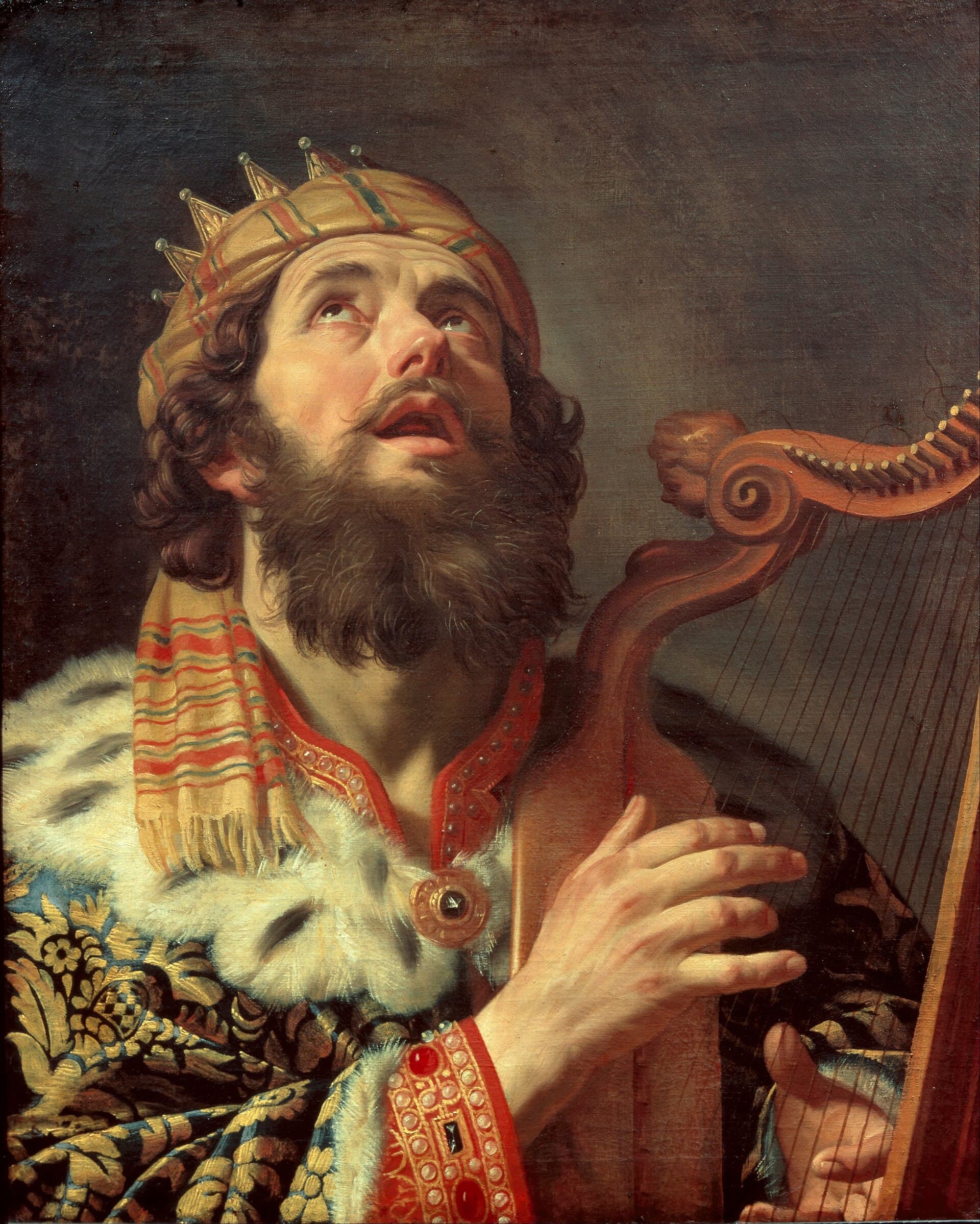
Gerard van Honthorst, King David Playing the Harp, 1622. Public domain.
Old Testament · Book 19 of 66
Psalms
Psalms is a collection of songs and prayers, arranged in five books and used in Israel's worship. Many are credited to David, and others to Asaph, the sons of Korah, Solomon and Moses.
Psalms is a collection of songs and prayers, arranged in five books and used in Israel's worship. Many are credited to David, and others to Asaph, the sons of Korah, Solomon and Moses.
What are the Psalms about?
The Psalms are the prayers and songs Israel sang to God, gathered into five books. The first book opens at a gate: the man who delights in the law of the LORD, and the King the LORD sets on Zion. The prayers of David follow, most of them cries out of trouble. The third book ends with the promise to David's throne in question, and the fourth answers that the LORD reigns. The fifth brings the people home and climbs to Jerusalem in song. Each book closes with a blessing, and the last five psalms are praise alone: “Let everything that has breath praise the LORD!” (Psalm 150:6).
All 150 chapters
Every chapter of the book, in one grid. Each cell opens that chapter.
- Book One41 psalms
- Book Two31 psalms
- Book Three17 psalms
- Book Four17 psalms
- Book Five44 psalms
The colour is the book of the Psalter the psalm stands in, and every cell opens that psalm's Study level.
Who wrote it, where, when, for whom, and why?
The headings name David over 73 psalms, Asaph over 12, the sons of Korah over 10, Solomon over 2, and Moses, Heman the Ezrahite and Ethan the Ezrahite over one each, and the rest carry no name. Scripture calls David the sweet psalmist of Israel (2 Samuel 23:1) and says he first committed a song of thanks to Asaph and his brothers (1 Chronicles 16:7). The church in Jerusalem, Peter and Jesus all name David as the speaker of psalms they quote (Acts 4:25; Acts 2:34; Mark 12:36).
These are the last words of David: “The oracle of David son of Jesse, the oracle of the man raised on high, the one anointed by the God of Jacob, and the sweet psalmist of Israel:
2 Samuel 23:1, Berean Standard Bible.
The psalms are sung at the house of the LORD on Zion, the holy mountain (2:6; 48:2), and the songs of ascents go up to it (122:1 to 2). Some are sung far from it: the singer of Psalm 42 remembers God from the land of the Jordan (42:6), David prays from the cave (142), and the exiles sit by the rivers of Babylon.
By their own headings and words the psalms span Israel's history. Psalm 90 is headed a prayer of Moses, Psalm 51 is set when Nathan came to David, and Psalm 72 closes with the note that the prayers of David son of Jesse are ended (72:20). Psalm 137 is sung after Jerusalem has fallen, and Psalm 126 when the LORD has restored the captives of Zion.
The headings direct many psalms to the choirmaster, and David appointed Levites to celebrate, to give thanks and to praise the LORD before the ark (1 Chronicles 16:4). The psalms are sung in the assembly (22:22), and the church was told to speak to one another with psalms, hymns and spiritual songs (Ephesians 5:19).
The psalms are Israel's words to God: its cries out of trouble, its confessions and its thanks. Jesus names them beside the Law and the Prophets as Scripture written about him (Luke 24:44), and the book ends by calling everything that has breath to praise the LORD.
Jesus said to them, “These are the words I spoke to you while I was still with you: Everything must be fulfilled that is written about Me in the Law of Moses, the Prophets, and the Psalms.”
Luke 24:44, Berean Standard Bible.
Sources. Psalms 2:6, 22:22, 42:6, 48:2, 72:20, 90, 122:1 to 2, 126:1, 137:1, 142 and 150:6; 2 Samuel 23:1; 1 Chronicles 16:4 and 16:7; Mark 12:36; Luke 24:44; Acts 2:34; Acts 4:25; Ephesians 5:19. The count of names is read from the site's table of what each heading says. Every verse is read in the Berean Standard Bible.
How are the Psalms arranged, and what are they for?
The five books the Psalter divides itself into, then what it teaches and what it was given to do.
- Book OnePsalms 1 to 41: 41 psalms, 616 verses
Two psalms at the gate, then the prayers of David, most of them cries out of trouble.
The turn: Psalm 1 sets the two ways and Psalm 2 sets the King on Zion, and the prayers that follow are that King's.
- Book TwoPsalms 42 to 72: 31 psalms, 465 verses
The sons of Korah, then David again from his confession to the prayer for the king.
The turn: Psalm 51 is the king's confession after his fall, and Psalm 72 is the prayer for the kingdom that closes the prayers of David.
- Book ThreePsalms 73 to 89: 17 psalms, 358 verses
Asaph and the sons of Korah on a nation in ruins, ending with the covenant with David questioned.
The turn: Psalm 89 recites the oath to David and then asks where the LORD's loving devotion of old has gone.
- Book FourPsalms 90 to 106: 17 psalms, 321 verses
Moses' prayer, then the psalms that say the LORD reigns, ending with Israel's story told twice.
The turn: Psalm 90 goes back to Moses, before Israel had a king, and Psalms 93 to 99 answer that the LORD reigns.
- Book FivePsalm 107 to the end: 44 psalms, 701 verses
The redeemed brought home, the King at the right hand, the Hallels, the ascents and the closing praise.
The turn: The redeemed are told to say so, the King is set at the LORD's right hand, and the ascents climb to Jerusalem.
The theme
The Psalms are the words of people speaking to God, and they move the way a praying life moves: from trouble told plainly, through confession and the memory of what God has done, to praise that has stopped asking for anything. Beside the one who prays stands the King the LORD has anointed, and when his throne falls the book turns to the throne of God, who reigns over Israel and the nations.
The purpose
The Psalter was gathered so that Israel would have words to pray and sing before God in every condition, at the temple, on the road to the feasts and in exile. It teaches the reader to bring grief, guilt and joy to God in the same breath, and to hope in the King God has promised. The synagogue kept it as its prayer book, and the church sings it still.
Five books, five seals, three turns
I 41 psalms
Sealed at Psalm 41:13
II 31 psalms
Sealed at Psalm 72:18 to 20
III 17 psalms
Sealed at Psalm 89:52
The king's fall. The last psalm of the book asks where the loving devotion sworn to David has gone.
IV 17 psalms
Sealed at Psalm 106:48
The answer. Moses and the psalms that say the LORD reigns answer the fallen throne.
V 44 psalms
Sealed at the last five psalms
The return. The last book opens with the redeemed gathered from the lands.
Book One: the book of David
What the 41 psalms of this book say, and the pages they open on.
The book opens with two psalms that carry no heading. Psalm 1 sets two ways side by side, the man whose delight is the law of the LORD and the wicked driven off like chaff, and Psalm 2 has the LORD install His King on Zion while the nations rage. From Psalm 3 almost every psalm carries David's name, and most of them are the prayers of one man in trouble asking to be heard, among them Psalm 22, the cry Jesus prayed from the cross, and Psalm 23, the shepherd psalm. Psalm 8 asks what man is, and Psalm 19 sets the heavens beside the law. The book closes with a blessing on the LORD, the God of Israel (41:13).
“I have installed My King on Zion, upon My holy mountain.”
- Study
Psalm 1wisdom, unnamedShow the summary and 3 pagesShow summary, 3 pagesHide the summary
The gate of the Psalter: two ways and two ends. The blessed man walks not, stands not, sits not with the wicked, and his delight is in the Law of the LORD, and on His law he meditates day and night. He is like a tree planted by streams of water, yielding its fruit in season, whose leaf does not wither. The wicked are not so, for they are like chaff driven off by the wind, and they will not stand in the judgment. The LORD guards the path of the righteous, but the way of the wicked will perish.
- It has 6 verses in the Berean Standard Bible.
- Its heading gives no name.
- It is filed with the wisdom and torah psalms on the page of Book One.
On this chapter (3)
- The two gates
Psalms 1 and 2 read side by side as the door of the book.
- The two ways
The way of the righteous and the way of the wicked.
- Book One of the Psalter
The page of Psalms 1 to 41, every psalm by its kind.
- Study
Psalm 2royal, unnamedShow the summary and 4 pagesShow summary, 4 pagesHide the summary
The nations rage and kings take counsel together against Jehovah and against his anointed. Heaven answers with laughter and decree: 'I have installed My King on Zion, upon My holy mountain. … You are My Son; today I have become Your Father.' The nations are offered as inheritance, rule with a rod of iron. The psalm closes in counsel: be wise, kiss the son, and blessed are all they that take refuge in him, quoted of Christ throughout the New Testament.
- It has 12 verses in the Berean Standard Bible.
- Its heading gives no name.
- It is filed with the royal psalms on the page of Book One.
On this chapter (4)
- The two gates
Psalms 1 and 2 read side by side as the door of the book.
- The Messianic Psalms
The psalms the New Testament reads of Christ.
- Does Psalm 2:12 read kiss the Son?
Answered under Where do readers disagree, lower on this page, with each reading and who holds it.
- Book One of the Psalter
The page of Psalms 1 to 41, every psalm by its kind.
- Study
Psalm 8praise, of DavidShow the summary and 2 pagesShow summary, 2 pagesHide the summary
'O LORD, our Lord, how majestic is Your name in all the earth!' Out of the mouth of babes strength is established; the moon and stars are the work of his fingers. 'what is man that You are mindful of him', made but little lower than God, crowned with glory and honor, given dominion over the works of his hands. Hebrews 2 reads the psalm of the Son of man; Jesus quotes verse 2 in the temple.
- It has 9 verses in the Berean Standard Bible.
- Its heading names David.
- It is filed with the praise psalms on the page of Book One.
On this chapter (2)
- The Messianic Psalms
The psalms the New Testament reads of Christ.
- Book One of the Psalter
The page of Psalms 1 to 41, every psalm by its kind.
- Study
Psalm 22lament, of DavidShow the summary and 3 pagesShow summary, 3 pagesHide the summary
The psalm of the cross. 'My God, my God, why have You forsaken me?': Jesus' own cry. Despised of the people, mocked ('He trusts in the LORD, let the LORD deliver him'), poured out like water, bones out of joint, hands and feet pierced (a line the Hebrew manuscripts differ over, and one the Dead Sea scroll from Nahal Hever supports) garments parted and lots cast: each detail walked at Calvary. At verse 22 the forsaken one turns to praise: 'I will proclaim Your name to my brothers' (22:22; Hebrews 2:12). The ends of the earth shall remember and turn to Jehovah; a seed shall serve him; 'all that He has done.'
- It has 31 verses in the Berean Standard Bible.
- Its heading names David.
- It is filed with the lament and trust psalms on the page of Book One.
On this chapter (3)
- The Messianic Psalms
The psalms the New Testament reads of Christ.
- Does Psalm 22:16 read pierced or like a lion?
Answered under Where do readers disagree, lower on this page, with each reading and who holds it.
- Book One of the Psalter
The page of Psalms 1 to 41, every psalm by its kind.
- Study
Psalm 23lament, of DavidShow the summary and 2 pagesShow summary, 2 pagesHide the summary
Psalm 23 says God cares for David the way a shepherd cares for a sheep, so he lacks nothing. Halfway through, the picture changes to a host setting out a table for his guest.
- The Hebrew title of the psalm reads A Psalm of David.
- Restore here means bringing back a sheep that has strayed, not only lifting a mood.
- The valley of verse 4 is read as the shadow of death by some commentators and as deep darkness by others.
- The rod is the club that fights off animals and the staff is the crook that hooks a straying sheep.
- The verb behind follow in verse 6 is the word for an enemy chasing prey, and here goodness and mercy do the chasing.
- It has 6 verses in the Berean Standard Bible.
- Its heading names David.
- It is filed with the lament and trust psalms on the page of Book One.
On this chapter (2)
- The LORD is my shepherd
Psalm 23, verse by verse.
- Book One of the Psalter
The page of Psalms 1 to 41, every psalm by its kind.
- Study
Psalm 32penitential, of DavidShow the summary and 2 pagesShow summary, 2 pagesHide the summary
The second penitential psalm; Paul quotes its opening in Romans 4. 'Blessed is he whose transgressions are forgiven, whose sins are covered.' Silence rotted the bones, day and night the hand was heavy. 'I acknowledged my sin to You … You forgave the guilt of my sin.' Therefore let every godly one pray in a time of finding. 'You are my hiding place.' Instruction follows: be not as the horse or mule needing bit and bridle; lovingkindness compasses him that trusteth in Jehovah. 'Be glad in the LORD and rejoice, O righteous ones; shout for joy, all you upright in heart.'
- It has 11 verses in the Berean Standard Bible.
- Its heading names David.
- It is filed with the penitential psalms on the page of Book One.
On this chapter (2)
- The penitential psalms
The seven psalms of confession the church reads together.
- Book One of the Psalter
The page of Psalms 1 to 41, every psalm by its kind.
Show the other 35 psalms of Book One
- Study
Psalm 3lament, of DavidShow the summary and 2 pagesShow summary, 2 pagesHide the summary
A psalm of David when he fled from Absalom his son. Adversaries multiply and say of him, 'God will not deliver him.' But Jehovah is a shield about him, his glory and the lifter of his head. He cried, and was answered out of the holy hill; he laid down, slept, and awaked, for Jehovah sustained him. Salvation belongs to Jehovah, the first morning psalm of the Psalter.
- It has 8 verses in the Berean Standard Bible.
- Its heading names David.
- It is filed with the lament and trust psalms on the page of Book One.
On this chapter (2)
- David's life in the psalms
The psalms whose headings set them in David's life.
- Book One of the Psalter
The page of Psalms 1 to 41, every psalm by its kind.
- Study
Psalm 4lament, of DavidShow the summary and 1 pageShow summary, 1 pageHide the summary
An evening psalm. David calls on the God of his righteousness, who enlarged him in distress. To the sons of men who love vanity: know that Jehovah has set apart the godly man for himself. Stand in awe and sin not; commune with your own heart upon your bed and be still. Gladness greater than harvest joy is put in his heart, and he both lays down and sleeps in peace, 'for You alone, O LORD, make me dwell in safety.'
- It has 8 verses in the Berean Standard Bible.
- Its heading names David.
- It is filed with the lament and trust psalms on the page of Book One.
On this chapter (1)
- Book One of the Psalter
The page of Psalms 1 to 41, every psalm by its kind.
- Study
Psalm 5lament, of DavidShow the summary and 1 pageShow summary, 1 pageHide the summary
A morning prayer: 'at daybreak I lay my plea before You and wait in expectation.' God takes no pleasure in wickedness; the arrogant shall not stand before him. David enters the house by the multitude of Jehovah's lovingkindness and asks to be led in righteousness because of his enemies, whose throat is an open sepulchre (quoted in Romans 3). Let all who take refuge in Jehovah rejoice; he will compass the righteous with favor as with a shield.
- It has 12 verses in the Berean Standard Bible.
- Its heading names David.
- It is filed with the lament and trust psalms on the page of Book One.
On this chapter (1)
- Book One of the Psalter
The page of Psalms 1 to 41, every psalm by its kind.
- Study
Psalm 6penitential, of DavidShow the summary and 2 pagesShow summary, 2 pagesHide the summary
The first penitential psalm. 'O LORD, do not rebuke me in Your anger', bones troubled, soul sore vexed, the bed swimming with tears each night. 'who can praise You from Sheol?' The turn is sudden and total: 'the LORD has heard my weeping. … the LORD accepts my prayer.' All the workers of iniquity are told to depart, words Jesus takes up in Matthew 7:23.
- It has 10 verses in the Berean Standard Bible.
- Its heading names David.
- It is filed with the penitential psalms on the page of Book One.
On this chapter (2)
- The penitential psalms
The seven psalms of confession the church reads together.
- Book One of the Psalter
The page of Psalms 1 to 41, every psalm by its kind.
- Study
Psalm 7lament, of DavidShow the summary and 1 pageShow summary, 1 pageHide the summary
A shiggaion of David concerning Cush a Benjamite. He pleads innocence before the righteous Judge: if there be iniquity in my hands, let the enemy overtake me. God is a righteous judge who has indignation every day; the wicked travaileth with iniquity, diggeth a pit, and falleth into it: his mischief returns upon his own head. David gives thanks according to Jehovah's righteousness and sings praise to the name of Jehovah Most High.
- It has 17 verses in the Berean Standard Bible.
- Its heading names David.
- It is filed with the lament and trust psalms on the page of Book One.
On this chapter (1)
- Book One of the Psalter
The page of Psalms 1 to 41, every psalm by its kind.
- Study
Psalm 9thanksgiving, of DavidShow the summary and 2 pagesShow summary, 2 pagesHide the summary
Thanksgiving with the whole heart: Jehovah has rebuked the nations, blotted out the name of the wicked, and sits enthroned for ever, having established his throne for judgment. He will judge the world in righteousness and is a high tower for the oppressed. 'Those who know Your name trust in You'. The nations sink in the pit they made; the needy shall not always be forgotten.
- It has 20 verses in the Berean Standard Bible.
- Its heading names David.
- It is filed with the thanksgiving psalms on the page of Book One.
On this chapter (2)
- The acrostic psalms
The psalms built on the Hebrew alphabet in order.
- Book One of the Psalter
The page of Psalms 1 to 41, every psalm by its kind.
- Study
Psalm 10lament, unnamedShow the summary and 2 pagesShow summary, 2 pagesHide the summary
'Why, O LORD, do You stand far off?' The wicked man in his pride persecutes the poor, saying in his heart, 'God has forgotten … never sees.' He lurks like a lion to catch the helpless. The psalmist calls: 'Arise, O LORD! Lift up Your hand, O God!' God has seen: the helpless leaveth himself to him who is the helper of the fatherless. Jehovah is King for ever; the nations perish out of his land.
- It has 18 verses in the Berean Standard Bible.
- Its heading gives no name.
- It is filed with the lament and trust psalms on the page of Book One.
On this chapter (2)
- The acrostic psalms
The psalms built on the Hebrew alphabet in order.
- Book One of the Psalter
The page of Psalms 1 to 41, every psalm by its kind.
- Study
Psalm 11lament, of DavidShow the summary and 1 pageShow summary, 1 pageHide the summary
Counselors urge flight: 'Flee as a bird to your mountain, for the foundations are destroyed.' David refuses: 'In Jehovah do I take refuge.' Jehovah is in his holy temple, his throne in heaven; his eyes behold and try the children of men. He tries the righteous, but on the wicked he will rain snares, fire and brimstone. 'Jehovah is righteous; he loveth righteousness: the upright shall behold his face.'
- It has 7 verses in the Berean Standard Bible.
- Its heading names David.
- It is filed with the lament and trust psalms on the page of Book One.
On this chapter (1)
- Book One of the Psalter
The page of Psalms 1 to 41, every psalm by its kind.
- Study
Psalm 12lament, of DavidShow the summary and 1 pageShow summary, 1 pageHide the summary
The godly man ceaseth and the faithful fail; men speak falsehood with flattering lips and a double heart, saying 'our lips are our own: who is lord over us?' Against that speech stand the words of Jehovah: pure words, as silver tried in a furnace, purified seven times. 'Because of the sighing of the needy, now will I arise': Jehovah will keep and preserve his own though the wicked walk on every side.
- It has 8 verses in the Berean Standard Bible.
- Its heading names David.
- It is filed with the lament and trust psalms on the page of Book One.
On this chapter (1)
- Book One of the Psalter
The page of Psalms 1 to 41, every psalm by its kind.
- Study
Psalm 13lament, of DavidShow the summary and 1 pageShow summary, 1 pageHide the summary
'How long, O LORD? Will You forget me forever?': four times the question falls. Sorrow daily in the heart, the enemy exalted. The prayer: 'Give light to my eyes, lest I sleep in death'. Then the pivot every psalm of lament turns on: 'But I have trusted in Your loving devotion; my heart will rejoice in Your salvation. I will sing to the LORD, for He has been good to me.'
- It has 6 verses in the Berean Standard Bible.
- Its heading names David.
- It is filed with the lament and trust psalms on the page of Book One.
On this chapter (1)
- Book One of the Psalter
The page of Psalms 1 to 41, every psalm by its kind.
- Study
Psalm 14lament, of DavidShow the summary and 1 pageShow summary, 1 pageHide the summary
'The fool says in his heart, “There is no God.”' Jehovah looks down from heaven upon the children of men: they are all gone aside, together become filthy; there is none that doeth good, no, not one, the verdict Paul makes universal in Romans 3. The workers of iniquity eat up God's people as bread, but God is in the generation of the righteous. 'Oh, that the salvation of Israel would come from Zion!'
- It has 7 verses in the Berean Standard Bible.
- Its heading names David.
- It is filed with the lament and trust psalms on the page of Book One.
On this chapter (1)
- Book One of the Psalter
The page of Psalms 1 to 41, every psalm by its kind.
- Study
Psalm 15wisdom, of DavidShow the summary and 1 pageShow summary, 1 pageHide the summary
'O LORD, who may abide in Your tent? Who may dwell on Your holy mountain?' The answer is a portrait in eleven strokes: he that walketh uprightly and worketh righteousness; speaketh truth in his heart; slandereth not; honoreth them that fear Jehovah; sweareth to his own hurt and changeth not; putteth not out his money to interest nor taketh reward against the innocent. 'He who does these things will never be shaken.'
- It has 5 verses in the Berean Standard Bible.
- Its heading names David.
- It is filed with the wisdom and torah psalms on the page of Book One.
On this chapter (1)
- Book One of the Psalter
The page of Psalms 1 to 41, every psalm by its kind.
- Study
Psalm 16lament, of DavidShow the summary and 2 pagesShow summary, 2 pagesHide the summary
A michtam of David: 'Preserve me, O God, for in You I take refuge.' Jehovah is his portion and cup; the lines are fallen in pleasant places. 'I have set the LORD always before me. … my body also will dwell securely. For You will not abandon my soul to Sheol, nor will You let Your Holy One see decay': the resurrection text Peter (Acts 2) and Paul (Acts 13) preach of Christ. 'You will fill me with joy in Your presence, with eternal pleasures at Your right hand.'
- It has 11 verses in the Berean Standard Bible.
- Its heading names David.
- It is filed with the lament and trust psalms on the page of Book One.
On this chapter (2)
- The Messianic Psalms
The psalms the New Testament reads of Christ.
- Book One of the Psalter
The page of Psalms 1 to 41, every psalm by its kind.
- Study
Psalm 17lament, of DavidShow the summary and 1 pageShow summary, 1 pageHide the summary
A prayer of David for vindication: 'You have tried my heart … I have resolved not to sin with my mouth.' He asks to be kept as the apple of the eye, hidden under the shadow of Jehovah's wings, from deadly enemies who compass him about, men of the world whose portion is in this life. The last verse looks past them all: 'As for me, I will behold Your face in righteousness; when I awake, I will be satisfied in Your presence.'
- It has 15 verses in the Berean Standard Bible.
- Its heading names David.
- It is filed with the lament and trust psalms on the page of Book One.
On this chapter (1)
- Book One of the Psalter
The page of Psalms 1 to 41, every psalm by its kind.
- Study
Psalm 18royal, of DavidShow the summary and 2 pagesShow summary, 2 pagesHide the summary
David's great deliverance song, sung 'in the day that Jehovah delivered him from the hand of all his enemies, and from the hand of Saul' (also 2 Samuel 22). Cords of death compassed him; he called, and the earth shook, smoke, fire, darkness under God's feet, the Most High uttering his voice. 'He drew me out of many waters.' Jehovah rewards according to righteousness, shows himself perfect with the perfect, and gives great deliverance to his king, 'to David and to his seed for evermore.'
- It has 50 verses in the Berean Standard Bible.
- Its heading names David.
- It is filed with the royal psalms on the page of Book One.
On this chapter (2)
- David's life in the psalms
The psalms whose headings set them in David's life.
- Book One of the Psalter
The page of Psalms 1 to 41, every psalm by its kind.
- Study
Psalm 19wisdom, of DavidShow the summary and 1 pageShow summary, 1 pageHide the summary
Two books of revelation in one psalm. The heavens declare the glory of God, day to day utters speech, their line gone out through all the earth (quoted in Romans 10), the sun as a bridegroom rejoicing to run his course. Then the law of Jehovah: perfect, restoring the soul; sure, making wise the simple; more to be desired than gold, sweeter than honey. The close turns inward: cleanse me from hidden faults, keep back your servant from presumptuous sins; 'May the words of my mouth and the meditation of my heart be pleasing in Your sight, O LORD, my Rock and my Redeemer.'
- It has 14 verses in the Berean Standard Bible.
- Its heading names David.
- It is filed with the wisdom and torah psalms on the page of Book One.
On this chapter (1)
- Book One of the Psalter
The page of Psalms 1 to 41, every psalm by its kind.
- Study
Psalm 20royal, of DavidShow the summary and 1 pageShow summary, 1 pageHide the summary
A battle-day liturgy for the king: 'May the LORD answer you in the day of trouble; may the name of the God of Jacob protect you.' Help from the sanctuary, remembrance of offerings, banners set up in the name of our God. The confession that divides the armies: 'Some trust in chariots and others in horses, but we trust in the name of the LORD our God.' They are bowed down and fallen; we are risen and stand upright.
- It has 9 verses in the Berean Standard Bible.
- Its heading names David.
- It is filed with the royal psalms on the page of Book One.
On this chapter (1)
- Book One of the Psalter
The page of Psalms 1 to 41, every psalm by its kind.
- Study
Psalm 21royal, of DavidShow the summary and 1 pageShow summary, 1 pageHide the summary
Thanksgiving after the battle Psalm 20 prayed for. The king joys in Jehovah's strength: heart's desire given, a crown of fine gold set on his head, 'He asked You for life, and You granted it … length of days, forever and ever.' His glory is great in Jehovah's salvation. The psalm turns to the king's enemies (fire shall swallow them) and closes: 'Be exalted, O LORD, in Your strength; we will sing and praise Your power.'
- It has 13 verses in the Berean Standard Bible.
- Its heading names David.
- It is filed with the royal psalms on the page of Book One.
On this chapter (1)
- Book One of the Psalter
The page of Psalms 1 to 41, every psalm by its kind.
- Study
Psalm 24praise, of DavidShow the summary and 1 pageShow summary, 1 pageHide the summary
'The earth is the LORD’s, and the fullness thereof'. Who shall ascend the hill of Jehovah? He that has clean hands and a pure heart. Then the gates are commanded: 'Lift up your heads, O gates! … that the King of Glory may enter!' Twice the question ('Who is this King of Glory?') and twice the answer: Jehovah strong and mighty, Jehovah of hosts. Traditionally tied to the ark's ascent to Zion; read by the church of the ascending Christ.
- It has 10 verses in the Berean Standard Bible.
- Its heading names David.
- It is filed with the praise psalms on the page of Book One.
On this chapter (1)
- Book One of the Psalter
The page of Psalms 1 to 41, every psalm by its kind.
- Study
Psalm 25lament, of DavidShow the summary and 2 pagesShow summary, 2 pagesHide the summary
An acrostic prayer. 'To You, O LORD, I lift up my soul'. Show me your ways; teach me your paths; remember not the sins of my youth: 'remember me according to Your loving devotion'. Good and upright is Jehovah: he will instruct sinners in the way, and the meek he will guide in justice. 'The LORD confides in those who fear Him, and reveals His covenant to them.' The psalm ends beyond one man: 'Redeem Israel, O God, from all its distress.'
- It has 22 verses in the Berean Standard Bible.
- Its heading names David.
- It is filed with the lament and trust psalms on the page of Book One.
On this chapter (2)
- The acrostic psalms
The psalms built on the Hebrew alphabet in order.
- Book One of the Psalter
The page of Psalms 1 to 41, every psalm by its kind.
- Study
Psalm 26lament, of DavidShow the summary and 1 pageShow summary, 1 pageHide the summary
'Vindicate me, O LORD! For I have walked with integrity'. David invites examination ('examine my heart and mind') and describes the separated life: he has not sat with men of falsehood, hates the assembly of evil-doers, washes his hands in innocency and compasses Jehovah's altar. 'O LORD, I love the house where You dwell, the place where Your glory resides.' Gather not my soul with sinners; my foot standeth in an even place.
- It has 12 verses in the Berean Standard Bible.
- Its heading names David.
- It is filed with the lament and trust psalms on the page of Book One.
On this chapter (1)
- Book One of the Psalter
The page of Psalms 1 to 41, every psalm by its kind.
- Study
Psalm 27lament, of DavidShow the summary and 1 pageShow summary, 1 pageHide the summary
'The LORD is my light and my salvation … whom shall I fear?' One thing he asks: to dwell in the house of Jehovah all the days of his life, to behold his beauty and inquire in his temple. In trouble he will be hidden in the pavilion, set upon a rock. 'Though my father and mother forsake me, the LORD will receive me.' The close is counsel forged in waiting: 'Still I am certain to see the goodness of the LORD in the land of the living. Wait patiently for the LORD; be strong and courageous.'
- It has 14 verses in the Berean Standard Bible.
- Its heading names David.
- It is filed with the lament and trust psalms on the page of Book One.
On this chapter (1)
- Book One of the Psalter
The page of Psalms 1 to 41, every psalm by its kind.
- Study
Psalm 28lament, of DavidShow the summary and 1 pageShow summary, 1 pageHide the summary
'To You, O LORD, I call; be not deaf to me, O my Rock', lest silence make him like them that go down into the pit. He lifts hands toward the holy oracle, asks not to be drawn away with the wicked who regard not the works of Jehovah. Then the answer: 'Blessed be the LORD, for He has heard … The LORD is my strength and my shield; my heart trusts in Him, and I am helped.' He is a stronghold to his anointed. 'Save Your people and bless Your inheritance; shepherd them and carry them forever.'
- It has 9 verses in the Berean Standard Bible.
- Its heading names David.
- It is filed with the lament and trust psalms on the page of Book One.
On this chapter (1)
- Book One of the Psalter
The page of Psalms 1 to 41, every psalm by its kind.
- Study
Psalm 29praise, of DavidShow the summary and 1 pageShow summary, 1 pageHide the summary
The psalm of the sevenfold 'voice of the LORD'. Ascribe to Jehovah glory and strength; worship in holy array. The voice is upon the waters, powerful, full of majesty; it breaketh the cedars of Lebanon, heweth out flames of fire, shaketh the wilderness, and strippeth the forests bare, a storm marching from sea to sanctuary while in his temple everything says, 'Glory!' Jehovah sat as King at the Flood; Jehovah will give strength to his people; Jehovah will bless his people with peace.
- It has 11 verses in the Berean Standard Bible.
- Its heading names David.
- It is filed with the praise psalms on the page of Book One.
On this chapter (1)
- Book One of the Psalter
The page of Psalms 1 to 41, every psalm by its kind.
- Study
Psalm 30thanksgiving, of DavidShow the summary and 1 pageShow summary, 1 pageHide the summary
A song at the dedication of the house. 'I will exalt You, O LORD, for You have lifted me up', healed, brought up from Sheol, kept alive. The theology of the night and the morning: 'His anger is fleeting, but His favor lasts a lifetime. Weeping may stay the night, but joy comes in the morning.' Prosperity had said 'I will never be shaken'; the hidden face taught otherwise. 'You turned my mourning into dancing … O LORD my God, I will give thanks forever.'
- It has 12 verses in the Berean Standard Bible.
- Its heading names David.
- It is filed with the thanksgiving psalms on the page of Book One.
On this chapter (1)
- Book One of the Psalter
The page of Psalms 1 to 41, every psalm by its kind.
- Study
Psalm 31lament, of DavidShow the summary and 1 pageShow summary, 1 pageHide the summary
'In You, O LORD, I have taken refuge'. Into your hand I commend my spirit: the words Jesus prays last from the cross (Luke 23:46). David is a reproach to neighbors, forgotten as a dead man out of mind, a broken vessel. Yet he says: 'My times are in Your hands'. Oh how great is the goodness laid up for them that fear him: hidden in the covert of his presence from the plottings of man. 'Be strong and courageous, all you who hope in the LORD.'
- It has 24 verses in the Berean Standard Bible.
- Its heading names David.
- It is filed with the lament and trust psalms on the page of Book One.
On this chapter (1)
- Book One of the Psalter
The page of Psalms 1 to 41, every psalm by its kind.
- Study
Psalm 33praise, unnamedShow the summary and 1 pageShow summary, 1 pageHide the summary
A call to new song and skilful playing, 'the word of the LORD is upright'. By the word of Jehovah were the heavens made, and all the host of them by the breath of his mouth, he spake, and it was done. He bringeth the counsel of the nations to nought; his own counsel standeth fast for ever. No king is saved by the multitude of a host; a horse is a vain thing for safety. 'Surely the eyes of the LORD are on those who fear Him … Our soul waits for the LORD; He is our help and our shield.'
- It has 22 verses in the Berean Standard Bible.
- Its heading gives no name.
- It is filed with the praise psalms on the page of Book One.
On this chapter (1)
- Book One of the Psalter
The page of Psalms 1 to 41, every psalm by its kind.
- Study
Psalm 34thanksgiving, of DavidShow the summary and 3 pagesShow summary, 3 pagesHide the summary
An acrostic from the cave era: the title sets it when David changed his demeanor before Abimelech, who drove him away. 'I will bless the LORD at all times … Magnify the LORD with me'. This poor man cried; the angel of Jehovah encampeth round about them that fear him. 'Taste and see that the LORD is good' (34:8; 1 Peter 2:3). Jehovah is nigh to them that are of a broken heart. 'He protects all his bones; not one of them will be broken': John 19:36 hears it at the cross. Evil shall slay the wicked; Jehovah redeemeth the soul of his servants.
- It has 22 verses in the Berean Standard Bible.
- Its heading names David.
- It is filed with the thanksgiving psalms on the page of Book One.
On this chapter (3)
- The acrostic psalms
The psalms built on the Hebrew alphabet in order.
- David's life in the psalms
The psalms whose headings set them in David's life.
- Book One of the Psalter
The page of Psalms 1 to 41, every psalm by its kind.
- Study
Psalm 35imprecatory, of DavidShow the summary and 2 pagesShow summary, 2 pagesHide the summary
'Contend with my opponents, O LORD', the first great imprecatory psalm. Enemies dug pits without cause; David had worn sackcloth when they were sick, 'I paced about as for my friend or brother'. They repay evil for good, hating him without a cause: John 15:25 finds the phrase fulfilled in Christ. He calls the Judge to awake to his cause, and vows: 'my tongue will proclaim Your righteousness and Your praises all day long.'
- It has 28 verses in the Berean Standard Bible.
- Its heading names David.
- It is filed with the imprecatory psalms on the page of Book One.
On this chapter (2)
- Praying the hard psalms
How the prayers against the enemy are prayed.
- Book One of the Psalter
The page of Psalms 1 to 41, every psalm by its kind.
- Study
Psalm 36lament, of DavidShow the summary and 1 pageShow summary, 1 pageHide the summary
An oracle on the wicked: no fear of God before his eyes (Romans 3:18); he deviseth iniquity upon his bed. Against that darkness, the widest sky in the Psalter: 'Your loving devotion, O LORD, reaches to the heavens, Your faithfulness to the clouds. Your righteousness is like the highest mountains; Your judgments are like the deepest sea.' The children of men take refuge under the shadow of your wings; 'They feast on the abundance of Your house … For with You is the fountain of life; in Your light we see light.'
- It has 12 verses in the Berean Standard Bible.
- Its heading names David.
- It is filed with the lament and trust psalms on the page of Book One.
On this chapter (1)
- Book One of the Psalter
The page of Psalms 1 to 41, every psalm by its kind.
- Study
Psalm 37wisdom, of DavidShow the summary and 3 pagesShow summary, 3 pagesHide the summary
An acrostic of patience: 'Do not fret over those who do evil'. Trust in Jehovah, and do good; delight yourself also in Jehovah, and he will give you the desires of your heart; commit your way to him; rest, and wait patiently. A little while, and the wicked shall not be; but 'the meek will inherit the land', the beatitude's source. The steps of a good man are established of Jehovah; though he fall, he shall not be utterly cast down. 'I once was young and now am old, yet never have I seen the righteous abandoned'. Mark the perfect man; the latter end of that man is peace.
- It has 40 verses in the Berean Standard Bible.
- Its heading names David.
- It is filed with the wisdom and torah psalms on the page of Book One.
On this chapter (3)
- Psalms 37 and 73
Two psalms on the prosperity of the wicked read together.
- The acrostic psalms
The psalms built on the Hebrew alphabet in order.
- Book One of the Psalter
The page of Psalms 1 to 41, every psalm by its kind.
- Study
Psalm 38penitential, of DavidShow the summary and 2 pagesShow summary, 2 pagesHide the summary
The third penitential psalm: 'Your arrows have pierced me deeply'. Wounds fester because of foolishness; friends and companions stand aloof from his plague; kinsmen stand afar off. He is as a deaf man who hears not, a man with no arguments left: 'I wait for You, O LORD; You will answer, O Lord my God.' Sin is owned plainly: 'I confess my iniquity; I am troubled by my sin.' The last words are the sick man's whole theology: 'Come quickly to help me, O Lord my Savior.'
- It has 22 verses in the Berean Standard Bible.
- Its heading names David.
- It is filed with the penitential psalms on the page of Book One.
On this chapter (2)
- The penitential psalms
The seven psalms of confession the church reads together.
- Book One of the Psalter
The page of Psalms 1 to 41, every psalm by its kind.
- Study
Psalm 39lament, of DavidShow the summary and 1 pageShow summary, 1 pageHide the summary
'I will watch my ways so that I will not sin with my tongue', silence held until the fire burned. Then the prayer for perspective: 'Show me, O LORD, my end … You, indeed, have made my days as handbreadths'. Surely every man walketh in a vain show; he heapeth up riches and knoweth not who shall gather them. 'And now, O Lord, for what do I wait? My hope is in You.' The psalm ends as a sojourner's plea ('a foreigner dwelling with You, a stranger like all my fathers') for one smile before departure.
- It has 13 verses in the Berean Standard Bible.
- Its heading names David.
- It is filed with the lament and trust psalms on the page of Book One.
On this chapter (1)
- Book One of the Psalter
The page of Psalms 1 to 41, every psalm by its kind.
- Study
Psalm 40thanksgiving, of DavidShow the summary and 2 pagesShow summary, 2 pagesHide the summary
'I waited patiently for the LORD … He lifted me up from the pit of despair … He set my feet upon a rock': a new song put in the mouth. Sacrifice and offering you have no delight in; 'my ears You have opened … Here I am, I have come … it is written about me in the scroll: I delight to do Your will, O my God': Hebrews 10 puts these words on the lips of Christ entering the world. Righteousness preached in the great assembly; innumerable evils compass; 'I am poor and needy; may the Lord think of me.'
- It has 17 verses in the Berean Standard Bible.
- Its heading names David.
- It is filed with the thanksgiving psalms on the page of Book One.
On this chapter (2)
- The Messianic Psalms
The psalms the New Testament reads of Christ.
- Book One of the Psalter
The page of Psalms 1 to 41, every psalm by its kind.
- Study
Psalm 41lament, of DavidShow the summary and 1 pageShow summary, 1 pageHide the summary
The close of Book I. 'Blessed is the one who cares for the poor; the LORD will deliver him in the day of trouble.' Enemies whisper against the sick man, awaiting his name's perishing; even 'my close friend … the one who shared my bread, has lifted up his heel against me': Jesus cites it of Judas at the table (John 13:18). 'raise me up, that I may repay them.' The doxology seals the book: 'Blessed be the LORD, the God of Israel, from everlasting to everlasting. Amen and Amen.'
- It has 13 verses in the Berean Standard Bible.
- Its heading names David.
- It is filed with the lament and trust psalms on the page of Book One.
On this chapter (1)
- Book One of the Psalter
The page of Psalms 1 to 41, every psalm by its kind.
Two psalms, one gate
Psalm 1 the blessed man
Characters (3)
Who the psalms and their headings name. A name with a page carries its door.
- David
The name over almost every psalm of this book, from Psalm 3 on.
- The anointed King
The King the LORD installs on Zion and calls His Son (2:6 to 7).
- The blessed man
The one who delights in the law of the LORD and meditates on it day and night (1:2).
Places (2)
Where the psalms stand.
- Zion
The holy mountain where the songs are sung.
- The house of the LORD
Where the shepherd psalm ends, the singer dwelling there forever (23:6).
Themes (3)
What these psalms raise, each on its own page.
- The two gates
Psalms 1 and 2 read side by side as the door of the book.
- The LORD is my shepherd
Psalm 23, verse by verse.
- The Messianic Psalms
The psalms the New Testament reads of Christ.
Where the New Testament uses these chapters (7)each marked as a quotation or an allusion, with the evidence
- Explicit quotationWhy do the nations rage?, Psalm 2:1 to 2 at Acts 4:25 to 26. The church in Jerusalem prays the opening of the psalm and names David as the one the Holy Spirit spoke through. Held by The church in Jerusalem, as Luke records it.
- Explicit quotationYou are My Son, Psalm 2:7 at Acts 13:33; Hebrews 1:5, 5:5. Paul says the words are fulfilled in the raising of Jesus and names the second Psalm; Hebrews sets them against the angels and applies them to Christ's call as high priest. Held by Paul, and the writer to the Hebrews.
- Explicit quotationWhat is man?, Psalm 8:4 to 6 at Hebrews 2:6 to 8; 1 Corinthians 15:27. Hebrews quotes the psalm's three verses and reads them of Jesus, and Paul quotes that God has put everything under His feet. Held by The writer to the Hebrews, and Paul.
- Explicit quotationYour Holy One will not see decay, Psalm 16:8 to 11 at Acts 2:25 to 28; Acts 13:35. Peter quotes the psalm at Pentecost as David speaking about the risen Christ, and Paul quotes its tenth verse in Antioch. Held by Peter and Paul, as Luke records them.
- Explicit quotationMy God, My God, Psalm 22:1 at Matthew 27:46. Jesus cries the first line of the psalm from the cross, and Matthew gives it in Aramaic and then in translation. Held by Jesus, as Matthew records him.
- Explicit quotationIn the assembly, Psalm 22:22 at Hebrews 2:12. Hebrews puts the psalm's vow to proclaim God's name to the brothers in the mouth of Christ. Held by The writer to the Hebrews.
- Explicit quotationA body You prepared, Psalm 40:6 to 8 at Hebrews 10:5 to 7. Hebrews gives the psalm's words as what Christ said when He came into the world, following the Greek, which reads a body where the Hebrew reads my ears You have opened. Held by The writer to the Hebrews.
Book Two: the Elohistic Psalter
What the 31 psalms of this book say, and the pages they open on.
The sons of Korah open the book with a thirst for God far from His house (42 and 43) and songs of the city of God (46 and 48). Psalm 45 is the wedding song of the king. From Psalm 51 David speaks again, beginning with the confession of a king who has fallen and asks for a clean heart, and the prayers that follow are made from caves, wilderness and war. The book ends with Psalm 72, a prayer that the king will judge the poor with justice and that all nations will be blessed in him. A note after its blessing closes the collection: the prayers of David son of Jesse are ended (72:20). In this book the Berean text prints God far more often than the LORD.
Create in me a clean heart, O God, and renew a right spirit within me.
- Study
Psalm 42lament, of Korah's sonsShow the summary and 1 pageShow summary, 1 pageHide the summary
Book II opens with the sons of Korah and the panting hart: 'As the deer pants for streams of water, so my soul longs after You, O God.' Tears have been food day and night while they say, 'Where is your God?' He remembers leading the throng to the house of God, and coins the refrain of the pair (42–43): 'Why are you downcast, O my soul? … Put your hope in God, for I will yet praise Him'. Deep calls to deep; all your waves are gone over me, yet Jehovah commands his lovingkindness in the daytime, and in the night his song is with me.
- It has 11 verses in the Berean Standard Bible.
- Its heading names the sons of Korah.
- It is filed with the lament and trust psalms on the page of Book Two.
On this chapter (1)
- Book Two of the Psalter
The page of Psalms 42 to 72, every psalm by its kind.
- Study
Psalm 45royal, of Korah's sonsShow the summary and 2 pagesShow summary, 2 pagesHide the summary
A royal wedding song: 'My heart is stirred by a noble theme … as I recite my verses to the king'. Fairer than the children of men, girding the sword in majesty, riding for truth and meekness and righteousness. 'Your throne, O God, endures forever and ever': Hebrews 1:8-9 reads the address of the Son. The queen stands in gold of Ophir; the king's daughter is all glorious within; virgins follow her into the palace. 'I will commemorate your name through all generations; therefore the nations will praise you forever and ever.'
- It has 17 verses in the Berean Standard Bible.
- Its heading names the sons of Korah.
- It is filed with the royal psalms on the page of Book Two.
On this chapter (2)
- The Messianic Psalms
The psalms the New Testament reads of Christ.
- Book Two of the Psalter
The page of Psalms 42 to 72, every psalm by its kind.
- Study
Psalm 46praise, of Korah's sonsShow the summary and 1 pageShow summary, 1 pageHide the summary
'God is our refuge and strength, a very present help in trouble', therefore no fear though the earth do change and the mountains be shaken into the heart of the seas. A river makes glad the city of God; 'God is in the midst of her; she shall not be moved: God will help her, and that right early.' He maketh wars to cease, breaketh the bow, burneth the chariots. 'Be still, and know that I am God: I will be exalted among the nations.' Jehovah of hosts is with us: Luther's psalm, 'A Mighty Fortress.'
- It has 11 verses in the Berean Standard Bible.
- Its heading names the sons of Korah.
- It is filed with the praise psalms on the page of Book Two.
On this chapter (1)
- Book Two of the Psalter
The page of Psalms 42 to 72, every psalm by its kind.
- Study
Psalm 51penitential, of DavidShow the summary and 4 pagesShow summary, 4 pagesHide the summary
The great penitential: the title sets it when Nathan the prophet came to David after he had gone in to Bath-sheba. Have mercy upon me according to your lovingkindness; wash me thoroughly: 'Against You, You only, have I sinned' (51:4; Romans 3:4). Behold, I was brought forth in iniquity. Purify me with hyssop: 'Create in me a clean heart, O God, and renew a right spirit within me. … Restore to me the joy of Your salvation'. The sacrifices of God are a broken spirit; a broken and a contrite heart he will not despise.
- It has 19 verses in the Berean Standard Bible.
- Its heading names David.
- It is filed with the penitential psalms on the page of Book Two.
On this chapter (4)
- The penitential psalms
The seven psalms of confession the church reads together.
- David's life in the psalms
The psalms whose headings set them in David's life.
- Is the heading of Psalm 51 history?
Answered under Where do readers disagree, lower on this page, with each reading and who holds it.
- Book Two of the Psalter
The page of Psalms 42 to 72, every psalm by its kind.
- Study
Psalm 63lament, of DavidShow the summary and 2 pagesShow summary, 2 pagesHide the summary
The title sets it in the wilderness of Judah. 'O God, You are my God. Earnestly I seek You; my soul thirsts for You. My body yearns for You in a dry and weary land without water.' Because your lovingkindness is better than life, my lips shall praise you. Satisfied as with marrow and fatness; remembered on the bed, meditated on in the night-watches. 'My soul clings to You; Your right hand upholds me': while they that seek his soul go into the lower parts of the earth.
- It has 11 verses in the Berean Standard Bible.
- Its heading names David.
- It is filed with the lament and trust psalms on the page of Book Two.
On this chapter (2)
- David's life in the psalms
The psalms whose headings set them in David's life.
- Book Two of the Psalter
The page of Psalms 42 to 72, every psalm by its kind.
- Study
Psalm 72royal, of SolomonShow the summary and 1 pageShow summary, 1 pageHide the summary
'A Psalm of Solomon' closing Book II, the portrait of the ideal king. He shall judge the poor with justice; righteousness shall flourish and abundance of peace, till the moon be no more. Dominion from sea to sea; kings of Tarshish and the isles bring tribute; 'all kings shall fall down before him; all nations shall serve him', read messianically by synagogue and church. His name endures for ever; 'men shall be blessed in him.' Then the doxology and the colophon: 'The prayers of David the son of Jesse are ended.'
- It has 20 verses in the Berean Standard Bible.
- Its heading names Solomon.
- It is filed with the royal psalms on the page of Book Two.
On this chapter (1)
- Book Two of the Psalter
The page of Psalms 42 to 72, every psalm by its kind.
Show the other 25 psalms of Book Two
- Study
Psalm 43lament, unnamedShow the summary and 1 pageShow summary, 1 pageHide the summary
The companion of Psalm 42, completing its triple refrain. 'Vindicate me, O God, and plead my case against an ungodly nation'. The prayer that became the church's introit: 'Send out Your light and Your truth; let them lead me. Let them bring me to Your holy mountain, and to the place where You dwell. Then I will go to the altar of God, to God, my greatest joy.' And once more: 'Why are you downcast, O my soul? … Put your hope in God, for I will yet praise Him, my Savior and my God.'
- It has 5 verses in the Berean Standard Bible.
- Its heading gives no name.
- It is filed with the lament and trust psalms on the page of Book Two.
On this chapter (1)
- Book Two of the Psalter
The page of Psalms 42 to 72, every psalm by its kind.
- Study
Psalm 44lament, of Korah's sonsShow the summary and 1 pageShow summary, 1 pageHide the summary
A corporate lament of the sons of Korah. 'We have heard with our ears … the work You did in their days, in the days of old': the land won not by their sword but by your right hand. But now: 'You have rejected and humbled us … You have made us a byword among the nations'. All this is come upon us, 'though we have not forgotten You or betrayed Your covenant': suffering without apostasy. 'Yet for Your sake we face death all day long' (44:22; Romans 8:36). 'Rise up; be our help! Redeem us on account of Your loving devotion.'
- It has 26 verses in the Berean Standard Bible.
- Its heading names the sons of Korah.
- It is filed with the lament and trust psalms on the page of Book Two.
On this chapter (1)
- Book Two of the Psalter
The page of Psalms 42 to 72, every psalm by its kind.
- Study
Psalm 47praise, of Korah's sonsShow the summary and 1 pageShow summary, 1 pageHide the summary
'Clap your hands, all you peoples … with a voice of triumph.' Jehovah Most High is terrible, a great King over all the earth, who subdueth peoples under us and chooseth our inheritance for us. 'God has ascended amid shouts of joy, the LORD with the sound of the horn', the church sings it at the Ascension. Sing praises with understanding: God reigneth over the nations; the princes of the peoples are gathered together to be the people of the God of Abraham.
- It has 9 verses in the Berean Standard Bible.
- Its heading names the sons of Korah.
- It is filed with the praise psalms on the page of Book Two.
On this chapter (1)
- Book Two of the Psalter
The page of Psalms 42 to 72, every psalm by its kind.
- Study
Psalm 48praise, of Korah's sonsShow the summary and 1 pageShow summary, 1 pageHide the summary
A song of Zion: 'Great is the LORD, and greatly to be praised in the city of our God, His holy mountain … the city of the great King' (48:1-2; Matthew 5:35). Kings assembled, saw, marveled, and fled: as we have heard, so have we seen. 'Within Your temple, O God, we contemplate Your loving devotion.' Walk about Zion; number the towers; mark her bulwarks: 'that you may tell the next generation. For this God is our God forever and ever; He will be our guide even till death.'
- It has 14 verses in the Berean Standard Bible.
- Its heading names the sons of Korah.
- It is filed with the praise psalms on the page of Book Two.
On this chapter (1)
- Book Two of the Psalter
The page of Psalms 42 to 72, every psalm by its kind.
- Study
Psalm 49wisdom, of Korah's sonsShow the summary and 1 pageShow summary, 1 pageHide the summary
A wisdom psalm addressed to all peoples, low and high together: a dark saying opened upon the harp. They that trust in wealth cannot by any means redeem a brother ('the redemption of their life is costly') for wise and foolish alike perish and leave their wealth to others; man in honor abideth not, like the beasts that perish. Sheol is their shepherd. But one line breaks the gloom: 'God will redeem my soul from the power of Sheol; for he will receive me.' Be not afraid when one is made rich; he carries nothing away.
- It has 20 verses in the Berean Standard Bible.
- Its heading names the sons of Korah.
- It is filed with the wisdom and torah psalms on the page of Book Two.
On this chapter (1)
- Book Two of the Psalter
The page of Psalms 42 to 72, every psalm by its kind.
- Study
Psalm 50wisdom, of AsaphShow the summary and 1 pageShow summary, 1 pageHide the summary
God the Judge summons his own: 'The Mighty One, God the LORD, speaks and summons the earth'. Gather my saints together, those that have made a covenant with me by sacrifice. He needs no bullock: 'every beast of the forest is Mine … the cattle on a thousand hills.' 'Sacrifice a thank offering to God … Call upon Me in the day of trouble; I will deliver you'. Then to the wicked who take the covenant in the mouth while casting God's words behind them: 'You have done these things, and I kept silent … now I rebuke you'. Whoso offereth thanksgiving glorifieth me.
- It has 23 verses in the Berean Standard Bible.
- Its heading names Asaph.
- It is filed with the wisdom and torah psalms on the page of Book Two.
On this chapter (1)
- Book Two of the Psalter
The page of Psalms 42 to 72, every psalm by its kind.
- Study
Psalm 52lament, of DavidShow the summary and 2 pagesShow summary, 2 pagesHide the summary
The title sets it when Doeg the Edomite came and told Saul of the priests' slaughter. 'Why do you boast of evil, O mighty man?': a tongue like a sharp razor, loving evil more than good. God shall likewise destroy you for ever, root you up out of the land of the living, while the righteous look on in awe: 'Look at the man who did not make God his refuge'. The contrast closes it: 'But I am like an olive tree flourishing in the house of God; I trust in the loving devotion of God forever and ever.'
- It has 9 verses in the Berean Standard Bible.
- Its heading names David.
- It is filed with the lament and trust psalms on the page of Book Two.
On this chapter (2)
- David's life in the psalms
The psalms whose headings set them in David's life.
- Book Two of the Psalter
The page of Psalms 42 to 72, every psalm by its kind.
- Study
Psalm 53lament, of DavidShow the summary and 1 pageShow summary, 1 pageHide the summary
The twin of Psalm 14, sounded again in Book II with 'Elohim' throughout: 'The fool says in his heart, “There is no God.”' God looks down from heaven; every one of them is gone back, filthy together, 'not even one' doing good, the double witness Paul gathers into Romans 3. One new note: 'God has scattered the bones of those who besieged you.' Oh that the salvation of Israel were come out of Zion!
- It has 6 verses in the Berean Standard Bible.
- Its heading names David.
- It is filed with the lament and trust psalms on the page of Book Two.
On this chapter (1)
- Book Two of the Psalter
The page of Psalms 42 to 72, every psalm by its kind.
- Study
Psalm 54lament, of DavidShow the summary and 2 pagesShow summary, 2 pagesHide the summary
The title sets it when the Ziphites came and asked Saul whether David was hiding among them. 'Save me, O God, by Your name, and vindicate me by Your might!', strangers risen against him, violent men who have not set God before them. The turn: 'Surely God is my helper; the Lord is the sustainer of my soul.' A freewill sacrifice promised: 'I will praise Your name, O LORD, for it is good. For He has delivered me from every trouble, and my eyes have stared down my foes.'
- It has 7 verses in the Berean Standard Bible.
- Its heading names David.
- It is filed with the lament and trust psalms on the page of Book Two.
On this chapter (2)
- David's life in the psalms
The psalms whose headings set them in David's life.
- Book Two of the Psalter
The page of Psalms 42 to 72, every psalm by its kind.
- Study
Psalm 55lament, of DavidShow the summary and 1 pageShow summary, 1 pageHide the summary
Betrayal's psalm. 'Listen to my prayer, O God … My heart murmurs within me'. 'Oh, that I had wings like a dove! I would fly away and find rest.' The wound is not an enemy's: 'it is you, a man like myself, my companion and close friend. We shared sweet fellowship together; we walked with the crowd into the house of God.' His words were smoother than butter, war in his heart. The counsel drawn from it all: 'Cast your burden upon the LORD and He will sustain you' (55:22; 1 Peter 5:7). 'But I will trust in You.'
- It has 23 verses in the Berean Standard Bible.
- Its heading names David.
- It is filed with the lament and trust psalms on the page of Book Two.
On this chapter (1)
- Book Two of the Psalter
The page of Psalms 42 to 72, every psalm by its kind.
- Study
Psalm 56lament, of DavidShow the summary and 2 pagesShow summary, 2 pagesHide the summary
The title sets it when the Philistines seized David in Gath. 'When I am afraid, I put my trust in You. In God, whose word I praise … I will not be afraid. What can man do to me?' Enemies wrest his words all day. The Psalter's tenderest bookkeeping: 'You have taken account of my wanderings. Put my tears in Your bottle … are they not in Your book?' This I know, that God is for me. Vows are upon me; 'You have delivered my soul from death … that I may walk before God in the light of life.'
- It has 13 verses in the Berean Standard Bible.
- Its heading names David.
- It is filed with the lament and trust psalms on the page of Book Two.
On this chapter (2)
- David's life in the psalms
The psalms whose headings set them in David's life.
- Book Two of the Psalter
The page of Psalms 42 to 72, every psalm by its kind.
- Study
Psalm 57lament, of DavidShow the summary and 2 pagesShow summary, 2 pagesHide the summary
The title sets it when David fled from Saul into the cave. 'Have mercy on me, O God … In the shadow of Your wings I will take shelter until the danger has passed.' He lies among lions; men's teeth are spears; they dug a pit and fell into it themselves. Twice the refrain rings: 'Be exalted, O God, above the heavens; may Your glory cover all the earth.' 'My heart is steadfast, O God … I will awaken the dawn', the fixed heart singing in a cave.
- It has 11 verses in the Berean Standard Bible.
- Its heading names David.
- It is filed with the lament and trust psalms on the page of Book Two.
On this chapter (2)
- David's life in the psalms
The psalms whose headings set them in David's life.
- Book Two of the Psalter
The page of Psalms 42 to 72, every psalm by its kind.
- Study
Psalm 58imprecatory, of DavidShow the summary and 2 pagesShow summary, 2 pagesHide the summary
Against unjust judges: 'Do you indeed speak justly, O rulers?' In heart they work wickedness; the wicked are estranged from the womb, venomous as the deaf adder that stoppeth her ear against the charmer. The imprecations fall (break their teeth; let them melt away as water) that the righteous may rejoice when he seeth the vengeance, 'Then men will say, “There is surely a reward for the righteous! There is surely a God who judges the earth!”'
- It has 11 verses in the Berean Standard Bible.
- Its heading names David.
- It is filed with the imprecatory psalms on the page of Book Two.
On this chapter (2)
- Praying the hard psalms
How the prayers against the enemy are prayed.
- Book Two of the Psalter
The page of Psalms 42 to 72, every psalm by its kind.
- Study
Psalm 59lament, of DavidShow the summary and 2 pagesShow summary, 2 pagesHide the summary
The title sets it when Saul sent men to watch David's house to kill him. Deliver me from the workers of iniquity: they return at evening, howling like dogs round about the city, belching with their mouth. 'But You, O LORD, laugh at them'. The refrain of the watch: 'I will keep watch for You, O my strength, because You, O God, are my fortress.' 'I will sing of Your strength and proclaim Your loving devotion in the morning. For You are my fortress, my refuge in times of trouble.'
- It has 17 verses in the Berean Standard Bible.
- Its heading names David.
- It is filed with the lament and trust psalms on the page of Book Two.
On this chapter (2)
- David's life in the psalms
The psalms whose headings set them in David's life.
- Book Two of the Psalter
The page of Psalms 42 to 72, every psalm by its kind.
- Study
Psalm 60lament, of DavidShow the summary and 2 pagesShow summary, 2 pagesHide the summary
After defeat in the north while Joab smote Edom: 'You have rejected us, O God … You have shaken the land'. A banner is given to them that fear you. Then God speaks in his holiness, parceling the land as its owner: Shechem, Succoth, Gilead, Manasseh; 'Ephraim is My helmet, Judah is My scepter. Moab is My washbasin; upon Edom I toss My sandal'. Who will bring me into the fortified city? 'With God we will perform with valor, and He will trample our enemies.'
- It has 12 verses in the Berean Standard Bible.
- Its heading names David.
- It is filed with the lament and trust psalms on the page of Book Two.
On this chapter (2)
- David's life in the psalms
The psalms whose headings set them in David's life.
- Book Two of the Psalter
The page of Psalms 42 to 72, every psalm by its kind.
- Study
Psalm 61lament, of DavidShow the summary and 1 pageShow summary, 1 pageHide the summary
'From the ends of the earth I call out to You whenever my heart is faint. Lead me to the rock that is higher than I.' A tower from the enemy; 'Let me dwell in Your tent forever and take refuge in the shelter of Your wings.' You have given me the heritage of those that fear your name. Prayer for the king (days prolonged, years as many generations, abiding before God), 'Then I will ever sing praise to Your name and fulfill my vows day by day.'
- It has 8 verses in the Berean Standard Bible.
- Its heading names David.
- It is filed with the lament and trust psalms on the page of Book Two.
On this chapter (1)
- Book Two of the Psalter
The page of Psalms 42 to 72, every psalm by its kind.
- Study
Psalm 62lament, of DavidShow the summary and 1 pageShow summary, 1 pageHide the summary
The psalm of 'only', the word tolls through it. 'In God alone my soul finds rest; my salvation comes from Him. He alone is my rock and my salvation. He is my fortress; I will never be shaken.' Men of low degree are vanity, men of high degree a lie; together lighter than vanity. 'Trust in Him at all times, O people; pour out your hearts before Him.' Power belongs to God, and lovingkindness also: 'For You will repay each man according to his deeds.'
- It has 12 verses in the Berean Standard Bible.
- Its heading names David.
- It is filed with the lament and trust psalms on the page of Book Two.
On this chapter (1)
- Book Two of the Psalter
The page of Psalms 42 to 72, every psalm by its kind.
- Study
Psalm 64lament, of DavidShow the summary and 1 pageShow summary, 1 pageHide the summary
'Hide me from the secret counsel of evil-doers', tongues whet like a sword, arrows aimed in secret at the perfect; 'they encourage themselves in an evil purpose,' saying, Who shall see? But God shall shoot at them; with an arrow suddenly shall they be wounded; their own tongue is made to fall upon themselves. 'And all men shall fear; and they shall declare the work of God', the righteous glad in Jehovah, taking refuge in him.
- It has 10 verses in the Berean Standard Bible.
- Its heading names David.
- It is filed with the lament and trust psalms on the page of Book Two.
On this chapter (1)
- Book Two of the Psalter
The page of Psalms 42 to 72, every psalm by its kind.
- Study
Psalm 65praise, of DavidShow the summary and 1 pageShow summary, 1 pageHide the summary
Harvest thanksgiving in Zion: 'Praise awaits You, O God, in Zion; to You our vows will be fulfilled. O You who listen to prayer, all people will come to You.' Iniquities prevail against me; 'You atone for our transgressions.' The God of our salvation stills the roaring of the seas and the tumult of the peoples. Then the year crowned with goodness: the river of God full of water, the pastures clothed with flocks, the valleys covered over with grain: 'They shout in triumph; indeed, they sing.'
- It has 13 verses in the Berean Standard Bible.
- Its heading names David.
- It is filed with the praise psalms on the page of Book Two.
On this chapter (1)
- Book Two of the Psalter
The page of Psalms 42 to 72, every psalm by its kind.
- Study
Psalm 66thanksgiving, unnamedShow the summary and 1 pageShow summary, 1 pageHide the summary
'Make a joyful noise to God, all the earth!': come and see the works of God: the sea turned to dry land, they went through the river on foot. He holdeth our soul in life. 'You, O God, have tested us; You have refined us like silver … we went through fire and water, but You brought us into abundance.' Then one voice from the many: 'Come and listen, all you who fear God, and I will declare what He has done for me.' 'If I had cherished iniquity in my heart, the Lord would not have listened. But God has surely heard; He has attended to the sound of my prayer.'
- It has 20 verses in the Berean Standard Bible.
- Its heading gives no name.
- It is filed with the thanksgiving psalms on the page of Book Two.
On this chapter (1)
- Book Two of the Psalter
The page of Psalms 42 to 72, every psalm by its kind.
- Study
Psalm 67praise, unnamedShow the summary and 1 pageShow summary, 1 pageHide the summary
The Aaronic blessing widened to the world: 'May God be gracious to us and bless us, and cause His face to shine upon us … that Your ways may be known on earth, Your salvation among all nations.' Twice the refrain: 'Let the peoples praise You, O God; let all the peoples praise You.' The nations sing for joy, for he judges the peoples with equity. The earth has yielded its increase; 'God, our God, blesses us … all the ends of the earth shall fear Him.'
- It has 7 verses in the Berean Standard Bible.
- Its heading gives no name.
- It is filed with the praise psalms on the page of Book Two.
On this chapter (1)
- Book Two of the Psalter
The page of Psalms 42 to 72, every psalm by its kind.
- Study
Psalm 68praise, of DavidShow the summary and 1 pageShow summary, 1 pageHide the summary
A processional of triumph: 'God arises. His enemies are scattered', the words of the ark's setting out (Numbers 10:35). A father of the fatherless, and a judge of the widows, is God; he setteth the solitary in families. Sinai quaked; kings of armies flee: 'You have ascended on high; You have led captives away. You have received gifts from men': Paul reads the Ascension there (Ephesians 4:8). 'Blessed be the Lord, who daily bears our burden'. Kingdoms of the earth, sing praises to God.
- It has 35 verses in the Berean Standard Bible.
- Its heading names David.
- It is filed with the praise psalms on the page of Book Two.
On this chapter (1)
- Book Two of the Psalter
The page of Psalms 42 to 72, every psalm by its kind.
- Study
Psalm 69imprecatory, of DavidShow the summary and 3 pagesShow summary, 3 pagesHide the summary
After Psalm 22, the passion psalm most quoted in the New Testament. 'the waters are up to my neck … I have sunk into the miry depths'. 'Those who hate me without cause outnumber the hairs of my head' (69:4; John 15:25); 'zeal for Your house has consumed me' (69:9; John 2:17); 'They poisoned my food with gall and gave me vinegar to quench my thirst' (69:21, the cross): 'May their place be deserted' (69:25; Acts 1:20 of Judas). Out of the depths the vow still rises: 'I will praise God’s name in song … the LORD listens to the needy and does not despise His captive people.'
- It has 36 verses in the Berean Standard Bible.
- Its heading names David.
- It is filed with the imprecatory psalms on the page of Book Two.
On this chapter (3)
- The Messianic Psalms
The psalms the New Testament reads of Christ.
- Praying the hard psalms
How the prayers against the enemy are prayed.
- Book Two of the Psalter
The page of Psalms 42 to 72, every psalm by its kind.
- Study
Psalm 70lament, of DavidShow the summary and 1 pageShow summary, 1 pageHide the summary
An urgent fragment, nearly identical to the close of Psalm 40: 'Make haste, O God, to deliver me! Hurry, O LORD, to help me!' Let them be put to shame that seek after my soul; let all those that seek you rejoice and be glad in you; let such as love your salvation say continually, 'Let God be magnified!' 'But I am poor and needy; hurry to me, O God … O LORD, do not delay.' The church made its opening words a daily prayer.
- It has 5 verses in the Berean Standard Bible.
- Its heading names David.
- It is filed with the lament and trust psalms on the page of Book Two.
On this chapter (1)
- Book Two of the Psalter
The page of Psalms 42 to 72, every psalm by its kind.
- Study
Psalm 71lament, unnamedShow the summary and 1 pageShow summary, 1 pageHide the summary
An old man's psalm with no superscription: 'In You, O LORD, I have taken refuge … You are my rock and my fortress.' By you have I been holden up from the womb; 'Do not discard me in my old age; do not forsake me when my strength fails.' 'O God, You have taught me from my youth … Even when I am old and gray, do not forsake me, O God, until I proclaim Your power to the next generation'. You will quicken me again, and bring me up again from the depths of the earth. My tongue shall talk of your righteousness all the day long.
- It has 24 verses in the Berean Standard Bible.
- Its heading gives no name.
- It is filed with the lament and trust psalms on the page of Book Two.
On this chapter (1)
- Book Two of the Psalter
The page of Psalms 42 to 72, every psalm by its kind.
LORD and God, counted in each book
| Book | LORD | God |
|---|---|---|
| Book I | 275 | 68 |
| Book II | 30 | 213 |
| Book III | 45 | 77 |
| Book IV | 110 | 27 |
| Book V | 245 | 41 |
| Psalms 42 to 83 | 43 | 270 |
Characters (3)
Who the psalms and their headings name. A name with a page carries its door.
Places (2)
Where the psalms stand.
- The city of God
The holy dwelling of the Most High, which God is within and which will not fall (46:4 to 5).
- The land of the Jordan
Where the singer of Psalm 42 remembers God from Hermon and Mount Mizar (42:6).
Themes (3)
What these psalms raise, each on its own page.
- The Messianic Psalms
Psalm 45 and Psalm 69 as the New Testament reads them.
- Praying the hard psalms
The prayers against the enemy, among them Psalms 58 and 69.
- The penitential psalms
Psalm 51 among the seven psalms of confession.
Where the New Testament uses these chapters (4)each marked as a quotation or an allusion, with the evidence
- Explicit quotationYour throne, O God, Psalm 45:6 to 7 at Hebrews 1:8 to 9. Hebrews quotes the wedding song's address to the king as what God says about the Son. Held by The writer to the Hebrews.
- Explicit quotationZeal for Your house, Psalm 69:9 at John 2:17; Romans 15:3. John says the disciples remembered the first half of the verse when Jesus cleared the temple, and Paul quotes its second half of Christ. Held by John, and Paul.
- Explicit quotationHated without reason, Psalm 69:4 at John 15:25. Jesus says the hatred He meets fulfils what is written in their Law. The same words stand at 35:19, so the quotation is not of Psalm 69 alone. Held by Jesus, as John records him.
- Probable allusionI am thirsty, Psalm 69:21 at John 19:28. John says Jesus spoke to fulfil the Scripture and was given sour wine; the psalm has vinegar given to the sufferer for his thirst. Held by John.
Book Three: the crisis of the throne
What the 17 psalms of this book say, and the pages they open on.
Asaph opens the book almost slipping at the ease of the wicked until he goes into the sanctuary of God (73:17), and his psalms go on to the sanctuary burned (74), the story told to the next generation (78) and the nations in God's inheritance (79). The sons of Korah follow with the longing for the courts of the LORD (84) and a prayer to be revived (85). Psalm 88 ends in darkness with no turn. Psalm 89 recites the covenant the LORD swore to David, that his throne would stand for all generations, and then asks where that loving devotion has gone. The book is sealed by a blessing on the LORD for ever (89:52).
Where, O Lord, is Your loving devotion of old, which You faithfully swore to David?
- Study
Psalm 73wisdom, of AsaphShow the summary and 2 pagesShow summary, 2 pagesHide the summary
Book III opens with Asaph nearly out the door: 'But as for me, my feet had almost stumbled … For I envied the arrogant when I saw the prosperity of the wicked.' No pangs in their death; pride is their necklace. 'Surely in vain I have kept my heart pure', until 'I entered God’s sanctuary; then I discerned their end': set in slippery places, as a dream when one awaketh. 'Yet I am always with You … Whom have I in heaven but You? … My flesh and my heart may fail, but God is the strength of my heart and my portion forever.'
- It has 28 verses in the Berean Standard Bible.
- Its heading names Asaph.
- It is filed with the wisdom and torah psalms on the page of Book Three.
On this chapter (2)
- Psalms 37 and 73
Two psalms on the prosperity of the wicked read together.
- Book Three of the Psalter
The page of Psalms 73 to 89, every psalm by its kind.
- Study
Psalm 78recital, of AsaphShow the summary and 1 pageShow summary, 1 pageHide the summary
The great history-psalm of Asaph: 'I will open my mouth in parables; I will utter things hidden from the beginning' (78:2; Matthew 13:35). Told so 'the generation to come' might set their hope in God, and not be as their fathers, a stubborn generation. Manna, 'the bread of the mighty,' rained upon them; yet they tempted God in their heart and 'limited the Holy One of Israel.' Plagues on Egypt retold; Shiloh forsaken; the ark captive. Then the sovereign turn: he chose Judah, Mount Zion, and 'David his servant… So he was their shepherd according to the integrity of his heart.'
- It has 72 verses in the Berean Standard Bible.
- Its heading names Asaph.
- It is filed with the historical recital psalms on the page of Book Three.
On this chapter (1)
- Book Three of the Psalter
The page of Psalms 73 to 89, every psalm by its kind.
- Study
Psalm 80lament, of AsaphShow the summary and 1 pageShow summary, 1 pageHide the summary
The vine psalm, with its triple refrain rising each time: 'Restore us, O God, and cause Your face to shine upon us, that we may be saved.' 'Hear us, O Shepherd of Israel, who leads Joseph like a flock; You who sit enthroned between the cherubim, shine forth'. You brought a vine out of Egypt, drove out the nations and planted it, why are its walls broken down? 'Let Your hand be upon the man at Your right hand, on the son of man You have raised up for Yourself.' Quicken us, and we will call upon your name.
- It has 19 verses in the Berean Standard Bible.
- Its heading names Asaph.
- It is filed with the lament and trust psalms on the page of Book Three.
On this chapter (1)
- Book Three of the Psalter
The page of Psalms 73 to 89, every psalm by its kind.
- Study
Psalm 84praise, of Korah's sonsShow the summary and 1 pageShow summary, 1 pageHide the summary
The pilgrim's psalm of the Korahites: 'How lovely is Your dwelling place, O LORD of Hosts! My soul longs, even faints, for the courts of the LORD'. The sparrow has found her a house, and the swallow a nest at your altars. 'blessed are those who dwell in Your house … As they pass through the Valley of Baca, they make it a place of springs', going from strength to strength. 'better is one day in Your courts than a thousand elsewhere. I would rather be a doorkeeper in the house of my God than dwell in the tents of the wicked. For the LORD God is a sun and a shield … He withholds no good thing from those who walk with integrity.'
- It has 12 verses in the Berean Standard Bible.
- Its heading names the sons of Korah.
- It is filed with the praise psalms on the page of Book Three.
On this chapter (1)
- Book Three of the Psalter
The page of Psalms 73 to 89, every psalm by its kind.
- Study
Psalm 88lament, of HemanShow the summary and 1 pageShow summary, 1 pageHide the summary
The darkest psalm, the only lament with no turn. Heman the Ezrahite cries day and night: 'my soul is full of troubles, and my life draws near to Sheol.' Laid in the lowest pit: 'You have removed my friends from me; You have made me repulsive to them'. The desperate questions: 'Do You work wonders for the dead? … Can Your loving devotion be proclaimed in the grave'. From youth up afflicted and ready to die. The last word of the psalm is darkness, left in the canon so the praying church would have words for its blackest nights.
- It has 18 verses in the Berean Standard Bible.
- Its heading names Heman the Ezrahite.
- It is filed with the lament and trust psalms on the page of Book Three.
On this chapter (1)
- Book Three of the Psalter
The page of Psalms 73 to 89, every psalm by its kind.
- Study
Psalm 89royal, of EthanShow the summary and 2 pagesShow summary, 2 pagesHide the summary
The Davidic covenant sung, then seemingly shipwrecked. 'I will sing of the loving devotion of the LORD forever'. The oath rehearsed: 'I have made a covenant with My chosen one … I will establish your offspring forever and build up your throne for all generations'; his seed to endure as the sun and moon, the faithful witness in the sky. Then the crash: 'You have spurned and rejected him … sullied his crown in the dust.' 'Where, O Lord, is Your loving devotion of old, which You faithfully swore to David?' Book III closes on the question, and its doxology: 'Blessed be the LORD forever! Amen and amen.'
- It has 52 verses in the Berean Standard Bible.
- Its heading names Ethan the Ezrahite.
- It is filed with the royal psalms on the page of Book Three.
On this chapter (2)
- The Davidic covenant
The oath the LORD swore to David.
- Book Three of the Psalter
The page of Psalms 73 to 89, every psalm by its kind.
Show the other 11 psalms of Book Three
- Study
Psalm 74lament, of AsaphShow the summary and 1 pageShow summary, 1 pageHide the summary
Lament over the burned sanctuary: 'Why have You rejected us forever, O God?' The enemy has done wickedly in the sanctuary: axes upon the carved work, fire in the holy place, 'There are no signs for us to see. There is no longer any prophet.' The plea reaches back to creation's throne: 'God is my King from ancient times … You divided the sea by Your strength … You crushed the heads of Leviathan … The day is Yours, and also the night'. 'Consider Your covenant … Rise up, O God; defend Your cause!'
- It has 23 verses in the Berean Standard Bible.
- Its heading names Asaph.
- It is filed with the lament and trust psalms on the page of Book Three.
On this chapter (1)
- Book Three of the Psalter
The page of Psalms 73 to 89, every psalm by its kind.
- Study
Psalm 75thanksgiving, of AsaphShow the summary and 1 pageShow summary, 1 pageHide the summary
'We give thanks to You, O God … The people declare Your wondrous works.' God himself speaks: 'When I choose a time, I will judge fairly. When the earth and all its dwellers quake, it is I who bear up its pillars.' Lift not up the horn; 'For exaltation comes neither from east nor west, nor out of the desert, but it is God who judges; He brings down one and exalts another.' In Jehovah's hand is a cup foaming with mixture, all the wicked of the earth shall drain its dregs.
- It has 10 verses in the Berean Standard Bible.
- Its heading names Asaph.
- It is filed with the thanksgiving psalms on the page of Book Three.
On this chapter (1)
- Book Three of the Psalter
The page of Psalms 73 to 89, every psalm by its kind.
- Study
Psalm 76praise, of AsaphShow the summary and 1 pageShow summary, 1 pageHide the summary
'God is known in Judah; His name is great in Israel. His tent is in Salem'. There he brake the arrows of the bow, the shield, the sword, and the battle. The stouthearted are made a spoil; they have slept their sleep: 'At Your rebuke, O God of Jacob, both horse and rider lie stunned', remembered of Sennacherib's night. 'You alone are to be feared. When You are angry, who can stand before You?' Even the wrath of man shall praise you. Vow, and pay to Jehovah your God.
- It has 12 verses in the Berean Standard Bible.
- Its heading names Asaph.
- It is filed with the praise psalms on the page of Book Three.
On this chapter (1)
- Book Three of the Psalter
The page of Psalms 73 to 89, every psalm by its kind.
- Study
Psalm 77lament, of AsaphShow the summary and 1 pageShow summary, 1 pageHide the summary
A night of no comfort: 'my soul refused to be comforted.' The terrible questions are asked aloud: 'Will the Lord spurn us forever … Is His loving devotion gone forever? Has His promise failed for all time? Has God forgotten to be gracious?' The turn is deliberate memory: 'I will remember the works of the LORD … I will reflect on all You have done'. The remembered exodus answers the questions: 'Your path led through the sea, Your way through the mighty waters, but Your footprints were not to be found. You led Your people like a flock by the hand of Moses and Aaron.'
- It has 20 verses in the Berean Standard Bible.
- Its heading names Asaph.
- It is filed with the lament and trust psalms on the page of Book Three.
On this chapter (1)
- Book Three of the Psalter
The page of Psalms 73 to 89, every psalm by its kind.
- Study
Psalm 79lament, of AsaphShow the summary and 1 pageShow summary, 1 pageHide the summary
Jerusalem in ruins: 'The nations, O God, have invaded Your inheritance; they have defiled Your holy temple'. The dead bodies of your servants given to the birds; blood shed like water round about Jerusalem, and none to bury. 'How long, O LORD?' Remember not against us the iniquities of our forefathers; 'Help us, O God of our salvation, for the glory of Your name … Why should the nations ask, “Where is their God?”' Let the sighing of the prisoner come before you. 'Then we Your people, the sheep of Your pasture, will thank You forever; from generation to generation we will declare Your praise.'
- It has 13 verses in the Berean Standard Bible.
- Its heading names Asaph.
- It is filed with the lament and trust psalms on the page of Book Three.
On this chapter (1)
- Book Three of the Psalter
The page of Psalms 73 to 89, every psalm by its kind.
- Study
Psalm 81praise, of AsaphShow the summary and 1 pageShow summary, 1 pageHide the summary
A feast-day summons: 'Sing for joy to God our strength … Sound the ram’s horn at the New Moon, and at the full moon on the day of our Feast': a statute for Israel from Joseph's going out of Egypt. God speaks: 'I relieved his shoulder of the burden … Open wide your mouth, and I will fill it.' Then heaven's grief: 'But My people would not listen to Me … So I gave them up to their stubborn hearts'. 'If only My people would listen to Me': enemies subdued soon, and 'with honey from the rock I would satisfy you.'
- It has 16 verses in the Berean Standard Bible.
- Its heading names Asaph.
- It is filed with the praise psalms on the page of Book Three.
On this chapter (1)
- Book Three of the Psalter
The page of Psalms 73 to 89, every psalm by its kind.
- Study
Psalm 82lament, of AsaphShow the summary and 1 pageShow summary, 1 pageHide the summary
God standeth in the congregation of God; he judgeth among the gods: 'How long will you judge unjustly'. Judge the poor and fatherless; rescue them out of the hand of the wicked. They walk in darkness; all the foundations of the earth are shaken. 'You are gods … But like mortals you will die', the verse Jesus takes up in John 10:34. The psalm ends in the only sufficient prayer: 'Arise, O God, judge the earth, for all the nations are Your inheritance.'
- It has 8 verses in the Berean Standard Bible.
- Its heading names Asaph.
- It is filed with the lament and trust psalms on the page of Book Three.
On this chapter (1)
- Book Three of the Psalter
The page of Psalms 73 to 89, every psalm by its kind.
- Study
Psalm 83imprecatory, of AsaphShow the summary and 2 pagesShow summary, 2 pagesHide the summary
The last Asaph psalm: 'O God, be not silent'. A ten-nation confederacy (Edom, Ishmael, Moab, the Hagarenes, Gebal, Ammon, Amalek, Philistia, Tyre, Assyria), consults 'against those You cherish', saying, 'let us erase them as a nation; may the name of Israel be remembered no more.' Do as at Midian, as to Sisera at the Kishon. Fill their faces with confusion, 'that they may seek Your name, O LORD … May they know that You alone, whose name is the LORD, are Most High over all the earth.'
- It has 18 verses in the Berean Standard Bible.
- Its heading names Asaph.
- It is filed with the imprecatory psalms on the page of Book Three.
On this chapter (2)
- Praying the hard psalms
How the prayers against the enemy are prayed.
- Book Three of the Psalter
The page of Psalms 73 to 89, every psalm by its kind.
- Study
Psalm 85lament, of Korah's sonsShow the summary and 1 pageShow summary, 1 pageHide the summary
'You showed favor to Your land, O LORD; You restored Jacob from captivity.' Yet the prayer: 'Will You not revive us again, that Your people may rejoice in You? Show us Your loving devotion'. 'I will listen to what God the LORD will say; for He will surely speak peace to His people': surely his salvation is nigh them that fear him, that glory may dwell in our land. Then the meeting the church loves: 'Loving devotion and faithfulness have joined together; righteousness and peace have kissed. Faithfulness sprouts from the earth, and righteousness looks down from heaven.'
- It has 13 verses in the Berean Standard Bible.
- Its heading names the sons of Korah.
- It is filed with the lament and trust psalms on the page of Book Three.
On this chapter (1)
- Book Three of the Psalter
The page of Psalms 73 to 89, every psalm by its kind.
- Study
Psalm 86lament, of DavidShow the summary and 1 pageShow summary, 1 pageHide the summary
The one Davidic psalm of Book III, woven of older prayers: 'Incline Your ear, O LORD, and answer me, for I am poor and needy.' 'You, O Lord, are kind and forgiving, rich in loving devotion to all who call on You.' The great ask: 'Teach me Your way, O LORD, that I may walk in Your truth. Give me an undivided heart, that I may fear Your name.' All nations shall come and worship. 'You, O Lord, are a compassionate and gracious God, slow to anger': Exodus 34 prayed back to its Author. 'Show me a sign of Your goodness, that my enemies may see and be ashamed; for You, O LORD, have helped me and comforted me.'
- It has 17 verses in the Berean Standard Bible.
- Its heading names David.
- It is filed with the lament and trust psalms on the page of Book Three.
On this chapter (1)
- Book Three of the Psalter
The page of Psalms 73 to 89, every psalm by its kind.
- Study
Psalm 87praise, of Korah's sonsShow the summary and 1 pageShow summary, 1 pageHide the summary
Zion's register of the nations. 'He has founded His city on the holy mountains. The LORD loves the gates of Zion more than all the dwellings of Jacob. Glorious things are ascribed to you, O city of God.' Then the astonishment: Rahab (Egypt) and Babylon counted among them that know me; Philistia, Tyre, Ethiopia: 'This one was born in Zion.' 'And it will be said of Zion … This one and that one were born in her'. Jehovah himself keeps the census. Singers and dancers alike say: 'All my springs of joy are in You.'
- It has 7 verses in the Berean Standard Bible.
- Its heading names the sons of Korah.
- It is filed with the praise psalms on the page of Book Three.
On this chapter (1)
- Book Three of the Psalter
The page of Psalms 73 to 89, every psalm by its kind.
Who the headings name in Book III
Asaph
Eleven psalms, mostly for the whole nation.
The sons of Korah
The courts of the LORD, and revive us again.
David
The one psalm of David in this book.
The sons of Korah
Zion, where the nations are born.
Heman the Ezrahite
The psalm that ends in darkness.
Ethan the Ezrahite
The covenant with David, and the question.
Characters (3)
Who the psalms and their headings name. A name with a page carries its door.
- Asaph
A Levite David set over the singing (1 Chronicles 16:7), whose name heads Psalms 73 to 83.
- Heman the Ezrahite
The name over Psalm 88, the psalm that ends in darkness.
- Ethan the Ezrahite
The name over Psalm 89, which asks where the promise to David has gone.
Places (2)
Where the psalms stand.
- The sanctuary
Where Asaph sees the end of the wicked (73:17), and which the enemy burns (74:7).
- The courts of the LORD
The dwelling the sons of Korah long for (84:1 to 2).
Themes (2)
What these psalms raise, each on its own page.
- The Davidic covenant
The oath to David that Psalm 89 recites and questions.
- Psalms 37 and 73
Two psalms on the prosperity of the wicked read together.
Where the New Testament uses these chapters (2)each marked as a quotation or an allusion, with the evidence
- Explicit quotationParables and hidden things, Psalm 78:2 at Matthew 13:35. Matthew says Jesus' parables fulfilled what was spoken through the prophet and quotes the psalm's second verse. Held by Matthew.
- Explicit quotationYou are gods, Psalm 82:6 at John 10:34. Jesus answers the charge of blasphemy by quoting the psalm as written in their Law. Held by Jesus, as John records him.
Book Four: the LORD reigns
What the 17 psalms of this book say, and the pages they open on.
The book opens with the prayer of Moses, the man of God, who says the Lord has been Israel's dwelling place in all generations, before the mountains were born (90:1 to 2). Psalm 91 speaks of the shelter of the Most High, and Psalm 92 is a song for the Sabbath. Psalms 93 to 99 then answer the failed throne of Psalm 89 with the throne of God: the LORD reigns, and the whole earth is called to sing a new song to Him. The psalms that follow praise the LORD who forgives and who made the world. The last two tell Israel's story twice, what God did and what Israel did, and the book is sealed by a blessing and a Hallelujah.
The LORD reigns! He is robed in majesty; the LORD has clothed and armed Himself with strength. The world indeed is firmly established; it cannot be moved.
- Study
Psalm 90wisdom, of MosesShow the summary and 2 pagesShow summary, 2 pagesHide the summary
Book IV opens with the oldest psalm: its title calls it a prayer of Moses the man of God. 'Lord, You have been our dwelling place through all generations. Before the mountains were born … from everlasting to everlasting You are God.' A thousand years in your sight are but as yesterday. We are consumed in your anger; our days pass away like a sigh: threescore years and ten. 'So teach us to number our days, that we may present a heart of wisdom.' 'May the favor of the Lord our God rest upon us; establish for us the work of our hands … yes, establish the work of our hands!'
- It has 17 verses in the Berean Standard Bible.
- Its heading names Moses.
- It is filed with the wisdom and torah psalms on the page of Book Four.
On this chapter (2)
- The fear of the LORD
The fear of the LORD, the beginning of wisdom.
- Book Four of the Psalter
The page of Psalms 90 to 106, every psalm by its kind.
- Study
Psalm 91lament, unnamedShow the summary and 1 pageShow summary, 1 pageHide the summary
The shelter psalm: 'He who dwells in the shelter of the Most High will abide in the shadow of the Almighty.' My refuge and my fortress; under his wings; his truth a shield and buckler. No terror by night nor arrow by day; a thousand fall at your side and it shall not come nigh you. 'He will command His angels concerning you', the verse Satan misquotes in the wilderness. Because he has set his love upon me, therefore will I deliver him: 'When he calls out to Me, I will answer him; I will be with him in trouble … and show him My salvation.'
- It has 16 verses in the Berean Standard Bible.
- Its heading gives no name.
- It is filed with the lament and trust psalms on the page of Book Four.
On this chapter (1)
- Book Four of the Psalter
The page of Psalms 90 to 106, every psalm by its kind.
- Study
Psalm 93praise, unnamedShow the summary and 1 pageShow summary, 1 pageHide the summary
The first of the enthronement psalms: 'The LORD reigns! He is robed in majesty … The world indeed is firmly established; it cannot be moved. Your throne was established long ago; You are from all eternity.' The floods have lifted up their voice; 'Above the roar of many waters … the mighty breakers of the sea … the LORD on high is majestic.' Your testimonies are very sure: 'holiness adorns Your house, O LORD, for all the days to come.'
- It has 5 verses in the Berean Standard Bible.
- Its heading gives no name.
- It is filed with the praise psalms on the page of Book Four.
On this chapter (1)
- Book Four of the Psalter
The page of Psalms 90 to 106, every psalm by its kind.
- Study
Psalm 95praise, unnamedShow the summary and 1 pageShow summary, 1 pageHide the summary
The Venite: 'Come, let us sing for joy to the LORD … let us kneel before the LORD our Maker. For He is our God, and we are the people of His pasture'. The great King above all gods holds the deep places of the earth in his hand; the sea is his, and he made it. Then the warning that Hebrews 3–4 preaches at length: 'Today, if you hear His voice, do not harden your hearts as you did at Meribah … So I swore on oath in My anger, “They shall never enter My rest.”'
- It has 11 verses in the Berean Standard Bible.
- Its heading gives no name.
- It is filed with the praise psalms on the page of Book Four.
On this chapter (1)
- Book Four of the Psalter
The page of Psalms 90 to 106, every psalm by its kind.
- Study
Psalm 103praise, of DavidShow the summary and 1 pageShow summary, 1 pageHide the summary
'Bless the LORD, O my soul; all that is within me, bless His holy name', and forget not all his benefits: who forgiveth, healeth, redeemeth, crowneth, satisfieth. Jehovah is merciful and gracious, slow to anger, and abundant in lovingkindness. 'He has not dealt with us according to our sins … As far as the east is from the west, so far has He removed our transgressions from us. As a father has compassion on his children, so the LORD has compassion on those who fear Him. For He knows our frame; He is mindful that we are dust.' Man's days are as grass, but the lovingkindness of Jehovah is from everlasting to everlasting. Bless Jehovah, all his works.
- It has 22 verses in the Berean Standard Bible.
- Its heading names David.
- It is filed with the praise psalms on the page of Book Four.
On this chapter (1)
- Book Four of the Psalter
The page of Psalms 90 to 106, every psalm by its kind.
- Study
Psalm 104praise, unnamedShow the summary and 1 pageShow summary, 1 pageHide the summary
Creation sung as a living household: light as a garment, the heavens stretched like a curtain, winds for messengers, flames of fire his ministers. Springs sent among the valleys; grass for the cattle, 'wine that gladdens the heart of man'; the cedars of Lebanon full of sap; the young lions seek their food from God. 'How many are Your works, O LORD! In wisdom You have made them all'. All wait upon you; 'You send Your Spirit, they are created, and You renew the face of the earth.' 'I will sing to the LORD all my life; I will sing praise to my God while I have my being.'
- It has 35 verses in the Berean Standard Bible.
- Its heading gives no name.
- It is filed with the praise psalms on the page of Book Four.
On this chapter (1)
- Book Four of the Psalter
The page of Psalms 90 to 106, every psalm by its kind.
Show the other 11 psalms of Book Four
- Study
Psalm 92thanksgiving, unnamedShow the summary and 1 pageShow summary, 1 pageHide the summary
The title calls it a psalm and a song for the Sabbath day. It is a good thing to give thanks to Jehovah, lovingkindness in the morning, faithfulness every night. 'For You, O LORD, have made me glad by Your deeds'. A brutish man knoweth not that when the wicked spring as the grass, it is that they shall be destroyed for ever. 'The righteous will flourish like a palm tree, and grow like a cedar in Lebanon … In old age they will still bear fruit', planted in the house of Jehovah, 'The LORD is upright; He is my Rock, and in Him there is no unrighteousness.'
- It has 15 verses in the Berean Standard Bible.
- Its heading gives no name.
- It is filed with the thanksgiving psalms on the page of Book Four.
On this chapter (1)
- Book Four of the Psalter
The page of Psalms 90 to 106, every psalm by its kind.
- Study
Psalm 94lament, unnamedShow the summary and 1 pageShow summary, 1 pageHide the summary
'O LORD, God of vengeance … shine forth.' The wicked break in pieces your people, slay the widow and the sojourner, and say, 'The LORD does not see'. The answer of the maker: 'He who affixed the ear, can He not hear? He who formed the eye, can He not see?' Jehovah knoweth the thoughts of man, that they are vanity (1 Corinthians 3:20). 'Blessed is the man You discipline … When anxiety overwhelms me, Your consolation delights my soul.' Jehovah has been my high tower; shall the throne of wickedness have fellowship with you?
- It has 23 verses in the Berean Standard Bible.
- Its heading gives no name.
- It is filed with the lament and trust psalms on the page of Book Four.
On this chapter (1)
- Book Four of the Psalter
The page of Psalms 90 to 106, every psalm by its kind.
- Study
Psalm 96praise, unnamedShow the summary and 1 pageShow summary, 1 pageHide the summary
'Sing to the LORD a new song; sing to the LORD, all the earth.' Declare his glory among the nations: 'For all the gods of the nations are idols, but it is the LORD who made the heavens.' Ascribe to Jehovah glory and strength; worship him in holy array. 'Declare among the nations: “The LORD reigns!”' Let the heavens be glad, the sea roar, the field exult, the trees of the wood sing for joy: 'before the LORD, for He is coming … He is coming to judge the earth. He will judge the world in righteousness and the peoples in His faithfulness.'
- It has 13 verses in the Berean Standard Bible.
- Its heading gives no name.
- It is filed with the praise psalms on the page of Book Four.
On this chapter (1)
- Book Four of the Psalter
The page of Psalms 90 to 106, every psalm by its kind.
- Study
Psalm 97praise, unnamedShow the summary and 1 pageShow summary, 1 pageHide the summary
'The LORD reigns, let the earth rejoice; let the distant shores be glad.' Clouds and darkness are round about him; righteousness and justice are the foundation of his throne; fire goeth before him; the mountains melt like wax at his presence. All that serve graven images are put to shame: 'Worship Him, all you gods!' (97:7; Hebrews 1:6 of the Son). Zion heard and was glad. 'Light shines on the righteous, gladness on the upright in heart. Rejoice in the LORD, you righteous ones, and praise His holy name.'
- It has 12 verses in the Berean Standard Bible.
- Its heading gives no name.
- It is filed with the praise psalms on the page of Book Four.
On this chapter (1)
- Book Four of the Psalter
The page of Psalms 90 to 106, every psalm by its kind.
- Study
Psalm 98praise, unnamedShow the summary and 1 pageShow summary, 1 pageHide the summary
'Sing to the LORD a new song, for He has done wonders; His right hand and holy arm have gained Him the victory.' Jehovah has made known his salvation; his righteousness has he openly showed in the sight of the nations; 'He has remembered His love and faithfulness to the house of Israel; all the ends of the earth have seen the salvation of our God.' Sea, world, floods, and hills join the orchestra (harp, trumpets, and the sound of cornet), 'before the LORD, the King', who cometh to judge the earth with righteousness. The seed-psalm of 'Joy to the World.'
- It has 9 verses in the Berean Standard Bible.
- Its heading gives no name.
- It is filed with the praise psalms on the page of Book Four.
On this chapter (1)
- Book Four of the Psalter
The page of Psalms 90 to 106, every psalm by its kind.
- Study
Psalm 99praise, unnamedShow the summary and 1 pageShow summary, 1 pageHide the summary
'The LORD reigns; let the nations tremble! He is enthroned above the cherubim'. Great in Zion, high above all peoples: 'He is holy', the refrain tolls three times. The King's strength loveth justice. Moses and Aaron among his priests, Samuel among them that call upon his name: 'They called to the LORD and He answered. He spoke to them from the pillar of cloud'. A forgiving God were you to them, though you took vengeance of their doings. 'Exalt the LORD our God and worship at His holy mountain, for the LORD our God is holy.'
- It has 9 verses in the Berean Standard Bible.
- Its heading gives no name.
- It is filed with the praise psalms on the page of Book Four.
On this chapter (1)
- Book Four of the Psalter
The page of Psalms 90 to 106, every psalm by its kind.
- Study
Psalm 100praise, unnamedShow the summary and 1 pageShow summary, 1 pageHide the summary
The doxology of the enthronement collection: 'Make a joyful noise to the LORD, all the earth. Serve the LORD with gladness; come into His presence with joyful songs.' Know that Jehovah, he is God: 'It is He who made us, and we are His; we are His people, and the sheep of His pasture.' Enter into his gates with thanksgiving, and into his courts with praise. 'For the LORD is good, and His loving devotion endures forever; His faithfulness continues to all generations': the Jubilate, and the tune every English church calls the Old Hundredth.
- It has 5 verses in the Berean Standard Bible.
- Its heading gives no name.
- It is filed with the praise psalms on the page of Book Four.
On this chapter (1)
- Book Four of the Psalter
The page of Psalms 90 to 106, every psalm by its kind.
- Study
Psalm 101royal, of DavidShow the summary and 1 pageShow summary, 1 pageHide the summary
A king's vow for his house and his court: 'I will sing of lovingkindness and justice… I will behave myself wisely in a perfect way… I will walk within my house with a perfect heart.' No base thing before the eyes; the perverse heart shall depart; the secret slanderer will he destroy; no worker of deceit shall dwell within his house. 'Mine eyes shall be upon the faithful of the land, that they may dwell with me.' Morning by morning will he destroy the wicked of the land, the standard every son of David fell short of until the Son of David.
- It has 8 verses in the Berean Standard Bible.
- Its heading names David.
- It is filed with the royal psalms on the page of Book Four.
On this chapter (1)
- Book Four of the Psalter
The page of Psalms 90 to 106, every psalm by its kind.
- Study
Psalm 102penitential, unnamedShow the summary and 2 pagesShow summary, 2 pagesHide the summary
The title calls it a prayer of the afflicted, when he is overwhelmed and pours out his complaint before Jehovah. Days consume like smoke; 'I am like a desert owl … I have eaten ashes like bread'. But you, O Jehovah, will abide for ever: 'You will rise up and have compassion on Zion, for it is time to show her favor … the LORD will rebuild Zion; He has appeared in His glory.' The close is quoted of the Son in Hebrews 1: 'In the beginning You laid the foundations of the earth … They will perish, but You remain … You remain the same, and Your years will never end.'
- It has 28 verses in the Berean Standard Bible.
- Its heading gives no name.
- It is filed with the penitential psalms on the page of Book Four.
On this chapter (2)
- The penitential psalms
The seven psalms of confession the church reads together.
- Book Four of the Psalter
The page of Psalms 90 to 106, every psalm by its kind.
- Study
Psalm 105recital, unnamedShow the summary and 1 pageShow summary, 1 pageHide the summary
Covenant history as praise: 'Give thanks to the LORD, call upon His name; make known His deeds among the nations.' Remember the covenant with Abraham, the oath to Isaac, confirmed to Jacob: 'I will give you the land of Canaan'. Joseph sold, tried by the word of Jehovah, then made lord of Egypt; Israel multiplied; Moses and Aaron sent with signs; the plagues rehearsed; the exodus with silver and gold. 'He remembered His holy promise to Abraham His servant', and gave them the lands of the nations 'that they might keep His statutes and obey His laws. Hallelujah!'
- It has 45 verses in the Berean Standard Bible.
- Its heading gives no name.
- It is filed with the historical recital psalms on the page of Book Four.
On this chapter (1)
- Book Four of the Psalter
The page of Psalms 90 to 106, every psalm by its kind.
- Study
Psalm 106recital, unnamedShow the summary and 1 pageShow summary, 1 pageHide the summary
The dark twin of Psalm 105: Israel's history as confession. 'We have sinned like our fathers'. They believed not at the Red Sea, yet 'He saved them for the sake of His name'; lusted in the wilderness; envied Moses: 'At Horeb they made a calf and worshiped a molten image … They forgot God their Savior'; despised the pleasant land; joined themselves to Baal-peor; sacrificed their sons and daughters to demons. Many times did he deliver them. 'Nevertheless He heard their cry; He took note of their distress. And He remembered His covenant with them'. Save us, O Jehovah our God, and gather us from among the nations. Book IV closes: 'Blessed be the LORD … Amen! … Hallelujah!'
- It has 48 verses in the Berean Standard Bible.
- Its heading gives no name.
- It is filed with the historical recital psalms on the page of Book Four.
On this chapter (1)
- Book Four of the Psalter
The page of Psalms 90 to 106, every psalm by its kind.
The LORD reigns, after Moses
Moses, before any king
94
the King praised
95
the King praised
98
the King praised
Characters (2)
Who the psalms and their headings name. A name with a page carries its door.
Places (2)
Where the psalms stand.
- The wilderness
Where Israel tested God at Meribah and Massah, the warning of Psalm 95 (95:8 to 9).
- Egypt and the Red Sea
The deliverance the last two psalms of the book recite.
Themes (2)
What these psalms raise, each on its own page.
- The fear of the LORD
The fear due to God, set beside the numbering of our days (90:11 to 12).
- The Messianic Psalms
The warning of today and the Maker who remains, as Hebrews reads them.
Where the New Testament uses these chapters (2)each marked as a quotation or an allusion, with the evidence
- Explicit quotationToday, if you hear His voice, Psalm 95:7 to 11 at Hebrews 3:7 to 11; Hebrews 4:7. Hebrews quotes the warning at length as the Holy Spirit speaking and reads its today as the day of the church. Held by The writer to the Hebrews.
- Explicit quotationYou laid the foundations, Psalm 102:25 to 27 at Hebrews 1:10 to 12. Hebrews applies the psalm's words on the Maker who remains when the heavens wear out to the Son. Held by The writer to the Hebrews.
Book Five: the return and the closing praise
What the 44 psalms of this book say, and the pages they open on.
The last book opens with the redeemed gathered from the lands and told to say so. A third collection of David follows, and in it the LORD tells the King to sit at His right hand and swears that he is a priest for ever in the order of Melchizedek. Psalms 113 to 118 are the Hallel sung at the feasts, and a long acrostic follows on the word of God. Psalms 120 to 134 are the songs of ascents, sung going up to Jerusalem. A psalm by the rivers of Babylon remembers Zion, and a last collection of David follows it. The book and the Psalter end with five psalms that each open and close with Hallelujah.
Let the redeemed of the LORD say so, whom He has redeemed from the hand of the enemy
- Study
Psalm 110royal, of DavidShow the summary and 4 pagesShow summary, 4 pagesHide the summary
The psalm the New Testament quotes most. 'The LORD said to my Lord: “Sit at My right hand until I make Your enemies a footstool for Your feet.”': Jesus' own riddle to the Pharisees (how is Messiah David's son and David's Lord?), the apostles' Ascension text. Your people offer themselves willingly in the day of your power, in holy array. Then the second oracle: 'The LORD has sworn and will not change His mind: “You are a priest forever in the order of Melchizedek.”', the backbone of Hebrews 5–7. He shall judge among the nations; he shall drink of the brook in the way; therefore will he lift up the head.
- It has 7 verses in the Berean Standard Bible.
- Its heading names David.
- It is filed with the royal psalms on the page of Book Five.
On this chapter (4)
- The Messianic Psalms
The psalms the New Testament reads of Christ.
- Melchizedek
The priest-king whose order the psalm names.
- Who is the priest-king the LORD seats at His right hand?
Answered under Where do readers disagree, lower on this page, with each reading and who holds it.
- Book Five of the Psalter
The page of Psalms 107 to 150, every psalm by its kind.
- Study
Psalm 116thanksgiving, unnamedShow the summary and 2 pagesShow summary, 2 pagesHide the summary
A personal thanksgiving from death's door: 'I love the LORD, for He has heard my voice … The ropes of death entangled me'. Then I called: 'O LORD, deliver my soul!' Gracious is Jehovah, and righteous: he preserveth the simple. 'Return to your rest, O my soul, for the LORD has been good to you. … I will walk before the LORD in the land of the living.' 'How can I repay the LORD for all His goodness to me? I will lift the cup of salvation and call on the name of the LORD … Precious in the sight of the LORD is the death of His saints.'
- It has 19 verses in the Berean Standard Bible.
- Its heading gives no name.
- It is filed with the thanksgiving psalms on the page of Book Five.
On this chapter (2)
- The Hallel
The psalms sung at the feasts, Psalms 113 to 118.
- Book Five of the Psalter
The page of Psalms 107 to 150, every psalm by its kind.
- Study
Psalm 121ascent, unnamedShow the summary and 2 pagesShow summary, 2 pagesHide the summary
The traveler's psalm: 'I lift up my eyes to the hills. From where does my help come? My help comes from the LORD, the Maker of heaven and earth.' Six times the keeping-word: he will not suffer your foot to be moved; 'your Protector will not slumber … the Protector of Israel will neither slumber nor sleep.' Jehovah is your keeper, your shade upon your right hand; the sun shall not smite you by day, nor the moon by night. 'The LORD will watch over your coming and going, both now and forevermore.'
- It has 8 verses in the Berean Standard Bible.
- Its heading gives no name.
- It is filed with the songs of ascents psalms on the page of Book Five.
On this chapter (2)
- The songs of ascents
The fifteen pilgrim songs, read in order.
- Book Five of the Psalter
The page of Psalms 107 to 150, every psalm by its kind.
- Study
Psalm 130ascent, unnamedShow the summary and 3 pagesShow summary, 3 pagesHide the summary
The De Profundis, sixth penitential psalm: 'Out of the depths I cry to You, O LORD!' If you should mark iniquities, who could stand? 'But with You there is forgiveness, so that You may be feared.' 'I wait for the LORD; my soul does wait, and in His word I put my hope', more than watchmen wait for the morning. 'O Israel, put your hope in the LORD, for with the LORD is loving devotion, and with Him is redemption in abundance. And He will redeem Israel from all iniquity.'
- It has 8 verses in the Berean Standard Bible.
- Its heading gives no name.
- It is filed with the songs of ascents psalms on the page of Book Five.
On this chapter (3)
- The songs of ascents
The fifteen pilgrim songs, read in order.
- The penitential psalms
The seven psalms of confession the church reads together.
- Book Five of the Psalter
The page of Psalms 107 to 150, every psalm by its kind.
- Study
Psalm 136recital, unnamedShow the summary and 1 pageShow summary, 1 pageHide the summary
The Great Hallel, twenty-six verses, and after every line the congregation answers: 'His loving devotion endures forever.' Give thanks to the God of gods, who alone doeth great wonders; who made the heavens, the sun to rule by day, the moon and stars by night; who smote Egypt, divided the Red Sea, overthrew Pharaoh; who led his people through the wilderness, smote great kings, and gave their land for a heritage; 'He remembered us in our low estate … He gives food to every creature. … Give thanks to the God of heaven! His loving devotion endures forever.'
- It has 26 verses in the Berean Standard Bible.
- Its heading gives no name.
- It is filed with the historical recital psalms on the page of Book Five.
On this chapter (1)
- Book Five of the Psalter
The page of Psalms 107 to 150, every psalm by its kind.
- Study
Psalm 139wisdom, of DavidShow the summary and 1 pageShow summary, 1 pageHide the summary
The psalm of the God who knows: 'O LORD, You have searched me and known me': my downsitting, mine uprising, my thoughts afar off. 'Where can I go to escape Your Spirit?' Heaven, Sheol, the wings of the morning, the uttermost parts of the sea: 'even there Your hand will guide me'. 'You formed my inmost being; You knit me together in my mother’s womb … I am fearfully and wonderfully made'; mine unformed substance written in your book. Thoughts precious, more than the sand. The close hands the searching back to the Searcher: 'Search me, O God, and know my heart … lead me in the way everlasting.'
- It has 24 verses in the Berean Standard Bible.
- Its heading names David.
- It is filed with the wisdom and torah psalms on the page of Book Five.
On this chapter (1)
- Book Five of the Psalter
The page of Psalms 107 to 150, every psalm by its kind.
Show the other 38 psalms of Book Five
- Study
Psalm 107thanksgiving, unnamedShow the summary and 1 pageShow summary, 1 pageHide the summary
Book V opens with four rescues and one refrain. Wanderers in the desert waste; prisoners in affliction and iron, 'because they rebelled against the words of God'; fools afflicted for their iniquities, drawing near to the gates of death; they that go down to the sea in ships, reeling at their wits' end. Each time: 'Then they cried out to the LORD in their trouble, and He delivered them from their distress', and each time: 'Let them give thanks to the LORD for His loving devotion'. He turns rivers into a wilderness, and a wilderness into standing water. 'Let him who is wise pay heed to these things and consider the loving devotion of the LORD.'
- It has 43 verses in the Berean Standard Bible.
- Its heading gives no name.
- It is filed with the thanksgiving psalms on the page of Book Five.
On this chapter (1)
- Book Five of the Psalter
The page of Psalms 107 to 150, every psalm by its kind.
- Study
Psalm 108lament, of DavidShow the summary and 1 pageShow summary, 1 pageHide the summary
A soldier's morning stitched from two Davidic psalms (57 and 60): 'My heart is steadfast, O God … I will awaken the dawn.' Your lovingkindness is great above the heavens. Then the land-grant oracle again: God has spoken in his holiness: Shechem, Succoth, Gilead, Manasseh, 'Judah is My scepter'. Moab, Edom, Philistia. 'Who will bring me to the fortified city? … Give us aid against the enemy, for the help of man is worthless. With God we will perform with valor, and He will trample our enemies.'
- It has 13 verses in the Berean Standard Bible.
- Its heading names David.
- It is filed with the lament and trust psalms on the page of Book Five.
On this chapter (1)
- Book Five of the Psalter
The page of Psalms 107 to 150, every psalm by its kind.
- Study
Psalm 109imprecatory, of DavidShow the summary and 2 pagesShow summary, 2 pagesHide the summary
The severest imprecatory psalm: 'O God of my praise, be not silent', against lying mouths that reward evil for good, 'and hatred for my love.' The curses are total: days few, office taken by another (Acts 1:20 of Judas), children fatherless. 'The cursing that he loved, may it fall on him'. The psalmist stands opposite: 'But You, O GOD, the Lord, deal kindly with me for the sake of Your name … I am poor and needy; my heart is wounded within me.' 'He stands at the right hand of the needy one, to save him from the condemners of his soul.'
- It has 31 verses in the Berean Standard Bible.
- Its heading names David.
- It is filed with the imprecatory psalms on the page of Book Five.
On this chapter (2)
- Praying the hard psalms
How the prayers against the enemy are prayed.
- Book Five of the Psalter
The page of Psalms 107 to 150, every psalm by its kind.
- Study
Psalm 111praise, unnamedShow the summary and 3 pagesShow summary, 3 pagesHide the summary
An acrostic of praise: 'I will give thanks to the LORD with all my heart in the council of the upright and in the assembly.' The works of Jehovah are great, sought out of all them that have pleasure therein; his work is honor and majesty. He has given food to them that fear him; 'He remembers His covenant forever.' The works of his hands are truth and justice; all his precepts are sure. 'He has sent redemption to His people; He has ordained His covenant forever; holy and awesome is His name. The fear of the LORD is the beginning of wisdom; all who follow His precepts gain rich understanding.'
- It has 10 verses in the Berean Standard Bible.
- Its heading gives no name.
- It is filed with the praise psalms on the page of Book Five.
On this chapter (3)
- The acrostic psalms
The psalms built on the Hebrew alphabet in order.
- The fear of the LORD
The fear of the LORD, the beginning of wisdom.
- Book Five of the Psalter
The page of Psalms 107 to 150, every psalm by its kind.
- Study
Psalm 112wisdom, unnamedShow the summary and 3 pagesShow summary, 3 pagesHide the summary
The mirror acrostic of 111: the man who fears Jehovah wears the character of the God he fears. 'Blessed is the man who fears the LORD, who greatly delights in His commandments.' Wealth and riches are in his house: 'Light dawns in the darkness for the upright'. He is gracious, lends, guides his affairs with justice. 'He does not fear bad news; his heart is steadfast, trusting in the LORD.' He has dispersed, he has given to the poor (2 Corinthians 9:9); his righteousness endureth for ever; his horn shall be exalted: while the desire of the wicked shall perish.
- It has 10 verses in the Berean Standard Bible.
- Its heading gives no name.
- It is filed with the wisdom and torah psalms on the page of Book Five.
On this chapter (3)
- The acrostic psalms
The psalms built on the Hebrew alphabet in order.
- The fear of the LORD
The fear of the LORD, the beginning of wisdom.
- Book Five of the Psalter
The page of Psalms 107 to 150, every psalm by its kind.
- Study
Psalm 113praise, unnamedShow the summary and 2 pagesShow summary, 2 pagesHide the summary
The Hallel opens (113–118, sung at Passover): 'Hallelujah! Give praise, O servants of the LORD … From where the sun rises to where it sets, the name of the LORD is praised.' High above all nations: 'He humbles Himself to behold the heavens and the earth', and stoops lower still: 'He raises the poor from the dust and lifts the needy from the dump to seat them with nobles'. He maketh the barren woman to keep house, a joyful mother of children: Hannah's song, and Mary's, in psalm form.
- It has 9 verses in the Berean Standard Bible.
- Its heading gives no name.
- It is filed with the praise psalms on the page of Book Five.
On this chapter (2)
- The Hallel
The psalms sung at the feasts, Psalms 113 to 118.
- Book Five of the Psalter
The page of Psalms 107 to 150, every psalm by its kind.
- Study
Psalm 114recital, unnamedShow the summary and 2 pagesShow summary, 2 pagesHide the summary
The exodus in eight electric verses. 'When Israel departed from Egypt … Judah became God’s sanctuary, and Israel His dominion.' The sea saw it, and fled; the Jordan was driven back; 'the mountains skipped like rams, the hills like lambs.' Then the question that has no answer but God: 'Why was it, O sea, that you fled'. 'Tremble, O earth, at the presence of the Lord … who turned the rock into a pool, the flint into a fountain of water!'
- It has 8 verses in the Berean Standard Bible.
- Its heading gives no name.
- It is filed with the historical recital psalms on the page of Book Five.
On this chapter (2)
- The Hallel
The psalms sung at the feasts, Psalms 113 to 118.
- Book Five of the Psalter
The page of Psalms 107 to 150, every psalm by its kind.
- Study
Psalm 115praise, unnamedShow the summary and 2 pagesShow summary, 2 pagesHide the summary
'Not to us, O LORD, not to us, but to Your name be the glory, because of Your loving devotion, because of Your faithfulness.' Wherefore should the nations say, Where is now their God? 'Our God is in heaven; He does as He pleases.' Their idols have mouths that speak not, eyes that see not: 'Those who make them become like them'. O Israel, trust in Jehovah: he is their help and their shield. Jehovah has been mindful of us; he will bless. 'The highest heavens belong to the LORD, but the earth He has given to mankind. … we who will bless the LORD, both now and forevermore.'
- It has 18 verses in the Berean Standard Bible.
- Its heading gives no name.
- It is filed with the praise psalms on the page of Book Five.
On this chapter (2)
- The Hallel
The psalms sung at the feasts, Psalms 113 to 118.
- Book Five of the Psalter
The page of Psalms 107 to 150, every psalm by its kind.
- Study
Psalm 117praise, unnamedShow the summary and 2 pagesShow summary, 2 pagesHide the summary
Psalm 117 is the shortest chapter in the Bible, two verses long. It calls every nation and every people to praise the LORD, and it gives one reason for the call, that his covenant love toward Israel is great and his faithfulness lasts for ever. The psalm sits inside the Hallel, the group of Psalms 113 to 118 sung at Passover and at the other feasts. A song addressed to the nations was therefore in the mouth of Israel every year. Paul quotes its first verse in Romans 15:11 to show that God always meant the nations to praise him alongside Israel.
- It has 2 verses in the Berean Standard Bible.
- Its heading gives no name.
- It is filed with the praise psalms on the page of Book Five.
On this chapter (2)
- The Hallel
The psalms sung at the feasts, Psalms 113 to 118.
- Book Five of the Psalter
The page of Psalms 107 to 150, every psalm by its kind.
- Study
Psalm 118thanksgiving, unnamedShow the summary and 3 pagesShow summary, 3 pagesHide the summary
The Hallel's climax, the last song before Gethsemane. 'Give thanks to the LORD, for He is good; His loving devotion endures forever.' Out of my distress I called; 'The LORD is on my side; I will not be afraid. What can man do to me?' All nations compassed me about; in the name of Jehovah I will cut them off. 'The stone the builders rejected has become the cornerstone.' (quoted by Jesus and Peter of himself. 'This is the day that the LORD has made … Blessed is he who comes in the name of the LORD'), the Palm Sunday cry. 'You are my God, and I will give You thanks.'
- It has 29 verses in the Berean Standard Bible.
- Its heading gives no name.
- It is filed with the thanksgiving psalms on the page of Book Five.
On this chapter (3)
- The Messianic Psalms
The psalms the New Testament reads of Christ.
- The Hallel
The psalms sung at the feasts, Psalms 113 to 118.
- Book Five of the Psalter
The page of Psalms 107 to 150, every psalm by its kind.
- Study
Psalm 119wisdom, unnamedShow the summary and 2 pagesShow summary, 2 pagesHide the summary
Psalm 119 is the longest chapter in the Bible, one hundred and seventy-six verses built as an acrostic. Its twenty-two stanzas run through the Hebrew alphabet in order, eight verses to a letter, and every verse of a stanza opens with its letter. Nearly every verse names the word of God by a term such as law, testimonies or precepts. The psalm is a prayer: its writer asks to be taught, kept, revived and delivered, and he asks it while the proud slander him and affliction wears him down. One conviction holds it together, that the word of God is what a life is built on.
- It has 176 verses in the Berean Standard Bible.
- Its heading gives no name.
- It is filed with the wisdom and torah psalms on the page of Book Five.
On this chapter (2)
- The acrostic psalms
The psalms built on the Hebrew alphabet in order.
- Book Five of the Psalter
The page of Psalms 107 to 150, every psalm by its kind.
- Study
Psalm 120ascent, unnamedShow the summary and 2 pagesShow summary, 2 pagesHide the summary
The Songs of Ascents begin (120–134): pilgrim songs for the road up to Jerusalem. This first one starts far from home: 'In my distress I cried to the LORD, and He answered me. Deliver my soul, O LORD, from lying lips and a deceitful tongue': sharp arrows of the mighty, coals of juniper. 'Woe to me that I dwell in Meshech, that I live among the tents of Kedar!': at home among the hostile. 'Too long have I dwelt among those who hate peace. I am in favor of peace; but when I speak, they want war.'
- It has 7 verses in the Berean Standard Bible.
- Its heading gives no name.
- It is filed with the songs of ascents psalms on the page of Book Five.
On this chapter (2)
- The songs of ascents
The fifteen pilgrim songs, read in order.
- Book Five of the Psalter
The page of Psalms 107 to 150, every psalm by its kind.
- Study
Psalm 122ascent, of DavidShow the summary and 2 pagesShow summary, 2 pagesHide the summary
Arrival: 'I was glad when they said to me, “Let us go to the house of the LORD.” Our feet are standing in your gates, O Jerusalem', a city compact together, whither the tribes go up to give thanks, where thrones are set for judgment, the thrones of the house of David. The pilgrim's charge: 'Pray for the peace of Jerusalem … May those who love you prosper. May there be peace within your walls … For the sake of my brothers and friends, I will say, “Peace be within you.”'
- It has 9 verses in the Berean Standard Bible.
- Its heading names David.
- It is filed with the songs of ascents psalms on the page of Book Five.
On this chapter (2)
- The songs of ascents
The fifteen pilgrim songs, read in order.
- Book Five of the Psalter
The page of Psalms 107 to 150, every psalm by its kind.
- Study
Psalm 123ascent, unnamedShow the summary and 2 pagesShow summary, 2 pagesHide the summary
The servant's eyes: 'I lift up my eyes to You, the One enthroned in heaven.' As the eyes of servants look to the hand of their master, and the eyes of a maid to the hand of her mistress, 'so our eyes are on the LORD our God until He shows us mercy.' The single petition, doubled: 'Have mercy on us, O LORD, have mercy, for we have endured much contempt', the scorning of those that are at ease, the contempt of the proud.
- It has 4 verses in the Berean Standard Bible.
- Its heading gives no name.
- It is filed with the songs of ascents psalms on the page of Book Five.
On this chapter (2)
- The songs of ascents
The fifteen pilgrim songs, read in order.
- Book Five of the Psalter
The page of Psalms 107 to 150, every psalm by its kind.
- Study
Psalm 124ascent, of DavidShow the summary and 2 pagesShow summary, 2 pagesHide the summary
'If the LORD had not been on our side … let Israel now declare'. Then the waters had overwhelmed us, the stream had gone over our soul. 'Blessed be the LORD, who has not given us as prey to their teeth. We have escaped like a bird from the snare of the fowler; the net is torn, and we have slipped away.' The pilgrim company's confession under one banner: 'Our help is in the name of the LORD, the Maker of heaven and earth.'
- It has 8 verses in the Berean Standard Bible.
- Its heading names David.
- It is filed with the songs of ascents psalms on the page of Book Five.
On this chapter (2)
- The songs of ascents
The fifteen pilgrim songs, read in order.
- Book Five of the Psalter
The page of Psalms 107 to 150, every psalm by its kind.
- Study
Psalm 125ascent, unnamedShow the summary and 2 pagesShow summary, 2 pagesHide the summary
'Those who trust in the LORD are like Mount Zion. It cannot be moved; it abides forever. As the mountains surround Jerusalem, so the LORD surrounds His people, both now and forevermore.' The sceptre of wickedness shall not rest upon the lot of the righteous, lest the righteous put forth their hands to iniquity. 'Do good, O LORD, to those who are good'; but the turners-aside to crooked ways Jehovah will lead forth with the workers of iniquity. 'Peace be upon Israel.'
- It has 5 verses in the Berean Standard Bible.
- Its heading gives no name.
- It is filed with the songs of ascents psalms on the page of Book Five.
On this chapter (2)
- The songs of ascents
The fifteen pilgrim songs, read in order.
- Book Five of the Psalter
The page of Psalms 107 to 150, every psalm by its kind.
- Study
Psalm 126ascent, unnamedShow the summary and 2 pagesShow summary, 2 pagesHide the summary
The pilgrims remember the return from exile: 'When the LORD restored the captives of Zion, we were like dreamers. Then our mouths were filled with laughter', even the nations said, 'The LORD has done great things for them.' The prayer follows the memory: 'Restore our captives, O LORD, like streams in the Negev', the sudden desert torrents of the Negev. Then the sowing law of the kingdom: 'Those who sow in tears will reap with shouts of joy. He who goes out weeping, bearing a trail of seed, will surely return with shouts of joy, carrying sheaves of grain.'
- It has 6 verses in the Berean Standard Bible.
- Its heading gives no name.
- It is filed with the songs of ascents psalms on the page of Book Five.
On this chapter (2)
- The songs of ascents
The fifteen pilgrim songs, read in order.
- Book Five of the Psalter
The page of Psalms 107 to 150, every psalm by its kind.
- Study
Psalm 127ascent, of SolomonShow the summary and 2 pagesShow summary, 2 pagesHide the summary
A song of Solomon among the Ascents: 'Unless the LORD builds the house, its builders labor in vain; unless the LORD protects the city, its watchmen stand guard in vain.' Vain to rise early and sit up late, eating the bread of toil: 'for He gives sleep to His beloved.' Then the house's true wealth: 'Children are indeed a heritage from the LORD, and the fruit of the womb is His reward.' As arrows in the hand of a mighty man, so are the children of youth: 'Blessed is the man whose quiver is full of them.'
- It has 5 verses in the Berean Standard Bible.
- Its heading names Solomon.
- It is filed with the songs of ascents psalms on the page of Book Five.
On this chapter (2)
- The songs of ascents
The fifteen pilgrim songs, read in order.
- Book Five of the Psalter
The page of Psalms 107 to 150, every psalm by its kind.
- Study
Psalm 128ascent, unnamedShow the summary and 2 pagesShow summary, 2 pagesHide the summary
The household blessing: 'Blessed are all who fear the LORD, who walk in His ways! For when you eat the fruit of your labor'. Your wife shall be as a fruitful vine in the innermost parts of your house; your children like olive plants round about your table. 'In this way indeed shall blessing come to the man who fears the LORD.' The blessing widens from house to city to nation: 'May the LORD bless you from Zion … that you may see your children’s children. Peace be upon Israel!'
- It has 6 verses in the Berean Standard Bible.
- Its heading gives no name.
- It is filed with the songs of ascents psalms on the page of Book Five.
On this chapter (2)
- The songs of ascents
The fifteen pilgrim songs, read in order.
- Book Five of the Psalter
The page of Psalms 107 to 150, every psalm by its kind.
- Study
Psalm 129ascent, unnamedShow the summary and 2 pagesShow summary, 2 pagesHide the summary
Israel's survival song: 'Many a time they have persecuted me from my youth … let Israel now declare … but they have not prevailed against me. The plowmen plowed over my back; they made their furrows long.' But 'The LORD is righteous; He has cut me from the cords of the wicked.' Let all that hate Zion be as the grass upon the housetops, which withereth before it groweth up, no reaper fills his hand with it, and no passer-by says, 'The blessing of the LORD be on you; we bless you in the name of the LORD.'
- It has 8 verses in the Berean Standard Bible.
- Its heading gives no name.
- It is filed with the songs of ascents psalms on the page of Book Five.
On this chapter (2)
- The songs of ascents
The fifteen pilgrim songs, read in order.
- Book Five of the Psalter
The page of Psalms 107 to 150, every psalm by its kind.
- Study
Psalm 131ascent, of DavidShow the summary and 2 pagesShow summary, 2 pagesHide the summary
The shortest of David's psalms and among the deepest: 'Jehovah, my heart is not haughty, nor mine eyes lofty; neither do I exercise myself in great matters, or in things too wonderful for me.' 'Surely I have stilled and quieted my soul; like a weaned child with his mother, like a weaned child is my soul within me': not the nursing infant demanding, but the weaned child content simply to be held. 'O Israel, hope in Jehovah from this time forth and for evermore.'
- It has 3 verses in the Berean Standard Bible.
- Its heading names David.
- It is filed with the songs of ascents psalms on the page of Book Five.
On this chapter (2)
- The songs of ascents
The fifteen pilgrim songs, read in order.
- Book Five of the Psalter
The page of Psalms 107 to 150, every psalm by its kind.
- Study
Psalm 132ascent, unnamedShow the summary and 3 pagesShow summary, 3 pagesHide the summary
The ark's psalm: remember for David all his affliction, the vow not to enter his house nor give sleep to his eyes 'until I find a place for the LORD, a dwelling for the Mighty One of Jacob.' We found it in the field of the wood: 'Arise, O LORD, to Your resting place, You and the ark of Your strength.' Jehovah's answering oath: 'One of your descendants I will place on your throne.' (132:11; Acts 2:30). Jehovah has chosen Zion: 'This is My resting place forever and ever … There I will make a horn grow for David; I have prepared a lamp for My anointed one.'
- It has 18 verses in the Berean Standard Bible.
- Its heading gives no name.
- It is filed with the songs of ascents psalms on the page of Book Five.
On this chapter (3)
- The Davidic covenant
The oath the LORD swore to David.
- The songs of ascents
The fifteen pilgrim songs, read in order.
- Book Five of the Psalter
The page of Psalms 107 to 150, every psalm by its kind.
- Study
Psalm 133ascent, of DavidShow the summary and 2 pagesShow summary, 2 pagesHide the summary
'Behold, how good and how pleasant it is for brethren to dwell together in unity!' Two pictures carry the whole psalm: the precious oil upon Aaron's head, running down the beard, to the skirt of his garments (priestly, consecrating, abundant; and the dew of Hermon coming down upon the mountains of Zion), the far north's freshness falling on the southern hill. 'For there Jehovah commanded the blessing, even life for evermore.'
- It has 3 verses in the Berean Standard Bible.
- Its heading names David.
- It is filed with the songs of ascents psalms on the page of Book Five.
On this chapter (2)
- The songs of ascents
The fifteen pilgrim songs, read in order.
- Book Five of the Psalter
The page of Psalms 107 to 150, every psalm by its kind.
- Study
Psalm 134ascent, unnamedShow the summary and 2 pagesShow summary, 2 pagesHide the summary
The last step of the Ascents: nightfall at the temple. 'Come, bless the LORD, all you servants of the LORD who serve by night in the house of the LORD! Lift up your hands to the sanctuary and bless the LORD!' The pilgrims charge the night-watch priests to keep the praise burning while the city sleeps; the watchmen answer with the road-worn travelers' benediction turned back on them: 'May the LORD, the Maker of heaven and earth, bless you from Zion.'
- It has 3 verses in the Berean Standard Bible.
- Its heading gives no name.
- It is filed with the songs of ascents psalms on the page of Book Five.
On this chapter (2)
- The songs of ascents
The fifteen pilgrim songs, read in order.
- Book Five of the Psalter
The page of Psalms 107 to 150, every psalm by its kind.
- Study
Psalm 135recital, unnamedShow the summary and 1 pageShow summary, 1 pageHide the summary
'Hallelujah! … who stand in the house of the LORD'. For Jehovah has chosen Jacob for himself; whatsoever Jehovah pleased, that has he done, in heaven and in earth. He causeth vapors to ascend from the ends of the earth; he smote the first-born of Egypt, smote great nations (Sihon, Og, all the kingdoms of Canaan) and gave their land for a heritage to Israel. 'Your name, O LORD, endures forever'. The idols of the nations are silver and gold, mouths that speak not; they that make them shall be like them. 'O house of Israel, bless the LORD … you who fear the LORD, bless the LORD!'
- It has 21 verses in the Berean Standard Bible.
- Its heading gives no name.
- It is filed with the historical recital psalms on the page of Book Five.
On this chapter (1)
- Book Five of the Psalter
The page of Psalms 107 to 150, every psalm by its kind.
- Study
Psalm 137imprecatory, unnamedShow the summary and 2 pagesShow summary, 2 pagesHide the summary
By the rivers of Babylon, there we sat down and wept, when we remembered Zion. Upon the willows we hanged our harps, for our captors required of us songs: 'Sing us a song of Zion.' 'How can we sing a song of the LORD in a foreign land? If I forget you, O Jerusalem, may my right hand cease to function.' Remember, O Jehovah, against the children of Edom the day of Jerusalem. The psalm ends with the exile's rawest cry against Babylon, the imprecation held in the canon unedited, grief given words before God.
- It has 9 verses in the Berean Standard Bible.
- Its heading gives no name.
- It is filed with the imprecatory psalms on the page of Book Five.
On this chapter (2)
- Praying the hard psalms
How the prayers against the enemy are prayed.
- Book Five of the Psalter
The page of Psalms 107 to 150, every psalm by its kind.
- Study
Psalm 138thanksgiving, of DavidShow the summary and 1 pageShow summary, 1 pageHide the summary
'I give You thanks with all my heart; before the gods I sing Your praises.' Toward your holy temple: 'You have exalted Your name and Your word above all else.' In the day that I called you answered me; you encouraged me with strength in my soul. All the kings of the earth shall give you thanks when they hear the words of your mouth. 'Though the LORD is on high, He attends to the lowly'. Though I walk in the midst of trouble, you will revive me. 'The LORD will fulfill His purpose for me. … do not abandon the works of Your hands.'
- It has 8 verses in the Berean Standard Bible.
- Its heading names David.
- It is filed with the thanksgiving psalms on the page of Book Five.
On this chapter (1)
- Book Five of the Psalter
The page of Psalms 107 to 150, every psalm by its kind.
- Study
Psalm 140lament, of DavidShow the summary and 1 pageShow summary, 1 pageHide the summary
'Rescue me, O LORD, from evil men', tongues sharpened like a serpent, adders' poison under their lips (Romans 3:13), the proud hiding snares and cords by the wayside. 'I say to the LORD, “You are my God.” … O GOD the Lord, the strength of my salvation, You shield my head in the day of battle.' Let not the wicked's desire be granted. 'I know that the LORD upholds justice for the poor and defends the cause of the needy. Surely the righteous will praise Your name; the upright will dwell in Your presence.'
- It has 13 verses in the Berean Standard Bible.
- Its heading names David.
- It is filed with the lament and trust psalms on the page of Book Five.
On this chapter (1)
- Book Five of the Psalter
The page of Psalms 107 to 150, every psalm by its kind.
- Study
Psalm 141lament, of DavidShow the summary and 1 pageShow summary, 1 pageHide the summary
An evening sacrifice of words: 'May my prayer be set before You like incense, my uplifted hands like the evening offering.' The guarded mouth: 'Set a guard, O LORD, over my mouth; keep watch at the door of my lips. Do not let my heart be drawn to any evil thing'. Correction welcomed: 'Let the righteous man strike me; let his rebuke be an act of loving devotion. It is oil for my head'. Mine eyes are to you, O Jehovah the Lord: keep me from the snare which they have laid for me; let the wicked fall into their own nets, whilst that I withal escape.
- It has 10 verses in the Berean Standard Bible.
- Its heading names David.
- It is filed with the lament and trust psalms on the page of Book Five.
On this chapter (1)
- Book Five of the Psalter
The page of Psalms 107 to 150, every psalm by its kind.
- Study
Psalm 142lament, of DavidShow the summary and 2 pagesShow summary, 2 pagesHide the summary
The title calls it a maskil of David, a prayer from when he was in the cave. 'I cry aloud to the LORD … I pour out my complaint before Him'. When my spirit was overwhelmed within me, you knew my path. The loneliest verse in the Psalter: 'Look to my right and see … There is no refuge for me; no one cares for my soul.' Then the counter-confession: 'I cry to You, O LORD: “You are my refuge, my portion in the land of the living.”' Bring my soul out of prison, that I may give thanks to your name: 'The righteous will gather around me because of Your goodness to me.'
- It has 7 verses in the Berean Standard Bible.
- Its heading names David.
- It is filed with the lament and trust psalms on the page of Book Five.
On this chapter (2)
- David's life in the psalms
The psalms whose headings set them in David's life.
- Book Five of the Psalter
The page of Psalms 107 to 150, every psalm by its kind.
- Study
Psalm 143penitential, of DavidShow the summary and 2 pagesShow summary, 2 pagesHide the summary
The last penitential psalm: 'O LORD, hear my prayer. … in Your righteousness, answer me. Do not bring Your servant into judgment, for no one alive is righteous before You': the verse behind Romans 3:20. The enemy has smitten my life down; my spirit is overwhelmed. 'I remember the days of old; I meditate on all Your works … I stretch out my hands to You'. The morning prayer: 'Let me hear Your loving devotion in the morning … Teach me to do Your will, for You are my God. May Your good Spirit lead me on level ground. For the sake of Your name, O LORD, revive me.'
- It has 12 verses in the Berean Standard Bible.
- Its heading names David.
- It is filed with the penitential psalms on the page of Book Five.
On this chapter (2)
- The penitential psalms
The seven psalms of confession the church reads together.
- Book Five of the Psalter
The page of Psalms 107 to 150, every psalm by its kind.
- Study
Psalm 144royal, of DavidShow the summary and 1 pageShow summary, 1 pageHide the summary
'Blessed be the LORD, my Rock, who trains my hands for war, my fingers for battle', my lovingkindness, my fortress, my high tower, my deliverer. 'O LORD, what is man, that You regard him … Man is like a breath; his days are like a passing shadow.' Bow your heavens and come down; deliver me out of great waters, from the hand of aliens. A new song promised; then the prayer for the commonwealth: sons as plants grown up in their youth, daughters as corner-stones hewn after the fashion of a palace, garners full, no cry in our streets. 'blessed are the people whose God is the LORD.'
- It has 15 verses in the Berean Standard Bible.
- Its heading names David.
- It is filed with the royal psalms on the page of Book Five.
On this chapter (1)
- Book Five of the Psalter
The page of Psalms 107 to 150, every psalm by its kind.
- Study
Psalm 145praise, of DavidShow the summary and 2 pagesShow summary, 2 pagesHide the summary
David's final psalm in the book, an acrostic of pure praise, and the hinge into the Psalter's closing Hallel. 'I will exalt You, my God and King … Great is the LORD and greatly to be praised; His greatness is unsearchable.' One generation shall laud your works to another. 'The LORD is gracious and compassionate, slow to anger and abounding in loving devotion. The LORD is good to all; His compassion rests on all He has made.' Your kingdom is an everlasting kingdom. 'The LORD upholds all who fall … You open Your hand and satisfy the desire of every living thing. … The LORD is near to all who call on Him, to all who call out to Him in truth.'
- It has 21 verses in the Berean Standard Bible.
- Its heading names David.
- It is filed with the praise psalms on the page of Book Five.
On this chapter (2)
- The acrostic psalms
The psalms built on the Hebrew alphabet in order.
- Book Five of the Psalter
The page of Psalms 107 to 150, every psalm by its kind.
- Study
Psalm 146praise, unnamedShow the summary and 1 pageShow summary, 1 pageHide the summary
The final Hallel begins (146–150, each opening and closing 'Hallelujah!'). 'I will praise the LORD all my life'. Put not your trust in princes, nor in the son of man, in whom there is no help, his breath goeth forth, his thoughts perish. 'Blessed is he whose help is the God of Jacob, whose hope is in the LORD his God': who made heaven and earth, who keepeth truth for ever, who executeth justice for the oppressed, giveth food to the hungry, looseth the prisoners, openeth the eyes of the blind, raiseth up them that are bowed down, preserveth the sojourner, upholdeth the fatherless and widow. 'The LORD reigns forever, your God, O Zion, for all generations.'
- It has 10 verses in the Berean Standard Bible.
- Its heading gives no name.
- It is filed with the praise psalms on the page of Book Five.
On this chapter (1)
- Book Five of the Psalter
The page of Psalms 107 to 150, every psalm by its kind.
- Study
Psalm 147praise, unnamedShow the summary and 1 pageShow summary, 1 pageHide the summary
'How good it is to sing praises to our God'. Jehovah builds up Jerusalem; he gathereth together the outcasts of Israel. The same hands hold both scales: 'He heals the brokenhearted and binds up their wounds. He determines the number of the stars; He calls them each by name.' He delighteth not in the strength of the horse: 'The LORD is pleased with those who fear Him, who hope in His loving devotion.' He giveth snow like wool, scattereth the hoar-frost like ashes: 'He sends forth His word and melts them'. He shows his word to Jacob: 'He has done this for no other nation; they do not know His judgments.'
- It has 20 verses in the Berean Standard Bible.
- Its heading gives no name.
- It is filed with the praise psalms on the page of Book Five.
On this chapter (1)
- Book Five of the Psalter
The page of Psalms 107 to 150, every psalm by its kind.
- Study
Psalm 148praise, unnamedShow the summary and 1 pageShow summary, 1 pageHide the summary
The cosmic choir: 'Praise the LORD from the heavens' (all his angels, all his host, sun and moon, stars of light, heavens of heavens) 'for He gave the command and they were created.' Then from the earth: sea-monsters and all deeps, fire and hail, snow and vapor, stormy wind fulfilling his word; mountains and hills, fruitful trees and cedars, beasts and cattle, creeping things and flying birds; kings of the earth and all peoples, young men and virgins, old men and children. 'Let them praise the name of the LORD, for His name alone is exalted … He has raised up a horn for His people, the praise of all His saints, of Israel, a people near to Him.'
- It has 14 verses in the Berean Standard Bible.
- Its heading gives no name.
- It is filed with the praise psalms on the page of Book Five.
On this chapter (1)
- Book Five of the Psalter
The page of Psalms 107 to 150, every psalm by its kind.
- Study
Psalm 149praise, unnamedShow the summary and 1 pageShow summary, 1 pageHide the summary
'Sing to the LORD a new song … His praise in the assembly of the godly.' Let Israel rejoice in his Maker; let the children of Zion be joyful in their King, praising with dance, timbrel and harp. 'For the LORD takes pleasure in His people; He adorns the afflicted with salvation.' Let the saints exult in glory; let them sing for joy upon their beds. The high praises of God in their mouth, and a two-edged sword in their hand, to execute the judgment written. 'This honor is for all His saints. Hallelujah!'
- It has 9 verses in the Berean Standard Bible.
- Its heading gives no name.
- It is filed with the praise psalms on the page of Book Five.
On this chapter (1)
- Book Five of the Psalter
The page of Psalms 107 to 150, every psalm by its kind.
- Study
Psalm 150praise, unnamedShow the summary and 1 pageShow summary, 1 pageHide the summary
The Psalter's final doxology, every line a summons. Where: 'Praise God in His sanctuary. Praise Him in His mighty heavens.' Why: 'for His mighty acts … for His excellent greatness.' How: with trumpet, psaltery and harp, timbrel and dance, stringed instruments and pipe, loud cymbals and high sounding cymbals, the whole orchestra of Israel. Who: 'Let everything that has breath praise the LORD!' Five books of tears, history, and hope end on one word: 'Hallelujah!'
- It has 6 verses in the Berean Standard Bible.
- Its heading gives no name.
- It is filed with the praise psalms on the page of Book Five.
On this chapter (1)
- Book Five of the Psalter
The page of Psalms 107 to 150, every psalm by its kind.
The steps, the Hallels and the acrostics of Book V
- The songs of ascents
- Fifteen steps, from the tents of Kedar to the house of the LORD by night.
- The Hallel of the feasts
- Six psalms, from the call to praise to the stone the builders rejected.
- The closing Hallel
- The last five psalms, each opening and closing with Hallelujah, ending at everything that has breath.
- The acrostics
- Psalm 111: Twenty-two lines on the works of the LORD, one to each letter. Psalm 112: Its companion, on the man who fears the LORD. Psalm 119: Twenty-two stanzas of eight verses, each verse opening with its stanza's letter. Psalm 145: The last acrostic of the book, on the greatness of the LORD.
Characters (3)
Who the psalms and their headings name. A name with a page carries its door.
- David
The name over a third collection of this book.
- Melchizedek
The priest-king of Salem, in whose order the King at the LORD's right hand is a priest for ever.
- Solomon
The name over one of the songs of ascents.
Places (2)
Where the psalms stand.
- Jerusalem
The city the pilgrims go up to and whose gates their feet stand within.
- Babylon
Where the exiles sat by the rivers and wept when they remembered Zion.
Themes (4)
What these psalms raise, each on its own page.
- The songs of ascents
The fifteen pilgrim songs.
- The Hallel
The six psalms sung at the feasts.
- The acrostic psalms
The psalms built on the Hebrew alphabet in order.
- The Messianic Psalms
The King at the right hand and the rejected stone, as the New Testament reads them.
Where the New Testament uses these chapters (5)each marked as a quotation or an allusion, with the evidence
- Explicit quotationAnother take his position, Psalm 109:8 at Acts 1:20. Peter quotes the book of Psalms by name when the apostles replace Judas. Held by Peter, as Luke records him.
- Explicit quotationSit at My right hand, Psalm 110:1 at Matthew 22:44; Acts 2:34 to 35; Hebrews 1:13. Jesus asks how David can call the Messiah Lord, Peter quotes the verse at Pentecost, and Hebrews sets it against the angels. Held by Jesus as Matthew records him, Peter, and the writer to the Hebrews.
- Explicit quotationA priest for ever, Psalm 110:4 at Hebrews 5:6; Hebrews 7:17. Hebrews builds its argument for Christ's priesthood on the oath of the psalm. Held by The writer to the Hebrews.
- Explicit quotationPraise the LORD, all you nations, Psalm 117:1 at Romans 15:11. Paul quotes the shortest psalm among the texts that call the Gentiles to praise. Held by Paul.
- Explicit quotationThe rejected stone, Psalm 118:22 to 23 at Matthew 21:42; 1 Peter 2:7. Jesus asks the chief priests whether they have never read the verse in the Scriptures, and Peter applies it to those who do not believe. Held by Jesus as Matthew records him, and Peter.
- Author
- David principally (73 Psalms + 2 NT-cited); Asaph, Sons of Korah, Solomon, Moses, Heman, Ethan; ~50 anonymous.
- Date
- Composed c. 1400 BC (Mosaic Ps 90) through the post-exilic period (Ps 126 ''when the Lord turned again the captivity of Zion''). Roughly a millennium of composition; editorial compilation likely into the Persian period.
- Audience
- The covenant community at worship: temple, synagogue, home, and exile. The Psalter is Israel's prayerbook and Christianity's devotional manual.
Where do readers disagree?
One list: the readings with their holders, and what the evidence does not settle.
Who wrote the psalms headed of David, and what does of David mean?
- David wrote them. Held by Derek Kidner, Psalms 1 to 72 (1973), and Bruce Waltke, Superscripts, Postscripts, or Both (1991).
- The headings were added by the collectors. Held by Hermann Gunkel, Einleitung in die Psalmen (1933), and Brevard S. Childs, Psalm Titles and Midrashic Exegesis (Journal of Semitic Studies 16, 1971).
What the evidence does not settle: The Hebrew is one letter before the name, which can mean by, for or belonging to, and no psalm settles which is meant in every heading.
The argument in full
David wrote them. The headings stand in the Hebrew text and in the Greek, and the New Testament argues from them as David's words (Mark 12:36; Acts 2:25 to 31).
The headings were added by the collectors. The Greek supplies headings where the Hebrew has none, so the practice of adding them went on after the Hebrew was set, and the headings are the earliest reading of the psalms.
How should the imprecatory psalms be prayed?
Praying the Hard Psalms, argued in full→- Vengeance handed over to God. Held by Dietrich Bonhoeffer, Psalms: The Prayer of the Bible (1940), and Erich Zenger, A God of Vengeance? (1996).
- Covenant curses, in the terms God set. Held by Walter C. Kaiser Jr., Toward Old Testament Ethics (1983), and John N. Day, Crying for Justice (2005).
- Prayed in the mouth of the Righteous One. Held by Augustine, Enarrationes in Psalmos (about AD 392 to 418).
- Real human hatred, recorded honestly. Held by C. S. Lewis, Reflections on the Psalms (1958).
What the evidence does not settle: Every reading notes that the psalmist asks God to act and does not act himself; they differ on whether a Christian may pray the words as his own.
The argument in full
Vengeance handed over to God. The one praying brings real rage to God and leaves the judgment with Him, which is what Romans 12:19 asks of a Christian.
Covenant curses, in the terms God set. The curses appeal to Genesis 12:3 and the covenant sanctions of Deuteronomy 27 and 28, spoken against those who set themselves against the covenant.
Prayed in the mouth of the Righteous One. Christ prays the psalm as the only one with a clean claim to it, and the church prays it in Him against evil rather than against persons.
Real human hatred, recorded honestly. The language is not softened, and its use lies in what it shows the reader who recoils from it.
Does Psalm 22:16 read pierced or like a lion?
- A verb: they pierced, or they dug through. Held by the Septuagint, the Syriac Peshitta and the Vulgate, and by Peter W. Flint's edition of the Nahal Hever Psalms scroll in Discoveries in the Judaean Desert XXXVIII (2000).
- Like a lion, my hands and my feet. Held by Rashi in his Commentary on Psalms, following the Masoretic Text as pointed, and by the Jewish Publication Society, Tanakh (1985).
What the evidence does not settle: The reading rests on one letter, and in the Nahal Hever scroll that letter is damaged, so the published reading is argued over.
The argument in full
A verb: they pierced, or they dug through. The ancient versions read a verb, and the first-century Hebrew scroll was published with a verb form, so the reading is older than the Masoretic pointing.
Like a lion, my hands and my feet. Read this way the line carries on the animals already in the psalm, the bulls, the dogs and the lion's mouth (22:12 to 13, 21).
Who is the priest-king the LORD seats at His right hand?
Melchizedek→- The Messiah, David's Lord. Held by John Calvin, Commentary on the Book of Psalms (1557), following Jesus at Matthew 22:41 to 45 and Hebrews 7.
- A king of David's line at his enthronement. Held by Sigmund Mowinckel, The Psalms in Israel's Worship (1962).
- Abraham. Held by Rashi in his Commentary on Psalms, on the psalm's first verse, following the Babylonian Talmud, Nedarim 32b.
What the evidence does not settle: Whether a heading of David makes David the speaker, and so someone other than David the one addressed.
The argument in full
The Messiah, David's Lord. David calls the one at the right hand my Lord, and no king of Israel was made a priest for ever by oath.
A king of David's line at his enthronement. The psalm is read as an oracle spoken over each new king of Judah in the temple, and the priesthood as the old royal priesthood of Jerusalem.
Abraham. The Lord at the right hand is Abraham after the battle of Genesis 14, where he met Melchizedek.
What does Selah mean?
- An interlude in the music. Held by the Septuagint, which renders it diapsalma, and by Charles Spurgeon in The Treasury of David, on 3:2.
- Always. Held by Jerome in his Latin Psalter from the Hebrew, the Psalterium iuxta Hebraeos, which renders it semper.
What the evidence does not settle: The word stands 71 times in the Psalms and three times in Habakkuk 3, always without a gloss, so no use in the text decides it.
The argument in full
An interlude in the music. The word stands at breaks in the sense, and the Greek translators read it as a pause for the instruments.
Always. Jerome followed Aquila's Greek, which read the word as for ever, a close to what went before.
Why do the Hebrew and Greek numberings differ, and where does a reader meet it?
- The Hebrew numbering. Held by the Masoretic Text in the Leningrad Codex, copied by Samuel ben Jacob (1008), and by the Protestant and modern Catholic translations after it, the Berean Standard Bible among them.
- The Greek numbering. Held by the Septuagint and by Jerome's Vulgate, and so by the Douay-Rheims Bible (1610) and Orthodox use.
What the evidence does not settle: Both count the same psalms and the text is the same; the reader meets the difference in older Catholic Bibles and in the church fathers, where Psalm 23 is Psalm 22.
The argument in full
The Hebrew numbering. Psalms 9 and 10 stand apart, and Psalms 114 and 115 stand apart.
The Greek numbering. The Greek joins 9 and 10 and joins 114 and 115, and splits 116 and 147 in two, so its numbers run one behind the Hebrew from Psalm 10 to Psalm 146.
Does Psalm 2:12 read kiss the Son?
The Two Gates→- Kiss the Son. Held by Charles Spurgeon, The Treasury of David (1869), with the King James Version and the Berean Standard Bible.
- Worship in purity. Held by Jerome, Psalterium iuxta Hebraeos, which renders it adorate pure.
- Kiss his feet. Held by the Revised Standard Version (1952), whose committee was chaired by Luther A. Weigle, by an emendation of the Hebrew.
What the evidence does not settle: The Hebrew uses the Hebrew word for son at 2:7 and an Aramaic form here, which is why readers have looked for another word.
The argument in full
Kiss the Son. The word bar is read as son, the Aramaic form, joined to the Son of 2:7.
Worship in purity. The word bar is read as the Hebrew for pure, so the kings are told to do homage sincerely.
Kiss his feet. The letters of 2:11 and 2:12 are rearranged to read a single command to kiss the LORD's feet.
Is the heading of Psalm 51 history?
- It records the occasion. Held by Derek Kidner, Psalms 1 to 72 (1973), and by Charles Spurgeon in The Treasury of David.
- It is an early reading of the psalm. Held by Brevard S. Childs, Psalm Titles and Midrashic Exegesis (Journal of Semitic Studies 16, 1971).
What the evidence does not settle: The last two verses ask God to build the walls of Jerusalem (51:18 to 19), which readers take either as David's prayer for the city or as a later line for a ruined one.
The argument in full
It records the occasion. The heading ties the psalm to Nathan's coming after David's sin (2 Samuel 12), and the psalm's confession fits that sin.
It is an early reading of the psalm. The historical headings were added by readers who set the psalms inside the life of David, and they show how the psalms were first read.
Was the Psalter arranged on purpose, and by whom?
- Arranged by editors, with royal psalms at the seams. Held by Gerald H. Wilson, The Editing of the Hebrew Psalter (1985).
- Arranged toward the coming King. Held by David C. Mitchell, The Message of the Psalter (1997).
- Gathered by use in worship. Held by Hermann Gunkel, Einleitung in die Psalmen (1933).
What the evidence does not settle: The seals and the collections are in the text, and the Midrash on Psalms, on Psalm 1, sets the five books beside the five books of Moses; who joined them, and when the last books were closed, the text does not say.
The argument in full
Arranged by editors, with royal psalms at the seams. Psalms 2, 41, 72 and 89 stand at the seams of the first three books, and Book Four answers the fall of the throne in Psalm 89 with the LORD's reign.
Arranged toward the coming King. The order carries a hope of a King to come, so the book reads forward to a messianic end.
Gathered by use in worship. Each psalm is read by its form and its setting in worship, and the order is that of the collections gathered, not an argument.
The Text and the Spade
- The Ketef Hinnom silver amulets (Jerusalem, excavated by Gabriel Barkay, 1979)late 7th to early 6th century BC
Two rolled silver strips from a burial chamber outside the Old City, inscribed in paleo-Hebrew with a form of the priestly blessing of Numbers 6:24-26, “May the LORD bless you and keep you”. They are the oldest known artifacts carrying text found in the Hebrew Bible, they predate the exile, and they write the divine name in the blessing formula. The bearing on the Psalter is the language: the blessing vocabulary these amulets preserve in daily use is the vocabulary the psalms of blessing draw on, and Psalm 67 opens by praying that blessing back, “May God be gracious to us and bless us, and cause His face to shine upon us”.
- The Tel Dan Stele9th century BC, discovered 1993-1994
An Aramaic victory inscription set up by a king of Damascus that names the “House of David” as a ruling dynasty within roughly a century and a half of David's own reign. It bears on the Psalter because seventy-three of its headings hang on David, and this is the earliest inscriptional evidence outside the Bible that his line was a recognized royal house.
- The monumental southern stairway of the Temple Mount (Benjamin Mazar's Jerusalem excavations, 1968-1978)Herodian construction over earlier phases
A broad flight of steps of deliberately uneven depth, with ritual immersion pools cut beside them, leading pilgrims up to the temple courts. The steps make the physical setting of the Songs of Ascents (Psalms 120-134) concrete: pilgrims climbed, paused, and sang their way up, which matches the short, portable, step-by-step form of those fifteen psalms.
The pages Psalms opens on
Studies238
- The Two Gates
- The Two Ways
- The Messianic Psalms
- The Lord Is My Shepherd
- The Songs of Ascents
- Praying the Hard Psalms
Show the next 6 titles
Show the next 6 titles
- The Imprecatory Psalms
- David's Life in the Psalms
- The Fear of the LORD
- 1 Peter: the Study Guide
- 2 Samuel: the Study Guide
- Acrostics: From Aleph to Taw
Show the next 6 titles
- The Tanakh
- Calming the Storm: Mark 4:35-41
- David
- David and Bathsheba: 2 Samuel 11-12
- Ecclesiastes: the Study Guide
- Goodness
Show the next 6 titles
- You Are Good, and You Do What Is Good
- Enter His Gates with Thanksgiving
- Thanks for Who He Is
- Bookends: How Scripture Frames Itself
- Integrity
- Matthew, the Study Guide
Show the next 6 titles
- Blessed Are the Meek
- Parallelism: the Bible's Rhyme of Thoughts
- Waiting on the Lord
- Romans: the Study Guide
- Song of Solomon: the Study Guide
- The Shepherd's Life: Psalm 23
Show the next 6 titles
Show the next 6 titles
- The Covenants
- Mazzaroth
- The Scarlet Thread
- Good Shepherd
- Names of God
- Put That on Mine Account: Imputation
Show the next 6 titles
- The Kings of Israel & Judah
- The Fulfillment Formula: Matthew's Ten Quotations
- The Golden Calf: Covenant Made, Broken, Remade
- Justice and Righteousness: Mishpat and Tsedaqah
- The Armor of God
- Trees: Eden, Cross, New Jerusalem
Show the next 6 titles
- Great High Priest
- Genealogies of Christ
- A Royal Priesthood: 1 Peter 2:4-10
- The Beatitudes
- The Tree
- Armageddon
Show the next 6 titles
- The Baptism of Jesus: Matthew 3
- The King
- The Rod and the Staff
- The Sceptre
- Peace and the Nervous System
- The Universal Indictment
Show the next 6 titles
- The Words Tom and Tamim
- The Crown
- The Image of God
- The Kingdom and Culture: Dominion, Transformation and Separation
- The Throne
- The Designer's Fingerprint
Show the next 6 titles
- The Craft of Scripture
- The Furnace & the Refiner's Fire
- The Lament Form in the Psalter
- A Costly Oath Kept
- Who May Dwell on Your Holy Mountain?
- Afterlife Vocabulary
Show the next 6 titles
- The Words Tiqvah and Elpis
- Joy and the Body
- Joy in the Spirit
- The Joy Set Before Him
- Mary and Martha: Luke 10:38-42
- The lot in Israel
Show the next 6 titles
Show the next 6 titles
- The Name
- David, a Type of Christ
- Hope That Does Not Disappoint
- Messianic Prophecy
- The Crucifixion
- The Lion
Show the next 6 titles
- The Questions Jesus Asked
- The Words Autarkes and Autarkeia
- The Good Shepherd
- Whose Money Is It
- The Door & the Gate
- The Mountain
Show the next 6 titles
- The Hebrew and Greek Words for Humility
- The Words Chazaq, Amats and Parrhesia
- Baal and the religion of Canaan
- The Divine Council
- David Danced Before the Ark
- Sackcloth
Show the next 6 titles
- Forgiveness
- Forgiving Yourself: What Scripture Says
- The Words Nasa, Salach and Aphiemi
- Rejoice in the Lord Always
- Strength Under Control
- Eve: The Mother of All Living
Show the next 6 titles
- Trust in the LORD with All Your Heart
- Hebel: the word the Berean text renders futility
- The Tabernacle
- Hope and Despair in the Mind
- Joy
- Water
Show the next 6 titles
- The City
- Zion & Jerusalem
- Redemption
- The Covenant Lawsuit: When God Sues His People
- The Words Nadab and Haplotes
- Grieving & Quenching the Spirit
Show the next 6 titles
- The Pharisee and the Tax Collector
- Nathan Before David
- Obedience Is Better Than Sacrifice
- The Worst King's Prayer
- The Fall & the Protoevangelium
- The Heart
Show the next 6 titles
- The Spirit in the Old Testament
- Daniel's Open Window
- The Dove
- Edom, the nation of Esau
- God and the Nations, from Abraham to the New Jerusalem
- The Priestly Blessing
Show the next 6 titles
- George Müller and the Orphans of Bristol
- The Virgin Birth
- The Widow, the Orphan & the Stranger
- The Covenant of Phinehas
- The Cleansing of the Temple: John 2 · Matthew 21
- The Intercession of Moses
Show the next 6 titles
- The World's Hatred
- The Euphrates
- The Ruler from Bethlehem
- Men Who Read the Sky: The Wise Men and the Star, Matthew 2
- Contentment and Comparison
- The Goodness of God and the Problem of Evil
Show the next 6 titles
- The Retribution Teaching and Its Limits
- The Horn
- Jebusite Jerusalem before David
- Now Thank We All Our God
- The Red Sea Crossing
- Walking on Water: Matthew 14:22-33
Show the next 6 titles
- Feeding the Five Thousand, John 6:1-15
- Manna
- The Kingdom Parables
- Shiloh
- Shiloh and the Scepter: Genesis 49:10
- The Ark and Dagon: 1 Samuel 4-6
Show the next 6 titles
- The Crossing of the Jordan
- The Nile
- The Quail at Kibroth-hattaavah
- The Rock in the Wilderness
- The stubborn and rebellious son
- The Cherubim
Show the next 6 titles
- The Shepherd
- The Brickfields of Egypt
- The Hebrew Calendar
- The Feast of Trumpets
- Jesus on Himself
- Jesus on the Scriptures
Show the next 6 titles
- Partakers of the Divine Nature
- The Dynastic-Ruler Reading of the Sons of God
- Korah's Rebellion
- Samson
- The Words Shalom and Eirene
- The Deity of Christ
Show the next 6 titles
- The Words Mishpat and Tsedaqah
- The Firstborn
- The Sea
- The Supremacy of Christ: Colossians 1:15-20
- The Seventy Years
- Angelology
Show the next 6 titles
- It Is Written
- The Temptation in the Wilderness: Matthew 4
- Sabbath Rest
- The Hardening of the Heart
- The Bible and the Ancient Near East
- The Pillar of Cloud and Fire
Show the next 6 titles
- Gratitude
- The Words Todah, Yadah and Eucharisteo
- Azazel and the Scapegoat
- The Ten Lepers
- Jesus on the Father
- The Words Agape, Philia, Chesed and Ahavah
Show the next 6 titles
- The Words Rachamim, Chesed and Eleos
- A Day in the Life
- Egypt's Famine Years and the Land of Pharaoh
- Joseph and the Tale of Two Brothers
- Locusts in Scripture
- The wife and sister scenes
Show the next 6 titles
- Baal of Peor
- Moses Strikes the Rock
- The Song of the Sea
- Jesus Stills the Storm
- The High-Priestly Line
- The Anchor of the Soul
Show the next 6 titles
Books beside it5
Sources for this page
The painting in the band is Gerard van Honthorst, King David Playing the Harp, 1622. Public domain. The five books, the chapter entries, the figures and the Context are read off the text of the Psalms, and every count is read from the store. The kinds of psalm on the five book pages follow Hermann Gunkel, Einleitung in die Psalmen (1933), as C. Hassell Bullock sets them out in Encountering the Book of Psalms (2001). The reading of the book as an anatomy of all the parts of the soul is John Calvin's, in the preface to his Commentary on the Book of Psalms (1557). The works behind the readings under Where do readers disagree are the Septuagint; the Vulgate; Jerome, Psalterium iuxta Hebraeos; Augustine, Enarrationes in Psalmos; the Babylonian Talmud, tractate Nedarim; Midrash Tehillim; Rashi, Commentary on Psalms; the King James Version (1611); Charles Spurgeon, The Treasury of David (1869); Hermann Gunkel, Einleitung in die Psalmen (1933); Dietrich Bonhoeffer, Psalms: The Prayer of the Bible (1940); the Revised Standard Version (1952); C. S. Lewis, Reflections on the Psalms (1958); Sigmund Mowinckel, The Psalms in Israel's Worship (1962); Brevard S. Childs, Psalm Titles and Midrashic Exegesis (1971); Derek Kidner, Psalms 1 to 72 (1973); Walter C. Kaiser Jr., Toward Old Testament Ethics (1983); Gerald H. Wilson, The Editing of the Hebrew Psalter (1985); the Jewish Publication Society, Tanakh (1985); Bruce Waltke, Superscripts, Postscripts, or Both (1991); Erich Zenger, A God of Vengeance? (1996); David C. Mitchell, The Message of the Psalter (1997); Peter W. Flint, Discoveries in the Judaean Desert XXXVIII (2000); and John N. Day, Crying for Justice (2005). Every verse quoted on this page is the Berean Standard Bible, read from the store.